
 100% FREE ACCESS
12th Standard Syllabus & Materials
12th Standard
TN 12th Computer Applications மின்னணு தரவு பரிமாற்றம் Sample Question Papers Study Material - QB365 Set A
NEW12th Standard
TN 12th Computer Applications மின் - வணிக பாதுகாப்பு அமைப்புகள் Sample Question Papers Study Material - QB365 Set A
NEW12th Standard
TN 12th Computer Applications மின்னணு செலுத்தல் முறைகள் Sample Question Papers Study Material - QB365 Set A
NEW12th Standard
TN 12th Computer Applications மின் - வணிகம் Sample Question Papers Study Material - QB365 Set A
NEW12th Standard
TN 12th Computer Applications திறந்த மூல கருத்துருக்கள் Sample Question Papers Study Material - QB365 Set A
NEW12th Standard
TN 12th Computer Applications வலையமைப்பு வடமிடல் Sample Question Papers Study Material - QB365 Set A

Published on: 26/08/2022
QB365 provides a detailed and simple solution for every Possible Book Back Questions in Class 12 Biology Subject - Zoology - Principles of Inheritance and Variation, English Medium. It will help Students to get more practice questions, Students can Practice these question papers in addition to score best marks.
Download Tamil Nadu 12th Standard Biology question papers, model tests, one-mark questions, important questions, and public exam papers in PDF format. Free study materials and answer keys for TN State Board students.
Questions + Answers key
Take MCQ Biology Test1.
Comment on the methods of Eugenics.
2.
What is extra chromosomal inheritance?
3.
Explain the inheritance of sex linked characters in human being.
4.
Discuss the genic balance mechanism of sex determination with reference to Drosophila.
5.
Give an account of genetic control of Rh factor.
6.
What is male heterogamety?
7.
How is sex determined in human beings?
8.
9.
Brief about female heterogamety.
1.
Application of the laws of genetics for the improvement of human race is called eugenics.
Two methods of Eugenics are:
(i) Constructive method or Positive eugenics
(ii) Restrictive method or Negative eugenics
(i) Positive eugenics: Positive eugenics attempts to increase consistently better or desirable germplasm and to preserve the best germplasm of the society. The desirable traits can be increased by adopting the following measures:
(a) Early marriage of those having desirable traits
(b) Subsiding the fit and establishing sperm and egg banks of precious germ plasm.
(c) Educating the basic principles of genetics and eugenics.
(d) Improvement of environmental conditions.
(e) Promotion of genetic research.
(ii) Negative eugenics: Negative eugenics attempts to eliminate the defective germplasm of the society by adopting the following measures:
(a) Sexual separation of the defectives
(b) Sterilization of the defectives
(c Control of immigration and
(d) Regulation of marriages
2.
(i) Certain characters are controlled by nonnuclear genomes found in chloroplast, mitochondria, infective agents and plasmids. These characters do not reveal Mendelian pattern of inheritance.
(ii) The inheritance of the extra chromosomal genes are found to exhibit maternal influence.
(iii) Although both male and female parents contribute equally to the zygote in terms of chromosomal genes, the female parent usually contributes the zygote's initial cytoplasm and organelles, since the sperms contain very little cytoplasm. If there are hereditary units in the cytoplasm, these will be transmitted to the offsprings through the egg, so the offsprings exhibit maternal effect.
(iv) The cytoplasmic extranuclear genes have a characteristic pattern of inheritance which do not resemble the genes of nuclear chromosomes and is known as extra chromosomal or extra nuclear or cytoplasmic inheritance and exhibit maternal influence.
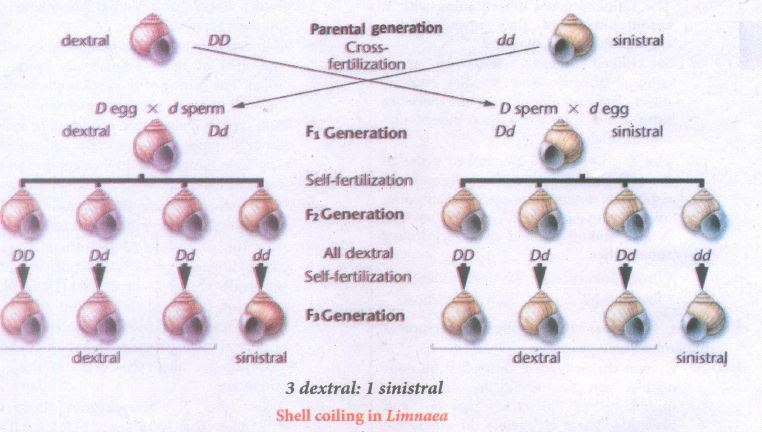
(v) In extra nuclear inheritance, male and female parents contribute equally their nuclear genes to the progeny but do not make equal contribution of' extra chromosomal genes hence, the crosses can yield different (or) non Mendelian results. Extra chromosomal inheritance in Limnaea peregra.
(vi) Limnaea peregra is a freshwater snail. The shell of these animals are spirally coiled. The coiling of the shell is clockwise (dextral) or anticlockwise (sinistral).
(vii) Both type of coilings are produced by two. different types of genetically controlled cleavages namely, dextral cleavage and sinistral cleavage.
(viii) In Limnaea, dextral coiling is normal and Sinistral coiling is a mutant character.
(ix) Direction of coiling is determined by a pair of nuclear genes, D( dextral) and d (sinistral). The gene for dextral (D) being dominant over sinistral coiling (d). In Fig. a dextral snail provides the eggs and a sinistral snail provides the sperm. The offsprings are all dextral (Dd), in the F1 generation.
(x) When the F1 heterozygous dextral individual (Dd) were self crossed the F2 generation showed dextral coiling with genotype of IDD, 2Dd and l dd.
(xi) When a reciprocal cross is made the F1 individuals have Dd genotype but are coiled sinistrally, as in the female parent. In both the crosses the Flare phenotypically similar to the female parent, though the offsprings in both crosses have the same genotype Dd. This is because the genotype of the maternal parent determines the phenotype of the offspring.
(xii) When the F1 sinistral individuals were self crossed, the shell coiling in the F2 generation, were all dextral. This is because the genes do not segregate in the F2 generation. Only in the F3 generation segregation occurs in the ratio of 3 dextral: 1 sinistral.
(xiii) Reasons: The type of cleavage depends on the organization of the egg which is established before the maturation division of the oocyte nucleus and by the influence of the maternal genotype.
(xiv) The direction of coiling of the shell depends upon the orientation of the mitotic spindle during the first cleavage.
(xv) Obviously, maternal control affects only one generation. In each generation the coiling is dependent on the maternal genotype.
3.
(i) The inheritance of a trait that is determined by a gene located on one of the sex chromosomes is called sex linked inheritance.
(ii) Genes present on the differential region of X or Y chromosomes are called sex linked genes. The genes present in the differential region of "X" chromosome are called X linked genes. The X-linked genes have no corresponding alleles in the Y chromosome.
(iii) The genes present in the differential region of Y chromosome are called Y- linked or holandric genes. The Y linked genes have no corresponding allele in X chromosome.
(iv) The Y linked genes inherit along with Y chromosome and they phenotypically express only in the male sex.
(v) Sex linked inherited traits are more common in males than females because, males are hemizygous and therefore express the trait when they inherit one mutant allele.
(vi) The X - linked and Y - linked genes in the differential region (non-homologus region) do not undergo pairing or crossing over during meiosis. The inheritance of X or Y linked genes is called sex-linked inheritance.
X linked Inheritance - Eg. Colour blindness
Y linked Inheritance - Eg. hypertrichosis
4.
(i) Genic balance mechanisms of sex determination in Drosophila was first studied by C. B. Bridges.
(ii) In Drosophila, the presence of Y chromosome is essential for the fertility of male sex, but does not determine the male sex.
(iii) The gene for femaleness is located on the X chromosome and those for maleness are located on the autosomes.
(iv) When geneticist C. B. Bridges, working with Drosophila, crossed a triploid (3n) female with a normal male, he observed many combinations of autosomes and sex chromosomes in the offspring.
(v) He suggested that sex In Drosophila is determined by the balance between the genes for femaleness located on the 'X' chromosomes and those for maleness located on the 'autosomes". Hence the sex of an individual is determined by the ratio of its X chromosome to that of its autosome sets. This ratio is termed sex index and is expressed as:
\(Sex \ index=\frac { Number \ of \ X \ Chromosomes }{ Number \ of \ Y \ Chromosomes } \left( \cfrac { X }{ A } \right) \)
(vi) Change in this ratio leads to a changed sex phenotype. The results obtained from a cross between triploid female Drosophila (3A:3X) with a diploid male (2A: XY) is shown in below.
(vii) Bridges classical cross of a triploid (3A+XXX) female fly and a diploid (2A+XY) male fly ♀ ♂
Triploid ♀ Diploid ♂
Parent 3A + XXX 2A + XY
Gametes (2A + XX) (A + X) (A + X) (A + Y)
(2A +X) (A+XX)
| A + X | A + Y | |
|---|---|---|
| 2A + XX | 3A + XXX Triploid Female |
3A + XXY Triploid Intersex |
| 2A + X | 3A + XX Triploid Intersex |
3A + XY Super Male |
| A + XX | 2A + XXX Super female |
2A+ XXY Diploid Female |
| A + X | 2A + XX Diploid Female |
2A + XY Diploid Male |
Different doses of X chromosomes and autosome sets and their effect in sex determination in Drosphild
| Phenotype | Number of 'X' Chromosomes (X) |
Number of Autosome sets (A) |
\(Sex \ Index=\frac { Number \ of \ X \ Chromosomes }{ Number \ of \ autosome \ sets } \) | |
|---|---|---|---|---|
| Metafemale/ Super female | 3 | 2 | 3/2 = 1.5 | |
| Normal Female | Teraploid | 4 | 4 | 4/4 = 1.0 |
| Triploid | 3 | 3 | 3/3 = 1.0 | |
| Diploid | 2 | 2 | 2/2 = 1.0 | |
| Haploid | 1 | 1 | 1/1 = 1.0 | |
| Inter sex | 2 | 3 | 2/3 = 0.67 | |
| Normal male | 1 | 2 | 1/2 = 0.50 | |
| Meta male / super male | 1 | 3 | 1/3 = 0.53 | |
A sex-switch gene in Drosophila directs female development. This gene, Sex-lethal (SxL) located on the X chromosome, has two states of activity. When it is 'on' it directs female development and when it is 'off' maleness ensures. Other genes located on the X chromosome and autosomes regulate this sex-switch gene. However, the Y- chromosome of Drosophila is required for male fertility.
5.
(i) Fisher and Race hypothesis:
Rh factor involves three different pairs of alleles located on three different closely linked loci on the chromosome pair. This system is more commonly in use today, and uses the 'Cde' nomenclature.
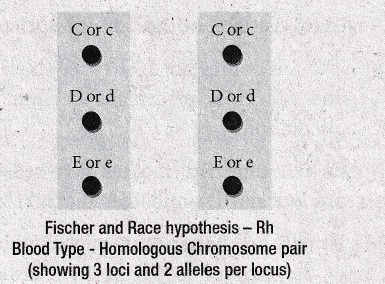
2. In the above Figure, three pairs of Rh alleles (Cc, Dd and Ee) occur at 3 different loci on homologous chromosome pair- 1.
3. The possible genotypes will be one C or c, one D or d, one E or e from each chromosome
For e.g. CDE/cde; CdE/cDe; cde/cde; CDe/CdE etc.
4. All genotypes carrying a dominant 'D' allele will produce Rh positive phenotype and double recessive genotype 'dd' will give rise to Rh negative phenotype.
(ii) Wiener Hypothesis
1. Wiener proposed the existence of eight alleles (R1, R2, RO, RZ, r, r1, r11, ry) at a single Rh locus.
2. All genotypes carrying a dominant 'R allele' (R1, R2, RO, RZ) will produce 'Rh- positive' phenotype and double recessive genotypes (rr, rr1, rr11, rry) will give rise to Rh- negative phenotype.
6.
Heterogametic Males:
In this method of sex determination the males are heterogametic producing dissimilar gametes while females are homogametic producing similar gametes.
It is of kinds XX-XO type and XX-XY type.
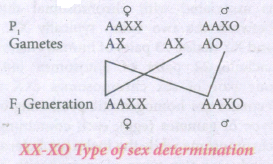
(i) XX-XO Type
(a) This method of sex determination is seen in bugs and some insects such as cockroaches and grasshoppers.
(b) The female with two X chromosomes are homogametic (XX) while the males with only one X chromosome are heterogametic (XO).
(c) The presence of an unpaired X chromosomes determines the male sex. The males with unpaired 'X' chromosome produce two types of sperms, one half with X chromosome and other half without X chromosome.
(d) The sex of the offspring depends upon the sperm that fertilizes the egg.
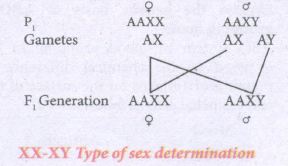
(ii) XX-XV type (Lygaeu Type):
This method of sex determination is seen in human beings and in Drosophila.
(a) The females are homogametic with XX chromosome, while the males are heterogametic with X and Y chromosome.
(b) Homogametic females produce only one kind of egg, each with one X chromosome, while the heterogametic males produce two kinds of sperms some with X chromosome and some with Y chromosome.
(c) The sex of the embryo depends on the fertilizing sperm. An egg fertilized by an 'X' bearing sperm produces a female, if fertilized by a 'Y' bearing sperm, a male is produced.
7.
1. The sex determining mechanism of humans is XX-XY type.
2. In humans, out of 23 pairs of chromosomes present, 22 pairs are exactly same in both males and females known as autosomes (body).
3. The 23rd chromosome is the sex chromosome. (i.e) Pair of X-chromosome (XX) is present in females and males having one X and one Y chromosome (XY).
4. During, spermatogenesis, in case of males two types of gametes are produced (x and y).
5. The 50% total sperms produced carry X-chromosomes and the rest 50% carry Y - chromosomes besides autosomes. This condition is called male diagamety.
6. The Y containing sperms and X containing sperms are called androsperms and gynosperms respectively.
7. Female produces only one type of ovum with an X-chromosome. If an ovum fertilizes with a sperm carrying X chromosome the zygote develops into a female (XX) and if an ovum is fertilized with sperm carrying Y-chromosome, zygote thus, formed will be male (YY).
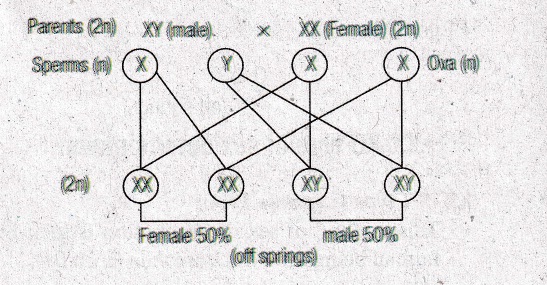
8. Hence, the genetic makeup of sperm, which fertilizes the ovum determines the sex of a child there are 50% chances of having either a male or female in each progeny.
9. Thus, it is by chance phenomenon, so women should not be blamed for giving birth to a girl child
8.
9.
1. In this method of sex determination, the homogametic male possesses two 'X' chromosomes as in certain insects and certain vertebrates like fishes, reptiles and birds producing a single type of gamete.
2. The female sex consists of a single 'Y' chromosome. Thus the females are heterogametic and produce two types of eggs.
3. To avoid confusion with the XX-XO and XX-XY trues of sex determination, the alphabets 'Z' and 'W 'are used here instead of X and Y respectively.
4. Heterogametic females are of two types, ZO-ZZ type and ZW-ZZ type.

12th Standard Syllabus & Materials
12th Standard
TN 12th Computer Applications களப்பெயர் முறைமை (DNS) Sample Question Papers Study Material - QB365 Set A
NEW12th Standard
TN 12th Computer Applications வலையமைப்பு எடுத்துக்காட்டுகள் மற்றும் நெறிமுறைகள் Sample Question Papers Study Material - QB365 Set A
NEW12th Standard
TN 12th Computer Applications கணினி வலையமைப்பு ஓர் அறிமுகம் Sample Question Papers Study Material - QB365 Set A
NEW12th Standard
TN 12th Computer Applications PHP-உடன் MySQL-ஐ இணைத்தல் Sample Question Papers Study Material - QB365 Set A



Tamilnadu Stateboard 12th Standard Subjects

Maths

Chemistry

Physics
Biology

Computer Science

Business Maths and Statistics

Economics

Commerce

Accountancy

History

Computer Applications
Biology
Computer Technology
Computer Applications
Computer Science
Business Maths and Statistics
Commerce
Economics
Maths
Chemistry
Physics
Computer Technology
History
Accountancy

Tamil

English

French
Tamilnadu Stateboard Standards

