
 100% FREE ACCESS
12th Standard Syllabus & Materials
12th Standard
TN 12th Maths Applications of Matrices and Determinants Sample Question Papers Study Material - QB365 Set A
NEW12th Standard
TN 12th Computer Applications மின்னணு தரவு பரிமாற்றம் Sample Question Papers Study Material - QB365 Set A
NEW12th Standard
TN 12th Computer Applications மின் - வணிக பாதுகாப்பு அமைப்புகள் Sample Question Papers Study Material - QB365 Set A
NEW12th Standard
TN 12th Computer Applications மின்னணு செலுத்தல் முறைகள் Sample Question Papers Study Material - QB365 Set A
NEW12th Standard
TN 12th Computer Applications மின் - வணிகம் Sample Question Papers Study Material - QB365 Set A
NEW12th Standard
TN 12th Computer Applications திறந்த மூல கருத்துருக்கள் Sample Question Papers Study Material - QB365 Set A

Published on: 26/08/2022
QB365 provides a detailed and simple solution for every Possible Creative Questions in Class 12 Biology Subject - Zoology - Reproduction in Organisms, English Medium. It will help Students to get more practice questions, Students can Practice these question papers in addition to score best marks.
Download Tamil Nadu 12th Standard Biology question papers, model tests, one-mark questions, important questions, and public exam papers in PDF format. Free study materials and answer keys for TN State Board students.
Questions + Answers key
Take MCQ Biology Test1.
What is ovoviviparous condition?
2.
Differentiate oviparous and viviparous condition.
3.
Draw a gemmule and label any 2 parts.
4.
What are gemmules?
5.
Why is conjugation considered to be a form of reproduction though there is no formation of a new individual?
6.
Differentiate autogamy and exogamy.
7.
Explain the types of fertilization depending on the place of occurrence.
8.
What is apolysis? Write its significance.
9.
Differentiate exogenous and endogenous budding.
10.
What is strobilation?
11.
Explain encystment in amoeba.
12.
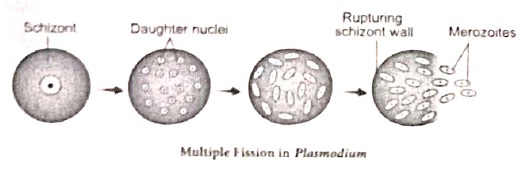
Explain multiple fission in plasmodium.
13.
What is repeated fission?
14.
What is asexual reproduction?
15.
Why are the offsprings of oviparous animal at a greater risk as compared to offsprings of viviparous organisms?
1.
(i) In Ovoviviparous animals, the embryo develops inside the egg and remains in the mother's body until they are ready to hatch.
(ii) This method of reproduction is similar to Viviparity but the embryos have no placental connection with the mother and receive their nourishment from the egg yolk. Ovoviviparity is seen in fishes like shark.
2.
| Oviparous condition | Viviparous condition |
| The young ones hatch from eggs laid outside the mother's body |
The animals give birth to young ones |
| The eggs are covered by hard calcareous shells in land animals |
The eggs lack a calcareous shell |
| The embryo is nourished by egg yolk. | The embryo is nourished in the uterus of the parent through the placenta. |
| Parental care is less E.g. Reptiles |
Parental care is for a longer period E.g. mammals |
3.
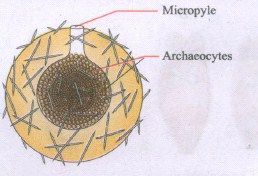
4.
(i) It is a mode of asexual reproduction in sponges.
(ii) Internal buds called gemmules are formed which is a hard ball, consisting of an internal mass of food laden archaeocytes.
(iii) During unfavourable conditions, the sponge disintegrates, but the gemmule withstands adverse conditions.
(Iv) The gemmules hatch during favourable conditions.
5.
(i) Conjugation the temporary union of the two individuals of the same species. During which they exchange certain amount of nuclear material (DNA) and then get separated E.g. bacteria.
(ii) No new individual is formed but after conjugation the two conjugants (participating organisms) show changes in their nuclear content. When they reproduce by asexual method, their off springs will inherit the nuclear content with changes. Hence conjugation is considered to a form of reproduction.
6.
| Autogamy | Exogamy |
| It is a type of fertilization in which male and female gametes are produced by the same cell or same organism and both gametes fuse together to form a zygote. |
It is type of fertilization in which the male and female gametes produced by different parents fuse to form a zygote. |
| Only one parent involved E.g. paramecium |
It is biparental E.g. human being |
7.
Depending upon the place where the fertilization takes place, it is of two types.
(i) External fertilization: In external fertilization, the fusion of male and female gametes takes place outside the body of female organisms in the water medium. E.g. sponges, fishes and amphibians.
(ii) Internal fertilization: In internal fertilization, the fusion of male and female gametes takes place within the body of female organisms. E.g. reptiles, aves and mammals.
8.
(i) In Tape worm the gravid proglottids are regularly cut off either singly or in groups from the posterior end by a process called apolysis.
(ii) This is very significant since it helps in transferring the developed embryos from the primary host (man) to find a secondary host (pig).
9.
| Exogenous budding | Endogenous Budding |
| Buds are formed on the outer surface of the parent body |
Buds are formed inside the cytoplasm within the body of the parent |
| E.g. Hydra | E.g. Noctiluca |
10.
(i) In some metazoan animals, a special type of transverse fission called strobilation occurs.
(ii) In the process of strobilation, several transverse fissions occur simultaneously giving rise to a number of individuals which often do not separate immediately from each other. E.g. Aurelia.
11.
(i) During unfavorable conditions Amoeba withdraws its pseudopodia and secretes a three-layered, protective, chitinous cyst wall around it and becomes inactive. This phenomenon is called encystment.
(ii) When conditions become favourable, the encysted Amoeba divides by multiple fission and produces many minute amoebae called pseudopodiospore or amoebulae.
(iii) The cyst wall breaks off liberating the young pseudopodiospores.
12.
(i) In Plasmodium, multiple fission occurs in the schizont and in the oocyte stages. When multiple fission occurs in the schizont, the process is called schizogony and the daughter individuals are called merozoites.
(ii) When multiple fission occurs in the oocyte, it is called sporogony and the daughter individuals are called sporozoites.
13.
If multiple fission produces four or many daughter individuals by equal cell division and the young ones do not separate until the process is complete, then this division is called repeated fission. E.g. Vorticella.
14.
(i) Reproduction by a single parent without the involvement of gamete formation is asexual reproduction and the offspring produced are genetically identical. (uniparental inheritance)
(ii) Asexual reproduction is usually by amitotic or mitotic division of the somatic (body) cells, hence is also known as somatogenic or blastogenic reproduction. Eg. members of Protista, Bacteria.
15.
Oviparous animals lay eggs outside their body. These eggs are exposed to various environmental conditions and may be eaten by predators also. They face lot of risks until the young ones hatche. But the offsprings of viviparous animals are more safe and protected in the maternal womb until they are born.

12th Standard Syllabus & Materials
12th Standard
TN 12th Computer Applications வலையமைப்பு வடமிடல் Sample Question Papers Study Material - QB365 Set A
NEW12th Standard
TN 12th Computer Applications களப்பெயர் முறைமை (DNS) Sample Question Papers Study Material - QB365 Set A
NEW12th Standard
TN 12th Computer Applications வலையமைப்பு எடுத்துக்காட்டுகள் மற்றும் நெறிமுறைகள் Sample Question Papers Study Material - QB365 Set A
NEW12th Standard
TN 12th Computer Applications கணினி வலையமைப்பு ஓர் அறிமுகம் Sample Question Papers Study Material - QB365 Set A



Tamilnadu Stateboard 12th Standard Subjects

Maths

Chemistry

Physics
Biology

Computer Science

Business Maths and Statistics

Economics

Commerce

Accountancy

History

Computer Applications
Biology
Computer Technology
Computer Applications
Computer Science
Business Maths and Statistics
Commerce
Economics
Maths
Chemistry
Physics
Computer Technology
History
Accountancy

Tamil

English

French
Tamilnadu Stateboard Standards

