
 100% FREE ACCESS
12th Standard Syllabus & Materials
12th Standard
TN 12th Maths Applications of Matrices and Determinants Sample Question Papers Study Material - QB365 Set A
NEW12th Standard
TN 12th Computer Applications மின்னணு தரவு பரிமாற்றம் Sample Question Papers Study Material - QB365 Set A
NEW12th Standard
TN 12th Computer Applications மின் - வணிக பாதுகாப்பு அமைப்புகள் Sample Question Papers Study Material - QB365 Set A
NEW12th Standard
TN 12th Computer Applications மின்னணு செலுத்தல் முறைகள் Sample Question Papers Study Material - QB365 Set A
NEW12th Standard
TN 12th Computer Applications மின் - வணிகம் Sample Question Papers Study Material - QB365 Set A
NEW12th Standard
TN 12th Computer Applications திறந்த மூல கருத்துருக்கள் Sample Question Papers Study Material - QB365 Set A

Published on: 26/08/2022
QB365 provides a detailed and simple solution for every Possible Book Back Questions in Class 12 Biology Subject - Zoology - Reproduction in Organisms, English Medium. It will help Students to get more practice questions, Students can Practice these question papers in addition to score best marks.
Download Tamil Nadu 12th Standard Biology question papers, model tests, one-mark questions, important questions, and public exam papers in PDF format. Free study materials and answer keys for TN State Board students.
Questions + Answers key
Take MCQ Biology Test1.
Differentiate between the following:
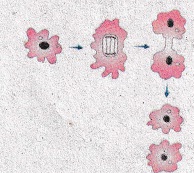
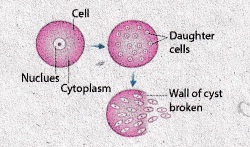
(a) Binary fission in amoeba and multiple fission in Plasmodium
(b) Budding in yeast and budding in Hydra
(c) Regeneration in lizard and Planaria
2.
Give reasons for the following:
(a) Some organisms like honey bees are called parthenogenetic animals
(b) A male honey bee has 16 chromosomes where as its female has 32 chromosomes
1.
(a)
| Binary Fission in Amoeba | Multiple fission in Plasmodium |
| lt results in the production of two individuals from a single parent. | It results in the production of several individuals |
| lt occurs under favourable conditions | It occurs both under favourable and unfavourable conditions |
| Nucleus of the parent cell divides only once to form two daughter nuclei | Nucleus of the parent cell undergoes repeated divisions to form a number of daughter nuclei |
| Cytoplasm divides after nuclear division | Cytoplasm does not divide after each nuclear division but divides during favourable condition |
| No part of parent body is left unused (e,g: Amoeba) | A part of the body (covering and residuai cytoplasm) is left unused. (e,g: Paramecium) |
 |
 |
(b) Budding in yeast and budding in hydra
| Budding in Yeast | Budding in Hydra |
| During budding the cell wall of the parent cell bulges out in the form of an out growth as bud | During budding the ectoderm cells increase and form a small elevation on the body surface as bud. |
| The parent nucleus divides into two daughter nuclei one of which migrates into bud. | Ectoderm and endoderm are pushed out to form the bud. The bud contains an interior lumen in continuation with parent's gastro vascular cavity (coelenteron) |
| As the bud enlarges and is fully formed, it is separated from the parentcell and grows into mature yeast. Sometimes a bud may produce another bud over it which is still attached to parent cell forming a false mycelium (or) pseudomycelium | The bud enlarges, develops a mouth and a circle of tentacles at its free end. When fully grown, the bud constricts at the base and finally separates from the parent body and leads an independent life |
(c) Regeneration is regrowth in the injured region
| Regeneration in Lizard | Regeneration in Planaria |
| This type of regeneration comes under epimorphosis type. | This type of regeneration comes under morphallaxis type |
| Several body parts can develop. | When the body is cut into several pieces, each piece can regenerate the lost parts and develops into a whole individual |
2.
(a) Some organisms like honeybees are called parthenogenetic animals.
1. In case of honeybees both haploid and diploid individuals formed, as a result of incomplete parthenogenesis.
2. Both sexual reproduction and parthenogenesis are inclusive.
3. Fertilized eggs (zygote) give rise to queen and workers (both are females) by the process of sexual reproduction.
4. Unfertilized eggs (ova) of females develop into drones (males) by the process of parthenogenesis.
(b) A male honeybee has 16 chromosomes where as its female has 32 chromosomes
1. It is because of haplodiploidy which is a sex determination system, in which males develop from unfertilized eggs (parthenogenesis) and are haploid (16n) and females develop frorn fertilized eggs and are diploid (32n) (sexual reproduction).
2. As unfertilized egg carries only half number of chromosome as compared to fertilized egg.
Therefore male honeybees have 16 chromosomes where as female has 32 chromosomes.

12th Standard Syllabus & Materials
12th Standard
TN 12th Computer Applications வலையமைப்பு வடமிடல் Sample Question Papers Study Material - QB365 Set A
NEW12th Standard
TN 12th Computer Applications களப்பெயர் முறைமை (DNS) Sample Question Papers Study Material - QB365 Set A
NEW12th Standard
TN 12th Computer Applications வலையமைப்பு எடுத்துக்காட்டுகள் மற்றும் நெறிமுறைகள் Sample Question Papers Study Material - QB365 Set A
NEW12th Standard
TN 12th Computer Applications கணினி வலையமைப்பு ஓர் அறிமுகம் Sample Question Papers Study Material - QB365 Set A



Tamilnadu Stateboard 12th Standard Subjects

Maths

Chemistry

Physics
Biology

Computer Science

Business Maths and Statistics

Economics

Commerce

Accountancy

History

Computer Applications
Biology
Computer Technology
Computer Applications
Computer Science
Business Maths and Statistics
Commerce
Economics
Maths
Chemistry
Physics
Computer Technology
History
Accountancy

Tamil

English

French
Tamilnadu Stateboard Standards

