
 100% FREE ACCESS
12th Standard Syllabus & Materials
12th Standard
TN 12th Computer Applications மின்னணு தரவு பரிமாற்றம் Sample Question Papers Study Material - QB365 Set A
NEW12th Standard
TN 12th Computer Applications மின் - வணிக பாதுகாப்பு அமைப்புகள் Sample Question Papers Study Material - QB365 Set A
NEW12th Standard
TN 12th Computer Applications மின்னணு செலுத்தல் முறைகள் Sample Question Papers Study Material - QB365 Set A
NEW12th Standard
TN 12th Computer Applications மின் - வணிகம் Sample Question Papers Study Material - QB365 Set A
NEW12th Standard
TN 12th Computer Applications திறந்த மூல கருத்துருக்கள் Sample Question Papers Study Material - QB365 Set A
NEW12th Standard
TN 12th Computer Applications வலையமைப்பு வடமிடல் Sample Question Papers Study Material - QB365 Set A

Published on: 26/08/2022
QB365 provides a detailed and simple solution for every Possible Creative Questions in Class 12 Biology Subject - Zoology - Evolution, English Medium. It will help Students to get more practice questions, Students can Practice these question papers in addition to score best marks.
Download Tamil Nadu 12th Standard Biology question papers, model tests, one-mark questions, important questions, and public exam papers in PDF format. Free study materials and answer keys for TN State Board students.
Questions + Answers key
Take MCQ Biology Test1.
How Urey - Miller's experiment supports the origin of life?
2.
Explain the evolutionary path of man.
3.
Explain natural selection through industrial melanism.
4.
What are all the factors involved in the process of organic evolution? Explain.
5.
Explain Darwin's theory of natural selection.
6.
How Prokaryotes and Eukaryotes evolved?
7.
State the modifications of forelimb in animals as an example of homology.
8.
How the duration of the earth's history has been divided into eras? Explain.
9.
Give a detailed account of Modern Synthetic Theory.
10.
Explain Oparin - Haldane hypothesis on evolution.
11.
Explain about the objections to Darwinism.
12.
Write about the two principles of Lamarck's theory.
13.
Explain Urey & Miller's experiment.
14.
Explain the theory of chemical evolution.
15.
Mention any three similarities found common in Neanderthal man and Homo sapiens.
1.
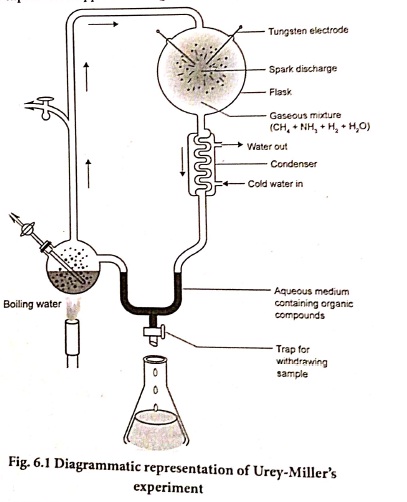
Urey and Miller (1953), paved way for understanding the possible synthesis of organic compounds that led to the appearance of living organisms is depicted in the Figure In their experiment, a mixture of gases was allowed circulate to over electric discharge from an tungsten electrode. A small flask was kept boiling and the steam emanating from it was made to mix with the mixture of gases (ammonia, methane and hydrogen)) in the large chamber that was connected to the boiling water. The steam condensed to form water which ran down the "U' tube. Experiment was conducted continuously for a week and the liquid was analysed. Glycine, alanine, beta-alanine and aspartic acid were identified. Thus Miller's experiments had an insight as to the possibility of abiogenetic synthesis of large amount of variety of organic compounds in nature from a mixture of sample gases in which the only source of carbon was methane. Later in similar experiments, formation of all types of amino acids, and nitrogen bases were noticed.
2.
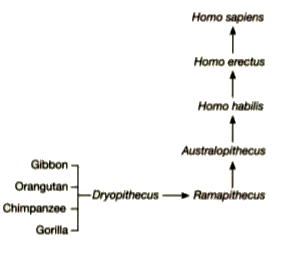
In the evolutionary hierarchy, human beings are considered to be the most evolved living beings and are considered to be at the pinnacle of evolutionary tree. Human evolution is one of the most important and significant milestones of biological evolution. It can be traced back to fossil records of ancestral organisms. According to palaeontological evidences, it had been concluded that the modern man originated from ancestral apes (Dryopithecus: Ramapithecus) which belonged to the class of Primates These species had close resemblances with goril las and chimpanzees. For example, bod ies were fully covered with thick hair and their walking style also resembled gorillas. Morphological changes involved in the evolution of man clearly indicate the above ancestry. The evolution of ancestral man and apes from the common ancestor and the evolution of modern man from the ancestral man can be shown in the given schematic diagram.
3.
(i) Industrial melanism is a classical case of Natural selection exhibited by the peppered moth, Biston betularia.
(ii) These were available in two colours, white and black.
(iii) Before industrialization peppered moth both white and black coloured were common in England.
(iv) Pre - industrialization witnessed white coloured background of the wall of the buildings hence the white coloured moths escaped from their Predators.
(v) Post industrialization, the tree trunks became dark due to smoke and soot let out from the industries.
(vi) The black moths camouflaged on the dark bark of the trees and the white moths were easily identified by their predators.
(vii) Hence the dark coloured moth population was selected and their number increased when compared to the white moths.
(viii) Nature offered positive selection pressure to the black coloured moths.
(x) The above proof shows that in a population, orgranisms that can adapt will survive and produced more progenies resulting in increase of population through natural selection.
4.
(i) Sewell Wright, Fisher, Mayer, Huxley, Dobzhanslry, Simpson and Haeckel explained Natural selection in the light of Post-Darwinian discoveries.
(ii) According to this theory gene mutations, chromosomal mutations, genetic recombinations, natural selection and reproductive isolation are the five basic factors involved in the process of organic evolution
(i) Gene mutation:
(i) Refers to the changes in the structure of the gene. It is also called gene/point mutation it alters the phenotype of an organism and produces variations in their offsprings.
(ii) Chromosomal mutation:
(i) Refers to the changes in the structure of chromosomes due to deletion, addition, duplication, inversion or translocation. This too alters the phenotype of an organism and produces variations in their offspring.
(iii) Genetic recombination:
(i) Is due to crossing over of genes during pachytene of meiosis. This brings about genetic variations in the individuals of the same species and leads to heritable variations for the formation of new species.
(iv) Natural selection:
(i) Does not produce any genetic variations but once such variations occur it favours some genetic changes while rejecting others (driving force of evolution).
(v) Reproductive isolation:
(i) Helps in preventing interbreeding between related organisms.
5.
(i) Charles Darwin explained the theory of evolution in his book 'The Origin of Species by Natural Selection'. During his journey around the Earth, he made extensive observations of plants and animals. He noted a huge variety and remarkable similarities among organisms and their adaptive features to cope up to their environment. He proved that fittest organisms can survive and leave more progenies than the unfit ones through natural selection.
(ii) Darwin's theory was based on several facts, observations and influences. They are:
(i) Over production (or) prodigality of production:
(i) All living organisms increase in their population in larger number.
(ii) For example, Salmon fish produces about 28 million eggs during breeding season and if all of them hatch, the seas would be filled with salmon in few generations.
(iii) Elephant, the slowest mammalian breeder that can produce six young ones in its life time can produce 6 million descendants at the end 750 years in the absence of any check.
(ii) Struggle for existence:
(i) Organisms struggle for food, space and mate. As these become a limiting factor competition exists among the members of the population.
(ii) Darwin denoted struggle for existence in three ways - Intra specific struggle between the same species for food, space and mate.
(ii) Inter specific struggle with different species for food and space.
(iv) Struggle with the environment to cope with the climatic variations, flood, earthquakes, drought, etc.
(iii) Universal occurrence of variations:
(i) No two individuals are alike.
(ii) There are variations found even in identical twins. Even the children born of the same parents differ in colour, height, behavior etc.
(iii) The useful variations found in an organism help them to overcome the struggles and such variations are passed on to the next future generation.
(iv) Origin of species by Natural selection:
(i) According to Darwin, nature is the most powerful selective force.
(ii) He compared origin of species by natural selection to a small isolated group.
(iii) Darwin believed that the struggle for existence resulted in the survival of the fittest.
(iv) Such organisms become better adapted to the changed environment.
6.
1. Abiotically produced molecules can spontaneously self assemble into droplets that enclose a watery solution and maintain a chemical environment different from their surroundings.
2. Scientists call these spheres as protobionts. Liposomes are lipids in a solution that can self assemble into a lipid bilayer. Some of the proteins inside the liposomes acquired the properties of enzymes resulting in fast multiplication of molecules.
3. The coacervates with nucleoprotein and nutrients had a limiting surface membrane that had the characters of a virus or free living genes.
4. Sub-sequently number of genes united to form proto-viruses somewhat similar to present day viruses.
5. Two major cell types that appeared during this time were significant. One form of the earliest cell contained clumps of nucleoproteins embedded in the cell substance.
6. Such cells were similar to the Monera. They are considered as ancestral to the modern bacteria and blue green algae
7. The other form of earliest cells contained nucleoprotein clumps that condensed into a central mass surrounded by a thin membrane
8. This membrane separated nucleoproteins from the cell substances. Such cells were referred to as Protista
9. When the natural sources of food in the ocean declined in course of time the ancestors of Monera and Protista had to evolve different methods for food procurement.
10. These may be summarized as parasitism, saprophytism, predatorism or animalism and chemosynthesis or photosynthesis. When the number of photosynthetic organisms increased there was an increase in the free O2 in the sea and atmosphere.
CH4 + ZO 2→ CO2 + 2H2O
4NH3 + 3O2→2N2 + 6H2O
11. The atmospheric oxygen combined with methane and ammonia to form CO2 and free nitrogen.
12. The presence of the free O2 brought about the evolution of aerobic respiration which could yield large amounts of energy by oxidation of food stuffs. Thus both Prokaryotes and Eukaryotes evolved.
7.
(a) The forelimbs of vertebrates are pentadactyl i.e, consist of same bones humerous, radius, ulna, carpals, metacarpals and phalanges. But differ in their function in different organisms.
(b) The forelimbs of the following animals got modified as shown below:
(i) Whales are modified for swimming.
(ii) Bats and birds are modified for flying.
(iii) Horses are modified for running.
(iv) Frogs are modified for leaping.
(v) Men are modified for grasping.
(vi) This indicates common ancestry and homology based on divergent evolution.
8.
(i) The Duration of earth's history has been divided into eras that include the Paleozoic, Mesozoic and Cenozoic.
(ii) Recent eras are further divided into periods, which are spilt into epochs.
Paleozoic era
(i) The Paleozoic era is characterized by the abundance of fossils of marine invertebrates. Towards the later half, other vertebrates (marine and terrestrial) except birds and mammals appeared.
(ii) The seven periods of Paleozoic era in order from oldest to the youngest are Cambrian (Age of invertebrates), Ordovician (fresh water fishes, Ostracoderms, various types of Molluscs) Silurian (origin of fishes), Devonian (Age of fishes, many types of fishes such as lung fishes, lobe finned fishes and ray finned fishes), Mississippian (earliest amphibians, Echinoderms), Pennsylvanian (earliest reptiles) Permian (mammal like reptile.
Mesozoic era: (dominance of reptiles)
(i) It is called the Golden age of reptiles, is divided into three periods namely Triassic (origin of egg laying mammals), Jurassic (Dinosaurs were dominant on the earth) fossil bird- (Archaeopteryx) and Cretaceous (extinction of toothed birds and dinosaurs, and emergence of modern birds).
Cenozoic era (Age of mammals)
(i) It is subdivided into two periods namely Tertiary and Quaternary.
(ii) Tertiary period is characterized by abundant of mammalian fauna.
(iii) This period is subdivided into epochs namely, Paleocene (placental mammals, Eocene (Monotremes except duck billed Platypus and Echidna, hoofed mammals and carnivores), Oligocene (higher placental mammals appeared), Miocene (origin of first man like apes) and Pliocene (origin of man from man like apes). Quaternary period witnesses decline of mammals and beginning of human social life).
9.
Sewell Wright, Fisher, Mayer, Huxley, Dobzhansky, Simpson and Haeckel explained Natural Selection in the light of Post-Darwinian discoveries. According to this theory gene mutations, chromosomal mutations, genetic recombinations, natural selection, and reproductive isolation are the five basic factors involved in the process of organic evolution.
i. Gene mutation refers to the changes in the structure of the gene. It is also called gene/ point mutation. It alters the phenotype of an organism and produces variations in their offsprings.
ii. A chromosomal mutation refers to the changes in the structure of chromosomes due to deletion, addition, duplication, inversion or translocation. This too alters the phenotype . of an organism and produces variations in their offspring.
iii. Genetic recombination is due to crossing over of genes during meiosis. This brings about genetic variations in the individuals of the same species and leads to heritable variations.
iv. Natural selection does not produce any genetic variations but once such variations occur it favors some genetic changes while rejecting others (driving force of evolution).
v. Reproductive isolation helps in preventing interbreeding between related organisms.
10.
According to the theory of chemical evolution, primitive organisms in the primordial environment of the Earth evolved spontaneously from inorganic substances and physical forces such as lightning, UV radiations, volcanic activities, etc. Oparin (1924) suggested that the organic compounds could have undergone a series of reactions leading to more complex molecules. He proposed that the molecules formed colloidal aggregates or 'coacervates' in an aqueous environment. The coacervates were able to absorb and assimilate organic compounds from the environment. Haldane (1929) proposed that the primordial sea served as a vast chemical laboratory powered by solar energy. The atmosphere was oxygen free and the combination of CO2, NH3 and UV radiations gave rise to organic compounds. The sea became a 'hot' dilute soup containing large populations of organic monomers and polymers. They envisaged that groups of monomers and polymers acquired lipid membranes and further developed into the first living cell. Haldane coined the term prebiotic soup and this became the powerful symbol of the Oparin-Haldane view on the origin of life (1924-1929). Oparin and Haldane independently suggested that if the primitive atmosphere was reducing and if there was appropriate supply of energy such as lightning or UV light then a wide range of organic compounds can be synthesized.
11.
Objections to Darwinism: Some objections raised against Darwinism were -
(i) Darwin failed to explain the mechanism of variation.
(ii) Darwinism explains the survival of the fittest but not the arrival of the fittest.
(iii) He focused on small fluctuating variations that are mostly non-heritable.
(iv) He did not distinguish between somatic and germinal variations.
(v) He could not explain the occurrence of vestigial organs, over specialization of some organs like large tusks in extinct mammoths, oversized antlers in the extinct Irish deer, etc.,
12.
Lamarck's theory: Jean Baptiste de Lamarck, was the first to postulate the theory of evolution in his famous book 'Philosophie Zoologique in the year 1809. The two principles of Lamarckian theory are:
(i) The theory of use and disuse - Organs that are used often will increase in size and those that are not used will degenerate. Neck in giraffe is an example of use and absence of limbs in snakes is an example for disuse theory.
(ii) The theory of inheritance of acquired characters - Characters that are developed during the lifetime of an organism are called acquired characters and these are then inherited.
13.
(i) Urey and Miller (1953), paved way for understanding the possible synthesis of organic compounds that led to the appearance of living organisms.
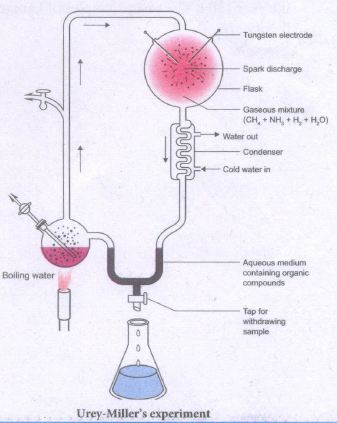
(ii) In their experiment, a mixture of gases was allowed to circulate over electric discharge from a tungsten electrode.
(iii) A small flask was kept boiling and the steam emanating from it was made to mix with the mixture of gases (ammonia, methane, and hydrogen) in the large chamber that was connected to the boiling water. The steam condensed to form water which ran down the 'U' tube.
(iv) The experiment was conducted continuously for a week and the liquid was analyzed. Glycine, alanine, beta-alanine, and aspartic A acid were identified. Thus Miller's experiments highlighted the possibility of abiogenetic synthesis of a large amount of variety of organic compounds in nature from a mixture of sample gases in which the only source of carbon was methane. Later in similar experiments, formation of all types of amino acids, and nitrogen bases were noticed.
14.
(i) According to the theory of chemical evolution primitive organisms in the primordial environment of the earth evolved spontaneously from inorganic substances and physical forces such, as lightning, UV radiations, volcanic activities, etc.
(ii) Oparin (1924) suggested that the organic compounds could have undergone a series of reactions leading to more complex molecules. He proposed that the molecules formed colloidal aggregates or 'coacervates' in an aqueous environment. The coacervates were able to absorb and assimilate organic compounds from the environment.
(iii) Haldane (1929) proposed that the primordial sea served as a vast chemical laboratory powered by solar energy. The atmosphere was oxygen free and the combination of CO2, NH3 and UV radiations gave rise to organic compounds.
(iv) The sea became a 'hot' dilute soup containing large populations of organic monomers and polymers. They proposed that groups of monomers and polymers acquired lipid membranes and further developed into the first living cell. Haldane coined the term prebiotic soup and this became the powerful symbol of the Oparin-Haldane view on the origin of life (1924-1929).
(v) Oparin and Haldane independently suggested that if the primitive atmosphere was reducing and if there was appropriate supply of energy such as lightning or UV light then a wide range of organic compounds can be synthesized.
15.
Similarities found in Neanderthal man and Homo sapiens.
(i) They knew to protect their bodies. Neanderthal man used animal hides to protect their bodies.
(ii) They knew the use of fire.
(iii) They buried their dead.

12th Standard Syllabus & Materials
12th Standard
TN 12th Computer Applications களப்பெயர் முறைமை (DNS) Sample Question Papers Study Material - QB365 Set A
NEW12th Standard
TN 12th Computer Applications வலையமைப்பு எடுத்துக்காட்டுகள் மற்றும் நெறிமுறைகள் Sample Question Papers Study Material - QB365 Set A
NEW12th Standard
TN 12th Computer Applications கணினி வலையமைப்பு ஓர் அறிமுகம் Sample Question Papers Study Material - QB365 Set A
NEW12th Standard
TN 12th Computer Applications PHP-உடன் MySQL-ஐ இணைத்தல் Sample Question Papers Study Material - QB365 Set A



Tamilnadu Stateboard 12th Standard Subjects

Maths

Chemistry

Physics
Biology

Computer Science

Business Maths and Statistics

Economics

Commerce

Accountancy

History

Computer Applications
Biology
Computer Technology
Computer Applications
Computer Science
Business Maths and Statistics
Commerce
Economics
Maths
Chemistry
Physics
Computer Technology
History
Accountancy

Tamil

English

French
Tamilnadu Stateboard Standards

