
 100% FREE ACCESS
12th Standard Syllabus & Materials
12th Standard
TN 12th Computer Applications மின்னணு தரவு பரிமாற்றம் Sample Question Papers Study Material - QB365 Set A
NEW12th Standard
TN 12th Computer Applications மின் - வணிக பாதுகாப்பு அமைப்புகள் Sample Question Papers Study Material - QB365 Set A
NEW12th Standard
TN 12th Computer Applications மின்னணு செலுத்தல் முறைகள் Sample Question Papers Study Material - QB365 Set A
NEW12th Standard
TN 12th Computer Applications மின் - வணிகம் Sample Question Papers Study Material - QB365 Set A
NEW12th Standard
TN 12th Computer Applications திறந்த மூல கருத்துருக்கள் Sample Question Papers Study Material - QB365 Set A
NEW12th Standard
TN 12th Computer Applications வலையமைப்பு வடமிடல் Sample Question Papers Study Material - QB365 Set A

Published on: 26/08/2022
QB365 provides a detailed and simple solution for every Possible Creative Questions in Class 12 Biology Subject - Zoology - Reproduction in Organisms, English Medium. It will help Students to get more practice questions, Students can Practice these question papers in addition to score best marks.
Download Tamil Nadu 12th Standard Biology question papers, model tests, one-mark questions, important questions, and public exam papers in PDF format. Free study materials and answer keys for TN State Board students.
Questions + Answers key
Take MCQ Biology Test1.
(a) Why is syngamy a major event in sexual reproduction?
(b) What are all the different kinds of syngamy?
2.
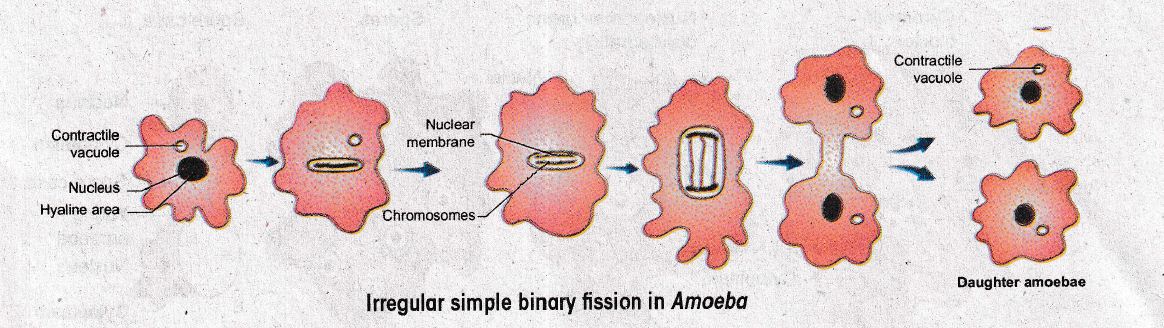
Diagrammatically represent the asexual reproduction of in Amoeba.
3.
What is binary fission? What are all the different types of binary fission? Explain.
4.
Given an account on following terms.
(a) Hologamy
(b) Isogamy
(c) Anisogamy
(d) Merogamy
(e) Paedogamy
5.
Describe the regeneration process noticed in living organism.
6.
Write notes on binary fission in animals.
7.
8.
Write a note on regeneration.
1.
(a) Syngamy involves the complete and permanent fusion of two haploid gametes to form a diploid zygote. It is the mode of sexual reproduction seen in animals.
(b) Different kinds of syngamy:
Depending upon the degree of differentiation of the fusing gametes syngamy may be of following types.
(i) Autogamy: :
The male and female gametes are produced by the same cell or same organism and both the gametes fuse together to form a zygote. e,g: Actinosphaerium and Paramecium.
(ii) Exogamy:
The male and female gametes are produced by different parents and they fuse to form a zygote. So it is biparental. e,g: Human - dioecious or unisexual animal
(iii) Hologamy:
In lower organisms, sometimes the entire mature organisms do not form gametes but they themselves behave as gametes and the fusion of such mature individuals is known as hologamy. (e,g:) Trichonympha
(iv) Paedogamy:
Sexual union of young individuals produced immediately after the division of the adult parent cell by mitosis.
(v) Merogamy:
Fusion of small sized and morphologically different gametes (merogametes) takes place.
(iv) Isogamy:
The fusion of morphological and physiological identical gametes (isogametes). (e,g:) Monocystis
(vii) Anisogamy:
Fusion of dissimilar gametes. (e,g:) Higher invertebrates and all vertebrates
2.
(i) Simple binary fission:
(i) The plane of division is hard to observe
(ii) The contractile vacuoles cease to function and disappear.
(iii) The nucleoli disintegrate and the nucleus divides mitotically.
(iv) The cell then constricts in the middle, so the cytoplasm divides and forms two daughter cells.
(ii) Multiple fission:
(i) During unfavourable conditions i.e., (increase or decrease in temperature, scarcity of food) Amoeba withdraws its pseudopodia and secretes a three-layered, protective, chitinous cyst wall around it.
(ii) After that it becomes inactive. This phenomenon is called encystment.
(iii) When conditions become favourable the encysted Amoeba divides by multiple fission and produces many minute daughter amoebae called pseudopodiospore or daughter amoebulae
(iv) The cyst wall absorbs water and breaks off to liberate the young pseudopodiospores, each with a fine pseudopodia.
(v) They feed and grow rapidly to lead an independent life.
(iii) Sporulation:
(i) During unfavourable conditions Amoeba multiplies by sporulation without encystment.
(ii) Nucleus breaks into several small fragments or chromatin blocks.
(iii) Each fragment develops a nuclear membrane becomes surrounded by cytoplasm and develops a spore-case around it.
(iv) When conditions become favourable, the parent body disintegrates and the spores are liberated, each develops into a young amoeba.
.JPG)
.JPG)
3.
Binary Fission:
(a) The parent organism divides into two halves and each half forms a daughter individual.
(b) The nucleus divides first amitotically or mitotically (karyokinesis), followed by the division of cytoplasm (cytokinesis).
(c) The resultant offsprings are genetically identical to the parent.
(d) Depending on the plane of fission, binary fission is of the following types
(i) Simple irregular binary fission
(ii) Transverse binary fission
(iii) Longitudinal binary fission
(iv) Oblique binary fission
(i) Simple binary mission (e,g: Amoeba):
(i) It occurs in Amoeba like irregular shaped organisms.
(ii) The plane of division is hard to observe.
(iii) The contractile vacuoles cease to function and disappear.
(iv) The nucleoli disintegrate and the nucleus divides mitotically.
(v) The cell then constricts in the middle, so the cytoplasm divides and forms two daughter cells each with a single nucleus.
(ii) Transverse binary fission: (e,g:) Paramecium and Planaria
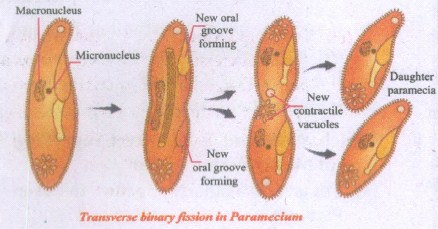
(i) The plane of the division runs along the transverse axis of the individual.
(ii) In Paramecium the macronucleus divides by amitosis and the micronucleus divides by mitosis.
(iii) Longitudinal binary fission: (e,g:) Vorticella and Euglena
(i) The nucleus and the cytoplasm divide in the longitudinal axis of the organism.
(ii) In flagellates, the flagellum is retained usually by one daughter cell.
(iii) The basal granule is divided into two and the new basal granule forms a flagellum in the other daughter individual.
(iv) Oblique binary fission: (e,g:) Ceratium
(i) The plane of division is oblique.
(ii) It is seen in dinoflagellates.
.JPG)
.JPG)
.JPG)
4.
(a) Hologamy: In Hologamy, the adult individuals do not produce gametes, but they themselves act as gametes and fuse to form new individuals.
E.g: Trichonympha
(b) Isogamy: Fusion of morphologically & physiologically similar gametes.
E.g: Monocystis
(c) Anisogamy: Fusion of morphologically & physiologically dissimilar gametes.
Eg: Vertebrates.
(d) Merogamy: Fusion of small-sized morphologically different gametes (microgametes)
(e) Paedogamy: Fusion of young individuals produced immediately after the mitotic division of adult parent cell.
5.
Regeneration is regrowth in the injured region. Regeneration was first studied in Hydra by Abraham Trembley in 1740. Regeneration is of two types, morphallaxis, and epimorphosis. In morphallaxis, the whole body grows from a small fragment e.g. Hydra and Planaria. When Hydra is accidentally cut into several pieces, each piece can regenerate the lost parts and develop into a whole new individual. The parts usually retain their original polarity, with oral ends, by developing tentacles .and aboral ends, by producing basal discs. Epimorphosis is the replacement of lost body parts. It is of two types, namely reparative and restorative regeneration. In reparative regeneration, only certain damaged tissue can be regenerated, whereas in restorative regeneration severed body parts can develop. e.g. starfish, the tail of wall lizard.
6.
In binary fission, the parent organism divides into two halves and each half forms a daughter individual. The nucleus divides first amitotically or mitotically (karyokinesis), followed by the division of the cytoplasm (cytokinesis). The resultant offsprings are genetically identical to the parent. Depending on the plane of fission, binary fission is of the following types
(i) Simple irregular binary fission
(ii) Transverse binary fission
(iii) Longitudinal binary fission
(iv) Oblique binary fission
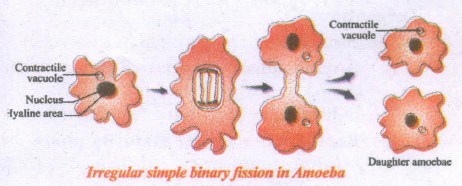
(i) Simple irregular binary fission is seen in Amoeba like irregular shaped organisms, where the plane of division is hard to observe. The contractile vacuoles cease to function and disappear. The nucleoli disintegrate and the nucleus divides mitotically. The cell then constricts in the middle, so the cytoplasm divides and forms two daughter cells.
(ii) In Transverse binary fission, the plane of the division runs along the transverse axis of the individual. E.g. Paramecium and Planaria. In Paramecium the macronucleus divides by amitosis and the micronucleus divides by mitosis.
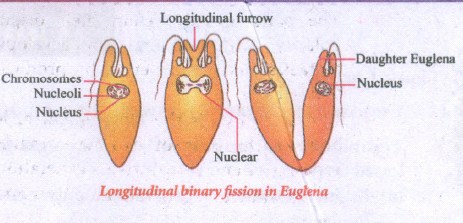
(iii) In Longitudinal binary fission the nucleus and the cytoplasm divides in the longitudinal axis of the organism. In flagellates, the flagellum is retained usually by one daughter cell. The basal granule is divided into two and the new basal granule forms a flagellum in the other daughter individual. E.g. Vorticella and Euglena.
(iv) In Oblique binary fission the plane of division is oblique. It is seen in dinoflagellates. E.g. Ceratium.
7.
8.
(i) Regeneration is regrowth in the injured region. Regeneration was first studied in Hydra by Abraham Trembley in 1740.
(ii) Regeneration is of two types, morphallaxis and epimorphosis. In morphallaxis the whole body grows from a small fragment. E.g. Hydra and Planaria.
(iii) When Hydra is accidentally cut into several pieces, each piece can regenerate the lost parts and develop into a whole new individual.
(iv) The parts usually retain their original polarity, with oral ends, by developing tentacles and aboral ends, by producing basal discs.
(v) Epimorphosis is the replacement of lost body' parts. It is of two types, namely reparative and restorative regeneration.
(vi) In reparative regeneration, only certain damaged tissue can be regenerated, whereas in restorative regeneration several body parts can develop. E.g. star fish, tail of wall lizard.

12th Standard Syllabus & Materials
12th Standard
TN 12th Computer Applications களப்பெயர் முறைமை (DNS) Sample Question Papers Study Material - QB365 Set A
NEW12th Standard
TN 12th Computer Applications வலையமைப்பு எடுத்துக்காட்டுகள் மற்றும் நெறிமுறைகள் Sample Question Papers Study Material - QB365 Set A
NEW12th Standard
TN 12th Computer Applications கணினி வலையமைப்பு ஓர் அறிமுகம் Sample Question Papers Study Material - QB365 Set A
NEW12th Standard
TN 12th Computer Applications PHP-உடன் MySQL-ஐ இணைத்தல் Sample Question Papers Study Material - QB365 Set A



Tamilnadu Stateboard 12th Standard Subjects

Maths

Chemistry

Physics
Biology

Computer Science

Business Maths and Statistics

Economics

Commerce

Accountancy

History

Computer Applications
Biology
Computer Technology
Computer Applications
Computer Science
Business Maths and Statistics
Commerce
Economics
Maths
Chemistry
Physics
Computer Technology
History
Accountancy

Tamil

English

French
Tamilnadu Stateboard Standards

