
 100% FREE ACCESS
12th Standard Syllabus & Materials
12th Standard
TN 12th Computer Applications மின்னணு தரவு பரிமாற்றம் Sample Question Papers Study Material - QB365 Set A
NEW12th Standard
TN 12th Computer Applications மின் - வணிக பாதுகாப்பு அமைப்புகள் Sample Question Papers Study Material - QB365 Set A
NEW12th Standard
TN 12th Computer Applications மின்னணு செலுத்தல் முறைகள் Sample Question Papers Study Material - QB365 Set A
NEW12th Standard
TN 12th Computer Applications மின் - வணிகம் Sample Question Papers Study Material - QB365 Set A
NEW12th Standard
TN 12th Computer Applications திறந்த மூல கருத்துருக்கள் Sample Question Papers Study Material - QB365 Set A
NEW12th Standard
TN 12th Computer Applications வலையமைப்பு வடமிடல் Sample Question Papers Study Material - QB365 Set A

Published on: 01/08/2019
Download Tamil Nadu 12th Standard Biology question papers, model tests, one-mark questions, important questions, and public exam papers in PDF format. Free study materials and answer keys for TN State Board students.
Questions + Answers key
Take MCQ Biology Test1.
Assertion (A): DMH -11 is a transgenic mustard.
Reason (R): It is developed by using barnase/ barstar technology.
Both A and R are wrong.
A is right R is wrong.
R explains A.
A and R are right, R does not explain A.
2.
Assertion (A): Zea mays is a monocotyledonous plant.
Reason (R): Shield shaped cotyledon is called scutellum.
A is correct R is incorrect.
R explains A.
Both A and R are incorrect.
Both A and R are correct. R does not explain A.
3.
The site of embryo implantation is the _____.
Uterus
Peritoneal cavity
Vagina
Fallopian tube
4.
Co-dominant blood group is ______.
A
AB
B
O
5.
In which type of parthenogenesis are only males produced?
Arrhenotoky
Thelytoky
Amphitoky
Both a and b
6.
Why crossing over is important?
7.
In the diagram given below.
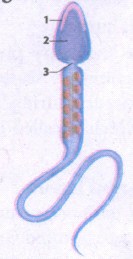
(a) Identify the diagram
(b) Label the parts indicated.
8.
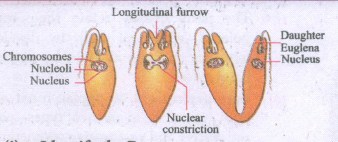
(i) Identify the Process
(ii) Name the Organism
9.
What are restriction enzyme. Mention their type with role in Biotechnology.
10.
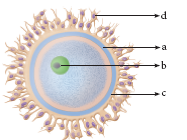
Identify the given image and label its parts marked as a, b, c and d
11.
12.
Mention any two differences between Homo habilis and Homo erectus
13.
What is cervical dysplasia?
14.
What are mycorrhizal?
15.
16.
Differentiate foeticide and infanticide
17.
Name the hormones produced from the placenta during pregnancy.
18.
Explain Agarose Gel electrophoresis technique.
19.
The following is the illustration of the sequence of ovarian events (a-i) in a human female.
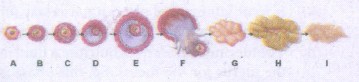
a) Identify the figure that illustrates ovulation and mention the stage of oogenesis it represents.
b) Name the ovarian hormone and the pituitary hormone that have caused the above-mentioned events.
c) Explain the changes that occurs in the uterus simultaneously in anticipation.
d) Write the difference between C and H.
1.
(c)
R explains A.
2.
(b)
R explains A.
3.
(a)
Uterus
4.
(b)
AB
5.
(a)
Arrhenotoky
6.
1. Exchange of segments leads to new gene combinations which plays an important role in evolution.
2. Studies of crossing over reveal that genes are arranged linearly on the chromosomes.
3. Genetic maps are made based on the frequency of crossing over.
4. Crossing over helps to understand the nature and mechanism of gene action.
5. If a useful new combination is formed it can be used in plant breeding.
7.
(a) Human Sperm
(b) 1- Acrosome 2 - Nucleus 3 - Neck
8.
(i) Longitudinal binary fission
(ii) Euglena
9.
A restriction enzyme or restriction endonuclease is an enzyme that cleaves DNA into fragments at or near specific recognition sites within the molecule known as restriction sites.
Types
(i) Exonucleases - which remove nucleotides one at a time from the end of a DNA molecule. e.g. Bal 31, Exonuclease III.
(ii) Endonucleases - which break the internal phosphodiester bonds within a DNA molecule. e.g. Hind II, EcoRI, PvulI, BamHI, TaqI.
(iii) The restriction enzymes are called as molecular scissors
(iv) They are used in recombinant DNA technology as they recognize & cut DNA within a specific sequence.
10.
Human Ovum
a - Vitelline membrane
b - Nucleus
c - Zona Pellucida
d - Corona radiata
11.
12.
| Homo habilis | Homo erectus |
|---|---|
| The brain capacity was between 650-800 cc. They were probably vegetarians. | The brain capacity was around 900 cc. They probably ate meat. |
13.
Cervical cancer is caused by a sexually transmitted virus called Human Papilloma virus (HPV). HPV may cause abnormal growth of cervical cells or cervical dysplasia.
14.
symbiotic association between a fungus and the roots of the plants is called mycorrhiza. The fungal symbiont in these associations absorbs the phosphorus from soil and transfers to the plant. Plants having such association show other benefits such as resistance to root borne pathogens, tolerance to salinity, drought, enhances plant growth and developments. For example, many members of the genus Glomus form mycorrhiza.
15.
16.
| Foeticide | Infanticide |
| It refers to aborting the female in the mother's womb. |
It refers to killing the female child after her birth |
17.
Human Chorionic Gonadotropin (hCG), Human Chorionic Somatotropin (hCS) (or) Human Placental Lactogen (hPL), oestrogens and progesterone.
18.
Agarose Gel Electrophoresis is used mainly for the purification of specific DNA fragments. Agarose is convenient for separating DNA fragments ranging in size from a few hundred to about 20000 base pairs. Polyacrylamide is preferred for the purification of smaller DNA fragments. The gel is complex network of polymeric molecules. DNA molecule is negatively charged molecule - under an electric field DNA molecule migrates through the gel. The electrophoresis is frequently performed with marker DNA fragments of known size which allow accurate size determination of an unknown DNA molecule by interpolation. The advantages of agarose gel electrophoresis are that the DNA bands can be readily detected at high sensitivity. The bands of DNA in the gel are stained with the dye Ethidium Bromide and DNA can be detected as visible fluorescence illuminated in UV light will give orange fluorescence, which can be photographed.
19.
(a) The figure 'F' represent ovulation.
Stage of oogenesis - Ovulatory or luteal stage of oogenesis
(b) (i) The ovarian hormone is progesterone which is released during ovulation.
(ii) The pituitary hormones are the follicle-stimulating hormone (FSH) and Luteinizing hormone (LSH) which are released during and ovulation from anterior pituitary gland.
(c) The endometrium of the uterus gets thickened and blood supply to the endometrium increase.
(d) Figure 'C' represents the secondary follicle and figure h represents the degenerating corpus luteum.
| Secondary follicle | Corpus luteurn |
| lt is surrounded by layers of granulosa cells | Absence of granulosa cells |
| Theca layer is present | Theca layer is absent. |

12th Standard Syllabus & Materials
12th Standard
TN 12th Computer Applications களப்பெயர் முறைமை (DNS) Sample Question Papers Study Material - QB365 Set A
NEW12th Standard
TN 12th Computer Applications வலையமைப்பு எடுத்துக்காட்டுகள் மற்றும் நெறிமுறைகள் Sample Question Papers Study Material - QB365 Set A
NEW12th Standard
TN 12th Computer Applications கணினி வலையமைப்பு ஓர் அறிமுகம் Sample Question Papers Study Material - QB365 Set A
NEW12th Standard
TN 12th Computer Applications PHP-உடன் MySQL-ஐ இணைத்தல் Sample Question Papers Study Material - QB365 Set A



Tamilnadu Stateboard 12th Standard Subjects

Maths

Chemistry

Physics
Biology

Computer Science

Business Maths and Statistics

Economics

Commerce

Accountancy

History

Computer Applications
Biology
Computer Technology
Computer Applications
Computer Science
Business Maths and Statistics
Commerce
Economics
Maths
Chemistry
Physics
Computer Technology
History
Accountancy

Tamil

English

French
Tamilnadu Stateboard Standards

