
 100% FREE ACCESS
12th Standard Syllabus & Materials
12th Standard
TN 12th Computer Applications மின்னணு தரவு பரிமாற்றம் Sample Question Papers Study Material - QB365 Set A
NEW12th Standard
TN 12th Computer Applications மின் - வணிக பாதுகாப்பு அமைப்புகள் Sample Question Papers Study Material - QB365 Set A
NEW12th Standard
TN 12th Computer Applications மின்னணு செலுத்தல் முறைகள் Sample Question Papers Study Material - QB365 Set A
NEW12th Standard
TN 12th Computer Applications மின் - வணிகம் Sample Question Papers Study Material - QB365 Set A
NEW12th Standard
TN 12th Computer Applications திறந்த மூல கருத்துருக்கள் Sample Question Papers Study Material - QB365 Set A
NEW12th Standard
TN 12th Computer Applications வலையமைப்பு வடமிடல் Sample Question Papers Study Material - QB365 Set A

Published on: 09/10/2019
Zoology - Evolution
Download Tamil Nadu 12th Standard Biology question papers, model tests, one-mark questions, important questions, and public exam papers in PDF format. Free study materials and answer keys for TN State Board students.
Questions + Answers key
Take MCQ Biology Test1.
A population will not exist in Hardy- Weinberg equilibrium if
Individuals mate selectively
There are no mutations
There is no migration
The population is large
2.
Human evolution occured in _____________ era
Paleozoic
Cenozoic
Mesozoic
Precambrian
3.
___________ is called age of fishes
Silurian
Ordovician
Devonian
Cambrian
4.
The term biogenesis was coined by
Thomas Huxley
Henry Bastian
Haldane
Weinberg
5.
6.
The golden age of reptiles was
Mesozoic era
Cenozoic era
Paleozoic era
Proterozoic era
7.
Fossils are generally found in
igneous rocks
metamorphic rocks
volcanic rocks
sedimentary rocks
8.
Who proposed the Germplasm theory?
Darwin
August Weismann
Lamarck
Alfred Wallace
9.
The phenomenon of “ Industrial Melanism” demonstrates
Natural selection
induced mutation
reproductive isolation
geographical isolation
10.
The first life on earth originated
in air
on land
in water
on mountain
11.
List the four eras of geological time scale.
12.
State the Biogenetic law.
13.
14.
15.
Explain Urey & Miller's experiment.
16.
Mention any three similarities found common in Neanderthal man and Homo sapiens.
17.
Explain the three major categories in which fossilization occur?
18.
Define microevolution.
19.
Define evolution.
20.
Differentiate between the eating habit and brain size of Australopithecus and Ramapithecus.
21.
22.
Who disproved Lamarck’s Theory of acquired characters? How?
23.
How does Hardy-Weinberg’s expression (p2 + 2pq + q2 = 1) explain that genetic equilibrium is maintained in a population? List any four factors that can disturb the genetic equilibrium.
24.
Australopithecus
25.
Prebiotic soup
26.
Coacervates
27.
ALXl
28.
Sewall Wright
29.
Assertion: Mutations produced every generation will accumulate over generations to produce a new species.
Reason: Sudden and large variations cannot produce heritable changes.
Codes:
(a) A is in the and R is the covered the explanation of A
(b) A and R right but R is not the correct separation of A
(c) A is correct R is false
(d) Both A & B are false
30.
Assertion: Hardy Weinberg's law is applicable only based on certain assumptions.
Reason: The law can be considered if nature acts as a selective force.
Codes:
(a) A is in the and R is the covered the explanation of A
(b) A and R right but R is not the correct separation of A
(c) A is correct R is false
(d) Both A & B are false
31.
(a) Overproduction
(b) Variation
(c) Use and disuse
(d) Origin of species
32.
(a) Fishes
(b) Marsupials
(c) Placental mammals
(d) Oenothera
1.
(a)
Individuals mate selectively
2.
(b)
Cenozoic
3.
(c)
Devonian
4.
(b)
Henry Bastian
5.
(d)
6.
(a)
Mesozoic era
7.
(d)
sedimentary rocks
8.
(b)
August Weismann
9.
(a)
Natural selection
10.
(c)
in water
11.
(a) Precambrian era
(b) Paleozoic era
(c) Mesozoic era
(d) Cenozoic era
12.
Ernst Von Haeckel propounded the "biogenetic law or theory of recapitulation" which states that the life history of an individual (ontogeny) briefly repeats or recapitulates the evolutionary history of the race (phylogeny). In other words "Ontogeny recapitulates Phylogeny".
13.
14.
15.
(i) Urey and Miller (1953), paved way for understanding the possible synthesis of organic compounds that led to the appearance of living organisms.
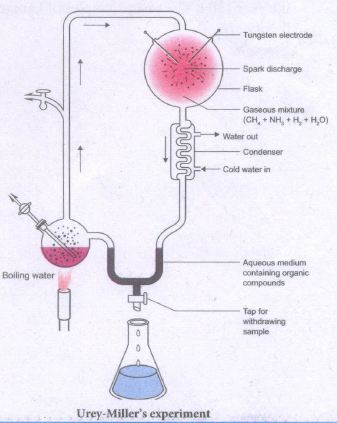
(ii) In their experiment, a mixture of gases was allowed to circulate over electric discharge from a tungsten electrode.
(iii) A small flask was kept boiling and the steam emanating from it was made to mix with the mixture of gases (ammonia, methane, and hydrogen) in the large chamber that was connected to the boiling water. The steam condensed to form water which ran down the 'U' tube.
(iv) The experiment was conducted continuously for a week and the liquid was analyzed. Glycine, alanine, beta-alanine, and aspartic A acid were identified. Thus Miller's experiments highlighted the possibility of abiogenetic synthesis of a large amount of variety of organic compounds in nature from a mixture of sample gases in which the only source of carbon was methane. Later in similar experiments, formation of all types of amino acids, and nitrogen bases were noticed.
16.
Similarities found in Neanderthal man and Homo sapiens.
(i) They knew to protect their bodies. Neanderthal man used animal hides to protect their bodies.
(ii) They knew the use of fire.
(iii) They buried their dead.
17.
Fossilization is the process by which plant and animal remains are preserved in sedimentary rocks. They fall under three main categories.
(i) Actual remains
The original hard parts such as bones, teeth or shells are preserved as such in the earth's atmosphere, which is not the common method of fozzilization.
2. When marine animals die, their hard parts such as bones, shells etc. are covered with sediments and are protected from further deterioration.
3. Such parts get preserved in vast ocean, the salinity in them prevents decay.
4. The sediments become hardened to form definite layers (or) strata.
5. For example wooly mammoth that lived 22 thousand years ago were preserved in the frozen coast of Siberia as such, several human beings and animals living in the animals living in the ancient city of pompeii were preserved infact by volcanic ash which gushed out from Mount Vesuvivs.
(ii) Petrifaction
1. After death of animals their original portion of their body may be replaced molecule for molecule by minerals and the original substance being lost through disintegration.
2. This method of fozzilation is called pertifaction.
3. The principle minerals involved in this type fozzilation are iron, pyrites, silica, calcium, carbonate, and bicarbonates of calcium and magnesium.
(iii) Natural moulds and casts
1. Even after disintegration, the body of an animal might leave indelible impression on the soft mud which later becomes hardened into stones. Such impressions are called moulds.
2. The cavities of the moulds may get filled up by hard minerals and get fozzillized, which are called casts.
3. Hardened faecal. matter termed as coprolites occur as tiny pellets.
4. Analysis of the coprolites enable us to understand the nature of diet, the pre historic animals thrived on.
18.
(i) Microevolution refers to the changes in allele frequencies within a population.
(ii) Allele frequencies in a population may change due to four fundamental forces of evolution such as natural selection, genetic drift, mutation and gene flow.
19.
The term evolution is used to describe heritable changes in one or more characteristics of a population of species from one generation to the other.
20.
(i) The earliest fossils of the prehistoric man like Ramapithecus lived some 14mya. They were hairy and walked like gorillas and chimpanzees.
(ii) They had a brain capacity of 1300cc.
(iii) They lived on tough food consisting of seeds and savannah grasses and had well developed grains and heavy molars.
(iv) Australopithecus had a brain capacity of 461cc, teeth consisted of small canines and large molars. Good are softer foods consisting of grass, leaves and fruits.
21.
22.
Lamarcks 'theory of acquired character's was disproved by August Weismann who conducted experiments on mice for twenty generations by cutting their tails and Weismann proved that change in the somatoplasm will not be transferred to the next generation but changes in the germplasm will be inherited.
23.
1. Hardy -Weinberg principle states that the allele frequencies in a population are stable and remain constant from generation to generation it is called genetic equilibrium.
2. The sum total of all the allele frequencies is one and is represented by the equation.
p2 + 2pq + q2 = 1
Any change of frequency of alleles in a population in interpreted as resulting in evolution.
The factors that affect the genetic equilibrium are
1. Gene flow/migration
2. Genetic drift
3. Mutation
4. Genetic recombination
24.
350 - 450 cc
25.
Haldane
26.
Colloids
27.
Mutation
28.
Genetic drift
29.
(d) Both A & B are false
30.
(c) A is correct R is false
31.
(c) Use and disuse
Reason: It is linked to Lamarckism whereas the others are linked to Darwinism.
32.
(d) Oenothera
Reason: It is not linked to adaptive radiation whereas the others show adaptive radiation.

12th Standard Syllabus & Materials
12th Standard
TN 12th Computer Applications களப்பெயர் முறைமை (DNS) Sample Question Papers Study Material - QB365 Set A
NEW12th Standard
TN 12th Computer Applications வலையமைப்பு எடுத்துக்காட்டுகள் மற்றும் நெறிமுறைகள் Sample Question Papers Study Material - QB365 Set A
NEW12th Standard
TN 12th Computer Applications கணினி வலையமைப்பு ஓர் அறிமுகம் Sample Question Papers Study Material - QB365 Set A
NEW12th Standard
TN 12th Computer Applications PHP-உடன் MySQL-ஐ இணைத்தல் Sample Question Papers Study Material - QB365 Set A



Tamilnadu Stateboard 12th Standard Subjects

Maths

Chemistry

Physics
Biology

Computer Science

Business Maths and Statistics

Economics

Commerce

Accountancy

History

Computer Applications
Biology
Computer Technology
Computer Applications
Computer Science
Business Maths and Statistics
Commerce
Economics
Maths
Chemistry
Physics
Computer Technology
History
Accountancy

Tamil

English

French
Tamilnadu Stateboard Standards

