
 100% FREE ACCESS
12th Standard Syllabus & Materials
12th Standard
TN 12th Computer Applications மின்னணு தரவு பரிமாற்றம் Sample Question Papers Study Material - QB365 Set A
NEW12th Standard
TN 12th Computer Applications மின் - வணிக பாதுகாப்பு அமைப்புகள் Sample Question Papers Study Material - QB365 Set A
NEW12th Standard
TN 12th Computer Applications மின்னணு செலுத்தல் முறைகள் Sample Question Papers Study Material - QB365 Set A
NEW12th Standard
TN 12th Computer Applications மின் - வணிகம் Sample Question Papers Study Material - QB365 Set A
NEW12th Standard
TN 12th Computer Applications திறந்த மூல கருத்துருக்கள் Sample Question Papers Study Material - QB365 Set A
NEW12th Standard
TN 12th Computer Applications வலையமைப்பு வடமிடல் Sample Question Papers Study Material - QB365 Set A

Published on: 04/11/2019
Zoology - Immunology
Download Tamil Nadu 12th Standard Biology question papers, model tests, one-mark questions, important questions, and public exam papers in PDF format. Free study materials and answer keys for TN State Board students.
Questions + Answers key
Take MCQ Biology Test1.
B cells that produce and release large amounts of antibody are called
Memory cells
Basophils
Plasma cells
killer cells
2.
3.
Which is not a macrophage?
Monocyte
Microglia
Kupffer cell
Lymphocyte
4.
Spread of cancerous cells to distant sites is termed as
Metastasis
Oncogenes
Proto-oncogenes
Malignant neoplasm
5.
Allergy involves
IgE
IgG
IgA
IgM
6.
Paratope is an
Antibody binding site on variable regions
Antibody binding site on heavy regions
Antigen binding site on variable regions
Antigen binding site on heavy regions
7.
Define innate immunity.
8.
List out chemical alarm signals produced during inflammation.
9.
What are interferons? Mention their role.
10.
Name and explain the type of barriers which involve macrophages.
11.
How does immune system work?
12.
Given below are some human organs. Identify one primary and one secondary lymphoid organ. Explain its role.
13.
What is metastasis?
14.
Explain the structure of immunoglobulin with suitable diagram.
15.
Explain the process of replication of retrovirus after it gains entry into the human body.
16.
Differentiate between:
Innate immunity and acquired immunity
17.
A person is infected by HIV. How will you diagnose for AIDS?
18.
What is vaccine? What are its types?
19.
What are the cells involved innate immune system?
20.
Pasteur
21.
Polio
22.
lgE
23.
Opsonin
24.
Thymus
1.
(c)
Plasma cells
2.
(d)
3.
(b)
Microglia
4.
(a)
Metastasis
5.
(a)
IgE
6.
(c)
Antigen binding site on variable regions
7.
Innate immunity is the natural phenomenon of resistance to infection which an individual possesses right from the birth.
8.
Inflammatory barriers is a type of Innate Immunity. Tissue damage and infection induce leakage of vascular fluid, containing chemotactic signals like serotonin, histamine and prostaglandins.
9.
Interferons are a group of signalling proteins produced by virus infected cells. They interfere with viral replication and hence named interferons. A virus infected cell releases interferons which induce antiviral state in the uninfected cells. They are chemical mediators under physiological barriers offering Innate immunity.
10.
The type of barrier that involves macrophages are the
(i) Phagocytic barriers which is a type of innate immunity.
(ii) In this mechanism, specialised cells such as monocytes, Neutrophils and tissue macro phages pha cytose and digest whole microorganisms.
11.
The immune responses may be primary or secondary.
(i) The primary immune response occurs when a pathogen comes in contact with the immune system for the first time.
(ii) The secondary immune response occurs when a person is exposed to the same antigen again. During this time, immunological memory has been established and the immune system can start producing antibodies immediately. Within hours after recognition of the antigen, a new army of plasma cells are generated. Within 2 to 3 days, the antibody concentration in the blood rises steeply to reach much higher level than primary response. This is also called as "booster response".
12.
(i) Primary Lymphoid organ: Thymus is a primary lymphoid organ.
Function: One of its main secretions is the hormone thymosin. It stimulates the T cell to become mature and immunocompetent.
(ii) Secondary Lymphoid organ: Tonsils is a secondary lymphoid organ.
The tonsils are part of the lymphatic system, which help to fight infections. They stop invading germs including bacteria and viruses.
13.
The tumor cells spread to other parts of the body from the tumour and give rise to secondary tumour. This is known as metastasis.
14.
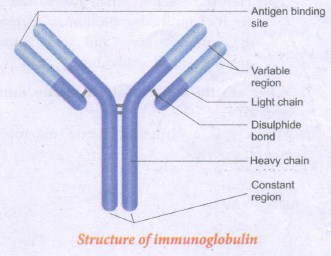
(i) In the 195"os,experiments by Porter and Edelman revealed the basic structure of the immunoglobulin.
(ii) An antibody molecule is Y shaped structu re that comprises of four polypeptide chains, two identical light chains (L) of molecular weight 25,000 Da (approximately 214 amino acids) and two identical heavy chains (H) of molecular weight 50,000 Da (approximately 450 amino acids).
(iii) The polypeptide chains are linked together by di-sulphide (S-S) bonds. One light chain is attached to each heavy chain and two heavy chains are attached to each other to form a Y shaped (Fig.) structure. Hence, an antibody is represented by H2L2.
(iv) Each chain (L and H) has two terminals. They are C - terminal (Carboxyl) and amino or N-terminal.
(v) Each chain (L and H) has two regions. They have variable (V) region at one end and a much larger constant (C) region at the other end.
(vi) Antibodies responding to different antigens have very different (V) regions but their (C) regions are the same in all antibodies.
(vii) In each arm of the monomer antibody, the (V) regions of the heavy and light chains combines to form an antigen - binding site shaped to 'fit' a specific antigenic determinant. Thus each antibody monomer has two such antigen - binding regions.
(viii) The (C) regions that forms the stem of the antibody monomer determine the antibody class and serve common functions in all antibodies.
15.
(i) After getting into the body of the person, the virus enters into macrophages where RNA genome of the virus replicates to form viral DNA with the help of the enzyme reverse transcriptase.
(ii) This viral DNA gets incorporated into the DNA of host cells and directs the infected cells to produce viral particles.
(iii) The macrophages continue to produce virus and in this way acts like a HIV factory.
(iv) Simultaneously, HIV enters into helper T-Iymphocytes, replicates and produces progeny viruses. The progeny viruses released in the blood attack other helper T-lymphocytes. The process is repeated.
(v) During this period, the person suffers from bouts of fever, diarrhoea and weight loss. Due to decrease in the number of helper T lymphocytes, the person starts suffering from infections and becomes immune deficient and unabie to protect against any infection.
16.
| S.No | Innate Immunity | Acquired Immunity |
| i. | Innate Immunity is the natural phenomenon of resistance to infection which an individual possesses right from birth. |
The immunity that an individual acquires after birth is known as acquired immunity. |
| ii. | The innate defense mechanisms are non-specific and are effective against a wide range of infectious agents. |
The unique features of acquired immunity are antigenic specificity, diversity, recognition of self and non-self and immunological memory |
| iii. | Innate Immunity comprises of anatomicalphysiological, phagocytic and inflammatory barriers. |
It has two components cell mediated immunity and antibody mediated immunity. |
17.
A simpl blood tes is available that can determine wheth r the person has been, infected with HIV. The ELISA test (Enzyme Linked ImmunoSorbent Assay) detects the presence of HIV antibodies. It is a preliminary test: Western blot test is more reliable and a confirmatory test. It detects the viral core proteins.r lf both tests detect the presence ofl:he antibodies, the person is corfsidered to be HIV positive. The vaccines are classified as first, second and third generation vaccines.
(i) First generation vaccine is further subdivided into live attenuated vaccine, killed vaccine and toxoids.
(a) Live attenuated vaccines use the weakened (attenuated), aged, less virulent form of the virus. E.g. Measles, mumps and rubella (MMR) vaccine and the Varicella (chickenpox) vaccine.
(b) Killed (inactivated) vaccines are killed or inactivated by heat and other methods. E.g. Salk's polio vaccine.
(c) Toxoid vaccines contain a toxin or chemical secreted by the bacteria or virus. They make us immune to the harmful effects of the infection, instead of to the infection itself. E.g. DPT vaccine (Diphtheria, Pertussis and Tetanus).
(ii) Second generation vaccine contains the pure surface antigen of the pathogen. E.g. Hepatitis- B vaccine.
(iii) Third generation vaccine contains the purest and the highest potency vaccines which are synthetic in generation. The latest revolution in vaccine is DNA vaccine or recombinant vaccine.
18.
A vaccine is a biological preparation that provides active acquired immunity to a particular disease and resembles a diseasecausing microorganism and is often made from weakened or atlenuated or killed forms of the microbes, their toxins, or one of its surface proteins. The vaccines are classified as first, second and third generation vaccines.
19.
Monocytes, neutrophils, tissue macrophages and phagocytes.
20.
Rabies
21.
Jonas salk
22.
Allergy
23.
Antibody
24.
T cells

12th Standard Syllabus & Materials
12th Standard
TN 12th Computer Applications களப்பெயர் முறைமை (DNS) Sample Question Papers Study Material - QB365 Set A
NEW12th Standard
TN 12th Computer Applications வலையமைப்பு எடுத்துக்காட்டுகள் மற்றும் நெறிமுறைகள் Sample Question Papers Study Material - QB365 Set A
NEW12th Standard
TN 12th Computer Applications கணினி வலையமைப்பு ஓர் அறிமுகம் Sample Question Papers Study Material - QB365 Set A
NEW12th Standard
TN 12th Computer Applications PHP-உடன் MySQL-ஐ இணைத்தல் Sample Question Papers Study Material - QB365 Set A



Tamilnadu Stateboard 12th Standard Subjects

Maths

Chemistry

Physics
Biology

Computer Science

Business Maths and Statistics

Economics

Commerce

Accountancy

History

Computer Applications
Biology
Computer Technology
Computer Applications
Computer Science
Business Maths and Statistics
Commerce
Economics
Maths
Chemistry
Physics
Computer Technology
History
Accountancy

Tamil

English

French
Tamilnadu Stateboard Standards

