
 100% FREE ACCESS
12th Standard Syllabus & Materials
12th Standard
TN 12th Computer Applications மின்னணு தரவு பரிமாற்றம் Sample Question Papers Study Material - QB365 Set A
NEW12th Standard
TN 12th Computer Applications மின் - வணிக பாதுகாப்பு அமைப்புகள் Sample Question Papers Study Material - QB365 Set A
NEW12th Standard
TN 12th Computer Applications மின்னணு செலுத்தல் முறைகள் Sample Question Papers Study Material - QB365 Set A
NEW12th Standard
TN 12th Computer Applications மின் - வணிகம் Sample Question Papers Study Material - QB365 Set A
NEW12th Standard
TN 12th Computer Applications திறந்த மூல கருத்துருக்கள் Sample Question Papers Study Material - QB365 Set A
NEW12th Standard
TN 12th Computer Applications வலையமைப்பு வடமிடல் Sample Question Papers Study Material - QB365 Set A

Published on: 09/10/2019
Zoology - Molecular Genetics
Download Tamil Nadu 12th Standard Biology question papers, model tests, one-mark questions, important questions, and public exam papers in PDF format. Free study materials and answer keys for TN State Board students.
Questions + Answers key
Take MCQ Biology Test1.
The Okazaki segments are joined by _________.
DNA polymerase
RNA polymerase
DNA ligase
Endonuclease
2.
The term ___________ refers to DNA of Prokaryotes.
Nuclein
Ribozyme
Genophore
Nucleosome
3.
Human Genome was sequenced in ________.
1979
2015
1989
2001
4.
One gene one enzyme hypothesis was proposed by Beadle and Tatum based on ________
Yeast
Drosophila
E. coli
Neurospora
5.
When lactose is present in the culture medium:
Transcription of lac y, lac z, lac a genes occurs.
Repressor is unable to bind to the operator.
Repressor is able to bind to the operator.
Both (a) and (b) are correct.
6.
7.
What is the basis for the difference in the synthesis of the leading and lagging strand of DNA molecules?
Origin of replication occurs only at the 5' end of the molecules
DNA ligase works only in the 3' → 5' direction
DNA polymerase can join new nucleotides only to the 3' end of the growing stand.
Helicases and single-strand binding proteins that work at the 5' end
8.
Hershey and Chase experiment with bacteriophage showed that ______.
Protein gets into the bacterial cells
DNA is the genetic material
DNA contains radioactive sulphur
Viruses undergo transformation
9.
Expand and define NHC
10.
What is a nucleosomer?
11.
From their examination of the structure of DNA, What did Watson and Crick infer about the probable mechanism of DNA replication, coding capability and mutation?
12.
Mention any two ways in which single nucleotide polymorphism (SNPs) identified in human genome can bring revolutionary change in biological and medical science.
13.
Give reasons: ‘Genetic code is universal’.
14.
Differentiate DNA and RNA.
15.
A low level of expression of lac operon occurs at all the windows for treatment of various genetic disorders. Justify the statement
16.
Distinguish between structural gene, regulatory gene and operator gene
17.
State any three goals of the human genome project.
18.
Differentiate - Leading stand and lagging strand
19.
Explain the formation of a nucleosome.
20.
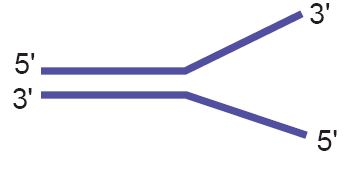
a) Identify the figure given below
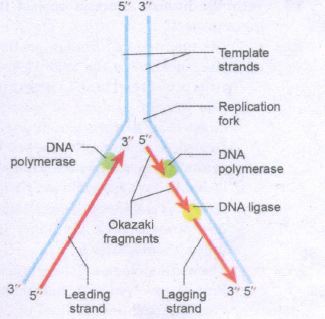
b) Redraw the structure as a replicating fork and label the parts
c) Write the source of energy for this replication and name the enzyme involved in this process.
d) Mention the differences in the synthesis of protein, based on the polarity of the two template strands.
21.
UGA
22.
Aminoacyl synthetase
23.
Semi-conservative model
24.
Initiation complex
25.
SNPs
26.
Assertion: Both the strands of DNA can be copied during transcription.
Reason: This will help to produce more RNA with different sequences
Codes:
A. A and R are true, R is the correct explanation of A
B. A and R are true, R is not the correct explanation of A
C. A is true, R is false
D. Both A and R are false
27.
Assertion: The tRNA decodes the information on mRNA.
Reason: It has an extra arm.
Codes:
A. A and R are true, Ris the correct explanation of A
B. A and R are true, R is not the correct explanation of A
C. A is true, R is false
D. Both A and R are false
28.
The triplet codon is described as 'degenerate code'.
29.
The genetic code is said to be Non-ambiguous.
30.
PCR is an important part of DNA finger printing technique.
31.
There are no tRNA for stop codons.
32.
_____________ is the monomer of DNA.
33.
__________ number of codons, codes for cystine
34.
Goldberg - Hogness box of eukaryotes is equivalent to__________ of prokaryotes.
35.
Kornberg enzyme is called as _________
1.
(c)
DNA ligase
2.
(c)
Genophore
3.
(d)
2001
4.
(d)
Neurospora
5.
(d)
Both (a) and (b) are correct.
6.
(c)
7.
(c)
DNA polymerase can join new nucleotides only to the 3' end of the growing stand.
8.
(b)
DNA is the genetic material
9.
NHC: Non-histone Chromosomal protein.
In eukaryotes, apart from histone proteins, additional set of proteins are required for packing of chromatin at higher level and are referred as non - histone chromosomal proteins
10.
In eukaryotes, chromatin is formed by a series of repeating units called nucleosomes. It consists of a histone octamer. The negatively charged DNA is wrapped around the positively charged histone octamer to form a nucleosome.
11.
They inferred each strand of the double strands helps was used as a template for the formation of a new, daughter strand having a complementary sequence of bases.
12.
There are 1.4 million locations where single base DNA differences (Called SNPs - Single Nucleotide Polymorphism - pronounce as snips) occurs in human's genome.
(i) By tracing human history
(ii) By finding chromosomal locations for disease associated sequences
13.
1. The genetic code is universal. It means that all known living systems use nucleic acids and the same three base codons (triplet codon) direct the synthesis of protein from amino acids. E.g, mRNA ,(UUU) codon codes for phenylalanine in all cells of all organisms.
2. Some exceptions are reported in prokaryotic, mitochondrial and chloroplast genomes. However similarities are more common than differences.
14.
| DNA | RNA |
| 1) It stands for De Oxyribo Nucleic acid | 1) It stands for Ribo Nucleic acid |
| 2) It contains De Oxyribose Sugar | 2) It contains Ribose Sugar |
| 3) The nitrogenous bases are adenine, guanine, thymine and cytosine | 3) The nitrogenous bases are adenine, guanine, uracil and cytosine |
| 4) It is a double stranded molecule | 4) It is a single stranded molecule. |
| 5) DNA is the hereditary material in all living organisms. | 5) RNA is the hereditary material only in some viruses. |
15.
In the complete absence of lac operon permease will not be synthesized which is essential for transport of lactose from the medium into the cells, then it cannot act as an inducer. Hence, cannot relieve the lac operon from its repressed state.
16.
| Structural gene | Regulatory gene | operator gene |
| They are concerned with the transcription of mRNA for the synthesis of particular polypeptide |
It controls the functioning of operator gene |
It determines the functioning of operator gene |
| They function only when RNA polymerases join |
It produces a repressor or apo- repressor for blocking operator gene |
It works only when it is not blocked by repressor |
| They function by forming mRNA for specific polypeptide |
It functions through the formation of mRNA of repressor or apo-repressor |
It functions through the presence (or) absence of repressor |
17.
(i) Identify all the genes (approximately 30000) in human DNA.
(ii) To store this information in databases.
(iii) Improve tools for data analysis.
18.
During DNA replication, One acts as the leading strand and the other is the lagging strand.
| Leading Strand | Lagging Strand |
|---|---|
| lt is continuously formed as replicated strand of DNA without any gap |
It is replicated strand of DNA which is formed by the joining of short segments called okazaki segment |
| The growth of leading strand is in 5' → 3'direction | Each okazaki segment grows in 5' → 3'direction but the growth of the lagging strand is in 5' → 3'direction. |
| lt does not require DNA ligase for its growth and used in PCR | DNA ligase is required for the formation of lagging strand from okazaki segments |
19.
(i) In eukaryotes, chromatin is formed by a series of repeating units called nucleosomes.
(ii) Korenberg proposed a model for the nucleosome, in which 2 molecules of the four histone proteins H2A, H2B, H3 AND H4 are organized to form a unit of eight molecules called histone octamere.
(iii) The negatively charged DNA is wrapped around the positively charged histone octamer to form a structure called nucleosome. A typical nucleosome contains 200 bp of DNA helix.
(iv) The histone octameres are in close contact and DNA is coiled on the outside of nucleosome.
(v) Neighbouring nucleosomes are connected by linker DNA (Hl) that is exposed to enzymes. The DNA makes two complete turns around the histone octameres and the two turns are sealed off by an HI molecule
(vi) Chromatin lacking HI has beads on a string appearance in which DNA enters and leaves the nucleosomes at random places.
(vii) HI of one nucleosome can interact with HI of the neighbouring nucleosomes resulting in the further folding of the fibre.
20.
(a) Replicating fork of DNA
(b)
(c) Source of Energy:
NTP's are used in the synthesis of RNA primers and ATP is used as an energy source for some of the enzymes, needed to initiate and sustain DNA synthesis occurs at the replication fork.
Enzymes involved in replication :
(i) DNA Helicase
(ii) DNA polymerase
(iii) Topoisomerase/DNA Gyrase
(iv) DNA ligase
(v) Primase
(d) Both the strands of (parental) DNA act as template for the synthesis of new strands
1. On the templates strand with \(3^{\prime} \rightarrow 5^{\prime}\) polarity the new strand (leading strand) is synthesized as a continuous stretch. It is called continuous synthesis (DNA polymerase carryout polymerisation).
2. On the other strand \(5^{\prime} \rightarrow 3^{\prime}\) polarity DNA synthesized as short stretches; it is called discontinuous synthesis.
3. Later the short stretches of DNA are joined by DNA-ligases into a continuous strand called lagging strand.
21.
Tyrosine
22.
Charging of tRNA
23.
Meselson and Stahl
24.
GTP
25.
Snips
26.
D. Both A and R are false
27.
B. A and R are true, R is not the correct explanation of A
28.
A degenerate code means that more than one triplet codon could code for a specific amino acid. For example: codons GUU, GUC, GUA and GUG code for valine.
29.
i) Non-ambiguous code means that one codon will code for one amino acid.
ii) There are specific codons for each amino acid. AUG codes for methionine.
30.
pCR stands for Polymerase chain reaction. In situations, there is only a small amount of DNA available for DNA finger printing. If needed many copies of the DNA can be produced by a method of DNA amplification called as PCR.
31.
The stop codons serve to indicate the termination of protein synthesis. Therefore when any one of the stop codons (UAA, UAG, UGA) appear on the mRNA. It will signal the action of GTP dependent release factor which cleaves the polypeptide chain from the terminal tRNA. The tRNA will further be released from ribosomes.
32.
()
Nucleotide
33.
()
Two
34.
()
Pribnow box
35.
()
DNA polymerase I

12th Standard Syllabus & Materials
12th Standard
TN 12th Computer Applications களப்பெயர் முறைமை (DNS) Sample Question Papers Study Material - QB365 Set A
NEW12th Standard
TN 12th Computer Applications வலையமைப்பு எடுத்துக்காட்டுகள் மற்றும் நெறிமுறைகள் Sample Question Papers Study Material - QB365 Set A
NEW12th Standard
TN 12th Computer Applications கணினி வலையமைப்பு ஓர் அறிமுகம் Sample Question Papers Study Material - QB365 Set A
NEW12th Standard
TN 12th Computer Applications PHP-உடன் MySQL-ஐ இணைத்தல் Sample Question Papers Study Material - QB365 Set A



Tamilnadu Stateboard 12th Standard Subjects

Maths

Chemistry

Physics
Biology

Computer Science

Business Maths and Statistics

Economics

Commerce

Accountancy

History

Computer Applications
Biology
Computer Technology
Computer Applications
Computer Science
Business Maths and Statistics
Commerce
Economics
Maths
Chemistry
Physics
Computer Technology
History
Accountancy

Tamil

English

French
Tamilnadu Stateboard Standards

