
 100% FREE ACCESS
12th Standard Syllabus & Materials
12th Standard
TN 12th Computer Applications மின்னணு தரவு பரிமாற்றம் Sample Question Papers Study Material - QB365 Set A
NEW12th Standard
TN 12th Computer Applications மின் - வணிக பாதுகாப்பு அமைப்புகள் Sample Question Papers Study Material - QB365 Set A
NEW12th Standard
TN 12th Computer Applications மின்னணு செலுத்தல் முறைகள் Sample Question Papers Study Material - QB365 Set A
NEW12th Standard
TN 12th Computer Applications மின் - வணிகம் Sample Question Papers Study Material - QB365 Set A
NEW12th Standard
TN 12th Computer Applications திறந்த மூல கருத்துருக்கள் Sample Question Papers Study Material - QB365 Set A
NEW12th Standard
TN 12th Computer Applications வலையமைப்பு வடமிடல் Sample Question Papers Study Material - QB365 Set A

Published on: 01/10/2019
Zoology - Principles of Inheritance and Variation
Download Tamil Nadu 12th Standard Biology question papers, model tests, one-mark questions, important questions, and public exam papers in PDF format. Free study materials and answer keys for TN State Board students.
Questions + Answers key
Take MCQ Biology Test1.
The__________ is called null allele.
IA
IOIB
IO
IBIB
2.
The ABO blood group was discovered by ________.
Sturli
Decastelle
Landsteiner
Alexander wiener
3.
Co-dominant blood group is ______.
A
AB
B
O
4.
Females with Turners syndrome have ______.
Small uterus
Rudimentary ovaries
Underdeveloped breasts
All of these
5.
Father of a child is colourblind and mother is carrier for colourblindness, the probability of the child being colourblind is _____.
25%
50%
100%
75%
6.
XO type of sex determination and XY type of sex determination are examples of ______.
Male heterogamety
Female heterogamety
Male homogamety
Both (b) and (c)
7.
What can be the blood group of offspring when both parents have AB blood group?
AB only
A, B and AB
A, B, AB and O
A and B only
8.
Which of the following phenotypes is not possible in the progeny of the parental genotypic combination IAIO x IAIB?
AB
O
A
B
9.
Three children of a family have blood groups A, AB and B. What could be the genotypes of their parents?
IA IB and IoIo
IA Io and IBIo
IB IB and IA IA
IA IA and IoIo
10.
Haemophilia is more common in males because it is a ______.
Recessive character carried by Y-chromosome
Dominant character carried by Y-chromosome
Dominant trait carried by X-chromosome
Recessive trait carried by X-chromosome
11.
What is a syndrome?
12.
13.
14.
What is Lyonisation?
15.
What is haplodiploidy?
16.
What are the applications of Karyotyping?
17.
Explain the mode of sex determination in honeybees.
18.
Differentiate Intersexes from Supersexes
19.
Why are sex linked recessive characters more common in the male human beings?
20.
Give an account of genetic control of Rh factor.
21.
What is male heterogamety?
22.
Turner's syndrome
23.
X/A
24.
Lyon
25.
Gennplasm
26.
Kappa
27.
| i) | SRY | - | X Chromosome |
| ii) | Heterogametic female | - | XX-XO |
| iii) | Barr body | - | Sex Chromatin |
| iv) | Rh factor | - | Landsteiner |
(a) i and iv
(b) ii and iii and iv
(c) ii only
(d) i and ii
28.
| i) | Downs syndrome | - | Trisomy 13 |
| ii) | Shell coiling in snail | - | Cytoplasmic inheritance |
| iii) | Kappa particle | - | Sonneborn |
| iv) | Eugenics | - | Galton |
(a) i and iv
(b) i only
(c) ii and iii
(d) i, ii and iv
1.
(c)
IO
2.
(c)
Landsteiner
3.
(b)
AB
4.
(d)
All of these
5.
(b)
50%
6.
(a)
Male heterogamety
7.
(b)
A, B and AB
8.
(b)
O
9.
(b)
IA Io and IBIo
10.
(d)
Recessive trait carried by X-chromosome
11.
Group of signs and symptoms that occur together and characterize a particular abnormality is called a syndrome.
Eg : Down's syndrome, Turner's syndrome, Klinefelter's syndrome, Patau's syndrome are some of the examples of chromosomal disorders.
12.
13.
14.
The inactivation of an X chromosome one of the two X chromosomes in every cell in some female mammal is randomly inactivated early in embryonic development and named after geneticist Mary Lyon.
The inactive X chromosome is silenced by it being packaged in such a way that it has a transcriptionally inactive structure called heterochromatin found in nucleoplasm of nucleus.
15.
Haplodiploidy is a sex determination system in which males develop from unfertilized eggs are haploid, and female develops from fertilized egg and is diploid.
It is sometimes called arrhenotoky.
e.g., Honeybees, ants, and wasps.
16.
(i) It helps in gender identification.
(ii) It is used to detect the chromosomal aberrations like deletion, duplication, translocation, invasion and nondisjunction of chromosomes.
(iii) It helps to identify the abnormalities of chromosomes like aneuploidy.
(iv) It is also used in predicting the evolutionary relationships between species.
(v) Genetic diseases in human beings can be detected by this technique.
17.
Sex determination in honeybees
sex determination is as follows
1. Haploid sex determination is seen in honeybees, it is based on the number of sets of chromosome, an individual receives.
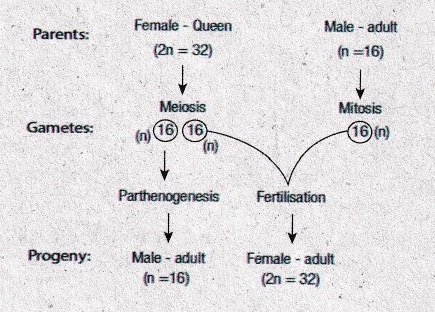
2. When the ovum is fertilized by a male gamete the zygote (2n = 32) develops into a female i.e., a queen or worker.
3. When the haploid ovum develops by parthenogenesis. i.e., without fertilization, a male individual, called drone is formed as adult male.
4. The male honeybees (drone) is haploid (with n = 16) and forms sperms by mitosis.
18.
Intersexes:
1. Intersexes refers to the individuals having the characteristics of both female and male sexes and their sexual anatomy does not seem to fit the typical definition of male or female.
Supersexes:
1. Supersexes ar formed as a result of abnormal combination of sex chromosomes.
2. Example : Super males in humans human beings have 44+XYY
19.
1. The X chromosome which is common to male and female carries a number of genes. Such genes are called sex linked genes and the characters controlled by them are termed as sex-linked characters. The inheritance of sex linked genes or traits is known as sex linked inheritance.
2. Sex linked inherited traits are more common in males than females, because males are hemizygous (XY) and therefore express that traits when they inherit one mutant allele.
3. Any male receiving X linked recessive allele from his mother will express the trait as his y chromosome has no corresponding allele.
4. If a recessive X linked gene causes disorder then more males than females have the disorder because the disorder is caused by a single allele in males. Their y chromosome does not carry any corresponding allele. So that sex linked recessive characters are mole in moles.
20.
(i) Fisher and Race hypothesis:
Rh factor involves three different pairs of alleles located on three different closely linked loci on the chromosome pair. This system is more commonly in use today, and uses the 'Cde' nomenclature.
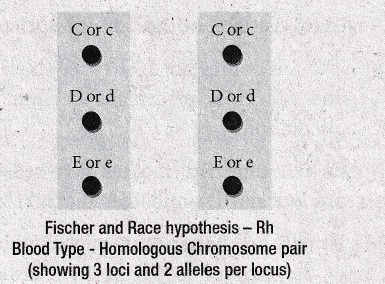
2. In the above Figure, three pairs of Rh alleles (Cc, Dd and Ee) occur at 3 different loci on homologous chromosome pair- 1.
3. The possible genotypes will be one C or c, one D or d, one E or e from each chromosome
For e.g. CDE/cde; CdE/cDe; cde/cde; CDe/CdE etc.
4. All genotypes carrying a dominant 'D' allele will produce Rh positive phenotype and double recessive genotype 'dd' will give rise to Rh negative phenotype.
(ii) Wiener Hypothesis
1. Wiener proposed the existence of eight alleles (R1, R2, RO, RZ, r, r1, r11, ry) at a single Rh locus.
2. All genotypes carrying a dominant 'R allele' (R1, R2, RO, RZ) will produce 'Rh- positive' phenotype and double recessive genotypes (rr, rr1, rr11, rry) will give rise to Rh- negative phenotype.
21.
Heterogametic Males:
In this method of sex determination the males are heterogametic producing dissimilar gametes while females are homogametic producing similar gametes.
It is of kinds XX-XO type and XX-XY type.
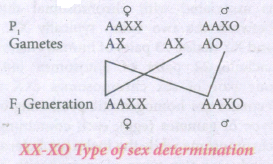
(i) XX-XO Type
(a) This method of sex determination is seen in bugs and some insects such as cockroaches and grasshoppers.
(b) The female with two X chromosomes are homogametic (XX) while the males with only one X chromosome are heterogametic (XO).
(c) The presence of an unpaired X chromosomes determines the male sex. The males with unpaired 'X' chromosome produce two types of sperms, one half with X chromosome and other half without X chromosome.
(d) The sex of the offspring depends upon the sperm that fertilizes the egg.
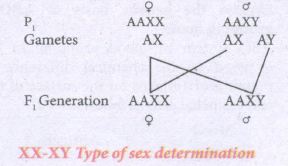
(ii) XX-XV type (Lygaeu Type):
This method of sex determination is seen in human beings and in Drosophila.
(a) The females are homogametic with XX chromosome, while the males are heterogametic with X and Y chromosome.
(b) Homogametic females produce only one kind of egg, each with one X chromosome, while the heterogametic males produce two kinds of sperms some with X chromosome and some with Y chromosome.
(c) The sex of the embryo depends on the fertilizing sperm. An egg fertilized by an 'X' bearing sperm produces a female, if fertilized by a 'Y' bearing sperm, a male is produced.
22.
44AA + XO
23.
Bridges
24.
Barr body
25.
eugenics
26.
bacterium
27.
(c) ii only
28.
(b) i only

12th Standard Syllabus & Materials
12th Standard
TN 12th Computer Applications களப்பெயர் முறைமை (DNS) Sample Question Papers Study Material - QB365 Set A
NEW12th Standard
TN 12th Computer Applications வலையமைப்பு எடுத்துக்காட்டுகள் மற்றும் நெறிமுறைகள் Sample Question Papers Study Material - QB365 Set A
NEW12th Standard
TN 12th Computer Applications கணினி வலையமைப்பு ஓர் அறிமுகம் Sample Question Papers Study Material - QB365 Set A
NEW12th Standard
TN 12th Computer Applications PHP-உடன் MySQL-ஐ இணைத்தல் Sample Question Papers Study Material - QB365 Set A



Tamilnadu Stateboard 12th Standard Subjects

Maths

Chemistry

Physics
Biology

Computer Science

Business Maths and Statistics

Economics

Commerce

Accountancy

History

Computer Applications
Biology
Computer Technology
Computer Applications
Computer Science
Business Maths and Statistics
Commerce
Economics
Maths
Chemistry
Physics
Computer Technology
History
Accountancy

Tamil

English

French
Tamilnadu Stateboard Standards

