
 100% FREE ACCESS
12th Standard Syllabus & Materials
12th Standard
TN 12th Computer Applications மின்னணு தரவு பரிமாற்றம் Sample Question Papers Study Material - QB365 Set A
NEW12th Standard
TN 12th Computer Applications மின் - வணிக பாதுகாப்பு அமைப்புகள் Sample Question Papers Study Material - QB365 Set A
NEW12th Standard
TN 12th Computer Applications மின்னணு செலுத்தல் முறைகள் Sample Question Papers Study Material - QB365 Set A
NEW12th Standard
TN 12th Computer Applications மின் - வணிகம் Sample Question Papers Study Material - QB365 Set A
NEW12th Standard
TN 12th Computer Applications திறந்த மூல கருத்துருக்கள் Sample Question Papers Study Material - QB365 Set A
NEW12th Standard
TN 12th Computer Applications வலையமைப்பு வடமிடல் Sample Question Papers Study Material - QB365 Set A

Published on: 09/03/2020
12th Standard Business Mathamatics English Medium All Chapter Book Back and Creative Two Marks Questions 2020
Download Tamil Nadu 12th Standard Business Maths and Statistics question papers, model tests, one-mark questions, important questions, and public exam papers in PDF format. Free study materials and answer keys for TN State Board students.
Questions + Answers key
Take MCQ Business Maths and Statistics Test
1.
Solve: \(\frac { dy }{ dx } \) = y sin 2x
2.
Find the rank of the matrix \(\left( \begin{matrix} 5 & 3 & 0 \\ 1 & 2 & -4 \\ -2 & -4 & 8 \end{matrix} \right) \)
3.
Calculate the seasonal indices by the method of simple average for the following data.
| Year | I quarter | II quarter | III quarter | IV quarter |
| 1985 | 68 | 62 | 61 | 63 |
| 1986 | 65 | 58 | 66 | 61 |
| 1987 | 68 | 63 | 63 | 67 |
4.
Using the method ofleast squares, fit a straight line trend for Σx = 10, Σy = 16.9, Σx2 = 30, Σxy = 47.4 and n = 7.
5.
A sample of 400 students is found to have mean height of 171.38 cms, Can it reasonable be regarded as a sample from a large population with mean height of 171.17 cms and standard deviation of 3.3 cms (Test at 5% level)
6.
Out of 1500 school students, a sample of 150 selected to test the accuracy of solving a problem in B.M. and of them 10 did a mistake. Calculate the standard error of sample proportion.
7.
Students of a class were given an aptitude test. Marks were found to be normally distributed with mean 60 and S.D. 5. Find the percentage of students who scored more than 60 marks.
8.
If the mean of the binomial distribution with 9 trial is 6, then find the variance.
9.
Find the mean for the probability density function \(f(x)=\begin{cases} \frac { 1 }{ 24 } ,-12\le x\le 12 \\ 0,\quad otherwise \end{cases}\)
10.
A random variable X has the probability mass function
| X | -2 | 3 | 1 |
| P(X=x) | \(\frac{k}{6}\) | \(\frac{k}{4}\) | \(\frac{k}{12}\) |
then find k
11.
For the given pay-off matrix, find the optimal decision under the minimax principle.
12.
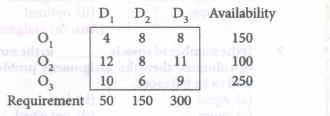
Determine an initial basic feasible solution to the following transportation problem using feast cost method.
13.
If \(\int _{ 0 }^{ 1 }{ \left( { 3x }^{ 2 }+2x+k \right) } dx=0\), find k.
14.
If f'(x) = 8x3 -2x2, f(2) = 1, find f(x)
15.
Form the differential equation of family of rectangular hyperbolas whose asymptotes are the Co-ordinate axes.
16.
Find the differential equation for y = mx + \(\frac { a }{ m } \) where m is arbitrary constant.
17.
If f(0) = 5, f(1) = 6, f(3) = 50, find f(2) by using Lagrange's formula.
18.
Find the missing term from the following data.
| x | 20 | 30 | 40 |
| y | 51 | - | 34 |
19.
Find the consumer's surplus for the demand function p = 25 - x -x2 when Po = 19
20.
The marginal cost function is MC = \(\frac{100}{x}\). Find the cost function C(x) if C(16) = 100.
21.
If A and B are non-singular matrices, prove that AB is non-singular.
22.
Find the rank of the matrix \(\left( \begin{matrix} 2 & -4 \\ -1 & 2 \end{matrix} \right) \)
23.
Find the rank of each of the following matrices.
\(\left( \begin{matrix} 1 & -1 \\ 3 & -6 \end{matrix} \right) \)
24.
Evaluate \({ \Delta }^{ 2 }\left( \frac { 1 }{ x } \right) \) by taking ‘1’ as the interval of differencing.
25.
Find (i) Δeax
(ii) Δ2ex
(iii) Δ log x
26.
What is the difference between Assignment Problem and Transportation Problem?
27.
What is transportation problem?
28.
Solve \(\frac { { d }^{ 2 }y }{ d{ x }^{ 2 } } -4\frac { dy }{ dx } +5y\) = 0
29.
State the test of adequacy of index number.
30.
What is the need for studying time series?
31.
What is single tailed test.
32.
Define critical value.
33.
Mention the properties of poisson distribution.
34.
Write the conditions for which the poisson distribution is a limiting case of binomial distribution.
35.
Explain the distribution function of a random variable.
36.
Construct cumulative distribution function for the given probability distribution.
| X | 0 | 1 | 2 | 3 |
| P(X = x) | 0.3 | 0.2 | 0.4 | 0.1 |
37.
Using Integration, find the area of the region bounded the line 2y + x = 8, the x axis and the lines x = 2, x = 4.
38.
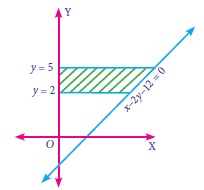
Find the area of the region bounded by the line x − 2y − 12 = 0 , the y-axis and the lines y = 2, y = 5.
39.
Evaluate \(\int { x } \sqrt { { x }^{ 2 }+1 } \ dx\)
40.
Evaluate \(\int { \frac { x }{ \sqrt { { x }^{ 2 }+1 } } dx } \)
1.
Separating the variables, we get,
\(\frac { dy }{ x } \)= sin 2x dx
Integrating both sides we get,
\(\int { \frac { dy }{ y } } =\int { \sin 2x } \)
⇒ log y = \(\frac { -\cos 2x }{ 1 }\)+c
2.
Let A= \(\left( \begin{matrix} 5 & 3 & 0 \\ 1 & 2 & -4 \\ -2 & -4 & 8 \end{matrix} \right) \)
Order of A is 3 \(\times\) 3.
∴\(\rho \)(A)\(\le \)3
Consider the third order minor \(\left| \begin{matrix} 5 & 3 & 0 \\ 1 & 2 & -4 \\ -2 & -4 & 8 \end{matrix} \right| =0\)
Since the third order minor vanishes, therefore \(\rho (A)\neq 3\)
Consider a second order minor \(\left| \begin{matrix} 5 & 3 \\ 1 & 2 \end{matrix} \right| =7\neq 0\)
There is a minor of order 2, which is not zero.
\(\therefore \rho (A)=2\)
3.
| Year | I quarter | II quarter | III quarter | IV quarter |
| 1985 | 68 | 62 | 61 | 63 |
| 1986 | 65 | 58 | 66 | 61 |
| 1987 | 68 | 63 | 63 | 67 |
| Total | 201 | 183 | 190 | 191 |
| Average | 67 | 61 | 63.33 | 63.67 |
Grand average = \(\frac{67 + 61 + 63.33 + 63.37}{4}\)
= \(\frac{255}{4}=63.75\)
Seasonal index (S.I) = \(\frac{Quarterly average}{Grand average}\times100\)
Hence, S.I for I quarter = \(\frac{67}{63.75}\times100\) = 105.01
S.I for II quarter = \(\frac{61}{63.75}\times100\) = 95.68
S.I for III quarter = \(\frac{63.33}{63.75}\times100\) = 99.35
S.I for IV quarter = \(\frac{63.67}{63.75}\times100\) = 99.87
4.
Let the straight line of best fit be y = ax + b.
The normal equations are
Σy = a Σx + nb
Σxy = a Σx2 + bΣx
⇒ 10a + 7b = 16.9 ....(1)
30a + 10b = 47.4.... (2)
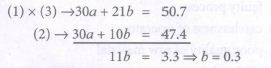
Substituting b = 0.3 in (2) we get
30a + 3 = 47.4 ⇒ 30a = 44.4
\(a=\frac{44.4}{30}=1.48\)
∴ The straight line trend is y = 1.48x + 0.3
5.
Given sample size n = 400
Sample mean \(\bar { x } \) = 171.38
Population mean μ = 171.17
Population Standard deviation σ = 3.3
Null hypotheses: H0 : μ = 171.17
Alternative hypotheses: H1 : μ ≠ 171.17
The test statistic, z = \(\frac { \bar { x } -\mu }{ \frac { \sigma }{ \sqrt { n } } } =\frac { 171.38-171.17 }{ \frac { 3.3 }{ \sqrt { 400 } } } \)
=\(\frac { 0.21 }{ 0.165 } \) = 1.273
As the level of significance is α = 0.005, \(Z_{ \frac { \alpha }{ 2 } }\) = 1.96
Here z < \(Z_{ \frac { \alpha }{ 2 } }\) as 1.273 < 1.96
Inference: since z < \(Z_{ \frac { \alpha }{ 2 } }\), we accept the null hypotheses at 5% level of significance.
Hence, we can conclude that the sample of 400 has taken from the population with mean height of 171.17 cm.
6.
Given population size N = 1500
Sample size n = 150
Sample proportion p =\(\frac { 10 }{ 150 } \)=0.07
∴ q = 1 - P = 1 - 0.07 = 0.93
Standard error of sample proportion =\(\sqrt { \frac { pq }{ n } } \)
=\(\sqrt { \frac { (0.07)(0.93) }{ 150 } } \)
S.E(p) = 0.02
7.
Given mean μ = 60 and S.D. σ = 5
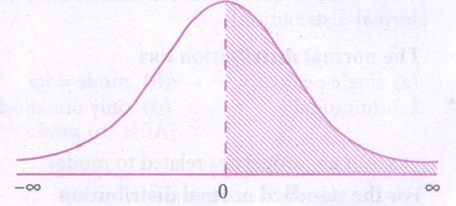
To find P(X > 60)
When X = 60, Z =\(\frac { X-\mu }{ \sigma } =\frac { 60-60 }{ 5 } \) = 0
∴ P(X > 60) = P(Z > 0) = P (0 < Z < ∞)
= 0.5
∴ 50% of students scored more than 60 marks
8.
Given n = 9 and mean = 6 ⇒ np = 6
9p = 6 ⇒ \(\frac { 6 }{ 9 } =\frac { 2 }{ 3 } \)
∴ q=1-p = \(1-\frac { 2 }{ 3 } =\frac { 1 }{ 3 } \)
Variance = npq = \(9\times \frac { 2 }{ 3 } \times \frac { 1 }{ 3 } \) = 2
9.
Mean = E(X)=\(\int _{ -\infty }^{ \infty }{ x.f(x)dx=\int _{ -12 }^{ 12 }{ x.\left( \frac { 1 }{ 24 } \right) } dx } \)
\(=\frac { 1 }{ 24 } \int _{ -12 }^{ 12 }{ x.dx } \)
\(=0[\because \int _{ -a }^{ a }{ f(x)dx=0 } when\ f(x)\ is\ an\ odd\ function]\)
\(\therefore E(X)=0\)
10.
Since the random variable. X is the probability mass function, Σpi = 1
\(\Rightarrow \frac { k }{ 6 } +\frac { k }{ 4 } +\frac { k }{ 12 } =1\Rightarrow \frac { 2k+3k+k }{ 12 } =1\)
\(\Rightarrow \frac { 6k }{ 12 } =1\Rightarrow k=\frac { 12 }{ 6 } =2\quad \therefore k=2\)
11.
| Alternative | Economy | Maximum | ||
| Growing | Stable | Declining | ||
| Bonds | 40 | 45 | 5 | 45 |
| Stocks | 70 | 30 | -13 | 70 |
| Mutual Funds | 53 | 45 | -5 | 53 |
Min (45, 70, 53) = 45
∴ Choosing Bonds is the best decision under minimax principle.
12.
Here total availability = 150 + 100 + 250 = 500
total requirement = 50 + 150 + 300 = 500
∴ Total availability = total requirement
∴ The given problem is a balanced transportation problem
Hence, there exists a feasible solution to the given problem
I - allocation:
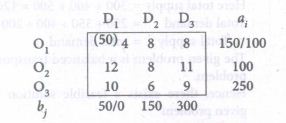
[∵ least cost is 4 & min (50,150) = 50]
II - allocation:
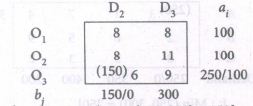
[∵ least cost is 6 & min (150, 250) = 150]
III - allocation:
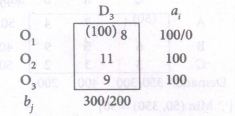
[∵ least cost is 8 & min (300, 100) = 100]
IV - allocation:
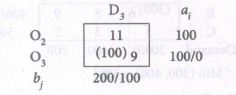
[∵ least cost is 9 & min (200,100) = 100]
V - allocation:
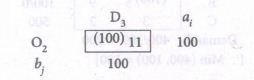
[∵ min (100, 100) = 100]
Thus, the allocations are
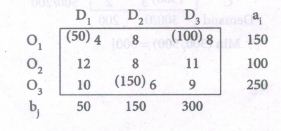
∴ The transportation schedule is
O1 → D1, O1 → D3, O2 → D3, O3 → D2, O3 → D3
Hence, the total transportation cost is
= 50(4) + 100(8) + 100(11) + 150(6) + 100(9)
= 200 + 800 + 1100 + 900 + 900
= Rs. 3900
13.
Given
⇒ \(\int _{ 0 }^{ 1 }{ \left( { 3x }^{ 2 }+2x+k \right) } dx=0\)
⇒ \({ \left[ \frac { { 3x }^{ 3 } }{ 3 } +\frac { { 2x }^{ 2 } }{ 2 } +kx \right] }_{ 0 }^{ 1 }=0\)
⇒ \(\therefore { \left[ { x }^{ 3 }+{ x }^{ 2 }+kx \right] }_{ 0 }^{ 1 }=0\)
⇒ [1 + 1 + k(1)] - (0) = 0
⇒ 2 + k = 0
⇒ k = -2
14.
Given f'(x) = 8x3 -2x2
∴ ∫ f'(x) dx = ∫ (8x3 - 2x2) dx
⇒ f(x) = \(\frac { { 8x }^{ 4 } }{ 4 } -\frac { { { 2x }^{ 3 } } }{ 3 } +c\)
⇒ f (x) = 2x4 - \(\frac { { { 2x }^{ 3 } } }{ 3 } +c\) ...(1)
Also, f(2) = 1
⇒ 1 = 2(24) - \(\frac { { 2\left( { { 2 }^{ 3 } } \right) } }{ 3 } +c\)
⇒ 1 = 32 - \(\frac { { 16 } }{ 3 } +c\)
⇒ 1 - 32 + \(\frac { { 16 } }{ 3 } \) = c ⇒ -31 + \(\frac { { 16 } }{ 3 } \) =c
⇒ \(\frac { { -93+16 } }{ 3 } =c\)
⇒ c = \(\frac { { -77 } }{ 3 } \)
∴ (1) ⟶ f(x) = 2x4 - \(\frac { { 2x }^{ 3 } }{ 3 } -\frac { { -77 } }{ 3 } \)
15.
Equation of family of rectangular hyperbolas whose asymptotes are the Co-ordinate axis is
xy - c2
Differentiating w.r.t. 'x' we get,
x.\(\frac { dy }{ dx } \)+y(1) = 0
⇒ x\(\left( \frac { dy }{ dx } \right) \)+y(1) = 0 which is the required differential equation.
16.
Given y = mx + \(\frac { a }{ m } \) ...(1)
Differentiating w.r.t. 'x' we get,
\(\frac { dy }{ dx } \) = m(1)+0 ⇒ m = \(\frac { dy }{ dx } \) ...(2)
Substituting (2) in (1) we get,
y = \(\left( \frac { dy }{ dx } \right) x+\frac { a }{ \frac { dy }{ dx } } \Rightarrow y=\frac { \left( \frac { dy }{ dx } \right) ^{ 2 }x+a }{ \left( \frac { dy }{ dx } \right) } \)
⇒ y\(\left( \frac { dy }{ dx } \right) =x\left( \frac { dy }{ dx } \right) ^{ 2 }\)+ a which is the required differential equation.
17.
By data we have,
x0 = 0, x1 = 1, x2 = 3
y0 = 5, y1 = 6, y2 = 50 and x = 2
Using Lagrange's formula, we get
\(y=\frac { (x-{ x }_{ 1 })(x-{ x }_{ 2 }) }{ ({ x }_{ 0 }-{ x }_{ 1 })({ x }_{ 0 }-{ x }_{ 2 }) } { y }_{ 0 }+\frac { (x-{ x }_{ 1 })(x-{ x }_{ 2 }) }{ ({ x }_{ 0 }-{ x }_{ 1 })({ x }_{ 0 }-{ x }_{ 2 }) } { y }_{ 1 }+\frac { (x-{ x }_{ 0 })(x-{ x }_{ 1 }) }{ ({ x }_{ 2 }-{ x }_{ 0 })({ x }_{ 0 }-{ x }_{ 1 }) } { y }_{ 2 }\)
= \(5\times \frac { (2-0)(2-3) }{ (0-1)(0-3) } +6\times \frac { (2-0)(2-3) }{ (1-0)(1-3) } +50\times \frac { (2-0)(2-1) }{ (3-0)(3-1) } \)
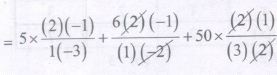
= \(\frac { 10 }{ 3 } -6+\frac { 50 }{ 3 } =\frac { 60 }{ 3 } -6=20-6=14\)
∴ f(2) = 14
18.
Since only two values of yare given, the polynomial which fits the data is of degree 1.
Hence 2nd differences are zeros
∴ Δ2(y0) = 0
⇒ (E-1)2yo=0
⇒(E2 - 2E + 1) yo = 0
⇒y2 - 2y1 +yo = 0
⇒34 - 2y1 + 51 = 0
⇒85 - 2y1 =0
⇒2y1 + 85 ⇒ y1 = \(\frac{85}{2}\)
⇒y1 = 42.5
19.
Given demand function is p = 25 - x - X2
and p0 = 19
⇒ 19 = 25-x-x2
⇒ x2 + x - 6 = 0
⇒ (x + 3) (x - 2) = 0
⇒ x = -3 or x = 2
Since x cannot be negative xo = 2
po xo = 19(2) = 38
\(CS=\int _{ 0 }^{ 2 }{ f(x)dx-{ p }_{ 0 }{ x }_{ 0 } } \)
\(=\int _{ 0 }^{ 2 }{ \left( 25-x-{ x }^{ 2 } \right) dx-38 } \)
\(={ \left( 25x-\frac { { x }^{ 2 } }{ 2 } -\frac { { x }^{ 3 } }{ 3 } \right) }_{ 0 }^{ 2 }-38\)
\(=25(2)-\frac { 4 }{ 2 } -\frac { 8 }{ 3 } -38\)
\(=50-2-\frac { 8 }{ 3 } -38\)
\(=10-\frac { 8 }{ 3 } =\frac { 30-8 }{ 3 } \)
\(CS=\frac { 22 }{ 3 } \) units
20.
Given \(MC=\frac { 100 }{ x } \)
\(\\ \int { MC } =\int { \frac { 100 }{ x } } \)
⇒ C = 100 log x + k
Given C(16) =100 ⇒ When x = 16,
C = 100
∴ 100 = 100 log 16 + k
⇒ k = 100-100 log 16
C = 100 log x + 100 - 100 log 16
= 100 (log x - log16 + 1)
\(C=100(log\left( \frac { x }{ 16 } \right) +1)\)
21.
Since A and B are non-singular,
|A| \(\neq \) 0, |B|\(\neq \) 0
Consider |AB| |A|·|B|
\(\neq \) 0 since |A|\(\neq \) 0 and |B|\(\neq \) 0.=? |AB| \(\neq \) 0
\(\therefore\) AB is non-singular.
22.
Let A = \(\left( \begin{matrix} 2 & -4 \\ -1 & 2 \end{matrix} \right) \)
The order of A is 2 \(\times\) 2
\(\rho (A)\le min(2,2)\)
\(\Rightarrow \rho (A)\le 2\)
\(\left| \begin{matrix} 2 & -4 \\ -1 & 2 \end{matrix} \right| =4-4=0\)
Since the second order minor vanishes \(\rho (A)\neq 2\)
We have to try for atleast one non-zero first order minor.
ie. atleast one non-zero element of A.
This is possible because A has non-zero element
\(\therefore \rho (A)-1\)
23.
Let \(A=\left( \begin{matrix} i & -1 \\ 3 & -6 \end{matrix} \right) \)
Order of A is 2 \(\times\) 2
\(\therefore \rho (A)\le 2\) [Since minimum of (2, 2) is 2]
Consider the second order minor
\(\left| \begin{matrix} 1 & -1 \\ 3 & -6 \end{matrix} \right| =-6-(-3)\)
= -6 + 3 = -3
\(\neq 0\)
There is a minor of order 2, which is not zero
\(\therefore \rho (A)=2\)
24.
\({ \Delta }^{ 2 }\left( \frac { 1 }{ x } \right) =\Delta \left( \Delta \left( \frac { 1 }{ x } \right) \right) \)
Now \(\Delta \left[ \frac { 1 }{ x } \right] =\frac { 1 }{ 1+x } -\frac { 1 }{ x } \)
\({ \Delta }^{ 2 }\left( \frac { 1 }{ x } \right) ={ \Delta }\left( \frac { 1 }{ 1+x } -\frac { 1 }{ x } \right) \)
\(=\Delta \left( \frac { 1 }{ 1+x } \right) -\Delta \left( \frac { 1 }{ x } \right) \)
Similarly \({ \Delta }^{ 2 }\left( \frac { 1 }{ x } \right) =\frac { 2 }{ x(x+1)(x+2) } \)
25.
(i) Δeax = ea(x+h)−ex
= eaX.eh-eax [∵ am+n = am.an]
= eax[eh-1]
(ii) Δ2ex = Δ.[Δex]
= Δ[ex+h - ex]
= Δ[exeh - ex]
= Δex [eh - 1]
= (eh - 1)Δex
= (eh−1).(eh−1).ex
= (eh−1)2.ex
(iii) Δ log x = log(x+h) − log x
= log \(\frac{x + h}{x}\)
= log \(\left( \frac { x }{ x } +\frac { h }{ x } \right) \)
= log \(\left( 1+\frac { h }{ x } \right) \)
26.
The assignment problem is a special case of transportation problem where the number of sources and destinations are equal. Here, jobs represent sources and machines represent destinations.
27.
A transportation problem is to determine the amount to be transported from each origin to each destinations such that the total transportation cost is minimized.
28.
Given \(\frac { { d }^{ 2 }y }{ d{ x }^{ 2 } } -4\frac { dy }{ dx } +5y\) = 0
(D2−4D+5)y = 0
The auxiliary equation is m2−4m + 5 = 0
⇒ (m−2)2−4 + 5 = 0
(m− 2)2 = –1
m - 2 = 土\(\sqrt{-1}\)
m = 2 土 i , it is if the form α 土 iβ
∴ C.F = e2x[A cos x + B sin x]
The general solution is y = e2x[A cos x + B sin x]
29.
Index numbers are studied to know the relative changes in price and quantity for any two years compared. There are two tests which are used to test the adequacy for an index number. The two tests are as follows.
(i) Time reversal test
(ii) Factor reversal test
The criterion for a good index number is to satisfy the above two tests.
30.
(i) It helps in the analysis of the past behavior
(i) It helps in forecasting and for future plans
(ii) It helps in the evaluation of current achievements
(iv) It helps in making comparative studies between one time period and others
31.
When the hypothesis about the population parameter is rejected only for the value of sample statistic falling into one of the tails of the sampling distribution, then it is known as one tailed test.
32.
The value of test statistic which separates the critical (or rejection) region and the acceptance region is called the critical value or significant value.
33.
Poisson distribution is the only distribution in which the mean and variance are equal.
34.
Poisson distribution is a limiting case of binomial distribution under the following conditions.
(i) n, the number of trials is indefinitely large ie., n⟶∞.
(ii) p, the constant probability of success in each trial is very small ie., p ⟶0.
(iii) np = λ is finite.Thus p = λ/n and q = 1 -(λ/n) where λ is a positive real number.
35.
The discrete cumulative distribution function or distribution function of a real valued discrete random variable X takes the countable number of points x1,x2, .... with corresponding probabilities p(x1)p(x2).... and the distribution function is defined by
Fx(x) = P(X≤x) for all x∈R
ie.Fx(x) = \(\sum _{ { x }_{ i }\le x }^{ }{ p({ x }_{ i }) } \)
For a continuous random variable with the probability density function fx(x) then the distribution function Fx(x) is defined by
Fx(x) = P(X≤x)
36.
We know Fx (x) = P(X ≤ x) for all x ∈ R
∴ F(0) = P(X ≤ 0) = P(0) = 0.3
F(1) = P(X ≤ 1) = P(0)+P(l)
= 0.3 + 0.2 = 0.5
F(2) = P(X ≤ 2) = P(0) + P(1) + P(2)
= 0.3 + 0.2 + 0.4 = 0.9
F(3) = P(X ≤ 3) = P(0) + P(1) + P(2) + P(3)
= 0.3 + 0.2 + 0.4 + 0.1 = 1
∴ Cumulative distribution function for the given probability distribution is 1
37.
2y + x = 8
| x | 0 | 8 |
| y | 4 | 0 |
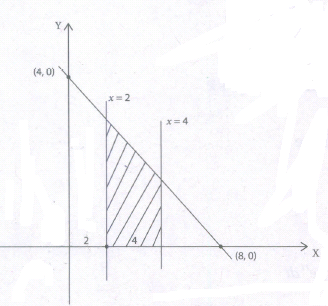
Given 2y + x = 8
2y = 8-x
y = \(\frac{1}{2}\) (8-x)
Given limits are x = 2 and x = 4
Area of the shaded region between the given limits
\(A=\int _{ a }^{ b }{ y\quad dx } =\int _{ 2 }^{ 4 }{ \frac { 1 }{ 2 } (8-x)dx } \)
\(\frac { 1 }{ 2 } \int _{ 2 }^{ 4 }{ (8-x)dx } =\frac { 1 }{ 2 } { \left[ 8x-\frac { { x }^{ 2 } }{ x } \right] }_{ 2 }^{ 4 }\)
\(=\frac { 1 }{ 2 } \left[ \left( 8(4)-\frac { { 4 }^{ 2 } }{ 2 } \right) \left( 8(2)-\frac { { 2 }^{ 2 } }{ 2 } \right) \right] \)
\(=\frac { 1 }{ 2 } [(32-8)-(16-21)]\)
\(=\frac { 1 }{ 2 } [24-14]\)
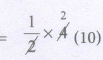
A = 5 sq. units.
38.
x - 2y - 12 = 0
x = 2y + 12
Required Area
= \(\int _{ 2 }^{ 5 }{ xdy } \)
= \(\int _{ 2 }^{ 5 }{ (2y+12)dy= } [{ { y }^{ 2 }+12y] }_{ 2 }^{ 5 }\)
= (25 + 60)−(4 + 24) = 57 sq.units
39.
\(\int { x } \sqrt { { x }^{ 2 }+1 }\ dx=\frac { 1 }{ 2 } \int { { \left( { x }^{ 2 }+1 \right) }^{ \frac { 1 }{ 2 } } } \left( 2x \right) dx\)
\(=\frac { 1 }{ 2 } \int { [f(x){ ] }^{ \frac { 1 }{ 2 } }f'(x)dx } \)
\(=\frac { 1 }{ 2 } \frac { [f(x){ ] }^{ \frac { 3 }{ 2 } } }{ \frac { 3 }{ 2 } } +c\)
\(=\frac { 1 }{ 3 } ({ x }^{ 2 }+1{ ) }^{ \frac { 3 }{ 2 } }+c\)
[ Take f (x) = x2 +1
\(\therefore \) f '(x) = 2x ]
40.
\(\int { \frac { x }{ \sqrt { { x }^{ 2 }+1 } } dx } =\frac { 1 }{ 2 } \int { \frac { x }{ \sqrt { { x }^{ 2 }+1 } } } dx\)
\(=\frac { 1 }{ 2 } \int { \frac { f'\left( x \right) }{ \sqrt { f\left( x \right) } } dx } \)
\(=\frac { 1 }{ 2 } [2\sqrt { f(x) } ]+c\)
\(=\sqrt { { x }^{ 2 }+1+ } c\)
[ Take f (x) = x2 +1
\(\therefore \) f '(x) = 2x ]

12th Standard Syllabus & Materials
12th Standard
TN 12th Computer Applications களப்பெயர் முறைமை (DNS) Sample Question Papers Study Material - QB365 Set A
NEW12th Standard
TN 12th Computer Applications வலையமைப்பு எடுத்துக்காட்டுகள் மற்றும் நெறிமுறைகள் Sample Question Papers Study Material - QB365 Set A
NEW12th Standard
TN 12th Computer Applications கணினி வலையமைப்பு ஓர் அறிமுகம் Sample Question Papers Study Material - QB365 Set A
NEW12th Standard
TN 12th Computer Applications PHP-உடன் MySQL-ஐ இணைத்தல் Sample Question Papers Study Material - QB365 Set A



Tamilnadu Stateboard 12th Standard Subjects

Maths

Chemistry

Physics

Biology

Computer Science
Business Maths and Statistics

Economics

Commerce

Accountancy

History

Computer Applications
Biology
Computer Technology
Computer Applications
Computer Science
Business Maths and Statistics
Commerce
Economics
Maths
Chemistry
Physics
Computer Technology
History
Accountancy

Tamil

English

French
Tamilnadu Stateboard Standards
