
 100% FREE ACCESS
12th Standard Syllabus & Materials
12th Standard
TN 12th Maths Applications of Matrices and Determinants Sample Question Papers Study Material - QB365 Set A
NEW12th Standard
TN 12th Computer Applications மின்னணு தரவு பரிமாற்றம் Sample Question Papers Study Material - QB365 Set A
NEW12th Standard
TN 12th Computer Applications மின் - வணிக பாதுகாப்பு அமைப்புகள் Sample Question Papers Study Material - QB365 Set A
NEW12th Standard
TN 12th Computer Applications மின்னணு செலுத்தல் முறைகள் Sample Question Papers Study Material - QB365 Set A
NEW12th Standard
TN 12th Computer Applications மின் - வணிகம் Sample Question Papers Study Material - QB365 Set A
NEW12th Standard
TN 12th Computer Applications திறந்த மூல கருத்துருக்கள் Sample Question Papers Study Material - QB365 Set A

Published on: 05/08/2019
Numerical Methods
Download Tamil Nadu 12th Standard Business Maths and Statistics question papers, model tests, one-mark questions, important questions, and public exam papers in PDF format. Free study materials and answer keys for TN State Board students.
Questions + Answers key
Take MCQ Business Maths and Statistics Test
1.
If y75 = 2459, y50 = 2018, y85 = 1180, and y90 =402, find y82
| x | 75 | 80 | 85 | 90 |
| y | 2459 | 2018 | 1180 | 402 |
2.
Find y when x = 0.2 given that
| x | 0 | 1 | 2 | 3 | 4 |
| y | 176 | 185 | 194 | 202 | 212 |
3.
If h = 1 then prove that (E−1Δ)x3 = 3x2 − 3x + 1.
4.
5.
Evaluate ∆(log ax).
6.
Given U0 = 1, U1 = 11, U2 = 21, U3 = 28 and U4 = 29 find Δ4U0
7.
Construct a forward difference table for y = f(x) = x3+2x+1 for x = 1,2,3,4,5
8.
Using Lagrange's formula find the value of y when x = 4 from the following table.
| x | 0 | 3 | 5 | 6 | 8 |
| y | 276 | 460 | 414 | 343 | 110 |
9.
From the following table, estimate the premium for a policy maturing at the age of 58.
| Age (x) | 40 | 45 | 50 | 55 | 60 |
| Premium (y) | 114.84 | 96.16 | 83.32 | 74.48 | 68.48 |
10.
Evaluate \(\Delta \)\(\left[ \frac { 5x+12 }{ { x }^{ 2 }+5x+6 } \right] \) by taking ‘1’ as the interval of differencing.
11.
The values of y = f(x) for x = 0,1,2, ...,6 are given by
| x | 0 | 1 | 2 | 3 | 4 | 5 | 6 |
| y | 2 | 4 | 10 | 16 | 20 | 24 | 38 |
Estimate the value of y (3.2) using forward interpolation formula by choosing the four values that will give the best approximation.
12.
(1 + Δ) (1 - ∇) is ______________
0
1
-1
(1 - ∇ . Δ)
13.
E-nf(x) is ______________
F(x + nh)
F(x - nh)
F(-nh)
f(x - n)
14.
Δ[f{x) . g(x)] = __________
Δf(x). Δg(x)
f(x) . Δg(x) + g(x) .Δf(x)
f(x) . Δg(x)
f(Δx) . g(Δx)
15.
If c is a constant, then Δc.f(x) ______________
0
c.f(Δx)
c.Δf(x)
f(Δcx)
16.
E2.f(x) = ______________
f(x + h)
f(x + 2h)
f(2h)
f(2x)
17.
If f (x)=x2 + 2x + 2 and the interval of differencing is unity then Δf (x) _______.
2x −3
2x +3
x + 3
x − 3
18.
Lagrange’s interpolation formula can be used for _______.
equal intervals only
unequal intervals only
both equal and unequal intervals
none of these.
19.
∇ f(a) = _______.
f (a) + f(a−h)
f (a) − f(a + h)
f (a) − f(a − h)
f (a)
20.
If m and n are positive integers then ΔmΔnf(x) = _______.
Δm+nf (x)
Δmf(x)
Δnf (x)
Δm-nf (x)
21.
Δf(x) = _______.
f(x+ h)
f(x) − f(x+h)
f(x + h) − f(x)
f (x) − f(x−h)
22.
Find the second order backward differences of f(x).
23.
If f(0) = 5, f(1) = 6, f(3) = 50, find f(2) by using Lagrange's formula.
1.
Since 82 lies at the beginning of the table, we can use Newton's forward interpolation formula
\(\Rightarrow { y }_{ o }+\frac { n }{ n! } \triangle { y }_{ o }+\frac { n(n+1) }{ 2! } { \triangle }^{ 2 }{ y }_{ o }+\frac { n(n+1)(n-2) }{ 3! } { \triangle }^{ 3 }{ (y }_{ o })\)
Also x0 + nh = 82 ⇒ 75 + n(5) = 82 ⇒ 5n = 82 - 75 = 7
⇒ n = \(\frac75\) = 1.4
The difference table is
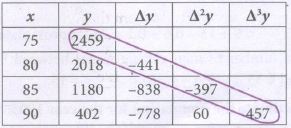
\(y=2459+\frac { 1.4 }{ 1! } (-441)+\frac { (1.4)(1.4-1) }{ 2! } (-397)+\frac { (1.4)(1.4-1)(1.4-2) }{ 3! } (457)\)
= 2459 - 617.4 - 111.6 - 25.592
y = 1704. 408 when x = 82.
2.
Since x = 0.2 lies at the beginning of the table, use Newton's foward interpolation formula
\(\Rightarrow { y }_{ o }+\frac { n }{ n! } \triangle { y }_{ o }+\frac { n(n+1) }{ 2! } { \triangle }^{ 2 }{ y }_{ o }+\frac { n(n+1)(n-2) }{ 3! } { \triangle }^{ 3 }{ (y }_{ o })\)
Here h = 1, xo = 0, x = 0.2
⇒ x0 + nh = 0.2 ⇒ 0 + n(1) = 0.2 ⇒ n = 0.2
The forward difference table is
| x | y | Δy | ∆2y | Δ3y | Δ4y |
| 0 | 176 | ||||
| 1 | 185 | 9 | |||
| 2 | 194 | 9 | 0 | ||
| 3 | 202 | 8 | -1 | -1 | |
| 4 | 212 | 10 | 2 | 3 | 4 |
∴ y = 176 +\(\frac { 0.2 }{ 1! } (9)+\frac { (0.2)(0.2-1) }{ 2! } (0)+\frac { (0.2)(0.2-1)(0.2-2) }{ 3! } (-1)+\frac { (0.2)(0.2-1)(0.2-2)(0.3-3) }{ 4! } (4)\)
= 176 + 1.8 - 0.048 - 0.1344 = 177.6176
ஃ Hence when x = 0.2, y = 177.6176.
3.
Given h = 1
LHS = (E−1Δ) x3
= Δ(E-1(x3))
= Δ(x - h)3 [∵ E-1f(x) = f(x - nh)]
= Δ(1 - h)3 [∵ h = 1]
= (x - 1+ 1)3 - (x - 1)3 [∵ Δf(x) =f(x + h) - f(x)]
= x3 - (x - 1)3
= x3 - (x3 - 3x2 + 3x - 1)
[∵ (a - b)3 = a3 - 3a2b + 3ab2 - b3]
= x3 - x3 + 3x2 - 3x + 1
= 3x2 - 3x + 1
= RHS
Hence proved
4.
5.
Δ(log ax) = log (ax + h) -log (ax)
= log\(\left( \frac { ax+h }{ ax } \right) \)
=log \(\left( \frac { ax }{ ax } +\frac { h }{ ax } \right) \)
= log \(\left( 1+\frac { h }{ ax } \right) \)
∴ ∆ (log ax) = log \(\left( 1+\frac { h }{ ax } \right) \)
6.
Δ2U0 = (E-1)4U0
= (E4 − 4E3+ 6E2− 4E+1)U0
= E4U0 - 4E3U0 + 6E2U0− 4EU0+ U0
= U4 − 4U3 + 6U2 − 4U1 + U0
= 29 − 4(28) + 6(21) − 4(11) + 1.
= 156 – 156 = 0
7.
y = f(x) = x3+2x+1 for x = 1,2,3,4,5
| x | y | Δy | Δ2y | Δ3y | Δ4y |
|---|---|---|---|---|---|
| 1 | 4 | ||||
| 9 | |||||
| 2 | 13 | 12 | |||
| 21 | 6 | ||||
| 3 | 34 | 18 | 0 | ||
| 39 | 6 | ||||
| 4 | 73 | 24 | |||
| 63 | |||||
| 5 | 136 | ||||
8.
Given xo = 0, x1 = 3, x2 = 5, x3 = 6, x4 = 8
yo = 276, y1 = 460, y2 = 414, y3 = 343, y4 = 110
Lagrange's formula is
y = \(\frac { (x-{ x }_{ 1 })(x-{ x }_{ 2 })(x-{ x }_{ 3 })(x-{ x }_{ 4 }) }{ ({ x }_{ 0 }-{ x }_{ 1 })({ x }_{ 0 }-{ x }_{ 2 })({ x }_{ 0 }-{ x }_{ 3 })({ x }_{ 0 }-{ x }_{ 4 }) } { y }_{ 0 }+\frac { (x-{ x }_{ 0 })(x-{ x }_{ 2 })(x-{ x }_{ 3 })(x-{ x }_{ 4 }) }{ ({ x }_{ 1 }-{ x }_{ 0 })({ x }_{ 1 }-{ x }_{ 2 })({ x }_{ 1 }-{ x }_{ 3 })({ x }_{ 1 }-{ x }_{ 4 }) } { y }_{ 1 }+\frac { (x-{ x }_{ 0 })(x-{ x }_{ 1 })(x-{ x }_{ 3 })(x-{ x }_{ 4 }) }{ ({ x }_{ 2 }-{ x }_{ 0 })({ x }_{ 2 }-{ x }_{ 1 })({ x }_{ 2 }-{ x }_{ 3 })({ x }_{ 2 }-{ x }_{ 4 }) } { y }_{ 2 }+\frac { (x-{ x }_{ 0 })(x-{ x }_{ 1 })(x-{ x }_{ 3 })(x-{ x }_{ 4 }) }{ ({ x }_{ 3 }-{ x }_{ 0 })({ x }_{ 3 }-{ x }_{ 1 })({ x }_{ 3 }-{ x }_{ 2 })({ x }_{ 3 }-{ x }_{ 4 }) } { y }_{ 3 }+\frac { (x-{ x }_{ 0 })(x-{ x }_{ 2 })(x-{ x }_{ 3 })(x-{ x }_{ 4 }) }{ ({ x }_{ 4 }-{ x }_{ 0 })({ x }_{ 4 }-{ x }_{ 2 })({ x }_{ 4 }-{ x }_{ 3 })({ x }_{ 4 }-{ x }_{ 4 }) } { y }_{ 4 }\)
⇒ 276 \(\frac { (1)(-1)(-2)(-4) }{ (-3)(-5)(-6)(-8) } +460\frac { (4)(-1)(-2)(-4) }{ (3)(-2)(-3)(-5) } +414\frac { (4)(1)(-1)(-4) }{ (5)(2)(-1)(-3) } +343\frac { (4)(1)(-1)(-2) }{ (6)(3)(1)(-2) } +110\frac { (4)(1)(-1)(-2) }{ (8)(5)(3)(2) } \)
⇒ y = -3.066 + 163.555 + 441.6 - 152.44 + 3.666
⇒ y = 453.311.
9.
Using Newton's backward interpolation formula,
we can find y when x = 58.
∴ x + nh = x ⇒ 60 + n(5) = 58
⇒ 5n = 58 - 60 = -2
⇒ n = \(\frac{-2}{5}\)= -0.4
and y(58) = \({ y }_{ n }+\frac { n }{ n! } \nabla { y }_{ n }+\frac { n(n+1) }{ 2! } { \nabla }^{ 2 }{ y }_{ n }+\frac { n(n+1)(n-2) }{ 3! } { \nabla }^{ 3 }{ (y }_{ n })+\) .....
The difference table is
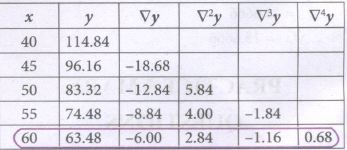
\(y(58)=68.48+\frac { (-0.4) }{ 1! } (-6)+\frac { (0.4)(-0.4+1) }{ 2! } (2.84)+\frac { (-0.4)(-0.4+1)(-0.4+2) }{ 3! } (-1.16)+\frac { (-0.4)(-0.4+2)(-0.4+2)(-0.4+3) }{ 3! } (0.68)\)
=68.48 + (0.4)(6) + \(\frac { (-0.4)(0.6) }{ 2 } (2.84)+\frac { (-0.4)(0.6)(1.6) }{ 6 } (-1.16)+\frac { (-0.4)(0.6)(1.6)(2.6) }{ 24 } (0.68)\)
= 68.48 + 2.4 - 0.3408 + 0.07424 - 0.028288
= 70.5851052
⇒ y(58) = 70.59
∴ Hence, premium for a policy maluting at the age of 58 is 70.59.
10.
\(\Delta \)\(\left[ \frac { 5x+12 }{ { x }^{ 2 }+5x+6 } \right] \)
By Partial fraction method
\(\frac { 5x+12 }{ { x }^{ 2 }+5x+6 } =\frac { A }{ x+3 } +\frac { B }{ x+2 } \)
\(A=\frac { 5x+12 }{ x+12 } [x=-3]=\frac { -15+12 }{ -1 } =\frac { -3 }{ -1 } =-3\)
\(B=\frac { 5x+12 }{ x+3 } \)[x = -2] \(=\frac { 2 }{ 1 } =2\)
\(\frac { 5x+12 }{ { x }^{ 2 }+5x+6 } = \left[ \frac { 3 }{ x+3 } +\frac { 2 }{ x+2 } \right] \)
\(\Delta \frac { 5x+12 }{ { x }^{ 2 }+5x+6 } =\Delta \left[ \frac { 3 }{ x+3 } +\frac { 2 }{ x+2 } \right] \)
\(=\left[ \frac { 3 }{ x+1+3 } -\frac { 3 }{ x+3 } \right] +\left\{ \frac { 2 }{ x+1+2 } -\frac { 2 }{ x+2 } \right\} \)
\(=3\left[ \frac { 1 }{ x+4 } -\frac { 1 }{ x+3 } \right] +2\left[ \frac { 1 }{ x+3 } -\frac { 1 }{ x+2 } \right] \)
\(=\left[ \frac { -3 }{ (x+4)(x+3) } -\frac { 2 }{ (x+3)(2+3) } \right] \)
\(=\frac { -5x-14 }{ (x+2)(x+3)(x+4) } \)
11.
Since we apply the forward interpolation formula,last four values of f(x) are taken into consideration (Take the values from x = 3).
The forward interpolation formula is
\({ y }_{ (x={ x }_{ 0 }+nh) }={ y }_{ 0 }+\frac { n }{ 1! } \Delta { y }_{ 0 }+\frac { n(n-1) }{ 2! } { \Delta }^{ 2 }{ y }_{0 }+\frac { n(n-1)(n-2) }{ 3! } { \Delta }^{ 3 }{ y }_{ 0 }+...\)
x0 + nh = 3.2, x0 = 3,y = 1
\(\therefore n=\frac { 1 }{ 5 } \)
The difference table is
| x | y | \(\Delta y\) | \({ \Delta }^{ 2 }y\) | \({ \Delta }^{ 2 }y\) |
| 3 | 16 | |||
| 4 | ||||
| 4 | 20 | 0 | ||
| 4 | 10 | |||
| 5 | 24 | 10 | ||
| 6 | 38 |
y(x=3.2) = \(16+\cfrac { 1 }{ 5 } (4)+\cfrac { \frac { 1 }{ 5 } \left( \frac { -4 }{ 5 } \right) }{ 2 } \left( 0 \right) +\cfrac { \frac { 1 }{ 5 } \left( \frac { -4 }{ 5 } \right) \left( \frac { -9 }{ 5 } \right) }{ 6 } \times 10\)
= 16+0.8+0+0.48
= 17.28
12.
(b)
1
13.
(b)
F(x - nh)
14.
(b)
f(x) . Δg(x) + g(x) .Δf(x)
15.
(c)
c.Δf(x)
16.
(b)
f(x + 2h)
17.
(b)
2x +3
18.
(c)
both equal and unequal intervals
19.
(c)
f (a) − f(a − h)
20.
(a)
Δm+nf (x)
21.
(c)
f(x + h) − f(x)
22.
We know f(x), ∇f(x + h), ∇f(x + 2h),... are the first order differences of f(x).
= f(x) - 2f(x - h) + f(x - 2h)
Consider ∇2f(x) = ∇[∇f(x))]
= ∇[f(x) - f(x - h)]
= ∇ f(X) - ∇ f(x - h)
= [f(x) - f(x - h)] - [f(x - h) - f(x - 2h)]
= f(x) - f(x - h) - f(x - h) - f(x - 2h)
∴ ∇2 f(x), ∇2 f(x + h), ∇2 f(x + 2h) ... are the second order differences of f(x).
23.
By data we have,
x0 = 0, x1 = 1, x2 = 3
y0 = 5, y1 = 6, y2 = 50 and x = 2
Using Lagrange's formula, we get
\(y=\frac { (x-{ x }_{ 1 })(x-{ x }_{ 2 }) }{ ({ x }_{ 0 }-{ x }_{ 1 })({ x }_{ 0 }-{ x }_{ 2 }) } { y }_{ 0 }+\frac { (x-{ x }_{ 1 })(x-{ x }_{ 2 }) }{ ({ x }_{ 0 }-{ x }_{ 1 })({ x }_{ 0 }-{ x }_{ 2 }) } { y }_{ 1 }+\frac { (x-{ x }_{ 0 })(x-{ x }_{ 1 }) }{ ({ x }_{ 2 }-{ x }_{ 0 })({ x }_{ 0 }-{ x }_{ 1 }) } { y }_{ 2 }\)
= \(5\times \frac { (2-0)(2-3) }{ (0-1)(0-3) } +6\times \frac { (2-0)(2-3) }{ (1-0)(1-3) } +50\times \frac { (2-0)(2-1) }{ (3-0)(3-1) } \)
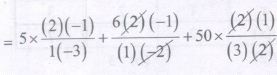
= \(\frac { 10 }{ 3 } -6+\frac { 50 }{ 3 } =\frac { 60 }{ 3 } -6=20-6=14\)
∴ f(2) = 14

12th Standard Syllabus & Materials
12th Standard
TN 12th Computer Applications வலையமைப்பு வடமிடல் Sample Question Papers Study Material - QB365 Set A
NEW12th Standard
TN 12th Computer Applications களப்பெயர் முறைமை (DNS) Sample Question Papers Study Material - QB365 Set A
NEW12th Standard
TN 12th Computer Applications வலையமைப்பு எடுத்துக்காட்டுகள் மற்றும் நெறிமுறைகள் Sample Question Papers Study Material - QB365 Set A
NEW12th Standard
TN 12th Computer Applications கணினி வலையமைப்பு ஓர் அறிமுகம் Sample Question Papers Study Material - QB365 Set A



Tamilnadu Stateboard 12th Standard Subjects

Maths

Chemistry

Physics

Biology

Computer Science
Business Maths and Statistics

Economics

Commerce

Accountancy

History

Computer Applications
Biology
Computer Technology
Computer Applications
Computer Science
Business Maths and Statistics
Commerce
Economics
Maths
Chemistry
Physics
Computer Technology
History
Accountancy

Tamil

English

French
Tamilnadu Stateboard Standards
