
 100% FREE ACCESS
12th Standard Syllabus & Materials
12th Standard
TN 12th Computer Applications மின்னணு தரவு பரிமாற்றம் Sample Question Papers Study Material - QB365 Set A
NEW12th Standard
TN 12th Computer Applications மின் - வணிக பாதுகாப்பு அமைப்புகள் Sample Question Papers Study Material - QB365 Set A
NEW12th Standard
TN 12th Computer Applications மின்னணு செலுத்தல் முறைகள் Sample Question Papers Study Material - QB365 Set A
NEW12th Standard
TN 12th Computer Applications மின் - வணிகம் Sample Question Papers Study Material - QB365 Set A
NEW12th Standard
TN 12th Computer Applications திறந்த மூல கருத்துருக்கள் Sample Question Papers Study Material - QB365 Set A
NEW12th Standard
TN 12th Computer Applications வலையமைப்பு வடமிடல் Sample Question Papers Study Material - QB365 Set A

Published on: 02/09/2022
QB365 provides a detailed and simple solution for every Possible Creative Questions in Class 12 Business Maths Subject - Retirement and Death of a Partner, English Medium. It will help Students to get more practice questions, Students can Practice these question papers in addition to score best marks.
Download Tamil Nadu 12th Standard Business Maths and Statistics question papers, model tests, one-mark questions, important questions, and public exam papers in PDF format. Free study materials and answer keys for TN State Board students.
Questions + Answers key
Take MCQ Business Maths and Statistics Test
1.
Show that the equations \(x+y+z=-3,3 x+y\)\(-2 z=-2,2 x+4 y+7 z=7\) are not consistent.
2.
Test the system of equations \(4 x-5 y-2 z=2\), \(5 x-4 y+2 z=-2,2 x+2 y+8 z=-1\) for consistency.
3.
Show that the equations \(x-3 y-8 z=-10\), \(3 x+y-4 z=0,2 x+5 y+6 z=13\) are consistent and have infinite sets of solution.
4.
Find the ranks of A + B and AB where \(A=\left(\begin{array}{ccc} 1 & 1 & -1 \\ 2 & -3 & 4 \\ 3 & -2 & 3 \end{array}\right)\) and \(B=\left(\begin{array}{ccc} -1 & -2 & -1 \\ 6 & 12 & 6 \\ 5 & 10 & 5 \end{array}\right)\)
5.
Find the rank of the following matrices
(i) \(\left(\begin{array}{cccc}
1 & 1 & 1 & 3 \\
2 & -1 & 3 & 4 \\
5 & -1 & 7 & 11
\end{array}\right)\)
(ii) \(\left(\begin{array}{llll}
4 & 2 & 1 & 3 \\
6 & 3 & 4 & 7 \\
2 & 1 & 0 & 1
\end{array}\right)\)
(iii) \(\left(\begin{array}{cccc}
3 & 1 & -5 & -1 \\
1 & -2 & 1 & -5 \\
1 & 5 & -7 & 2
\end{array}\right)\)
(iv) \(\left(\begin{array}{cccc}
3 & 1 & 2 & 0 \\
1 & 0 & -1 & 0 \\
2 & 1 & 3 & 0
\end{array}\right)\)
(v) \(\left(\begin{array}{cccc}
0 & 1 & 2 & 1 \\
2 & -3 & 0 & -1 \\
1 & -1 & -1 & 0
\end{array}\right)\)
(vi) \(\left(\begin{array}{cccc}
1 & 2 & -1 & 3 \\
2 & 4 & 1 & -2 \\
3 & 6 & 3 & -7
\end{array}\right)\)
(vii) \(\left(\begin{array}{cccc}
1 & -2 & 3 & 4 \\
-2 & 4 & -1 & -3 \\
-1 & 2 & 7 & 6
\end{array}\right)\)
6.
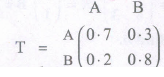
Two products A and B currently share the market with shares 60% and 40% each respectively. Each week some brand switching latees place. Of those who bought A the previous week 70% buy it again whereas 30% switch over to B. Of those who bought B the previous week, 80% buy it again whereas 20% switch over to A. Find their shares after one week and after two weeks.
7.
Solve: 2x + 3y = 5, 6x + 5y = 11
8.
If \(A=\left( \begin{matrix} 2 & 4 \\ 4 & 3 \end{matrix} \right) ,X=\left( \begin{matrix} n \\ 1 \end{matrix} \right) B=\left( \begin{matrix} 8 \\ 11 \end{matrix} \right) \) and AX = B then find n.
9.
If \(\left[ \begin{matrix} 1 & 0 & 0 \\ 0 & 0 & 1 \\ 0 & 1 & 0 \end{matrix} \right] \left[ \begin{matrix} x \\ y \\ z \end{matrix} \right] =\left[ \begin{matrix} 2 \\ -1 \\ 3 \end{matrix} \right] \) find x,y and z
10.
Solve: 2x - 3y - 1 = 0, 5x + 2y - 12 = 0 by Cramer's rule.
11.
Show that the equations x- 3y + 4z = 3, 2x - 5y + 7z = 6, 3x - 8y + 11z = 1 are inconsistent
12.
Show that the equations x + 2y = 3, y - z = 2, x + y + z = 1 are consistent and have infinite sets of solution.
13.
Show that the equations 2x - y + z = 7, 3x + y - 5z = 13, x + y + z = 5 are consistent and have a unique solution.
14.
Find the rank of the matrix \(A=\left( \begin{matrix} 1 & 2 & -4 \\ 2 & -1 & 3 \\ 8 & 1 & 9 \end{matrix}\begin{matrix} 5 \\ 6 \\ 7 \end{matrix} \right) \)
15.
Find the rank of the matrix
\(A=\left( \begin{matrix} 2 & 4 & 5 \\ 4 & 8 & 10 \\ -6 & -12 & -15 \end{matrix} \right) \)
1.
In matrix form
\(\left(\begin{array}{ccc}
1 & 1 & 1 \\
3 & 1 & -2 \\
2 & 4 & 7
\end{array}\right)\left(\begin{array}{l}
x \\
y \\
z
\end{array}\right)=\left(\begin{array}{c}
-3 \\
-2 \\
7
\end{array}\right)\)
Augmented matrix
\((A, B)=\left(\begin{array}{cccc}
1 & 1 & 1 & -3 \\
3 & 1 & -2 & -2 \\
2 & 4 & 7 & 7
\end{array}\right)\)
\(\sim\left(\begin{array}{cccc}
1 & 1 & 1 & -3 \\
0 & -2 & -5 & 7 \\
0 & 2 & 5 & 13
\end{array}\right) R_{2} \rightarrow R_{3}-2 R_{1}\)
\(\sim\left(\begin{array}{cccc}
1 & 1 & 1 & -3 \\
0 & -2 & -5 & 7 \\
0 & 0 & 0 & 20
\end{array}\right) \quad R_{3} \rightarrow R_{3}+R_{2}\)
\(
\rho(A, B)=3, \rho(A)=2
\)
\(\rho(A, B) \neq \rho(A)
\)
The system is inconsistent.
2.
In matrix form
\(\left(\begin{array}{ccc}
4 & -5 & -2 \\
5 & -4 & 2 \\
2 & 2 & 8
\end{array}\right)\left(\begin{array}{l}
x \\
y \\
z
\end{array}\right)=\left(\begin{array}{c}
2 \\
-2 \\
-1
\end{array}\right)\)
Augmented matrix
\((\Lambda, B)=\left(\begin{array}{cccc}
1 & -5 & -2 & 2 \\
5 & -1 & 2 & -2 \\
2 & 2 & 8 & -1
\end{array}\right)\)
\(\sim\left(\begin{array}{cccc}
1 & -5 & -2 & 2 \\
0 & 9 & 18 & -18 \\
0 & 9 & 18 & -1
\end{array}\right) \begin{aligned}
&R_{2} \rightarrow 4 R_{2}-5 R_{1} \\
&R_{3} \rightarrow 2 R_{3}-R_{1}
\end{aligned}\)
\(\sim\left(\begin{array}{cccc}
1 & -5 & -2 & 2 \\
0 & 9 & 18 & -18 \\
0 & 0 & 0 & 1.1
\end{array}\right) R_{3} \rightarrow R_{3}-R_{2}\)
\(
\rho(A, B)=3, \rho(A)=2
\)
\( \rho(A, B) \neq \rho(A)
\)
The system is inconsistent
3.
In matrix form
\(\left(\begin{array}{ccc}
1 & -3 & -8 \\
3 & 1 & -4 \\
2 & 5 & 6
\end{array}\right)\left(\begin{array}{l}
x \\
y \\
z
\end{array}\right)=\left(\begin{array}{c}
-10 \\
0 \\
13
\end{array}\right)\)
AX = B
Augmented matrix
\((A, B)=\left(\begin{array}{cccc}
1 & -3 & -8 & -10 \\
3 & 1 & -4 & 0 \\
2 & 5 & 6 & 13
\end{array}\right)\)
\(\sim\left(\begin{array}{cccc}
1 & -3 & -8 & -10 \\
0 & 10 & 20 & 30 \\
0 & 11 & 22 & 33
\end{array}\right) R_{2} \rightarrow R_{2}-3 R_{1}\)
\(\sim\left(\begin{array}{cccc}
1 & -3 & -8 & -10 \\
0 & 1 & 2 & 3 \\
0 & 1 & 2 & 3
\end{array}\right) \begin{aligned}
&R_{2} \rightarrow R_{2} / 10 \\
&R_{3} \rightarrow R_{3} / 11
\end{aligned}\)
\(\sim\left(\begin{array}{cccc}
1 & -3 & -8 & -10 \\
0 & 1 & 2 & 3 \\
0 & 0 & 0 & 0
\end{array}\right) R_{3} \rightarrow R_{3}-R_{2}\)
\(\rho(A, B)=\rho(A)=2<3\)
It is consistent and has infinite solution.
4.
\(A+B=\left(\begin{array}{ccc}
1 & 1 & -1 \\
2 & -3 & 4 \\
3 & -2 & 3
\end{array}\right)+\left(\begin{array}{ccc}
-1 & -2 & -1 \\
6 & 12 & 6 \\
5 & 10 & 5
\end{array}\right)\)
\(=\left(\begin{array}{ccc}
0 & -1 & -2 \\
8 & 9 & 10 \\
8 & 8 & 8
\end{array}\right)\)
\(\sim\left(\begin{array}{ccc}
1 & 1 & 1 \\
8 & 9 & 10 \\
0 & -1 & -2
\end{array}\right) \begin{aligned}
&R_{1} \leftrightarrow R_{3} \\
&R_{3} \rightarrow R_{3} / 8
\end{aligned}\)
\(\sim\left(\begin{array}{lll}
1 & 1 & 1 \\
0 & 1 & 2 \\
0 & 1 & 2
\end{array}\right)^{2} R_{2} \rightarrow R_{2}-8 R_{1},\)
\(\sim\left(\begin{array}{lll}
1 & 1 & 1 \\
0 & 1 & 2 \\
0 & 0 & 0
\end{array}\right) R_{3} \rightarrow R_{3}-R_{2}\)
\(\rho(A+B)=2\)
\(A B=\left(\begin{array}{ccc}
1 & 1 & -1 \\
2 & -3 & 4 \\
3 & -2 & 3
\end{array}\right)\left(\begin{array}{ccc}
-1 & -2 & -1 \\
6 & 12 & 6 \\
5 & 10 & 5
\end{array}\right)\)
\(=\left(\begin{array}{ccc}
-1+6-5 & -2+12-10 & -1+6-5 \\
-2-18+20 & -4-36+40 & -2-18+20 \\
-3-12+15 & -6-24+30 & -3-12+15
\end{array}\right)\)
\(=\left(\begin{array}{lll}
0 & 0 & 0 \\
0 & 0 & 0 \\
0 & 0 & 0
\end{array}\right)\)
\(\rho(A B)=0\)
5.
(i) \(A=\left(\begin{array}{cccc}
1 & 1 & 1 & 3 \\
2 & -1 & 3 & 4 \\
5 & -1 & 7 & 11
\end{array}\right)\)
\(\sim\left(\begin{array}{cccc}
1 & 1 & 1 & 3 \\
0 & -3 & 1 & -2 \\
0 & -6 & 2 & -4
\end{array}\right) \begin{aligned}
&R_{2} \rightarrow R_{2}-2 R_{1} \\
&R_{3} \rightarrow R_{3}-5 R_{1}
\end{aligned}\)
\(\sim\left(\begin{array}{cccc}
1 & 1 & 1 & 3 \\
0 & -3 & 1 & -2 \\
0 & 0 & 0 & 0
\end{array}\right) R_{3} \rightarrow R_{3}-2 R_{2}\)
\(\rho(A)=2\)
(ii) \(\left(\begin{array}{llll}
4 & 2 & 1 & 3 \\
6 & 3 & 4 & 7 \\
2 & 1 & 0 & 1
\end{array}\right)\)
\(
\left(\begin{array}{cccc}
1 & 2 & 4 & 3 \\
4 & 3 & 6 & 7 \\
0 & 1 & 2 & 1
\end{array}\right) C_{1} \leftrightarrow C_{3} \\
\left(\begin{array}{cccc}
1 & 2 & 4 & 3 \\
0 & -5 & -10 & -5 \\
0 & 1 & 2 & 1
\end{array}\right) R_{2} \rightarrow R_{2}-4 R_{1}
\)
\(
\sim\left(\begin{array}{llll}
1 & 2 & 4 & 3 \\
0 & 1 & 2 & 1 \\
0 & 1 & 2 & 1
\end{array}\right) R_{2} \rightarrow-R_{2} / 5 \\
\sim\left(\begin{array}{llll}
1 & 2 & 4 & 3 \\
0 & 1 & 2 & 1 \\
0 & 0 & 0 & 0
\end{array}\right) R_{3} \rightarrow R_{3}-R_{2}
\)
\(\rho(A)=2\)
(iii) \(\left(\begin{array}{cccc}
3 & 1 & -5 & -1 \\
1 & -2 & 1 & -5 \\
1 & 5 & -7 & 2
\end{array}\right)\)
\(\sim\left(\begin{array}{cccc}
1 & -2 & 1 & -5 \\
3 & 1 & -5 & -1 \\
1 & 5 & -7 & 2
\end{array}\right)^{-} R_{1} \leftrightarrow R_{2}\)
\(\sim\left(\begin{array}{cccc}
1 & -2 & 1 & -5 \\
0 & 7 & -8 & 14 \\
0 & 7 & -8 & 7
\end{array}\right) \begin{aligned}
&R_{2} \rightarrow R_{2}-3 R_{1} \\
&R_{3} \rightarrow R_{3}-R_{1}
\end{aligned}\)
\(\sim\left(\begin{array}{cccc}
1 & -2 & 1 & -5 \\
0 & 7 & -8 & 14 \\
0 & 0 & 0 & -7
\end{array}\right) R_{3} \rightarrow R_{3}-R_{2}\)
\(\rho(A)=3\)
(iv) \(\left(\begin{array}{cccc}
3 & 1 & 2 & 0 \\
1 & 0 & -1 & 0 \\
2 & 1 & 3 & 0
\end{array}\right)\)
\(\sim\left(\begin{array}{cccc}
1 & 0 & -1 & 0 \\
3 & 1 & 2 & 0 \\
2 & 1 & 3 & 0
\end{array}\right) R_{1} \leftrightarrow R_{2}\)
\(\sim\left(\begin{array}{cccc}
1 & 0 & -1 & 0 \\
0 & 1 & 5 & 0 \\
0 & 1 & 5 & 0
\end{array}\right) \begin{aligned}
&R_{2} \rightarrow R_{2}-3 R_{1} \\
&R_{3} \rightarrow R_{3}-2 R_{1}
\end{aligned}\)
\(\sim\left(\begin{array}{cccc}
1 & 0 & -1 & 0 \\
0 & 1 & 5 & 0 \\
0 & 0 & 0 & 0
\end{array}\right) R_{3} \rightarrow R_{3}-R_{2}\)
\(\rho(A)=2\)
(v) \(\left(\begin{array}{cccc}
0 & 1 & 2 & 1 \\
2 & -3 & 0 & -1 \\
1 & -1 & -1 & 0
\end{array}\right)\)
\(\sim\left(\begin{array}{cccc}
1 & -1 & -1 & 0 \\
2 & -3 & 0 & -1 \\
0 & 1 & 2 & 1
\end{array}\right) R_{1} \leftrightarrow R_{3}\)
\(\sim\left(\begin{array}{cccc}
1 & -1 & -1 & 0 \\
0 & -1 & 2 & -1 \\
0 & 1 & 2 & 1
\end{array}\right) R_{2} \rightarrow R_{2}-2 R_{1}\)
\(\sim\left(\begin{array}{cccc}
1 & -1 & -1 & 0 \\
0 & -1 & 1 & -1 \\
0 & 0 & 4 & 0
\end{array}\right) R_{3} \rightarrow R_{3}+R_{2}\)
\(\rho(A)=3\)
(vi) \(\left(\begin{array}{cccc}
1 & 2 & -1 & 3 \\
2 & 4 & 1 & -2 \\
3 & 6 & 3 & -7
\end{array}\right)\)
\(\sim\left(\begin{array}{cccc}
1 & 2 & -1 & 3 \\
0 & 0 & 3 & -8 \\
0 & 0 & 6 & -16
\end{array}\right) \begin{aligned}
&R_{2} \rightarrow R_{2}-2 R_{1} \\
&R_{3} \rightarrow R_{3}-3 R_{1}
\end{aligned}\)
\(\sim\left(\begin{array}{cccc}
1 & 2 & -1 & 3 \\
0 & 0 & 3 & -8 \\
0 & 0 & 0 & 0
\end{array}\right) R_{3} \rightarrow R_{3}-2 R_{2}\)
\(\rho(A)=2\)
(vii) \(\left(\begin{array}{cccc}
1 & -2 & 3 & 4 \\
-2 & 4 & -1 & -3 \\
-1 & 2 & 7 & 6
\end{array}\right)\)
\(\sim\left(\begin{array}{cccc}
1 & -2 & 3 & 4 \\
0 & 0 & 5 & 5 \\
0 & 0 & 10 & 10
\end{array}\right) R_{2} \rightarrow R_{2}+2 R_{1}\)
\(\sim\left(\begin{array}{cccc}
1 & -2 & 3 & 4 \\
0 & 0 & 5 & 5 \\
0 & 0 & 0 & 0
\end{array}\right) R_{3} \rightarrow R_{3}-2 R_{2}\)
\(p(A)=2\)
6.
Transition probability matrix
Shares after one week
\(\left( \cdot 6\cdot 4 \right) \left( \begin{matrix} \cdot 7 & \cdot 3 \\ \cdot 6 & \cdot 8 \end{matrix} \right) \)
= (-6\(\times\)·7+-4x·2 ·6\(\times\)·3+·4\(\times\)·8)
= z:(-42+·08 ·18+·32)= (·50 ·50)
\(\Rightarrow\) A = 50% and B = 50%
Shares after two weeks \(\left( \cdot 5\cdot 5 \right) \left( \begin{matrix} \cdot 7 & \cdot 3 \\ \cdot 2 & \cdot 8 \end{matrix} \right) \)
= (-5\(\times\)·7+·5\(\times\).2 ·5\(\times\)·3 +·5\(\times\)·8)
= (-35+·10 ·15 + 40) = (-45 ·55)
A = 45% and B = 55%
7.
Given non-homogeneous equations are
2x + 3y = 5 6X + 5y = 11
\(\Delta =\left| \begin{matrix} 2 & 3 \\ 6 & 5 \end{matrix} \right| =10-18=-8\)
Since \(\Delta \neq 0\) Cramer's rule can be applied and the system is consistent with unique solution
\(\Delta x=\left| \begin{matrix} 5 & 3 \\ 11 & 5 \end{matrix} \right| =25-33=-8\)
\(\Delta y=\left| \begin{matrix} 2 & 5 \\ 6 & 11 \end{matrix} \right| =22-30=-8\)
\(\therefore x=\cfrac { \Delta x }{ \Delta } =\cfrac { -8 }{ -8 } =1\)
\(y=\cfrac { \Delta y }{ \Delta } =\cfrac { -8 }{ -8 } =1\)
\(\therefore \) Solution set is {1, 1}
8.
GivenAX B
\(\left( \begin{matrix} 2 & 4 \\ 4 & 3 \end{matrix} \right) ,\left( \begin{matrix} n \\ 1 \end{matrix} \right) \left( \begin{matrix} 8 \\ 11 \end{matrix} \right) \)
\(\Rightarrow \left( \begin{matrix} 2n+4 \\ 4n+3 \end{matrix} \right) =\left( \begin{matrix} 8 \\ 11 \end{matrix} \right) \)
Equating the corresponding entries on both sides, we get
2n +4 = 8
2n = 8-4
2n=4
\(n=\cfrac { 4 }{ 2 } \)
2 = 2
9.
\(\left[ \begin{matrix} 1 & 0 & 0 \\ 0 & 0 & 1 \\ 0 & 1 & 0 \end{matrix} \right] \left[ \begin{matrix} x \\ y \\ z \end{matrix} \right] =\left[ \begin{matrix} 2 \\ -1 \\ 3 \end{matrix} \right] \)
\(\Rightarrow \left( \begin{matrix} x0+0 \\ 0+0+z \\ 0+y+0 \end{matrix} \right) =\left( \begin{matrix} 2 \\ -1 \\ 3 \end{matrix} \right) \)
\(\Rightarrow \left( \begin{matrix} x \\ y \\ z \end{matrix} \right) =\left( \begin{matrix} 2 \\ -1 \\ 3 \end{matrix} \right) \)
\(\Rightarrow x=2\quad z=-1\quad y=3\)
\(\therefore\) Solution set is {2,3, -1}
10.
The non-homogeneous equations are
2x - 3y - 1 = 0, 5x + 2y - 12 = 0
\(\Delta =\left| \begin{matrix} 2 & -3 \\ 5 & 2 \end{matrix} \right| =4+15=19\neq 0\)
Since \(\Delta \neq 0\) Cramer's rule can be applied and the system is consistent with unique solution.
\(\Delta x=\left| \begin{matrix} 1 & -3 \\ 12 & 2 \end{matrix} \right| =2+36=38\)
\(\Delta y=\left| \begin{matrix} 2 & 1 \\ 5 & 12 \end{matrix} \right| =24-5=19\)
\(x=\cfrac { \Delta x }{ \Delta } =\cfrac { 38 }{ 19 } =1\)
\(y=\cfrac { \Delta y }{ \Delta } =\cfrac { 19 }{ 19 } =1\)
\(\therefore \) Solution set is {2, 1}
11.
Given non-homogeneous equations are
x- 3y + 4z = 3, 2x - 5y + 7z = 6, 3x - 8y + 11z = 1
| Augmented matrix [A, B] |
Elementary Transformation |
|---|---|
| \(\left( \begin{matrix} 1 & -3 & 4 \\ 2 & -5 & 7 \\ 3 & -8 & 11 \end{matrix}\begin{matrix} 3 \\ 6 \\ 1 \end{matrix} \right) \) | |
| \(\sim \left( \begin{matrix} 1 & -3 & 4 \\ 0 & 1 & -1 \\ 0 & 1 & -1 \end{matrix}\begin{matrix} 3 \\ 0 \\ -8 \end{matrix} \right) \) | \({ R }_{ 2 }\rightarrow { R }_{ 2 }-2{ R }_{ 1 }\) \({ R }_{ 3 }\rightarrow { R }_{ 3 }-{ 3R }_{ 1 }\) |
| \(\sim \left( \begin{matrix} 1 & -3 & 4 \\ 0 & 1 & -1 \\ 0 & 0 & -0 \end{matrix}\begin{matrix} 3 \\ 0 \\ -8 \end{matrix} \right) \) | \({ R }_{ 3 }\rightarrow { R }_{ 3 }-R_{ 2 }\) |
Clearly \(\rho (A)=2\) and \(\rho (A,B)=3\)
\(\rho (A,B)\neq \rho (A)\)
Hence, the given system is inconsistent and has no solution.
12.
Given non-homogeneous equations are
x + 2y = 3,y - z = 2,x + Y + z = 1
| Augmented matrix [A, B] |
Elementary Transformation |
|---|---|
| \(\left( \begin{matrix} 1 & 2 & 0 \\ 0 & 1 & -1 \\ 1 & 1 & 1 \end{matrix}\begin{matrix} 3 \\ 2 \\ 1 \end{matrix} \right) \) | |
| \(\sim \left( \begin{matrix} 1 & 2 & 0 \\ 0 & 1 & -1 \\ 0 & -1 & 1 \end{matrix}\begin{matrix} 3 \\ 2 \\ -2 \end{matrix} \right) \) | \({ R }_{ 3 }\rightarrow { R }_{ 3 }+{ R }_{ 2 }\) |
| \(\sim \left( \begin{matrix} 1 & 2 & 0 \\ 0 & 1 & -1 \\ 0 & 0 & 0 \end{matrix}\begin{matrix} 3 \\ 2 \\ 0 \end{matrix} \right) \) | \({ R }_{ 3 }\rightarrow { R }_{ 3 }+{ R }_{ 2 }\) |
Obviously,\(\rho (A)=2\) and \(\rho (A,B)\)
Hence \(\rho (A)=2\quad \rho\) (A, B) = 2
\(\therefore\) The system is consistent and has infinite number of solutions.
13.
The non-homogeneous equation are
2x - y + z = 7, 3x + y - 5z = 13, x + y + z = 5
| Augmented matrix [A,B] |
Elementary Transformation |
|---|---|
| \(\left( \begin{matrix} 2 & -1 & 1 \\ 3 & 1 & -5 \\ 1 & 1 & 1 \end{matrix}\begin{matrix} 7 \\ 13 \\ 5 \end{matrix} \right) \) | |
| \(-\left( \begin{matrix} 1 & 1 & 1 \\ 3 & 1 & -5 \\ 2 & -1 & 1 \end{matrix}\begin{matrix} 5 \\ 13 \\ 7 \end{matrix} \right) \) | \({ R }_{ 1 }\leftrightarrow { R }_{ 3 }\) |
| \(\sim \left( \begin{matrix} 1 & 1 & 1 \\ 0 & -2 & -8 \\ 0 & -3 & -1 \end{matrix}\begin{matrix} 5 \\ -2 \\ -3 \end{matrix} \right) \) | \({ R }_{ 2 }\rightarrow { R }_{ 2 }-3{ R }_{ 1 }\) \({ R }_{ 3 }\rightarrow { R }_{ 3 }-2{ R }_{ 1 }\) |
| \(\sim \left( \begin{matrix} 1 & 1 & 1 \\ 0 & -2 & -8 \\ 0 & 0 & 11 \end{matrix}\begin{matrix} 5 \\ -2 \\ 0 \end{matrix} \right) \) | \({ R }_{ 3 }\rightarrow { R }_{ 3 }-\cfrac { 3 }{ 2 } { R }_{ 2 }\) |
Clearly \(\rho (A)=3\) and \(\rho (A,B)\) = 3 = Number of unknowns
\(\therefore\) The given system is consistent and has unique solution.
14.
The order of A is 3 x 4
\(\therefore \rho (A)\le min\left( 3,4 \right) \)
\(\rho (A)\le 3\)
Consider the third order minor
\(\left| \begin{matrix} 1 & 2 & -4 \\ 2 & -1 & 3 \\ 8 & 1 & 9 \end{matrix} \right| =1\left| \begin{matrix} -1 & 3 \\ 1 & 9 \end{matrix} \right| -2\left| \begin{matrix} 2 & 3 \\ 8 & 9 \end{matrix} \right| -4\left| \begin{matrix} 2 & -1 \\ 8 & 1 \end{matrix} \right| \)
= 1(- 9 - 3) - 2(18 - 24) - 4(2 + 8)
= 1 (-12) - 2 (- 6) - 4 (10)
= - 12 + 12 - 40
= - 40::\(\neq \) 0.
There is a minor of order 3, which is not zero
\(\therefore \rho (A)=3\)
15.
The order of A is 3 x 3
\(\therefore \rho (A)\le min(3,3)\)
\(\Rightarrow \rho (A)\le 3\)
| Matrix | Elementary Transformation |
|---|---|
| \(\left( \begin{matrix} 2 & 4 & 5 \\ 4 & 8 & 10 \\ -6 & -12 & -15 \end{matrix} \right) \) | |
| \(-\left( \begin{matrix} 1 & 1 & 1 \\ 2 & 2 & 2 \\ -3 & -3 & -3 \end{matrix} \right) \) | \({ C }_{ 1 }\rightarrow { C }_{ 1 }\div 2\) \({ C }_{ 2 }\rightarrow { C }_{ 2 }\div 4\) \({ C }_{ 3 }\rightarrow { C }_{ 3 }\div 5\) |
| \(-\left( \begin{matrix} 1 & 1 & 1 \\ 0 & 0 & 0 \\ 0 & 0 & 0 \end{matrix} \right) \) | \({ R }_{ 2 }\rightarrow { R }_{ 1 }-{ 2R }_{ 1 }\) \({ R }_{ 3 }\rightarrow { R }_{ 3 }+3{ R }_{ 1 }\) |
The last equivalent matrix is in echelon form and it has one non-zero row
\(\therefore \rho (A)=1\)

12th Standard Syllabus & Materials
12th Standard
TN 12th Computer Applications களப்பெயர் முறைமை (DNS) Sample Question Papers Study Material - QB365 Set A
NEW12th Standard
TN 12th Computer Applications வலையமைப்பு எடுத்துக்காட்டுகள் மற்றும் நெறிமுறைகள் Sample Question Papers Study Material - QB365 Set A
NEW12th Standard
TN 12th Computer Applications கணினி வலையமைப்பு ஓர் அறிமுகம் Sample Question Papers Study Material - QB365 Set A
NEW12th Standard
TN 12th Computer Applications PHP-உடன் MySQL-ஐ இணைத்தல் Sample Question Papers Study Material - QB365 Set A



Tamilnadu Stateboard 12th Standard Subjects

Maths

Chemistry

Physics

Biology

Computer Science
Business Maths and Statistics

Economics

Commerce

Accountancy

History

Computer Applications
Biology
Computer Technology
Computer Applications
Computer Science
Business Maths and Statistics
Commerce
Economics
Maths
Chemistry
Physics
Computer Technology
History
Accountancy

Tamil

English

French
Tamilnadu Stateboard Standards
