
 100% FREE ACCESS
12th Standard Syllabus & Materials
12th Standard
TN 12th Computer Applications மின்னணு தரவு பரிமாற்றம் Sample Question Papers Study Material - QB365 Set A
NEW12th Standard
TN 12th Computer Applications மின் - வணிக பாதுகாப்பு அமைப்புகள் Sample Question Papers Study Material - QB365 Set A
NEW12th Standard
TN 12th Computer Applications மின்னணு செலுத்தல் முறைகள் Sample Question Papers Study Material - QB365 Set A
NEW12th Standard
TN 12th Computer Applications மின் - வணிகம் Sample Question Papers Study Material - QB365 Set A
NEW12th Standard
TN 12th Computer Applications திறந்த மூல கருத்துருக்கள் Sample Question Papers Study Material - QB365 Set A
NEW12th Standard
TN 12th Computer Applications வலையமைப்பு வடமிடல் Sample Question Papers Study Material - QB365 Set A

Published on: 02/09/2022
QB365 provides a detailed and simple solution for every Possible Book Back Questions in Class 12 Business Maths Subject - Retirement and Death of a Partner, English Medium. It will help Students to get more practice questions, Students can Practice these question papers in addition to score best marks.
Download Tamil Nadu 12th Standard Business Maths and Statistics question papers, model tests, one-mark questions, important questions, and public exam papers in PDF format. Free study materials and answer keys for TN State Board students.
Questions + Answers key
Take MCQ Business Maths and Statistics Test
1.
Solve the following equation by using Cramer’s rule
x + 4y + 3z = 2, 2x−6y + 6z = −3, 5x− 2y + 3z = −5
2.
Solve the following equation by using Cramer’s rule
x + y + z = 6, 2x + 3y− z =5, 6x−2y− 3z = −7
3.
Solve the following equation by using Cramer’s rule
2x + y −z = 3, x + y + z =1, x− 2y− 3z = 4
4.
A salesman has the following record of sales during three months for three items A, B and C, which have different rates of commission.
| Months | Sales of units | Total commission drawn (in Rs) | ||
| A | B | C | ||
| January | 90 | 100 | 20 | 800 |
| February | 130 | 50 | 40 | 900 |
| March | 60 | 100 | 30 | 850 |
Find out the rate of commission on the items A, B and C by using Cramer’s rule
5.
The cost of 2kg of wheat and 1kg of sugar is Rs. 100. The cost of 1kg of wheat and 1kg of rice is Rs. 80. The cost of 3kg of wheat, 2kg of sugar and 1kg of rice is Rs. 220. Find the cost of each per kg using Cramer’s rule.
6.
Solve the equations x + 2y + z = 7, 2x − y + 2z = 4, x + y − 2z = −1 by using Cramer’s rule
7.
Find k if the equations x + y + z = 1, 3x − y − z = 4, x+ 5y + 5z = k are inconsistent.
8.
Find k if the equations 2x + 3y − z = 5, 3x − y + 4z = 2, x + 7y − 6z = k are consistent.
9.
Two products A and B currently share the market with shares 50% and 50% each respectively. Each week some brand switching takes place. Of those who bought A the previous week, 60% buy it again whereas 40% switch over to B. Of those who bought B the previous week, 80% buy it again where as 20% switch over to A. Find their shares after one week and after two weeks. If the price war continues, when is the equilibrium reached?
10.
Two types of soaps A and B are in the market. Their present market shares are 15% for A and 85% for B. Of those who bought A the previous year, 65% continue to buy it again while 35% switch over to B. Of those who bought B the previous year, 55% buy it again and 45% switch over to A. Find their market shares after one year and when is the equilibrium reached?
11.
A new transit system has just gone into operation in Chennai. Of those who use the transit system this year, 30% will switch over to using metro train next year and 70% will continue to use the transit system. Of those who use metro train this year, 70% will continue to use metro train next year and 30% will switch over to the transit system. Suppose the population of Chennai city remains constant and that 60% of the commuters use the transit system and 40% of the commuters use metro train this year.
(i) What percent of commuters will be using the transit system after one year?
(ii) What percent of commuters will be using the transit system in the long run?
12.
80% of students who do maths work during one study period, will do the maths work at the next study period. 30% of students who do english work during one study period, will do the english work at the next study period. Initially there were 60 students do maths work and 40 students do english work.
Calculate,
(i) The transition probability matrix
(ii) The number of students who do maths work, english work for the next subsequent 2 study periods.
13.
A total of Rs. 8,500 was invested in three interest earning accounts. The interest rates were 2%, 3% and 6% if the total simple interest for one year was Rs. 380 and the amount, invested at 6% was equal to the sum of the amounts in the other two accounts, then how much was invested in each account? (use Cramer’s rule).
14.
In a market survey three commodities A, B and C were considered. In finding out the index number some fixed weights were assigned to the three varieties in each of the commodities. The table below provides the information regarding the consumption of three commodities according to the three varieties and also the total weight received by the commodity
| Commodity Variety | Variety | Total weight | ||
| I | II | III | ||
| A | 1 | 2 | 3 | 11 |
| B | 2 | 4 | 5 | 21 |
| C | 3 | 5 | 6 | 27 |
Find the weights assigned to the three varieties by using Cramer’s Rule.
15.
An automobile company uses three types of Steel S1, S2 and S3 for providing three different types of Cars C1, C2 and C3. Steel requirement R (in tonnes) for each type of car and total available steel of all the three types are summarized in the following table.
| Types of Steel | Types of Car | Total Steel available | ||
| C1 | C2 | C3 | ||
| S1 | 3 | 2 | 4 | 28 |
| S2 | 1 | 1 | 2 | 13 |
| S3 | 2 | 2 | 2 | 14 |
Determine the number of Cars of each type which can be produced by Cramer’s rule.
16.
The price of 3 Business Mathematics books, 2 Accountancy books and one Commerce book is Rs. 840. The price of 2 Business Mathematics books, one Accountancy book and one Commerce book is Rs. 570. The price of one Business Mathematics book, one Accountancy book and 2 Commerce books is Rs. 630. Find the cost of each book by using Cramer’s rule.
17.
Solve by Cramer’s rule x + y + z = 4, 2x − y + 3z = 1, 3x + 2y − z = 1
18.
An amount of Rs. 5,000/- is to be deposited in three different bonds bearing 6%, 7% and 8% per year respectively. Total annual income is Rs. 358/-. If the income from first two investments is Rs. 70/- more than the income from the third, then find the amount of investment in each bond by rank method.
19.
The price of three commodities X, Y and Z are x, y and z respectively Mr. Anand purchases 6 units of Z and sells 2 units of X and 3 units of Y. Mr. Amar purchases a unit of Y and sells 3 units of X and 2units of Z. Mr. Amit purchases a unit of X and sells 3 units of Y and a unit of Z. In the process they earn Rs. 5,000/-, Rs. 2,000/- and Rs. 5,500/- respectively. Find the prices per unit of three commodities by rank method.
20.
For what values of the parameter λ, will the following equations fail to have unique solution: 3x − y+λz = 1, 2x + y + z = 2, x + 2y − λz = −1 by rank method.
21.
Show that the equations 5x + 3y + 7z = 4, 3x + 26y + 2z = 9, 7x + 2y + 10z = 5 are consistent and solve them by rank method.
22.
23.
The total number of units produced (P) is a linear function of amount of over times in labour (in hours) (l), amount of additional machine time (m) and fixed finishing time (a)
i.e, P = a + bl + cm
From the data given below, find the values of constants a, b and c
| Day | Production (in Units P) |
Labour (in Hrs l) |
Additional Machine Time (in Hrs m) |
| Monday Tuesday Wednesday |
6,950 6,725 7,100 |
40 35 40 |
10 9 12 |
Estimate the production when overtime in labour is 50 hrs and additional machine time is 15 hrs.
24.
Investigate for what values of ‘a’ and ‘b’ the following system of equations x + y + z = 6,x + 2y + 3z = 10, x + 2y + az = b have
(i) no solution
(ii) a unique solution
(iii) an infinite number of solutions.
25.
Find k, if the equations x + y + z = 7, x + 2y + 3z = 18, y + kz = 6 are inconsistent
26.
Find k, if the equations x + 2y − 3z = −2, 3x − y − 2z = 1, 2x + 3y − 5z = k are consistent.
27.
Show that the equations are inconsistent x − 4y + 7z = 14, 3x + 8y − 2z = 13, 7x − 8y + 26z = 5
28.
Show that the equations x + y + z = 6, x + 2y + 3z = 14, x + 4y + 7z = 30 are consistent and solve them.
29.
Show that the equations 2x + y + z = 5, x + y + z = 4, x − y + 2z = 1 are consistent and hence solve them.
1.
\(\Delta =\left| \begin{matrix} 1 & 4 & 3 \\ 2 & -6 & 6 \\ 5 & -2 & 3 \end{matrix} \right| \)
= \(1\left| \begin{matrix} -6 & 6 \\ -2 & 3 \end{matrix} \right| -4\left| \begin{matrix} 2 & 6 \\ 5 & 3 \end{matrix} \right| +3\left| \begin{matrix} 2 & -6 \\ 5 & -2 \end{matrix} \right| \)
= 1(-18 + 12) - 4(6 - 30) +3 (- 4 +30)
= 1(- 6) - 4(- 24) + 3(26)
= - 6 + 96 + 78 = 168 \(\neq \) 0
Since \(\Delta \neq 0\) the system is consistent with unique solution and Cramer's rule can be applied
\(\Delta x=\left| \begin{matrix} 2 & 4 & 3 \\ -3 & -6 & 6 \\ -5 & -2 & 3 \end{matrix} \right| \)
= \(2\left| \begin{matrix} -6 & 6 \\ -2 & 3 \end{matrix} \right| -4\left| \begin{matrix} -3 & 6 \\ -5 & 3 \end{matrix} \right| +3\left| \begin{matrix} -3 & -6 \\ -5 & -2 \end{matrix} \right| \)
= 2 (- 18 + 12) - 4(- 9 +30) + 3(6 -30)
= 2(- 6) - 4(21) + 3(- 24)
= -12-84-72 =-168
\(\Delta y=\left| \begin{matrix} 1 & 2 & 3 \\ 2 & - & 6 \\ 5 & -5 & 3 \end{matrix} \right| =1\left| \begin{matrix} -3 & 6 \\ -5 & 3 \end{matrix} \right| -2\left| \begin{matrix} 2 & 6 \\ 5 & 3 \end{matrix} \right| +3\left| \begin{matrix} 2 & -3 \\ 5 & -5 \end{matrix} \right| \)
= 1 (-9+30)-2(6-30)+3(- 10+ 15)
= 1(21) - 2(- 24) + 3(5)
= 21 + 48 + 15 = 84
\(\Delta z=\left| \begin{matrix} 1 & 4 & 2 \\ 2 & -6 & -3 \\ 5 & -2 & -5 \end{matrix} \right| \)
= \(1\left| \begin{matrix} -6 & -3 \\ -2 & -5 \end{matrix} \right| -4\left| \begin{matrix} 2 & -3 \\ 5 & -5 \end{matrix} \right| +2\left| \begin{matrix} 2 & -6 \\ 5 & -2 \end{matrix} \right| \)
= 1(30-6)-4(-10+ 15)+2(-4+30)
= 24 - 4(5) + 2(26)
= 24 - 20 + 52 = 56
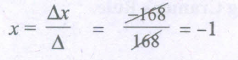
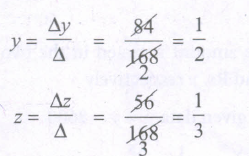
Solution set is \(\left\{ -1,\frac { 1 }{ 2 } ,\frac { 1, }{ 3 } \right\} \)
2.
\(\Delta =\left| \begin{matrix} 1 & 1 & 1 \\ 2 & 3 & -1 \\ 6 & -2 & -3 \end{matrix} \right| \)
= \(1\left| \begin{matrix} 3 & -1 \\ -2 & -3 \end{matrix} \right| -1\left| \begin{matrix} 2 & -1 \\ 6 & 3 \end{matrix} \right| +1\left| \begin{matrix} 2 & 3 \\ 6 & -2 \end{matrix} \right| \)
= 1(-9 -2) -1(-6 +6) + 1(-4 -18)
= 1(-11) -1(0) +1(-22)
= -11 -22 = -33 \(\neq \)0
Since \(\Delta \neq 0\)
Cramer's rule can be applied and the system is consistent with unique solution
\(\Delta x=\left| \begin{matrix} 6 & 1 & 1 \\ 5 & 3 & -1 \\ -7 & -2 & -3 \end{matrix} \right| \)
= \(6\left| \begin{matrix} 3 & -1 \\ -2 & -3 \end{matrix} \right| -1\left| \begin{matrix} 5 & -1 \\ -7 & -3 \end{matrix} \right| +1\left| \begin{matrix} 5 & 3 \\ -7 & -2 \end{matrix} \right| \)
= 6 (-9 -2) -1(-15 -7) + 1(-10 +21)
= 6 (-11) -1 (-22) + 1 (11)
= -66 + 22 + 11= - 33
\(\Delta y=\left| \begin{matrix} 1 & 6 & 1 \\ 2 & 5 & -1 \\ 6 & -7 & -3 \end{matrix} \right| \)
= \(1\left| \begin{matrix} 5 & -1 \\ -7 & -3 \end{matrix} \right| -6\left| \begin{matrix} 2 & -1 \\ 6 & -3 \end{matrix} \right| +1\left| \begin{matrix} 2 & 5 \\ 6 & -7 \end{matrix} \right| \)
= 1(-15 -7) -6(-6 +6) + 1(-14 -30)
= 1(-22) -6(0) + 1 (-44)
= -22 - 44 = - 66
\(\Delta z=\left| \begin{matrix} 1 & 1 & 6 \\ 2 & 3 & 5 \\ 6 & -2 & -7 \end{matrix} \right| \)
= \(=1\left| \begin{matrix} 3 & 5 \\ -2 & -7 \end{matrix} \right| -1\left| \begin{matrix} 2 & 5 \\ 6 & -7 \end{matrix} \right| +6\left| \begin{matrix} 2 & 3 \\ 6 & -2 \end{matrix} \right| \)
= 1(-21 +10) -1(-14 -30) +6 (-4 -18)
=1(-11) -1(-44) +6(-22)
= -11 + 44 - 132 = - 99
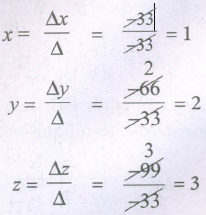
\(\therefore\) Solution set is {1, 2, 3}
3.
\(\Delta =\left| \begin{matrix} 2 & 1 & -1 \\ 1 & 1 & 1 \\ 1 & -2 & 3 \end{matrix} \right| =2\)
\(\left| \begin{matrix} 1 & 1 \\ -2 & -3 \end{matrix} \right| -1\left| \begin{matrix} 1 & 1 \\ 1 & -3 \end{matrix} \right| -1\left| \begin{matrix} 1 & 1 \\ 1 & -2 \end{matrix} \right| \)
= 2 (-3+2) - 1 (-3 -1) -1 (-2-1)
= 2(-1) -1 (-4) -1 (-3)
= -2 + 4 + 3 = 5.
Since\(\Delta \neq 0\),
we can apply Cramer's rule and the system is consistent with unique solution.
\(x=\left| \begin{matrix} 3 & 1 & -1 \\ 1 & 1 & 1 \\ 4 & -2 & 3 \end{matrix} \right| =3\left| \begin{matrix} 1 & 1 \\ -2 & -3 \end{matrix} \right| -1\left| \begin{matrix} 1 & 1 \\ 4 & -3 \end{matrix} \right| -1\left| \begin{matrix} 1 & 1 \\ 4 & -2 \end{matrix} \right| \)
= 3(-3 + 2) -1(-3 -4) -1(-2 -4)
= 3 (-1) -1 (-7) -1 (-6)
= -3 + 7 + 6 = 10.
\(\Delta y=\left| \begin{matrix} 2 & 3 & -1 \\ 1 & 1 & 1 \\ 1 & 4 & -3 \end{matrix} \right| =2\left| \begin{matrix} 1 & 1 \\ 4 & -3 \end{matrix} \right| -3\left| \begin{matrix} 1 & 1 \\ 1 & -3 \end{matrix} \right| -1\left| \begin{matrix} 1 & 1 \\ 1 & 4 \end{matrix} \right| \)
= 2(-3 -4) -3 (-3 -1) -1 (4-1)
= 2 (-7) -3 (-4) -1(3)
= 14 + 12 - 3 = -5
\(\Delta z=\left| \begin{matrix} 2 & 1 & 3 \\ 1 & 1 & 1 \\ 1 & -2 & 4 \end{matrix} \right| \)
= \(2\left| \begin{matrix} 1 & 1 \\ -2 & 4 \end{matrix} \right| -1\left| \begin{matrix} 1 & 1 \\ 1 & 4 \end{matrix} \right| +3\left| \begin{matrix} 1 & 1 \\ 1 & -2 \end{matrix} \right| \)
= 2(4 + 2) -1(4 -1) + 3(-2 -1)
= 2(6) -1(3) + 3(-3)
= 12 - 3 - 9
= 0
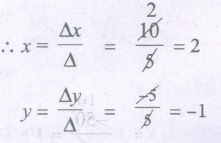
\(z=\cfrac { \Delta z }{ \Delta } =\cfrac { 0 }{ 5 } =0\)
\(\therefore\)Solution set is (2, -1, 0)
4.
Let the rate of commission on the items A, B and C be x, y and z respectively.
By the given data, the non-homogeneous equations are
90x + 100y + 20z = 800
\(\Rightarrow\)9x + 10y + 2z = 80
130x + 50y + 40z = 900
\(\Rightarrow\) 13x + 5y + 4z = 90
60x + 100y + 30z = 850
\(\Rightarrow\) 6x + 10y + 3z = 85
\(\Delta =\left| \begin{matrix} 9 & 10 & 2 \\ 13 & 5 & 4 \\ 6 & 10 & 3 \end{matrix} \right| \)
\(9\left| \begin{matrix} 5 & 4 \\ 10 & 3 \end{matrix} \right| -10\left| \begin{matrix} 13 & 4 \\ 6 & 3 \end{matrix} \right| +2\left| \begin{matrix} 13 & 5 \\ 6 & 10 \end{matrix} \right| \)
= 9 (15 - 40) - 10 (39 - 24) + 2(130 - 30)
= 9 (- 25) - 10(15) + 2(100)
= - 225 - 150 + 200
= -175
Since \(\Delta \neq 0\) Cramer's rule can be applied and the system is consistent with unique solution.
\(\Delta x=\left| \begin{matrix} 80 & 10 & 2 \\ 90 & 5 & 4 \\ 85 & 10 & 3 \end{matrix} \right| \)
= \(80\left| \begin{matrix} 5 & 4 \\ 10 & 3 \end{matrix} \right| -10\left| \begin{matrix} 90 & 4 \\ 85 & 3 \end{matrix} \right| +2\left| \begin{matrix} 90 & 5 \\ 85 & 10 \end{matrix} \right| \)
= 80(15 - 40) - 10(270 - 340) + 2(900 - 425)
= 80 (- 25) - 10 (- 70) + 2 (475)
= - 2000 + 700 + 950
= -350
\(\Delta y=\left| \begin{matrix} 9 & 80 & 2 \\ 13 & 90 & 4 \\ 6 & 85 & 3 \end{matrix} \right| \)
= \(9\left| \begin{matrix} 90 & 4 \\ 85 & 3 \end{matrix} \right| -80\left| \begin{matrix} 13 & 4 \\ 6 & 3 \end{matrix} \right| +2\left| \begin{matrix} 13 & 90 \\ 6 & 85 \end{matrix} \right| \)
= 9(270 - 340) - 80(39 - 24) +2(1105 - 540)
= 9(- 70) - 80(15) + 2(565)
= - 630 - 1200 + 1130
= -700
\(\Delta z=\left| \begin{matrix} 9 & 10 & 80 \\ 13 & 5 & 90 \\ 6 & 10 & 85 \end{matrix} \right| \)
= \(9\left| \begin{matrix} 5 & 90 \\ 10 & 85 \end{matrix} \right| -10\left| \begin{matrix} 13 & 90 \\ 6 & 85 \end{matrix} \right| +80\left| \begin{matrix} 13 & 5 \\ 6 & 10 \end{matrix} \right| \)
= 9(425 - 900) - 10(1105 - 540) + 80(130 - 30)
= 9(- 475) - 10(565) + 80 (100)
= - 4275 - 5650 + 8000
= - 1925
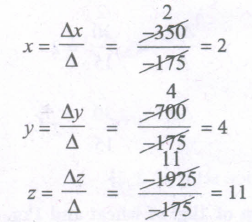
\(\therefore\) The rate of commission on the items A, Band Care 2%, 4% and 11%
5.
Let the cost of lkg of wheat be Rs. x, 1kg of sugar be Rs. y and lkg of rice be Rs. z.
By the given data,
2x + y = 100
x + z = 80
3x + 2y + z = 220
\(\Delta =\left| \begin{matrix} 2 & 1 & 0 \\ 1 & 0 & 1 \\ 3 & 2 & 1 \end{matrix} \right| =2\left| \begin{matrix} 0 & 1 \\ 2 & 1 \end{matrix} \right| -1\left| \begin{matrix} 1 & 1 \\ 3 & 1 \end{matrix} \right| +0\)
= 2 (0 - 2) -1 (1 - 3) + 0
= 2(-2) - 1(- 2)
= - 4 + 2 = -2
\(\Delta x=\left| \begin{matrix} 100 & 1 & 0 \\ 80 & 0 & 1 \\ 220 & 2 & 1 \end{matrix} \right| =100\left| \begin{matrix} 0 & 1 \\ 2 & 1 \end{matrix} \right| -1\left| \begin{matrix} 80 & 1 \\ 220 & 1 \end{matrix} \right| +0\)
= 100(0 - 2) - 1 (80 - 220)
= 100(- 2) - 1(- 140)
= - 200 + 140 = - 60.
\(\Delta y=\left| \begin{matrix} 2 & 100 & 0 \\ 1 & 80 & 1 \\ 3 & 220 & 1 \end{matrix} \right| =2\left| \begin{matrix} 80 & 1 \\ 220 & 1 \end{matrix} \right| -100\left| \begin{matrix} 1 & 1 \\ 3 & 1 \end{matrix} \right| +0\)
= 2 (80 - 220) - 100 (1 - 3)
= 2 (- 140) - 100 (-2)
= - 280 + 200 = - 80.
\(\Delta z=\left| \begin{matrix} 2 & 1 & 100 \\ 1 & 0 & 80 \\ 3 & 2 & 220 \end{matrix} \right| \)
\(2\left| \begin{matrix} 0 & 80 \\ 2 & 220 \end{matrix} \right| -1\left| \begin{matrix} 1 & 80 \\ 3 & 220 \end{matrix} \right| +100\left| \begin{matrix} 1 & 0 \\ 3 & 2 \end{matrix} \right| \)
= 2(0 - 160) - 1(220 - 240) + 100(2 - 0)
= 2(- 160) - 1(- 20) + 100(2)
= - 320 + 20 + 200
= -100
\(x=\cfrac { \Delta x }{ \Delta } =\cfrac { -60 }{ -2 } =30\)
\(y=\cfrac { \Delta y }{ \Delta } =\cfrac { -80 }{ -2 } =40\)
\(z=\cfrac { \Delta z }{ \Delta } =\cfrac { -100 }{ -2 } =50\)
\(\therefore\) The cost of 1 kg of wheat is Rs. 30
The cost of 1 kg sugar is Rs. 40 and The cost of 1 kg of rice is Rs. 50
6.
\(\Delta =\left| \begin{matrix} 1 & 2 & 1 \\ 2 & -1 & 2 \\ 1 & 1 & -2 \end{matrix} \right| \)
= \(1\left| \begin{matrix} -1 & 2 \\ 1 & -2 \end{matrix} \right| -2\left| \begin{matrix} 2 & 2 \\ 1 & -2 \end{matrix} \right| +1\left| \begin{matrix} 2 & -1 \\ 1 & 1 \end{matrix} \right| \)
= 1(2 -2) - 2(-4 -2) + 1(2 + 1)
= 1(0)-2(-6)+1(3)
= 12 + 3 = 15\(\neq \)0.
Since \(\Delta \neq 0\) Cramer's rule can be applied and thesystem is consistent with unique solution.
\({ \Delta }x=\left| \begin{matrix} 7 & 2 & 1 \\ 4 & -1 & 2 \\ -1 & 1 & -2 \end{matrix} \right| \)
= \(7\left| \begin{matrix} -1 & 2 \\ 1 & -2 \end{matrix} \right| -2\left| \begin{matrix} 4 & 2 \\ -1 & -2 \end{matrix} \right| +1\left| \begin{matrix} 4 & -1 \\ -1 & 1 \end{matrix} \right| \)
= 7 (2 -2) -2 (-8 + 2) + 1 (4 - 1)
= 7 (0) - 2(-6) + 1(3)
= 12 + 3 = 15
\(\Delta y=\left| \begin{matrix} 1 & 7 & 1 \\ 2 & 4 & 2 \\ 1 & -1 & -2 \end{matrix} \right| \)
= \(1\left| \begin{matrix} 4 & 2 \\ -1 & -2 \end{matrix} \right| -7\left| \begin{matrix} 2 & 2 \\ 1 & -2 \end{matrix} \right| +1\left| \begin{matrix} 2 & 4 \\ 1 & -1 \end{matrix} \right| \)
= 1 (- 8 + 2) -7(-4 -2) + 1(-2 -4)
= 1 (-6) -7 (-6) + 1 (-6)
= - 6 + 42 - 6 = 30
\(\Delta z=\left| \begin{matrix} 1 & 2 & 7 \\ 2 & -1 & 4 \\ 1 & 1 & -1 \end{matrix} \right| \)
= \(1\left| \begin{matrix} -1 & 4 \\ 1 & -1 \end{matrix} \right| -2\left| \begin{matrix} 2 & 4 \\ 1 & -1 \end{matrix} \right| +7\left| \begin{matrix} 2 & -1 \\ 1 & 1 \end{matrix} \right| \)
= 1 (1 - 4) - 2(- 2 - 4) + 7(2 + 1)
= 1(-3)-2(-6)+7(3)
= - 3 + 12 + 21 = 30
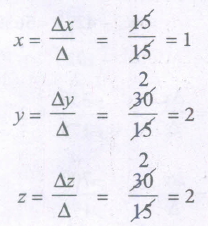
\(\therefore\) Solution set is {1, 2, 2}
7.
x +y + z = 1, 3x - y - z = 4, x + 5y + 5z = k
| Augmented matrix [A,B] |
Elementary Transformation |
|---|---|
| \(\left( \begin{matrix} 1 & 1 & 1 \\ 3 & -1 & -1 \\ 1 & 5 & 5 \end{matrix}\begin{matrix} 1 \\ 4 \\ k \end{matrix} \right) \) | |
| \(\sim \left( \begin{matrix} 1 & 1 & 1 \\ 0 & -4 & -4 \\ 0 & 4 & 4 \end{matrix}\begin{matrix} 1 \\ 1 \\ k-1 \end{matrix} \right) \) | \({ R }_{ 2 }\rightarrow { R }_{ 3 }-3{ R }_{ 1 }\) \({ R }_{ 3 }\rightarrow { R }_{ 3 }-{ R }_{ 1 }\) |
| \(\sim \left( \begin{matrix} 1 & 1 & 1 \\ 0 & -4 & -4 \\ 0 & 0 & 0 \end{matrix}\begin{matrix} 1 \\ 1 \\ k \end{matrix} \right) \) | \({ R }_{ 3 }\rightarrow { R }_{ 3 }+{ R }_{ 2 }\) |
Here clearly \(\rho (A)=2\)
Since the given system is inconsistent \(\rho (A)\neq \rho (A,B)\)
This can take any value other than zero.
\(\therefore\) k can take any value other than zero.
8.
Given non-homogeneous equations are
2x + 3y - z = 5, 3x - y + 4z = 2, x + 7y - 6z = k
| Augmented matrix | Elementary Transformation |
|---|---|
| \(\left( \begin{matrix} 2 & 3 & -1 \\ 3 & -1 & 4 \\ 1 & 7 & -6 \end{matrix}\begin{matrix} 5 \\ 2 \\ k \end{matrix} \right) \) | |
| \(\left( \begin{matrix} 1 & 7 & -6 \\ 3 & -1 & 4 \\ 2 & 3 & -1 \end{matrix}\begin{matrix} k \\ 2 \\ 5 \end{matrix} \right) \) | \({ R }_{ 1 }\leftrightarrow { R }_{ 3 }\) |
| \(\left( \begin{matrix} 1 & 7 & -6 \\ 0 & -22 & 22 \\ 0 & -11 & 11 \end{matrix}\begin{matrix} k \\ 2-3k \\ 5-2k \end{matrix} \right) \) | \({ R }_{ 2 }\rightarrow { R }_{ 2 }-3{ R }_{ 1 }\) |
| \(\left( \begin{matrix} 1 & 7 & -6 \\ 0 & -22 & 22 \\ 0 & 0 & 0 \end{matrix}\begin{matrix} k \\ 2-3k \\ 2(5-2k)-(2-3k) \end{matrix} \right) \) | \({ R }_{ 2 }\rightarrow { R }_{ 2 }-3{ R }_{ 1 }\) \({ R }_{ 3 }\rightarrow { R }_{ 3 }-2{ R }_{ 1 }\) |
| \(\left( \begin{matrix} 1 & 7 & -6 \\ 0 & -22 & 22 \\ 0 & 0 & 0 \end{matrix}\begin{matrix} k \\ 2-3k \\ 10-4k-2+3k \end{matrix} \right) \) | \({ R }_{ 3 }\rightarrow 2{ R }_{ 3 }-{ R }_{ 2 }\) |
| \(\left( \begin{matrix} -1 & 7 & -6 \\ 0 & -22 & 22 \\ 0 & 0 & 0 \end{matrix}\begin{matrix} k \\ 2-3k \\ 8-k \end{matrix} \right) \) |
Here \(\rho (A)=2\)
Since the given system is consistent, \(\rho \)(A, B) must be equal to 2.
This can happen only when
8 - k = 0 \(\Rightarrow\) k = 8
9.
Transition probability matrix
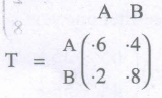
By the given data
A = 50% = ·5
B = 50% = ·5
Shares after one week
\(\left( \cdot 5\quad \cdot 5 \right) \left( \begin{matrix} \cdot 6 & \cdot 4 \\ \cdot 2 & \cdot 8 \end{matrix} \right) \)
= \(\left( \cdot 5 \right) \left( \cdot 5 \right) \left( \cdot 2 \right) \cdot 5\left( 4 \right) +\cdot 5\left( \cdot 8 \right) \)
= \(\left( \cdot 30+\cdot 10\cdot 20+40 \right) \)
= \(\left( \cdot 40\quad \cdot 60 \right) \)
\(\therefore\) Shares after one week for products A and Bare 40% and 60% respectively.
Shares after two weeks
\(\left( \cdot 4\quad \cdot 6 \right) \left( \begin{matrix} \cdot 6 & \cdot 4 \\ \cdot 2 & \cdot 8 \end{matrix} \right) \)
\(\left( \left( \cdot 4 \right) \left( \cdot 6 \right) +\left( \cdot 6 \right) \left( \cdot 2 \right) \cdot \left( \cdot 4 \right) \left( \cdot 4 \right) +\cdot 6\left( 0.8 \right) \right) \)
= \(\left( \cdot 24+\cdot 12\quad \cdot 16+\cdot 48 \right) \)
= \(\left( \cdot 36\quad \cdot 64 \right) \)
\(\therefore\) Shares after two week for products A and Bare 36% and 64% respectively.
At equilibrium, we must have (A B) T = (A B)
where A+B = 1
\(\left( A\quad B \right) \left( \begin{matrix} \cdot 6 & \cdot 4 \\ \cdot 2 & \cdot 8 \end{matrix} \right) =\left( A\quad B \right) \)
\(\Rightarrow\) = (-6A+·2B -4A+·8B) = (A B)
Equating the corresponding entries on both sides
we get,
·6A+ ·2B = A
\(\Rightarrow\) ·6A + ·2(1 - A) = A
\(\Rightarrow\) ·6A + ·2 - ·2A = A
\(\Rightarrow \) ·2 = A - ·6A + ·2A
\(\Rightarrow \) ·2 = A (1 - ·6 + ·2)
\(\Rightarrow \) ·2 = A (·4 + ·2)
\(\Rightarrow \) ·2 = A (·6)
\(\Rightarrow \) \(A=\cfrac { \cdot 2 }{ \cdot 6 } =\cdot 33\Rightarrow A=33\)
and B = 1 - A = 1 - ·33 = ·67\(\Rightarrow \) B = 67%
\(\therefore\) Equilibrium is reached when A = 33% and B = 67%
10.
Transition probability matrix
(A B) T = (A B)
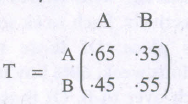
Where A represents the percent of people those who bought soap A and B represents the percent of people those who bought soap B.
By the given data
A = 15% = ·15
and B = 85% = ·85
Percentage after one year is
\(\left( \cdot 15\quad \cdot 85 \right) \left( \begin{matrix} \cdot 65 & \cdot 35 \\ \cdot 45 & \cdot 55 \end{matrix} \right) \)
= ((.15)(·65) + (·85)(-45) ·15(-35)+ ·85(-55))
= (-0975 + ·3825 ·0525 + -4675)
= (-48 ·52)
Hence, market share after one year is 48% and 52% At equilibrium,
\(\left( A\quad B \right) \left( \begin{matrix} \cdot 65 & \cdot 35 \\ \cdot 45 & \cdot 55 \end{matrix} \right) =(A\quad B)\)
(-65A + A5B ·35A +·55B) = (A B)
Equating the corresponding entries on both sides we get
\(\Rightarrow \cdot 65A+\cdot 45B=A\)
\(\Rightarrow \cdot 65A+\cdot 45(1-A)=A\)
[Since A+B = 1 B = 1-A]
\(\Rightarrow \cdot 65A+\cdot 45-\cdot 45A=A\)
\(\Rightarrow \cdot 45=A-\cdot 65A+\cdot 45A\)
\(\Rightarrow \cdot 45=A\left( \cdot 35+45 \right) \)
\(\Rightarrow \cdot 45=A(\cdot 35+45)\)
\(\Rightarrow \cdot 45=A(-8)\)
\(\Rightarrow A=\cfrac { \cdot 45 }{ \cdot 8 } =\cdot 5625=56.25\)
\(\therefore B=1-A=1-\cdot 5625=\cdot 4375\)
= 43.75%
\(\therefore\) Equilibrium is reached when A = 56.25% and B = 43.75%
11.
Transition probability matrix
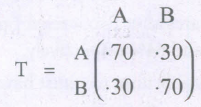
Where A represents the percentage of people using transit system and B represents the percentage of people using metro train.
By the given data
A 60% = .60
and B 40% = ·4
= ((-6)(-7)+(-4)(-3) (-6)(-3)+(-4)(-7))
= (-42+·12 ·18+·28)
= (-54 -46)
\(\therefore\) A = 54%and B = 46%
(i) The percent of Commuters using the transit system after one year is 54% and the percent of commuters using the metro train after one year is 46%
(ii) Equilibrium will be reached in the long run. At equilibrium we must have
(A B) T = (A B)
where A+B = 1
\(\Rightarrow \left( A\quad B \right) \left( \begin{matrix} \cdot 7 & \cdot 3 \\ \cdot 3 & \cdot 7 \end{matrix} \right) =(A\quad B)\)
(-7A +·3B ·3A +.7B) = (A B)
Equaling the entries on both sides, we get
·7A+ ·3B = A
\(\Rightarrow \cdot 7A+\cdot 3(1-A)=A\)
\(\left[ \because A+B=1\Rightarrow B=1-A \right] \)
\(\Rightarrow \cdot 7A+\cdot 3(1-A)=A\)
\(\Rightarrow \cdot 3=A-\cdot 7A+\cdot 3A\)
\(\Rightarrow \cdot 3=A(\cdot 3+\cdot 3)\)
\(\Rightarrow 3=A(\cdot 6)\)
\(\Rightarrow A=\cfrac { \cdot 3 }{ \cdot 6 } =\cfrac { 1 }{ 2 } =\cdot 50\)
\(\therefore\) The percent of commuters using the transit system in the long run is 50%
12.
(i) Transition probability matrix T = \(_{ E }^{ M }\left( \begin{matrix} \overset { M }{ 0.8 } & \overset { E }{ 0.2 } \\ 0.7 & 0.3 \end{matrix} \right) \)
After one study period, \(\left( \overset { M }{ 60\quad } \overset { E }{ 40 } \right) \) \(_{ E }^{ M }\left( \begin{matrix} \overset { M }{ 0.8 } & \overset { E }{ 0.2 } \\ 0.7 & 0.3 \end{matrix} \right) \) =\(\left( \overset { M }{ 76\quad } \overset { E }{ 24 } \right) \)
So in the very next study period, there will be 76 students do maths work and 24 students do the English work.
After two study periods,
\(\left( \overset { M }{ 76\quad } \overset { E }{ 24 } \right) \) \(_{ E }^{ M }\left( \begin{matrix} \overset { M }{ 0.8 } & \overset { E }{ 0.2 } \\ 0.7 & 0.3 \end{matrix} \right) \)
= (60.8+16.8 15.2+7.2)
= (77.6 22.4)
After two study periods there will be 78 (approx) students do maths work and 22 (approx) students do English work.
13.
Let the amount invested in the rate of 2%, 3% and 6% be Rs. x, Rs. y and Rs. z respectively
By the given data,
x+ y+z = 8500
\(\cfrac { 2x }{ 100 } +\cfrac { 3y }{ 100 } +\cfrac { 6z }{ 100 } =380\)
\(\Rightarrow \cfrac { 2x+3y+6z }{ 100 } =380\)
\(\because Interest=\cfrac { PNR }{ 100 } =\cfrac { x\times 1\times 2 }{ 100 } =\cfrac { 2x }{ 100 } \)
\(\Rightarrow 2x+3y+6z=38000\)
Also,z = x+y
x+y-z =0
\(\Delta =\left| \begin{matrix} 1 & 1 & 1 \\ 2 & 3 & 6 \\ 1 & 1 & -1 \end{matrix} \right| \)
\(1\left| \begin{matrix} 3 & 6 \\ 1 & -1 \end{matrix} \right| -1\left| \begin{matrix} 2 & 6 \\ 1 & -1 \end{matrix} \right| +1\left| \begin{matrix} 2 & 3 \\ 1 & 1 \end{matrix} \right| \)
= 1(-3 - 6) - 1(-2 -6) + 1 (2 - 3)
= 1(-9) - 1 (-8) + 1(-1)
= -9 + 8 - 1 = 2 \(\neq \) 0
Since \(\Delta \neq 0\),Cramer's rule can be applied and the system is consistent with unique solution
\({ \Delta x }=\left| \begin{matrix} 8500 & 1 & 1 \\ 38000 & 3 & 6 \\ 0 & 1 & -1 \end{matrix} \right| \)
= \(8500\left| \begin{matrix} 3 & 6 \\ 1 & -1 \end{matrix} \right| -1\left| \begin{matrix} 38000 & 6 \\ 1 & -1 \end{matrix} \right| +1\left| \begin{matrix} 38000 & 3 \\ 0 & 1 \end{matrix} \right| \)
= 8500 (- 3 - 6) - 1(-38000 -0) + 1(38000 - 0)
= 8500(-9) - 1(-38000) + 1(38000)
= - 76500 + 38000 + 38000
= -500
\(\Delta y=\left| \begin{matrix} 1 & 8500 & 1 \\ 2 & 38000 & 6 \\ 1 & 0 & -1 \end{matrix} \right| \)
= \(1\left| \begin{matrix} 38000 & 6 \\ 0 & -1 \end{matrix} \right| -8500\left| \begin{matrix} 2 & 6 \\ 1 & -1 \end{matrix} \right| +1\left| \begin{matrix} 2 & 38000 \\ 1 & 0 \end{matrix} \right| \)
= 1 (-38000 - 0) - 8500 (-2 -6) + 1(0 - 38000)
= - 38000 - 8500 (-8) - 38000
= - 38000 + 68000 - 38000
= - 8000
\(\Delta z=\left| \begin{matrix} 1 & 1 & 8500 \\ 2 & 3 & 38000 \\ 1 & 1 & 0 \end{matrix} \right| \)
= \(1\left| \begin{matrix} 38000 & 6 \\ 0 & -1 \end{matrix} \right| -1\left| \begin{matrix} 2 & 38000 \\ 1 & 0 \end{matrix} \right| +8500\left| \begin{matrix} 2 & 3 \\ 1 & 1 \end{matrix} \right| \)
= 1 (0 - 38000) - 1(0 -38000) +85000 (2 - 3)
= - 38000 + 38000 + 8500 (-1)
= - 8500
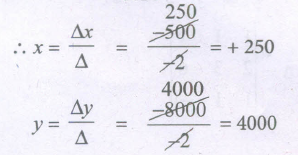
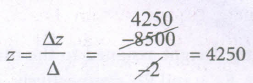
Hence, the amount invested in the three accounts are Rs. 250, Rs. 4000 and Rs. 4250 respectively.
14.
Let the weight assigned to the three varieties be Rs. x, Rs. y and Rs. z respectively By the given data,
x + 2y + 3z = 11
2x + 4y + 5z = 21
3x + 5y + 6z = 27
\(\Delta =\left| \begin{matrix} 1 & 2 & 3 \\ 2 & 4 & 5 \\ 3 & 5 & 6 \end{matrix} \right| =1\left| \begin{matrix} 4 & 5 \\ 5 & 6 \end{matrix} \right| -2\left| \begin{matrix} 2 & 5 \\ 3 & 6 \end{matrix} \right| +3\left| \begin{matrix} 2 & 4 \\ 3 & 5 \end{matrix} \right| \)
= 1(24 - 25) -2(12 - 15) + 3(10 - 12)
= 1(-1) -2 (-3) + 3(-2)
= -1+6 - 6 = -1\(\neq \) 0.
Since \(\Delta \neq 0\) the system is consistent with unique solution and Cramer's rule can be applied.
\(\Delta x=\left| \begin{matrix} 11 & 2 & 3 \\ 21 & 4 & 5 \\ 27 & 5 & 6 \end{matrix} \right| \)
\(=11\left| \begin{matrix} 4 & 5 \\ 5 & 6 \end{matrix} \right| -2\left| \begin{matrix} 21 & 5 \\ 27 & 6 \end{matrix} \right| +3\left| \begin{matrix} 21 & 4 \\ 27 & 5 \end{matrix} \right| \)
= 11(24 - 25) - 2(126 - 135) + 3(105 - 108)
= 11(-1) - 2(-9) + 3 (-3)
= 11+18-9
= -2
\(\Delta y=\left| \begin{matrix} 1 & 11 & 3 \\ 2 & 21 & 5 \\ 3 & 27 & 6 \end{matrix} \right| \)
= \(\left| \begin{matrix} 21 & 5 \\ 27 & 6 \end{matrix} \right| -11\left| \begin{matrix} 2 & 5 \\ 3 & 6 \end{matrix} \right| +3\left| \begin{matrix} 2 & 21 \\ 3 & 27 \end{matrix} \right| \)
= 1(126 - 135) - 11(12 -15) + 3(54 - 63)
= - 9 - 11(-3) + 3(-9)
= - 9 + 33 - 27
= 3
\(\Delta z=\left| \begin{matrix} 1 & 2 & 11 \\ 2 & 4 & 21 \\ 3 & 5 & 27 \end{matrix} \right| =1\left| \begin{matrix} 4 & 21 \\ 5 & 27 \end{matrix} \right| -2\left| \begin{matrix} 2 & 21 \\ 3 & 27 \end{matrix} \right| +11\left| \begin{matrix} 2 & 4 \\ 3 & 5 \end{matrix} \right| \)
= 1(108 - 105) - 2(54 - 63) + 11(10 - 12)
= 1(3) - 2(-9) + 11(-2)
= 3 + 18 - 22
= -1
\(x=\cfrac { \Delta x }{ \Delta } =\cfrac { -2 }{ -1 } =2\)
\(y=\cfrac { \Delta y }{ \Delta } =\cfrac { -3 }{ 1 } =3\)
and \(z=\cfrac { \Delta z }{ \Delta } =\cfrac { -1 }{ -1 } =1\)
Hence, the weights assigned to the three varieties are 2, 3 and 1 respectively
15.
Let ‘x’ be the number of cars of type C1
Let ‘y’ be the number of cars of type C2
Let ‘z’ be the number of cars of type C3
3x + 2y + 4z = 28
x + y + 2z =13
2x + 2y + z =14
Here \({ \triangle }=\left| \begin{matrix} 3 & 2 & 4 \\ 1 & 1 & 2 \\ 2 & 2 & 1 \end{matrix} \right| =-3\neq 0\)
\({ \triangle }_{ x }=\left| \begin{matrix} 28 & 2 & 4 \\ 13 & 1 & 2 \\ 14 & 2 & 1 \end{matrix} \right| =-6\)
\({ \triangle }_{ y }=\left| \begin{matrix} 3 & 28 & 4 \\ 1 & 1 & 2 \\ 2 & 2 & 1 \end{matrix} \right| =-9\)
\({ \triangle }_{ z }=\left| \begin{matrix} 3 & 2 & 28 \\ 1 & 1 & 13 \\ 2 & 2 & 14 \end{matrix} \right| =-12\)
\(\therefore \) By Cramer’s rule
\(x=\frac { { \triangle }x }{ { \triangle } } =\frac { -6 }{ -3 } =2\)
\(y=\frac { { \triangle }y }{ { \triangle } } =\frac { -9 }{ -3 } =3\)
\(z=\frac { { \triangle }z }{ { \triangle } } =\frac { -12 }{ -3 } =4\)
\(\therefore \) The number of cars of each type which can be produced are 2, 3 and 4.
16.
Let ‘x’ be the cost of a Business Mathematics book
Let ‘y’ be the cost of a Accountancy book.
Let ‘z’ be the cost of a Commerce book.
\(\therefore \) 3x + 2y + z = 840
2x + y + z = 570
x + y + 2z = 630
Here \({ \triangle }=\left| \begin{matrix} 3 & 2 & 1 \\ 2 & 1 & 1 \\ 1 & 1 & 2 \end{matrix} \right| =-2\neq 0\)
\({ \triangle }_{ x }=\left| \begin{matrix} 840 & 2 & 1 \\ 570 & 1 & 1 \\ 630 & 1 & 2 \end{matrix}\begin{matrix} 1 \\ 1 \\ 2 \end{matrix} \right| =-240 \)
\({ \triangle }_{ y }=\left| \begin{matrix} 3 & 840 & 1 \\ 2 & 570 & 1 \\ 1 & 630 & 2 \end{matrix} \right| =-300 \)
\({ \triangle }_{ z }=\left| \begin{matrix} 3 & 2 & 840 \\ 2 & 1 & 570 \\ 1 & 1 & 630 \end{matrix} \right| =-360\)
\(\therefore \) By Cramer’s rule
\(x=\frac { { \triangle }x }{ { \triangle } } =\frac { -240 }{ -2 } =120 \)
\(y=\frac { { \triangle }y }{ { \triangle } } =\frac { 300 }{ -2 } =150 \)
\(z=\frac { { \triangle }z }{ { \triangle } } =\frac { 360 }{ -2 } =180\)
\(\therefore \) The cost of a Business Mathematics book is Rs. 120,
the cost of a Accountancy book is Rs. 150 and
the cost of a Commerce book is Rs. 180.
17.
Here \(\triangle =\left| \begin{matrix} 1 & 1 & 1 \\ 2 & -1 & 3 \\ 3 & 2 & -1 \end{matrix} \right| =13\neq 0\)
\(\therefore \) We can apply Cramer’s Rule and the system is consistent and it has unique solution.
\({ \triangle }_{ x }=\left| \begin{matrix} 1 & 1 & 1 \\ 2 & -1 & 3 \\ 3 & 2 & -1 \end{matrix} \right| =-13\)
\( { \triangle }_{ y }=\left| \begin{matrix} 1 & 4 & 1 \\ 2 & 1 & 3 \\ 3 & 1 & -1 \end{matrix} \right| =39\)
\( { \triangle }_{ z }=\left| \begin{matrix} 1 & 1 & 4 \\ 2 & -1 & 1 \\ 3 & 2 & 1 \end{matrix} \right| =26\)
\(\therefore \) By Cramer’s rule
\(x=\frac { { \triangle }x }{ { \triangle } } =\frac { -13 }{ 13 } =-1\)
\( y=\frac { { \triangle }y }{ { \triangle } } =\frac { 39 }{ 13 } =3\)
\( z=\frac { { \triangle }z }{ { \triangle } } =\frac { 26 }{ 13 } =2\)
\(\therefore \) The solution is (x, y, z) = (−1, 3, 2)
18.
Let the amount of investment in each bond be
Rs. x, Rs. y, Rs. z respectively.
Given x + y + z = 5000 ..(1)
Also \(\cfrac { 6x }{ 100 } +\cfrac { 7y }{ 100 } +\cfrac { 8z }{ 100 } =358\)
∴ Interes \(= \cfrac { PNR }{ 100 } =\cfrac { x\times 1\times 6 }{ 100 } =\cfrac { 6x }{ 100 } \)
\(\Rightarrow \cfrac { 6x+7y+8z }{ 100 } =358\)
\(\Rightarrow 6x+7y++8z=35800\)
Given that \(\cfrac { 6x }{ 100 } +\cfrac { 7y }{ 100 } =70+\cfrac { 8z }{ 100 } \)
\(\Rightarrow 6x+7y=7008z\)
\(\Rightarrow 6x+7y-8z=7000\)
The matrix equation corresponding to the given system is
\(\left( \begin{matrix} 1 & 1 & 1 \\ 6 & 7 & 8 \\ 6 & 7 & -8 \end{matrix} \right) \left( \begin{matrix} x \\ y \\ z \end{matrix} \right) =\left( \begin{matrix} 5000 \\ 35800 \\ 7000 \end{matrix} \right) \)
| Augmented matrix [A,B] | Elementary Transformation |
|---|---|
| \(\left( \begin{matrix} 1 & 1 & 1 \\ 6 & 7 & 8 \\ 6 & 7 & -8 \end{matrix}\begin{matrix} 5000 \\ 35800 \\ 7000 \end{matrix} \right) \) | |
| \(\left( \begin{matrix} 1 & 1 & 1 \\ 0 & 1 & 2 \\ 0 & 1 & -14 \end{matrix}\begin{matrix} 5000 \\ 5800 \\ -2300 \end{matrix} \right) \) | \(\ { R }_{ 2 }\rightarrow { R }_{ 2 }-6{ R }_{ 1 }\) \({ { R }_{ 3 }\rightarrow { R }_{ 3 }-{ 6R }_{ 1 } }\) |
| \(\left( \begin{matrix} 1 & 1 & 1 \\ 0 & 1 & 2 \\ 0 & 0 & -16 \end{matrix}\begin{matrix} 5000 \\ 5800 \\ -28800 \end{matrix} \right) \) | \({ R }_{ 3 }\rightarrow { R }_{ 3 }-{ R }_{ 2 }\) |
The last equivalent matrix is in echelon form and ρ(A) = ρ([A,B]) = 3 = Number of unknowns
Thus, the given system is consistent with unique solution. To find the solution, let us rewrite the above echelon form into the matrix form
\(\left( \begin{matrix} 1 & 1 & 1 \\ 0 & 1 & 2 \\ 0 & 0 & -16 \end{matrix} \right) \left( \begin{matrix} x \\ y \\ z \end{matrix} \right) =\left( \begin{matrix} 5000 \\ 5800 \\ -28800 \end{matrix} \right) \)
\(\Rightarrow x+y+z=5000\) ...(1)
\(\Rightarrow y+2z=5800\) ..(2)
\(\Rightarrow -16z=-28800\) ...(3)
\((3)\Rightarrow -16z=-28800\)
\(\Rightarrow z=\cfrac { 28800 }{ -16 } =1800\)
Substituting z = 1800 in (2) we get,
y + 2(1800) = 5800
\(\Rightarrow\) y + 3600 = 5800
\(\Rightarrow\) y=5800-3600
\(\Rightarrow\) y = 2200
Substituting y = 2200 and z = 1800 in (1) we get
\(\Rightarrow\) x + 2200 + 1800 = 5000
\(\Rightarrow\)x + 4000 = 5000
\(\Rightarrow\)x = 5000 - 4000
\(\Rightarrow\)x = 1000
Hence, the amount of investment in each bond is Rs. 1000, Rs. 2200 and Rs. 1800 respectively
19.
Given that the price of commodities X, Y and Z are x, y and z respectively
By the given data
| Transaction | x | y | z | Earning |
|---|---|---|---|---|
| Mr. Anand | +2 | +3 | -6 | Rs.5000 |
| Mr. Amar | +3 | -1 | +2 | Rs.2000 |
| Mr. Amit | -1 | +3 | +1 | Rs.5500 |
Here, purchasing is taken as negative symbol and selling is taken as positive symbol
Thus, the non-homogeneous equations are
2x + 3y - 6z = 5000
3x - y + 2z = 2000
-x + 3y + z = 550
The matrix equation corresponding to the given system is
\(\left( \begin{matrix} 2 & 3 & -6 \\ 3 & -1 & 2 \\ -1 & 3 & 1 \end{matrix} \right) \left( \begin{matrix} x \\ y \\ z \end{matrix} \right) =\left( \begin{matrix} 5000 \\ 2000 \\ 5500 \end{matrix} \right) \)
| Augmented matrix | Elementary Transformation |
|---|---|
| \(\left( \begin{matrix} 2 & 3 & -6 \\ 3 & -1 & 2 \\ -1 & 3 & 1 \end{matrix}\begin{matrix} 5000 \\ 2000 \\ 5500 \end{matrix} \right) \) | |
| \(\left( \begin{matrix} -1 & 3 & 1 \\ 3 & -1 & 2 \\ 2 & 3 & -6 \end{matrix}\begin{matrix} 5500 \\ 2000 \\ 5000 \end{matrix} \right) \) |  |
| \(\left( \begin{matrix} 1 & -3 & -1 \\ 3 & -1 & 2000 \\ 2 & 3 & -6 \end{matrix}\begin{matrix} -5000 \\ 2000 \\ 5500 \end{matrix} \right) \) | \({ R }_{ 1 }\rightarrow { R }_{ 1 }\left( -1 \right) \) |
| \(\left( \begin{matrix} 1 & -3 & -1 \\ 0 & 8 & 5 \\ 0 & 9 & -4 \end{matrix}\begin{matrix} -5500 \\ 18500 \\ 16000 \end{matrix} \right) \) | \({ R }_{ 2 }\rightarrow { R }_{ 2 }-3{ R }_{ 1 }\) \({ R }_{ 3 }\rightarrow { R }_{ 3 }-2{ R }_{ 1 }\) |
| \(\left( \begin{matrix} 1 & -3 & -1 \\ 0 & 1 & \frac { 65 }{ 8 } \\ 0 & 1 & \frac { -4 }{ 9 } \end{matrix}\begin{matrix} -5500 \\ \frac { 18500 }{ 8 } \\ \frac { 16000 }{ 9 } \end{matrix} \right) \) | \({ R }_{ 2 }\rightarrow { R }_{ 2 }\div 8\) \({ R }_{ 3 }\rightarrow { R }_{ 3 }\div 9\) |
| \(\left( \begin{matrix} 1 & -3 & -1 \\ 0 & 1 & \frac { 5 }{ 8 } \\ 0 & 0 & \frac { -4 }{ 9 } -\frac { 5 }{ 8 } \end{matrix}\begin{matrix} -5500 \\ \frac { 18500 }{ 8 } \\ \frac { 16000 }{ 9 } -\cfrac { 18500 }{ 8 } \end{matrix} \right) \) | \({ R }_{ 3 }\rightarrow R_{ 3 }-{ R }_{ 2 }\) |
| \(\left( \begin{matrix} 1 & -3 & -1 \\ 0 & 1 & \frac { 5 }{ 8 } \\ 0 & 0 & \frac { -77 }{ 72 } \end{matrix}\begin{matrix} -5500 \\ \frac { 18500 }{ 8 } \\ \frac { -38500 }{ 72 } \end{matrix} \right) \) |
.Clearly the last equivalent matrix is in echelon form and it has three non-zero rows
\(\therefore \rho (A)=\rho \left( \left[ A,B \right] \right) =3\) Number of unknowns.
\(\therefore\) The given system is consistent and has unique solution. To find the solution, let us rewrite the above : echelon form into the matrix form.
\(\left( \begin{matrix} 1 & -3 & -1 \\ 0 & 1 & \frac { 5 }{ 8 } \\ 0 & 0 & \frac { -77 }{ 72 } \end{matrix} \right) \left( \begin{matrix} x \\ y \\ z \end{matrix} \right) \left( \begin{matrix} -5000 \\ \frac { 18500 }{ 8 } \\ \frac { -38500 }{ 72 } \end{matrix} \right) \)
\(\Rightarrow x-3y-z=-5500\)
\(y+\cfrac { 5 }{ 8 } z=\cfrac { 18500 }{ 8 } \)
\(\cfrac { -77 }{ 72 } z=\cfrac { 38500 }{ 72 } \)
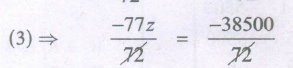
\(\Rightarrow z=\cfrac { -38500 }{ -77 } \)
\(\Rightarrow z=500\)
\((2)\Rightarrow y+\cfrac { 5 }{ 8 } \left( 500 \right) =\cfrac { 18500 }{ 8 } \)
\(y=\cfrac { 18500 }{ 8 } -\cfrac { 2500 }{ 8 } \)
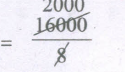
\(\Rightarrow y=2000\)
\((1)\Rightarrow x-3\left( 2000 \right) -500=-5500\)
\(\Rightarrow x-6000-500=-5500\)
\(\Rightarrow x-6000-500=-5500\)
\(\Rightarrow x=-5500+6500\)
\(\Rightarrow x=1000\)
Hence, the prices per unit of three commodities are Rs.1000, Rs. 2000 and Rs. 500 respectively
20.
Given non-homogeneous equations are
\(3x-y+\lambda z=1\)
\(2x+y+z=2\)
\(x+2y-\lambda z=-1\)
The matrix equation corresponding to the given system is
| Augmented matrix [A,B] | Elementary Transformation |
|---|---|
| \(\left( \begin{matrix} 3 & -1 & \lambda \\ 2 & 1 & 1 \\ 1 & 2 & - \end{matrix}\begin{matrix} 1 \\ 2 \\ -1 \end{matrix} \right) \) | |
| \(\sim \left( \begin{matrix} 1 & 2 & -\lambda \\ 2 & 1 & 1 \\ 3 & -1 & \lambda \end{matrix}\begin{matrix} -1 \\ 2 \\ 1 \end{matrix} \right) \) | \({ R }_{ 1 }\leftrightarrow { R }_{ 3 }\) |
| \(\sim \left( \begin{matrix} 1 & 2 & -\lambda \\ 0 & -3 & 1+2\lambda \\ 3 & -1 & \lambda \end{matrix}\begin{matrix} -1 \\ 4 \\ 1 \end{matrix} \right) \) | \({ R }_{ 2 }\rightarrow { R }_{ 2 }-2{ R }_{ 1 }\) |
| \(\left( \begin{matrix} 1 & 2 & -\lambda \\ 0 & -3 & 1+2\lambda \\ 0 & -7 & 4\lambda \end{matrix}\begin{matrix} -1 \\ 4 \\ 4 \end{matrix} \right) \) | \({ R }_{ 3 }\rightarrow { R }_{ 3 }-3{ R }_{ 1 }\) |
| \(\sim \left( \begin{matrix} 1 & 2 & -\lambda \\ 0 & -1 & \frac { 1+2\lambda }{ 3 } \\ 0 & - & \frac { 4\lambda }{ 7 } \end{matrix}\begin{matrix} -1 \\ \frac { 4 }{ 3 } \\ \frac { 4 }{ 7 } \end{matrix} \right) \) | \({ R }_{ 2 }\rightarrow { R }_{ 2 }\div 3\) \({ R }_{ 3 }\rightarrow { R }_{ 3 }\div 7\) |
| \(\left( \begin{matrix} 1 & 2 & -\lambda \\ 0 & -1 & \frac { 1+2 }{ 3 } \\ 0 & 0 & \frac { -7-2\lambda }{ 21 } \end{matrix}\begin{matrix} -1 \\ \frac { 4 }{ 3 } \\ \frac { -16 }{ 21 } \end{matrix} \right) \) | \({ R }_{ 3 }\rightarrow { R }_{ 3 }-{ R }_{ 2 }\) |
Since
\(\cfrac { 4\lambda }{ 7 } -\cfrac { 1+2\lambda }{ 3 } \)
= \(\cfrac { 12\lambda -7-14\lambda }{ 21 } =\cfrac { -7-2\lambda }{ 21 } \)
and \(\cfrac { 4 }{ 7 } -\cfrac { 4 }{ 3 } =\cfrac { 12-28 }{ 21 } \)
= \(\cfrac { -16 }{ 21 } \)
\(\therefore\) Since the system is fail to have unique solution either it can have infinitely many solution or it may be inconsistent.
This can happen only when \(\cfrac { -7-2\lambda }{ 21 } =0\)
\(\Rightarrow -7-2\lambda =0\)
\(\Rightarrow -7=2\lambda \)
\(\Rightarrow \lambda =\cfrac { -7 }{ 2 } \)
21.
Given non-homogeneous equations are
5x+ 3y + 7z = 4
3x + 26y + 2z = 9
7x + 2y + 10z = 5
The matrix equation corresponding to the given system is
\(\left( \begin{matrix} 5 & 3 & 7 \\ 3 & 26 & 2 \\ 7 & 2 & 10 \end{matrix} \right) \left( \begin{matrix} x \\ y \\ z \end{matrix} \right) =\left( \begin{matrix} 4 \\ 9 \\ 5 \end{matrix} \right) \)
| Augmented matrix [A, B] | Elementary Transformation |
|---|---|
| \(\left( \begin{matrix} 5 & 3 & 7 \\ 3 & 26 & 2 \\ 7 & 2 & 10 \end{matrix}\begin{matrix} 4 \\ 9 \\ 5 \end{matrix} \right) \) | |
| \(\sim \left( \begin{matrix} 3 & 26 & 2 \\ 5 & 3 & 7 \\ 7 & 2 & 10 \end{matrix}\begin{matrix} 9 \\ 4 \\ 5 \end{matrix} \right) \) | \({ R }_{ 1 }\leftrightarrow { R }_{ 2 }\) |
| \(\left( \begin{matrix} 1 & \frac { 26 }{ 3 } & \frac { 2 }{ 3 } \\ 5 & 3 & 7 \\ 7 & 2 & 10 \end{matrix}\begin{matrix} 3 \\ 4 \\ 5 \end{matrix} \right) \) | \({ R }_{ 1 }\rightarrow { R }_{ 1 }\div 3\) |
| \(\left( \begin{matrix} 1 & \frac { 26 }{ 3 } & \frac { 2 }{ 3 } \\ 0 & \frac { -121 }{ 3 } & \frac { 11 }{ 3 } \\ 7 & 2 & 5 \end{matrix}\begin{matrix} 3 \\ -11 \\ 5 \end{matrix} \right) \) | \({ R }_{ 2 }\rightarrow { R }_{ 2 }-5{ R }_{ 1 }\) |
| \(\left( \begin{matrix} 1 & \frac { 26 }{ 3 } & \frac { 2 }{ 3 } \\ 0 & \frac { -121 }{ 3 } & \frac { 11 }{ 3 } \\ 0 & \frac { -176 }{ 3 } & \frac { 16 }{ 3 } \end{matrix}\begin{matrix} 3 \\ -11 \\ -16 \end{matrix} \right) \) | \({ R }_{ 3 }\rightarrow { R }_{ 3 }-7{ R }_{ 1 }\) |
| \(\sim \left( \begin{matrix} 1 & \frac { 26 }{ 3 } & \frac { 2 }{ 3 } \\ 0 & \frac { -11 }{ 3 } & \frac { 1 }{ 3 } \\ 0 & \frac { -11 }{ 3 } & \frac { 1 }{ 3 } \end{matrix}\begin{matrix} 3 \\ -1 \\ -1 \end{matrix} \right) \) | \({ R }_{ 2 }\rightarrow { R }_{ 2 }\div 11\) \({ R }_{ 3 }\rightarrow { R }_{ 3 }\div 16\) |
| \(\left( \begin{matrix} 1 & \frac { 26 }{ 3 } & \frac { 2 }{ 3 } \\ 0 & \frac { -11 }{ 3 } & \frac { 1 }{ 3 } \\ 0 & 0 & 0 \end{matrix}\begin{matrix} 3 \\ -1 \\ 0 \end{matrix} \right) \) | \({ R }_{ 3 }\rightarrow { R }_{ 3 }-{ R }_{ 2 }\) |
\(\therefore\) The system is consistent with infinitely many solutions let us rewrite the above echelon form into matrix form
\(\left( \begin{matrix} 1 & \frac { 26 }{ 3 } & \frac { 2 }{ 3 } \\ 0 & \frac { -11 }{ 3 } & \frac { 1 }{ 3 } \\ 0 & 0 & 0 \end{matrix} \right) \left( \begin{matrix} x \\ y \\ z \end{matrix} \right) =\left( \begin{matrix} 3 \\ -1 \\ 0 \end{matrix} \right) \)
\(x+\cfrac { 26 }{ 3 } y+\cfrac { 2 }{ 3 } z=3\)
\(x+\cfrac { 26 }{ 3 } y+\cfrac { 2 }{ 3 } z=3\)
let z = k where k\(\in\) R
\((2)\Rightarrow \cfrac { -11 }{ 3 } y+\cfrac { k }{ 3 } =-1\)
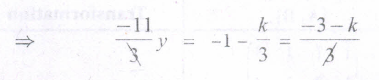
\(\Rightarrow \ -11y=-3-k\)
11y = 3 + k
\(\Rightarrow \quad y=\cfrac { 1 }{ 11 } \left( 3+k \right) \)
Substituting \(y=\cfrac { 1 }{ 11 } \left( 3+k \right) \) and z = k in (1) we get,
\(x+\cfrac { 26 }{ 3 } \left( \cfrac { 3+k }{ 11 } \right) +\cfrac { 2 }{ 3 } k=3\)
\(=\cfrac { 26 }{ 3 } \left( \cfrac { 3+k }{ 11 } \right) -\cfrac { 2k }{ 3 } +3\)
\(\cfrac { 78-26k }{ 33 } -\cfrac { 2k }{ 3 } +3\)
\(\cfrac { 78-26k-22k+99 }{ 33 } \)
\(\cfrac { 78-26k-22k+99 }{ 33 } \)
\(\cfrac { 21-48k }{ 33 } =\cfrac { 3(7-16k) }{ 33 } \)
= \(\cfrac { 1 }{ 11 } (7-6k)\)
\(\therefore\) Solution set is \(\left\{ \cfrac { 1 }{ 11 } \left( 7-16k \right), \cfrac { 1 }{ 11 } (3+k),k \right\} \)K \(\in\) R
Hence, for different values of k, we get infinitely many solutions.
22.
23.
We have, P = a + bl + cm
Putting above values we have
6,950 = a + 40b + 10c
6,725 = a + 35b + 9c
7,100 = a + 40b + 12c
The Matrix equation corresponding to the given system is
\(\left( \begin{matrix} 1 & 40 & 10 \\ 1 & 35 & 9 \\ 1 & 40 & 12 \end{matrix} \right) \left( \begin{matrix} a \\ b \\ c \end{matrix} \right) =\left( \begin{matrix} 6950 \\ 6725 \\ 7100 \end{matrix} \right) \)
| Augmented matrix [A,B] | Elementary Transformation |
| \(\left( \begin{matrix} 1 & 40 & 10 \\ 1 & 35 & 9 \\ 1 & 40 & 12 \end{matrix}\begin{matrix} 6950 \\ 6725 \\ 7100 \end{matrix} \right) \) \(\left( \begin{matrix} 1 & 40 & 10 \\ 0 & -5 & -1 \\ 0 & 0 & 2 \end{matrix}\begin{matrix} 6950 \\ -225 \\ 150 \end{matrix} \right) \) |
\({ R }_{ 2 }\rightarrow { R }_{ 2 }-{ R }_{ 1 }\) \({ R }_{ 3 }\rightarrow { R }_{ 3 }-{ R }_{ 1 }\) |
| \(\rho (A)=3,\rho ([A,B])=3\) |
\(\therefore \) The given system is equivalent to the matrix equation
\(\left( \begin{matrix} 1 & 40 & 10 \\ 0 & -5 & -1 \\ 0 & 0 & 2 \end{matrix} \right) \left( \begin{matrix} a \\ b \\ c \end{matrix} \right) =\left( \begin{matrix} 6950 \\ -225 \\ 150 \end{matrix} \right) \)
a + 40b + 10c = 6950 (1)
-5b - c = -225 (2)
2c = 150 (3)
c- = 75
Now, (2) \(\Rightarrow \) -5b - 75 = -225
b = 30
and (1) \(\Rightarrow \) a + 1200 + 750 = 6950
a = 5000
a = 5000, b = 30, c = 75
\(\therefore \) The production equation is P = 5000 + 301 + 75m
\(\therefore \) Pat l = 50, m = 15 = 5000 + 30(50) + 75(15)
= 7625 units.
\(\therefore \) The production = 7,625 units.
24.
The matrix equation corresponding to the given system is
\(\left( \begin{matrix} 1 & 1 & 1 \\ 1 & 2 & 3 \\ 1 & 2 & a \end{matrix} \right) \left( \begin{matrix} X \\ Y \\ Z \end{matrix} \right) =\left( \begin{matrix} 6 \\ 10 \\ b \end{matrix} \right) \)
AX = B
| Augmented matrix [A,B] | Elementary Transformation |
| \(\left( \begin{matrix} 1 & 1 & 1 \\ 1 & 2 & 3 \\ 1 & 2 & a \end{matrix}\begin{matrix} 6 \\ 10 \\ b \end{matrix} \right) \) \(\sim \left( \begin{matrix} 1 & 1 & 1 \\ 0 & 1 & 2 \\ 0 & 1 & a-1 \end{matrix}\begin{matrix} 6 \\ 4 \\ b-6 \end{matrix} \right) \) \(\sim \left( \begin{matrix} 1 & 1 & 1 \\ 0 & 1 & 2 \\ 0 & 0 & a-3 \end{matrix}\begin{matrix} 6 \\ 4 \\ b-10 \end{matrix} \right) \) |
\({ R }_{ 2 }\rightarrow { R }_{ 2 }-{ R }_{ 1 }\) \({ R }_{ 3 }\rightarrow { R }_{ 3 }-{ R }_{ 1 }\) |
Case (i) For no solution:
The system possesses no solution only when \(\rho (A)\neq ([A,B])\) which is possible only when a−3 = 0 and b −10 \(\neq \) 0.
Hence for a = 3, b \(\neq \) 10, the system possesses no solution.
Case (ii) For a unique solution:
The system possesses a unique solution only when \(\rho (A)= ([A,B])\)=number of unknowns.
i.e when \(\rho (A)=\rho ([A,B])\) = 3
Which is possible only when a−3 \(\neq \) 0 and b may be any real number as we can observe .
Hence for a \(\neq \) and b \(\in \) R, the system possesses a unique solution.
Case (iii) For an infinite number of solutions:
The system possesses an infinite number of solutions only when
\(\rho (A)=\rho ([A,B])\)
Hence for a = 3, b = 10, the system possesses infinite number of solutions.
25.
The matrix equation corresponding to the given system is
\(\left( \begin{matrix} 1 & 1 & 1 \\ 1 & 2 & 3 \\ 0 & 1 & k \end{matrix} \right) \left( \begin{matrix} X \\ Y \\ Z \end{matrix} \right) =\left( \begin{matrix} 7 \\ 18 \\ 6 \end{matrix} \right) \)
AX = B
| Augmented matrix [A,B] | Elementary Transformation |
|
\(\left( \begin{matrix} 1 & 1 & 1 \\ 1 & 2 & 3 \\ 0 & 1 & k \end{matrix}\begin{matrix} 7 \\ 18 \\ 6 \end{matrix} \right) \) ρ(A) = 2 or 3, ρ([A]) = 3 |
\({ R }_{ 2 }\rightarrow { R }_{ 2 }-{ R }_{ 1 }\) \({ R }_{ 3 }\rightarrow { R }_{ 3 }-{ R }_{ 2 }\) |
For the equations to be inconsistent
\(\rho ([A,B])\neq \rho (A)\)
It is possible if k − 2 = 0.
\(\therefore \) k = 2
26.
The matrix equation corresponding to the given system is
\(\left( \begin{matrix} 1 & 2 & -3 \\ 3 & -1 & -2 \\ 2 & 3 & -5 \end{matrix} \right) \left( \begin{matrix} X \\ Y \\ Z \end{matrix} \right) =\left( \begin{matrix} -2 \\ 1 \\ k \end{matrix} \right) \)
AX = B
| Augmented matrix [A,B] | Elementary Transformation |
| \(\left( \begin{matrix} 1 & 2 & -3 \\ 3 & -1 & -2 \\ 2 & 3 & -5 \end{matrix}\begin{matrix} -2 \\ 1 \\ k \end{matrix} \right) \) \(\sim \left( \begin{matrix} 1 & 2 & -3 \\ 0 & -7 & 7 \\ 0 & -1 & 1 \end{matrix}\begin{matrix} -2 \\ 7 \\ 4+k \end{matrix} \right) \) \(\sim \left( \begin{matrix} 1 & 2 & -3 \\ 0 & -7 & 7 \\ 0 & 0 & 0 \end{matrix}\begin{matrix} -2 \\ 7 \\ 21+7k \end{matrix} \right) \) |
\({ R }_{ 2 }\rightarrow { R }_{ 2 }-{ 3R }_{ 1 }\) \({ R }_{ 3 }\rightarrow { R }_{ 3 }-2{ R }_{ 1 }\) \({ R }_{ 3 }\rightarrow 7{ R }_{ 3 }-{ R }_{ 2 }\) |
| \(\rho (A)=2,\rho ([A,B])=2\quad or\quad 3\) |
For the equations to be consistent, \(\rho ([A,B])=\)\(\rho (A)=2\)
\(\therefore \) 21 + 7k = 0
7k = -21
k = -3
27.
The matrix equation corresponding to the given system is
\(\left( \begin{matrix} 1 & -4 & 7 \\ 3 & 8 & -2 \\ 7 & -8 & 26 \end{matrix} \right) \left( \begin{matrix} X \\ Y \\ Z \end{matrix} \right) =\left( \begin{matrix} 14 \\ 13 \\ 5 \end{matrix} \right) \)
AX = B
| Augmented matrix [A,B] | Elementary Transformation |
| \(\left( \begin{matrix} 1 & -4 & 7 \\ 3 & 8 & -2 \\ 7 & -8 & 26 \end{matrix}\begin{matrix} 14 \\ 13 \\ 5 \end{matrix} \right) \) \(\sim \left( \begin{matrix} 1 & -4 & 7 \\ 0 & 20 & -23 \\ 0 & 20 & -23 \end{matrix}\begin{matrix} 14 \\ -29 \\ -93 \end{matrix} \right) \) \(\sim \left( \begin{matrix} 1 & -4 & 7 \\ 0 & 20 & -23 \\ 0 & 0 & 0 \end{matrix}\begin{matrix} 14 \\ -29 \\ 64 \end{matrix} \right) \) |
|
| \(\rho (A)=2,\rho ([A,B])=3\) |
The last equivalent matrix is in the echelon form. [A, B] has 3 non-zero rows and [A] has 2 non-zero rows.
\(\therefore \rho ([A,B])=3\),\(\rho (A)=2,\)
\(\rho (A)\neq ([A,B])\)
The system is inconsistent and has no solution.
28.
The matrix equation corresponding to the given system is
\(\left( \begin{matrix} 1 & 1 & 1 \\ 1 & 2 & 3 \\ 1 & 4 & 7 \end{matrix} \right) \left( \begin{matrix} X \\ Y \\ Z \end{matrix} \right) =\left( \begin{matrix} 6 \\ 14 \\ 30 \end{matrix} \right) \)
A X = B
| Augmented matrix [A,B] | Elementary Transformation |
| \(\left( \begin{matrix} 1 & 1 & 1 \\ 1 & 2 & 3 \\ 1 & 4 & 7 \end{matrix}\begin{matrix} 6 \\ 14 \\ 30 \end{matrix} \right) \) \(\sim \left( \begin{matrix} 1 & 1 & 1 \\ 0 & 1 & 2 \\ 0 & 2 & 4 \end{matrix}\begin{matrix} 6 \\ 8 \\ 16 \end{matrix} \right) \) \(\sim \left( \begin{matrix} 1 & 1 & 1 \\ 0 & 1 & 2 \\ 0 & 0 & 0 \end{matrix}\begin{matrix} 6 \\ 8 \\ 0 \end{matrix} \right) \) |
\({ R }_{ 2 }\rightarrow { R }_{ 2 }-{ R }_{ 1 }\) \({ R }_{ 3 }\rightarrow { R }_{ 3 }-{ R }_{ 2 }\) \({ R }_{ 3 }\rightarrow { R }_{ 3 }-{ 2R }_{ 2 }\) |
| \(\rho (A)=2,\rho ([A,B])=2\) |
Obviously the last equivalent matrix is in the echelon form. It has two non-zero rows.
\(\rho (A)=2,\rho ([A,B])=2\)
\(\rho (A)=2,\rho ([A,B])=2\)
The given system is equivalent to the matrix equation,
\(\left( \begin{matrix} 1 & 1 & 1 \\ 0 & 1 & 2 \\ 0 & 0 & 0 \end{matrix} \right) \left( \begin{matrix} X \\ Y \\ Z \end{matrix} \right) =\left( \begin{matrix} 6 \\ 8 \\ 0 \end{matrix} \right) \)
x + y + z = 6 (1)
y + 2z = 8 (2)
\((2)\Rightarrow \)Y = 8 - 2Z,
\((2)\Rightarrow \) X = 6 - Y - Z = 6 - (8 - 2z) - Z = z - 2
Let us take z = k,k \(\in \) R, we get x = k − 2, y = 8 − 2k, Thus by giving different values for k we get different solutions.
Hence the given system has infinitely many solutions.
29.
The matrix equation corresponding to the given system is
\(\left( \begin{matrix} 2 & 1 & 1 \\ 1 & 1 & 1 \\ 1 & -1 & 2 \end{matrix} \right) \left( \begin{matrix} X \\ Y \\ Z \end{matrix} \right) =\left( \begin{matrix} 5 \\ 4 \\ 1 \end{matrix} \right) \)
A X = B
| Augmented matrix [A,B] | Elementary Transformation |
| \(\left( \begin{matrix} 2 & 1 & 1 \\ 1 & 1 & 1 \\ 1 & -1 & 2 \end{matrix}\begin{matrix} 5 \\ 4 \\ 1 \end{matrix} \right) \) \(\sim \left( \begin{matrix} 1 & 1 & 1 \\ 2 & 1 & 1 \\ 1 & -1 & 2 \end{matrix}\begin{matrix} 4 \\ 5 \\ 1 \end{matrix} \right) \) \( \left( \begin{matrix} 1 & 1 & 1 \\ 0 & -1 & -1 \\ 1 & -2 & 1 \end{matrix}\begin{matrix} 4 \\ -3 \\ -3 \end{matrix} \right) \) \(\sim \left( \begin{matrix} 1 & 1 & 1 \\ 2 & -1 & -1 \\ 0 & 0 & 3 \end{matrix}\begin{matrix} 4 \\ -3 \\ 3 \end{matrix} \right) \) |
\({ R }_{ 1 }\leftrightarrow { R }_{ 2 }\) \({ R }_{ 2 }\rightarrow { R }_{ 2 }-{ 2R }_{ 1 }\) \({ R }_{ 3 }\rightarrow { R }_{ 3 }-{ R }_{ 1 }\) \({ R }_{ 3 }\rightarrow { R }_{ 3 }-{ 2R }_{ 2 }\) |
| \(\rho (A)=3,\) \(\rho ([A,B])=3\) |
Obviously the last equivalent matrix is in the echelon form. It has three non-zero rows.
\(\rho (A)=3,\) \(\rho ([A,B])=3\) = Number of unknowns .
The given system is consistent and has unique solution.
To find the solution, let us rewrite the above echelon form into the matrix form.
\(\left( \begin{matrix} 1 & 1 & 1 \\ 0 & -1 & -1 \\ 0 & 0 & 3 \end{matrix} \right) \left( \begin{matrix} X \\ Y \\ Z \end{matrix} \right) =\left( \begin{matrix} 4 \\ -3 \\ 3 \end{matrix} \right) \)
x + y + z = 4 (1)
y + z = 3 (2)
3z = 3 (3)
\((3)\Rightarrow z=1\)
\((2)\Rightarrow y=3-z=2 \)
\((1)\Rightarrow x=4-y-z\)
x = 1
\(\therefore \) x = 1, y = 2, z = 1

12th Standard Syllabus & Materials
12th Standard
TN 12th Computer Applications களப்பெயர் முறைமை (DNS) Sample Question Papers Study Material - QB365 Set A
NEW12th Standard
TN 12th Computer Applications வலையமைப்பு எடுத்துக்காட்டுகள் மற்றும் நெறிமுறைகள் Sample Question Papers Study Material - QB365 Set A
NEW12th Standard
TN 12th Computer Applications கணினி வலையமைப்பு ஓர் அறிமுகம் Sample Question Papers Study Material - QB365 Set A
NEW12th Standard
TN 12th Computer Applications PHP-உடன் MySQL-ஐ இணைத்தல் Sample Question Papers Study Material - QB365 Set A



Tamilnadu Stateboard 12th Standard Subjects

Maths

Chemistry

Physics

Biology

Computer Science
Business Maths and Statistics

Economics

Commerce

Accountancy

History

Computer Applications
Biology
Computer Technology
Computer Applications
Computer Science
Business Maths and Statistics
Commerce
Economics
Maths
Chemistry
Physics
Computer Technology
History
Accountancy

Tamil

English

French
Tamilnadu Stateboard Standards
