
 100% FREE ACCESS
12th Standard Syllabus & Materials
12th Standard
TN 12th Computer Applications மின்னணு தரவு பரிமாற்றம் Sample Question Papers Study Material - QB365 Set A
NEW12th Standard
TN 12th Computer Applications மின் - வணிக பாதுகாப்பு அமைப்புகள் Sample Question Papers Study Material - QB365 Set A
NEW12th Standard
TN 12th Computer Applications மின்னணு செலுத்தல் முறைகள் Sample Question Papers Study Material - QB365 Set A
NEW12th Standard
TN 12th Computer Applications மின் - வணிகம் Sample Question Papers Study Material - QB365 Set A
NEW12th Standard
TN 12th Computer Applications திறந்த மூல கருத்துருக்கள் Sample Question Papers Study Material - QB365 Set A
NEW12th Standard
TN 12th Computer Applications வலையமைப்பு வடமிடல் Sample Question Papers Study Material - QB365 Set A

Published on: 02/09/2022
QB365 provides a detailed and simple solution for every Possible Creative Questions in Class 12 Business Maths Subject - Retirement and Death of a Partner, English Medium. It will help Students to get more practice questions, Students can Practice these question papers in addition to score best marks.
Download Tamil Nadu 12th Standard Business Maths and Statistics question papers, model tests, one-mark questions, important questions, and public exam papers in PDF format. Free study materials and answer keys for TN State Board students.
Questions + Answers key
Take MCQ Business Maths and Statistics Test
1.
Solve the equations by determinant method.
(i) x + 2y + 5z = 23, 3x + y + 4z = 26, 6x + y + 7z = 47
(ii) 2x + 2y - z - 1 = 0, x + y -7 = 0, 3x + 2y - 3z = 1
(iii) \(\frac{1}{x}+\frac{2}{y}-\frac{1}{z}=1, \frac{2}{x}+\frac{4}{y}+\frac{1}{z}=5 ; \frac{3}{x}-\frac{2}{y}-\frac{2}{z}=0\)
2.
Examine the consistency of the system of equations. If it is consistent then solve the same.
\((i) 4 x+3 y+6 z=25, x+5 y+7 z=13, 2 x+9 y+z=1\)
\((ii) x-3 y-8 z=-10,3 x+y-4 z=0, 2 x+5 y+6 z-13=0\)
3.
For what values of k, the system of equations kx + y.+ z = 1, x+ ky + z = 1, x + y + kz = 1, have
(i) unique solution
(ii) more than one solution
(iii) No solution
4.
Discuss the solution of the system of equation for all values of \(\lambda\) \(x+y+z=2,2 x+y-2 z=2, \lambda x+y+4 z=2\)
5.
Investigate for what values of \(\lambda\) the simultaneous equations x+y+z = 6, x +2y + 3z = 10, x + 2y + \(\lambda\)z have
(i) no solution
(ii) unique solution
(iii) infinite number of solutions
6.
Show that the equations x + y + z = 6, x + 2y + 3z 14, z + 4y + 72 = 30 are consistent and solve them.
7.
Verify whether the given system of equations is consistent. If it is consistent solve, them 2x + 5y + 7z = 52, x + y + z = 9, 2x + y - z = 0.
8.
Find k if the equations x + y + z = 3, x + 3y + 2z = 6, x + 5y + 3z = k are in consistènt.
9.
Find k if the equation x + 2y 3 = -2, 3x - y - 2z = 1 and 2x + 3y 5z = k are consistent
10.
Show that the equations are consistent and have a unique. solution. Solve, them using rank method 2x-y + z = 7, 3x + y- 5z = 13, x + y + z = 0.
11.
A new transit system has just gone into operation in a city. Of those who use the transit system this year, 10% will switch over to using their own car next year and 90% will continue to use the transit system. Of those who use their cars this year, 80% will continue to use their cars next year and 20% will switch over to the transit system. Suppose the population of the city remains constant and that 50% of the commuters use the transit system and 50% of the commuters use their own car this year,
(i) What percent of commuters will be using the transit system after one year?
(ii) What percent of commuters will be using the transit system in the long run?
12.
Using determinants, find the quadratic defined by f(x) = ax2 + bx + c if
f(1) = 0,
f(2) = - 2 and
f(3) = -6.
13.
For what values of k, the system of equations kx+ y+z = 1, x+ ky+z= 1, x+ y+kz = 1 have
(I) Unique solution
(ii) More than one solution
(iii) no solution
14.
A mixture is to be made of three foods A, B, C. The three foods A, B, C contain nutrients P, Q, R as shown below
| Ounces per pound of Nutrient | |||
| Food | P | Q | R |
| A | 1 | 2 | 5 |
| B | 3 | 1 | 1 |
| C | 4 | 2 | 1 |
How to form a mixture which will have 8 ounces of P, 5 ounces of Q and 7 ounces of R? (Cramer's rule).
15.
The sum of three numbers is 6. If we multiply the third number by 2 and add the first number to the result we get 7. By adding second and third numbers to three times the first number we get 12. Find the numbers using rank method
1.
\(\Delta=\left|\begin{array}{lll} 1 & 2 & 5 \\ 3 & 1 & 4 \\ 6 & 1 & 7 \end{array}\right|\)
\(=1(7-4)-2(21-24)+5(3-6)\)
\(=3+6-15=-6 \neq 0\)
\(\Delta_{x}=\left|\begin{array}{lll} 23 & 2 & 5 \\ 26 & 1 & 4 \\ 47 & 1 & 7 \end{array}\right|\)
\(=23(7-4)-2(182-188)\) + 5 (26 - 47)
= 69 +12-105 = -24
\(\Delta_{y}=\left|\begin{array}{lll} 1 & 23 & 5 \\ 3 & 26 & 4 \\ 6 & 47 & 7 \end{array}\right|\)
= 1(182 -188) -23(21 - 24) +5(141 -156)
= -6+69-75 = -12
\(\Delta_{z}=\left|\begin{array}{lll} 1 & 2 & 23 \\ 3 & 1 & 26 \\ 6 & 1 & 47 \end{array}\right|\)
= 1(47 - 26)-2(141 - 156) +23(3 - 6) + 23(3 - 6)
= 21+ 30-69 = -18
\( x=\frac{\Delta_{x}}{\Delta}=\frac{-24}{-6}=4 \)
\( \mathrm{y}=\frac{\Delta_{y}}{\Delta}=\frac{-12}{-6}=2 \)
\( \mathrm{z}=\frac{\Delta_{z}}{\Delta}=\frac{-18}{-6}=3 \)
\( x=4, \mathrm{y}=2, \mathrm{z}=3\)
(ii) \(\Delta=\left|\begin{array}{lll} 2 & 2 & -1 \\ 1 & 1 & -1 \\ 3 & 2 & -3 \end{array}\right|\)
= 2(-3+2)-2(-3 +3)- 1(2-3)
= -2 +0+1= -1\(\neq\)0
\(\Delta_{x}=\left|\begin{array}{lll} 1 & 2 & -1 \\ 0 & 1 & -1 \\ 1 & 2 \cdot & -3 \end{array}\right|\)
= 1(-3 +2)-2(0 + 1)-1(0- 1)
= -1-2+1 = -2
\(\Delta_{y}=\left|\begin{array}{lll} 2 & 1 & -1 \\ 1 & 0 & -1 \\ 3 & 1 & -3 \end{array}\right|\)
= 2(0+1)-1(-3+3)-1 (1-0)
= 2+0-1 = 1
\(\Delta_{z}=\left|\begin{array}{lll} 2 & 2 & 1 \\ 1 & 1 & 0 \\ 3 & 2 & 1 \end{array}\right|\)
= 2(1-0)-2(1-0) +1 (2-3)
= 2 - 2 - 1 = -1
\( x=\frac{\Delta_{x}}{\Delta}=\frac{-2}{-1}=2 \)
\(y=\frac{\Delta_{y}}{\Delta}=\frac{1}{-1}=-1 \)
\( z=\frac{\Delta_{z}}{\Delta}=\frac{-1}{-1}=1 \)
x = 2, y = -1, z = 1 is the solution.
(iii) \(\frac{1}{x}+\frac{2}{y}-\frac{1}{z}=1, \frac{2}{x}+\frac{4}{y}+\frac{1}{z}=5 ; \frac{3}{x}-\frac{2}{y}-\frac{2}{z}=0\)
\(\text { Let } \frac{1}{x}=a, \frac{1}{y}=b, \frac{1}{z}=c\)
a+ 2b-c =1
2a +4b+ c = 5
3a-2b-2c = 0
\(\Delta=\left|\begin{array}{ccc} 1 & 2 & -1 \\ 2 & 4 & 1 \\ 3 & -2 & -2 \end{array}\right|\)
1(-8 +2)-2(-4-3)- 1(-4-12)
= -6+ 14+ 16 24 \(\neq\)0
\(\Delta_{a}=\left|\begin{array}{ccc} 1 & 2 & -1 \\ 5 & 4 & 1 \\ 0 & -2 & -2 \end{array}\right|\)
= 1(-8+2)-2(-10-0)-1-10-0)
= -6+20+10 = 24
\(\Delta_{b}=\left|\begin{array}{ccc} 1 & 1 & -1 \\ 2 & 5 & 1 \\ 3 & 0 & -2 \end{array}\right|\)
= 1(-10-0)-1(-4-3)-1 (0-15)
-10+7 + 15 = 12
\(\Delta_{c}=\left|\begin{array}{ccc} 1 & 2 & 1 \\ 2 & 4 & 5 \\ 3 & -2 & 0 \end{array}\right|\)
\( =1(0+10)-2(0-15)+1(-4-12) \)
= 10+30-16 = 24
\( \mathrm{a}=\frac{\Delta_{a}}{\Delta}=\frac{24}{24}=1 \Rightarrow x=1 \)
\( \mathrm{~b}=\frac{\Delta_{b}}{\Delta}=\frac{12}{24}=\frac{1}{2} \Rightarrow \mathrm{y}=2 \)
\( \mathrm{c}=\frac{\Delta_{c}}{\Delta}=\frac{24}{24}=1 \Rightarrow \mathrm{z}=1\)
2.
(i) In matrix form
\(\left(\begin{array}{lll} 4 & 3 & 6 \\ 1 & 5 & 7 \\ 2 & 9 & 1 \end{array}\right)\left(\begin{array}{l} x \\ y \\ z \end{array}\right)=\left(\begin{array}{c} 25 \\ 13 \\ 1 \end{array}\right)\)
AX = B
The augmented matrix is
\((A, B)=\left(\begin{array}{cccc} 4 & 3 & 6 & 25 \\ 1 & 5 & 7 & 13 \\ 2 & 9 & 1 & 1 \end{array}\right)\)
\(\sim\left(\begin{array}{cccc} 1 & 5 & 7 & 13 \\ 4 & 3 & 6 & 25 \\ 2 & 9 & 1 & 1 \end{array}\right) R_{1} \leftrightarrow R_{2}\)
\(\sim\left(\begin{array}{cccc} 1 & 5 & 7 & 13 \\ 0 & -17 & -22 & -27 \\ 0 & -1 & -13 & -25 \end{array}\right) R_{3} \rightarrow R_{3}-2 R_{1}\)
\(\sim\left(\begin{array}{cccc} 1 & 5 & 7 & 13 \\ 0 & -17 & -22 & -27 \\ 0 & 0 & 199 & 398 \end{array}\right) R_{3} \rightarrow-17 R_{3}+R_{2}\)
\(\rho(A, B)=\rho(A)=3\)
System is consistent and has unique solution
In matrix form
\(\left(\begin{array}{ccc} 1 & 5 & 7 \\ 0 & -17 & -22 \\ 0 & 0 & 199 \end{array}\right)\left(\begin{array}{l} x \\ y \\ z \end{array}\right)=\left(\begin{array}{c} 13 \\ -27 \\ 398 \end{array}\right)\)
199z = 398
z = 2
-17y - 22z = -27
-17y = 44-27
-17y = 17
y = -1
x+ 5y+7z = 13
\(x-5+14=13 \Rightarrow x=4\)
Solution is x = 4, y = -1, z = 2
(ii) In matrix form
\(\left(\begin{array}{ccc} 1 & -3 & -8 \\ 3 & 1 & -4 \\ 2 & 5 & 6 \end{array}\right)\left(\begin{array}{l} x \\ y \\ z \end{array}\right)=\left(\begin{array}{c} -10 \\ 0 \\ 13 \end{array}\right)\)
AX = B
Augumented matrix
\((A, B)=\left(\begin{array}{cccc} 1 & -3 & -8 & -10 \\ 3 & 1 & -4 & 0 \\ 2 & 5 & 6 & 13 \end{array}\right)\)
\(\sim\left(\begin{array}{cccc} 1 & -3 & -8 & -10 \\ 0 & 10 & 20 & 30 \\ 0 & 11 & 22 & 33 \end{array}\right) \begin{gathered} R_{2} \rightarrow R_{2}-3 R_{1} \text {, } \\ R_{3} \rightarrow R_{3}-2 R_{1} \end{gathered}\)
\(\sim\left(\begin{array}{cccc} 1 & -3 & -8 & -10 \\ 0 & 1 & 2 & 3 \\ 0 & 1 & 2 & 3 \end{array}\right) \begin{aligned} &R_{2} \rightarrow R_{2} / 10 \\ &R_{3} \rightarrow R_{3} / 11 \end{aligned}\)
\(\sim\left(\begin{array}{cccc} 1 & -3 & -8 & -10 \\ 0 & 1 & 2 & 3 \\ 0 & 0 & 0 & 0 \end{array}\right) R_{3} \rightarrow R_{3}-R_{2}\)
\(\rho(A, B)=\rho(A)=2<3\)
It is consistent and has infinitely many solution.
In matrix form
\(\left(\begin{array}{ccc} 1 & -3 & -8 \\ 0 & 1 & 2 \\ 0 & 0 & 0 \end{array}\right)\left(\begin{array}{c} x \\ y \\ z \end{array}\right)=\left(\begin{array}{c} -10 \\ 3 \\ 0 \end{array}\right)\)
x- 3y - 8z = -10
y + 2z = 3
Let z = k, \(k \in R\)
y = 3-2k
x - 9+ 6k- 8k = -10
x = 2k-1
Solution set : x = 2k-1, y = 3-2k, z = \(k \in R\)
3.
In matrix form
\(\left(\begin{array}{rrr}
k & -1 & 1 \\
1 & k & 1 \\
1 & 1 & k
\end{array}\right)\left(\begin{array}{l}
x \\
y \\
z
\end{array}\right)=\left(\begin{array}{l}
1 \\
1 \\
1
\end{array}\right)\)
AX = B
The augmented matrix
\((\mathrm{A}, \mathrm{B})=\left(\begin{array}{llll}
k & 1 & 1 & 1 \\
1 & k & 1 & 1 \\
1 & 1 & k & 1
\end{array}\right)\)
\(\sim\left(\begin{array}{llll}
1 & 1 & k & 1 \\
1 & k & 1 & 1 \\
k & 1 & 1 & 1
\end{array}\right) R_{1} \leftrightarrow R_{3}\)
\(\sim\left(\begin{array}{cccc}
1 & 1 & k & 1 \\
0 & k-1 & 1-k & 0 \\
0 & 1-k & 1-k^{2} & 1-k
\end{array}\right) \begin{gathered}
R_{2} \rightarrow R_{2}-R_{1} \\
R_{3} \rightarrow R_{3}-k R_{1}
\end{gathered}\)
\(\sim\left(\begin{array}{cccc}
1 & 1 & k & 1 \\
0 & k-1 & 1-k & 0 \\
0 & 0 & 2-k-k^{2} & 1-k
\end{array}\right) \quad R_{3} \rightarrow R_{3}+R_{2}\)
\(\sim\left(\begin{array}{cccc}
1 & 1 & k & 1 \\
0 & k-1 & 1-k & 0 \\
0 & 0 & (k+2)(1-k) & 1-k
\end{array}\right)\)
Case (i):
when k\(\neq\)1
\(\rho(A, B)=\rho(A)=3\)
The system has unique solution.
Case (ii):
If k = 1
\(\rho(A, B)=\rho(A)=1<3\)
The system is consistent and has infinitely many solution.
Case (iii):
If k = -2
\(\rho(A, B)=3, \rho(A)=2\)
\(\rho(A, B) \neq \rho(A)\)
The system is 2 = 2 inconsistent. Hence no solution.
4.
In matrix form
\(\left(\begin{array}{ccc}
1 & 1 & 1 \\
2 & 1 & -2 \\
\lambda & 1 & 4
\end{array}\right)\left(\begin{array}{l}
x \\
y \\
z
\end{array}\right)=\left(\begin{array}{l}
2 \\
2 \\
2
\end{array}\right)\)
Augmented matrix
\((A, B)=\left(\begin{array}{cccc}
1 & 1 & 1 & 2 \\
2 & 1 & -2 & 2 \\
\lambda & 1 & 4 & 2
\end{array}\right)\)
\(\sim\left(\begin{array}{cccc}
1 & 1 & 1 & 2 \\
0 & -1 & -4 & -2 \\
0 & 1-\lambda & 4-\lambda & 2-2 \lambda
\end{array}\right) \begin{aligned}
&R_{2} \rightarrow R_{2}-2 R_{1} \\
&R_{3} \rightarrow R_{3}-\lambda R_{1}
\end{aligned}\)
\(\sim\left(\begin{array}{cccc}
1 & 1 & 1 & 2 \\
0 & -1 & -4 & -2 \\
0 & -\lambda & -\lambda & -2 \lambda
\end{array}\right) R_{3} \rightarrow R_{j}+R_{2}\)
\(\sim\left(\begin{array}{cccc}
1 & 1 & 1 & 2 \\
0 & -1 & -4 & -2 \\
0 & 0 & 3 \lambda & 0
\end{array}\right) \quad R_{3} \rightarrow R_{3}-\lambda R_{2}\)
Case (i) : When \(\lambda \neq 0\)
\(\rho(A, B)=\rho(A)=3\)
The system has unique solution
Case (ii) : When \(\lambda =0\)
\(\rho(A, B)=\rho(A)=2\)
The system is consistent and has infinitely many solution.
5.
In matrir form
\(\left(\begin{array}{lll}
1 & 1 & 1 \\
1 & 2 & 3 \\
1 & 2 & \lambda
\end{array}\right)\left(\begin{array}{l}
x \\
y \\
z
\end{array}\right)=\left(\begin{array}{c}
6 \\
10 \\
\mu
\end{array}\right)\)
AX = B
The augmented matrix is
\((A, B)=\left(\begin{array}{cccc}
1 & 1 & 1 & 6 \\
1 & 2 & 3 & 10 \\
1 & 2 & \lambda & \mu
\end{array}\right)\)
\(\sim\left(\begin{array}{cccc}
1 & 1 & 1 & 6 \\
0 & 1 & 2 & 4 \\
0 & 0 & \lambda-3 & \mu-10
\end{array}\right) \begin{aligned}
&R_{2} \rightarrow R_{2}-R_{1} \\
&R_{3} \rightarrow R_{3}-R_{2}
\end{aligned}\)
Case 1 :
\( \lambda-3=0 \text { and } \mu \neq 10
\)
\( \rho(A)=2, \rho(A, B)=3
\)
\( \therefore \rho(A) \neq \rho(A, B)\)
System is inconsistent and has no solution.
Case 2 :
\(\lambda \neq 3\) and \(\mu\) cantakeany value in R
\(
\rho(A)=3, \rho(A, B)=3
\)
\(\rho(A)=\rho(A, B)=3
\)
System is consistent and "has, unique solution
Case 3 :
\(\lambda=3, \mu=10\)
\(\rho(A)=\rho(A, B)=2<3\)
The system is consistent and has infinite number of solution.
6.
In matrix form
\(\left(\begin{array}{lll}
1 & 1 & 1 \\
1 & 2 & 3 \\
1 & 4 & 7
\end{array}\right)\left(\begin{array}{l}
x \\
y \\
z
\end{array}\right)=\left(\begin{array}{c}
6 \\
14 \\
30
\end{array}\right)\)
AX = B
The augnmented matrix is
\((A, B)=\left(\begin{array}{cccc}
1 & 1 & 1 & 6 \\
1 & 2 & 3 & 14 \\
1 & 4 & 7 & 30
\end{array}\right)\)
\(\sim\left(\begin{array}{cccc}
1 & 1 & 1 & 6 \\
0 & 1 & 2 & 8 \\
0 & 3 & 6 & 24
\end{array}\right) \begin{aligned}
&R_{2} \rightarrow R_{2}-R_{2} \\
&R_{3} \rightarrow R_{3}-R_{2}
\end{aligned}\)
\(\sim\left(\begin{array}{llll}
1 & 1 & 1 & 6 \\
0 & 1 & 2 & 8 \\
0 & 0 & 0 & 0
\end{array}\right) R_{3} \rightarrow R_{3}-3 R_{2}\)
\(\rho(A, B)=\rho(A)=2\)
System is consistent and has an infinite number of solution
In matrix form
\(\left(\begin{array}{lll}
1 & 1 & 1 \\
0 & 1 & 2 \\
0 & 0 & 0
\end{array}\right)\left(\begin{array}{l}
x \\
y \\
z
\end{array}\right)=\left(\begin{array}{l}
6 \\
8 \\
0
\end{array}\right)\)
\(
x+y+z =6
\)
\(y+2 z =8
\)
\(\text {Let } z =k, k \in R
\)
\(y =8-2 \mathrm{k}
\)
\(x =6-y-z
\)
\(=6-8 +2 \mathrm{k}-\mathrm{k}
\)
\(=\mathrm{k}-2
\)
Solution is \(x=\mathrm{k}-2, \mathrm{y}=\mathrm{s}-2 \mathrm{k}, \mathrm{z}=\mathrm{k}\)
\(k \in R\)
7.
In matrix form
\(\left(\begin{array}{ccc}
2 & 5 & 7 \\
1 & 1 & 1 \\
2 & 1 & -1
\end{array}\right)\left(\begin{array}{l}
x \\
y \\
z
\end{array}\right)=\left(\begin{array}{c}
52 \\
9 \\
0
\end{array}\right)\)
AX = B
Augumented matrix
\((A, B)=\left(\begin{array}{cccc}
2 & 5 & 7 & 52 \\
1 & 1 & 1 & 9 \\
2 . & 1 & -1 & 0
\end{array}\right)\)
\(\sim\left(\begin{array}{cccc}
1 & 1 & 1 & 9 \\
2 & 5 & 7 & 52 \\
2 & 1 & -1 & 0
\end{array}\right) R_{1} \leftrightarrow R_{2}\)
\(\sim\left(\begin{array}{cccc}
1 & 1 & 1 & 9 \\
0 & 3 & 5 & 34 \\
0 & -1 & -3 & -18
\end{array}\right) \begin{aligned}
&R_{2} \rightarrow R_{2}-2 R_{1} \\
&R_{3} \rightarrow R_{3}-2 R_{1}
\end{aligned}\)
\(\sim\left(\begin{array}{cccc}
1 & 1 & 1 & 9 \\
0 & 3 & 5 & 34 \\
0 & 0 & -4 & -20
\end{array}\right) R_{3} \rightarrow 3 R_{3}+R_{2}\)
\(\rho(A, B)=\rho(A)=3\)
It is consistent and has unique solution. In matrix form
\(\left(\begin{array}{ccc}
1 & 1 & 1 \\
0 & 3 & 5 \\
0 & 0 & -4
\end{array}\right)\left(\begin{array}{l}
x \\
y \\
z
\end{array}\right)=\left(\begin{array}{c}
9 \\
34 \\
-20
\end{array}\right)\)
\(-4 z=-20 \Rightarrow z=5\)
3y + 5z = 34
\(3 y+25=34 \Rightarrow y=9 / 3=3\)
x + y + z = 9
x = 9-3-5 = 1
Solutions are x = 1, y = 3, z = 5.
8.
In matrix form
\(\left(\begin{array}{lll}
1 & 1 & 1 \\
1 & 3 & 2 \\
1 & 5 & 3
\end{array}\right)\left(\begin{array}{l}
x \\
y \\
z
\end{array}\right)=\left(\begin{array}{l}
3 \\
6 \\
k
\end{array}\right)\)
AX = B
Augmented matrix
\((A, B)=\left(\begin{array}{cccc}
1 & 1 & 1 & 3 \\
1 & 3 & 2 & 6 \\
1 & 5 & 3 & k
\end{array}\right)\)
\(\sim\left(\begin{array}{cccc}
1 & 1 & 1 & 3 \\
0 & 2 & 1 & 3 \\
0 & 4 & 2 & k-3
\end{array}\right) \begin{aligned}
&R_{2} \rightarrow R_{2}-R_{1} \\
&R_{3} \rightarrow R_{3}-R_{1}
\end{aligned}\)
\(\sim\left(\begin{array}{cccc}
1 & 1 & 1 & 3 \\
0 & 2 & 1 & 3 \\
0 & 0 & 0 & k-9
\end{array}\right) R_{3} \rightarrow R_{3}-2 R_{2}\)
The system is inconsistent \(\rho(A, B) \neq \rho(A)\)
\(
\rho(A, B)=3 \text { as } \rho(A) =2
\)
\(\therefore k-9 \neq 0
\)
\(k \neq 9
\)
9.
In matrix form
\(\left(\begin{array}{ccc}
1 & 2 & -3 \\
3 & -1 & -2 \\
2 & 3 & -5
\end{array}\right)\left(\begin{array}{l}
x \\
y \\
z
\end{array}\right)=\left(\begin{array}{c}
-2 \\
1 \\
k
\end{array}\right)\)
AX = B
Augmented matrix
\((A, B)=\left(\begin{array}{cccc}
1 & 2 & -3 & -2 \\
3 & -1 & -2 & 1 \\
2 & 3 & -5 & k
\end{array}\right)\)
\(\sim\left(\begin{array}{cccc}
1 & 2 & -3 & -2 \\
0 & -7 & 7 & 7 \\
0 & -1 & 1 & K+4
\end{array}\right) \begin{aligned}
&R_{2} \rightarrow R_{2}-3 R_{1} \\
&R_{3} \rightarrow R_{3}-2 R_{1}
\end{aligned}\)
\(\sim\left(\begin{array}{cccc}
1 & 2 & -3 & -2 \\
0 & -1 & 1 & 1 \\
0 & -1 & 1 & k+4
\end{array}\right) \quad R_{2} \rightarrow R_{2} / 7\)
\(\sim\left(\begin{array}{cccc}
1 & 2 & -3 & -2 \\
0 & -1 & 1 & 1 \\
0 & 0 & 0 & k+3
\end{array}\right) \quad R_{3} \rightarrow R_{3}-R_{2}\)
Since the system is consistent
\(\rho(A, B)=\rho(A)=2\)
k + 3 = 0
k = -3
10.
In matrix form
\(\left(\begin{array}{ccc}
2 & -1 & 1 \\
3 & 1 & -5 \\
1 & 1 & 1
\end{array}\right)\left(\begin{array}{l}
x \\
y \\
z
\end{array}\right)=\left(\begin{array}{c}
7 \\
13 \\
0
\end{array}\right)\)
AX = B
Augmented matrix
\((A, B)=\left(\begin{array}{cccc}
2 & -1 & 1 & 7 \\
3 & 1 & -5 & 13 \\
1 & 1 & 1 & 0
\end{array}\right)\)
\(\sim\left(\begin{array}{cccc}
1 & 1 & 1 & 0 \\
3 & 1 & -5 & 13 \\
2 & -1 & 1 & 7
\end{array}\right) R_{1} \leftrightarrow R_{3}\)
\(\sim\left(\begin{array}{cccc}
1 & 1 & -1 & 0 \\
0 & -2 & -8 & 13 \\
0 & -3 & -1 & 7
\end{array}\right) \begin{gathered}
R_{2} \rightarrow R_{2}-3 R_{1} \\
R_{3} \rightarrow R_{3}-2 R_{1}
\end{gathered}\)
\(\sim\left(\begin{array}{cccc}
1 & 1 & 1 & 0 \\
0 & -2 & -8 & 13 \\
0 & 0 & 22 & -25
\end{array}\right) R_{3} \rightarrow 2 R_{3}-3 R_{2}\)
In matrix form
\(\left(\begin{array}{ccc}
1 & 1 & 1 \\
0 & -2 & -8 \\
0 & 0 & 22
\end{array}\right)\left(\begin{array}{c}
x \\
y \\
z
\end{array}\right)=\left(\begin{array}{c}
0 \\
13 \\
-25
\end{array}\right)\)
\(\rho(A ; B)=\rho(A)=3\)
It is consistent and has unique solution
\(
22 \mathrm{z} =-25
\)
\(\mathrm{z} =-\frac{25}{22}
\)
\(-2 \mathrm{y}-8 \mathrm{z} =13
\)
\(-2 \mathrm{y}-8\left(-\frac{25}{22}\right) =13
\)
\(\Rightarrow \quad-2 \mathrm{y} =13-\frac{100}{11}=\frac{43}{11}
\)
\(\mathrm{y} =-\frac{43}{22}
\)
\(x+y+z =0
\)
\(x-\frac{43}{22}-\frac{25}{22} =0
\)
\(x =\frac{68}{22}
\)
11.
Let A represents the percent of commuters who use the transit system and B represents the percent of commuters who use their own car. Transition probability matrix
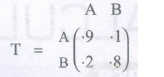
Given 50% of commuters use the transit system and 50% of the commuters use their own car this year.
(i) Percentage of commuters after one year
\(\left( \cdot 5\cdot 5 \right) \left( \begin{matrix} \cdot 9 & \cdot 1 \\ \cdot 2 & \cdot 8 \end{matrix} \right) \)
= (-5\(\times\)·9+·5\(\times\).2 ·5\(\times\)·1+·5\(\times\)·8)
= (-45 + ·10 ·05 +.40)
= (-55 - 45)
A = 55% and B = 45%
(ii) Equilibrium will be reached in the long run at equilibrium, we must have
(A B)T = (A B) wher A+B = 1
\(\Rightarrow \left( \begin{matrix} A & B \end{matrix} \right) \left( \begin{matrix} \cdot 9 & \cdot 1 \\ \cdot 2 & \cdot 8 \end{matrix} \right) =\left( \begin{matrix} A & B \end{matrix} \right) \)
\(\left( \begin{matrix} \cdot 9A+\cdot 2B & \cdot 1A+8B \end{matrix} \right) =\left( \begin{matrix} A & B \end{matrix} \right) \)
Equating the corresponding entries on both sides we get,
\(\cdot 9A+\cdot 2B=A\Rightarrow \cdot 9A+\cdot 2(1-A)=A\)
[Since A + B = 1, B = 1 -A]
\(\Rightarrow \cdot 9A+\cdot 2-\cdot 2A=A\)
\(\Rightarrow \cdot 2=A-\cdot 9A+\cdot 2A\)
\(\Rightarrow \cdot 2=A(1-\cdot 9+\cdot 2)\)
\(\Rightarrow \cdot 2=A=(\cdot 3)\)
\(\therefore\) 67% of the commuters will be using the transit system in the long run.
12.
fix) = ax2 + bx + c
\(f(1)=0\Rightarrow a\left( 1 \right) ^{ 2 }+b(1)+c=0\Rightarrow a+b+c=0\) ...(1)
\(f(2)=-2\Rightarrow a\left( { 2 }^{ 2 } \right) +b(2)+c=-2\Rightarrow 4a+2b+c=2\)..(2)
\(f(3)-6\Rightarrow a(3^{ 2 })+b(3)+c=-6\Rightarrow 9a+3b+c=-6\)
Now \(\Delta =\left| \begin{matrix} 1 & 1 & 1 \\ 4 & 2 & 1 \\ 9 & 3 & 1 \end{matrix} \right| \)
= 1(2 - 3) - 1(4 - 9) + 1(12 - 18)
= \(-1+5-6=-2\neq 0\)
Since \(\Delta \neq 0\) Cramer's rule can be applied and the system has unique solution
\(\Delta a=\left| \begin{matrix} 0 & 1 & 1 \\ -2 & 2 & 1 \\ -6 & 3 & 1 \end{matrix} \right| \)
= 0-1(-2+6)+ 1(-6+ 12)
= -4 + 6 = 2
\(\Delta b=\left| \begin{matrix} 1 & 0 & 1 \\ 4 & -2 & 1 \\ 9 & -6 & 1 \end{matrix} \right| \)
= 1(-2+6)+0+1(-24+ 18)
= 4 - 6 = -2
\(\Delta c=\left| \begin{matrix} 1 & 1 & 0 \\ 4 & 2 & -2 \\ 9 & 3 & -6 \end{matrix} \right| \)
= 1 (-12 + 6) - 1( - 24 + 18) + 0
= -6 + 6 = 0
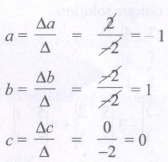
f(n) = (-1)x2 + 1(x) + 0
f(x) = x2+ x.
13.
The given non-homogeneous equations can be written as
\(\left( \begin{matrix} k & 1 & 1 \\ 1 & k & 1 \\ 1 & 1 & k \end{matrix} \right) \left( \begin{matrix} x \\ y \\ z \end{matrix} \right) =\left( \begin{matrix} 1 \\ 1 \\ 1 \end{matrix} \right) \)
| Augmented matrix [A, B] |
Elementary Transformation |
|---|---|
| \(\left( \begin{matrix} k & 1 & 1 \\ 1 & k & 1 \\ 1 & 1 & k \end{matrix}\begin{matrix} 1 \\ 1 \\ 1 \end{matrix} \right) \) | |
| \(\sim \left( \begin{matrix} 1 & 1 & k \\ 1 & k & 1 \\ k & 1 & 1 \end{matrix}\begin{matrix} 1 \\ 1 \\ 1 \end{matrix} \right) \) | \({ R }_{ 1 }\leftrightarrow { R }_{ 3 }\) |
| \(\sim \left( \begin{matrix} 1 & 1 & k \\ 0 & k-1 & 1-k \\ 0 & 1-k & 1-{ k }^{ 2 } \end{matrix}\begin{matrix} 1 \\ 0 \\ 1-k \end{matrix} \right) \) | \({ R }_{ 2 }\rightarrow { R }_{ 2 }-R_{ 1 }\) \({ R }_{ 3 }\rightarrow { R }_{ 3 }-k{ R }_{ 1 }\) |
| \(\sim \left( \begin{matrix} 1 & 1 & k \\ 0 & k-1 & 1-k \\ 0 & 0 & 2-k-{ k }^{ 2 } \end{matrix}\begin{matrix} 1 \\ 0 \\ 1-k \end{matrix} \right) \) | \({ R }_{ 3 }\rightarrow { R }_{ 3 }{ +R_{ 2 } }\) |
Case (i):
When \(k\neq 1\) and \(k\neq 2\)
\(\rho (A)=\rho (A,B)=3=\) Number of unknowns
\(\therefore \) The system has unique solution
Case (ii):
When k = 1
\(\left[ A,B \right] \sim \left( \begin{matrix} 1 & 1 & 1 \\ 0 & 0 & 0 \\ 0 & 0 & 0 \end{matrix}\begin{matrix} 1 \\ 0 \\ 0 \end{matrix} \right) \)
\(\rho (A)=\rho\) (A, B) = 1
\(\therefore \) The system is consistent and has infinitely many solutions.
Case (iii):
When k = - 2
\(\left[ A,B \right] \sim \left( \begin{matrix} 1 & 1 & -2 \\ 0 & -3 & 3 \\ 0 & 0 & 0 \end{matrix}\begin{matrix} 1 \\ 0 \\ -3 \end{matrix} \right) \)
\(\rho (A)=2\rho (A,B)\)= 3
\(\Rightarrow \rho (A)\neq 2\rho (A,B)\)
\(\therefore\) The system is inconsistent and has no solution.
14.
Let x pounds of food A, y pounds of food B and z pounds of food C be needed to form the mixture.
Given x + 3y + 4z = 8
2x + y + 2z = 5
5x + y + z = 7
\(\Delta =\left| \begin{matrix} 1 & 3 & 4 \\ 2 & 1 & 2 \\ 5 & 1 & 1 \end{matrix} \right| \)
= \(1\left| \begin{matrix} 1 & 2 \\ 1 & 1 \end{matrix} \right| -3\left| \begin{matrix} 2 & 2 \\ 5 & 1 \end{matrix} \right| +4\left| \begin{matrix} 2 & 1 \\ 5 & 1 \end{matrix} \right| \)
= 1(1 - 2) - 3(2 - 10) + 4(2 - 5)
= 1(-1)-3(-8)+4(-3)
= - 1 + 24 - 12 = 11
Since \(\Delta \neq 0\) Cramer's rule can be applied and the system has unique solution.
\(\Delta x=\left| \begin{matrix} 8 & 3 & 4 \\ 5 & 1 & 2 \\ 7 & 1 & 1 \end{matrix} \right| \)
= \(8\left| \begin{matrix} 1 & 2 \\ 1 & 1 \end{matrix} \right| -3\left| \begin{matrix} 5 & 2 \\ 7 & 1 \end{matrix} \right| +4\left| \begin{matrix} 5 & 1 \\ 7 & 1 \end{matrix} \right| \)
= 8(1 - 2) - 3(5 - 14) + 4(5 - 7)
= 8 (- 1) - 3 (- 9) + 4 (- 2)
= 8 + 27 - 8 = 11
\(\Delta y=\left| \begin{matrix} 1 & 8 & 4 \\ 2 & 5 & 2 \\ 5 & 7 & 1 \end{matrix} \right| =1\left| \begin{matrix} 5 & 2 \\ 7 & 1 \end{matrix} \right| -8\left| \begin{matrix} 2 & 2 \\ 5 & 1 \end{matrix} \right| +4\left| \begin{matrix} 2 & 5 \\ 5 & 7 \end{matrix} \right| \)
= 1(5 - 14) - 8(2 - 10) + 4(14 - 25)
= 1 (- 9) - 8 (- 8) + 4 (- 11)
= 9 + 64 - 44 = 11
\(\Delta z=\left| \begin{matrix} 1 & 3 & 8 \\ 2 & 1 & 5 \\ 5 & 1 & 7 \end{matrix} \right| =1\left| \begin{matrix} 1 & 5 \\ 1 & 7 \end{matrix} \right| -3\left| \begin{matrix} 2 & 5 \\ 5 & 7 \end{matrix} \right| +8\left| \begin{matrix} 2 & 1 \\ 5 & 1 \end{matrix} \right| \)
= 1(7 - 5) - 3(14 - 25) + 8(2 - 5)
= 1 (2) - 3 (- 11) + 8 (- 3)
= 2 + 33 - 24
= 11
\(\therefore\ x=\cfrac { \Delta x }{ \Delta } =\cfrac { 11 }{ 11 } =1\)
\(y=\cfrac { \Delta y }{ \Delta } =\cfrac { 11 }{ 11 } =1\)
\(z=\cfrac { \Delta z }{ \Delta } =\cfrac { 11 }{ 11 } =1\)
Hence, the mixture is formed by mixing one pound of each of the foods A, B and C.
15.
Let the three numbers be x, y and z respectively
Given
x + y + z = 6
x + 2z = 7
3x + y + z = 12
| Augmented matrix [A, B] |
Elementary Transformation' |
|---|---|
| \(\left( \begin{matrix} 1 & 1 & 1 \\ 1 & 0 & 2 \\ 3 & 1 & 1 \end{matrix}\begin{matrix} 6 \\ 7 \\ 12 \end{matrix} \right) \) | |
| \(\left( \begin{matrix} 1 & 1 & 1 \\ 0 & -1 & 1 \\ 0 & -2 & -2 \end{matrix}\begin{matrix} 6 \\ 1 \\ -6 \end{matrix} \right) \) | \({ R }_{ 2 }\rightarrow { R }_{ 2 }-{ R }_{ 1 }\) \({ R }_{ 3 }\rightarrow { R }_{ 2 }-3{ R }_{ 1 }\) |
| \(\sim \left( \begin{matrix} 1 & 1 & 1 \\ 0 & -1 & 1 \\ 0 & 0 & -4 \end{matrix}\begin{matrix} 6 \\ 1 \\ -8 \end{matrix} \right) \) | \({ R }_{ 3 }\rightarrow { R }_{ 3 }-2{ R }_{ 2 }\) |
The last equivalent matrix is in echelon form
\(\rho (A)=3\) and \(\rho (A,B)=3\)
\(\therefore \rho (A)=\rho (A,B)=3=Numberofunknowns\)
\(\therefore\) The system is consistent and has unique solution.
To find the solutions, let us rewrite the echelon form into matrix form
\(\left( \begin{matrix} 1 & 1 & 1 \\ 0 & -1 & 1 \\ 0 & 0 & -4 \end{matrix}\begin{matrix} x \\ y \\ z \end{matrix} \right) \left( \begin{matrix} x \\ y \\ z \end{matrix} \right) =\left( \begin{matrix} 6 \\ 1 \\ -8 \end{matrix} \right) \)
x + y + z = 6 ..(1)
-y + z = 1
-4z = -8
From (3),\(-4z=-8\Rightarrow z=\cfrac { -8 }{ -4 } =2\)
Substituting z = 2 in (2) we get
\(-y+2=1\Rightarrow -y=1-2\Rightarrow -y=-1\)
\(\Rightarrow y=1\)
Substitutingy = 1 andz = 2 in (1) we get
\(x+1+2=6\Rightarrow x+3=6\Rightarrow x=6-3\)
\(\Rightarrow x=3\)
Hence, the numbers are 3, 1, 2.

12th Standard Syllabus & Materials
12th Standard
TN 12th Computer Applications களப்பெயர் முறைமை (DNS) Sample Question Papers Study Material - QB365 Set A
NEW12th Standard
TN 12th Computer Applications வலையமைப்பு எடுத்துக்காட்டுகள் மற்றும் நெறிமுறைகள் Sample Question Papers Study Material - QB365 Set A
NEW12th Standard
TN 12th Computer Applications கணினி வலையமைப்பு ஓர் அறிமுகம் Sample Question Papers Study Material - QB365 Set A
NEW12th Standard
TN 12th Computer Applications PHP-உடன் MySQL-ஐ இணைத்தல் Sample Question Papers Study Material - QB365 Set A



Tamilnadu Stateboard 12th Standard Subjects

Maths

Chemistry

Physics

Biology

Computer Science
Business Maths and Statistics

Economics

Commerce

Accountancy

History

Computer Applications
Biology
Computer Technology
Computer Applications
Computer Science
Business Maths and Statistics
Commerce
Economics
Maths
Chemistry
Physics
Computer Technology
History
Accountancy

Tamil

English

French
Tamilnadu Stateboard Standards
