
 100% FREE ACCESS
12th Standard Syllabus & Materials
12th Standard
TN 12th Maths Applications of Matrices and Determinants Sample Question Papers Study Material - QB365 Set A
NEW12th Standard
TN 12th Computer Applications மின்னணு தரவு பரிமாற்றம் Sample Question Papers Study Material - QB365 Set A
NEW12th Standard
TN 12th Computer Applications மின் - வணிக பாதுகாப்பு அமைப்புகள் Sample Question Papers Study Material - QB365 Set A
NEW12th Standard
TN 12th Computer Applications மின்னணு செலுத்தல் முறைகள் Sample Question Papers Study Material - QB365 Set A
NEW12th Standard
TN 12th Computer Applications மின் - வணிகம் Sample Question Papers Study Material - QB365 Set A
NEW12th Standard
TN 12th Computer Applications திறந்த மூல கருத்துருக்கள் Sample Question Papers Study Material - QB365 Set A

Published on: 02/09/2022
QB365 provides a detailed and simple solution for every Possible Book Back Questions in Class 12 Business Maths Subject - Retirement and Death of a Partner, English Medium. It will help Students to get more practice questions, Students can Practice these question papers in addition to score best marks.
Download Tamil Nadu 12th Standard Business Maths and Statistics question papers, model tests, one-mark questions, important questions, and public exam papers in PDF format. Free study materials and answer keys for TN State Board students.
Questions + Answers key
Take MCQ Business Maths and Statistics Test
1.
Solve the following equation by using Cramer’s rule
5x + 3y = 17; 3x + 7y = 31
2.
Find the rank of each of the following matrices.
\(\left( \begin{matrix} 1 & -2 & 3 \\ -2 & 4 & -1 \\ -1 & 2 & 7 \end{matrix}\begin{matrix} 4 \\ -3 \\ 6 \end{matrix} \right) \)
3.
Find the rank of each of the following matrices.
\(\left( \begin{matrix} 3 & 1 & -5 \\ 1 & -2 & 1 \\ 1 & 5 & -7 \end{matrix}\begin{matrix} -1 \\ -5 \\ 2 \end{matrix} \right) \)
4.
Find the rank of each of the following matrices.
\(\left( \begin{matrix} 1 & 2 & -1 \\ 2 & 4 & 1 \\ 3 & 6 & 3 \end{matrix}\begin{matrix} 3 \\ -2 \\ -7 \end{matrix} \right) \)
5.
Find the rank of each of the following matrices.
\(\left( \begin{matrix} -1 & 2 & -2 \\ 4 & -3 & 4 \\ -2 & 4 & -4 \end{matrix} \right) \)
6.
Find the rank of each of the following matrices.
\(\left( \begin{matrix} 2 & -1 & 1 \\ 3 & 1 & -5 \\ 1 & 1 & 1 \end{matrix} \right) \)
7.
The subscription department of a magazine sends out a letter to a large mailing list inviting subscriptions for the magazine. Some of the people receiving this letter already subscribe to the magazine while others do not. From this mailing list, 60% of those who already subscribe will subscribe again while 25% of those who do not now subscribe will subscribe. On the last letter it was found that 40% of those receiving it ordered a subscription. What percent of those receiving the current letter can be expected to order a subscription?
8.
Examine the consistency of the system of equations: x + y + z = 7, x + 2y + 3z = 18, y + 2z = 6.
9.
Find the rank of the matrix A =\(\left( \begin{matrix} 4 & 5 & 2 \\ 3 & 2 & 1 \\ 4 & 4 & 8 \end{matrix}\begin{matrix} 2 \\ 6 \\ 0 \end{matrix} \right) \)
10.
Find the rank of the matrix A =\(\left( \begin{matrix} -2 & 1 & 3 \\ 0 & 1 & 1 \\ 1 & 3 & 4 \end{matrix}\begin{matrix} 4 \\ 2 \\ 7 \end{matrix} \right) \)
11.
The subscription department of a magazine sends out a letter to a large mailing list inviting subscriptions for the magazine. Some of the people receiving this letter already subscribe to the magazine while others do not. From this mailing list, 45% of those who already subscribe will subscribe again while 30% of those who do not now subscribe will subscribe. On the last letter, it was found that 40% of those receiving it ordered a subscription. What percent of those receiving the current letter can be expected to order a subscription?
12.
Akash bats according to the following traits. If he makes a hit (S), there is a 25% chance that he will make a hit his next time at bat. If he fails to hit (F), there is a 35% chance that he will make a hit his next time at bat. Find the transition probability matrix for the data and determine Akash’s long- range batting average.
13.
Parithi is either sad (S) or happy (H) each day. If he is happy in one day, he is sad on the next day by four times out of five. If he is sad on one day, he is happy on the next day by two times out of three. Over a long run, what are the chances that Parithi is happy on any given day?
14.
Consider the matrix of transition probabilities of a product available in the market in two brands A and B.
\(_{ B }^{ A }\left( \begin{matrix} \overset { A }{ 0.9 } & \overset { B }{ 0.1 } \\ 0.3 & 0.7 \end{matrix} \right) \)
Determine the market share of each brand in equilibrium position.
15.
At marina two types of games viz., Horse riding and Quad Bikes riding are available on hourly rent. Keren and Benita spent Rs. 780 and Rs. 560 during the month of May.
| Name | Number of hours | Total amount spent (in Rs) |
|
| Horse Riding | Quad Bike Riding | ||
| Keren | 3 | 4 | 780 |
| Benita | 2 | 3 | 560 |
Find the hourly charges for the two games (rides). (Use determinant method).
16.
A total of Rs. 8,600 was invested in two accounts. One account earned \(4\frac { 3 }{ 4 } %\)% annual interest and the other earned \(6\frac { 1 }{ 2 } %\)% annual interest. If the total interest for one year was Rs. 431.25, how much was invested in each account? (Use determinant method).
17.
A commodity was produced by using 3 units of labour and 2 units of capital, the total cost is Rs 62. If the commodity had been produced by using 4 units of labour and one unit of capital, the cost is Rs 56. What is the cost per unit of labour and capital? (Use determinant method).
18.
Solve the following equations by using Cramer’s rule
2x + 3y = 7; 3x + 5y = 9
19.
The total cost of 11 pencils and 3 erasers is Rs. 64 and the total cost of 8 pencils and 3 erasers is Rs. 49. Find the cost of each pencil and each eraser by Cramer’s rule.
20.
The following table represents the number of shares of two companies A and B during the month of January and February and it also gives the amount in rupees invested by Ravi during these two months for the purchase of shares of two companies. Find the the price per share of A and B purchased during both the months
| Months | Number of Shares of the company |
Amount invested by Ravi (in Rs) |
|
| A | B | ||
| January | 10 | 5 | 125 |
| February | 9 | 12 | 150 |
21.
Solve the equations 2x + 3y = 7, 3x + 5y = 9 by Cramer’s rule.
22.
Show that the following system of equations have unique solution:
x + y + z = 3, x + 2y + 3z = 4, x + 4y + 9z = 6 by rank method.
23.
If A=\(\left( \begin{matrix} 1 & 1 & -1 \\ 2 & -3 & 4 \\ 3 & -2 & 3 \end{matrix} \right) \) and B=\(\left( \begin{matrix} 1 & -2 & 3 \\ -2 & 4 & -6 \\ 5 & 1 & -1 \end{matrix} \right) \), then find the rank of AB and the rank of BA.
24.
Show that the equations 3x − 2y = 6, 6x − 4y = 10 are inconsistent
25.
Show that the equations 2x + y = 5,4x + 2y = 10 are consistent and solve them.
26.
Show that the equations x + y = 5, 2x + y = 8 are consistent and solve them.
27.
Find the rank of the matrix A = \(\left( \begin{matrix} 1 & 1 & 1 \\ 3 & 4 & 5 \\ 2 & 3 & 4 \end{matrix}\begin{matrix} 1 \\ 2 \\ 0 \end{matrix} \right) \)
28.
Find the rank of the matrix A = \(\left( \begin{matrix} 0 & 1 & 2 \\ 1 & 2 & 3 \\ 3 & 1 & 1 \end{matrix}\begin{matrix} 1 \\ 2 \\ 3 \end{matrix} \right) \)
29.
Find the rank of the matrix A = \(\left( \begin{matrix} 1 & 2 & 3 \\ 2 & 3 & 4 \\ 3 & 5 & 7 \end{matrix} \right) \)
30.
Find the rank of the matrix \(\left( \begin{matrix} 1 & 2 & -1 \\ 2 & 4 & 1 \\ 3 & 6 & 3 \end{matrix}\begin{matrix} 3 \\ -2 \\ -7 \end{matrix} \right) \)
31.
Find the rank of the matrix \(\left( \begin{matrix} 5 & 3 & 0 \\ 1 & 2 & -4 \\ -2 & -4 & 8 \end{matrix} \right) \)
32.
Find the rank of the matrix \(\left( \begin{matrix} 0 & -1 & 5 \\ 2 & 4 & -6 \\ 1 & 1 & 5 \end{matrix} \right) \)
1.
\(\Delta =\left| \begin{matrix} 5 & 3 \\ 3 & 7 \end{matrix} \right| =5(7)-3(3)\)
= 119 - 93 = 26
\(\Delta x=\left| \begin{matrix} 17 & 3 \\ 31 & 7 \end{matrix} \right| =17(7)-31(3)\)
= 119 - 93 = 2
\(\Delta y=\left| \begin{matrix} 5 & 17 \\ 3 & 31 \end{matrix} \right| =5(31)-17(3)\)
= 155 - 51 = 104
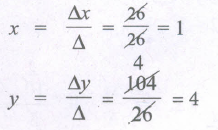
\(\therefore\) Solution set is (1, 4)
2.
A =\(\left( \begin{matrix} 1 & -2 & 3 \\ -2 & 4 & -1 \\ -1 & 2 & 7 \end{matrix}\begin{matrix} 4 \\ -3 \\ 6 \end{matrix} \right) \)
The order of A is 3 x 4
\(\therefore \rho (A)\le \text{minimum} \ of(3,4)\)
\(\rho (A)\le 3\)
Let us transform the matrix A to an echelon form
| Matrix A | Elementary Transformation |
|---|---|
| \(A=\left( \begin{matrix} 1 & -2 & 3 \\ -2 & 4 & -1 \\ -1 & 2 & 7 \end{matrix}\begin{matrix} 4 \\ -3 \\ 6 \end{matrix} \right) \) | |
| \(\sim \left( \begin{matrix} 1 & -2 & 3 \\ 0 & 0 & 5 \\ -1 & 2 & 7 \end{matrix}\begin{matrix} 4 \\ 5 \\ 6 \end{matrix} \right) \) | \({ R }_{ 2 }-{ R }_{ 2 }+2{ R }_{ 1 }\) |
| \(\left( \begin{matrix} 1 & -2 & 3 \\ 0 & 0 & 5 \\ 0 & 0 & 10 \end{matrix}\begin{matrix} 4 \\ 5 \\ 10 \end{matrix} \right) \) | \({ R }_{ 3 }\rightarrow { R }_{ 3 }+{ R }_{ 1 }\) |
| \(\left( \begin{matrix} 1 & -2 & 3 \\ 0 & 0 & 5 \\ 0 & 0 & 0 \end{matrix}\begin{matrix} 4 \\ 5 \\ 0 \end{matrix} \right) \) | \({ R }_{ 3 }\rightarrow { R }_{ 3 }-2{ R }_{ 2 }\) |
The matrix is in echelon form and the number of non- zero rows is 2
\(\therefore \rho (A)=2\)
3.
A =\(\left( \begin{matrix} 3 & 1 & -5 \\ 1 & -2 & 1 \\ 1 & 5 & -7 \end{matrix}\begin{matrix} -1 \\ -5 \\ 2 \end{matrix} \right) \)
The order of A is 3 x 4
\(\therefore \rho (A)\le \text{minimum} \ of(3,4)\)
\(\therefore \rho (A)\le 3\)
Let us transform the matrix A to an echelon form
| Matrix A | Elementary Transformation |
|---|---|
| \(A=\left( \begin{matrix} 3 & 1 & -5 \\ 1 & -2 & 1 \\ 1 & 5 & -7 \end{matrix}\begin{matrix} -1 \\ -5 \\ 2 \end{matrix} \right) \) | |
| \(\sim \left( \begin{matrix} 1 & 5 & -7 \\ 1 & -2 & 1 \\ 3 & 1 & -5 \end{matrix}\begin{matrix} 2 \\ -5 \\ -1 \end{matrix} \right) \) | \({ R }_{ 1 }\leftrightarrow { R }_{ 3 }\) |
| \(\sim \left( \begin{matrix} 1 & 5 & -7 \\ 0 & -7 & 8 \\ 3 & 1 & -5 \end{matrix}\begin{matrix} 2 \\ -7 \\ -1 \end{matrix} \right) \) | \({ R }_{ 2 }\rightarrow { R }_{ 2 }+{ R }_{ 1 }\) |
| \(\sim \left( \begin{matrix} 1 & 5 & -7 \\ 0 & -7 & 8 \\ 0 & -14 & 16 \end{matrix}\begin{matrix} 2 \\ -7 \\ -7 \end{matrix} \right) \) | \({ R }_{ 3 }\rightarrow { R }_{ 3 }+{ 3R }_{ 1 }\) |
| \(\sim \left( \begin{matrix} 1 & 5 & -7 \\ 0 & -7 & 8 \\ 0 & 0 & 0 \end{matrix}\begin{matrix} 2 \\ -7 \\ 7 \end{matrix} \right) \) | \({ R }_{ 3 }\rightarrow { R }_{ 3 }-{ 2R }^{ 2 }\) |
The matrix is in echelon form and the number of non-zero matrix is 3
\(\therefore \rho (A)=3\)
4.
Let A =\(\left( \begin{matrix} 1 & 2 & -1 \\ 2 & 4 & 1 \\ 3 & 6 & 3 \end{matrix}\begin{matrix} 3 \\ -2 \\ -7 \end{matrix} \right) \)
The order of A is 3 x 4
\(\therefore \rho \left( A \right) \le 3\) [Since minimum of (3, 3) is 3]
Let us transform the matrix to an echelon form.
| Matrix A | Elementary Transformation |
|---|---|
| \(A=\left( \begin{matrix} 1 & 2 & -1 \\ 2 & 4 & 1 \\ 3 & 6 & 3 \end{matrix}\begin{matrix} 3 \\ -2 \\ -7 \end{matrix} \right) \) | |
| \(\sim \left( \begin{matrix} 1 & 2 & -1 \\ 0 & 0 & 3 \\ 3 & 6 & 3 \end{matrix}\begin{matrix} 3 \\ -8 \\ -7 \end{matrix} \right) \) | \({ R }_{ 2 }\rightarrow { { R }_{ 2 }-2{ R }_{ 1 } }\) |
| \(\sim \left( \begin{matrix} 1 & 2 & -1 \\ 0 & 0 & 3 \\ 0 & 0 & 6 \end{matrix}\begin{matrix} 3 \\ -8 \\ -16 \end{matrix} \right) \) | \({ R }_{ 3 }\rightarrow { R }_{ 2 }-3{ R }_{ 1 }\) |
| \(\left( \begin{matrix} 1 & 2 & -1 \\ 0 & 0 & 3 \\ 0 & 0 & 0 \end{matrix}\begin{matrix} 3 \\ -18 \\ 0 \end{matrix} \right) \) | \({ R }_{ 3 }\rightarrow { R }_{ 3 }-2{ R }_{ 2 }\) |
The matrix is in echelon form and the number of non- zero rows is 2.
\(\therefore \rho (A)=2\)
5.
Let A = \(\left( \begin{matrix} -1 & 2 & -2 \\ 4 & -3 & 4 \\ -2 & 4 & -4 \end{matrix} \right) \)
The order of A is 3 x 3
\(\therefore \rho (A)\le 3\) [Since minimum of (3,3) is 3]
Let us transform the matrix to an echelon form
| Matrix A | Elementary Transformation |
|---|---|
| \(A=\left( \begin{matrix} -1 & 2 & -2 \\ 4 & -3 & 4 \\ -2 & 4 & -4 \end{matrix} \right) \) | |
| \(\sim \left( \begin{matrix} 1 & -2 & 2 \\ 4 & -3 & 4 \\ -4 & 4 & -4 \end{matrix} \right) \) | \(R_{ 1 }\rightarrow { R }_{ 1 }\left( -1 \right) \) |
| \(\sim \left( \begin{matrix} 1 & -2 & 2 \\ 0 & 5 & -4 \\ -2 & 4 & -4 \end{matrix} \right) \) | \({ R }_{ 2 }\rightarrow { R }_{ 2 }-4{ R }_{ 1 }\) |
| \(\sim \left( \begin{matrix} 1 & -2 & 2 \\ 0 & 5 & -4 \\ 0 & 0 & 0 \end{matrix} \right) \) | \({ R }_{ 3 }\rightarrow { R }_{ 32 }+2R_{ 1 }\) |
The matrix is in echelon form and the number of non-zero rows is 2.
\(\therefore \rho (A)=2\)
6.
Let \(A=\left( \begin{matrix} 2 & -1 & 1 \\ 3 & 1 & -5 \\ 1 & 1 & 1 \end{matrix} \right) \)
The order of A is 3 x 3
\(\therefore \rho (A)\le 3\) [Since minimum of (3,3) is 3]
Let us transform the matrix A to an echelon form
| Matrix A | Elementary Transformation |
|---|---|
| \(A=\left( \begin{matrix} 2 & -1 & 1 \\ 3 & 1 & -5 \\ 1 & 1 & 1 \end{matrix} \right) \) | |
| \(\sim \left( \begin{matrix} 1 & 1 & 1 \\ 3 & 1 & -5 \\ 2 & -1 & 1 \end{matrix} \right) \) | \({ R }_{ 1 }\leftrightarrow { R }_{ 3 }\) |
| \(\sim \left( \begin{matrix} 1 & 1 & 1 \\ 0 & -2 & -8 \\ 0 & -3 & -1 \end{matrix} \right) \) | \({ { R }_{ 2 }\rightarrow { R }_{ 2 }3{ R }_{ 1 } }\) \({ R }_{ 3 }-{ R }_{ 3 }-2{ R }_{ 1 }\) |
| \(\sim \left( \begin{matrix} 1 & 1 & 1 \\ 0 & -1 & -4 \\ 0 & -3 & -1 \end{matrix} \right) \) | \({ R }_{ 2 }\rightarrow { R }_{ 2 }\div 2\) |
| \(\sim \left( \begin{matrix} 1 & 1 & 1 \\ 0 & -1 & -4 \\ 0 & 0 & 11 \end{matrix} \right) \) | \({ R }_{ 3 }\rightarrow { R }_{ 3 }-3{ R }_{ 2 }\) |
This matrix is in echelon from and number of non zero rows is 3.
\(\therefore \rho (A)=3\)
7.
Let A represents the percent of people who subscribe the magazine and B represents the percent of people who do not subscribe the magazine.
Given 60% of people subscribe again implies 40% of people do not subscribe. And 25% of people are going to subscribe implies 75% of people are not going to subscribe.
\(\therefore\) Transition probability matrix.
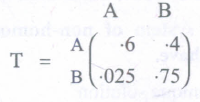
Also, it is given that 40% of those received the order of subscription implies 60% are not going to receive the order.
\(\left( \begin{matrix} \cdot 4 & \cdot 6 \end{matrix} \right) \left( \begin{matrix} \cdot 6 & \cdot 4 \\ \cdot 25 & \cdot 75 \end{matrix} \right) \)
= \(\left( \left( \begin{matrix} \cdot 4 & \cdot 6 \end{matrix} \right) +\left( \cdot 6 \right) \left( \cdot 25 \right) \left( \cdot 4 \right) \left( \cdot 4 \right) +\left( \cdot 6 \right) \left( \cdot 75 \right) \right) \)
= \(\left( \cdot 24+\cdot 15\quad \cdot 16+\cdot 45 \right) =\left( \cdot 39\quad \cdot 61 \right) \)
\(\therefore\) 39% of people who received the current letter can be expected to order a subscription.
8.
Given non homogeneous equation are x +y += 7, x + 2y + 3z = 18, y + 2z = 6
| Augmented matrix [A,B] | Elementary Transformation |
|---|---|
| \(\left( \begin{matrix} 1 & 1 & 1 \\ 1 & 2 & 3 \\ 0 & 1 & 2 \end{matrix}\begin{matrix} 7 \\ 18 \\ 6 \end{matrix} \right) \) | |
| \(\sim \left( \begin{matrix} 1 & 1 & 1 \\ 0 & 1 & 2 \\ 0 & 1 & 2 \end{matrix}\begin{matrix} 7 \\ 11 \\ 6 \end{matrix} \right) \) | \({ R }_{ 2 }\rightarrow { R }_{ 2 }-{ R }_{ 1 }\) |
| \(\sim \left( \begin{matrix} 1 & 1 & 1 \\ 0 & 1 & 2 \\ 0 & 0 & 0 \end{matrix}\begin{matrix} 7 \\ 11 \\ -5 \end{matrix} \right) \) | \({ R }_{ 3 }\rightarrow { R }_{ 3 }-{ R }_{ 2 }\) |
Here \(\rho (A)=2\) and \(\rho (A,b)=3\)
Since \(\rho (A)\neq \rho (A,B)\) the given system is inconsistent and has no solution.
9.
Given A =\(\left( \begin{matrix} 4 & 5 & 2 \\ 3 & 2 & 1 \\ 4 & 4 & 8 \end{matrix}\begin{matrix} 2 \\ 6 \\ 0 \end{matrix} \right) \)
\(\left( \begin{matrix} 4 & 5 & 2 \\ 3 & 2 & 1 \\ 1 & 1 & 2 \end{matrix}\begin{matrix} 2 \\ 6 \\ 0 \end{matrix} \right) { R }_{ 3 }\rightarrow { R }_{ 3 }\div 4\)
\(\left( \begin{matrix} 1 & 1 & 2 \\ 3 & 2 & 1 \\ 4 & 5 & 2 \end{matrix}\begin{matrix} 0 \\ 6 \\ 2 \end{matrix} \right) { R }_{ 1 }\leftrightarrow { R }_{ 3 }\)
\(\left( \begin{matrix} 1 & 1 & 2 \\ 0 & -1 & -5 \\ 0 & 1 & -6 \end{matrix}\begin{matrix} 0 \\ 6 \\ 2 \end{matrix} \right) \)\({ R }_{ 2 }\rightarrow { R }_{ 2 }-3{ R }_{ 1 }\)
\(\left( \begin{matrix} 1 & 1 & 2 \\ 0 & -1 & -5 \\ 0 & 1 & -6 \end{matrix}\begin{matrix} 0 \\ 6 \\ 2 \end{matrix} \right) \begin{matrix} { R }_{ 2 }\rightarrow { R }_{ 2 }-3{ R }_{ 1 } \\ { R }_{ 3 }\rightarrow { R }_{ 3 }-4{ R }_{ 1 } \end{matrix}\)
\(\left( \begin{matrix} 1 & 1 & 2 \\ 0 & -1 & -5 \\ 0 & 0 & -11 \end{matrix}\begin{matrix} 0 \\ 6 \\ 8 \end{matrix} \right) { R }_{ 3 }\rightarrow { R }_{ 3 }+{ R }_{ 2 }\)
The last equivalent matrix is in echelon form and there are 3 non-zero rows
\(\therefore \rho (A)=3\)
10.
Given A =\(\left( \begin{matrix} -2 & 1 & 3 \\ 0 & 1 & 1 \\ 1 & 3 & 4 \end{matrix}\begin{matrix} 4 \\ 2 \\ 7 \end{matrix} \right) \)
\(\sim \left( \begin{matrix} 1 & 3 & 4 \\ 0 & 1 & 1 \\ -2 & 1 & 3 \end{matrix}\begin{matrix} 7 \\ 2 \\ 4 \end{matrix} \right) { R }_{ 1 }\rightarrow { R }_{ 3 }\)
\(\sim \left( \begin{matrix} 1 & 3 & 4 \\ 0 & 1 & 1 \\ 0 & 7 & 11 \end{matrix}\begin{matrix} 7 \\ 2 \\ 18 \end{matrix} \right) { R }_{ 2 }\rightarrow { { R_{ 2 }+2{ R }_{ 1 } } }\)
\(\sim \left( \begin{matrix} 1 & 3 & 4 \\ 0 & 1 & 1 \\ 0 & 0 & 4 \end{matrix}\begin{matrix} 7 \\ 2 \\ 4 \end{matrix} \right) { R }_{ 3 }\rightarrow { R_{ 3 }-{ 7R }_{ 2 } }\)
The last equivalent matrix is in echelon form and there are 3 non - zero rows.
\(\therefore \rho (A)=3\)
11.
Transition probability matrix
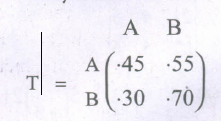
Where A represents the percentage of subscribers and B represents the percentage of non - subscribers.
A 40% = ·40
By the given data, 40% received the order of subscription = 60% are non-subscribers.
A 40% = ·40
and B 60% = ·60
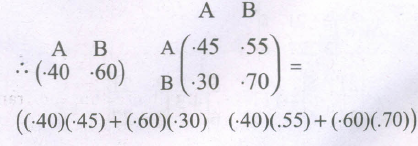
((-40)(-45) + (·60)(-30) (-40)(.55) + (-60)(.70))
(-18+·18 ·22+42)
(·36 ·64)
\(\Rightarrow\) 36% of those receiving the current letter can be expected to order a subscription
12.
The Transition probability matrix is T = \(\left( \begin{matrix} 0.25 & 0.75 \\ 0.35 & 0.65 \end{matrix} \right) \)
At equilibrium, (S F) \(\left( \begin{matrix} 0.25 & 0.75 \\ 0.35 & 0.65 \end{matrix} \right) \) = (S F)
where S + F = 1
0.25 S + 0.35 F = S
0.25 S + 0.35 (1 – S) = S
On solving this, we get S = \(\frac { 0.35 }{ 1.10 } \)
⇒ S = 0.318 and F = 0.682
\(\therefore \) Akash’s batting average is 31.8%
13.
The transition porbability matrix is T = \(\left( \begin{matrix} \frac { 1 }{ 3 } & \frac { 2 }{ 3 } \\ \frac { 4 }{ 5 } & \frac { 1 }{ 5 } \end{matrix} \right) \)
At equilibrium, (S H) \(\left( \begin{matrix} \frac { 1 }{ 3 } & \frac { 2 }{ 3 } \\ \frac { 4 }{ 5 } & \frac { 1 }{ 5 } \end{matrix} \right) \) = (S H)
where S + H = 1
\(\frac { 4 }{ 5 } S+\frac { 1 }{ 3 } H=S\)
\(\frac { 1 }{ 3 } (1 - H)+\frac { 4 }{ 5 } H= 1- H\)
On solving this, we get S = \(\frac { 6 }{ 11 } \) and H = \(\frac { 5 }{ 11 } \)
In the long run, on a randomly selected day, his chances of being happy is \(\frac { 5 }{ 11 } \)
14.
Transition probability matrix
T = \(_{ B }^{ A }\left( \begin{matrix} \overset { A }{ 0.9 } & \overset { B }{ 0.1 } \\ 0.3 & 0.7 \end{matrix} \right) \)
At equilibrium, (A B) T = (AB) where A + B = 1
(A B) \(\left( \begin{matrix} 0.9 & 0.1 \\ 0.3 & 0.7 \end{matrix} \right) \) = (A B)
0.9A + 0.3B = A
0.9A + 0.3(1−A) = A
0.9A−0.3A + 0.3 = A
0.6A + 0.3 = A
0.4A = 0.3
A = \(\frac { 0.3 }{ 0.4 } =\frac { 3 }{ 4 } \)
B = 1-\(\frac { 3 }{ 4 } =\frac { 1 }{ 4 } \)
Hence the market share of brand A is 75% and the market share of brand B is 25%
15.
Let the hourly charge for horse riding be Rs. x and the hourly charge for quad bike be Rs. y from the given data,
3x + 4y = 780
2x+ 3y = 560
\(\Delta =\left| \begin{matrix} 3 & 4 \\ 2 & 3 \end{matrix} \right| =3(3)-2(4)=9-8=1\neq 0\)
Since \(\Delta \neq 0\) the system is consistent with unique solution and Cramer's rule can be applied
\(\Delta x=\left| \begin{matrix} 780 & 4 \\ 560 & 3 \end{matrix} \right| =780(30-4(560)\)
= 2340 - 2240 = 100
\(\Delta y=\left| \begin{matrix} 3 & 780 \\ 2 & 560 \end{matrix} \right| =39560)-2(780)\)
= \(1680 - 1560\) = 120
\(\therefore x=\cfrac { \Delta x }{ \Delta } =\cfrac { 100 }{ 1 } =100\)
\(y=\cfrac { \Delta y }{ \Delta } =\cfrac { 120 }{ 1 } =120\)
\(\therefore\) Hourly charges for the two rides are Rs. 100 and Rs. 120 respectively.
16.
Let the amount invested in the two accounts be Rs. x and Rs. y respectively
By the given data, x + y = 8600 ..(1)
\(4\cfrac { 3 }{ 4 } \times \cfrac { x }{ 100 } +6\cfrac { 1 }{ 2 } \times \cfrac { y }{ 100 } =431.25\) \(\left[ \therefore interest=\cfrac { PNR }{ 100 } \right] \)
\(\Rightarrow \cfrac { 19x }{ 400 } +\cfrac { 13y }{ 3200 } =431.25\)
\(\Rightarrow \cfrac { 19x+26y }{ 400 } =431.25\)
19x + 26y = 172500 ...(2)
\(\Delta =\left| \begin{matrix} 1 & 1 \\ 19 & 26 \end{matrix} \right| =1(26)-1(19)\)
= 26-19 =7
\({ \Delta }x=\left| \begin{matrix} 8600 & 1 \\ 172500 & 26 \end{matrix} \right| =8600(26)-1(172500)\)
= 223600 - 172500 = 51100
\(\Delta y=\left| \begin{matrix} 1 & 8600 \\ 19 & 172500 \end{matrix} \right| =1(172500)-19(8600)\)
= 172500 - 163400 = 9100
\(x=\cfrac { \Delta x }{ \Delta } -\cfrac { 51100 }{ 7 } =7300\)
\(y=\cfrac { \Delta y }{ \Delta } =\cfrac { 9100 }{ 7 } =1300\)
\(\therefore\) Investment in the interest of \(4\frac { 3 }{ 4 } \) % account is Rs. 7300 and investment in the rate of \(6\frac { 1 }{ 2 } \) account is Rs.1300.
17.
Let Rs. x represents the cost per unit of labour and Rs. y represents the cost per unit of capital
Given
3x + 2y = 62
4x +y = 56
\(\Delta =\left| \begin{matrix} 3 & 2 \\ 4 & 1 \end{matrix} \right| =3(1)-4(2)=3-8=-5\)
Since \(\Delta \neq 0\) the system is consistent with unique solution and Cramer's rule can be applied.
\(\Delta x=\left| \begin{matrix} 62 & 2 \\ 56 & 1 \end{matrix} \right| =62(1)-56(2)=62-112=-50\)
\({ \Delta }_{ y }=\left| \begin{matrix} 3 & 62 \\ 4 & 56 \end{matrix} \right| =3(56)-4(62)\)
= 168 - 248 = -80
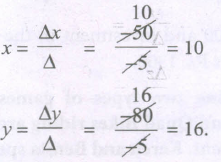
\(\therefore\) Cost per unit oflabour is Rs. 10 and the cost per unit of capital is Rs. 16.
18.
\(\Delta =\left| \begin{matrix} 2 & 3 \\ 3 & 5 \end{matrix} \right| =10-9=1\neq 0\)
Since \(\Delta \neq 0\)
we can apply Cramer's rule and the system is consistent with unique solution.
\(\Delta x=\left| \begin{matrix} 7 & 3 \\ 9 & 5 \end{matrix} \right| =7(5)-9(3)\)
= 35 - 27 = 8
\(\Delta y=\left| \begin{matrix} 2 & 7 \\ 3 & 9 \end{matrix} \right| =2(9)-3(7)\)
= 18 - 21 = -3
\(\therefore\) \(x=\cfrac { \Delta x }{ \Delta } =\cfrac { 8 }{ 1 } =8\)
\(y=\cfrac { \Delta y }{ \Delta } =\cfrac { -3 }{ 1 } =3\)
\(\therefore\) Solution set is (8, -3)
19.
Let ‘x’ be the cost of a pencil
Let ‘y’ be the cost of an eraser
\(\therefore \) By given data, we get the following equations
11x + 3y = 64
8x + 3y = 49
\(\triangle =\left| \begin{matrix} 11 & 3 \\ 8 & 3 \end{matrix} \right| =9\neq 0,\) It has unique solution.
\({ \triangle }_{ x }\left| \begin{matrix} 64 & 3 \\ 49 & 3 \end{matrix} \right| =45\)
\({ \triangle }_{ y }\left| \begin{matrix} 11 & 64 \\ 8 & 49 \end{matrix} \right| =27\)
\(\therefore \) By Cramer’s rule
\(x={ \frac { \triangle x }{ \triangle } =\frac { 45 }{ 9 } =5 }\)
\(y={ \frac { \triangle y }{ \triangle } =\frac { 27 }{ 9 } =3 }\)
\(\therefore \) The cost of a pencil is Rs. 5 and the cost of an eraser is Rs. 3.
20.
Let the price of one share of A be x
Let the price of one share of B be y
\(\therefore \) By given data, we get the following equations
10x + 5y = 125
9x + 12y = 150
\(\triangle =\left| \begin{matrix} 10 & 5 \\ 9 & 12 \end{matrix} \right| =75\neq 0\)
\({ \triangle }_{ x }=\left| \begin{matrix} 125 & 5 \\ 150 & 12 \end{matrix} \right| =750\)
\({ \triangle }_{ y }=\left| \begin{matrix} 10 & 125 \\ 9 & 150 \end{matrix} \right| =375\)
\(\therefore \) Cramer’s rule
\(x=\frac { \triangle x }{ \triangle } =\frac { 750 }{ 75 } =10\)
\( y=\frac { \triangle y }{ \triangle } =\frac { 375 }{ 75 } =5\)
The price of the share A is Rs10 and the price of the share B is Rs. 5.
21.
The equations are
2x + 3y = 7
3x + 5y = 9
Here \(\triangle =\left| \begin{matrix} 2 & 3 \\ 3 & 5 \end{matrix} \right| =1\)
\(\neq 0\)
\(\therefore \) we can apply Cramer’s Rule
Now \({ \triangle }_{ x }=\left| \begin{matrix} 7 & 3 \\ 9 & 5 \end{matrix} \right| =8\) \({ \triangle }_{ y }=\left| \begin{matrix} 2 & 7 \\ 3 & 9 \end{matrix} \right| =-3\)
\(\therefore \) By Cramer’s rule
\(x=\frac { { \triangle }_{ X } }{ \triangle } =\frac { 8 }{ 1 } =8\) \(y=\frac { { \triangle }_{ y } }{ \triangle } =\frac { -3 }{ 1 } =-3\)
\(\therefore \) Solution is x = 8, y = −3
22.
Given non-homogeneous equations are
x + y + z = 3
x + 2y + 3z = 4
x + 4y + 9z = 6
The matrix equation corresponding to the given system is
\(\left( \begin{matrix} 1 & 1 & 1 \\ 1 & 2 & 3 \\ 11 & 4 & 9 \end{matrix} \right) \left( \begin{matrix} x \\ y \\ z \end{matrix} \right) =\left( \begin{matrix} 3 \\ 4 \\ 6 \end{matrix} \right) \)
AX = B
| Augmented matrix | Elementary Transformation |
|---|---|
| \(\left( \begin{matrix} 1 & 1 & 1 \\ 1 & 2 & 3 \\ 1 & 4 & 9 \end{matrix}\begin{matrix} 3 \\ 4 \\ 6 \end{matrix} \right) \) | |
| \(\left( \begin{matrix} 1 & 1 & 1 \\ 0 & 1 & 2 \\ 0 & 3 & 8 \end{matrix}\begin{matrix} 3 \\ 1 \\ R \end{matrix} \right) \) | \({ R }_{ 2 }\rightarrow { R }_{ 2 }-{ R }_{ 1 }\) \({ R }_{ 3 }\rightarrow { R }_{ 3 }-{ R_{ 1 } }\) |
| \(\left( \begin{matrix} 1 & 1 & 1 \\ 0 & 1 & 2 \\ 0 & 0 & 2 \end{matrix}\begin{matrix} 3 \\ 1 \\ 0 \end{matrix} \right) \) | \({ R }_{ 3 }\rightarrow { R }_{ 3 }-{ R }_{ 2 }\) |
Clearly the last equivalent matrix is in echelon form and it has three non-zero rows
\(\therefore \rho (A)=3\quad \rho \left( \left[ A,B \right] \right) =3\)
\(\rho (A)=\rho \left( \left[ A,B \right] \right) =3\)
\(\therefore\) The given system is consistent and has unique solution.
To find the solution, let us rewrite the above echelon form into the matrix form
\(\left( \begin{matrix} 1 & 1 & 1 \\ 0 & 1 & 2 \\ 0 & 0 & 2 \end{matrix} \right) \left( \begin{matrix} x \\ y \\ z \end{matrix} \right) =\left( \begin{matrix} 3 \\ 1 \\ 0 \end{matrix} \right) \)
\(\Rightarrow\) x + y + z = 3
y + 2z = 1
\((3)\Rightarrow 2x=0\Rightarrow z=\cfrac { 0 }{ 2 } =0\)
\((2)\Rightarrow y+2(0)=1\Rightarrow y+0=1\Rightarrow y=1-0=1\)
\(\left( 1 \right) \Rightarrow x+1+0=3\)
\(\Rightarrow x+1=3\)
\(\Rightarrow x=3-1\)
\(\Rightarrow x=2\)
\(\therefore\) Solution set [2, 1, 0]
23.
Given
A = \(\left( \begin{matrix} 1 & 1 & -1 \\ 2 & -3 & 4 \\ 3 & -2 & 3 \end{matrix} \right) \) and B = \(\left( \begin{matrix} 1 & -2 & 3 \\ -2 & 4 & -6 \\ 5 & 1 & -1 \end{matrix} \right) \)
\(AB=\left( \begin{matrix} 1 & 1 & -1 \\ 2 & -3 & 4 \\ 3 & -2 & 3 \end{matrix} \right) \left( \begin{matrix} 1 & -2 & 3 \\ -2 & 4 & -6 \\ 5 & 1 & -1 \end{matrix} \right) \)
= \(\left( \begin{matrix} 1-2+5 & -2+4-1 & 3-6+1 \\ 2+6+20 & -4-12+45 & 6+18-4 \\ 3+4+15 & -6-8+3 & 9+12-3 \end{matrix} \right) \)
= \(\left( \begin{matrix} -6 & 1 & -2 \\ 28 & -12 & 20 \\ 22 & -11 & 18 \end{matrix} \right) =\left( \begin{matrix} -6 & 1 & -2 \\ 28 & -12 & 20 \\ 22 & -11 & 18 \end{matrix} \right) \)
| Matrix (AB) | Elementary Transformation |
|---|---|
| \(AB=\left( \begin{matrix} -6 & 1 & -2 \\ 28 & -12 & 20 \\ 22 & -11 & 18 \end{matrix} \right) \) | |
| \(\sim \left( \begin{matrix} 1 & -6 & -2 \\ -12 & 28 & 20 \\ -11 & 22 & 18 \end{matrix} \right) \) | \({ C }_{ 1 }\leftrightarrow { C }_{ 2 }\) |
| \(\sim \left( \begin{matrix} 1 & -6 & -2 \\ -12 & 28 & 20 \\ -11 & 22 & 18 \end{matrix} \right) \) | \({ R }_{ 2 }\rightarrow { R }_{ 2 }+12{ R }_{ 1 }\) |
| \(\sim \left( \begin{matrix} 1 & -6 & -2 \\ 0 & -44 & -4 \\ 0 & -44 & -4 \end{matrix} \right) \) | \({ R }_{ 3 }\rightarrow { R }_{ 3 }+11{ R }_{ 1 }\) |
| \(\sim \left( \begin{matrix} 1 & -6 & -2 \\ 0 & -44 & -4 \\ 0 & 0 & 0 \end{matrix} \right) \) | \({ R }_{ 3 }\rightarrow { R }_{ 3 }-{ R }_{ 2 }\) |
The matrix is in echelon form and the number of non-zero rows is 2.
\(\therefore \rho (AB)=2\)
Now \(BA=\left( \begin{matrix} 1 & -2 & 3 \\ -2 & 4 & -6 \\ 5 & 1 & -1 \end{matrix} \right) \left( \begin{matrix} 1 & 1 & -1 \\ 2 & -3 & 4 \\ 3 & -2 & 3 \end{matrix} \right) \)
= \(\left( \begin{matrix} 1-4+9 & 1+6-6 & -1-8+9 \\ -2+8-18 & -2-12+12 & 2+16-18 \\ 5+2-3 & 5-3+2 & -5+4-3 \end{matrix} \right) \)
= \(\left( \begin{matrix} 6 & 1 & 0 \\ -12 & -2 & 0 \\ 4 & 4 & -4 \end{matrix} \right) \)
| Matrix (BA) | Elementary Transformation |
|---|---|
| \(BA=\left( \begin{matrix} 6 & 1 & 0 \\ -12 & -2 & 0 \\ 4 & 4 & -4 \end{matrix} \right) \) | |
| \(\sim \left( \begin{matrix} 1 & 6 & 0 \\ -2 & -12 & 0 \\ 4 & 4 & -4 \end{matrix} \right) \) | \({ C }_{ 1 }\leftrightarrow { C }_{ 2 }\) |
| \(\sim \left( \begin{matrix} 1 & 6 & 0 \\ 0 & 0 & 0 \\ 4 & 4 & -4 \end{matrix} \right) \) | \({ R }_{ 2 }\rightarrow { R }_{ 2 }+2{ R }_{ 1 }\) |
| \(\sim \left( \begin{matrix} 1 & 6 & 0 \\ 0 & 0 & 0 \\ 0 & -20 & -4 \end{matrix} \right) \) | \({ R }_{ 3 }\rightarrow { R }_{ 3 }-4R_{ 1 }\) |
The number of non-zero rows is 2.
\(\therefore \rho (BA)=2\)
24.
The matrix equation corresponding to the given system is
\(\left( \begin{matrix} 3 & -2 \\ 6 & -4 \end{matrix} \right) \left( \begin{matrix} x \\ y \end{matrix} \right) =\left( \begin{matrix} 6 \\ 10 \end{matrix} \right) \)
AX = B
| Matrix A | Augmented matrix [A,B] | Elementary Transformation |
| \(\left( \begin{matrix} 3 & -2 \\ 6 & -4 \end{matrix} \right) \) \(\sim \left( \begin{matrix} 3 & -2 \\ 0 & 0 \end{matrix} \right) \) |
\(\left( \begin{matrix} 3 & -2 & 6 \\ 6 & -4 & 10 \end{matrix} \right) \) \(\sim \left( \begin{matrix} 3 & -2 & 6 \\ 0 & 0 & -2 \end{matrix} \right) \) |
\({ R }_{ 2 }\rightarrow { R }_{ 2 }-{ 2R }_{ 1 }\) |
| \(\rho (A)=1\) | \(\rho ([A,B])=2\) |
\(\therefore \)\(\rho ([A,B])=2\), \(\rho (A)=1\)
\(\rho (A)\neq \rho \left( [A,B] \right) \)
\(\therefore \) The given system is inconsistent and has no solution.
25.
The matrix equation corresponding to the system is
\(\left( \begin{matrix} 2 & 1 \\ 4 & 2 \end{matrix} \right) \left( \begin{matrix} x \\ y \end{matrix} \right) =\left( \begin{matrix} 5 \\ 10 \end{matrix} \right) \)
A X = B
| Matrix A | Augmented matrix [A,B] | Elementary Transformation |
| \(\left( \begin{matrix} 2 & 1 \\ 4 & 2 \end{matrix} \right) \) \(\sim \left( \begin{matrix} 2 & 1 \\ 4 & 2 \end{matrix} \right) \) |
\(\left( \begin{matrix} 2 & 1 & 5 \\ 4 & 2 & 10 \end{matrix} \right) \) \(\sim \left( \begin{matrix} 2 & 1 & 5 \\ 4 & 2 & 10 \end{matrix} \right) \) |
\({ R }_{ 2 }\rightarrow { R }_{ 2 }-{ 2R }_{ 1 }\) |
| \(\rho (A)=1\) | \(\rho ([A,B])=1\) |
\(\rho (A)=\rho ([A,B])=1<\)number of unknowns
\(\therefore \)The given system is consistent and has infinitely many solutions.
Now, the given system is transformed into the matrix equation.
\(\left( \begin{matrix} 2 & 1 \\ 0 & 0 \end{matrix} \right) \left( \begin{matrix} x \\ y \end{matrix} \right) =\left( \begin{matrix} 5 \\ 0 \end{matrix} \right) \)
\(\Rightarrow 2x+y=5\)
Let us take y = k,k \(\in \)R
\(\Rightarrow 2x+k=5\)
\(x=\frac { 1 }{ 2 } (5-k)\)
\(x=\frac { 1 }{ 2 } (5-k),y=k\ for\ all\ k\in R\)
Thus by giving different values for k, we get different solution.
Hence the system has infinite number of solutions.
26.
The matrix equation corresponding to the given system is
\(\begin{pmatrix} 1 & 1 \\ 2 & 1 \end{pmatrix}\left( \begin{matrix} x \\ y \end{matrix} \right) =\left( \begin{matrix} 5 \\ 8 \end{matrix} \right) \)
A X = B
| Matrix A | Augmented matrix [A,B] | Elementary Transformation |
| \(\begin{pmatrix} 1 & 1 \\ 2 & 1 \end{pmatrix}\) \(\sim \begin{pmatrix} 1 & 1 \\ 0 & -1 \end{pmatrix}\) |
\(\left( \begin{matrix} 1 & 1 & 5 \\ 2 & 1 & 8 \end{matrix} \right) \) \(\sim \left( \begin{matrix} 1 & 1 & 5 \\ 0 & -1 & -2 \end{matrix} \right) \) |
\({ R }_{ 2 }\rightarrow { R }_{ 2 }-{ 2R }_{ 1 }\) |
| \(\rho (A)=2\) | \(\rho ([A,B])=2\) |
Number of non-zero rows is 2.
\(\rho (A)=\rho ([A,B])=2=\) Number of unknowns.
The given system is consistent and has unique solution.
Now, the given system is transformed into
\(\left( \begin{matrix} 0 & 1 \\ 0 & -1 \end{matrix} \right) \left( \begin{matrix} x \\ y \end{matrix} \right) =\left( \begin{matrix} 5 \\ -2 \end{matrix} \right) \)
x + y = 5
y = 2
\(\therefore (1)\Rightarrow x+2=5\)
x = 3
Solution is x = 3, y = 2
27.
The order of A is 3 \(\times\) 4.
\(\therefore \) \(\rho (A)\le 3.\)
Let us transform the matrix A to an echelon form
| Matrix A | Elementary Transformation |
| \(A=\left( \begin{matrix} 1 & 1 & 1 \\ 3 & 4 & 5 \\ 2 & 3 & 4 \end{matrix}\begin{matrix} 1 \\ 2 \\ 0 \end{matrix} \right) \) \(\sim \left( \begin{matrix} 1 & 1 & 1 \\ 0 & 1 & 2 \\ 0 & 1 & 2 \end{matrix}\begin{matrix} 1 \\ -1 \\ -2 \end{matrix} \right) \) \(\sim \left( \begin{matrix} 1 & 1 & 1 \\ 0 & -1 & -2 \\ 0 & 0 & 0 \end{matrix}\begin{matrix} 1 \\ 1 \\ -1 \end{matrix} \right) \) |
\({ R }_{ 2 }\rightarrow { R }_{ 2 }-{ 3R }_{ 1 }\) \({ R }_{ 3 }\rightarrow { R }_{ 3 }-{ 2R }_{ 1 }\) \({ R }_{ 3 }\rightarrow { R }_{ 3 }-{ R }_{ 2 }\) |
The number of non zero rows is 3.
\(\therefore \) \(\rho (A)=3.\)
28.
The order of A is 3 \(\times\) 4.
\(\rho (A)\le 3.\)
Let us transform the matrix A to an echelon form
| Matrix A | Elementary Transformation |
| \(A=\left( \begin{matrix} 0 & 1 & 2 \\ 1 & 2 & 3 \\ 3 & 1 & 1 \end{matrix}\begin{matrix} 1 \\ 2 \\ 3 \end{matrix} \right) \) \(A=\left( \begin{matrix} 0 & 1 & 3 \\ 0 & 1 & 2 \\ 3 & 1 & 1 \end{matrix}\begin{matrix} 2 \\ 1 \\ 3 \end{matrix} \right) \) \(\sim \left( \begin{matrix} 1 & 2 & 3 \\ 0 & 1 & 2 \\ 0 & -5 & -8 \end{matrix}\begin{matrix} 2 \\ 1 \\ -3 \end{matrix} \right) \) \(\sim \left( \begin{matrix} 1 & 2 & 3 \\ 0 & 1 & 2 \\ 0 & 0 & 2 \end{matrix}\begin{matrix} 2 \\ 1 \\ 2 \end{matrix} \right) \) |
\({ R }_{ 1 }\rightarrow { R }_{ 2 }\) \({ R }_{ 3 }\rightarrow { R }_{ 3 }-{ 3R }_{ 1 }\) \({ R }_{ 3 }\rightarrow { R }_{ 3 }+{ 5R }_{ 2 }\) |
The number of non zero rows is 3.
\(\rho (A)=3.\)
29.
The order of A is 3 \(\times\) 3.
\(\therefore \rho (A)=\le 3.\)
Let us transform the matrix A to an echelon form by using elementary transformations.
| Matrix A | Elementary Transformation |
| \(A=\left( \begin{matrix} 1 & 2 & 3 \\ 2 & 3 & 4 \\ 3 & 5 & 7 \end{matrix} \right) \) \(\sim \left( \begin{matrix} 1 & 2 & 3 \\ 0 & -1 & -2 \\ 0 & -1 & -2 \end{matrix} \right) \) \(\sim \left( \begin{matrix} 1 & 2 & 3 \\ 0 & -1 & -2 \\ 0 & 0 & 0 \end{matrix} \right) \) The above matrix is in echelon form |
\({ R }_{ 2 }\rightarrow { R }_{ 2 }\rightarrow { 2R }_{ 1 }\) \({ R }_{ 3 }\rightarrow { R }_{ 3 }\rightarrow { 3 }R_{ 1 }\) \({ R }_{ 3 }\rightarrow { R }_{ 3 }\rightarrow { R }_{ 2 }\) |
The number of non zero rows is 2
∴ Rank of A is 2.
\(\rho (A)=2.\)
30.
Let A = \(\left( \begin{matrix} 1 & 2 & -1 \\ 2 & 4 & 1 \\ 3 & 6 & 3 \end{matrix}\begin{matrix} 3 \\ -2 \\ -7 \end{matrix} \right) \)
Order of A is 3 \(\times\) 4
∴\(\rho \)(A)\(\le \)3
Consider the third order minors
\(\left| \begin{matrix} 1 & 2 & -1 \\ 2 & 4 & 1 \\ 3 & 6 & 3 \end{matrix} \right| =\) 0, \(\left| \begin{matrix} 1 & -1 & 3 \\ 2 & 1 & -2 \\ 3 & 3 & -7 \end{matrix} \right| =0\)
\(\left| \begin{matrix} 1 & 2 & 3 \\ 2 & 4 & -2 \\ 3 & 6 & -7 \end{matrix} \right| =0,\) \(\left| \begin{matrix} 2 & -1 & 3 \\ 4 & 1 & -2 \\ 6 & 3 & -7 \end{matrix} \right| =0\)
Since all third order minors vanishes, \(\rho (A)\neq 3\)
Now, let us consider the second order minors,
Consider one of the second order minors \(\\ \\ \left| \begin{matrix} 2 & -1 \\ 4 & 1 \end{matrix} \right| =6\neq 0\)
There is a minor of order 2 which is not zero.
\(\therefore \rho (A)=2\)
31.
Let A= \(\left( \begin{matrix} 5 & 3 & 0 \\ 1 & 2 & -4 \\ -2 & -4 & 8 \end{matrix} \right) \)
Order of A is 3 \(\times\) 3.
∴\(\rho \)(A)\(\le \)3
Consider the third order minor \(\left| \begin{matrix} 5 & 3 & 0 \\ 1 & 2 & -4 \\ -2 & -4 & 8 \end{matrix} \right| =0\)
Since the third order minor vanishes, therefore \(\rho (A)\neq 3\)
Consider a second order minor \(\left| \begin{matrix} 5 & 3 \\ 1 & 2 \end{matrix} \right| =7\neq 0\)
There is a minor of order 2, which is not zero.
\(\therefore \rho (A)=2\)
32.
Let A =\(\left( \begin{matrix} 0 & -1 & 5 \\ 2 & 4 & -6 \\ 1 & 1 & 5 \end{matrix} \right) \)
Order of A is 3 \(\times\) 3
∴ \(\rho \)(A)\(\le \)3
Consider the third order minor \(\left| \begin{matrix} 0 & -1 & 5 \\ 2 & 4 & -6 \\ 1 & 1 & 5 \end{matrix} \right| =6\neq 0\)
There is a minor of order 3, which is not zero
\(\therefore \rho (A)=3\)

12th Standard Syllabus & Materials
12th Standard
TN 12th Computer Applications வலையமைப்பு வடமிடல் Sample Question Papers Study Material - QB365 Set A
NEW12th Standard
TN 12th Computer Applications களப்பெயர் முறைமை (DNS) Sample Question Papers Study Material - QB365 Set A
NEW12th Standard
TN 12th Computer Applications வலையமைப்பு எடுத்துக்காட்டுகள் மற்றும் நெறிமுறைகள் Sample Question Papers Study Material - QB365 Set A
NEW12th Standard
TN 12th Computer Applications கணினி வலையமைப்பு ஓர் அறிமுகம் Sample Question Papers Study Material - QB365 Set A



Tamilnadu Stateboard 12th Standard Subjects

Maths

Chemistry

Physics

Biology

Computer Science
Business Maths and Statistics

Economics

Commerce

Accountancy

History

Computer Applications
Biology
Computer Technology
Computer Applications
Computer Science
Business Maths and Statistics
Commerce
Economics
Maths
Chemistry
Physics
Computer Technology
History
Accountancy

Tamil

English

French
Tamilnadu Stateboard Standards
