
 100% FREE ACCESS
12th Standard Syllabus & Materials
12th Standard
TN 12th Computer Applications மின்னணு தரவு பரிமாற்றம் Sample Question Papers Study Material - QB365 Set A
NEW12th Standard
TN 12th Computer Applications மின் - வணிக பாதுகாப்பு அமைப்புகள் Sample Question Papers Study Material - QB365 Set A
NEW12th Standard
TN 12th Computer Applications மின்னணு செலுத்தல் முறைகள் Sample Question Papers Study Material - QB365 Set A
NEW12th Standard
TN 12th Computer Applications மின் - வணிகம் Sample Question Papers Study Material - QB365 Set A
NEW12th Standard
TN 12th Computer Applications திறந்த மூல கருத்துருக்கள் Sample Question Papers Study Material - QB365 Set A
NEW12th Standard
TN 12th Computer Applications வலையமைப்பு வடமிடல் Sample Question Papers Study Material - QB365 Set A

Published on: 02/09/2022
QB365 provides a detailed and simple solution for every Possible Book Back Questions in Class 12 Business Maths Subject - Integral Calculus – II, English Medium. It will help Students to get more practice questions, Students can Practice these question papers in addition to score best marks.
Download Tamil Nadu 12th Standard Business Maths and Statistics question papers, model tests, one-mark questions, important questions, and public exam papers in PDF format. Free study materials and answer keys for TN State Board students.
Questions + Answers key
Take MCQ Business Maths and Statistics Test
1.
The marginal cost function MC = 2 + 5ex Find AC.
2.
Find the area of the region bounded by the curve y2 = 27x3 and the lines x = 0, y = 1 and y = 2.
3.
Find the area of the region bounded by the curve between the parabola y = 8x2 − 4x + 6 the y-axis and the ordinate at x = 2.
4.
For the marginal revenue function MR = 6 − 3x2 − x3, Find the revenue function and demand function.
5.
The marginal revenue function for a firm is given by MR = \(\frac { 2 }{ x+3 } -\frac { 2x }{ { \left( x+3 \right) }^{ 2 } } +5\). Show that the demand function is \(P=\frac{2}{x+3}+5\)
6.
A company has determined that marginal cost function for x product of a particular commodity is given by MC = 125 +10x − \(\frac { { x }^{ 2 } }{ 9 } \). Where C is the cost of producing x units of the commodity. If the fixed cost is Rs. 250 what is cost of producing 15 units
7.
A manufacture’s marginal revenue function is given by MR = 275 − x − 0.3x2. Find the increase in the manufactures total revenue if the production is increased from 10 to 20 units.
8.
The demand and supply functions under perfect competition are pd = 1600 − x2 and ps = 2x2 + 400 respectively. Find the producer’s surplus.
9.
The demand function for a commodity is p = \(\frac { 36 }{ x+4 } \). Find the consumer’s surplus when the prevailing market price is Rs. 6.
10.
If the supply function for a product is p = 3x + 5x2. Find the producer’s surplus when x = 4.
11.
Calculate the producer’s surplus at x = 5 for the supply function p = 7 + x.
12.
The demand function for a commodity is p = e−x. Find the consumer’s surplus when p = 0.5.
13.
The demand function p = 85 − 5x and supply function p = 3x − 35. Calculate the equilibrium price and quantity demanded. Also calculate consumer’s surplus.
14.
Calculate consumer’s surplus if the demand function p = 122 − 5x − 2x2 and x = 6
15.
Calculate consumer’s surplus if the demand function p = 50 − 2x and x = 20
16.
Find the producer’s surplus defined by the supply curve g(x) = 4x + 8 when xo= 5.
17.
The demand function of a commodity is y = 36 − x2. Find the consumer’s surplus for y0 = 11
18.
If MR = 14 − 6x + 9x2, find the demand function.
19.
The marginal cost function of a commodity is given by MC = \(\frac { 14000 }{ \sqrt { 7x+4 } } \) and the fixed cost is Rs. 18,000. Find the total cost and average cost.
20.
Find the revenue function and the demand function if the marginal revenue for x units is MR = 10 + 3x − x2.
21.
If the marginal revenue function is R'(x) = 1500 − 4x − 3x2. Find the revenue function and average revenue function.
22.
Given the marginal revenue function \(\frac { 4 }{ ({ 2x+3 })^{ 2 } } \)-1, show that the average revenue function is P = \(\frac { 4 }{ 6x+9 } \)-1
23.
24.
The marginal revenue (in thousands of Rupees) functions for a particular commodity is 5 + 3 −0 03 e. x where x denotes the number of units sold. Determine the total revenue the sale of 100 units. (Given e -0.03x = 0.05 approximately)
25.
Determine the cost of producing 200 air conditioners if the marginal cost (is per unit) is C' (x) = \(\frac { { x }^{ 2 } }{ 200 } \) + 4
26.
If the marginal cost function of x units of output is \(\frac { a }{ \sqrt { ax+b } } \) and if the cost of output is zero. Find the total cost as a function of x.
27.
The marginal cost function is MC = 300 \({ x }^{ \frac { 2 }{ 5 } }\) and fixed cost is zero. Find out the total cost and average cost functions.
28.
The marginal cost function of a product is given by \(\frac { dC }{ dx } \) = 100 −10x + 0.1x2 where x is the output. Obtain the total and the average cost function of the firm under the assumption, that its fixed cost is Rs. 500.
29.
An account fetches interest at the rate of 5% per annum compounded continuously An individual deposits Rs. 1,000 each year in his account. How much will be in the account after 5 years.(e0.25 = 1.284)
30.
A company receives a shipment of 500 scooters every 30 days. From experience it is known that the inventory on hand is related to the number of days x. Since the shipment, I (x) = 500 − 0.03x2, the daily holding cost per scooter is Rs. 0.3. Determine the total cost for maintaining inventory for 30 days.
31.
In year 2000 world gold production was 2547 metric tons and it was growing exponentially at the rate of 0.6% per year. If the growth continues at this rate, how many tons of gold will be produced from 2000 to 2013? [e0.078 = 1.0811)
32.
The cost of over haul of an engine is Rs. 10,000 The operating cost per hour is at the rate of 2x − 240 where the engine has run x km. Find out the total cost if the engine run for 300 hours after overhaul.
33.
Mr. Arul invests Rs. 10,000 in ABC Bank each year, which pays an interest of 10% per annum compounded continuously for 5 years. How much amount will there be after 5 years.(e0.5 = 1.6487)
34.
A company receives a shipment of 200 cars every 30 days. From experience it is known that the inventory on hand is related to the number of days. Since the last shipment, I(x)=200 − 0.2x. Find the daily holding cost for maintaining inventory for 30 days if the daily holding cost is Rs. 3.5
35.
For the marginal revenue function MR = 35 + 7x − 3x2, find the revenue function and demand function.
36.
The price of a machine is 6,40,000 if the rate of cost saving is represented by the function f(t) = 20,000 t. Find out the number of years required to recoup the cost of the function.
37.
A company produces 50,000 units per week with 200 workers. The rate of change of productions with respect to the change in the number of additional labour x is represented as 300 - 5x2/3. If 64 additional labours are employed, find out the additional number of units, the company can produce.
38.
The rate of new product is given by f (x) = 100 − 90 e−x where x is the number of days the product is on the market. Find the total sale during the first four days. (e–4 = 0.018)
39.
The marginal cost function MC = 2 + 5ex Find C if C (0)=100
40.
A company has determined that the marginal cost function for a product of a particular commodity is given by MC = 125 +10x - \(\frac{x^2}{9}\) where C rupees is the cost of producing x units of the commodity. If the fixed cost is Rs.250 what is the cost of producing 15 units.
41.
The marginal cost function of manufacturing x shoes is 6 +10x − 6x2. The cost producing a pair of shoes is Rs. 12. Find the total and average cost function.
42.
Find the area of the region lying in the first quadrant bounded by the region y = 4x2, x = 0, y = 0 and y = 4
43.
Using integration, find the area of the region bounded by the line y −1 = x, the x axis and the ordinates x = –2, x = 3.
44.
Find the area bounded by the line y = x, the x-axis and the ordinates x = 1, x = 2
45.
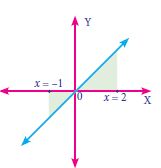
Find the area bounded by y = x between the lines x = −1 and x = 2 with x -axis.
1.
Given MC = 2 + 5ex
\(C=\int { MC } dx+k\)
\(=\int { (2+5{ e }^{ x })dx } +k\)
= 2x + 5ex + k
Average cost = \(\frac { C }{ x } =\frac { 2x+5{ e }^{ x }+95 }{ x } \)
\(AC=2+\frac { 5{ e }^{ x } }{ x } +\frac { 95 }{ x } \)
2.
Given Curve is y2 = 27x3.
\({ x }^{ 3 }=\frac { { y }^{ 2 } }{ 27 } \)
\(x={ \left( \frac { { y }^{ 2 } }{ 27 } \right) }^{ \frac { 1 }{ 3 } }=\frac { { y }^{ \frac { 2 }{ 3 } } }{ 3 } \)
∴ Area \(=\frac { 1 }{ 3 } \int _{ 1 }^{ 2 }{ { y }^{ \frac { 2 }{ 3 } } } dy=\frac { 1 }{ 3 } { \left( \frac { { y }^{ \frac { 2 }{ 3 } +1 } }{ \frac { 2 }{ 3 } +1 } \right) }_{ 1 }^{ 2 }\)
\(={ \left( \frac { 1 }{ 3 } .\frac { { y }^{ \frac { 5 }{ 3 } } }{ \frac { 5 }{ 3 } } \right) }_{ 1 }^{ 2 }\)
\(=\frac { 1 }{ 3 } \times \frac { 3 }{ 5 } { \left( { y }^{ \frac { 5 }{ 3 } } \right) }_{ 1 }^{ 2 }=\frac { 1 }{ 5 } \left( { 2 }^{ \frac { 5 }{ 3 } }-{ 1 }^{ \frac { 5 }{ 3 } } \right) \)
\(=\frac { 1 }{ 5 } \left( { 2 }^{ \frac { 5 }{ 3 } }-1 \right) \)sq.units
3.
Given y = 8x2-4x+6
Area \(=\int _{ 0 }^{ 2 }{ ({ 8x }^{ 2 }-4x+6)dx } \)
\(={ \left( \frac { 8x^{ 3 } }{ 3 } -\frac { { 4x }^{ 2 } }{ 2 } +6x \right) }_{ 0 }^{ 2 }\)
\(={ \left( \frac { 8x^{ 3 } }{ 3 } -{ 2x }^{ 2 }+6x \right) }_{ 0 }^{ 2 }\)
\(=\left[ \frac { 8(8) }{ 3 } -2(4)+6(2) \right] -0\)
\(=\frac { 64+12 }{ 3 } =\frac { 76 }{ 3 } \)
Area = \(\frac { 76 }{ 3 } \)sq.units
4.
Given MR = 6 − 3x2 − x3
⇒ ഽMR =ഽ(6 − 3x2 − x3)dx
\(\Rightarrow \mathrm{R}=6 x-\frac{\not{3} x^{3}}{\not3}-\frac{x^{4}}{4}+k\)
\(\Rightarrow 6x-{ x }^{ 3 }-\frac { { x }^{ 4 } }{ 4 } +k\)
When x = 0, R = 0 ⇒ k = 0
\(\Rightarrow R=6x-{ x }^{ 3 }-\frac { { x }^{ 4 } }{ 4 } \)
Demand function \(P=\frac { R }{ x } =6-{ x }^{ 2 }-\frac { { x }^{ 3 } }{ 4 } \)
5.
Given \(MR=\frac { 2 }{ x+3 } -\frac { 2x }{ (x+{ 3) }^{ 2 } } +5\)
\(\Rightarrow \int { MR } =\int { \left( \frac { 2 }{ x+3 } -\frac { 2x }{ (x+{ 3) }^{ 2 } } +5 \right) dx } \)
\(\Rightarrow R=2log(x+3)-2\int { \frac { x }{ { (x+3) }^{ 2 } } dx+5x+k } \)
\(\Rightarrow R=2log(x+3)-2\left[ \int { \frac { x+3-3 }{ { (x+3) }^{ 2 } } dx } \right] +5x+k\)
\(\Rightarrow R=21log(x+3)-2\left[ \int { \frac { 1 }{ x+3 } dx-3\int { \frac { dx }{ { (x+3) }^{ 2 } } } } \right] +5x+k\)

\(\Rightarrow R=\frac { -6 }{ x+3 } +5x+k\)
When x = 0, R = 0 ⇒ k = 0
\(0=\frac { -6 }{ 3 } +0+k\Rightarrow k=+2\)
\(\therefore R=\frac { -6 }{ x+3 } +5x-2\)
Demand function \(P=\frac { R }{ x } \)
\(\Rightarrow P=\frac { -6 }{ x(x+3) } +5+\frac { 2 }{ x } \)
\(\Rightarrow P=\frac { -6+2(x+3) }{ x(x+3) } +5\)
\(\Rightarrow P=\frac { -6+2x+6 }{ x(x+3) } +5\)
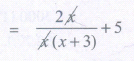
\(\Rightarrow P=\frac { 2 }{ x+3 } +5\)
6.
Given \(MC=125+10x-\frac { { x }^{ 2 } }{ 9 } \)
\(\Rightarrow \int { MC } =\int { \left( 125+10x-\frac { { x }^{ 2 } }{ 9 } \right) } dx\)
\(\Rightarrow C=125x+\frac { { 10x }^{ 2 } }{ 2 } -\frac { { x }^{ 3 } }{ 9\times 3 } +k\)
\(\\ \Rightarrow C=125x+{ 5x }^{ 2 }-\frac { { x }^{ 3 } }{ 27 } +k\)
Given fixed cost is Rs. 250,
When x = 0, C = 250 ⇒ k = 250
\(\therefore C=125x+{ 5x }^{ 2 }-\frac { { x }^{ 3 } }{ 27 } +250\)
When x = 15, C = ?
\(\therefore \ C=125(15)+5{ (15) }^{ 2 }-\frac { { 15 }^{ 3 } }{ 27 } +250\)
\(=1875+1125-\frac { 3375 }{ 27 } +250\)
= 3000-125+250
= Rs. 3125
∴ C = Rs. 3125
7.
Given MR = 275 - x - 0.3x2
ഽMR = f(275 - x - 0.3x2)dx
To find the total revenue, when it is increased from 10 to 20 units
\(R=\int _{ 10 }^{ 20 }{ (275-x-0.3{ x }^{ 2 })dx } \)
\(={ \left( 275x-\frac { { x }^{ 2 } }{ 2 } -0.3\frac { { x }^{ 3 } }{ 3 } \right) }_{ 10 }^{ 20 }\)
\(={ \left( 275x-\frac { { x }^{ 2 } }{ 2 } -0.1{ x }^{ 3 } \right) }_{ 10 }^{ 20 }\)
\(=\left[ 275(20)-\frac { { 10 }^{ 2 } }{ 2 } -0.1({ 10 }^{ 3 }) \right] \)
= [5500 - 200 - 800] - [2750 - 50 - 100]
= [5500 - 1000] - [2750 - 150]
= 4500-2600 = 1,900
R = Rs. 1,900
8.
Given demand function Pd = 1600 - x2 and
Supply function Ps = 2x2 + 400
Under perfect competition pd = ps
⇒ 1600 - x2 = 2x2 + 400
⇒ 1600-400 = 2x2 + x2
⇒ 1200 = 3x2
\(\Rightarrow \frac { 1200 }{ 3 } ={ x }^{ 2 } \Rightarrow { x }^{ 2 }=400\)
\(\Rightarrow x=\pm \sqrt { 400 } =+20\quad or-20\)
Since x cannot be negative, x0 = 20
∴ p0 = 1600 - (20)2 = 1600 - 400
= 1200
∴ p0x0 = (1200) (20) = 24000
Producer's Surplus PS = Poxo -\(\int _{ 0 }^{ x }{ g(x)dx } \)
\(=24000-\int _{ 0 }^{ 20 }{ ({ 2x }^{ 2 }+400)dx } \)
\(=24000-{ \left[ \frac { { 2x }^{ 3 } }{ 3 } +400x \right] }_{ 0 }^{ 20 }\)
\(=24000-\left[ \frac { { 2(20) }^{ 3 } }{ 3 } +400(20) \right] \)
\(=24000-\left[ \frac { 16000 }{ 3 } +8000 \right] \)
\(=24000-\left[ \frac { 16000+24000 }{ 3 } \right] \)
\(=24000-\left[ \frac { 40000 }{ 3 } \right] \)
\(=\frac { 72000-40000 }{ 3 } \)
PS = \( \frac{32000}{3}\)units
9.
Given demand function p = \(\frac{36}{x+4}\)
Also, given market price is 6
⇒ p0 = 6
\(\therefore \ \frac{1}{\not 6}=\frac {\not 36}{x_{0}+4}\)
⇒ x0 + 4 = 6
⇒ x0 = 6 - 4 = 2
⇒ x0 = 2
⇒ p0x0 = 6 x 2 = 12
Consumer's Surplus
\(CS=\int _{ 0 }^{ x }{ f(x)dx-{ p }_{ 0 }{ x }_{ 0 } } \)
\(=\int _{ 0 }^{ 2 }{ \frac { 36 }{ x+4 } dx-12 } \)
\(=36 \log{ \left[ x+4 \right] }_{ 0 }^{ 2 }-12\)
= 36 [log(2 + 4) -log(0 +4)] - 12
= 36 [log 6 -log 4] - 12
= 36log\((\frac{6}{4})\)-12
[∴ log m-log n = log \((\frac{m}{n})\)]
CS = 36 log\((\frac{3}{2})\)-12 units
10.
Given supply function P = 3x + 5x2 and x = 4.
When x0 = 4, p0 = 3(4)+5(42)
= 12 + 80 = 92
∴ p0x0 = 92 x 4 = 368
Producer's Surplus
\(PS={ p }_{ 0 }{ x }_{ 0 }-\int _{ 0 }^{ x }{ g(x)dx } \)
\(=368-\int _{ 0 }^{ 4 }{ (3x+5{ x }^{ 2 })dx } \)
\(=368-{ \left( \frac { { 3x }^{ 2 } }{ 2 } +\frac { { 5x }^{ 3 } }{ 3 } \right) }_{ 0 }^{ 4 }\)
\(=368-\left( \frac { 3({ 4 }^{ 2 }) }{ 2 } +5\frac { ({ 4 }^{ 3 }) }{ 3 } \right) \)
\(=368-\left( 24+\frac { 320 }{ 3 } \right) \)
= 368-(24+106.66)
= 368-(130.66)
P.S = 237.3 units
11.
Given supply function p = 7 + x and x = 5
When x0 = 5, p0 = 7 + 5 = 12
∴ p0x0 = x12 = 60
Producer's Surplus
\(={ p }_{ 0 }{ x }_{ 0 }-\int _{ g }^{ x }{ (x)dx } \)
\(=60-\int _{ 0 }^{ 5 }{ (7+x)dx } \)
\(=60-{ \left[ 7x+\frac { { x }^{ 2 } }{ 2 } \right] }_{ 0 }^{ 5 }\)
\(=60-\left[ 7(5)+\frac { { 5 }^{ 2 } }{ 2 } \right] \)
\(=60-\left[ 35+\frac { 25 }{ 2 } \right] \)
= 60-(35+12.5)
= 60-47.5
P.S = 12.5 = \(\frac{25}{2}\) units.
12.
Given demand function p = e-x
and p = 0.5
when p0 = 0.5, 0.5 = e-x
⇒ \(\frac{1}{2}=e^-x\)
\(\Rightarrow \frac { 1 }{ 2 } =\frac { 1 }{ { e }^{ x } } \Rightarrow ex=2\)
\(\Rightarrow x=\log 2\)
\(\therefore \ { p }_{ 0 }{ x }_{ 0 }=0.5\ \log 2=\frac { 1 }{ 2 } \log 2\)
Consumer's Surplus
\(=\int _{ 0 }^{ x }{ f(x)dx-{ p }_{ 0 }{ x }_{ 0 } } \)
\(=\int _{ 0 }^{ log2 }{ { e }^{ -x }dx-\frac { 1 }{ 2 } log2 } \)
\(={ \left[ \frac { { e }^{ -x } }{ -1 } \right] }_{ 0 }^{ log2 }-\frac { 1 }{ 2 } log2\)
\(=-{ \left[ { e }^{ -x } \right] }_{ 0 }^{ log2 }-\frac { 1 }{ 2 } log2\)
\(=-\left( { e }^{ -log2 }-{ e }^{ 0 } \right) -\frac { 1 }{ 2 } log2\)
\(=-\left( { e }^{ log\quad \frac { 1 }{ 2 } }-1 \right) -\frac { 1 }{ 2 } log2\)
\(=-\left( \frac { 1 }{ 2 } -1 \right) -\frac { 1 }{ 2 } log2\)
\(=-\left( -\frac { 1 }{ 2 } \right) -\frac { 1 }{ 2 } log2\)
\(\\ =\frac { 1 }{ 2 } -\frac { 1 }{ 2 } log2=\frac { 1 }{ 2 } (1-{ log }_{ e }2)\)
∴ C.S = \(\frac{1}{2}\)[1-loge 2] units
13.
Given demand function Pd = 85 - 5x and
Supply function p5 = 3x - 35
At equilibrium prices,Pd = Ps
⇒ 85 - 5x = 3x - 35
⇒ 85 + 35 = 3x + 5x
⇒ 120 = 8x
⇒ x = \(\frac{120}{8}\) = 15
When x0 = 15, p0 = 85-5(15)
= 85 - 75 = 10
p0 = 10
∴ p0x0 = 15\(\times\)10 = 150
Consumer's Surplus
\(Cs=\int _{ 0 }^{ x }{ f(x) } dx-{ p }_{ 0 }{ x }_{ 0 }\)
\(=\int _{ 0 }^{ 15 }{ (85-5x)dx-150 } \)
\(={ \left[ 85x-\frac { 5{ x }^{ 2 } }{ 2 } \right] }_{ 0 }^{ 15 }-150\)
\(=85(15)-5\frac { { (15) }^{ 2 } }{ 2 } -150\)
\(=1275-\frac { 1125 }{ 2 } -150\)
= 1275 - 562.5 - 150
= 1275 - 712.5
Cs = 562.5
14.
Given demand functionp = 122 - 5x - 2x2 and x = 6
When x0 = 6, p0 = 122-5(6)-2(6)2
= 122-30-72
= 122-102
P0 = 20
p0x0 = 20 \(\times\) 6 = 120
Consumer's Surplus
CS \(=\int _{ 0 }^{ x }{ f(x) } dx-{ p }_{ 0 }{ x }_{ 0 }\)
\(=\int _{ 0 }^{ 6 }{ (122-5x-2{ x }^{ 2 })dx-120 } \)
\(={ \left[ 122x-\frac { 5{ x }^{ 2 } }{ 2 } -\frac { { 2x }^{ 3 } }{ 3 } \right] }_{ 0 }^{ 6 }-120\)
\(=122(6)-5\frac { \left( { 6 }^{ 2 } \right) }{ 2 } -2\frac { \left( { 6 }^{ 3 } \right) }{ 3 } -120\)
\(=732-\frac { 180 }{ 2 } -\frac { 432 }{ 3 } -120\)
= 732-90-144-120
= 732-354
C.S = 378 units
15.
Given demand function P = 50 - 2x
and x = 20
when x0 = 20,
p0 = 50 - 2(20) = 50-40 = 10
p0x0 = 20(10) = 200
Consumer's Surplus \(CS=\int _{ 0 }^{ x0 }{ f(x) } dx-{ p }_{ 0 }{ x }_{ 0 }\)
\(CS=\int _{ 0 }^{ 20 }{ (50-2x)dx-200 } \)
= 50(20)-(20)2-200
= 1000-400-200
= 1000-600
cs = 400 units
16.
g(x) = 4x + 8 and x0 = 5
p0 = 4(5) + 8 = 28
PS = x0 p0 – \(\int _{ 0 }^{ { x }_{ o } }{ g(x) } \) dx
= (5 × 28) - \(\int _{ 0 }^{ 5 }{ (4x+8) } \) dx
= 140 – \({ \left[ 4\left( \frac { { x }^{ 2 } }{ 2 } \right) +8x \right] }_{ 0 }^{ 5 }\)
= 140 – (50 + 40)
= 50 units
Hence the producer’s surplus = 50 units.
17.
Given y = 36 − x2 and y0 = 11
11 = 36 – x2
x2 = 25
x = 5
CS = \(\int _{ 0 }^{ x }{ \text{(demand }\ \text{ function)dx–(Price×quantity demanded)}}\)
= \(\int _{ 0 }^{ 5 }{ (36-{ x }^{ 2 })dx-5\times 11 } \)
= \({ \left[ 36x-\frac { { x }^{ 3 } }{ 3 } \right] }_{ 0 }^{ 5 }-55\)
= \(\left[ 36(5)-\frac { { 5 }^{ 3 } }{ 3 } \right] -55\)
= \(180-\frac { 125 }{ 3 } -55=\frac { 250 }{ 3 } \)
Hence the consumer’s surplus is = \(\frac { 250 }{ 3 } \)
18.
Given MR = 14 - x + 9x2
⇒ \(\frac{dR}{dx}\) = 14 - 6x + 9x2
⇒ dR = (14 - 6x + 9x2)dx
⇒ ഽdR = ഽ(14 - 6x + 9x2)dx
\(\Rightarrow \ R=14x-\frac { 6{ x }^{ 2 } }{ 2 } +\frac { { 9x }^{ 3 } }{ 3 } +k\)
When x = 0, R = 0 ⇒ k = 0
R = 14x - 3x2+ 3x3
Demand function \(P=\frac { R }{ x } =\frac { 14x-3{ x }^{ 2 }+{ 3x }^{ 3 } }{ x } \)
⇒ P = 14 − 3x + 3x2
19.
Given \(MC=\frac { 14000 }{ \sqrt { 7x+4 } } \)
\(\Rightarrow \frac { dc }{ dx } =\frac { 14000 }{ \sqrt { 7x+4 } } \)
\(\Rightarrow dC=\frac { 14000 }{ \sqrt { 7x+4 } } dx\)
\(\Rightarrow \int { dC } =14000\int { \frac { dx }{ \sqrt { 7x+4 } } } \)
\(\Rightarrow 14000\int { (7x+4)^{ -\frac { 1 }{ 2 } }dx } \)
\(\Rightarrow C=14000\frac { { (7x+4) }^{ -\frac { 1 }{ 2 } +1 } }{ \left( -\frac { 1 }{ 2 } +1 \right) 7 } +k\)
\(\Rightarrow C=14000\frac { { (7x+4) }^{ \frac { 1 }{ 2 } } }{ \frac { 7 }{ 2 } } +k\)
\(C={\not14000} \times \frac{2}{\not 7} \sqrt{7 x+4}+k\)
\(\Rightarrow C=4000\sqrt { 7x+4 } +k\) ...(1)
Given fixed cost is 18,000
When x = 0, C = 18000
⇒ 18000 = 4000√4 + k
⇒ 18000 = 4000(2) + k
⇒ k = 18000-8000
⇒ k = 10000
∴(1) becomes,
C = 4000\(\sqrt { 7x+4 } +10000\),
Average Cost (AC) \(=\frac{C}{x}\)
= \(\frac { 4000 }{ x } \sqrt { 7x+4 } +\frac { 10000 }{ x } \)
20.
Given
\(MR=10+3x-{ x }^{ 2 }\)
\(\frac { dR }{ dx } =10+3x-{ x }^{ 2 }\)
\(\Rightarrow dR=(10+3x-{ x }^{ 2 })dx\)
\(\Rightarrow \int { dR } =\int { (10+3x-{ x }^{ 2 }) } dx\)
\(\Rightarrow R=10x+\frac { { 3x }^{ 2 } }{ 2 } -\frac { { x }^{ 3 } }{ 3 } +k\)
When x = 0, R = 0 ⇒ k = 0
\(\Rightarrow R=10x+\frac { { 3x }^{ 2 } }{ 2 } -\frac { { x }^{ 2 } }{ 3 } \)
Demand function\(P=\frac { R }{ x } =\frac { 10x+\frac { { 3x }^{ 2 } }{ 2 } -\frac { { x }^{ 3 } }{ 3 } }{ x } \)
P = 10 + \(\frac { { 3x }^{ 2 } }{ 2 } -\frac { { x }^{ 3 } }{ 3 } \)
21.
Given
\(MR=R'(x)=1500-4x-3{ x }^{ 2 }\)
\(\Rightarrow \int { R'(x) } =\int { (1500-4x-3x^{ 2 })dx } \)
\(\Rightarrow R(x)=1500x-\frac { { 4x }^{ 2 } }{ 2 } -\frac { { 3x }^{ 3 } }{ 3 } +k\)
\(\Rightarrow R(x)=1500x-2{ x }^{ 2 }-{ x }^{ 3 }+k\)
When x = 0, R = 0 ⇒ k = 0
\(\Rightarrow R(x)=1500x-2{ x }^{ 2 }-{ x }^{ 3 }\)
Average revenue function \(=\frac { R(x) }{ x } \)
\(=\frac { 1500x-{ 2x }^{ 2 }-{ x }^{ 3 } }{ x } \)
AR = 1500 - 2x - x2
22.
Given marginal revenue function \(=\frac { 4 }{ { (2x+3) }^{ 2 } } -1\)
\(\Rightarrow MR=\frac { dR }{ dx } =4(2x+3{ ) }^{ -2 }-1\)
\(\Rightarrow dR=(4(2x+3{ ) }^{ -2 }-1)dx\)
\(\Rightarrow \int { dR=4\int { (2x+3{ ) }^{ -2 } } dx-\int { dx } } \)
\(\Rightarrow R=4\frac { { (2x+3) }^{ -2+1 } }{ { (-2+1) }^{ 2 } } -x\)
\(\Rightarrow R=4\frac { (2x+3{ ) }^{ -1 } }{ -2 } -x\)
\(\Rightarrow R=\frac { -2 }{ (2x+3) } -x+k\) ..(1)
When x = 0, R = 0
\(\Rightarrow 0=\frac { -2 }{ 3 } -0+k\Rightarrow =\frac { 2 }{ 3 } \)
∴ (1) becomes
\(R=\frac { -2 }{ 2x+3 } -x+\frac { 2 }{ 3 } \)
We know that R = Px ⇒ P = \(\frac{R}{x}\)
∴ Average revenue function
\(P=\frac { R }{ x } =\frac { R }{ x } =\frac { -2 }{ x(2x+3) } -\frac { x }{ x } +\frac { 2 }{ 3x } \)
\(=\frac { -2 }{ x(2x+3) } -1+\frac { 2 }{ 3x } \)
\(=\frac { -2 }{ x(2x+3) } +\frac { 2 }{ 3x } -1\)
\(=\frac { -6+2(2x+3) }{ 3x(2x+3) } -1\)
\(=\frac{-\not 6+4 x+\not 6}{3 x(2 x+3)}-1 \)
\(=\frac{4 \not x}{3\not x(2 x+3)}-1\)
\(=\frac { 4 }{ 3(2x+3) } -1\)
\(\\ \\ P=\frac { 4 }{ 6x+9 } -1\)
Hence Proved.
23.
24.
Given marginal revenue MR = 5 + 3e - 0.03x
\(\Rightarrow \frac { dR }{ dx } =5+{ 3e }^{ -0.03x }\)
\(\Rightarrow dR=(5+3{ e }^{ -0.03x })dx\)
Total revenue from sale of 100 units is
\(R=\int _{ 0 }^{ 100 }{ (5+3{ e }^{ -0.03x })dx } \)
\(={ \left[ 5x+3\frac { { e }^{ -0.03x } }{ -0.03 } \right] }_{ 0 }^{ 100 }\)
\(={ \left[ 5x-\frac { { e }^{ -0.03x } }{ 0.01 } \right] }_{ 0 }^{ 100 }\)
\(=\left( 5(100)-\frac { { e }^{ -0.03(100) } }{ 0.01 } \right) -\left( 0-\frac { { e }^{ -0.03(0) } }{ 0.01 } \right) \)
\(=500-\frac { { e }^{ -3 } }{ .01 } +\frac { { e }^{ 0 } }{ 0.01 } \)
\(=500-\frac { .05 }{ .01 } +\frac { 1 }{ .01 } \)
= 500 - 5 + 100
= 600 - 5 = 595
∴ Total revenue = 595\(\times\)1000
= Rs. 595000
[∵ Revenue is given in thousands]
25.
Given marginal cost MC = C'(x) = \(\frac { { x }^{ 2 } }{ 200 } +4\)
\(\Rightarrow \int { MC=\int { C'(x)=\int { \left( \frac { { x }^{ 2 } }{ 200 } +4 \right) dx } } } \)
To find the cost of producing 200 air conditioners
\(C=\int _{ 0 }^{ 200 }{ \left( \frac { { x }^{ 2 } }{ 200 } +4 \right) dx } \)
\(={ \left[ \frac { 1 }{ 200 } \times \frac { { x }^{ 3 } }{ 3 } +4x \right] }_{ 0 }^{ 200 }\)
\(={ \left[ \frac { { x }^{ 3 } }{ 600 } +4x \right] }_{ 0 }^{ 200 }\)
\(=\left[ \frac { { (200) }^{ 3 } }{ 600 } +4(200) \right] -0\)
\(=\frac { 8000000 }{ 600 } +800\)
= 13333.33 + 800
= Rs. 14,133.33
Hence, the cost of producing 200 air conditioners is Rs. 14133.33
26.
Given marginal cost function = \(\frac { a }{ \sqrt { ax+b } } \)
\(\Rightarrow MC=\frac { a }{ \sqrt { ax+b } } \Rightarrow \frac { dC }{ dx } =\frac { a }{ \sqrt { ax+b } } \)
\(\Rightarrow dC=\frac { a }{ \sqrt { ax+b } } dx\)
\(\Rightarrow \int { dC } =a\int { \frac { dx }{ \sqrt { ax+b } } } \)
\(\Rightarrow C=a\int { { (ax+b) }^{ \frac { -1 }{ 2 } }dx } \)
\(\Rightarrow C=\not a \frac{(a x+b)^{\frac{-1}{2}+1}}{\left(-\frac{1}{2}+1\right) \not a}+k\)
\(\Rightarrow C=\frac { { (ax+b) }^{ \frac { 1 }{ 2 } } }{ 1 } +k\)
\(\Rightarrow C=2\sqrt { ax+b } +k\) ...(1)
Since the cost of output is zero.
C = 0, when x = 0
\(\therefore (1)\rightarrow 0=2\sqrt { 0+b } +k\)
\(\Rightarrow 0=2\sqrt { b } +k\)
\(\Rightarrow k=-2\sqrt { b } \)
∴(1)becomes
\(C=2\sqrt { ax+b } -2\sqrt { b } \)
27.
Given \(MC=300{ x }^{ \frac { 2 }{ 5 } }\)
\(\Rightarrow \frac { dC }{ dx } =300{ x }^{ \frac { 2 }{ 5 } }\)
\(\int { dC } =300\int { { x }^{ \frac { 2 }{ 5 } }dx } \)
\(\Rightarrow C=300\frac { { x }^{ \frac { 2 }{ 5 } +1 } }{ \frac { 2 }{ 5 } +1 } +k\)
\(\Rightarrow C=300\frac { { x }^{ \frac { 7 }{ 5 } } }{ \frac { 7 }{ 5 } } +k\)
\(\Rightarrow C=300\times \frac { 5 }{ 7 } { x }^{ \frac { 7 }{ 5 } }+k\) ...(1)
Given fixed cost is zero ⇒ k = 0
∴(1) becomes,
\(C=\frac { 1500 }{ 7 } { x }^{ \frac { 7 }{ 5 } }+0\Rightarrow C=\frac { 1500 }{ 7 } { x }^{ \frac { 7 }{ 5 } }\)
Average cost function \((AC)=\frac { C }{ x } \)
\(\Rightarrow AC=\frac { 1500 }{ 7 } \frac { { x }^{ \frac { 7 }{ 5 } } }{ x } \)
\(\Rightarrow AC=\frac { 1500 }{ 7 } { x }^{ \frac { 7 }{ 5 } -1 }\)
\(\Rightarrow AC=\frac { 1500 }{ 7 } { x }^{ \frac { 2 }{ 5 } }\)
28.
Given marginal cost function
\(MC=\frac { dc }{ dx } =100-10x+0.1{ x }^{ 2 }\)
\(\Rightarrow C=\int { (100-10x+0.1{ x }^{ 2 })dx } \)
\(\Rightarrow C=100x-\frac { { 10x }^{ 2 } }{ 2 } +\frac { { 0.1x }^{ 3 } }{ 3 } +k\) ...(1)
Given fixed cost is Rs. 500 ⇒ k = 500
∴ (1) becomes,
\(C=100x-5{ x }^{ 2 }+\frac { { 0.1x }^{ 3 } }{ 3 } +500\)
Average cost function
\(AC=\frac { C }{ x } =\frac { 100x-{ 5x }^{ 2 }+\frac { { 0.1x }^{ 3 } }{ 3 } }{ x } +500\)
\(AC=100-5x+\frac { { 0.1x }^{ 2 } }{ 3 } +\frac { 500 }{ x } \)
29.
Given P = Rs.1000, r = \(\frac{5}{100}\) = 0.05 and N = 5
Amount after 5 years
=\(\int _{ 0 }^{ 5 }{ 1000 } { e }^{ 0.05t }dt\)
\(\left[ \therefore A=\int _{ 0 }^{ N }{ p{ e }^{ rl }dt } \right] \)
\(=1000\int _{ 0 }^{ 5 }{ { e }^{ 0.05t }dt } \)
\(=1000{ \left( \frac { { e }^{ 0.05t } }{ 0.05 } \right) }_{ 0 }^{ 5 }\)
\(=\frac { 1000 }{ 0.05 } { \left( \frac { { e }^{ 0.05 } }{ 0.05 } \right) }_{ 0 }^{ 5 }\)
\(=\frac { 1000 }{ 0.05 } { \left( { e }^{ 0.05t } \right) }_{ 0 }^{ 5 }\)
\(=20,000({ e }^{ 0.05(5) }-{ e }^{ 0.05(0) })\)
\(\\ =20,000\left( { e }^{ 0.25 }-{ e }^{ 0 } \right) \)
[∵ e0.25 = 1.284]
= 20,000(.284-1)
= Rs. 5,680
Hence, the amount after 5 years will be Rs. 5680
30.
Given inventory on hand I(x) = 500 - 0.03x2
Holding cost per scooter is C1 = Rs. 0.3
Time period T = 30 days
Total inventory carrying cost
\(={ C }_{ 1 }\int _{ 0 }^{ r }{ I(x)dx } \)
\(=0.3\int _{ 0 }^{ 30 }{ ({ 500-0.03x }^{ 2 })dx } \)
\(=0.3{ \left[ 500x-\frac { { 0.03x }^{ 3 } }{ 3 } \right] }_{ 0 }^{ 30 }\)
\(=0.3{ \left[ 500x-0.01{ x }^{ 3 } \right] }_{ 0 }^{ 30 }\)
\(=0.3\left\{ \left[ 500(30)-0.01{ (30) }^{ 3 } \right] -0 \right\} \)
= 0.3[15000 - 0.01 (27000)]
= 0.3[15000 - 270]
= 0.3 (14730)
= Rs. 4419
Hence, the total cost or maintaining inventory for 30 days = Rs. 4419.
31.
Annual consumption at timet = 0 (In the year 2000) = p0 = 2547 metric ton.
Total production of Gold from 2000 to 2013 = \(\int _{ 0 }^{ 13 }{ 2547e^{ 0.006t } } dt\)
= \(\frac { 2547 }{ 0.006 } \left[ e^{ 0.006t } \right] _{ 0 }^{ 13 }\)
= 424500 (e0.078 −1)
= 34,426.95 metric tons approximately.
32.
Given cost of overhaul of an engine is Rs. 10,000
Operating cost per hour = 2x - 240.
Total cost for the engine to run for 300 hours
after overhaul =10,000+\(\int _{ 0 }^{ 300 }{ (2x-240) } dx\)
\(=10,000+{ \left[ \frac { { 2x }^{ 2 } }{ 2 } -240x \right] }_{ 0 }^{ 300 }\)
\(=10,000+{ [{ x }^{ 2 }-240x] }_{ 0 }^{ 300 }\)
= 10,000 + 90,000 - 72,000
= 1,00,000 - 72,000
= Rs. 28,000
33.
p = 10000, r = 0.1, N = 5
Annuity = \(\int _{ 0 }^{ 5 }{ 10000 } { e }^{ 0.1t }\ dt\)
= \(\frac { 10000 }{ 0.1 } { \left( { e }^{ 0.1t } \right) }_{ 0 }^{ 5 }\)
= \(100000[{ e }^{ 0.1\times 5 }-{ e }^{ 0 }]\)
= 100000 (e0.5 −1)
=100000 [0.6487]
= Rs. 64,870
34.
Here I(x) = 200 – 0.2x
C1 = Rs. 3.5
T = 30
Total inventory carrying cost = C1\(\int _{ 0 }^{ r }{ I(x) } dx=3.5\int _{ 0 }^{ 30 }{ (200-0.2x) } dx\)
= \(3.5{ \left( 200x-\frac { { 0.2x }^{ 2 } }{ 2 } \right) }_{ 0 }^{ 30 }\) = 20,685
35.
Given MR = 35 + 7x − 3x2
R = \(\int { (MR)dx } +k\)
= \(\int { (35+7x+3{ x }^{ 2 }) } dx+k\)
R = 35x + \(\frac { 7 }{ 2 } \) x2 − x3 + k
Since R = 0 when x = 0, k = 0
R = 35x + \(\frac { 7 }{ 2 } \) x2 − x3
Demand function P = \(\frac{R}{x}\)
P = 35 + \(\frac { 7 }{ 2 } \) x - x2
36.
Saving Cost S(t) = \(\int _{ 0 }^{ t }{ 20000t } \ dt\)
= 10000 t2
To recoup the total price,
10000 t2 = 640000
t2 = 64
t = 8
When t = 8 years, one can recoup the price.
37.
Let p be the additional product produced for additional of x labour,
\(\frac{dp}{dx}\) = 300 - 5x2/3
\(p=\int _{ 0 }^{ 64 }{ { \left( 300-5{ x }^{ \frac { 2 }{ 3 } } \right) } } dx\)
\(={ \left[ 300x-3{ x }^{ \frac { 5 }{ 3 } } \right] }_{ 0 }^{ 64 }\)
= 300 \(\times\) 64 -3(64)5/3
= 16128
∴ The number of additional units produced 16128
Total number of units produced by 264 workers
= 50,000 + 16,128 = 66128 units
38.
Total sale = \(\int _{ 0 }^{ 4 }{ (100-{ 90 }e^{ -x }) } dx\)
= \({ (100x+90e^{ -x }) }_{ 0 }^{ 4 }\)
= 400 + 90e−4 −(0 + 90)
= 400 + 90(0.018) −90
= 311.62 units
39.
Given MC = 2 + 5ex
\(C=\int { MC } dx+k\)
\(=\int { (2+5{ e }^{ x })dx } +k\)
= 2x + 5ex + k
x = 0 ⇒ C = 100,
100 = 2(0)+ 5(e0 )+ k
k = 95
C = 2x + 5 ex + 95.
40.
\(MC=125+10x-\frac { { x }^{ 2 } }{ 9 } \)
\(C=\int { MC } dx+k\)
\(=\int { \left( 125+10x-\frac { x^{ 2 } }{ 9 } \right) } dx+k\)
= 125 + 5x2- \(\frac { { x }^{ 3 } }{ 27 } \) + k
Fixed cost k = 250
C = 125x + 5x2- \(\frac { { x }^{ 3 } }{ 27 } \) + 250
When x = 15
C = 125(15) + 5(15)2- \(\frac { { (15) }^{ 3 } }{ 27 } \) + 250
= 1875 +1125 −125 + 250
C = Rs. 3,125
41.
Given,
Marginal cost MC = 6 +10x − 6x2
C = \(\int { MC } dx+k\)
= \(\int { (6+10x-{ 6x }^{ 2 })dx+k } \)
= 6x + 5x2 − 2x3 + k (1)
when x = 2, C = 12 (given)
12 = 12 + 20 −16 + k
k = -4
C = 6x + 5x2 − 2x3 − 4
Average cost = \(\frac { C }{ x } =\frac { 6x+{ 5x }^{ 2 }-2{ x }^{ 3 }+{ 4 } }{ x } \)
= 6 + 5x − 2x2 − \(\frac { 4 }{ x } \)
42.
Given curve y = 4x2 is an open upward parabola
\(\Rightarrow \frac { y }{ 4 } ={ x }^{ 2 }\)
The limits are from y = 0 to y = 4
Since the shaded region lies to the right of Y-axis,
required area \(=\int _{ 0 }^{ 4 }{ xdy } \)
\(=\int _{ 0 }^{ 4 }{ \sqrt { \frac { y }{ 4 } } dy } \)
\(=\frac { 1 }{ 2 } \int _{ 0 }^{ 4 }{ \sqrt { y } dy } =\frac { 1 }{ 2 } \int _{ 0 }^{ 4 }{ { y }^{ \frac { 1 }{ 2 } }dy } \)
\(=\frac{1}{2}\left[\frac{y^{\frac{3}{2}}}{\frac{3}{2}}\right]_{0}^{4}=\frac{1}{\not2} \times \frac{\not2}{3}\left[y^{\frac{3}{2}}\right]_{0}^{4}\)
\(=\frac { 1 }{ 3 } \left[ { 4 }^{ \frac { 3 }{ 2 } }-0 \right] =\frac { 1 }{ 3 } \left[ { 4 }^{ \frac { 3 }{ 2 } } \right] \)
\(=\frac { 1 }{ 3 } { 4 }^{ 1 }\sqrt { 4 } =\frac { 1 }{ 3 } .4(2)\)
A = \(\frac{8}{3}\) sq.units
43.
y-1 = x
| x | 0 | -1 |
| y | 1 | 0 |
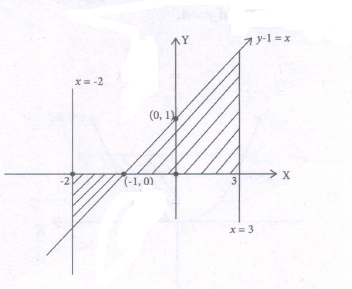
Given line is y - 1 = x ⇒ y = x + 1
Given limits are from x = - 2 to 3.
In the diagram, the area from x = - 2 to x = -1 lies below the X-axis and the area from x = -1 to x = 3 lies above the X-axis.
∴ Required Area
\(=\int _{ 2 }^{ -1 }{ -ydx+ } \int _{ -1 }^{ 3 }{ ydx } \)
\(=-\int _{ -2 }^{ -1 }{ ydx } +\int _{ -1 }^{ 3 }{ ydx } \)
\(=\int _{ -1 }^{ -2 }{ ydx } +\int _{ -1 }^{ 3 }{ ydx } \left[ \because \int _{ a }^{ b }{ f(x)dx=-\int _{ b }^{ a }{ f(x)dx } } \right] \)
\(=\int _{ -1 }^{ -2 }{ (x+1)dx+\int _{ -1 }^{ 3 }{ (x+1)dx } } \)
\(={ \left( \frac { { x }^{ 2 } }{ 2 } +x \right) }_{ -1 }^{ -2 }+{ \left( \frac { { x }^{ 2 } }{ 2 } +x \right) }_{ -1 }^{ 3 }\)
\(=\left( \frac { 4 }{ 2 } -2 \right) -\left( \frac { 1 }{ 2 } -1 \right) +\left( \frac { 9 }{ 2 } +3 \right) -\left( \frac { 1 }{ 2 } -1 \right) \)
\(=(2-2)-\left( -1\frac { 1 }{ 2 } \right) +\left( \frac { 15 }{ 2 } \right) -\left( -\frac { 1 }{ 2 } \right) \)
\(=0+\frac { 1 }{ 2 } +\frac { 15 }{ 2 } +\frac { 1 }{ 2 } =\frac { 17 }{ 2 } \) sq.units.
44.
y = x
| x | 1 | 2 |
| y | 1 | 2 |
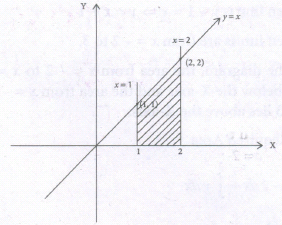
Given line y = x
The limits are x = 1, x = 2
Since the shaded area lies to the right of Y-axis,
Area \(=\int _{ 1 }^{ 2 }{ y\quad dx } \)
\(=\int _{ 1 }^{ 2 }{ x\quad dx } ={ \left( \frac { { x }^{ 2 } }{ 2 } \right) }_{ 1 }^{ 2 }\)
\(=\frac { { 2 }^{ 2 } }{ 2 } -\frac { { 1 }^{ 2 } }{ 2 } =2-\frac { 1 }{ 2 } \)
= \(\frac{4-1}{2}=\) \(\frac{3}{2}\) sq.units
45.
Required area = \(\int _{ -1 }^{ 0 }{ -xdx } +\int _{ 0 }^{ 2 }{ xdx } \)
\(=-{ \left[ \frac { { x }^{ 2 } }{ 2 } \right] }_{ -1 }^{ 0 }{ +\left[ \frac { { x }^{ 2 } }{ 2 } \right] }_{ 0 }^{ 2 }=-\left[ 0-\frac { 1 }{ 2 } \right] +\left[ \frac { 4 }{ 2 } -0 \right] \)
\(=\frac { 5 }{ 2 } \) sq.units

12th Standard Syllabus & Materials
12th Standard
TN 12th Computer Applications களப்பெயர் முறைமை (DNS) Sample Question Papers Study Material - QB365 Set A
NEW12th Standard
TN 12th Computer Applications வலையமைப்பு எடுத்துக்காட்டுகள் மற்றும் நெறிமுறைகள் Sample Question Papers Study Material - QB365 Set A
NEW12th Standard
TN 12th Computer Applications கணினி வலையமைப்பு ஓர் அறிமுகம் Sample Question Papers Study Material - QB365 Set A
NEW12th Standard
TN 12th Computer Applications PHP-உடன் MySQL-ஐ இணைத்தல் Sample Question Papers Study Material - QB365 Set A



Tamilnadu Stateboard 12th Standard Subjects

Maths

Chemistry

Physics

Biology

Computer Science
Business Maths and Statistics

Economics

Commerce

Accountancy

History

Computer Applications
Biology
Computer Technology
Computer Applications
Computer Science
Business Maths and Statistics
Commerce
Economics
Maths
Chemistry
Physics
Computer Technology
History
Accountancy

Tamil

English

French
Tamilnadu Stateboard Standards
