
 100% FREE ACCESS
12th Standard Syllabus & Materials
12th Standard
TN 12th Maths Applications of Matrices and Determinants Sample Question Papers Study Material - QB365 Set A
NEW12th Standard
TN 12th Computer Applications மின்னணு தரவு பரிமாற்றம் Sample Question Papers Study Material - QB365 Set A
NEW12th Standard
TN 12th Computer Applications மின் - வணிக பாதுகாப்பு அமைப்புகள் Sample Question Papers Study Material - QB365 Set A
NEW12th Standard
TN 12th Computer Applications மின்னணு செலுத்தல் முறைகள் Sample Question Papers Study Material - QB365 Set A
NEW12th Standard
TN 12th Computer Applications மின் - வணிகம் Sample Question Papers Study Material - QB365 Set A
NEW12th Standard
TN 12th Computer Applications திறந்த மூல கருத்துருக்கள் Sample Question Papers Study Material - QB365 Set A

Published on: 02/09/2022
QB365 provides a detailed and simple solution for every Possible Book Back Questions in Class 12 Business Maths Subject -Probability Distributions, English Medium. It will help Students to get more practice questions, Students can Practice these question papers in addition to score best marks.
Download Tamil Nadu 12th Standard Business Maths and Statistics question papers, model tests, one-mark questions, important questions, and public exam papers in PDF format. Free study materials and answer keys for TN State Board students.
Questions + Answers key
Take MCQ Business Maths and Statistics Test
1.
People’s monthly electric bills in chennai are normally distributed with a mean of Rs.225 and a standard deviation of Rs. 55. Those people spend a lot of time online. In a group of 500 customers, how many would we expect to have a bill that is Rs. 100 or less?
2.
The birth weight of babies is Normally distributed with mean 3,500 g and standard deviation 500 g. What is the probability that a baby is born that weighs less than 3,100 g?
3.
Entry to a certain University is determined by a national test. The scores on this test are normally distributed with a mean of 500 and a standard deviation of 100. Raghul wants to be admitted to this university and he knows that he must score better than at least 70% of the students who took the test. Raghul takes the test and scores 585. Will he be admitted to this university?
4.
If electricity power failures occur according to a Poisson distribution with an average of 3 failures every twenty weeks, calculate the probability that there will not be more than one failure during a particular week.
5.
Hospital records show that of patients suffering from a certain disease 75% die of it. What is the probability that of 6 randomly selected patients, 4 will recover?
6.
Assuming that a fatal accident in a factory during the year is 1/1200, calculate the probability that in a factory employing 300 workers there will be atleast two fatal accidents in a year. (given e–0.25 = 0.7788).
7.
It is given that 5% of the electric bulbs manufactured by a company are defective. Using poisson distribution find the probability that a sample of 120 bulbs will contain no defective bulb.
8.
The mortality rate for a certain disease is 7 in 1000. What is the probability for just 2 deaths on account of this disease in a group of 400? [Given e(–2.8) = 0.06]
9.
Consider five mice from the same litter, all suffering from Vitamin A deficiency. They are fed a certain dose of carrots. The positive reaction means recovery from the disease. Assume that the probability of recovery is 0.73. What is the probability that atleast 3 of the 5 mice recover.
10.
Assume that a drug causes a serious side effect at a rate of three patients per one hundred. What is the probability that atleast one person will have side effects in a random sample of ten patients taking the drug?
11.
Determine the binomial distribution for which the mean is 4 and variance 3. Also find P(X=15).
12.
Among 28 professors of a certain department, 18 drive foreign cars and 10 drive local made cars. If 5 of these professors are selected at random, what is the probability that atleast 3 of them drive foreign cars?
13.
Defects in yarn manufactured by a local mill can be approximated by a distribution with a mean of 1.2 defects for every 6 metres of length. If lengths of 6 metres are to be inspected, find the probability of less than 2 defects.
14.
Mention the properties of binomial distribution.
15.
The average daily procurement of milk by village society in 800 litres with a standard deviation of 100 litres. Find out proportion of societies procuring milk between 800 litres to 1000 litres per day.
16.
Weights of fish caught by a traveler are approximately normally distributed with a mean weight of 2.25 kg and a standard deviation of 0.25 kg. What percentage of fish weigh less than 2 kg?
17.
Assume that the mean height of soldiers is 69.25 inches with a variance of 9.8 inches. How many soldiers in a regiment of 6,000 would you expect to be over 6 feet tall?
18.
Assume the mean height of children to be 69.25 cm with a variance of 10.8 cm. How many children in a school of 1,200 would you expect to be over 74 cm tall?
19.
Assuming one in 80 births is a case of twins, calculate the probability of 2 or more sets of twins on a day when 30 births occur.
20.
When counting red blood cells, a square grid is used, over which a drop of blood is evenly distributed. Under the microscope an average of 8 erythrocytes are observed per single square. What is the probability that exactly 5 erythrocytes are found in one square?
21.
A pair of dice is thrown 4 times. If getting a doublet is considered a success, find the probability of 2 successes.
22.
Suppose A and B are two equally strong table tennis players. Which of the following two events is more probable:
(a) A beats B exactly in 3 games out of 4 or
(b) A beats B exactly in 5 games out of 8 ?
23.
If the chance of running a bus service according to schedule is 0.8, calculate the probability on a day schedule with 10 services :
(i) exactly one is late
(ii) atleast one is late
24.
What is the probability of guessing correctly atleast six of the ten answers in a TRUE/FALSE objective test?
25.
If x is a binomially distributed random variable with E(x) = 2 and van (x) = 4/3 Find P(x = 5)
26.
27.
The probability that a student get the degree is 0.4 Determine the probability that out of 5 students
(i) one will be graduate
(ii) atleast one will be graduate
28.
A and B play a game in which their chance of winning are in the ratio 3 : 2 Find A’s chance of winning atleast three games out of five games played.
1.
Given μ = 225, σ = 55
P(X≤100)
When X = 100, Z = \(\frac { X-\mu }{ \sigma } \)
= \(\frac { 100-225 }{ 55 } \) = -2.272
∴ P(X≤100) = P(Z≤-2.272)
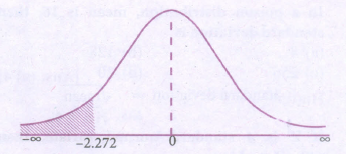
= 0.5-0.4884 = 0.0116
∴ Probability of one customer to have a bill for Rs.100 or less is 0.0116.
∴ Out of 500 customers, the number of persons to have a bill for Rs. 100 or less is 0.0116 x 500 = 5.8 ≌ 6.
2.
Given μ = 3500, σ = 500
P(X<3100)
When X = 3100,
Z = \(\frac { X-\mu }{ \sigma } =\frac { 3100-3500 }{ 500 } \)
= -0.8
∴ P(X<3100) = P(Z<-0.8)
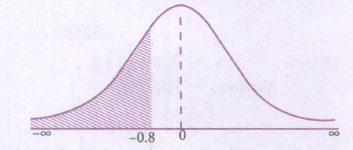
= 0.5-0.2881= 0.2119
Hence, the probability that a baby is born with weight less than 3100g is 0.2119.
3.
Given μ = 500, σ = 100
P(X< 585)
When X = 585, Z = \(\frac { X-\mu }{ \sigma } \)
= \(\frac { 585-500 }{ 100 } =\frac { 85 }{ 100 } \) = 0.85
P(X < 858) = P(Z< 0.85)
P(-∞
= 0.8023
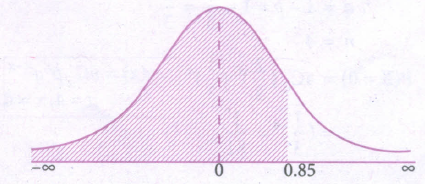
When his score is 585,
80.23% of people have scored less than Rahul
∴ Rahul will be admitted to the university.
4.
Given average = λ = \(\frac { 3 }{ 20 } \) = 0.15
P(will not be more than one failure)
= P(X ≤ 1)
= P(X = 0) + P(X = 1)
= \(\frac { { e }^{ -\lambda }.{ \lambda }^{ 0 } }{ 0! } +\frac { { e }^{ -\lambda }.{ \lambda }^{ 1 } }{ 1! } \)
= e-λ (1+λ) =e-0.15 (1+0.15)
= (0.8607) (1.15)
= (0.98981 [e-0.15 =0.8607]
∴ Probability that there will not be more than one failure = 0.98981
5.
Let p be the probability of a patient to recover
Given q = 75% = \(\frac { 75 }{ 100 } \) = 0.75
∴ P = 1 - q = 1 - 0.75 = 0.25
n = 6
P (4 will recover) = P(X = 4)
= 6C4 (0.25)4 (0.75)2
[∵ P(x) = nCx pxqn-x n = 6, x = 4
= 6C2 (0.25)4 (0.75)2
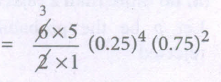
= 15 (0.25)4 (0.75)2
P(X = 4) = 0.03295
6.
Let p be the probability of fatal accident in a year.
Given p = \(\frac { 1 }{ 1200 } \) and n=300
∴ λ = np = 300 x \(\frac { 1 }{ 1200 } =\frac { 1 }{ 4 } \) = 0.25
Hence X follows a poisson distribution with
p(x,λ) = \(\frac { e^{ -\lambda }.{ \lambda }^{ x } }{ x! } \)
∴ P (atleast 2 fatal accidents)
= P(X≥2)
= 1-P(X<2)
= 1 - [P(X = 0) + P(X =1)]
= 1-\(\left[ \frac { { e }^{ -\lambda }.{ \lambda }^{ 0 } }{ 0! } +\frac { { e }^{ -\lambda }.{ \lambda }^{ 1 } }{ 1! } \right] \)
= 1-e-λ (1+λ)
= 1-e-0.25 (1+0.25)
= 1 - 0.7788 (1.25) = 1 - 0.9735
= 0.0265
Hence, the probability of atleast 2 fatal accidents in a year = 0.0265.
7.
Let p be the probability of defective electric bulb.
p = \(\frac { 5 }{ 100 } \) and n = 120
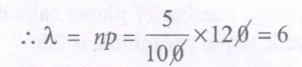
Hence λ follows Poisson distribution with
p(x,λ) = \(\frac { e^{ -\lambda }.{ \lambda }^{ x } }{ x! } \)
∴ P (no defective bulb) = P(X = 0)
= \(\frac { { e }^{ -6 }.6^{ 0 } }{ 0! } \) = e-6 [λ = 6 and x = 0]
P(X=0) = 0.0025 [∵ e-6 = 0.0025]
8.
Let X be probability of mortality rate for a certain disease
∴ p = \(\frac { 7 }{ 1000 } \) and n = 400

Hence X follows poisson distribution with p(x, λ)
= \(\frac { e^{ -\lambda }.{ \lambda }^{ x } }{ x! } \)
∴ P (just 2 deaths) = P(X = 2)
= \(\frac { e^{ -2.8 }(2.8)^{ 2 } }{ 2! } \) [∵ p(x,λ) =\(\frac { e^{ -\lambda }.{ \lambda }^{ x } }{ x! } \), λ = 2.8, x = 2]
= \(\frac { (0.06)(2.8)^{ 2 } }{ 2 } \) = (0.03)(2.8)2 = 0.2352
∴ Probability for just 2 deaths on account of this disease = 0.2352.
9.
Let p be the probability of mice recovering from vitamin A deficiency
Given p = 0.73 ⇒ q = 1 - 0.73 = 0.27 and n = 5
∴ P (atleast 3 mice recover) = P(X ≥ 3)
P(X≥3) = 1-P(X<3)
= 1 - [P(X = 0) + P(X = 1) + P (X = 2)]
= 1-[5C0 (0.73)0 (0.27)5 + 5C1 (0.73)1 (0.27)4 + 5C2 (0.73)2 (0.27)3 ]
= 1-[(0.27)5 + 5(0.73)(0.27)4 + \(\frac { 5\times 4 }{ 2\times 1 } \)+(0.73)2 (0.27)3 ]
= 1 - [0.00143 + 0.01939 + 0.10489]
= 1 - 0.1257
P(X≥3) = 0.8743
10.
Let p be the probability of drug's side effect
∴ p = \(\frac { 3 }{ 100 } \) =.03
⇒ q = 1-p = 1-0.03 = 0.97 and n = 10
P (atleast one person will have side effect)
= P(X ≥ 1)
= 1 - P(X < 1)
= 1 - [P(X =0)] ∵ p(x) =nCx pxqn-x, n=10, x=0
= 1-[10C0 (0.03)0 (0.97)10 ]
= 1-(0.97)10 [∵ 10C0 = 1 and (0.03)0 = 1]
= 1-0.7374
P(X≥1) = 0.2626
11.
Given mean of the binomial distribution is 4.
⇒ np =4 ...(1)
Variance=3 ⇒ npq =3..(2)
(2) \(\div \) (1) given, \(\frac { npq }{ np } =\frac { 3 }{ 4 } \Rightarrow q=\frac { 3 }{ 4 } \)
∴ p=1-q =\(1-\frac { 3 }{ 4 } =\frac { 1 }{ 4 } \)
Substituting p=\(\frac { 1 }{ 4 } \) in (1) we get,
n\(\left( \frac { 1 }{ 4 } \right) \) =4 ⇒ n=16
∴ The binomial distribution is nCx pxqn-x, x=0,1,2....n
⇒ 16Cx \(\left( \frac { 1 }{ 4 } \right) ^{ x }\left( \frac { 3 }{ 4 } \right) ^{ 16-x }\) x=0,1,2,......16.
∴ P(X=15) =16C15 \(\left( \frac { 1 }{ 4 } \right) ^{ 15 }\left( \frac { 3 }{ 4 } \right) ^{ 1 }\)
=16C1 \(\frac { 1 }{ { 4 }^{ 15 } } .\frac { 3 }{ 4 } =16.\frac { (3) }{ 4^{ 16 } } =\frac { 4^{ 2 }.(3) }{ 4^{ 16 } } \)
P(X=15) =\(\frac { 3 }{ { 4 }^{ 14 } } \).
12.
Let p be the probability of driving foreign cars
∴ p = \(\frac { 18 }{ 28 } \) = 0.64 and
q = 1 - p = 1 - 0.64 = 0.36
n = 5
∴ P (atleast 3 of them drive foreign cars)
= P(X ≥3) = 1-P(X<3)
= 1-[P(X = 0) + P(X = 1) + P (X = 2)]
= 1-[5C0 (0.64)0 (0.36)5 + 5C1 (0.64)1 + 5C2 (0.64)2 (0.36)3 (0.36)4 ]
= 1-[(0.36)5 + 5(0.64) (0.36)4 + \(\frac { 5\times 4 }{ 2\times 1 } \) (0.64)2 (0.36)3 ]
= 1-[0.0060 + 0.0537 + 0.1911]
= 1-(0.2508) = 0.7492
13.
Let X be p probability random variable denoting the number of defective yarns.
Mean = np = 1.2, n = 6
6p = 1.2
\(p=\frac{1.2}{6}=0.2\)
q = 1-p = 1-0.2 = 0.8
P(X <2) = P(X = 0)+ P(X = 1)
P(X = x) = nCx px qn-x
P(X<2) = 6C0(0.2)0(0.8)0+6C1(0.2)1 (8)5
= (0.32768)2
= 0.6553
14.
(i) Binomial distribution is symmetrical if p = q = 0.5. It is skew symmetric if p≠q. It is positively skewed if p < 0.5 and it is negatively skewed if p > 0.5.
(ii) For binomial distribution, variance is less than mean.
Variance = npq = (np)q < np < mean.
15.
We are given mean μ = 800 and standard deviation σ = 100
Probability that the procurement of milk between 800 litres to 1000 litres per day is
P(800 < X < 1000)
\(P(\frac { 800-800 }{ 100 })\)
P(0 < Z < 2) = 0.4772 (table value)
Therefore 47.75 percent of societies procure milk between 800 litres to 1000 litres per day.
16.
We are given mean μ = 2.25 and standard deviation σ = 0.25.
Probability that weight of fish is less than 2 kg is P(X < 2.0)
When x = 20 \(Z=\frac { X-\mu }{ \sigma } =\frac { 2.0-2.25 }{ 0.25 } =P(Z<-1.0)=P(Z>1.0)\)
= 0.5 – 0.3413 = 0.1587
Therefore 15.87% of fishes weigh less than 2 kg.
17.
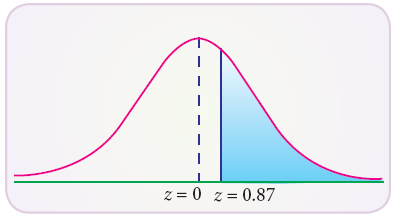
Let X be the height of soldiers follows normal distribution with mean 69.25 inches and standard deviation 3.13 then the soldiers over 6 feet tall (6ft × 12= 72 inches)
The standard normal variate
\(Z=\frac { X-\mu }{ \sigma } =\frac { 72-69.25 }{ 3.13 } =0.8786\)
P(X > 72) = P(Z > 0.8786)
= 0.5 – P(0 < Z < 0.88)
= 0.5 – 0.3106 = 0.1894
Number of soldiers expected to be over 6 feet tall in 6000 are 6000 × 0.1894 =1136
18.
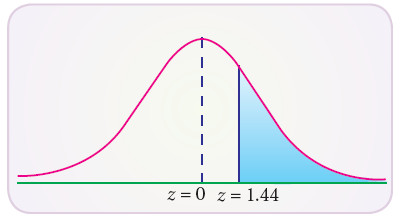
Let the distribution of heights be normally distributed with mean mean 68.22 and standard deviation = 3.286
\(Z=\frac { X-\mu }{ \sigma } =\frac { X-69.25 }{ 3.286 } \)
When X = 74
\(Z=\frac { X-\mu }{ \sigma } =\frac { 74-69.25 }{ 3.286 } =1.4455\)
Now P(Z > 74) = P(Z > 1.44)
= 0.5 – 0.4251
= 0.0749
Expected number of children to be over 74 cm out of 1200 children
= 1200 × 0.0749 ≈ 90 children
19.
Let x devotes the set of twins on a day
P(twin birth) = p = 1/80 = 0.0125 and n = 30
The value of mean λ = np = 30 × 0.0125 = 0.375
Hence, X follows poisson distribution with p(x)\(\frac { { e }^{ -\lambda }{ \lambda }^{ x } }{ x! } \)
The probability is
P(2 or more) = 1 – [p (x = 0) + p (x = )] \(=1-\left[ \frac { { e }^{ -0.375 }{ (0.375) }^{ 0 } }{ 0! } +\frac { { e }^{ -0.375 }{ (0.375) }^{ 1 } }{ 1! } \right] \)
\(=1-{ e }^{ -0.375 }[1+0.375]\)
\(=1-(0.6873\times 1.375)\)
= 0.055
20.
Let X be a random variable follows poisson distribution with number of erythrocytes.
Hence, Mean λ = 8 erythrocytes/single square
P(exactly 5 erythrocytes are in one square) = P(X = 5)=\(\\ \frac { { e }^{ -\lambda }{ \lambda }^{ x } }{ x! } =\frac { { e }^{ -8 }{ 8 }^{ 5 } }{ 5! } \)
\(=\frac { 0.000335\times 32768 }{ 120 } \)
= 0.0916
The probability that exactly 5 erythrocytes are found in one square is 0.0916. i.e there are 9.16% chances that exactly 5 erythrocytes are found in one square.
21.
In a throw of a pair of dice the doublets are (1, 1) (2, 2) (3, 3) (4, 4) (5, 5) (6, 6)
Probability of getting a doublet p = 6/36 = 1/6
⇒ q = 1 – p = 5/6 and also n = 4 is given
The probability of successes
\(=\left( \begin{matrix} 4 \\ x \end{matrix} \right) { (\frac { 1 }{ 6 } ) }^{ x }\left( \frac { 5 }{ 6 } \right) ^{ 4-x }\)
Therefore the probability of 2 successes are
\(P(X=2)\left( \begin{matrix} 4 \\ 2 \end{matrix} \right) { (\frac { 1 }{ 6 } ) }^{ 2 }\left( \frac { 5 }{ 6 } \right) ^{ 4-2 }\)
\(=6\times \frac { 1 }{ 36 } \times \frac { 25 }{ 36 } \)
\(=\frac { 25 }{ 216 } \)
22.
Here p = q = 1/2
(a) probability of A beating B in exactly 3 games out of 4
\(\left( \begin{matrix} 4 \\ 3 \end{matrix} \right) { (\frac { 1 }{ 2 } ) }^{ 3 }\left( \frac { 1 }{ 2 } \right) ^{ 4-3 }\)
= 1/4 = 25%
(b) probability of A beating B in exactly 5 games out of 8
\(\left( \begin{matrix} 8 \\ 5 \end{matrix} \right) { (\frac { 1 }{ 2 } ) }^{ 5 }\left( \frac { 1 }{ 2 } \right) ^{ 8-5 }\)
\(=\frac { 7 }{ 32 } \) = 21.875%
Clearly, the first event is more probable.
23.
Probability of bus running late is denoted as p = 1-0.8 = 0.2
Probability of bus running according to the schedule is q = 0.8
Also given that n = 10
The binomial distribution is p(x) = 10Cx(0.2)x(0.8)10-x
(i) probability that exactly one is late P(x = 1) = 10C1pq9
= 10C1(0.2)(0.8)9
(ii) probability that at least one is late
= 1 – probability that none is late
= 1 – p(x = 0)
= 1– (0.8)10
24.
Probability p of guessing an answer correctly is p = \(\frac{1}{2}\)
⇒ q = \(\frac{1}{2}\)
Probability of guessing correctly x answers in 10 questions
\(P(X=x)=p(x)^{ n }{ C }_{ x }{ q }^{ n-x }=10Cx\left( \frac { 1 }{ 2 } \right) \left( \frac { 1 }{ 2 } \right) \)
The required probability P(X ≥ 6) = P(6) + P(7) + P(8) + P(9) + P(10)
\(={ \left( \frac { 1 }{ 2 } \right) }^{ 10 }\left[ { 10C }_{ 6 }+{ 10C }_{ 7 }+{ 10C }_{ 8 }+{ 10C }_{ 9 }+{ 10C }_{ 10 } \right] \)
\(=\left[ \frac { 1 }{ 1024 } \right] [210+120+45+10+1]\)
\(=\frac { 193 }{ 512 } \)
25.
The p.m.f. Binomial distribution is
p(x) = nCxpxqn-x
Given that E(x) = 2
For the Binomial distribution mean is given by np = 2 ... (1)
Given that var (x) = 4/3
For Binomial distribution variance is given by npq=4/3 ...(2)
\(\frac { (2) }{ (1) }⇒\frac {npq}{np} =\frac { \frac { 4 }{ 3 } }{ 2 } =\frac { 4 }{ 6 } =\frac { 2 }{ 3 } \)
q = 2/3 and p = 1–2/3 = 1/3
Substitute is (1) we get
n = 6
Hence, P(X = 5) = 6C5\({ \left( \frac { 1 }{ 3 } \right) }^{ 5 }{ \left( \frac { 2 }{ 3 } \right) }^{ 6-5 }\) = 0.0108
26.
27.
Probability of getting a degree p = 0.4
∴ q = 1– p
= 1 - 0.4
= 0.6
(i) P (one will be a graduate) = P(X = 1) = 5C1 (0.4)(0.6)4
= 0.2592
(ii) P ( atleast one will be a graduate) = 1–P (none will be a graduate)
= 1-5C0(P0)(Q)5-0
= 1-5C0(0.4)0(0.6)5
= 1-0.0777
= 0.9222
28.
Let ‘p’ be the probability that ‘A’ wins the game. Then we are given n = 5, p = 3/5, q = 1–\(\frac{3}{5}=\frac{2}{5}\)(since q = 1–p)
Hence by binomial probability law, the probability that out of the 5 games played, A wins ‘x’ games is given by
P(X = x) = p(x) = 5Cx\({ \left( \frac { 3 }{ 5 } \right) }^{ x }{ \left( \frac { 2 }{ 5 } \right) }^{ 5-x }\)
The required probability that ‘A’ wins atleast three games is given by
P(X\(\le\)3) = P(X = 3) + P(X = 4) + P(X = 5)
\(=5c3{ \left( \frac { 3 }{ 5 } \right) }^{ 3 }{ \left( \frac { 2 }{ 5 } \right) }^{ 2 }5C4{ \left( \frac { 3 }{ 5 } \right) }^{ 4 }{ \left( \frac { 2 }{ 5 } \right) }^{ 1 }+5C5{ \left( \frac { 3 }{ 5 } \right) }^{ 5 }{ \left( \frac { 2 }{ 5 } \right) }^{ 0 }\)
= 0.6826

12th Standard Syllabus & Materials
12th Standard
TN 12th Computer Applications வலையமைப்பு வடமிடல் Sample Question Papers Study Material - QB365 Set A
NEW12th Standard
TN 12th Computer Applications களப்பெயர் முறைமை (DNS) Sample Question Papers Study Material - QB365 Set A
NEW12th Standard
TN 12th Computer Applications வலையமைப்பு எடுத்துக்காட்டுகள் மற்றும் நெறிமுறைகள் Sample Question Papers Study Material - QB365 Set A
NEW12th Standard
TN 12th Computer Applications கணினி வலையமைப்பு ஓர் அறிமுகம் Sample Question Papers Study Material - QB365 Set A



Tamilnadu Stateboard 12th Standard Subjects

Maths

Chemistry

Physics

Biology

Computer Science
Business Maths and Statistics

Economics

Commerce

Accountancy

History

Computer Applications
Biology
Computer Technology
Computer Applications
Computer Science
Business Maths and Statistics
Commerce
Economics
Maths
Chemistry
Physics
Computer Technology
History
Accountancy

Tamil

English

French
Tamilnadu Stateboard Standards
