
 100% FREE ACCESS
12th Standard Syllabus & Materials
12th Standard
TN 12th Maths Applications of Matrices and Determinants Sample Question Papers Study Material - QB365 Set A
NEW12th Standard
TN 12th Computer Applications மின்னணு தரவு பரிமாற்றம் Sample Question Papers Study Material - QB365 Set A
NEW12th Standard
TN 12th Computer Applications மின் - வணிக பாதுகாப்பு அமைப்புகள் Sample Question Papers Study Material - QB365 Set A
NEW12th Standard
TN 12th Computer Applications மின்னணு செலுத்தல் முறைகள் Sample Question Papers Study Material - QB365 Set A
NEW12th Standard
TN 12th Computer Applications மின் - வணிகம் Sample Question Papers Study Material - QB365 Set A
NEW12th Standard
TN 12th Computer Applications திறந்த மூல கருத்துருக்கள் Sample Question Papers Study Material - QB365 Set A

Published on: 02/09/2022
QB365 provides a detailed and simple solution for every Possible Book Back Questions in Class 12 Business Maths Subject -Random Variable and Mathematical Expectation, English Medium. It will help Students to get more practice questions, Students can Practice these question papers in addition to score best marks.
Download Tamil Nadu 12th Standard Business Maths and Statistics question papers, model tests, one-mark questions, important questions, and public exam papers in PDF format. Free study materials and answer keys for TN State Board students.
Questions + Answers key
Take MCQ Business Maths and Statistics Test
1.
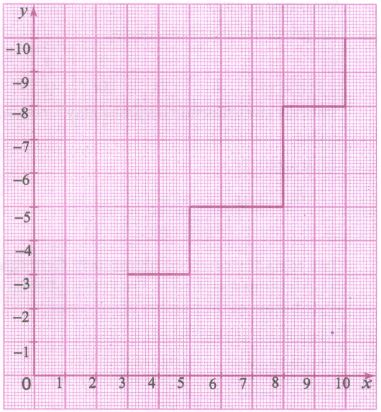
Consider a random variable X with p.d.f
\(f(x)=\left\{\begin{array}{l} 3 x^{2}, \text { if } 0< x< 1 \\ 0, \text { otherwise } \end{array}\right.\)
2.
3.
The p.d.f. of X is defined as \(f(x)= \begin{cases}k & \text { for } 0< x \leq 4 \\ 0, & \text { otherwise }\end{cases}\)
4.
A person tosses a coin and is to receive Rs. 4 for a head and is to pay Rs. 2 for a tail. Find the expectation and variance of his gains.
5.
The number of miles an automobile tire lasts before it reaches a critical point in tread wear can be represented by a p.d.f.
\(f(x)= \begin{cases}\frac{1}{30} e^{-\frac{x}{30}}, & \text { for } x>0 \\ 0, & \text { for } x \leq 0\end{cases}\)
Find the expected number of miles (in thousands) a tire would last until it reaches the critical tread wear point.
6.
In a business venture a man can make a profit of Rs. 2,000 with a probability of 0.4 or have a loss of Rs. 1,000 with a probability of 0.6. What is his expected, variance and standard deviation of profit?
7.
Let X be a continuous random variable with probability density function
\(f(x)=\left\{\begin{array}{l} \frac{3}{x^{4}}, x \geq 1 \\ 0, \text { otherwise } \end{array}\right.\)
Find the mean and variance of X.
8.
The following table is describing about the probability mass function of the random variable X
| x | 3 | 4 | 5 |
| P(x) | 0.1 | 0.1 | 0.2 |
Find the standard deviation of x.
9.
A commuter train arrives punctually at a station every 25 minutes. Each morning, a commuter leaves his house and casually walks to the train station. Let X denote the amount of time, in minutes, that commuter waits for the train from the time he reaches the train station. It is known that the probability density function of X is
\(f(x)= \begin{cases}\frac{1}{25}, \text { for } & 0 < x < 25 \\ 0, & \text { otherwise }\end{cases}\)
10.
The time to failure in thousands of hours of an important piece of electronic equipment used in a manufactured DVD player has the density function.\(f(x)= \begin{cases}3e^{-3x} & x > 0 \\ 0, & \text { otherwise }\end{cases}\)
Find the expected life of the piece of equipment.
11.
If f (x) is defined by f(x)=ke-2x, 0\(\le\)x<\(\infty\) is a density function. Determine the constant k and also find mean.
12.
Consider a random variable X with probability density function \(f(x)= \begin{cases}4x^3 & \text { if } 0< x < 1 \\ 0, & \text { otherwise }\end{cases}\)
Find E(X) and V(X).
13.
14.
A fair die is thrown. Find out the expected value of its outcomes.
15.
An urn contains four balls of red, black, green and blue colours. There is an equal probability of getting any coloured ball. What is the expected value of getting a blue ball out of 30 experiments with replacement?
16.
State the properties of distribution function.
17.
What are the properties of
(i) discrete random variable and
(ii) continuous random variable?
18.
Explain the terms
(i) probability mass function,
(ii) probability density function and
(iii) probability distribution function.
19.
The discrete random variable X has the following probability function \(P(X=x) = \begin{cases}kx & x =2, 4, 6 \\ k(x - 2), & x = 8 \\ 0, & \text { otherwise } \\ \end{cases}\) where k is a constant. Show that k = \(\frac{1}{18}\)
20.
Let X be a discrete random variable with the following p.m.f
\(p(x) = \begin{cases}0.3 & \text { for } x =3 \\ 0.2, & \text { for } x = 5 \\ 0.3, & \text { for } x = 8 \\ 0.2, & \text { for} x = 10 \\ 0, & \text { otherwise } \\ \end{cases}\)
Find and plot the c.d.f. of X.
21.
A continuous random variable X has the following p.d.f f(x) = ax, 0\(\le\)x\(\le\)1
Determine the constant a and also find P\(\\ \left[ X\le \frac { 1 }{ 2 } \right] \)
22.
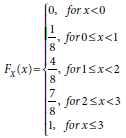
A coin is tossed thrice. Let X be the number of observed heads. Find the cumulative distribution function of X.
23.
Two unbiased dice are thrown simultaneously and sum of the upturned faces considered as random variable. Construct a probability mass function.
24.
If you toss a fair coin three times, the outcome of an experiment consider as random variable which counts the number of heads on the upturned faces. Find out the probability mass function and check the properties of the probability mass function.
25.
\(\text { If } \ p(x) \ = \begin{cases}\frac{x}{20}, & x=0,1,2,3,4,5 \\ 0, & \text { otherwise }\end{cases}\)
Find
(i) P(X<3) and
(ii) P(2
1.
Given p.d.f. is \(f(x)=\left\{\begin{array}{l} 3 x^{2}, \text { if } 0< x< 1 \\ 0, \text { otherwise } \end{array}\right.\)
\(E(X)=\int _{ -\infty }^{ \infty }{ x.f(x)dx } \)
\(=\int _{ 0 }^{ 1 }{ x.(3{ x }^{ 2 })dx } \)
\(=3\int _{ 0 }^{ 1 }{ { x }^{ 3 }dx=3. } { \left[ \frac { { x }^{ 4 } }{ 4 } \right] }_{ 0 }^{ 1 }\)
\(=\frac { 3 }{ 4 } (1-0)=\frac { 3 }{ 4 } \)
\(E({ X }^{ 2 })=\int _{ 0 }^{ 1 }{ { x }^{ 2 }.3{ x }^{ 2 }dx=3 } \int _{ 0 }^{ 1 }{ { x }^{ 4 }dx=3.{ \left[ \frac { { x }^{ 5 } }{ 5 } \right] }_{ 0 }^{ 1 } } \)
\(=\frac { 3 }{ 5 } (1-0)=\frac { 3 }{ 5 } \)
\(Var(X)=E({ X }^{ 2 })-{ [E(X)] }^{ 2 }=\frac { 3 }{ 5 } -{ \left( \frac { 3 }{ 4 } \right) }^{ 2 }\)
\(=\frac { 3 }{ 5 } -\frac { 9 }{ 16 } =\frac { 48-45 }{ 80 } =\frac { 3 }{ 80 } \)
\(V(3X-2)={ 3 }^{ 2 }V(X)[\because V(aX+b)={ a }^{ 2 }V(X)]\)
\(\\ =9\times \frac { 3 }{ 80 } =\frac { 27 }{ 80 } \)
\(\therefore V(3X-2)=\frac { 27 }{ 80 } \)
2.
3.
Given p.d.f. is
Since f(x) is a p.d.f.\(\int _{ -\infty }^{ \infty }{ f(x)dx=1 } \)
\(\Rightarrow \int _{ 0 }^{ 4 }{ kdx=1\Rightarrow k\int _{ 0 }^{ 4 }{ dx=1\Rightarrow k{ [x] }_{ 0 }^{ 4 }=1 } } \)
\(\Rightarrow k(4-0)=1\Rightarrow 4k=1\Rightarrow k=\frac { 1 }{ 4 } \)
Also P(2≤x≤4) =\(\int _{ 0 }^{ 4 }{ f(x)dx } \)
\(=2\int _{ 2 }^{ 4 }{ kdx=\int _{ 2 }^{ 4 }{ \frac { 1 }{ 4 } dx=\frac { 1 }{ 4 } \int _{ 2 }^{ 4 }{ dx } } } \)
\(=\frac { 1 }{ 4 } { [x] }_{ 2 }^{ 4 }=\frac { 1 }{ 4 } (4-2)=\frac { 2 }{ 4 } =\frac { 1 }{ 2 } \)
\(\\ \therefore P(2\le X\le 4)=\frac { 1 }{ 2 } \)
4.
When a coin is tossed, sample space S = {H, T}
Since he is receiving Rs. 4 for a head and pays Rs. 2 for a tail,
∴ X take values 4 and -2.
∴ Probability for getting a head is \(\frac{1}{2}\) and probability for getting a tail is \(\frac{1}{2}\).
The probability mass function is
| X = x | 4 | -2 |
| P(X = x) | \(\frac{1}{2}\) | \(\frac{1}{2}\) |
∴ Expectation E(X) = Σxp(x)
= 4(\(\frac{1}{2}\)) - 2(\(\frac{1}{2}\))
= 2-1 = 1
∴ His expectation is Rs. 1
E(x2) = ∑x2p(x)
= 42(\(\frac{1}{2}\)) + (-2)2(\(\frac{1}{2}\))
= 16(\(\frac{1}{2}\)) + 4(\(\frac{1}{2}\))
= 8 + 2 = 10
Variance (X) = E(X2)-[E(X)]2
= 10-12 = 9
∴ Variance of his gains Rs. 9
5.
Given p.d.f is
\(f(x)= \begin{cases}\frac{1}{30} e^{-\frac{x}{30}}, & \text { for } x>0 \\ 0, & \text { for } x \leq 0\end{cases}\)
Expected number of miles
\(E(X)=\int _{ -\infty }^{ \infty }{ x.f(x)dx } \)
\(=\int _{ 0 }^{ \infty }{ x.\frac { 1 }{ 30 } { e }^{ \frac { -x }{ 30 } }dx=\int _{ }^{ \infty }{ { xe }^{ \frac { -x }{ 36 } }dx } } \)
\(\left[ \because \int _{ 0 }^{ \infty }{ { x }^{ n }{ e }^{ -axdx }=\frac { n! }{ { a }^{ n+1 } } Hence\quad n=1,a=\frac { 1 }{ 30 } } \right] \)
\(=\frac { 1 }{ 30 } \left( \frac { 1! }{ { \left( \frac { 1 }{ 30 } \right) }^{ 2 } } \right) \)
\(=\frac { 1 }{ 30 } \times \frac { 1 }{ { \left( \frac { 1 }{ 30 } \right) }^{ 2 } } =\frac { 1 }{ \frac { 1 }{ 30 } } =30\)
∴ E(X) = 30 miles (in thousands) or 30,000 miles.
6.
Since the profit is Rs. 2000 and the loss is Rs. 1000
X can take values 2000 and -1000.
∴ The probability mass function is
| X = x | 2000 | -1000 |
| P(X = x) | 0.4 | 0.6 |
∴ Expected profit E(X) = Σxp(x)
= 2000(0.4)-1000(0.6)
= 800-600
E(X) = Rs. 200
E(X2) = Σx2p(x)
= 20002(0.4)-10002(0.6)
= 1600000+600000
= 2200000
∴ Var(X) = E(X2)-[E(X)]2
= 2200000-(200)2
= 2200000-40000
= 2160000.
Standard deviation = \(\sqrt{variance}=\sqrt{2160000}\)
= 1469.69.
7.
Given probability density function is
\(f(x)=\left\{\begin{array}{l} \frac{3}{x^{4}}, x \geq 1 \\ 0, \text { otherwise } \end{array}\right.\)
Here E(X) = \(\int _{ 1 }^{ \infty }{ dx\quad x.f(x)dx } \)
\(=\int _{ 1 }^{ \infty }{ x.\frac { 3 }{ { x }^{ 4 }dx } } dx=3\int _{ 1 }^{ \infty }{ \frac { 1 }{ { x }^{ 3 } } dx=3\int _{ 1 }^{ \infty }{ { x }^{ -3 }dx } } \)
\(=3{ \left[ \frac { { x }^{ -3+1 } }{ -3+1 } \right] }_{ 1 }^{ \infty }={ \left( \frac { { x }^{ -2 } }{ -2 } \right) }_{ 1 }^{ \infty }=\frac { -3 }{ 2 } { \left( \frac { 1 }{ { x }^{ 2 } } \right) }_{ 1 }^{ \infty }\)
\(=\frac { -3 }{ 2 } \left( \frac { 1 }{ \infty } -\frac { 1 }{ 1 } \right) =\frac { -3 }{ 2 } (0-1)=\frac { 3 }{ 2 } \)
\([\because \frac { 1 }{ \infty } =0]\)
\(E(X)=\frac { 3 }{ 2 } \)
\(E({ X }^{ 2 })=\int _{ 1 }^{ \infty }{ \frac { 1 }{ { x }^{ 2 } } dx=3\int _{ 1 }^{ \infty }{ { x }^{ -2 }dx } } \)
\(=3{ \left[ \frac { { x }^{ -1 } }{ -1 } \right] }_{ 1 }^{ \infty }=-3{ \left[ \frac { 1 }{ x } \right] }_{ 1 }^{ \infty }=-3\left[ \frac { 1 }{ \infty } -1 \right] =3\)
Var(X) = E(X2)-[E(X)]2
\(\\ =3-{ \left( \frac { 3 }{ 2 } \right) }^{ 2 }=3-\frac { 9 }{ 4 } =\frac { 12-9 }{ 4 } \)
\(Var(X)=\frac { 3 }{ 4 } \)
8.
Given probability mass function is
| x | 3 | 4 | 5 |
| P(x) | 0.1 | 0.1 | 0.2 |
\(E(X)=\sum _{ x=3 }^{ 4,5 }{ xp(x) } \)
= 0.6+ 1.2 +2.5
E(X2) = Σx2p(x)
= 9(0.2) + 16(0.3) +25(0.5)
= 1.8 + 4.8 + 12.5
= 19.1
Var(X) = E(X2)-[E(X)]2
= 19.1-(4.3)2
19.1- 18.49
V(X) = 0.61
Stdard deviation = \(\sqrt{Variance}=\sqrt{0 .61}\)
= 0.78
9.
Expected value of the random variable is
\(E(X)=\int _{ -\infty }^{ \infty }{ xf(x) } dx\)
\(=\int _{ 0 }^{ 25 }{ x \frac{1}{25}dx } \)
\(=\frac { 1 }{ 25 } \int _{ 0 }^{ 25 }{ xdx } \)
\(=\frac { 1 }{ 25 } { \left[ \frac { { x }^{ 2 } }{ 2 } \right] }_{ 0 }^{ 25 }\)
= 12.5
Therefore, the expected waiting time of the commuter is 12.5 minutes.
10.
We know that,
\(E(X)=\int _{ -\infty }^{ \infty }{ xf(x)dx } \)
\(=\int _{ 0 }^{ \infty }{ x{ e }^{ -3x } } dx\)
\(=3\int _{ 0 }^{ \infty }{ { xe }^{ -3x }dx } \)
\(=3\left\{ { \left[ \frac { { xe }^{ -3x } }{ -3 } \right] }_{ 0 }^{ \infty }\int _{ 0 }^{ \infty }{ \frac { { e }^{ -3x } }{ -3 } dx } \right\} \)( ∵ ∫udv = uv - ∫ vdu)
\(=\int _{ 0 }^{ \infty }{ { e }^{ -3x }dx } \)
\(=\frac{1}{3}\)
Therefore, the expected life of the piece of equipment is \(=\frac{1}{3}\)hrs (in thousands).
11.
We know that
\(\int _{ -\infty }^{ \infty }{ f(x)dx=1 } \),since f(x) is a density function
\(\int _{ 0 }^{ \infty }{ { ke }^{ -2x } } dx=1\)
\(k\int _{ 0 }^{ \infty }{ { ke }^{ -2x } } dx=1\)
\(k{ \left[ \frac { { e }^{ -2x } }{ -2 } \right] }_{ 0 }^{ \infty }=1\)
⇒ k = 2
\(E(X)=\int _{ -\infty }^{ \infty }{ xf(x)dx } \)
\(=\int _{ 0 }^{ \infty }{ x{ e }^{ -2x } } dx\)
\(=2\int _{ 0 }^{ \infty }{ { xe }^{ -2x }dx } \)
\(=2\left\{ { \left[ \frac { { xe }^{ -2x } }{ -2 } \right] }_{ 0 }^{ \infty }\int _{ 0 }^{ \infty }{ \frac { { e }^{ -2x } }{ -2 } dx } \right\} \)
\((\because \int { udv=uv-\int { udv } } )\)
\(=\int _{ 0 }^{ \infty }{ { e }^{ -2x }dx } \) \(=\frac { 1 }{ 2 } \)
12.
We know that,
\(E(X)=\int _{ -\infty }^{ \infty }{ xf(x)dx } \)
\(=\int _{ 0 }^{ 1 }{ x{ 4x }^{ 3 } } dx\)
\(=4{ \left[ \frac { { x }^{ 5 } }{ 5 } \right] }_{ 0 }^{ 1 }\)
\(E(X)=\frac { 4 }{ 5 } \)
\(E\left( { X }^{ 2 } \right) =\int _{ -\infty }^{ \infty }{ { x }^{ 2 } } f(x)dx\)
\(=\int _{ 0 }^{ 1 }{ { x }^{ 2 }{ 4x }^{ 3 } } dx\)
\(=4{ \left[ \frac { { x }^{ 6 } }{ 6 } \right] }_{ 0 }^{ 1 }\)
\(=\frac { 4 }{ 6 } =\frac { 2 }{ 3 } \)
\(V(X)=\left( { x }^{ 2 } \right) -{ [E(X)] }^{ 2 }\)
\(=\frac { 4 }{ 6 } -{ \left[ \frac { 4 }{ 5 } \right] }^{ 2 }\)
\(=\frac { 2 }{ 75 } \)
13.
14.
If the random variable X is the top face of a tossed, fair, six sided die, then the probability mass function of X is
Px (x) = \(\frac{1}{6}\), for x = 1, 2, 3, 4, 5 and 6
The average toss, that is, the expected value of X is
\(E(X)=\sum _{ x }^{ }{ { P }_{ x }(x) } \)
\(E(X)=\left( 1\times \frac { 1 }{ 6 } \right) +\left( 2\times \frac { 1 }{ 6 } \right) +\left( 3\times \frac { 1 }{ 6 } \right) +\left( 4\times \frac { 1 }{ 6 } \right) +\left( 5\times \frac { 1 }{ 6 } \right) +\left( 6\times \frac { 1 }{ 6 } \right) \)
\(=\frac { 1 }{ 6 } (1+2+3+4+5+6)\)
\(=\frac { 7 }{ 2 } \)
= 3.5
Therefore, the expected toss of a fair six sided die is 3.5.
15.
Probability of getting a blue ball = (p) =\(\frac{1}{4}\) = 0.25
Total experiments (N) = 30
Expected value = Number of experiments × Probability
= N x p
= 30 x 0.25
= 7.50
Therefore, the expected value of getting blue ball is approximately 8.
16.
1) 0≤F(x)≤1, -∞
2) F(-∞) = 0 and F(∞) = 1
3) is a non-decreasing function, F(a) ≤F(b) for a
4) \(\underset { h\rightarrow 0 }{ lim } \) F(x+h) = F(x), since F(x) is continuous from the right
5) F'(x) = f(x)≥0
6) P(a≤x≤b) = F(b)-F(a)
17.
For discrete random variable:
p(xi)≥0∀i and \(\sum _{ i=1 }^{ n }{ p({ x }_{ i }) } =1\) and X takes only
infinite number of values
For Continuous random variable:
f(X)≥0∀x and \(\int _{ -\infty }^{ \infty }{ f(x)dx=1 } \) and X takes
infinite number of values in the interval.
18.
(i) Probability mass function:
If X is a discrete random variable with distinet values x1, x2, xn then the function denoted by px (x) and defined by
PX(x) = p(x)
= {p(x = xi) = pi = p(xi)if x = xi, i = 1, 2,...n
0 if x ≠ xi
Here p(xi)≥0∀i & \(\sum _{ i=1 }^{ n }{ p({ x }_{ i })=1 } \)
(ii) Probability density function:
The probability that a random variable X takes a value in th interval [t1, t2] [open or closed] is given by the integral of a function called the probability density function
\(P({ t }_{ 1 }\le X\le { t }_{ 2 })=\int _{ { t }_{ 1 } }^{ { t }_{ 2 } }{ { f }_{ x }(x)dx } \)
Here f(x) ≥0∀ x and \(\int _{ -\infty }^{ \infty }{ f(x)dx=1 } \)
(iii) Probability distribution function:
Fora discrete distribution, the distribution function of a random variable X is defined as
FX(x) = P(X ≤ x)for all x ∈ R.
19.
Given probability distribution function is
\(= \begin{cases}kx & x =2, 4, 6 \\ k(x - 2), & x = 8 \\ 0, & \text { otherwise } \\ \end{cases}\)
where k is a constant
| X = x | 2 | 4 | 6 | 8 |
| P(X=x) | 2k | 4k | 6k | k(8-2) = 6k |
Since the given function is a probability distribution function, each ρi>0Σ ρi=1
⇒ 2k+4k+6k+6k = 1
⇒ 18 k = 1
⇒ k = \(\frac{1}{18}\)
20.
Given probability mass function is
| X=x | 3 | 5 | 8 | 10 |
| P(X=x) | 0.3 | 0.2 | 0.3 | 0.2 |
∴ The cumulative distribution function Fx(x) is
Fx(0) = 0 if x < 3
Fx(3) = P(X = 3) = 0.3, for 3 ≤x<5
Fx(5) = P(X = 3)+P(X = 5) = 0.3+0.2 = 0.5, for 5≤X<8
Fx(8) = P(X = 3)+P(X+5)+P(X = 8)
= 0.3+0.2+0.3
= 0.8,8≤x<10
Fx(10) = P(X = 3)+P(X = 5)+P(X = 8)+P(X = 10)
= 0.3+0.2+0.3+0.2
= 1 for x ≥10
\(F_{x}(x)= \begin{cases}0, & \text { if } x<3 \\ 0.3, & \text { if } 3 \leq x < 1 \\ 0.5, & \text { if } 5 \leq x < 8 \\ 0.8, & \text { if } 8 \leq x < 10 \\ 1, & \text { if } x ≥ 10 \\ \end{cases}\)
21.
We know that
\(\int _{ -\infty }^{ \infty }{ f(x)dx=1 } \)
\(\int _{ 0 }^{ -\infty }{ ax\quad dx } \Rightarrow a\int _{ 0 }^{ 1 }{ xdx=1 } \)
\(\Rightarrow a{ \left( \frac { { x }^{ 2 } }{ 2 } \right) }^{ 1 }=1\)
\(\Rightarrow \frac { a }{ 2 } (1-0)=1\)
\(\Rightarrow\)a = 2
\(P\left[ x\le \frac { 1 }{ 2 } \right] =\int _{ -\infty }^{ \frac { 1 }{ 2 } }{ f(x)dx } \)
\(=\int _{ 0 }^{ \frac { 1 }{ 2 } }{ axdx } \)
\(=\int _{ 0 }^{ \frac { 1 }{ 2 } }{ 2xdx } \)
\(=\frac { 1 }{ 4 } \)
22.
The sample space (S) = { (HHH), (HHT), (HTH), (HTT), (THH), (THT), (TTH), (TTT)}
X takes the values: 3, 2, 2, 1, 2, 1, 1, and 0
| Range of X(Rx) | 0 | 1 | 2 | 3 |
| Px(x) | \(\frac{1}{8}\) | \(\frac{3}{8}\) | \(\frac{3}{8}\) | \(\frac{1}{8}\) |
| Fx(x) | \(\frac{1}{8}\) | \(\frac{4}{8}\) | \(\frac{7}{8}\) | 1 |
Thus, we have
23.
Sample space \((s)=\left\{ \begin{matrix} (1,1) & (1,2) & (1,3) \\ (2,1) & (2,2) & (2,3) \\ \begin{matrix} (3,1) \\ (4,1) \\ \begin{matrix} (5,1) \\ (6,1) \end{matrix} \end{matrix} & \begin{matrix} (3,2) \\ (4,2) \\ \begin{matrix} (5,2) \\ (6,2) \end{matrix} \end{matrix} & \begin{matrix} (3,3) \\ (4,3) \\ \begin{matrix} (5,3) \\ (6,3) \end{matrix} \end{matrix} \end{matrix}\begin{matrix} (1,4) & (1,5) & (1,6) \\ (2,4) & (2,5) & (2,6) \\ \begin{matrix} (3,4) \\ (4,4) \\ \begin{matrix} (5,4) \\ (6,4) \end{matrix} \end{matrix} & \begin{matrix} (3,5) \\ (4,5) \\ \begin{matrix} (5,5) \\ (6,5) \end{matrix} \end{matrix} & \begin{matrix} (3,6) \\ (4,6) \\ \begin{matrix} (5,6) \\ (6,6) \end{matrix} \end{matrix} \end{matrix} \right\} \)
Total outcomes : n(S) = 36
24.
Let X is the random variable which counts the number of heads on the upturned faces. The outcomes are stated below
| Outcomes | (HHH) | (HHT) | (HTH) | (THH) | (THT) | (TTH) | (HTT) | (TTT) |
| Values of X | 3 | 2 | 2 | 2 | 1 | 1 | 1 | 0 |
These values are summarized in the following probability table.
| Value of X | 0 | 1 | 2 | 3 | Total |
| P(xi) | \(\frac{1}{8}\) | \(\frac{3}{8}\) | \(\frac{3}{8}\) | \(\frac{1}{8}\) | \(\sum _{ i=0 }^{ 3 }{ p({ x }_{ i })=1 } \) |
(i) p(xi) \(\ge\)0\(\forall \) i and
(ii) \(\sum _{ i=0 }^{ 3 }{ p({ x }_{ i })=1 } \)
Hence, p(xi) is a probability mass function.
25.
P(X<3) = P(X = 1)+P(X = 2)
\(=0+\frac{1}{20}+\frac{2}{20}\) = \(\frac{3}{20}\)
P(2
\(=\frac{3}{20}+\frac{4}{20}\) = \(\frac{7}{20}\)

12th Standard Syllabus & Materials
12th Standard
TN 12th Computer Applications வலையமைப்பு வடமிடல் Sample Question Papers Study Material - QB365 Set A
NEW12th Standard
TN 12th Computer Applications களப்பெயர் முறைமை (DNS) Sample Question Papers Study Material - QB365 Set A
NEW12th Standard
TN 12th Computer Applications வலையமைப்பு எடுத்துக்காட்டுகள் மற்றும் நெறிமுறைகள் Sample Question Papers Study Material - QB365 Set A
NEW12th Standard
TN 12th Computer Applications கணினி வலையமைப்பு ஓர் அறிமுகம் Sample Question Papers Study Material - QB365 Set A



Tamilnadu Stateboard 12th Standard Subjects

Maths

Chemistry

Physics

Biology

Computer Science
Business Maths and Statistics

Economics

Commerce

Accountancy

History

Computer Applications
Biology
Computer Technology
Computer Applications
Computer Science
Business Maths and Statistics
Commerce
Economics
Maths
Chemistry
Physics
Computer Technology
History
Accountancy

Tamil

English

French
Tamilnadu Stateboard Standards
