
 100% FREE ACCESS
12th Standard Syllabus & Materials
12th Standard
TN 12th Maths Applications of Matrices and Determinants Sample Question Papers Study Material - QB365 Set A
NEW12th Standard
TN 12th Computer Applications மின்னணு தரவு பரிமாற்றம் Sample Question Papers Study Material - QB365 Set A
NEW12th Standard
TN 12th Computer Applications மின் - வணிக பாதுகாப்பு அமைப்புகள் Sample Question Papers Study Material - QB365 Set A
NEW12th Standard
TN 12th Computer Applications மின்னணு செலுத்தல் முறைகள் Sample Question Papers Study Material - QB365 Set A
NEW12th Standard
TN 12th Computer Applications மின் - வணிகம் Sample Question Papers Study Material - QB365 Set A
NEW12th Standard
TN 12th Computer Applications திறந்த மூல கருத்துருக்கள் Sample Question Papers Study Material - QB365 Set A

Published on: 02/09/2022
QB365 provides a detailed and simple solution for every Possible Creative Questions in Class 12 Business Maths Subject - Differential Equations, English Medium. It will help Students to get more practice questions, Students can Practice these question papers in addition to score best marks.
Download Tamil Nadu 12th Standard Business Maths and Statistics question papers, model tests, one-mark questions, important questions, and public exam papers in PDF format. Free study materials and answer keys for TN State Board students.
Questions + Answers key
Take MCQ Business Maths and Statistics Test
1.
Solve: cosx(1 + cos y)dx − sin y(1 + sin x)dy = 0
2.
Solve: y(1 - x) - x\(\frac{dy}{dx}\) = 0
3.
Solve: \(\frac { dy }{ dx } ={ ae }^{ y }\)
4.
The marginal cost function of manufacturing x gloves is 6 + 10x − 6x2. The total cost of producing a pair of gloves is Rs. 100. Find the total and average cost function.
5.
Solve \(y d x-x d y-3 x^{2} y^{2} e^{x^{3}} d x=0\)
6.
Solve sec2x tan y dx + sec2y tan x dy = 0
7.
Solve \(\frac { dy }{ dx } \) = ex−y+ x2e− y
8.
Find the differential equation corresponding to y = ae4x + be−x where a, b are arbitrary constants.
9.
10.
Find the differential equation of the family of curves y = ex (acos x + bsin x) where a and b are arbitrary constants.
11.
Find the differential equation of the family of parabola with foci at the origin and axis along the x-axis.
12.
Find the differential equation of all circles passing through the origin and having their centers on the y axis.
13.
Form the differential equation that represents all parabolas each of which has a latus rectum 4a and whose axes are parallel to the x axis.
14.
Find the differential equation of the family of all straight lines passing through the origin.
15.
Form the differential equation by eliminating α and β from (x − α)2 + (y − β)2 = r2
1.
cos x(1 + cos y)dx − sin y(1 + sin x)dy
Separating the variables we get
\(\frac { \cos x }{ 1+\sin x } dx=\frac { \sin y }{ 16 \cos y } dy\)
Integrating both sides we get
\(\int { \frac { \cos x }{ 1+\sin x } } dx=\int { \frac { \sin y }{ 16 \cos y } } dy\)
put 1 + sin x = t ⇒ cos x dx = dt
Also 1 + cosy = s ⇒ -siny dy = ds
⇒ siny dy = -ds
⇒ \(\int { \frac { dt }{ t } } =-\int { \frac { ds }{ s } } \)
⇒ log t = log s + log c
⇒ log t = log\(\left( \frac { c }{ s } \right) \)
[∵ log m- logn=log\(\frac{m}{n}\)]
⇒ t=\(\frac { c }{ s } \)
⇒ 1+sinx =\(\frac { c }{ 1+cosy } \)
[∵ t = 1 + sin x & s = 1 + cos y]
⇒ (1 + sin x)(1 + cos y) = c
2.
Given y(1-x) - x\(\frac { dy }{ dx } \) = 0
⇒ y(1-x) = x\(\frac { dy }{ dx } \)
Separating the variables we get,
⇒ \(\frac { (1-x) }{ x } dx=\frac { dy }{ y } \)
⇒ \(\left( \frac { 1 }{ x } -1 \right) =\frac { dy }{ y } \)
Integrating both sides we get,
\(\int { \left( \frac { 1 }{ x } -1 \right) } dx=\int { \frac { dy }{ y } } \)
⇒ logx - x = log y+c
3.
Given \(\frac { dy }{ dx } \) = ae7
Separating the variables we get,
\(\frac { dy }{ { e }^{ y } } \) =adx ⇒ e-y dy = adx
Integrating both sides we get,
\(\int { e^{ -y }dy } =a\int { dx } \)
-e-y= ax+c
ax + e-y+ c = 0
4.
Given MC = 6 + 10x − 6x2
i.e., \(\frac { dc }{ dx } \) = 6+10x−6x2
dc = (6 +10x − 6x2)dx
ഽdc = ഽ(6 +10x − 6x2)dx + k
c = 6x + 10\(\frac { { x }^{ 2 } }{ 2 } -6\frac { { x }^{ 3 } }{ 3 } \) + k
c = 6x + 5x2 − 2x3 + k (1)
Given c = 100 when x = 2
∴ (1) ⇒ 100 = 12 + 5(4) − 2(8) + k
⇒ k = 84
∴ (1) ⇒ c (x) = 6x + 5x2 − 2x3 + 84
Average Cost AC = \(\frac { c }{ x } \) = 6 + 5x − 2x2 + \(\frac { 84 }{ x } \)
5.
Given equation can be written as \(\frac { ydx-xdy }{ { y }^{ 2 } } -{ 3x }^{ 2 }{ e }^{ { x }^{ 2 } }dx=0\)
Integrating, ഽ\(\frac { ydx-xdy }{ { y }^{ 2 } } \) - ഽ3x2ex3 dx = c
ഽ\(d\left( \frac { x }{ y } \right) \) - ഽetdt = c
(where t = x3 and dt = 3x2dx )
\(\frac { x }{ y } \) - et = c
\(\frac { x }{ y } \) - \({ e }^{ { x }^{ 2 } }\) = c
6.
Separating the variables, we get
\(\frac { { \sec }^{ x }x }{ \tan x } dx+\frac { { \sec }^{ 2 } }{ { \tan y } } dy=0\)
Integrating, we get
ഽ\(\frac { { \sec }^{ x }x }{ \tan x } \)dx + ഽ\(\frac { { \sec }^{ 2 } }{ { \tan y } } dy\) = c
log tan x + log tan y = log c
log(tan x tan y) = log c
tan x tan y = c
7.
Given \(\frac { dy }{ dx } \) = ex−y + x2e−y = e−yex + e−yx2
= e−y(ex + x2)
Separating the variables, we get eydy=(ex + x2)dx
Integrating, we get ഽeydy = ഽ(ex+x2)dx
ey = ex + \(\frac { x^{ 3 } }{ 3 } \) + c
8.
Given y = ae4x + be−x. (1)
Here a and b are arbitrary constants
From (1), \(\frac { dy }{ dx } \) = 4ae4x− be−x (2)
and \(\frac { { d }^{ 2 }y }{ { dx }^{ 2 } } \) = 16ae4x+ be−x (3)
(1) + (2) ⇒ \(y+\frac { dy }{ dx } \) = 5ae4x (4)
= (2) + (3) ⇒ \(\frac { dy }{ dx } +\frac { { d }^{ 2 }y }{ { dx }^{ 2 } } \) = 20ae4x
= 4(5ae4x)
= \(4\left( y+\frac { dy }{ dx } \right) \)
\(\frac { dy }{ dx } +\frac { { d }^{ 2 }y }{ { dx }^{ 2 } } =4y+4\frac { dy }{ dx } \)
⇒ \(\frac { { d }^{ 2 }y }{ { dx }^{ 2 } } -3\frac { dy }{ dx } -4y=0\) which is the required differential equation
9.
10.
y = ex (acos x + bsin x) (1)
Differentiating (1) w.r.t x, we get
\(\frac { dy }{ dx } \) = ex (acos x + bsin x)+ ex (−a sin x + b cos x)
= y + ex (−asin x + bcos x) (from (1))
⇒ \(\frac { dy }{ dx } \) - y = ex (−a sin x + bcos x) (2)
Again differentiating, we get
\(\frac { { d }^{ 2 }y }{ { dx }^{ 2 } } -\frac { dy }{ dx } \) = ex (−a sin x + b cos x) + ex (−a cos x − b sin x)
\(\frac { { d }^{ 2 }y }{ { dx }^{ 2 } } -\frac { dy }{ dx } \)= ex (−a sin x + bcos x) − ex (a cos x + b sin x)
\(\frac { { d }^{ 2 }y }{ { dx }^{ 2 } } -\frac { dy }{ dx } \) = \(\left( \frac { dy }{ dx } -y \right) -y\) (from (1) and (2))
⇒\(\frac { { d }^{ 2 }y }{ { dx }^{ 2 } } -\frac { dy }{ dx } \)+2y = 0, which is the requited differential equation.
11.
Equation of family of parabolas with foci at the origin and axis along the x-axis is
y2 = 4a(x+a) ...(1)
[ ∵ the focus is at the origin its vertex will be (-a, 0) and latus rectum is 4a]
Differentiating w.r.t. 'x' we get,
2y\(\left( \frac { dy }{ dx } \right) \) = 4a(1) ....(1)
⇒ 2y\(\left( \frac { dy }{ dx } \right) \) = 4a ...(2)
Also \(\frac { 2y }{ 4 } \left( \frac { dy }{ dx } \right) \) = a
⇒ \(\frac { y }{ 2 } \left( \frac { dy }{ dx } \right) \) = a...(3)
Substituting (2) and (3) in (1) we get,
y2 = 2y\(\left( \frac { dy }{ dx } \right) \left[ x+\frac { y }{ 2 } \left( \frac { dy }{ dx } \right) \right] \)
⇒ y2 = 2xy\(\left( \frac { dy }{ dx } \right) +{ y }^{ 2 }\left( \frac { dy }{ dx } \right) ^{ 2 }\)
Dividing by Y we get,
\(y=2x\frac { dy }{ dx } { +y\left( \frac { dy }{ dx } \right) }^{ 2 }\).
12.
Equation of all circles passing through the origin and having their centres on the y-axis.
x2 + (y - k)2 = k2 ....(1)
[where (0, k) is the centre of the cirde which lies on the y-axis and radius is k].
Differentiating w.r.t. 'x
⇒ 2x + 2(y-k)\(\frac { dy }{ dx } \) = 0
⇒ (y-k) =\(\frac { -x }{ \frac { dy }{ dx } } \) ....(2)
Also, y+\(\frac { x }{ \frac { dy }{ dx } } \) = k ....(3)
Substituting (2) & (3) in (1) we get
\({ x }^{ 2 }+\left( \frac { -x }{ \frac { dy }{ dx } } \right) ^{ 2 }=\left( y+\frac { x }{ \frac { dy }{ dx } } \right) ^{ 2 }\)
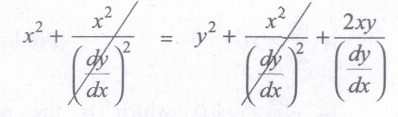
⇒ x2 = y2+\(\\ \frac { 2xy }{ \frac { dy }{ dx } } \)
⇒ \(y^{2}-x^{2}-2 x y \frac{d y}{d x}=0\)
13.
Equation of the family of paraboles with latus rectum 4a and whose axes are parallel to the x-axis is (y- k)2 = 4a(x- h)
[Where (h, k) is the centre of the parabola]
Differentiating w.r.t. 'x' we get,
2(y-k)\(\left( \frac { dy }{ dx } \right) \) = 4a(1)
⇒ 2(y-k)\(\left( \frac { dy }{ dx } \right) \) = 4a (1)
Differentiating again w.r.t x we get,
2(y-k)\(\left( \frac { { d }^{ 2 }y }{ dx^{ 2 } } \right) +\left( \frac { dy }{ dx } \right) (2)\frac { dy }{ dx } \) = 0 (Product rule)
(y-k)\(\left( \frac { d^{ 2 }y }{ dx^{ 2 } } \right) +\left( \frac { dy }{ dx } \right) ^{ 2 }\) = 0 [Divided by 2]
y-k= \(\frac { -\left( \frac { dy }{ dx } \right) ^{ 2 } }{ \frac { { d }^{ 2 }y }{ dx^{ 2 } } } \) (2)
Substituting (2) in (1) we get,
2\(\frac { -\left( \frac { dy }{ dx } \right) ^{ 2 } }{ \frac { { d }^{ 2 }y }{ dx^{ 2 } } } \left( \frac { dy }{ dx } \right) \)= 4a
⇒ \(-2\left( \frac { dy }{ dx } \right) ^{ 3 }=4a\left( \frac { d^{ 2 }y }{ dx^{ 2 } } \right) \)
⇒ \(4a\left( \frac { d^{ 2 }y }{ dx^{ 2 } } \right) +\left( \frac { dy }{ dx } \right) ^{ 3 }\)= 0
\(2a\frac { { d }^{ 2 }y }{ { dx }^{ 2 } } +{ \left( \frac { dy }{ dx } \right) }^{ 3 }=0\).
14.
Let the equation of straight lines passing through the origin be
y = mx ..(1)
where m is the arbitrary constant
Differentiating w.r.t 'x' we get,
\(\frac { dy }{ dx } \)= m(1) ⇒ \(\frac { dy }{ dx } \) = m .....(2)
Substituting (2) in (1) we get,
\(y=x\frac { dy }{ dx } \).
15.
Given equation is (x - α)2 + (y - β)2 = r2
Differentiating w.r.t. 'x' we get,
2 (x - α)2 + (y - β)\(\frac { dy }{ dx } \) = r2
⇒ (x - α) + (y - β)\(\frac { dy }{ dx } \) = 0....(2)
Differentiating again w.r.t. 'x' we get
1+(y-β) \(\frac { d^{ 2 }y }{ dx^{ 2 } } +\frac { dy }{ dx } .\frac { dy }{ dx } \) = 0
⇒ 1+(y-β) \(\frac { d^{ 2 }y }{ dx^{ 2 } } +\left( \frac { dy }{ dx } \right) ^{ 2 }\)= 0
⇒ y-β = \(\frac { -1\left( 1+\left( \frac { dy }{ dx } \right) ^{ 2 } \right) }{ \frac { d^{ 2 }y }{ dx^{ 2 } } } \) .....(3)
Substituting this value in (2) we get
(x-α) = \(\left( \frac { 1+\left( \frac { dy }{ dx } \right) ^{ 2 }\frac { dy }{ dx } }{ \frac { d^{ 2 }y }{ dx^{ 2 } } } \right) \) ......(4)
Substituting (3) and (4) in (1) we get
\(\frac { \left\{ 1+\left( \frac { dy }{ dx } \right) ^{ 2 }\left( \frac { dy }{ dx } \right) ^{ 2 } \right\} }{ \left( \frac { d^{ 2 }y }{ dx^{ 2 } } \right) ^{ 2 } } +\frac { \left\{ 1+\left( \frac { dy }{ dx } \right) ^{ 2 } \right\} ^{ 2 } }{ \left( \frac { d^{ 2 }y }{ dx^{ 2 } } \right) ^{ 2 } } \)
=\(\left( \frac { d^{ 2 }y }{ dx^{ 2 } } \right) ^{ 2 }\)
⇒ \(\left[ 1+\left( \frac { dy }{ dx } \right) ^{ 2 } \right] \left[ \left( \frac { dy }{ dx } \right) ^{ 2 }+1 \right] ={ r }^{ 2 }\left( \frac { d^{ 2 }y }{ dx^{ 2 } } \right) \)
⇒ \(\left[ 1+\left( \frac { dy }{ dx } \right) ^{ 2 } \right] ^{ 3 }\)
= \({ r }^{ 2 }\left( \frac { d^{ 2 }y }{ dx^{ 2 } } \right) ^{ 2 }\)

12th Standard Syllabus & Materials
12th Standard
TN 12th Computer Applications வலையமைப்பு வடமிடல் Sample Question Papers Study Material - QB365 Set A
NEW12th Standard
TN 12th Computer Applications களப்பெயர் முறைமை (DNS) Sample Question Papers Study Material - QB365 Set A
NEW12th Standard
TN 12th Computer Applications வலையமைப்பு எடுத்துக்காட்டுகள் மற்றும் நெறிமுறைகள் Sample Question Papers Study Material - QB365 Set A
NEW12th Standard
TN 12th Computer Applications கணினி வலையமைப்பு ஓர் அறிமுகம் Sample Question Papers Study Material - QB365 Set A



Tamilnadu Stateboard 12th Standard Subjects

Maths

Chemistry

Physics

Biology

Computer Science
Business Maths and Statistics

Economics

Commerce

Accountancy

History

Computer Applications
Biology
Computer Technology
Computer Applications
Computer Science
Business Maths and Statistics
Commerce
Economics
Maths
Chemistry
Physics
Computer Technology
History
Accountancy

Tamil

English

French
Tamilnadu Stateboard Standards
