
 100% FREE ACCESS
12th Standard Syllabus & Materials
12th Standard
TN 12th Computer Applications மின்னணு தரவு பரிமாற்றம் Sample Question Papers Study Material - QB365 Set A
NEW12th Standard
TN 12th Computer Applications மின் - வணிக பாதுகாப்பு அமைப்புகள் Sample Question Papers Study Material - QB365 Set A
NEW12th Standard
TN 12th Computer Applications மின்னணு செலுத்தல் முறைகள் Sample Question Papers Study Material - QB365 Set A
NEW12th Standard
TN 12th Computer Applications மின் - வணிகம் Sample Question Papers Study Material - QB365 Set A
NEW12th Standard
TN 12th Computer Applications திறந்த மூல கருத்துருக்கள் Sample Question Papers Study Material - QB365 Set A
NEW12th Standard
TN 12th Computer Applications வலையமைப்பு வடமிடல் Sample Question Papers Study Material - QB365 Set A

Published on: 31/08/2020
12th Standard Business Maths English Medium Important 2 Mark Creative Questions (New Syllabus) 2020
Download Tamil Nadu 12th Standard Business Maths and Statistics question papers, model tests, one-mark questions, important questions, and public exam papers in PDF format. Free study materials and answer keys for TN State Board students.
Questions + Answers key
Take MCQ Business Maths and Statistics Test
1.
A sample of 400 students is found to have mean height of 171.38 cms, Can it reasonable be regarded as a sample from a large population with mean height of 171.17 cms and standard deviation of 3.3 cms (Test at 5% level)
2.
If 10 coins are tossed, find the probability that exactly 5 heads appears.
3.
A continuous random variable. X has the p.d.f. defined by \(f(x)=\left\{\begin{array}{l} C e^{-a x}, \quad 0<x<\infty \\ 0, \quad \text { elsewhere } \end{array}\right.\) Find the value of C if a> 0
4.
An unbiased die is rolled. If the random variable X is defined as
X(w) = {1, the outcome w is an even number
{0, if the outcome w is an odd number
Find the probability distribution of X.
5.
The following is the pay-off matrix (in rupees) for three strategies and three states of nature. Select a strategy using maximin principle.
6.
If f'(x) = 8x3 -2x2, f(2) = 1, find f(x)
7.
Form the differential equation of family of rectangular hyperbolas whose asymptotes are the Co-ordinate axes.
8.
If f(0) = 5, f(1) = 6, f(3) = 50, find f(2) by using Lagrange's formula.
9.
If the marginal revenue for a commodity is MR = 9 - 6x2 + 2x, find the total revenue function.
10.
Solve: 2x + 3y = 4 and 4x + 6y = 8 using Cramer's rule.
1.
Given sample size n = 400
Sample mean \(\bar { x } \) = 171.38
Population mean μ = 171.17
Population Standard deviation σ = 3.3
Null hypotheses: H0 : μ = 171.17
Alternative hypotheses: H1 : μ ≠ 171.17
The test statistic, z = \(\frac { \bar { x } -\mu }{ \frac { \sigma }{ \sqrt { n } } } =\frac { 171.38-171.17 }{ \frac { 3.3 }{ \sqrt { 400 } } } \)
=\(\frac { 0.21 }{ 0.165 } \) = 1.273
As the level of significance is α = 0.005, \(Z_{ \frac { \alpha }{ 2 } }\) = 1.96
Here z < \(Z_{ \frac { \alpha }{ 2 } }\) as 1.273 < 1.96
Inference: since z < \(Z_{ \frac { \alpha }{ 2 } }\), we accept the null hypotheses at 5% level of significance.
Hence, we can conclude that the sample of 400 has taken from the population with mean height of 171.17 cm.
2.
Given n = 10, P(H) = \(\frac { 1 }{ 2 } \) ⇒ p =\(\frac { 1 }{ 2 } \)
q=1-p = \(1-\frac { 1 }{ 2 } =\frac { 1 }{ 2 } \)
P(X = x) = nCx pxqn-x
∴ P(X = 5) = 10C5 p5q5
= \(\frac { 10\times 9\times 8\times 7\times 6 }{ 5\times 4\times 3\times 2\times 1 } \left( \frac { 1 }{ 2 } \right) ^{ 5 }\left( \frac { 1 }{ 2 } \right) ^{ 10 }\)
= \(\frac { 6\times 7\times 6 }{ 2^{ 10 } } \)
= \(\frac { 2\times 3\times 7\times 2\times 3 }{ 2^{ 10 } } =\frac { 63 }{ { 2 }^{ 8 } } \)
= \(\frac { 63 }{ 256 } \).
3.
Since f(x) is a probability density function,
\(\int _{ -\infty }^{ \infty }{ f(x)dx=1 } \)
\(\Rightarrow \int _{ 0 }^{ \infty }{ { ce }^{ -ax }dx=1 } \Rightarrow C\int _{ 0 }^{ \infty }{ { e }^{ -ax }dx=1 } \)
\(\Rightarrow c{ \left[ \frac { { e }^{ -ax } }{ -a } \right] }_{ 0 }^{ \infty }=1\Rightarrow \frac { -c }{ a } [{ e }^{ -\infty }-{ e }^{ 0 }]\)
\(\Rightarrow \frac { -c }{ a } [0-1]=1\quad [\because { e }^{ -\infty }=0,{ e }^{ 0 }=1]\)
\(\Rightarrow \frac { c }{ a } =1\Rightarrow C=a\quad \therefore C=a\)
4.
When a die is rolled, sample space
S = {1, 2, 3, 4, 5, 6} ⇒ n(S) = 6
∴P(X = 0) = Probability of getting an odd number = \(\frac{3}{6}\)[∵ Their are 3 favourable events]
= \(\frac{1}{2}\)
Thus, the probability distribution of the random variable X is given by
| X | 0 | 1 |
| P(X) | \(\frac{1}{2}\) | \(\frac{1}{2}\) |
5.
| Strategy | States of Nature | Minimum | ||
| S1 | S2 | S3 | ||
| d1 | 12 | 9 | 13 | 9 |
| d2 | 15 | 11 | 8 | 8 |
| d3 | 5 | 8 | 10 | 5 |
Max (9, 8, 5) = 9
∴ d1 is the best strategy using maximin principle.
6.
Given f'(x) = 8x3 -2x2
∴ ∫ f'(x) dx = ∫ (8x3 - 2x2) dx
⇒ f(x) = \(\frac { { 8x }^{ 4 } }{ 4 } -\frac { { { 2x }^{ 3 } } }{ 3 } +c\)
⇒ f (x) = 2x4 - \(\frac { { { 2x }^{ 3 } } }{ 3 } +c\) ...(1)
Also, f(2) = 1
⇒ 1 = 2(24) - \(\frac { { 2\left( { { 2 }^{ 3 } } \right) } }{ 3 } +c\)
⇒ 1 = 32 - \(\frac { { 16 } }{ 3 } +c\)
⇒ 1 - 32 + \(\frac { { 16 } }{ 3 } \) = c ⇒ -31 + \(\frac { { 16 } }{ 3 } \) =c
⇒ \(\frac { { -93+16 } }{ 3 } =c\)
⇒ c = \(\frac { { -77 } }{ 3 } \)
∴ (1) ⟶ f(x) = 2x4 - \(\frac { { 2x }^{ 3 } }{ 3 } -\frac { { -77 } }{ 3 } \)
7.
Equation of family of rectangular hyperbolas whose asymptotes are the Co-ordinate axis is
xy - c2
Differentiating w.r.t. 'x' we get,
x.\(\frac { dy }{ dx } \)+y(1) = 0
⇒ x\(\left( \frac { dy }{ dx } \right) \)+y(1) = 0 which is the required differential equation.
8.
By data we have,
x0 = 0, x1 = 1, x2 = 3
y0 = 5, y1 = 6, y2 = 50 and x = 2
Using Lagrange's formula, we get
\(y=\frac { (x-{ x }_{ 1 })(x-{ x }_{ 2 }) }{ ({ x }_{ 0 }-{ x }_{ 1 })({ x }_{ 0 }-{ x }_{ 2 }) } { y }_{ 0 }+\frac { (x-{ x }_{ 1 })(x-{ x }_{ 2 }) }{ ({ x }_{ 0 }-{ x }_{ 1 })({ x }_{ 0 }-{ x }_{ 2 }) } { y }_{ 1 }+\frac { (x-{ x }_{ 0 })(x-{ x }_{ 1 }) }{ ({ x }_{ 2 }-{ x }_{ 0 })({ x }_{ 0 }-{ x }_{ 1 }) } { y }_{ 2 }\)
= \(5\times \frac { (2-0)(2-3) }{ (0-1)(0-3) } +6\times \frac { (2-0)(2-3) }{ (1-0)(1-3) } +50\times \frac { (2-0)(2-1) }{ (3-0)(3-1) } \)
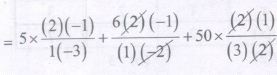
= \(\frac { 10 }{ 3 } -6+\frac { 50 }{ 3 } =\frac { 60 }{ 3 } -6=20-6=14\)
∴ f(2) = 14
9.
Given MR = 9 - 6x2 + 2x
⇒ഽMR=ഽ(9 - 6x2 + 2x)sx
\(\Rightarrow R=9x-\frac { { 6x }^{ 3 } }{ 3 } +\frac { { 2x }^{ 2 } }{ 2 } +k\)
⇒ R = 9x - 2x3 + x2 + k
When x = 0, R = 0 ⇒ k = 0
∴ R = 9x - 2x3 + x2
10.
\(\Delta =\left| \begin{matrix} 2 & 3 \\ 4 & 6 \end{matrix} \right| =12-12=0\)
\(\Delta x=\left| \begin{matrix} 4 & 3 \\ 8 & 6 \end{matrix} \right| =24-24=0\)
\(\Delta x=\left| \begin{matrix} 4 & 3 \\ 8 & 6 \end{matrix} \right| =24-24=0\)
\(\therefore \Delta =\Delta x=\Delta y=0\)
\(\therefore \) The system is consistent with infinite number of solutions
let y = k, \(k\epsilon R\)
\(\therefore 2x+3k=4\Rightarrow 2x=4-3k\)
\(\Rightarrow x=\cfrac { 1 }{ 2 } \left( 4-3k \right) ,k\epsilon R\)
\(\therefore \) Solution set is \(\left\{ \cfrac { 4-3k }{ 2 } ,k \right\} ,k\epsilon R\)

12th Standard Syllabus & Materials
12th Standard
TN 12th Computer Applications களப்பெயர் முறைமை (DNS) Sample Question Papers Study Material - QB365 Set A
NEW12th Standard
TN 12th Computer Applications வலையமைப்பு எடுத்துக்காட்டுகள் மற்றும் நெறிமுறைகள் Sample Question Papers Study Material - QB365 Set A
NEW12th Standard
TN 12th Computer Applications கணினி வலையமைப்பு ஓர் அறிமுகம் Sample Question Papers Study Material - QB365 Set A
NEW12th Standard
TN 12th Computer Applications PHP-உடன் MySQL-ஐ இணைத்தல் Sample Question Papers Study Material - QB365 Set A



Tamilnadu Stateboard 12th Standard Subjects

Maths

Chemistry

Physics

Biology

Computer Science
Business Maths and Statistics

Economics

Commerce

Accountancy

History

Computer Applications
Biology
Computer Technology
Computer Applications
Computer Science
Business Maths and Statistics
Commerce
Economics
Maths
Chemistry
Physics
Computer Technology
History
Accountancy

Tamil

English

French
Tamilnadu Stateboard Standards
