
 100% FREE ACCESS
12th Standard Syllabus & Materials
12th Standard
TN 12th Maths Applications of Matrices and Determinants Sample Question Papers Study Material - QB365 Set A
NEW12th Standard
TN 12th Computer Applications மின்னணு தரவு பரிமாற்றம் Sample Question Papers Study Material - QB365 Set A
NEW12th Standard
TN 12th Computer Applications மின் - வணிக பாதுகாப்பு அமைப்புகள் Sample Question Papers Study Material - QB365 Set A
NEW12th Standard
TN 12th Computer Applications மின்னணு செலுத்தல் முறைகள் Sample Question Papers Study Material - QB365 Set A
NEW12th Standard
TN 12th Computer Applications மின் - வணிகம் Sample Question Papers Study Material - QB365 Set A
NEW12th Standard
TN 12th Computer Applications திறந்த மூல கருத்துருக்கள் Sample Question Papers Study Material - QB365 Set A

Published on: 31/12/2022
QB365 provides a detailed and simple solution for every Possible Questions in Class 12 Business Maths Subject - Important 2 Mark English Medium. It will help Students to get more practice questions, Students can Practice these question papers in addition to score best marks.
Download Tamil Nadu 12th Standard Business Maths and Statistics question papers, model tests, one-mark questions, important questions, and public exam papers in PDF format. Free study materials and answer keys for TN State Board students.
Questions + Answers key
Take MCQ Business Maths and Statistics Test
1.
he cost of over haul of an engine is ₹10,000 The operating cost per hour is at the rate of 2x − 240 where the engine has run x km. Find out the total cost if the engine run for 300 hours after overhaul.
2.
State any 2 demerits of simple random sampling.
3.
It is given that 3% of the electric bulbs manufactured by a company are defective find the probability that a simple of 100 bulbs will contain
(i) no defective
(ii) exactly one defective (e-3 = 0.0498)
4.
If \(\mathrm{F}(x)=\frac{1}{\pi}\left(\frac{\pi}{2}+\tan ^{-1} x\right)-\infty<x<\infty\) distribution function of a continuous variable X, find \(\mathrm{P}(0 \leq x \leq 1)\)
5.
Calculate a forward difference table for the following data
| x | 20 | 30 | 40 | 50 |
| y | 51 | 43 | 34 | 24 |
6.
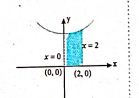
Find the area under the curve y = \(4 x^{2}-8 x+6\) bounded by the y-axis, x-axis and the ordinate x = 2
7.
\(\int \frac{e^{5 \log _{e} x}-e^{+\log _{1} x}}{e^{3 \log _{e} x}-e^{2 \log _{1} x}} d x\)
8.
Find the order and degree of the following differential equation
\(\frac { { d }^{ 2 }y }{ { dx }^{ 3 } } -3{ \left( \frac { dy }{ dx } \right) }^{ 6 }+2y={ x }^{ 2 }\)
9.
Calculate the 3-yearlymoving averages of the production figures (in tonnes) for the following data.
| Year | 1973 | 1974 | 1975 | 1976 | 1977 | 1978 | 1979 | 1980 | 1981 | 1982 | 1983 | 1984 | 1985 | 1986 | 1987 |
| Production | 15 | 21 | 30 | 36 | 42 | 46 | 50 | 56 | 63 | 70 | 74 | 82 | 90 | 95 | 102 |
10.
Consider the following pay-off (profit) matrix action, states
| Action | States | |
| B1 | B2 | |
| A1 | 8 | 6 |
| A2 | 9 | 2 |
| A3 | 6 | 4 |
Determine the best action using maximin principle.
11.
Write down the order and degree of the following differential equations.
\(\left( \frac { dy }{ dx } \right) ^{ 2 }-7\frac { d^{ 3 }y }{ { dx }^{ 3 } } +y\frac { { d }^{ 2 }y }{ dx^{ 2 } } +4\frac { dy }{ dx } \)- log x = 0
12.
Find the rank of the matrix \(\left( \begin{matrix} 2 & -4 \\ -1 & 2 \end{matrix} \right) \)
13.
Find the rank of each of the following matrices.
\(\left( \begin{matrix} 1 & -1 \\ 3 & -6 \end{matrix} \right) \)
14.
Prove that
E ∇ = Δ = ∇E
15.
Evaluate \({ \Delta }^{ 2 }\left( \frac { 1 }{ x } \right) \) by taking ‘1’ as the interval of differencing.
16.
What is the difference between Assignment Problem and Transportation Problem?
17.
What is the Assignment problem?
18.
Solve \(\frac { { d }^{ 2 }y }{ d{ x }^{ 2 } } -4\frac { dy }{ dx } +5y\) = 0
19.
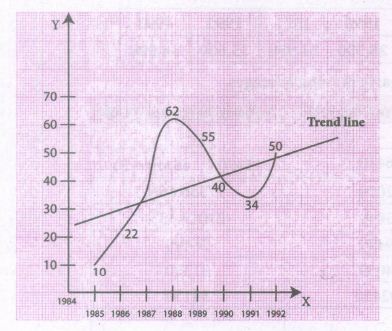
The following table gives the number of small-scale units registered with the Directorate of Industries between 1985 and 1991. Show the growth on a trend line by the free hand method.
| Years | 1985 | 1986 | 1987 | 1988 | 1989 | 1990 | 1991 | 1992 |
| No. of units (in‘000) | 10 | 22 | 36 | 62 | 55 | 40 | 34 | 50 |
20.
Explain cyclic variations.
21.
Define alternative hypothesis.
22.
Define parameter.
23.
Write down the conditions in which the Normal distribution is a limiting case of binomial distribution.
24.
Write the conditions for which the poisson distribution is a limiting case of binomial distribution.
25.
Describe what is meant by a random variable.
26.
The discrete random variable X has the probability function
| X | 1 | 2 | 3 | 4 |
| P(X=x) | k | 2k | 3k | 4k |
Show that k = 0.1.
27.
Using Integration, find the area of the region bounded the line 2y + x = 8, the x axis and the lines x = 2, x = 4.
28.
Integrate the following with respect to x.
\(\sqrt { 1-\sin2x } \)
29.
Evaluate \(\int { \left( { x }^{ 3 }+7 \right) \left( x-4 \right) dx } \)
30.
Find the rank of each of the following matrices.
\(\left( \begin{matrix} 5 & 6 \\ 7 & 8 \end{matrix} \right) \)
1.
₹28,000
2.
(i) This requires a complete list of the population but such upto date lists are not available in many enquiries.
(ii) If the size of the sample is small, then it will not be a representative of the population.
3.
Let X be the random variable denoting the number of defective items
\(
\mathrm{p}=\frac{3}{100}, \mathrm{n}=100, \lambda=\mathrm{np}=3
\)
\(\mathrm{P}(\mathrm{X}=\mathrm{x})=\frac{e^{-\dot{\lambda}} \lambda^{x}}{x !}
\)
\(\mathrm{P}(\mathrm{X}=0)=\frac{e^{-3} 3^{0}}{0 !}=0.0498
\)
\(\mathrm{P}(\mathrm{X}=1)=\frac{e^{-3} 3^{1}}{1 !}=3(0.0498)=0.1494
\)
4.
\(\mathrm{F}(x)=\frac{1}{\pi}\left(\frac{\pi}{2}+\tan ^{-1} x\right)\)
\(
P(0 \leq x \leq 1) =\mathrm{F}(1)-\mathrm{F}(0)
\)
\( =\frac{1}{\pi}\left(\frac{\pi}{2}+\tan ^{-1} 1\right)-\frac{1}{\pi}\left(\frac{\pi}{2}+\tan ^{-1} 0\right)
\)
\( =\frac{1}{2}+\frac{1}{\pi}\left(\frac{\pi}{4}\right)-\frac{1}{2}-\frac{1}{\pi}(0)=\frac{1}{4}
\)
5.
| x | y | \(\Delta y\) | \(\Delta^2 y\) | \(\Delta^3 y\) |
| 20 | 51 | |||
| -8 | ||||
| 30 | 43 | -1 | ||
| -9 | 0 | |||
| 40 | 34 | -1 | ||
| -10 | ||||
| 50 | 42 |
6.
\( \mathrm{A} =\int_{a}^{b} y d x \quad \frac{x=0 \mid}{(0,0)} \mid(2,0) \)
\(=\int_{0}^{2}\left(4 x^{2}-8 x+6\right) d x \)
\( =\left[\frac{4 x^{3}}{3}-\frac{8 x^{2}}{2}+6 x\right]_{0}^{2}=\frac{32}{3}-16+12 \)
\( =\frac{32}{3}-4=\frac{20}{3} \text { sq. units } \)
7.
\(\int \frac{e^{5 \log _{e} x}-e^{4 \log _{e} x}}{e^{3 \log _{e} x}-e^{2 \log _{e} x}} d x=\int \frac{e^{\log _{e} x^{3}}-e^{\log _{e} x^{4}}}{e^{\log _{e} x^{3}}-e^{\log _{e} x^{2}}} d x\)
\(
=\int \frac{x^{5}-x^{4}}{x^{3}-x^{2}} d x=\int \frac{x^{2}\left(x^{3}-x^{2}\right)}{x^{3}-x^{2}} d x \\
\)
\(=\int x^{2} d x=\frac{x^{3}}{3}+c
\)
8.
\(\frac { { d }^{ 2 }y }{ { dx }^{ 3 } } -3{ \left( \frac { dy }{ dx } \right) }^{ 6 }+2y={ x }^{ 2 }\)
∴ order = 3,
∴ Degree = 1
9.
| Year | Production | 3-yearly moving total | 3-yearly moving average |
| 1973 | 15 | - | - |
| 1974 | 21 | 22.00 | |
| 1975 | 30 | 66 | 29.00 |
| 1976 | 36 | 87 | 36.00 |
| 1977 | 42 | 108 | 41.33 |
| 1978 | 46 | 124 | 46.00 |
| 1979 | 50 | 138 | 50.67 |
| 1980 | 56 | 152 | 56.33 |
| 1981 | 63 | 169 | 63.00 |
| 1982 | 70 | 189 | 69.00 |
| 1983 | 74 | 207 | 75.33 |
| 1984 | 82 | 226 | 82.00 |
| 1985 | 90 | 246 | 89.00 |
| 1986 | 95 | 267 | 95.67 |
| 1987 | 102 | 287 | - |
10.
| Action | States | Minimum | |
| B1 | B2 | ||
| A1 | 8 | 6 | 6 |
| A2 | 9 | 2 | 2 |
| A3 | 6 | 4 | 4 |
Max (6, 2, 4) = 6
∴ Action Al is the best according to maximin principle
11.
The highest derivative if of order 3 and its power is 1
∴ order is 3 and degree is 1.
12.
Let A = \(\left( \begin{matrix} 2 & -4 \\ -1 & 2 \end{matrix} \right) \)
The order of A is 2 \(\times\) 2
\(\rho (A)\le min(2,2)\)
\(\Rightarrow \rho (A)\le 2\)
\(\left| \begin{matrix} 2 & -4 \\ -1 & 2 \end{matrix} \right| =4-4=0\)
Since the second order minor vanishes \(\rho (A)\neq 2\)
We have to try for atleast one non-zero first order minor.
ie. atleast one non-zero element of A.
This is possible because A has non-zero element
\(\therefore \rho (A)-1\)
13.
Let \(A=\left( \begin{matrix} i & -1 \\ 3 & -6 \end{matrix} \right) \)
Order of A is 2 \(\times\) 2
\(\therefore \rho (A)\le 2\) [Since minimum of (2, 2) is 2]
Consider the second order minor
\(\left| \begin{matrix} 1 & -1 \\ 3 & -6 \end{matrix} \right| =-6-(-3)\)
= -6 + 3 = -3
\(\neq 0\)
There is a minor of order 2, which is not zero
\(\therefore \rho (A)=2\)
14.
LHS = E∇
(1).JPG)
| [∵ Δ = \(\frac { E-1 }{ E } \)] |
[∵ Δ = E - 1]
= E - 1 = Δ
RHS
(2).JPG)
= E - 1 = Δ = RHS
∴ E∇ = Δ = ∇ E
Hence proved.
15.
\({ \Delta }^{ 2 }\left( \frac { 1 }{ x } \right) =\Delta \left( \Delta \left( \frac { 1 }{ x } \right) \right) \)
Now \(\Delta \left[ \frac { 1 }{ x } \right] =\frac { 1 }{ 1+x } -\frac { 1 }{ x } \)
\({ \Delta }^{ 2 }\left( \frac { 1 }{ x } \right) ={ \Delta }\left( \frac { 1 }{ 1+x } -\frac { 1 }{ x } \right) \)
\(=\Delta \left( \frac { 1 }{ 1+x } \right) -\Delta \left( \frac { 1 }{ x } \right) \)
Similarly \({ \Delta }^{ 2 }\left( \frac { 1 }{ x } \right) =\frac { 2 }{ x(x+1)(x+2) } \)
16.
The assignment problem is a special case of transportation problem where the number of sources and destinations are equal. Here, jobs represent sources and machines represent destinations.
17.
To assign the different jobs to the different machines (one job per machine) to minimize the overall cost is known as assignment problem.
18.
Given \(\frac { { d }^{ 2 }y }{ d{ x }^{ 2 } } -4\frac { dy }{ dx } +5y\) = 0
(D2−4D+5)y = 0
The auxiliary equation is m2−4m + 5 = 0
⇒ (m−2)2−4 + 5 = 0
(m− 2)2 = –1
m - 2 = 土\(\sqrt{-1}\)
m = 2 土 i , it is if the form α 土 iβ
∴ C.F = e2x[A cos x + B sin x]
The general solution is y = e2x[A cos x + B sin x]
19.
20.
Cyclic uniformly periodic in nature. They may or may not follow exactly similar patterns after equal intervals of time. Generally one cyclic period ranges from 7 to.9 years and there is no hard and fast rule in the fixation of years for a cyclic period. For example, every business cycle has a Start-Boom-Depression- Recover maintenance during booms and depressions, changes in government monetary policies, changes in interestrates.
21.
Any hypothesis which is complementary to the null hypothesis is called as the alternative hypothesis and it is usually denoted by H1.
22.
The statistical constants of the population like mean (μ), variance (σ2) are referred as population parameters.
23.
Normal distribution is a limiting case of Binomial distribution under the following conditions.
(i) n, the number of trials is infinitely large i.e. n ⟶ ∞
(ii) Neither p(or q) is very small.
24.
Poisson distribution is a limiting case of binomial distribution under the following conditions.
(i) n, the number of trials is indefinitely large ie., n⟶∞.
(ii) p, the constant probability of success in each trial is very small ie., p ⟶0.
(iii) np = λ is finite.Thus p = λ/n and q = 1 -(λ/n) where λ is a positive real number.
25.
When we perform any experiment, we expect an outcome. We associate a real numbers with each outcome of an experiment. In other words, we considering a function whose domain is the set of possible outcomes and whose range is subset of the set of real numbers such a function is called random variable.
26.
The given probability function is
| X | 1 | 2 | 3 | 4 |
| P(X = x) | k | 2k | 3k | 4k |
Since the given function is a probability function, each ρi>0 and Σρi = 1
⇒ k + 2k + 3k + 4k = 1
⇒10k = 1 ⇒ k = \(\frac{1}{10}\)
⇒ k = 0.1
27.
2y + x = 8
| x | 0 | 8 |
| y | 4 | 0 |
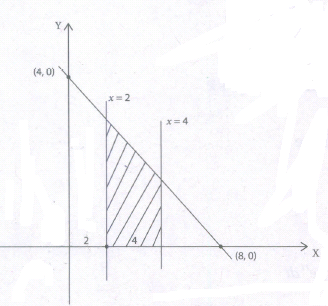
Given 2y + x = 8
2y = 8-x
y = \(\frac{1}{2}\) (8-x)
Given limits are x = 2 and x = 4
Area of the shaded region between the given limits
\(A=\int _{ a }^{ b }{ y\quad dx } =\int _{ 2 }^{ 4 }{ \frac { 1 }{ 2 } (8-x)dx } \)
\(\frac { 1 }{ 2 } \int _{ 2 }^{ 4 }{ (8-x)dx } =\frac { 1 }{ 2 } { \left[ 8x-\frac { { x }^{ 2 } }{ x } \right] }_{ 2 }^{ 4 }\)
\(=\frac { 1 }{ 2 } \left[ \left( 8(4)-\frac { { 4 }^{ 2 } }{ 2 } \right) \left( 8(2)-\frac { { 2 }^{ 2 } }{ 2 } \right) \right] \)
\(=\frac { 1 }{ 2 } [(32-8)-(16-21)]\)
\(=\frac { 1 }{ 2 } [24-14]\)
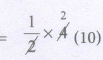
A = 5 sq. units.
28.
\(\int { \sqrt { 1-\sin2x } dx } \)
\(=\int { \sqrt { { \sin }^{ 2 }x+{ \cos }^{ 2 }x-2\sin x \cos x } dx } \) [∵1 = sin2x + cos2x sin2x = 2sin x cos x]
\(=\int { \sqrt { { \left( \sin x-\cos x \right) }^{ 2 } } } dx\) [∵(a−b)2=a2−2ab+b2]
=∫(sinx − cosx)dx
=−cosx − sinx+ c
=−(cosx + sinx)+c
29.
\(\int { \left( { x }^{ 3 }+7 \right) \left( x-4 \right) dx } \)
= \(\int { \left( { x }^{ 4 }-{ 4x }^{ 3 }+7x-28 \right) dx } \)
\(= \frac { { x }^{ 5 } }{ 5 } -{ x }^{ 4 }+\frac { { 7x }^{ 2 } }{ 2 } -28x+c\)
30.
Let \(A=\left( \begin{matrix} 5 & 6 \\ 7 & 8 \end{matrix} \right) \)
Order of A is 2 \(\times\) 2
\(\therefore \rho (A)\le 2\) [Since minimum of (2, 2) is 2]
Consider the second order minor
\(\left| \begin{matrix} 5 & 6 \\ 7 & 8 \end{matrix} \right| =40-42\)
= \(-2\neq 0\)
There is a minor of order 2, which is not zero
\(\therefore \rho (A)=2\)

12th Standard Syllabus & Materials
12th Standard
TN 12th Computer Applications வலையமைப்பு வடமிடல் Sample Question Papers Study Material - QB365 Set A
NEW12th Standard
TN 12th Computer Applications களப்பெயர் முறைமை (DNS) Sample Question Papers Study Material - QB365 Set A
NEW12th Standard
TN 12th Computer Applications வலையமைப்பு எடுத்துக்காட்டுகள் மற்றும் நெறிமுறைகள் Sample Question Papers Study Material - QB365 Set A
NEW12th Standard
TN 12th Computer Applications கணினி வலையமைப்பு ஓர் அறிமுகம் Sample Question Papers Study Material - QB365 Set A



Tamilnadu Stateboard 12th Standard Subjects

Maths

Chemistry

Physics

Biology

Computer Science
Business Maths and Statistics

Economics

Commerce

Accountancy

History

Computer Applications
Biology
Computer Technology
Computer Applications
Computer Science
Business Maths and Statistics
Commerce
Economics
Maths
Chemistry
Physics
Computer Technology
History
Accountancy

Tamil

English

French
Tamilnadu Stateboard Standards
