
 100% FREE ACCESS
12th Standard Syllabus & Materials
12th Standard
TN 12th Computer Applications மின்னணு தரவு பரிமாற்றம் Sample Question Papers Study Material - QB365 Set A
NEW12th Standard
TN 12th Computer Applications மின் - வணிக பாதுகாப்பு அமைப்புகள் Sample Question Papers Study Material - QB365 Set A
NEW12th Standard
TN 12th Computer Applications மின்னணு செலுத்தல் முறைகள் Sample Question Papers Study Material - QB365 Set A
NEW12th Standard
TN 12th Computer Applications மின் - வணிகம் Sample Question Papers Study Material - QB365 Set A
NEW12th Standard
TN 12th Computer Applications திறந்த மூல கருத்துருக்கள் Sample Question Papers Study Material - QB365 Set A
NEW12th Standard
TN 12th Computer Applications வலையமைப்பு வடமிடல் Sample Question Papers Study Material - QB365 Set A

Published on: 01/09/2020
12th Standard Business Maths English Medium Important 3 Mark Book Back Questions (New Syllabus) 2020
Download Tamil Nadu 12th Standard Business Maths and Statistics question papers, model tests, one-mark questions, important questions, and public exam papers in PDF format. Free study materials and answer keys for TN State Board students.
Questions + Answers key
Take MCQ Business Maths and Statistics Test
1.
Find the rank of each of the following matrices.
\(\left( \begin{matrix} 2 & -1 & 1 \\ 3 & 1 & -5 \\ 1 & 1 & 1 \end{matrix} \right) \)
2.
Using graphic method, find the value of y when x = 48 from the following data:
| x | 40 | 50 | 60 | 70 |
| y | 6.2 | 7.2 | 9.1 | 12 |
3.
A farmer wants to decide which of the three crops he should plant on his 100-acre farm. The profit from each is dependent on the rainfall during the growing season. The farmer has categorized the amount of rainfall as high medium and low. His estimated profit for each is shown in the table.
| Rainfall | Estimated Conditional Profit(Rs.) | ||
| crop A | crop B | crop C | |
| High | 8000 | 3500 | 5000 |
| Medium | 4500 | 4500 | 5000 |
| Low | 2000 | 5000 | 4000 |
If the farmer wishes to plant only crop, decide which should be his best crop using
(i) Maximin
(ii) Minimax
4.
By constructing a difference table and using the second order differences as constant, find the sixth term of the series 8,12,19,29,42…
5.
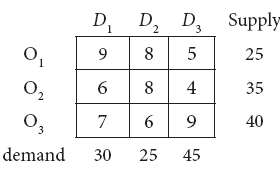
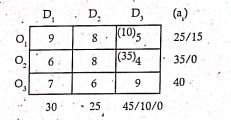
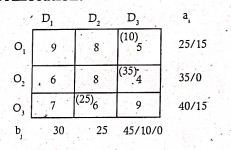
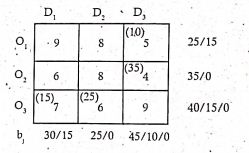
Obtain an initial basic feasible solution to the following transportation problem by using least- cost method.
6.
A business man has three alternatives open to him each of which can be followed by any of the four possible events. The conditional pay offs for each action - event combination are given below:
| Alternative | Pay – offs (Conditional events) | |||
| A | B | C | D | |
| X | 8 | 0 | -10 | 6 |
| Y | -4 | 12 | 18 | -2 |
| A3 | 14 | 6 | 0 | 8 |
Determine which alternative should the businessman choose, if he adopts the maximin principle.
7.
Obtain an initial basic feasible solution to the following transportation problem using least cost method.
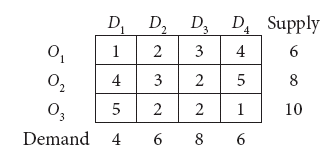
Here Oi and Dj denote ith origin and jth destination respectively.
8.
An Enquiry was made into the budgets of the middle class families in a city gave the following information.
| Expenditure | Food | Rent | Clothing | Fuel | Rice |
| Price(2010) | 150 | 50 | 100 | 20 | 60 |
| Price(2011) | 174 | 60 | 125 | 25 | 90 |
| Weights | 35 | 15 | 20 | 10 | 20 |
What changes in the cost of living have taken place in the middle class families of a city?
9.
Explain the method of fitting a straight line.
10.
Solve sec2x tan y dx + sec2y tan x dy = 0
11.
Evaluate the following integrals:
\(\int _{ 0 }^{ 1 }{ \sqrt { x(x-1) } } \) dx
12.
A sample of 100 items, draw from a universe with mean value 4 and S.D 3, has a mean value 63.5. Is the difference in the mean significant at 0.05 level of significance?
13.
Find the sample size for the given standard deviation 10 and the standard error with respect of sample mean is 3.
14.
Evaluate the following:
\(\int _{ 1 }^{ 4 }{ f(x) } dx\) where f(x) = \(\begin{cases} 4x+3, \\ 3x+5, \end{cases}\begin{matrix} 1 & \le & x \\ 2 & \le & x \end{matrix}\begin{matrix} \le & 2 \\ \le & 4 \end{matrix}\)
15.
If electricity power failures occur according to a Poisson distribution with an average of 3 failures every twenty weeks, calculate the probability that there will not be more than one failure during a particular week.
16.
Assume that a drug causes a serious side effect at a rate of three patients per one hundred. What is the probability that atleast one person will have side effects in a random sample of ten patients taking the drug?
17.
Integrate the following with respect to x
\(\frac { 1 }{ \sqrt { { x }^{ 2 }-3x+2 } } \)
18.
Suppose A and B are two equally strong table tennis players. Which of the following two events is more probable:
(a) A beats B exactly in 3 games out of 4 or
(b) A beats B exactly in 5 games out of 8 ?
19.
Evaluate ഽ \(\frac { dx }{ 2+x-{ x }^{ 2 } } \)
20.
A person tosses a coin and is to receive Rs. 4 for a head and is to pay Rs. 2 for a tail. Find the expectation and variance of his gains.
21.
Consider a random variable X with probability density function \(f(x)= \begin{cases}4x^3 & \text { if } 0< x < 1 \\ 0, & \text { otherwise }\end{cases}\)
Find E(X) and V(X).
22.
Calculate consumer’s surplus if the demand function p = 122 − 5x − 2x2 and x = 6
23.
The marginal cost function of a product is given by \(\frac { dC }{ dx } \) = 100 −10x + 0.1x2 where x is the output. Obtain the total and the average cost function of the firm under the assumption, that its fixed cost is Rs. 500.
24.
If you toss a fair coin three times, the outcome of an experiment consider as random variable which counts the number of heads on the upturned faces. Find out the probability mass function and check the properties of the probability mass function.
25.
The marginal cost function MC = 2 + 5ex Find C if C (0)=100
26.
Evaluate \(\int { \frac { dx }{ x\left( { x }^{ 3 }+1 \right) } } \)
27.
Evaluate \(\int { } \)x3exdx
28.
Integrate the following with respect to x.
\(\frac { { e }^{ 3x }+{ e }^{ 5x } }{ { e }^{ x }+{ e }^{ -x } } \)
29.
Evaluate \(\int \frac{x^{3}+5 x^{2}-9}{x+2} d x\)
30.
Evaluate \(\int \frac{a x^{2}+b x+c}{\sqrt{x}} d x\)
31.
At marina two types of games viz., Horse riding and Quad Bikes riding are available on hourly rent. Keren and Benita spent Rs. 780 and Rs. 560 during the month of May.
| Name | Number of hours | Total amount spent (in Rs) |
|
| Horse Riding | Quad Bike Riding | ||
| Keren | 3 | 4 | 780 |
| Benita | 2 | 3 | 560 |
Find the hourly charges for the two games (rides). (Use determinant method).
32.
Find the rank of the matrix A = \(\left( \begin{matrix} 0 & 1 & 2 \\ 1 & 2 & 3 \\ 3 & 1 & 1 \end{matrix}\begin{matrix} 1 \\ 2 \\ 3 \end{matrix} \right) \)
33.
Find the order and degree of the following differential equations.
\(\frac{d^{3} y}{d x^{3}}+3\left(\frac{d y}{d x}\right)^{3}+2 \frac{d y}{d x}=0\)
34.
Find the differential equation of the following
y = cx + c − c3
1.
Let \(A=\left( \begin{matrix} 2 & -1 & 1 \\ 3 & 1 & -5 \\ 1 & 1 & 1 \end{matrix} \right) \)
The order of A is 3 x 3
\(\therefore \rho (A)\le 3\) [Since minimum of (3,3) is 3]
Let us transform the matrix A to an echelon form
| Matrix A | Elementary Transformation |
|---|---|
| \(A=\left( \begin{matrix} 2 & -1 & 1 \\ 3 & 1 & -5 \\ 1 & 1 & 1 \end{matrix} \right) \) | |
| \(\sim \left( \begin{matrix} 1 & 1 & 1 \\ 3 & 1 & -5 \\ 2 & -1 & 1 \end{matrix} \right) \) | \({ R }_{ 1 }\leftrightarrow { R }_{ 3 }\) |
| \(\sim \left( \begin{matrix} 1 & 1 & 1 \\ 0 & -2 & -8 \\ 0 & -3 & -1 \end{matrix} \right) \) | \({ { R }_{ 2 }\rightarrow { R }_{ 2 }3{ R }_{ 1 } }\) \({ R }_{ 3 }-{ R }_{ 3 }-2{ R }_{ 1 }\) |
| \(\sim \left( \begin{matrix} 1 & 1 & 1 \\ 0 & -1 & -4 \\ 0 & -3 & -1 \end{matrix} \right) \) | \({ R }_{ 2 }\rightarrow { R }_{ 2 }\div 2\) |
| \(\sim \left( \begin{matrix} 1 & 1 & 1 \\ 0 & -1 & -4 \\ 0 & 0 & 11 \end{matrix} \right) \) | \({ R }_{ 3 }\rightarrow { R }_{ 3 }-3{ R }_{ 2 }\) |
This matrix is in echelon from and number of non zero rows is 3.
\(\therefore \rho (A)=3\)
2.
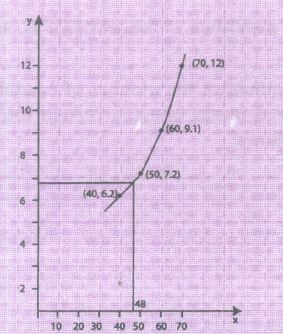
Scale:
In x axis 1 cm = 10 units
In y axis 1 cm = 2 units
Plot the points (40, 6.2), (50, 7.2), (60, 9.1) and (70, 12). At x = 48, draw a vertical line to the graph and from the intersecting point, draw a horizontal line to meet the y-axis
From the graph, we find that when x = 48, the value of Y is equal to 6.8.
3.
| Estimated Conditional Profit 0 | |||||
| Rainfall | High | Medium | Low | Minimum payoff | Maximum payoff |
| Crop A | 8000 | 4500 | 2000 | 2000 | 8000 |
| Crop B | 3500 | 4500 | 5000 | 3500 | 5000 |
| Crop C | 5000 | 5000 | 4000 | 4000 | 5000 |
(i) Max (2000,3500,4000) = 4000
∴ Crop C is the best according to maximin criteria
(ii) Min (8000,5000,5000) = 5000
∴ Crop B and C are best according to minimax criteria
4.
Let k be the sixth term of the series in the difference table.
First we find the forward differences
| x | y | ∆ | ∆2 |
| 1 | 8 | ||
| 4 | |||
| 2 | 12 | 3 | |
| 7 | |||
| 3 | 19 | 3 | |
| 10 | |||
| 4 | 29 | 3 | |
| 13 | |||
| 5 | 42 | k-55 | |
| k-42 | |||
| 6 | k |
Given that the second differences are constant
∴ k – 55 = 3
k = 58
∴ the sixth term of the series is 58
5.
First allocation:
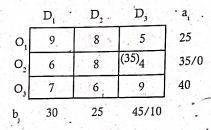
Second allocation:
Third allocation:
Fourth allocation:
Final allocation:
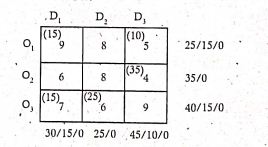
The total transportation cost is
\( =(15 \times 9)+(10 \times 5)+(35 \times 4) +(15 \times 7)+(25 \times 6) \)
= 135 + 50 + 140 + 105 + 150 = Rs. 580
6.
| Alternative | Pay – offs (Conditional events) | Minimum Pay off | |||
| A | B | C | D | ||
| X | 8 | 0 | -10 | 6 | -10 |
| Y | -4 | 12 | 18 | -2 | -4 |
| A3 | 14 | 6 | 0 | 8 | 0 |
Max (–10,–4, 0) = 0. Since the maximum payoff is 0, the alternative Z is selected by the businessman
7.
Total Supply = Total Demand = 24
\(\therefore\)The given problem is a balanced transportation problem.
Hence there exists a feasible solution to the given problem.
Given Transportation Problem is:
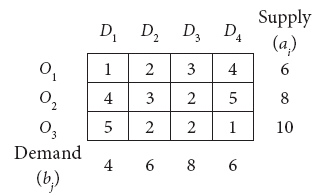
The least cost is 1 corresponds to the cells (O1, D1) and (O3, D4)
Take the Cell (O1, D1) arbitrarily.
Allocatemin (6,4) = 4 units to this cell.
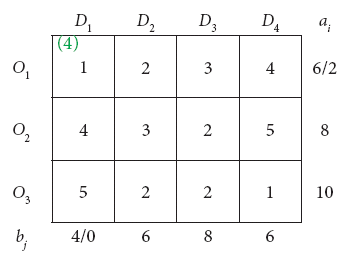
The reduced table is
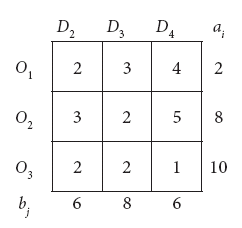
The least cost corresponds to the cell (O3, D4). Allocate min (10,6) = 6 units to this cell.
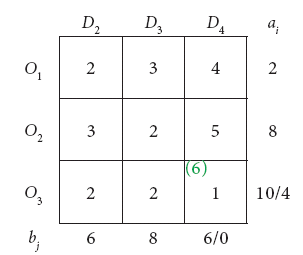
The reduced table is
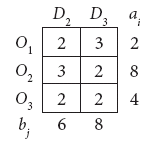
The least costis 2 corresponds to the cells (O1, D2), (O2, D3), (O3, D2), (O3, D3)
Allocate min (2,6) = 2 units to this cell.
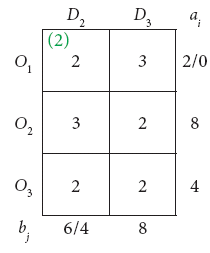
The reduced table is
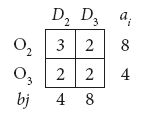
The least cost is 2 corresponds to the cells (O2, D3), (O3, D2), (O3, D3)
Allocate min ( 8,8) = 8 units to this cell.
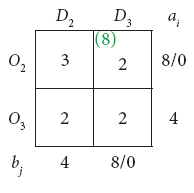
The reduced table is
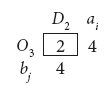
Here allocate 4 units in the cell (O3, D2)
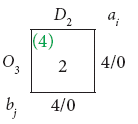
Thus we have the following allocations:
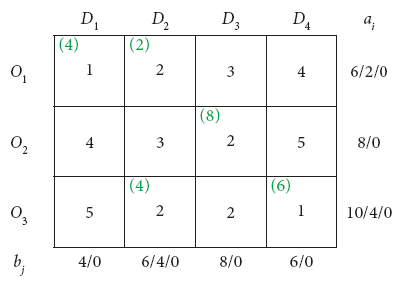
Transportation schedule :
O1⟶D1, O1⟶D2,O2⟶D3,O3⟶D2,O3⟶D4
Total transportation cost
= (4×1)+ (2×2)+(8×2)+(4×2)+(6×1)
= 4+4+16+8+6
= Rs. 38.
8.
| Expenditure | Weights (V) | Rent 2010 (p0) | Price 2011 (p1) | P = \(\frac {p_{1}}{p_{0}} \times 100\) | PV |
| Food | 35 | 150 | 174 | 116 | 4060 |
| Rent | 15 | 50 | 60 | 120 | 1800 |
| Clothing | 20 | 100 | 125 | 125 | 2500 |
| Fuel | 10 | 20 | 25 | 125 | 1250 |
| Rice | 20 | 60 | 90 | 150 | 3000 |
| 100 | 12610 |
Cost of living index number = \(\frac {\sum PV}{\sum V}\) = \(\frac {12610}{100}\) = 126.10
∴ The cost ofliving has increased upto 26.10% in 2011 as compared to 2010.
9.
The line of least fit is a line from which the sum of the deviations of various points is zero. This is the best method for obtaining the trend values.
(i) The straight line trend is represented by
Y = a + b X ...(1)
where Y is the actual value and X is time
(ii) The constants 'a' and 'b' are estimated by solving the following two normal Equations
\(\sum\) Y = n a + b \(\sum\) X
\(\sum\) XY = a\(\sum\) X + b \(\sum\) X2 where n is the number of years given in the data.
(iii) By substituting the values of 'a' and 'b' in the trend equation (1), we get the line of best fit.
10.
Separating the variables, we get
\(\frac { { \sec }^{ x }x }{ \tan x } dx+\frac { { \sec }^{ 2 } }{ { \tan y } } dy=0\)
Integrating, we get
ഽ\(\frac { { \sec }^{ x }x }{ \tan x } \)dx + ഽ\(\frac { { \sec }^{ 2 } }{ { \tan y } } dy\) = c
log tan x + log tan y = log c
log(tan x tan y) = log c
tan x tan y = c
11.
\(I=\int _{ 0 }^{ 1 }{ \sqrt { x(x-1) } dx } \)
= \(\int _{ 0 }^{ 1 }{ \sqrt { { x }^{ 2 }-xdx } } \)
= \(\int _{ 0 }^{ 1 }{ \sqrt { { x }^{ 2 }-x+\cfrac { 1 }{ 4 } -\cfrac { 1 }{ 4 } dx } } \)
= \(\int _{ 0 }^{ 1 }{ \sqrt { \left( x-\cfrac { 1 }{ 2 } \right) ^{ 2 }-\left( \cfrac { 1 }{ 2 } \right) ^{ 2 }dx } } \)
\(\left[ \because \int { \sqrt { { x }^{ 2 }-{ a }^{ 2 } } dx } =\cfrac { x }{ 2 } \sqrt { { x }^{ 2 } } -\cfrac { { a }^{ 2 } }{ 2 } \log\left| x+\sqrt { { x }^{ 2 }-{ a }^{ 2 } } \right| \right] \)
= \(\left[ \cfrac { x-\frac { 1 }{ 2 } }{ 2 } \sqrt { { x }^{ 2 }-x } -\cfrac { 1 }{ 8 } \log|x-\cfrac { 1 }{ 2 } +\sqrt { { x }^{ 2 }-x } \right] _{ 0 }^{ 1 }\)
= \(\left[ \cfrac { 1-\frac { 1 }{ 2 } }{ 2 } \sqrt { 0 } -\cfrac { 1 }{ 8 } \log|1-\cfrac { 1 }{ 2 } +0| \right] -\left[ 0-\cfrac { 1 }{ 8 } \log|-\cfrac { 1 }{ 2 } | \right] \)
= \(-\cfrac { 1 }{ 8 } \log\left| \cfrac { 1 }{ 2 } \right| +\cfrac { 1 }{ 8 } \log\left| \cfrac { 1 }{ 2 } \right| \)
= 0
12.
Sample size n = 100,
Sample mean \(\\ \bar { X } =3.5\)
Population mean μ = 4
Population standard deviation σ = 3
Null Hypotheses: There is no significant difference in the mean. i.e., Ho : μ = 4
Alternative Hypotheses : There is Significant difference in the mean.
i.e., H1 : μ ≠ H
The level of significance ∝ = 5% = 0.05
Applying the test statistic,\(Z=\frac { \bar { X } -\mu }{ \frac { \sigma }{ \sqrt { n } } } \)
\(\Rightarrow Z=\frac { 3.5-4 }{ \frac { 3 }{ \sqrt { 100 } } } =\frac { -.5 }{ .3 } =-1.667\)
\(\Rightarrow |Z|=1.667\)
\({ Z }_{ \frac { \alpha }{ 2 } }=1.96\)
Here Z < \({ Z }_{ \frac { \alpha }{ 2 } }\)i.e., 1.667<1.96
Inference: Since Z<\({ Z }_{ \frac { \alpha }{ 2 } }\)at 5% level of significance, the null hypothesis H0 is accepted. Hence there is no Significant difference in the mean.
13.
Given \(\sigma\) = 10, S.E. \(\bar { X } \) = 3
We know that S.E = \(\frac { \sigma }{ \sqrt { n } } \)
Therefore, \(3=\frac { 10 }{ \sqrt { n } } \Rightarrow \sqrt { n } =\frac { 10 }{ 3 } \)
Taking Squaring on both sides we get
\(n=\left(\frac{10}{3}\right)^{2}=\frac{100}{9}=11.11 \cong 11\),
The required sample size is 11.
14.
\(\int _{ 1 }^{ 4 }{ f\left( x \right) } =\int _{ 1 }^{ 2 }{ f\left( x \right) } dx+\int _{ 2 }^{ 4 }{ f\left( x \right) } dx\)
\(=\int _{ 1 }^{ 2 }{ \left( 4x+3 \right) } dx+\int _{ 2 }^{ 4 }{ \left( 3x+5 \right) } dx\)
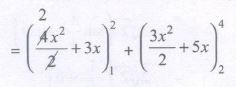
\(={ \left( { 2x }^{ 2 }+3x \right) }_{ 1 }^{ 2 }+{ \left( \frac { { 3x }^{ 2 } }{ 2 } +5x \right) }_{ 2 }^{ 4 }\)
\(=\left[ 2\left( { 2 }^{ 2 } \right) +3(2) \right] -\left[ 2{ { \left( 1 \right) }^{ 2 }+3(1) } \right] +\left[ \frac { 3\left( { 4 }^{ 2 } \right) }{ 2 } +5(4) \right] -\left[ \frac { 3\left( { 2 }^{ 2 } \right) }{ 2 } +5(2) \right] \)
= (8+6) - (2-3) + (24+20) - (6+10)
= 14-5+44-16
= 58 - 21 = 37
15.
Given average = λ = \(\frac { 3 }{ 20 } \) = 0.15
P(will not be more than one failure)
= P(X ≤ 1)
= P(X = 0) + P(X = 1)
= \(\frac { { e }^{ -\lambda }.{ \lambda }^{ 0 } }{ 0! } +\frac { { e }^{ -\lambda }.{ \lambda }^{ 1 } }{ 1! } \)
= e-λ (1+λ) =e-0.15 (1+0.15)
= (0.8607) (1.15)
= (0.98981 [e-0.15 =0.8607]
∴ Probability that there will not be more than one failure = 0.98981
16.
Let p be the probability of drug's side effect
∴ p = \(\frac { 3 }{ 100 } \) =.03
⇒ q = 1-p = 1-0.03 = 0.97 and n = 10
P (atleast one person will have side effect)
= P(X ≥ 1)
= 1 - P(X < 1)
= 1 - [P(X =0)] ∵ p(x) =nCx pxqn-x, n=10, x=0
= 1-[10C0 (0.03)0 (0.97)10 ]
= 1-(0.97)10 [∵ 10C0 = 1 and (0.03)0 = 1]
= 1-0.7374
P(X≥1) = 0.2626
17.
\(\int { \frac { dx }{ \sqrt { { x }^{ 2 }-3x+2 } } } \)
\(=\int { \frac { dx }{ \sqrt { { x }^{ 2 }-3x+\frac { 9 }{ 4 } -\frac { 9 }{ 4 } } +2 } } \)
\({ \left[ \frac { 1 }{ 2 } (3) \right] }^{ 2 }=\frac { 9 }{ 4 } \)
Adding and subtracting \(\frac { 9 }{ 4 } \)
\(=\int { \frac { dx }{ \sqrt { { \left( x-\frac { 3 }{ 2 } \right) }^{ 2 } } -\frac { 1 }{ 4 } } } \)
\(=\int { \frac { dx }{ \sqrt { { \left( x-\frac { 3 }{ 2 } \right) }^{ 2 }-{ \left( \frac { 1 }{ 2 } \right) }^{ 2 } } } } \)
\(\left[ \because \int { \frac { dx }{ \sqrt { { x }^{ 2 }+{ a }^{ 2 } } } } =\log { \left| x+\sqrt { { x }^{ 2 }+{ a }^{ 2 } } \right| } +c \right] \)
\(=\log { \left| \left( x-\frac { 3 }{ 2 } \right) +\sqrt { { x }^{ 2 }-3x+2 } \right| } +c\)
18.
Here p = q = 1/2
(a) probability of A beating B in exactly 3 games out of 4
\(\left( \begin{matrix} 4 \\ 3 \end{matrix} \right) { (\frac { 1 }{ 2 } ) }^{ 3 }\left( \frac { 1 }{ 2 } \right) ^{ 4-3 }\)
= 1/4 = 25%
(b) probability of A beating B in exactly 5 games out of 8
\(\left( \begin{matrix} 8 \\ 5 \end{matrix} \right) { (\frac { 1 }{ 2 } ) }^{ 5 }\left( \frac { 1 }{ 2 } \right) ^{ 8-5 }\)
\(=\frac { 7 }{ 32 } \) = 21.875%
Clearly, the first event is more probable.
19.
ഽ \(\frac { dx }{ 2+x-{ x }^{ 2 } } \) = ഽ\(\frac { dx }{ { \left( \frac { 3 }{ 2 } \right) }^{ 2 }-{ \left( x-\frac { 1 }{ 2 } \right) }^{ 2 } } \)
= \(\frac { 1 }{ 2\left( \frac { 3 }{ 2 } \right) } \log\left| \frac { \frac { 3 }{ 2 } +\left( x-\frac { 1 }{ 2 } \right) }{ \frac { 3 }{ 2 } -\left( x-\frac { 1 }{ 2 } \right) } \right| +c\)
= \(\frac { 1 }{ 3 } \log\left| \frac { 2+2x }{ 4-2x } \right| +c\)
= \(\frac { 1 }{ 3 } \log\left| \frac { 1+x }{ 2-x } \right| +c\)
| By completing the squares |
| 2 + x -x2 = 2 [x2 - x] = 2 - \(\left[ { \left( x-\frac { 1 }{ 2 } \right) }^{ 2 }-\frac { 1 }{ 4 } \right] \) = \(\left[ { \left( x-\frac { 1 }{ 2 } \right) }^{ 2 }-\frac { 1 }{ 4 } \right] \) |
20.
When a coin is tossed, sample space S = {H, T}
Since he is receiving Rs. 4 for a head and pays Rs. 2 for a tail,
∴ X take values 4 and -2.
∴ Probability for getting a head is \(\frac{1}{2}\) and probability for getting a tail is \(\frac{1}{2}\).
The probability mass function is
| X = x | 4 | -2 |
| P(X = x) | \(\frac{1}{2}\) | \(\frac{1}{2}\) |
∴ Expectation E(X) = Σxp(x)
= 4(\(\frac{1}{2}\)) - 2(\(\frac{1}{2}\))
= 2-1 = 1
∴ His expectation is Rs. 1
E(x2) = ∑x2p(x)
= 42(\(\frac{1}{2}\)) + (-2)2(\(\frac{1}{2}\))
= 16(\(\frac{1}{2}\)) + 4(\(\frac{1}{2}\))
= 8 + 2 = 10
Variance (X) = E(X2)-[E(X)]2
= 10-12 = 9
∴ Variance of his gains Rs. 9
21.
We know that,
\(E(X)=\int _{ -\infty }^{ \infty }{ xf(x)dx } \)
\(=\int _{ 0 }^{ 1 }{ x{ 4x }^{ 3 } } dx\)
\(=4{ \left[ \frac { { x }^{ 5 } }{ 5 } \right] }_{ 0 }^{ 1 }\)
\(E(X)=\frac { 4 }{ 5 } \)
\(E\left( { X }^{ 2 } \right) =\int _{ -\infty }^{ \infty }{ { x }^{ 2 } } f(x)dx\)
\(=\int _{ 0 }^{ 1 }{ { x }^{ 2 }{ 4x }^{ 3 } } dx\)
\(=4{ \left[ \frac { { x }^{ 6 } }{ 6 } \right] }_{ 0 }^{ 1 }\)
\(=\frac { 4 }{ 6 } =\frac { 2 }{ 3 } \)
\(V(X)=\left( { x }^{ 2 } \right) -{ [E(X)] }^{ 2 }\)
\(=\frac { 4 }{ 6 } -{ \left[ \frac { 4 }{ 5 } \right] }^{ 2 }\)
\(=\frac { 2 }{ 75 } \)
22.
Given demand functionp = 122 - 5x - 2x2 and x = 6
When x0 = 6, p0 = 122-5(6)-2(6)2
= 122-30-72
= 122-102
P0 = 20
p0x0 = 20 \(\times\) 6 = 120
Consumer's Surplus
CS \(=\int _{ 0 }^{ x }{ f(x) } dx-{ p }_{ 0 }{ x }_{ 0 }\)
\(=\int _{ 0 }^{ 6 }{ (122-5x-2{ x }^{ 2 })dx-120 } \)
\(={ \left[ 122x-\frac { 5{ x }^{ 2 } }{ 2 } -\frac { { 2x }^{ 3 } }{ 3 } \right] }_{ 0 }^{ 6 }-120\)
\(=122(6)-5\frac { \left( { 6 }^{ 2 } \right) }{ 2 } -2\frac { \left( { 6 }^{ 3 } \right) }{ 3 } -120\)
\(=732-\frac { 180 }{ 2 } -\frac { 432 }{ 3 } -120\)
= 732-90-144-120
= 732-354
C.S = 378 units
23.
Given marginal cost function
\(MC=\frac { dc }{ dx } =100-10x+0.1{ x }^{ 2 }\)
\(\Rightarrow C=\int { (100-10x+0.1{ x }^{ 2 })dx } \)
\(\Rightarrow C=100x-\frac { { 10x }^{ 2 } }{ 2 } +\frac { { 0.1x }^{ 3 } }{ 3 } +k\) ...(1)
Given fixed cost is Rs. 500 ⇒ k = 500
∴ (1) becomes,
\(C=100x-5{ x }^{ 2 }+\frac { { 0.1x }^{ 3 } }{ 3 } +500\)
Average cost function
\(AC=\frac { C }{ x } =\frac { 100x-{ 5x }^{ 2 }+\frac { { 0.1x }^{ 3 } }{ 3 } }{ x } +500\)
\(AC=100-5x+\frac { { 0.1x }^{ 2 } }{ 3 } +\frac { 500 }{ x } \)
24.
Let X is the random variable which counts the number of heads on the upturned faces. The outcomes are stated below
| Outcomes | (HHH) | (HHT) | (HTH) | (THH) | (THT) | (TTH) | (HTT) | (TTT) |
| Values of X | 3 | 2 | 2 | 2 | 1 | 1 | 1 | 0 |
These values are summarized in the following probability table.
| Value of X | 0 | 1 | 2 | 3 | Total |
| P(xi) | \(\frac{1}{8}\) | \(\frac{3}{8}\) | \(\frac{3}{8}\) | \(\frac{1}{8}\) | \(\sum _{ i=0 }^{ 3 }{ p({ x }_{ i })=1 } \) |
(i) p(xi) \(\ge\)0\(\forall \) i and
(ii) \(\sum _{ i=0 }^{ 3 }{ p({ x }_{ i })=1 } \)
Hence, p(xi) is a probability mass function.
25.
Given MC = 2 + 5ex
\(C=\int { MC } dx+k\)
\(=\int { (2+5{ e }^{ x })dx } +k\)
= 2x + 5ex + k
x = 0 ⇒ C = 100,
100 = 2(0)+ 5(e0 )+ k
k = 95
C = 2x + 5 ex + 95.
26.
\(\int { \frac { dx }{ x\left( { x }^{ 3 }+1 \right) } } =\int { \frac { { x }^{ 2 } }{ { x }^{ 3 }\left( x^{ 3 }+1 \right) } dx } \)
\(=\frac { 1 }{ 3 } \int { \frac { dz }{ z\left( z+1 \right) } dz } \)
\(=\frac { 1 }{ 3 } \int { \left[ \frac { 1 }{ z } -\frac { 1 }{ z+1 } \right] dz } \)
\(=\frac { 1 }{ 3 } \left[ \log\left| z \right| -\log\left| z+1 \right| \right] +c\)
\(=\frac { 1 }{ 3 } \log\left| \frac { z }{ z+1 } \right| +c\)
\(=\frac { 1 }{ 3 } \log\left| \frac { { x }^{ 3 } }{ { x }^{ 3 }+1 } \right| +c\)
| Take z = x3 \(\therefore\) dz = 3x2 dx \(\Rightarrow \frac { dz }{ 3 } ={ x }^{ 2 }dx\) |
By partial fractions, \(\frac { 1 }{ z\left( z+1 \right) } =\frac { A }{ z } +\frac { B }{ z+1 } \) \(\Rightarrow \frac { 1 }{ z\left( z+1 \right) } =\frac { 1 }{ z } +\frac { 1 }{ z+1 } \) |
27.
\(\int { } \)x3exdx = \(\int { } \)udv
= uv − u'v1 + u''v2 − u'''v3 + ...
= x3ex −3x2 ex + 6xex −6ex + c
= ex (x3 −3x2 +6x −6)+ c
| Successive derivatives | Repeated integrals |
| Take u = x3 u' = 3x2 u'' = 6x u''' = 6 |
and dv = exdx v = ex v1 = ex v2 = ex v3 = ex |
28.
\(\int { \frac { { e }^{ 3x }+{ e }^{ 5x } }{ { e }^{ x }+{ e }^{ -x } } } dx\)
\(=\int { \left( \frac { { e }^{ 3x }+{ e }^{ 5x } }{ { e }^{ x }+\frac { 1 }{ { e }^{ x } } } \right) } dx\quad =\quad \int { \frac { { e }^{ 3x }+{ e }^{ 5x } }{ \frac { { e }^{ 2x }+1 }{ { e }^{ x } } } } dx\)
\(=\int { \frac { { e }^{ x }\left( { e }^{ 3x }+{ e }^{ 5x } \right) }{ { e }^{ 2x }+1 } } dx\)
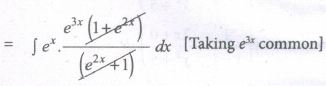
\(=\int { { e }^{ 4x } } dx=\frac { { e }^{ 4x } }{ 4 } +c\)
29.
\(\int { \frac { { x }^{ 2 }+{ 5x }^{3 }-9 }{ x+2 } dx=\int { \left[ { x }^{ 2 }+3x-6+\frac { 3 }{ x+2 } \right] } } dx\)
\(=\frac { x^{ 3 } }{ 3 } +\frac { { 3x }^{ 2 } }{ 2 } -6x+3 \log\left| x+2 \right| +c\)
[By simple division,
\(\frac { { x }^{ 3 }+{ 5x }^{ 3 }-9 }{ x+2 } ={ x }^{ 2 }+3x-6+\frac { 3 }{ x+2 } \)]
30.
\(\int { \frac { { ax }^{ 2 }+bx+c }{ \sqrt { x } } dx } \)
=\(\int { \left( { ax }^{ \frac { 2 }{ 3 } }+{ bx }^{ \frac { 2 }{ 3 } }+{ cx }^{ -\frac { 1 }{ 2 } } \right) dx } \)
=\(a\int { { x }^{ \frac { 3 }{ 2 } }dx+b\int { { x }^{ \frac { 1 }{ 2 } }+c\int { { x }^{ -\frac { 1 }{ 2 } }dx } } } \)
=\(\frac { { 2ax }^{ \frac { 5 }{ 2 } } }{ 5 } +\frac { { 2bx }^{ \frac { 3 }{ 2 } } }{ 3 } +{ 2cx }^{ \frac { 1 }{ 2 } }+k\)
31.
Let the hourly charge for horse riding be Rs. x and the hourly charge for quad bike be Rs. y from the given data,
3x + 4y = 780
2x+ 3y = 560
\(\Delta =\left| \begin{matrix} 3 & 4 \\ 2 & 3 \end{matrix} \right| =3(3)-2(4)=9-8=1\neq 0\)
Since \(\Delta \neq 0\) the system is consistent with unique solution and Cramer's rule can be applied
\(\Delta x=\left| \begin{matrix} 780 & 4 \\ 560 & 3 \end{matrix} \right| =780(30-4(560)\)
= 2340 - 2240 = 100
\(\Delta y=\left| \begin{matrix} 3 & 780 \\ 2 & 560 \end{matrix} \right| =39560)-2(780)\)
= \(1680 - 1560\) = 120
\(\therefore x=\cfrac { \Delta x }{ \Delta } =\cfrac { 100 }{ 1 } =100\)
\(y=\cfrac { \Delta y }{ \Delta } =\cfrac { 120 }{ 1 } =120\)
\(\therefore\) Hourly charges for the two rides are Rs. 100 and Rs. 120 respectively.
32.
The order of A is 3 \(\times\) 4.
\(\rho (A)\le 3.\)
Let us transform the matrix A to an echelon form
| Matrix A | Elementary Transformation |
| \(A=\left( \begin{matrix} 0 & 1 & 2 \\ 1 & 2 & 3 \\ 3 & 1 & 1 \end{matrix}\begin{matrix} 1 \\ 2 \\ 3 \end{matrix} \right) \) \(A=\left( \begin{matrix} 0 & 1 & 3 \\ 0 & 1 & 2 \\ 3 & 1 & 1 \end{matrix}\begin{matrix} 2 \\ 1 \\ 3 \end{matrix} \right) \) \(\sim \left( \begin{matrix} 1 & 2 & 3 \\ 0 & 1 & 2 \\ 0 & -5 & -8 \end{matrix}\begin{matrix} 2 \\ 1 \\ -3 \end{matrix} \right) \) \(\sim \left( \begin{matrix} 1 & 2 & 3 \\ 0 & 1 & 2 \\ 0 & 0 & 2 \end{matrix}\begin{matrix} 2 \\ 1 \\ 2 \end{matrix} \right) \) |
\({ R }_{ 1 }\rightarrow { R }_{ 2 }\) \({ R }_{ 3 }\rightarrow { R }_{ 3 }-{ 3R }_{ 1 }\) \({ R }_{ 3 }\rightarrow { R }_{ 3 }+{ 5R }_{ 2 }\) |
The number of non zero rows is 3.
\(\rho (A)=3.\)
33.
The highest derivative is third order and its power is one
∴ order : 3,
degree : 1
34.
Given equation is y = cx + c - c3 ....(1)
Differentiating w.r.t 'x' we get,
\(\frac { dy }{ dx } \) = c(1) + 0-0
⇒ \(\frac { dy }{ dx } \) = c ....(2)
Substituting (2) in (1) we get,
y=\(x\left( \frac { dy }{ dx } \right) +\left( \frac { dy }{ dx } \right) -\left( \frac { dy }{ dx } \right) ^{ 3 }\) which is the required differential equation.

12th Standard Syllabus & Materials
12th Standard
TN 12th Computer Applications களப்பெயர் முறைமை (DNS) Sample Question Papers Study Material - QB365 Set A
NEW12th Standard
TN 12th Computer Applications வலையமைப்பு எடுத்துக்காட்டுகள் மற்றும் நெறிமுறைகள் Sample Question Papers Study Material - QB365 Set A
NEW12th Standard
TN 12th Computer Applications கணினி வலையமைப்பு ஓர் அறிமுகம் Sample Question Papers Study Material - QB365 Set A
NEW12th Standard
TN 12th Computer Applications PHP-உடன் MySQL-ஐ இணைத்தல் Sample Question Papers Study Material - QB365 Set A



Tamilnadu Stateboard 12th Standard Subjects

Maths

Chemistry

Physics

Biology

Computer Science
Business Maths and Statistics

Economics

Commerce

Accountancy

History

Computer Applications
Biology
Computer Technology
Computer Applications
Computer Science
Business Maths and Statistics
Commerce
Economics
Maths
Chemistry
Physics
Computer Technology
History
Accountancy

Tamil

English

French
Tamilnadu Stateboard Standards
