
 100% FREE ACCESS
12th Standard Syllabus & Materials
12th Standard
TN 12th Computer Applications மின்னணு தரவு பரிமாற்றம் Sample Question Papers Study Material - QB365 Set A
NEW12th Standard
TN 12th Computer Applications மின் - வணிக பாதுகாப்பு அமைப்புகள் Sample Question Papers Study Material - QB365 Set A
NEW12th Standard
TN 12th Computer Applications மின்னணு செலுத்தல் முறைகள் Sample Question Papers Study Material - QB365 Set A
NEW12th Standard
TN 12th Computer Applications மின் - வணிகம் Sample Question Papers Study Material - QB365 Set A
NEW12th Standard
TN 12th Computer Applications திறந்த மூல கருத்துருக்கள் Sample Question Papers Study Material - QB365 Set A
NEW12th Standard
TN 12th Computer Applications வலையமைப்பு வடமிடல் Sample Question Papers Study Material - QB365 Set A

Published on: 01/09/2020
12th Standard Business Maths English Medium Important 3 Mark Creative Questions (New Syllabus) 2020
Download Tamil Nadu 12th Standard Business Maths and Statistics question papers, model tests, one-mark questions, important questions, and public exam papers in PDF format. Free study materials and answer keys for TN State Board students.
Questions + Answers key
Take MCQ Business Maths and Statistics Test
1.
From the data given below, construct a cost of living index number by family budget method for 1986 with 1976 as the base year.
| Commodity | P | Q | R | S | T | U |
| Quantity in 1976 | 50 | 25 | 10 | 20 | 30 | 40 |
| Price in 1976 (Rs) | 10 | 5 | 8 | 7 | 9 | 6 |
| Price in 1986 (Rs) | 6 | 4 | 3 | 8 | 10 | 12 |
2.
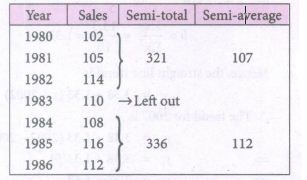
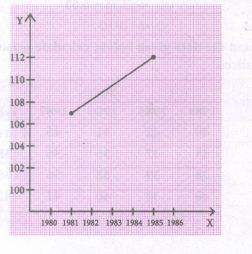
Find a trend line to the following data by the method of sami-averages.
| Years | 1980 | 1981 | 1982 | 1983 | 1984 | 1985 | 1986 |
| Sales | 102 | 105 | 114 | 110 | 108 | 116 | 112 |
3.
A random sample of marks in mathematics secured by 50 students out of 200 students showed a mean of 75 and a standard deviation of 10. Find the 95% confidence limits for the estimate of their mean marks.
4.
The probability that an event A happens in one treat of an experiment is 0.4. Three independent treats of the experiment are performed. Find the p!probability that the event A happens at least once.
5.
A random variable. X has following distribution
| X | -1 | 0 | 1 | 2 |
| P(X=x) | \(\frac{1}{3}\) | \(\frac{1}{6}\) | \(\frac{1}{6}\) | \(\frac{1}{3}\) |
Find E(2X+3)2
6.
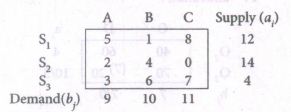
Find the initial basic feasible solution for the following transportation problem by Vogel's approximation method.
7.
If f' (x) = 3x2 - \(\frac { 2 }{ { x }^{ 3 } } \) and f(1) = 0, find f(x)
8.
Show that the equation of the curve whose slope at any point is equal to y + 2x and which passes through the origin is y = 2(ex-x-1).
9.
Form the differential equation for \(\frac { { x }^{ 2 } }{ { a }^{ 2 } } +\frac { { y }^{ 2 } }{ { b }^{ 2 } } \)=1 where a & b are arbitrary constants.
10.
Find the number of men getting wages between Rs. 30 and Rs. 35 from the following table.
| Wages (x) | 20 - 30 | 30 - 40 | 40 - 50 | 50 - 60 |
| No. of men (y) | 9 | 30 | 35 | 42 |
11.
Find the area bounded by one arc of the curve y = sin ax and the x-axis.
12.
Show that the equations x + 2y = 3, y - z = 2, x + y + z = 1 are consistent and have infinite sets of solution.
1.
| Commodity | Price | Quantity V | P = \(\frac {p_{1}}{p_{0}} \times 100\) | PV | |
| P0 | P1 | ||||
| P | 10 | 6 | 50 | 60 | 3000 |
| Q | 5 | 4 | 25 | 80 | 2000 |
| R | 8 | 3 | 10 | 37.5 | 375 |
| S | 7 | 8 | 20 | 114.29 | 2285.8 |
| T | 9 | 10 | 30 | 111.11 | 3333.3 |
| U | 6 | 12 | 40 | 200 | 8000 |
| 175 | 18994.1 | ||||
Cost ofliving index = \(\frac{\sum PV}{\sum V}\) = \(\frac {18994.1}{175}\) = 108.54
2.
No of years = 7 (odd), by omitting the middle year we have
3.
Sample size n = 50
Sample mean \(\bar { x } \) = 75
Sample S.D. s = 10
Standard error (S.E) = \(\frac { s }{ \sqrt { n } } =\frac { 10 }{ \sqrt { 50 } } =\frac { 10 }{ 7.07 } \)
= 1.414
As the significance level is α = 0.005, \(Z_{ \frac { \alpha }{ 2 } }\) = 1.96
∴ 95% confidence limits for the population mean is \(\bar { X } -Z_{ \frac { \alpha }{ 2 } }(S.E)\le \bar { X } -Z_{ \frac { \alpha }{ 2 } }(S.E)\)
⇒ 75 - (1.96)(1.414) ≤ μ ≤ 75 + (1.96)(1.414)
⇒ 75-2.771 ≤ μ ≤ 75 + 2.771
⇒ 72.23 ≤ μ ≤ 77.77
Hence, the 95% confidence interval of the population mean is (72.23, 77.77)
4.
p = 0.4, n = 3
q =1 - P = 1 - 0.4 = 0.6
P(X = x) = nCx pxqn-x
P(X≥1) = P(X = 1) + P(X = 2) + P(X = 3)
=3C1 (0.4)1 (0.6)2 + 3C2 (0.4)2 (0.6) + 3C3 (0.4)3 (0.6)0
=3 x \(\left( \frac { 4 }{ 10 } \right) \left( \frac { 36 }{ 100 } \right) +3\left( \frac { 16 }{ 100 } \right) \left( \frac { 6 }{ 100 } \right) +\left( \frac { 64 }{ 1000 } \right) \)
= \(\frac { 1 }{ 1000 } \)(432+288+64) =\(\frac { 784 }{ 1000 } \)
P(X≥1) = 0.784
5.
\(E(X)=\sum { xp(x)=-1(\frac { 1 }{ 3 } )+0(\frac { 1 }{ 6 } )+1(\frac { 1 }{ 6 } )+2\left( \frac { 1 }{ 3 } \right) } \)
\(=\frac { -1 }{ 3 } +\frac { 1 }{ 6 } +\frac { 2 }{ 3 } =\frac { -2+1+4 }{ 6 } \)
\(=\frac { 3 }{ 6 } =\frac { 1 }{ 2 } \)
\(E({ X }^{ 3 })={ \sum { x } }^{ 2 }p(x)\)
\(=1(\frac { 1 }{ 3 } )+0(\frac { 1 }{ 6 } )+1(\frac { 1 }{ 6 } )+4(\frac { 1 }{ 3 } )\)
\(=\frac { 1 }{ 3 } +\frac { 1 }{ 6 } +\frac { 4 }{ 3 } =\frac { 2+1+8 }{ 6 } =\frac { 11 }{ 6 } \)
\(\therefore E{ (2X+3) }^{ 2 }=E(4{ X }^{ 2 }+12X+9)\)
\(=4\left( \frac { 11 }{ 6 } \right) +12\left( \frac { 1 }{ 2 } \right) +9\)
\(=\frac { 22 }{ 3 } +6+9=\frac { 22 }{ 3 } +15\)
\(=\frac { 22+45 }{ 3 } =\frac { 67 }{ 3 } \)
\(\therefore E(2X+3{ ) }^{ 2 }=\frac { 67 }{ 3 } \)
6.
Σai = 12 + 14 + 4 = 30
Σbj = 9 + 10 + 11 = 30
Σai = Σbj
∴ The given problem is a balanced transportation problem.
Hence, there exists a feasible solution to the given problem.
I - allocation :
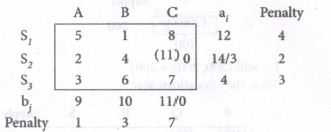
[∵ the highest penalty is 7, In C, least cost is 0 & min (11, 14) = 11]
II - allocation :
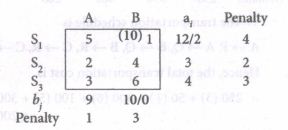
[∵ the highest penalty is 4, In S1'least cost is 1& min (10, 12) = 10]
III - allocation :
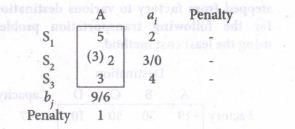
[∵ In A, least cost is 2 & min (9, 3) = 3]
IV - allocation :
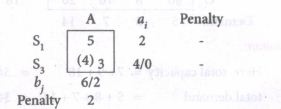
[∵ In A, least cost is 3 & min (6,4) = 4]
V - allocation :
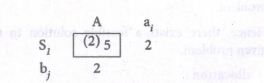
[∵ min (2, 2) = 2]
Thus, the allocations are
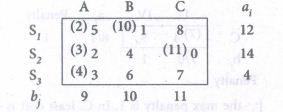
∴ The transportation schedule is
S1 → A, S1 → B, S2 → A, S2 → C S3 → A
Hence, the total transportation cost is
= 2(5) + 10(1) + 3(2) + 11(0) + 4(3)
= 10 + 10 + 6 + 0 + 12 = Rs. 38
7.
Given
f' (x) = 3x2 - \(\frac { 2 }{ { x }^{ 3 } } \)
We know f(x) = ∫ f'(x) dx
= \(\int { \left( { 3x }^{ 2 }-\frac { 2 }{ { x }^{ 3 } } \right) } \)
\(f\left( x \right) =3\left( \frac { { x }^{ 3 } }{ 3 } \right) -2\left( \frac { { -x }^{ -2 } }{ -2 } \right) +c\)
\(f\left( x \right) ={ x }^{ 3 }+\frac { 1 }{ { x }^{ 2 } } +c....(1)\)
Also, f(1) = 0
\(0={ 1 }^{ 3 }+\frac { 1 }{ { 1 }^{ 2 } } +c\)
= 1 + 1 + c
c = -2
\(\therefore f\left( x \right) ={ x }^{ 3 }+\frac { 1 }{ { x }^{ 2 } } -2\)
8.
Given slope = y + 2x
⇒ \(\frac { dy }{ dx } \) = y+2x
⇒ \(\frac { dy }{ dx } \)- y = 2x
This is of the form \(\frac { dy }{ dx } \)+ Py = Q where P = -1, Q = 2x
\(\\ \int { P } dx=\int { -1 } dx\) = -x
∴ I.F. = \(e^{ \int { P } dx }\) = e-x
∴ The solution is y.\(e^{ \int { P } dx }=\int { Q } .e^{ \int { P } dx }\)dx+C
⇒ y.e-x = \(\int { 2x } \).e-xdx+C
Let u = x; dv = e-x
u2 = 1; v = -e-x
v1 = e-x
⇒ ye-x = 2[-xe-x-1(e-x)]+C
[Bernoulli's formula]
⇒ ye-x = -2x e-x -2e-x+ C...(1)
Since the Curve passes through (0, 0), we get
⇒ 0 = 0-2e0 + C ⇒ C = 2
(1) becomes,
∴ ye-x = -2xe-x - 2e-x + 2
ye-x = -2xe-x - 2e-x + 2ex.e-x
= e-x(2 ex-2x-2)
ye-x = 2e-x(ex-x-1)
9.
Given \(\frac { { x }^{ 2 } }{ { a }^{ 2 } } +\frac { { y }^{ 2 } }{ { b }^{ 2 } } \)= 1
⇒ \(\frac { { b }^{ 2 }x^{ 2 }+{ a }^{ 2 }{ y }^{ 2 } }{ { a }^{ 2 }{ y }^{ 2 } } \)= 1
⇒ b2x2+a2y2 = a2b2
Differentiating again w.r.t 'x' we get,
2b2x + 2a2y\(\frac { dy }{ dx } \)=0 ⇒ b2x+a2yy1 = 0 ....(2)
Differentiating w.r.t 'x' we get,
b2 + a2[yy2 + y1y1] = 0
⇒ b2 + a2[yy2 + y12] = 0 ...(3)
Eliminating a2 and b2 from (1) and (3) we get
\(\left| \begin{matrix} x & y{ y }_{ 1 } \\ 1 & { y }_{ 1 }^{ 2 }+y{ y }_{ 2 } \end{matrix} \right| \) = 0
⇒ x(y12+yy2) - yy1 = 0
⇒ x\(\left( \left( \frac { dy }{ dx } \right) ^{ 2 }+y.\frac { d^{ 2 }y }{ { dx }^{ 2 } } \right) -y\left( \frac { dy }{ dx } \right) \)= 0 which is the required differential equation.
10.
Let us calculate the number of men whose wages is less than Rs. 35 by using Newton's forward interpolation formula
xo + nh = x ⇒ 30 + n (10) = 35
⇒ 10n = 35 - 30 = 5
⇒ n = \(\frac{5}{10}\) = 0.5
The difference table is
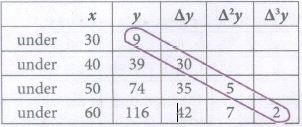
\(\Rightarrow { y }_{ o }+\frac { n }{ n! } \triangle { y }_{ o }+\frac { n(n+1) }{ 2! } { \triangle }^{ 2 }{ y }_{ o }+\frac { n(n+1)(n-2) }{ 3! } { \triangle }^{ 3 }{ (y }_{ o })\)
\(y(35)=9+\frac { 0.5 }{ 1! } (30)+\frac { (0.5)(0.5-1) }{ 2 } (5)+\frac { (0.5)(0.5-1)(0.5-2) }{ 6 } (2)\)
= 9 + 15 - 0.6 + 0.1 = 24 (approximately)
∴ Number of men getting wages between Rs. 30 and Rs. 35 is y(35) - y(30) = 24 - 9 = 15.
11.
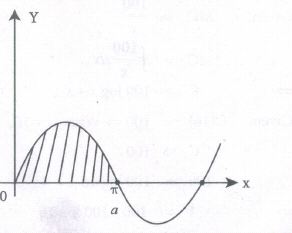
The limits for one arch of the curve y = sin ax When y = 0 ⇒Sin ax = 0
⇒ sin ax = sin 0, sin \(\pi\)
⇒ ax = 0 or ax = \(\pi\)
⇒ x = 0, x = \(\frac{\pi}{a}\)
∴ The limits are from x = 0 to x = \(\frac{\pi}{a}\)
∴ Area =\(\int _{ a }^{ b }{ ydx } \)
\(=\int _{ 0 }^{ a }{ sin\quad ax\quad dx } \)
\(={ \left[ -\frac { cos\quad ax }{ a } \right] }_{ 0 }^{ \frac { \pi }{ a } }\)
\(=-\frac { 1 }{ a } \left[ cos\quad a\times \frac { \pi }{ a } -cos(a)(0) \right] \)
\(=-\frac { 1 }{ a } \left[ cos\quad \pi -cos0 \right] \)
\(=-\frac { 1 }{ a } (-1-1)[\because cos0=1\ cos\pi =-1]\)
\(A=\frac { 2 }{ a } \) sq.units.
12.
Given non-homogeneous equations are
x + 2y = 3,y - z = 2,x + Y + z = 1
| Augmented matrix [A, B] |
Elementary Transformation |
|---|---|
| \(\left( \begin{matrix} 1 & 2 & 0 \\ 0 & 1 & -1 \\ 1 & 1 & 1 \end{matrix}\begin{matrix} 3 \\ 2 \\ 1 \end{matrix} \right) \) | |
| \(\sim \left( \begin{matrix} 1 & 2 & 0 \\ 0 & 1 & -1 \\ 0 & -1 & 1 \end{matrix}\begin{matrix} 3 \\ 2 \\ -2 \end{matrix} \right) \) | \({ R }_{ 3 }\rightarrow { R }_{ 3 }+{ R }_{ 2 }\) |
| \(\sim \left( \begin{matrix} 1 & 2 & 0 \\ 0 & 1 & -1 \\ 0 & 0 & 0 \end{matrix}\begin{matrix} 3 \\ 2 \\ 0 \end{matrix} \right) \) | \({ R }_{ 3 }\rightarrow { R }_{ 3 }+{ R }_{ 2 }\) |
Obviously,\(\rho (A)=2\) and \(\rho (A,B)\)
Hence \(\rho (A)=2\quad \rho\) (A, B) = 2
\(\therefore\) The system is consistent and has infinite number of solutions.

12th Standard Syllabus & Materials
12th Standard
TN 12th Computer Applications களப்பெயர் முறைமை (DNS) Sample Question Papers Study Material - QB365 Set A
NEW12th Standard
TN 12th Computer Applications வலையமைப்பு எடுத்துக்காட்டுகள் மற்றும் நெறிமுறைகள் Sample Question Papers Study Material - QB365 Set A
NEW12th Standard
TN 12th Computer Applications கணினி வலையமைப்பு ஓர் அறிமுகம் Sample Question Papers Study Material - QB365 Set A
NEW12th Standard
TN 12th Computer Applications PHP-உடன் MySQL-ஐ இணைத்தல் Sample Question Papers Study Material - QB365 Set A



Tamilnadu Stateboard 12th Standard Subjects

Maths

Chemistry

Physics

Biology

Computer Science
Business Maths and Statistics

Economics

Commerce

Accountancy

History

Computer Applications
Biology
Computer Technology
Computer Applications
Computer Science
Business Maths and Statistics
Commerce
Economics
Maths
Chemistry
Physics
Computer Technology
History
Accountancy

Tamil

English

French
Tamilnadu Stateboard Standards
