
 100% FREE ACCESS
12th Standard Syllabus & Materials
12th Standard
TN 12th Computer Applications மின்னணு தரவு பரிமாற்றம் Sample Question Papers Study Material - QB365 Set A
NEW12th Standard
TN 12th Computer Applications மின் - வணிக பாதுகாப்பு அமைப்புகள் Sample Question Papers Study Material - QB365 Set A
NEW12th Standard
TN 12th Computer Applications மின்னணு செலுத்தல் முறைகள் Sample Question Papers Study Material - QB365 Set A
NEW12th Standard
TN 12th Computer Applications மின் - வணிகம் Sample Question Papers Study Material - QB365 Set A
NEW12th Standard
TN 12th Computer Applications திறந்த மூல கருத்துருக்கள் Sample Question Papers Study Material - QB365 Set A
NEW12th Standard
TN 12th Computer Applications வலையமைப்பு வடமிடல் Sample Question Papers Study Material - QB365 Set A

Published on: 31/12/2022
QB365 provides a detailed and simple solution for every Possible Questions in Class 12 Business Maths Subject - Important 3 Mark English Medium. It will help Students to get more practice questions, Students can Practice these question papers in addition to score best marks.
Download Tamil Nadu 12th Standard Business Maths and Statistics question papers, model tests, one-mark questions, important questions, and public exam papers in PDF format. Free study materials and answer keys for TN State Board students.
Questions + Answers key
Take MCQ Business Maths and Statistics Test
1.
A random sample of 500 apples was taken from large consignment and 45 of them were found to be bad. Find the limits at which the bad apples lie at 99% confidence interval.
2.
The average percentage of failure in a certain examination is 40. What is the probàbility that out of a group of 6 candidates atleast 4 passed in the examination?
3.
Given the p.d.f of a continuous random variable X as follows \(f(x)= \begin{cases}k x(1-x) & \text { for } 0<x<1 \\ 0 & \text { otherwise }\end{cases}\). Find k and c.d.f.
4.
Solve: \(\left(x^{2}-y x^{2}\right) d y+\left(y^{2}+x^{2} y^{2}\right) d x=0\)
5.
The supply for a commodity is \(\mathrm{p}=x^{2}+4 x+5\), where x denotes supply. Find the producer's surplus when price is 10.
6.
\(\int x^{3} \sin \left(x^{4}\right) d x\)
7.
Compute Fisher's price index number for the following data.
| Commodity | Base Year | Current Year | ||
| Price | Quantity | Price | Quantity | |
| A | 10 | 12 | 12 | 15 |
| B | 7 | 15 | 5 | 20 |
| C | 5 | 24 | 9 | 20 |
| D | 16 | 5 | 14 | 5 |
8.
If a random variable. X has the probability distribution
| X | 0 | 1 | 2 | 3 | 4 | 5 |
| P(X=x) | a | 2a | 3a | 4a | 5a | 6a |
then find F(4)
9.
Using Lagrange's formula, find the value of y when x = 42 from the following table
| x | 40 | 50 | 60 | 70 |
| y | 31 | 73 | 124 | 159 |
10.
If \(\left[ \begin{matrix} 1 & 0 & 0 \\ 0 & 0 & 1 \\ 0 & 1 & 0 \end{matrix} \right] \left[ \begin{matrix} x \\ y \\ z \end{matrix} \right] =\left[ \begin{matrix} 2 \\ -1 \\ 3 \end{matrix} \right] \) find x,y and z
11.
Solve: \(\frac { 1+{ x }^{ 2 } }{ 1+y } =xy\frac { dy }{ dx } \)
12.
The following data relates to indirect labour expenses and the level of output
| Months | Jan | Feb | Mar | Apr | May | June |
| Units of output | 200 | 300 | 400 | 640 | 540 | 580 |
| Indirect labour expenses (Rs) | 2500 | 2800 | 3100 | 3820 | 3220 | 3640 |
Estimate the expenses at a level of output of 350 units, by using graphic method
13.
14.
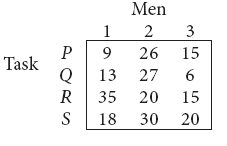
Solve the following assignment problem.
15.
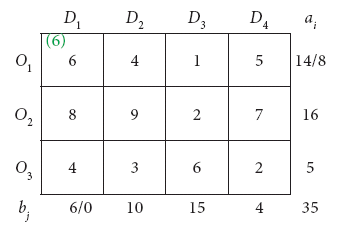
Determine an initial basic feasible solution to the following transportation problem using North West corner rule.
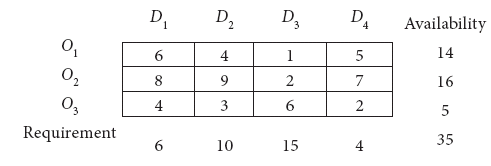
Here Oi and Dj represent ith origin and jth destination.
16.
Construct the cost of living Index number for 2015 on the basis of 2012 from the following data using family budget method.
| Commodity | Price | Weight | |
| 2012 | 2015 | ||
| Rice | 250 | 280 | 10 |
| Wheat | 70 | 280 | 5 |
| Corn | 150 | 170 | 6 |
| Oil | 25 | 35 | 4 |
| Dhal | 85 | 90 | 3 |
17.
State the different methods of measuring trend.
18.
Solve \(y d x-x d y-3 x^{2} y^{2} e^{x^{3}} d x=0\)
19.
Explain the procedures of testing of hypothesis
20.
Explain in detail about sampling error.
21.
The mortality rate for a certain disease is 7 in 1000. What is the probability for just 2 deaths on account of this disease in a group of 400? [Given e(–2.8) = 0.06]
22.
When counting red blood cells, a square grid is used, over which a drop of blood is evenly distributed. Under the microscope an average of 8 erythrocytes are observed per single square. What is the probability that exactly 5 erythrocytes are found in one square?
23.
For the marginal revenue function MR = 6 − 3x2 − x3, Find the revenue function and demand function.
24.
If f (x) is defined by f(x)=ke-2x, 0\(\le\)x<\(\infty\) is a density function. Determine the constant k and also find mean.
25.
The cost of over haul of an engine is Rs. 10,000 The operating cost per hour is at the rate of 2x − 240 where the engine has run x km. Find out the total cost if the engine run for 300 hours after overhaul.
26.
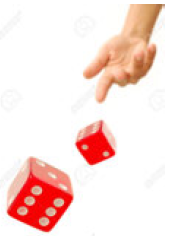
Two unbiased dice are thrown simultaneously and sum of the upturned faces considered as random variable. Construct a probability mass function.
27.
Evaluate \(\int { \left( { x }^{ 2 }-2x+5 \right) } { e }^{ -x }dx\)
28.
Evaluate \(\int { \frac { 7x-1 }{ { x }^{ 2 }-5x+6 } dx } \)
29.
At marina two types of games viz., Horse riding and Quad Bikes riding are available on hourly rent. Keren and Benita spent Rs. 780 and Rs. 560 during the month of May.
| Name | Number of hours | Total amount spent (in Rs) |
|
| Horse Riding | Quad Bike Riding | ||
| Keren | 3 | 4 | 780 |
| Benita | 2 | 3 | 560 |
Find the hourly charges for the two games (rides). (Use determinant method).
30.
If A=\(\left( \begin{matrix} 1 & 1 & -1 \\ 2 & -3 & 4 \\ 3 & -2 & 3 \end{matrix} \right) \) and B=\(\left( \begin{matrix} 1 & -2 & 3 \\ -2 & 4 & -6 \\ 5 & 1 & -1 \end{matrix} \right) \), then find the rank of AB and the rank of BA.
1.
n = 500
P = proportion of bad apples
\(=\frac{45}{500}=0.09\)
q = 1 - p = 1 - 0.09 = 0.91
Confidence limits for the population p of bad apples are given by
\(=p \pm Z_{c} \sqrt{\frac{p q}{n}}\)
\(=0.09 \pm(2.58) \sqrt{\frac{(0.09)(0.91)}{500}}\)
\(=0.09 \pm 0.033\)
Required interval is (0.057, 0.123) Thus the bad apples in the consignment lie between 5.7% and 12.3%
2.
Let X be the random variable denoting the number of student who passes.
\(
\mathrm{p}=\frac{60}{100}=\frac{3}{5}, \mathrm{q}=\frac{40}{100}=\frac{2}{5}
\)
\(\mathrm{n}=6, \mathrm{P}(\mathrm{X}=\mathrm{x})=n C_{x} p^{x} q^{n-x}
\)
\(\mathrm{P}^{\prime}(\mathrm{X} \geq 4)=\mathrm{P}(\mathrm{X}=4)+\mathrm{P}(\mathrm{X}=5)+\mathrm{P}(\mathrm{X}=6)\)
\(
=6 C_{4}\left(\frac{3}{5}\right)^{4}\left(\frac{2}{5}\right)^{2}+6 C_{1}\left(\frac{3}{5}\right)^{4}\left(\frac{2}{5}\right)+\left(\frac{3}{5}\right)^{6} \)
\(=15 \frac{(81 \times 4)}{5^{6}}+\frac{(6)(243)(2)}{5^{6}}+\frac{729}{5^{6}}
\)
\( =\frac{8505}{15625}\)
3.
\(\because\) if is a p.d.f
\(
\int_{-\infty}^{x} f(x) d x =1
\)
\(k \int_{0}^{1} x(1-x) d x =1
\)
\(k \int_{0}^{1}\left(x-x^{2}\right) d x =1
\)
\(k\left[\frac{x^{2}}{2}-\frac{x^{3}}{3}\right]_{0}^{1} =1
\)
\(k\left(\frac{1}{2}-\frac{1}{3}\right) =1
\)
\(k\left(\frac{1}{6}\right)=1 \Rightarrow k=6\)
Cumulative distribution function
\(
\mathrm{F}(x) =0 \text { for } x \geq 0
\)
\(\mathrm{F}(x) =\mathrm{P}(\mathrm{X} \leq x)=\int_{-1}^{1} f(x) d x
\)
\( =\int_{0}^{x} 6 x(1-x) d x
\)
\(\int_{0}^{x}\left(6 x-6 x^{2}\right) d x =\left[\frac{6 x^{2}}{2}-\frac{6 x^{3}}{3}\right]_{0}^{x}=3 x^{2}-2 x^{3}
\)
\(\therefore \mathrm{F}(x) =0 \text { for } x<0
\)
\( =3 x^{2}-2 x^{3} \text { for } 0<x<1 \)
\( =1 \text { for } x \geq 1
\)
4.
\(
\left(x^{2}-\mathrm{y} x^{2}\right) \mathrm{dy} =-\left(\mathrm{y}^{2}+x^{2} \mathrm{y}^{2}\right) \mathrm{d} x
\)
\(x^{2}(1-\mathrm{y}) \mathrm{dy} =-\mathrm{y}^{2}\left(1+x^{2}\right) \mathrm{d} x
\)
\(\int \frac{1-y}{y^{2}} d y =-\int \frac{\left(1+x^{2}\right)}{x^{2}} d x
\)
\(\int \frac{d y}{y^{2}}-\int \frac{y d y}{y^{2}} =-\int x^{-2} d x-\int d x
\)
\(\int y^{-2} d y-\int \frac{d y}{y} =-\int x^{-2} d x-\int d x
\)
\(\frac{y^{-1}}{-1}-\log |y| =\frac{x^{-1}}{1}-x+c
\)
\(\log |y|+\frac{1}{y}+\frac{1}{x}-x =\mathrm{c}
\)
5.
\(
\mathrm{p} =x^{2}+4 x+5
\)
\(\mathrm{p} =10
\)
\(x^{2}+4 x+5 =10
\)
\(x^{2}+4 x-5 =0
\)
\((x+5)(x-1) =0 \Rightarrow x=1
\)
\(
\mathrm{PS} =p_{0} x_{0}-\int_{0}^{x_{1}} g(x) d x
\)
\( =36-\int_{0}^{3}\left(3+x^{2}\right) d x=36-\left[3 x+\frac{x^{3}}{3}\right]_{0}^{3}
\)
\(=36-[9+9]=36-18=18 \text { units }\)
6.
\(
\mathrm{t} =x^{4}, \mathrm{dt}=4 x^{3} \mathrm{~d} x
\)
\(\frac{d t}{4} =x^{3} \mathrm{~d} x
\)
\(\frac{1}{4} \int \sin t d t =\frac{-1}{4} \cos t+c
\)
\( =-\frac{1}{4} \cos \left(\mathrm{x}^{4}\right)+c
\)
7.
| Commodity | Base Year | Current Year | ||
| p0 | q0 | p1 | q1 | |
| A | 10 | 12 | 12 | 15 |
| B | 7 | 15 | 5 | 20 |
| C | 5 | 24 | 9 | 20 |
| D | 16 | 5 | 14 | 5 |
| p1q0 | p0q0 | p1q1 | p0q1 |
| 144 | 120 | 180 | 150 |
| 75 | 105 | 100 | 140 |
| 216 | 120 | 180 | 100 |
| 70 | 80 | 70 | 80 |
| 505 | 425 | 530 | 470 |
Fisher's ideal index = \(\sqrt \frac {\sum p_{1}q_{0}\times \sum p_{1}q_{1}}{\sum p_{0}q_{0}\times \sum p_{0}q_{1}} \times 100\)
= \(\sqrt{\frac{505}{425} \times \frac {430}{470}} \times 100\)
\(P^{F}_{01}\) = 115.75
8.
Since the random variable X is the probability distribution function, Σpi = 1
∴ a + 2a + 3a + 4a + 5a + 6a = 1
21a = 1 ⇒ a = \(\frac{1}{21}\)
Now, F(4) = P(X ≤ 4)
= P(X = 0) + P(X = 1) + P(X = 2)P(X = 3) + P(X = 4)
= a + 2a + 3a + 4a + 5a = 15a
= 15\((\frac{1}{21})=\frac{5}{7}\)
∴ F(4) = \(\frac{5}{7}\)
9.
By data, we have
xo = 40, x1 = 50, x2 = 60, x3 = 70
yo = 31, y1 = 73, y2 = 124, y3 = 159.
Using Lagrange's formula, we get
\(y={ y }_{ 0 }\frac { (x-{ x }_{ 1 })(x-{ x }_{ 2 })(x-{ x }_{ 3 }) }{ ({ x }_{ 0 }-{ x }_{ 1 })({ x }_{ 0 }-{ x }_{ 2 })({ x }_{ 0 }-{ x }_{ 3 }) } +{ y }_{ 1 }\frac { (x-{ x }_{ 0 })(x-{ x }_{ 2 })(x-{ x }_{ 3 }) }{ ({ x }_{ 1 }-{ x }_{ 0 })({ x }_{ 1 }-{ x }_{ 2 })({ x }_{ 1 }-{ x }_{ 3 }) } { y }_{ 2 }+\frac { (x-{ x }_{ 0 })(x-{ x }_{ 1 })(x-{ x }_{ 3 }) }{ ({ x }_{ 2 }-{ x }_{ 0 })({ x }_{ 2 }-{ x }_{ 1 })({ x }_{ 2 }-{ x }_{ 3 }) } +{ y }_{ 3 }\frac { (x-{ x }_{ 0 })(x-{ x }_{ 1 })(x-{ x }_{ 3 }) }{ ({ x }_{ 3 }-{ x }_{ 0 })({ x }_{ 3 }-{ x }_{ 1 })({ x }_{ 3 }-{ x }_{ 2 }) } \)
∴ y(42) = 31\(\frac { (-8)(-18)(-28) }{ (-10)(-20)(-30) } +73\frac { (2)(-18)(-28) }{ (10)(-10)(-20) } +124\frac { (2)(-8)(-28) }{ (20)(10)(-10) } +59\frac { (2)(-8)(-28) }{ (30)(20)(10) } \)
= 20. 832 + 36. 792 - 27. 776 + 7.632
y = 37. 48
10.
\(\left[ \begin{matrix} 1 & 0 & 0 \\ 0 & 0 & 1 \\ 0 & 1 & 0 \end{matrix} \right] \left[ \begin{matrix} x \\ y \\ z \end{matrix} \right] =\left[ \begin{matrix} 2 \\ -1 \\ 3 \end{matrix} \right] \)
\(\Rightarrow \left( \begin{matrix} x0+0 \\ 0+0+z \\ 0+y+0 \end{matrix} \right) =\left( \begin{matrix} 2 \\ -1 \\ 3 \end{matrix} \right) \)
\(\Rightarrow \left( \begin{matrix} x \\ y \\ z \end{matrix} \right) =\left( \begin{matrix} 2 \\ -1 \\ 3 \end{matrix} \right) \)
\(\Rightarrow x=2\quad z=-1\quad y=3\)
\(\therefore\) Solution set is {2,3, -1}
11.
Given \(\frac { a+{ x }^{ 2 } }{ 1+y } =xy\frac { dy }{ dx } \)
Separating the variables we get,
\(\frac { (1+{ x }^{ 2 })dx }{ x } \) = y(1+y)dy
⇒ \(\left( \frac { 1 }{ x } +\frac { { x }^{ 2 } }{ x } \right) \)dx = (y+y2)dy
⇒ \(\left( \frac { 1 }{ x } +x \right) \) = (y+y2)dy
Integrating both sides we get,
\(\int { \left( \frac { 1 }{ x } +x \right) dx } =\int { (y+y^{ 2 })dy } \)
⇒ logx + \(\frac { { x }^{ 2 } }{ 2 } =\frac { { y }^{ 2 } }{ 2 } +\frac { y^{ 3 } }{ 3 } \) + C.
12.
Scale:
In x-axis 1 cm = 100 units
In y-axis 1 cm = 1000 units
Plot the points (200, 2500), (300, 2800) (400, 3100) (640; 3820), (540,3220) and (580, 3640).
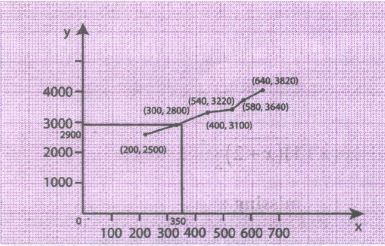
At x = 350, draw a vertical line and from the intersecting point on the curve, draw a horizontal line.
From the graph, we find that when x = 350, y = 2900.
Hence, the expense at a level of 350 units is Rs. 2900
13.
14.
Since the number of columns is less than the number of rows, given assignment problem is unbalanced one. To balance it , introduce a dummy column with all the entries zero. The revised assignment problem is
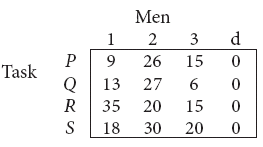
Here only 3 tasks can be assigned to 3 men.
Step 1: Its not necessary, since each row contains zero entry. Go to Step 2.
Step 2:
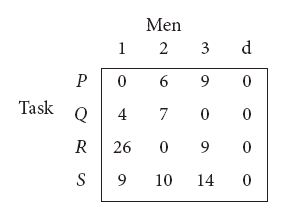
Step 3 (Assignment) :
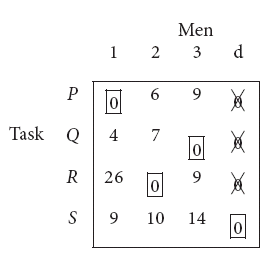
Since each row and each columncontains exactly one assignment,all the three men have been assigned a task. But task S is not assigned to any Man. The optimal assignment schedule and total cost is
| Task | Men | cost |
| P | 1 | 9 |
| Q | 3 | 6 |
| R | 2 | 20 |
| s | d | 0 |
| Total cost | 35 | |
The optimal assignment (minimum) cost = Rs. 35
15.
Given transportation table is
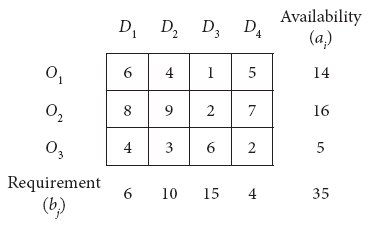
Total Availability = Total Requirement
Therefore the given problem is balanced transportation problem.
Hence there exists a feasible solution to the given problem.
First allocation :
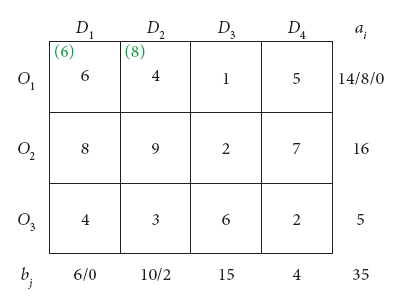
Second allocation :
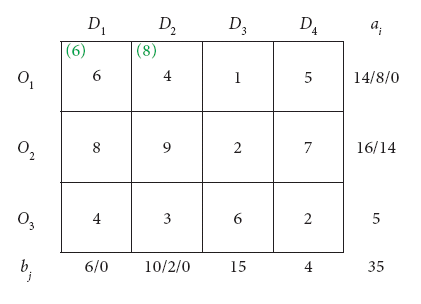
Third Allocation :
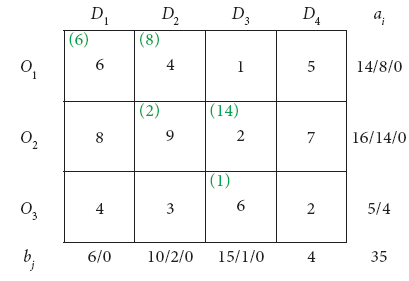
Fourth Allocation :
Fifth allocation :
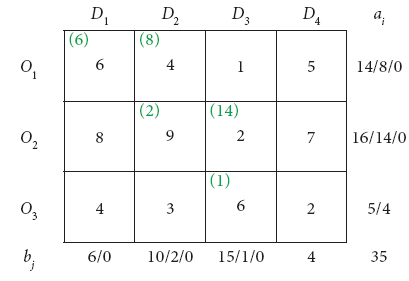
Final allocation :
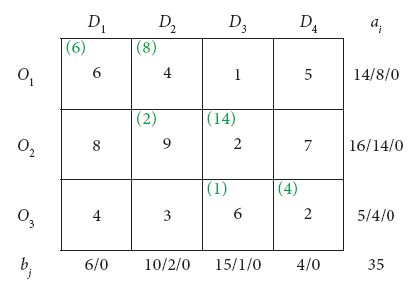
Transportation schedule : O1⟶D1, O1⟶D2, O2⟶D2, O2⟶D3, O3⟶D3,O3⟶D3.
The transportation cost
= (6\(\times\)6)+(8\(\times\)4)+(2\(\times\)9)+(14\(\times\)2)+(1\(\times\)6)+(4\(\times\)2)
= Rs.128
16.
| Commodity | Price | P = \(\frac {p_{1}}{p_{0}}\) \(\times 100\) | V | [PV | |
| 2012 (p0) | 2015 (p0) | ||||
| Rice | 250 | 280 | 112 | 10 | 1120 |
| Wheat | 70 | 85 | 121.42 | 5 | 607.1 |
| Corn | 150 | 170 | 113.33 | 6 | 679.98 |
| Oil | 25 | 35 | 140 | 4 | 560 |
| Dhal | 85 | 90 | 105.88 | 3 | 317.64 |
| 28 | 3284.72 | ||||
Using family budget method,
C.L.I = \(\frac {\sum PV}{\sum V}\) = \(\frac {3284.72}{28}\) = 117.31
17.
The different methods of measurements of trends are
(i) Free hand or graphic method
(ii) Method of semi averages
(iii) Method of moving averages
(iv) Method of least squares
18.
Given equation can be written as \(\frac { ydx-xdy }{ { y }^{ 2 } } -{ 3x }^{ 2 }{ e }^{ { x }^{ 2 } }dx=0\)
Integrating, ഽ\(\frac { ydx-xdy }{ { y }^{ 2 } } \) - ഽ3x2ex3 dx = c
ഽ\(d\left( \frac { x }{ y } \right) \) - ഽetdt = c
(where t = x3 and dt = 3x2dx )
\(\frac { x }{ y } \) - et = c
\(\frac { x }{ y } \) - \({ e }^{ { x }^{ 2 } }\) = c
19.
Hypothesis testing is also referred as "Statistical Decision Making".
There are two types of statistical hypothesis
(i) Null hypothesis: which is tested for possible rejection under the assumption that it is true
(ii) Alternative hypothesis which is complementary to the null hypothesis
For example: Ho:μ=μ0
i) H1:μ≠μ0 is know as two tailed alternative test
ii) H1:μ>μ0 and H1:μ<μ0 are known as one tailed alternative
iii) H1:μ>μ0 is said to be right tailed test where the critical region lies entirely on the right tail of the normal curve.
iv) H1:μ<μ0 is said to the left tailed test where the critical region lies entirely on the left tail of the normal curve.
20.
Errors, which arise in the normal course of investigation or enumeration on account of chance, are called sampling errors. Sampling Errors arise due to the following reasons:
a) Faulty selection of the sample instead of correct sample by defective sampling technique.
b) The investigator substitutes a convenient sample if the original sample is not available while investigation.
c) In area surveys, while dealing with border lines it depends upon the investigator whether to include them in the sample or not. This is known as Faulty demarcation of sampling units.
21.
Let X be probability of mortality rate for a certain disease
∴ p = \(\frac { 7 }{ 1000 } \) and n = 400

Hence X follows poisson distribution with p(x, λ)
= \(\frac { e^{ -\lambda }.{ \lambda }^{ x } }{ x! } \)
∴ P (just 2 deaths) = P(X = 2)
= \(\frac { e^{ -2.8 }(2.8)^{ 2 } }{ 2! } \) [∵ p(x,λ) =\(\frac { e^{ -\lambda }.{ \lambda }^{ x } }{ x! } \), λ = 2.8, x = 2]
= \(\frac { (0.06)(2.8)^{ 2 } }{ 2 } \) = (0.03)(2.8)2 = 0.2352
∴ Probability for just 2 deaths on account of this disease = 0.2352.
22.
Let X be a random variable follows poisson distribution with number of erythrocytes.
Hence, Mean λ = 8 erythrocytes/single square
P(exactly 5 erythrocytes are in one square) = P(X = 5)=\(\\ \frac { { e }^{ -\lambda }{ \lambda }^{ x } }{ x! } =\frac { { e }^{ -8 }{ 8 }^{ 5 } }{ 5! } \)
\(=\frac { 0.000335\times 32768 }{ 120 } \)
= 0.0916
The probability that exactly 5 erythrocytes are found in one square is 0.0916. i.e there are 9.16% chances that exactly 5 erythrocytes are found in one square.
23.
Given MR = 6 − 3x2 − x3
⇒ ഽMR =ഽ(6 − 3x2 − x3)dx
\(\Rightarrow \mathrm{R}=6 x-\frac{\not{3} x^{3}}{\not3}-\frac{x^{4}}{4}+k\)
\(\Rightarrow 6x-{ x }^{ 3 }-\frac { { x }^{ 4 } }{ 4 } +k\)
When x = 0, R = 0 ⇒ k = 0
\(\Rightarrow R=6x-{ x }^{ 3 }-\frac { { x }^{ 4 } }{ 4 } \)
Demand function \(P=\frac { R }{ x } =6-{ x }^{ 2 }-\frac { { x }^{ 3 } }{ 4 } \)
24.
We know that
\(\int _{ -\infty }^{ \infty }{ f(x)dx=1 } \),since f(x) is a density function
\(\int _{ 0 }^{ \infty }{ { ke }^{ -2x } } dx=1\)
\(k\int _{ 0 }^{ \infty }{ { ke }^{ -2x } } dx=1\)
\(k{ \left[ \frac { { e }^{ -2x } }{ -2 } \right] }_{ 0 }^{ \infty }=1\)
⇒ k = 2
\(E(X)=\int _{ -\infty }^{ \infty }{ xf(x)dx } \)
\(=\int _{ 0 }^{ \infty }{ x{ e }^{ -2x } } dx\)
\(=2\int _{ 0 }^{ \infty }{ { xe }^{ -2x }dx } \)
\(=2\left\{ { \left[ \frac { { xe }^{ -2x } }{ -2 } \right] }_{ 0 }^{ \infty }\int _{ 0 }^{ \infty }{ \frac { { e }^{ -2x } }{ -2 } dx } \right\} \)
\((\because \int { udv=uv-\int { udv } } )\)
\(=\int _{ 0 }^{ \infty }{ { e }^{ -2x }dx } \) \(=\frac { 1 }{ 2 } \)
25.
Given cost of overhaul of an engine is Rs. 10,000
Operating cost per hour = 2x - 240.
Total cost for the engine to run for 300 hours
after overhaul =10,000+\(\int _{ 0 }^{ 300 }{ (2x-240) } dx\)
\(=10,000+{ \left[ \frac { { 2x }^{ 2 } }{ 2 } -240x \right] }_{ 0 }^{ 300 }\)
\(=10,000+{ [{ x }^{ 2 }-240x] }_{ 0 }^{ 300 }\)
= 10,000 + 90,000 - 72,000
= 1,00,000 - 72,000
= Rs. 28,000
26.
Sample space \((s)=\left\{ \begin{matrix} (1,1) & (1,2) & (1,3) \\ (2,1) & (2,2) & (2,3) \\ \begin{matrix} (3,1) \\ (4,1) \\ \begin{matrix} (5,1) \\ (6,1) \end{matrix} \end{matrix} & \begin{matrix} (3,2) \\ (4,2) \\ \begin{matrix} (5,2) \\ (6,2) \end{matrix} \end{matrix} & \begin{matrix} (3,3) \\ (4,3) \\ \begin{matrix} (5,3) \\ (6,3) \end{matrix} \end{matrix} \end{matrix}\begin{matrix} (1,4) & (1,5) & (1,6) \\ (2,4) & (2,5) & (2,6) \\ \begin{matrix} (3,4) \\ (4,4) \\ \begin{matrix} (5,4) \\ (6,4) \end{matrix} \end{matrix} & \begin{matrix} (3,5) \\ (4,5) \\ \begin{matrix} (5,5) \\ (6,5) \end{matrix} \end{matrix} & \begin{matrix} (3,6) \\ (4,6) \\ \begin{matrix} (5,6) \\ (6,6) \end{matrix} \end{matrix} \end{matrix} \right\} \)
Total outcomes : n(S) = 36
27.
\(\int { \left( { x }^{ 2 }-2x+5 \right) } { e }^{ -x }dx =\int { udv } \)
= uv − u'v1 + u''v2 − u'''v3 + ...
= (x2 − 2x + 5)(−e−x )− (2x − 2)e−x + 2(−e−x )+ c
= e−x (−x2 −5)+ c
| Successive derivatives | Repeated integrals |
|
Take u = x2 − 2x + 5 |
and dv = e−xdx v = − e−x v1 = e-x v2 = e-x |
28.
\(\int { \frac { 7x-1 }{ { x }^{ 2 }-5x+6 } dx } =\int { \left[ \frac { 20 }{ x-3 } -\frac { 13 }{ x-2 } \right] dx } \)
\(=20\int { \frac { dx }{ x-3 } -13\int { \frac { dx }{ x-2 } } } \)
\(20log\left| x-3 \right| -13 \log\left| x-2 \right| +c\)
[ By partial fractions,
\(\frac { 7x-1 }{ { x }^{ 2 }-5x+6 } =\frac { A }{ x-3 } +\frac { B }{ x-2 } \Rightarrow \frac { 7x-1 }{ { x }^{ 2 }-5x+6 } =\frac { 20 }{ x-3 } -\frac { 13 }{ x-2 } \)]
29.
Let the hourly charge for horse riding be Rs. x and the hourly charge for quad bike be Rs. y from the given data,
3x + 4y = 780
2x+ 3y = 560
\(\Delta =\left| \begin{matrix} 3 & 4 \\ 2 & 3 \end{matrix} \right| =3(3)-2(4)=9-8=1\neq 0\)
Since \(\Delta \neq 0\) the system is consistent with unique solution and Cramer's rule can be applied
\(\Delta x=\left| \begin{matrix} 780 & 4 \\ 560 & 3 \end{matrix} \right| =780(30-4(560)\)
= 2340 - 2240 = 100
\(\Delta y=\left| \begin{matrix} 3 & 780 \\ 2 & 560 \end{matrix} \right| =39560)-2(780)\)
= \(1680 - 1560\) = 120
\(\therefore x=\cfrac { \Delta x }{ \Delta } =\cfrac { 100 }{ 1 } =100\)
\(y=\cfrac { \Delta y }{ \Delta } =\cfrac { 120 }{ 1 } =120\)
\(\therefore\) Hourly charges for the two rides are Rs. 100 and Rs. 120 respectively.
30.
Given
A = \(\left( \begin{matrix} 1 & 1 & -1 \\ 2 & -3 & 4 \\ 3 & -2 & 3 \end{matrix} \right) \) and B = \(\left( \begin{matrix} 1 & -2 & 3 \\ -2 & 4 & -6 \\ 5 & 1 & -1 \end{matrix} \right) \)
\(AB=\left( \begin{matrix} 1 & 1 & -1 \\ 2 & -3 & 4 \\ 3 & -2 & 3 \end{matrix} \right) \left( \begin{matrix} 1 & -2 & 3 \\ -2 & 4 & -6 \\ 5 & 1 & -1 \end{matrix} \right) \)
= \(\left( \begin{matrix} 1-2+5 & -2+4-1 & 3-6+1 \\ 2+6+20 & -4-12+45 & 6+18-4 \\ 3+4+15 & -6-8+3 & 9+12-3 \end{matrix} \right) \)
= \(\left( \begin{matrix} -6 & 1 & -2 \\ 28 & -12 & 20 \\ 22 & -11 & 18 \end{matrix} \right) =\left( \begin{matrix} -6 & 1 & -2 \\ 28 & -12 & 20 \\ 22 & -11 & 18 \end{matrix} \right) \)
| Matrix (AB) | Elementary Transformation |
|---|---|
| \(AB=\left( \begin{matrix} -6 & 1 & -2 \\ 28 & -12 & 20 \\ 22 & -11 & 18 \end{matrix} \right) \) | |
| \(\sim \left( \begin{matrix} 1 & -6 & -2 \\ -12 & 28 & 20 \\ -11 & 22 & 18 \end{matrix} \right) \) | \({ C }_{ 1 }\leftrightarrow { C }_{ 2 }\) |
| \(\sim \left( \begin{matrix} 1 & -6 & -2 \\ -12 & 28 & 20 \\ -11 & 22 & 18 \end{matrix} \right) \) | \({ R }_{ 2 }\rightarrow { R }_{ 2 }+12{ R }_{ 1 }\) |
| \(\sim \left( \begin{matrix} 1 & -6 & -2 \\ 0 & -44 & -4 \\ 0 & -44 & -4 \end{matrix} \right) \) | \({ R }_{ 3 }\rightarrow { R }_{ 3 }+11{ R }_{ 1 }\) |
| \(\sim \left( \begin{matrix} 1 & -6 & -2 \\ 0 & -44 & -4 \\ 0 & 0 & 0 \end{matrix} \right) \) | \({ R }_{ 3 }\rightarrow { R }_{ 3 }-{ R }_{ 2 }\) |
The matrix is in echelon form and the number of non-zero rows is 2.
\(\therefore \rho (AB)=2\)
Now \(BA=\left( \begin{matrix} 1 & -2 & 3 \\ -2 & 4 & -6 \\ 5 & 1 & -1 \end{matrix} \right) \left( \begin{matrix} 1 & 1 & -1 \\ 2 & -3 & 4 \\ 3 & -2 & 3 \end{matrix} \right) \)
= \(\left( \begin{matrix} 1-4+9 & 1+6-6 & -1-8+9 \\ -2+8-18 & -2-12+12 & 2+16-18 \\ 5+2-3 & 5-3+2 & -5+4-3 \end{matrix} \right) \)
= \(\left( \begin{matrix} 6 & 1 & 0 \\ -12 & -2 & 0 \\ 4 & 4 & -4 \end{matrix} \right) \)
| Matrix (BA) | Elementary Transformation |
|---|---|
| \(BA=\left( \begin{matrix} 6 & 1 & 0 \\ -12 & -2 & 0 \\ 4 & 4 & -4 \end{matrix} \right) \) | |
| \(\sim \left( \begin{matrix} 1 & 6 & 0 \\ -2 & -12 & 0 \\ 4 & 4 & -4 \end{matrix} \right) \) | \({ C }_{ 1 }\leftrightarrow { C }_{ 2 }\) |
| \(\sim \left( \begin{matrix} 1 & 6 & 0 \\ 0 & 0 & 0 \\ 4 & 4 & -4 \end{matrix} \right) \) | \({ R }_{ 2 }\rightarrow { R }_{ 2 }+2{ R }_{ 1 }\) |
| \(\sim \left( \begin{matrix} 1 & 6 & 0 \\ 0 & 0 & 0 \\ 0 & -20 & -4 \end{matrix} \right) \) | \({ R }_{ 3 }\rightarrow { R }_{ 3 }-4R_{ 1 }\) |
The number of non-zero rows is 2.
\(\therefore \rho (BA)=2\)

12th Standard Syllabus & Materials
12th Standard
TN 12th Computer Applications களப்பெயர் முறைமை (DNS) Sample Question Papers Study Material - QB365 Set A
NEW12th Standard
TN 12th Computer Applications வலையமைப்பு எடுத்துக்காட்டுகள் மற்றும் நெறிமுறைகள் Sample Question Papers Study Material - QB365 Set A
NEW12th Standard
TN 12th Computer Applications கணினி வலையமைப்பு ஓர் அறிமுகம் Sample Question Papers Study Material - QB365 Set A
NEW12th Standard
TN 12th Computer Applications PHP-உடன் MySQL-ஐ இணைத்தல் Sample Question Papers Study Material - QB365 Set A



Tamilnadu Stateboard 12th Standard Subjects

Maths

Chemistry

Physics

Biology

Computer Science
Business Maths and Statistics

Economics

Commerce

Accountancy

History

Computer Applications
Biology
Computer Technology
Computer Applications
Computer Science
Business Maths and Statistics
Commerce
Economics
Maths
Chemistry
Physics
Computer Technology
History
Accountancy

Tamil

English

French
Tamilnadu Stateboard Standards
