
 100% FREE ACCESS
12th Standard Syllabus & Materials
12th Standard
TN 12th Maths Applications of Matrices and Determinants Sample Question Papers Study Material - QB365 Set A
NEW12th Standard
TN 12th Computer Applications மின்னணு தரவு பரிமாற்றம் Sample Question Papers Study Material - QB365 Set A
NEW12th Standard
TN 12th Computer Applications மின் - வணிக பாதுகாப்பு அமைப்புகள் Sample Question Papers Study Material - QB365 Set A
NEW12th Standard
TN 12th Computer Applications மின்னணு செலுத்தல் முறைகள் Sample Question Papers Study Material - QB365 Set A
NEW12th Standard
TN 12th Computer Applications மின் - வணிகம் Sample Question Papers Study Material - QB365 Set A
NEW12th Standard
TN 12th Computer Applications திறந்த மூல கருத்துருக்கள் Sample Question Papers Study Material - QB365 Set A

Published on: 02/09/2022
QB365 provides a detailed and simple solution for every Possible Book Back Questions in Class 12 Business Maths Subject - Integral Calculus – II, English Medium. It will help Students to get more practice questions, Students can Practice these question papers in addition to score best marks.
Download Tamil Nadu 12th Standard Business Maths and Statistics question papers, model tests, one-mark questions, important questions, and public exam papers in PDF format. Free study materials and answer keys for TN State Board students.
Questions + Answers key
Take MCQ Business Maths and Statistics Test
1.
The price elasticity of demand for a commodity is \(\frac { p }{ { x }^{ 3 } } \). Find the demand function if the quantity of demand is 3, when the price is Rs. 2
2.
A company requires f(x) number of hours to produce 500 units. It is represented by f (x) = 1800x−0.4. Find out the number of hours required to produce additional 400 units. [(900)0.6 = 59.22, (500)0.6 = 41.63]
3.
The demand equation for a product is pd = 20 − 5x and the supply equation is ps = 4x + 8. Determine the consumer’s surplus and producer’s surplus under market equilibrium.
4.
The marginal cost of production of a firm is given by C'(x) = 20 + \(\frac { x }{ 20 } \) the marginal revenue is given by R'(x) = 30 and the fixed cost is Rs. 100. Find the profit function
5.
Find the consumer’s surplus and producer’s surplus for the demand function pd = 25 − 3x and supply function ps = 5 + 2x.
6.
The demand equation for a products is x = \(\sqrt { 100-p } \) and the supply equation is x = \(\frac{p}{2}\) -10. Determine the consumer’s surplus and producer’s surplus, under market equilibrium.
7.
Under perfect competition for a commodity the demand and supply laws are Pd = \(\frac { 8 }{ x+1 } -2\) and Ps = \(\frac { x-3 }{ 2 } \) respectively. Find the consumer’s and producer’s surplus.
8.
The demand and supply function of a commodity are pd = 18− 2x − x2 and ps = 2x − 3 . Find the consumer’s surplus and producer’s surplus at equilibrium price.
9.
If the marginal cost (MC) of a production of the company is directly proportional to the number of units (x) produced, then find the total cost function, when the fixed cost is Rs. 5,000 and the cost of producing 50 units is Rs. 5,625.
10.
The marginal cost of production of a firm is given by C'(x) = 5 + 0.13x, the marginal revenue is given by R'(x) = 18 and the fixed cost is Rs. 120. Find the profit function.
11.
A firm’s marginal revenue function is MR = 20e-x/10 \(\left( 1-\frac { x }{ 10 } \right) \). Find the corresponding demand function.
12.
The elasticity of demand with respect to price p for a commodity is \(\eta _{ d }=\frac { p+2{ p }^{ 2 } }{ 100-p-{ p }^{ 2 } } \).Find demand function where price is Rs. 5 and the demand is 70.
13.
When the Elasticity function is \(\frac { x }{ x-2 } \). Find the function when x = 6 and y = 16.
14.
The elasticity of demand with respect to price for a commodity is given by \(\frac{(4-x)}{x}\), where p is the price when demand is x. Find the demand function when price is 4 and the demand is 2. Also find the revenue function.
15.
Elasticity of a function \(\frac{Ey}{Ex}\) is given by \(\frac{Ey}{Ex}\) = \(\frac { -7x }{ (1-2x)(2+3x) } \). Find the function when x = 2, y = \(\frac{3}{8}\)
16.
The price of a machine is Rs. 5,00,000 with an estimated life of 12 years. The estimated salvage value is Rs. 30,000. The machine can be rented at Rs. 72,000 per year. The present value of the rental payment is calculated at 9% interest rate. Find out whether it is advisable to rent the machine.(e−1.08 = 0.3396).
17.
The marginal revenue function (in thousand of rupees ) of a commodity is 10 + e−0.05x Where x is the number of units sold. Find the total revenue from the sale of 100 units (e−5 = 0.0067)
18.
The marginal cost and marginal revenue with respect to commodity of a firm are given by C'(x) = 8 + 6x and R'(x)= 24. Find the total Profit given that the total cost at zero output is zero.
19.
The marginal cost C'(x) and marginal revenue R'(x) are given by C'(x) = 50 + \(\frac{x}{50}\) and R'(x) = 60. The fixed cost is Rs. 200. Determine the maximum profit
20.
21.
The rate of change of sales of a company after an advertisement campaign is represented as, f (t) = 3000e−0.3t where t represents the number of months after the advertisement. Find out the total cumulative sales after 4 months and the sales during the fifth month. Also find out the total sales due to the advertisement campaign [e-1.2 = 0.3012, e-1.5 = 0.2231].
22.
Find the area bounded by the curve y = x2 and the line y = 4
23.
24.
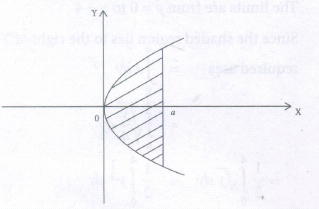
Using integration find the area of the region bounded between the line x = 4 and the parabola y2 = 16x.
25.
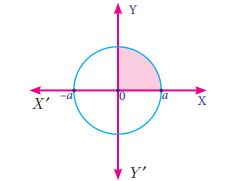
Using integration find the area of the circle whose center is at the origin and the radius is a units.
26.
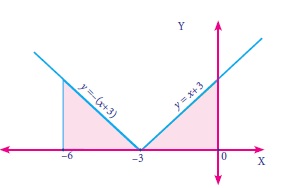
Sketch the graph \(y=\left| x+3 \right| \) and evaluate \(\int _{ -6 }^{ 0 }{ \left| x+3 \right| } \) dx.
27.
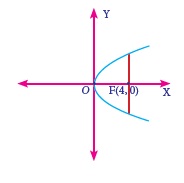
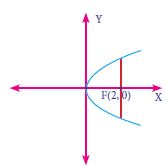
Find the area of the parabola \({ y }^{ 2 }=8x\) bounded by its latus rectum.
28.
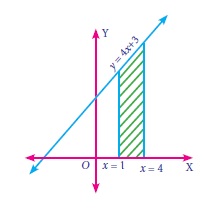
Find the area bounded by y = 4x + 3 with x- axis between the lines x = 1 and x = 4
1.
Given elasticity of demand = \(\frac{p}{x^3}\)
\(\Rightarrow \frac { -p }{ x } .\frac { dx }{ dp } =\frac { p }{ { x }^{ 3 } } \)
\(\Rightarrow \frac { { -x }^{ 3 }dx }{ x } =p.\frac { dp }{ p } \)
\(\Rightarrow -{ x }^{ 2 }dx=dp\)
\(\Rightarrow -\int { { x }^{ 2 }dx } =\int { dp } \)
\(\Rightarrow -\frac { { x }^{ 3 } }{ 3 } +k=p\)
When p = 2, x = 3
\(\Rightarrow -\frac { { 3 }^{ 3 } }{ 3 } +k=2\)
k = 2 + 9 ⇒ k = 11
∴ (1) becomes
\(P=-\frac { { x }^{ 3 } }{ 3 } +11\)
= 11−\(\frac { { x }^{ 3 } }{ 3 } \)
2.
Given f(x) = 1800x-0.4
Since additional 400 units are required, the limits are from x = 500 to x = 900.
\(\therefore \int { f(x)dx } =\int _{ 500 }^{ 900 }{ 1800{ x }^{ -0.4 } } dx\)
\(=1800{ \left[ \frac { { x }^{ -0.4+1 } }{ -0.4+1 } \right] }_{ 500 }^{ 900 }\)
\(\\ =1800{ \left( \frac { { x }^{ 0.6 } }{ 0.6 } \right) }_{ 500 }^{ 900 }\)
\(\\ =3000{ \left( { x }^{ 0.6 } \right) }_{ 500 }^{ 900 }\)
= 3000( (900)0·6 - (500)0.6)
= 3000 (59.22 - 41.63)
[∵ (900)0·6 = 59.22 & (500)0·6 = 41.63]
= 3000(17.59)
= 52,770
Hence, 52,770 hours are required to manufacture additional 400 units.
3.
Given demand function Pd = 20 - 5x and
Supply function Ps = 4x + 8
Under market equilibrium ps = Pd
⇒ 20-5x = 4x+8
⇒ 20-8 = 4x+5x
⇒ 12 = 9x
\(\Rightarrow x=\frac{\not 12}{\not 9}=\frac{4}{3}\)
When \({ x }_{ 0 }=\frac { 4 }{ 3 } ,{ p }_{ 0 }=20-5\left( \frac { 4 }{ 3 } \right) =20-\frac { 20 }{ 3 } \)
\(=\frac { 60-20 }{ 3 } =\frac { 40 }{ 3 } \)
\(\therefore { p }_{ 0 }{ x }_{ 0 }=\frac { 40 }{ 3 } \times \frac { 4 }{ 3 } =\frac { 160 }{ 9 } \)
Consumer Surplus (CS)
\(=\int _{ 0 }^{ x }{ f(x)dx } -{ p }_{ 0 }{ x }_{ 0 }\)
\(=\int _{ 0 }^{ \frac { 4 }{ 3 } }{ (20-5x)dx } \)
\(={ \left[ 20x-\frac { { 5x }^{ 2 } }{ 2 } \right] }_{ 0 }^{ \frac { 4 }{ 3 } }-\frac { 160 }{ 9 } \)
\(=20\left( \frac { 4 }{ 3 } \right) -\frac { 5 }{ 2 } \left( \frac { 16 }{ 9 } \right) -\frac { 160 }{ 9 } \)
\(=\frac { 80 }{ 3 } -\frac { 40 }{ 9 } -\frac { 160 }{ 9 } \)
\(=\frac { 240-40-160 }{ 9 } =\frac { 40 }{ 9 } \)
\(\therefore CS=\frac { 40 }{ 9 }\)units
Producer's Surplus
\((PS)={ p }_{ 0 }{ x }_{ 0 }-\int _{ 0 }^{ x }{ g(x)dx } \)
\(=\frac { 160 }{ 9 } -\int _{ 0 }^{ \frac { 4 }{ 3 } }{ (4x+8)dx } \)
\(=\frac { 160 }{ 9 } -{ \left[ \frac { { 4x }^{ 2 } }{ 2 } +8x \right] }_{ 0 }^{ \frac { 4 }{ 3 } }\)
\(=\frac { 160 }{ 9 } -\left( 2\left( \frac { 16 }{ 9 } \right) +8\left( \frac { 4 }{ 3 } \right) \right) \)
\(=\frac { 160 }{ 9 } -\left( \frac { 32 }{ 9 } +\frac { 32 }{ 3 } \right) \)
\(=\frac { 160 }{ 9 } -\frac { 32 }{ 9 } -\frac { 32 }{ 3 } \)
\(PS=\frac { 160-32-96 }{ 9 } =\frac { 32 }{ 9 } \)units
4.
Given C'(x) = 20 + \(\frac{x}{20}\)
R'(x) = 30
C'(x) = 20 + \(\frac{x}{20}\)
\(\Rightarrow \int { C'(x) } =\int { \left( 20+\frac { x }{ 20 } \right) dx } \)
\(=20x+\frac { { x }^{ 2 } }{ 40 } +{ k }_{ 1 }\)
Since fixed cost is Rs. 100
When x = 0, C = 100 ⇒ k1 = 100
\(\therefore \ C(x)=20x+\frac { { x }^{ 2 } }{ 40 } +100\) ...(1)
Also, R'(x) = 30
\(\Rightarrow \int { R'(x) } =\int { 30 } dx\)
⇒ R(x) = 30x + k2
When x = 0, R = 0 ⇒ k2 = 0
∴ R(x) = 30x ...(2)
Profit function = R(x) - C(x)
\(=30x-\left( 20x+\frac { { x }^{ 2 } }{ 40 } +100 \right) \)
\(=30x-20x-\frac { { x }^{ 2 } }{ 40 } -100\)
\(P=10x-\frac { { x }^{ 2 } }{ 40 } -100\)
5.
Given demand function Pd = 25 - 3x and
Supply function Ps= 5 + 2x
At market equilibrium, Pd = Ps
⇒ 25-3x = 5+2x
⇒ 25-5 = 2x+3x
⇒ 20 = 5x
⇒ x = \(\frac{20}{5}\)
⇒ x0 = 4
When x0 = 4, p0 = 25-3(4)
= 25-12 = 13
p0 = 13
∴p0x0 = 13(4) = 52
∴ Consumer's surplus
\(CS=\int _{ 0 }^{ x }{ f(x) } dx-{ p }_{ 0 }{ x }_{ 0 }\)
\(\\ =\int _{ 0 }^{ 4 }{ (25-3x)dx-52 } \)
\(={ \left[ 25x-\frac { { 3x }^{ 2 } }{ 2 } \right] }_{ 0 }^{ 4 }-52\)
\(=25(4)-\frac { 3\left( { 4 }^{ 2 } \right) }{ 2 } -52\)
=100-24-52
=100-76
C.S = 24 units
Producer's Surplus
\((PS)={ p }_{ 0 }{ x }_{ 0 }-\int _{ 0 }^{ x }{ g(x)dx } \)
\(=52-\int _{ 0 }^{ 4 }{ (5+2x)dx } \)
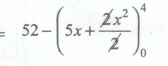
= 52 - (5(4) + 42}
= 52 - (20 + 16)
= 52 - 36
PS = 16 units
6.
Given demand equation is \(x=\sqrt { 100-p } \) and
Supply equation is \(x=\frac { p }{ 2 } -10\)
At market equilibrium, \(\sqrt { 100-p } =\frac { p }{ 2 } -10\) Squaring both sides,
\(100-p={ \left( \frac { p }{ 2 } -10 \right) }^{ 2 }\)
\(\frac { { p }^{ 2 } }{ 4 } -10p+p=0\)
\(\frac { { p }^{ 2 } }{ 4 } -9p=0\)
\({ p }^{ 2 }-36p=0\)
p(p-36) = 0
p = 0 or p = 36
Since p cannot be zero, p = 36
\(\therefore \ { x }_{ 0 }=\sqrt { 100-36 } =\sqrt { 64 } =8\)
∴ p0x0 = 36 x 8 = 288
Given demand equation is \(x=\sqrt { 100-p } \)
X2 = 100-P(Squaring both sides)
p = 100-x2
Consumer's Surplus
\(CS=\int _{ 0 }^{ x }{ f(x) } dx-{ p }_{ 0 }{ x }_{ 0 }\)
\(CS=\int _{ 0 }^{ 8 }{ (100-{ x }^{ 2 }) } dx-288\)
\(={ \left[ 100x-\frac { { x }^{ 3 } }{ 3 } \right] }_{ 0 }^{ 8 }-288\)
\(=100(8)-\frac { { 8 }^{ 3 } }{ 3 } -288\)
\(=800-\frac { 512 }{ 3 } -288\)
\(=512-\frac { 512 }{ 3 } \)
\(=\frac { 1536-512 }{ 3 } \)
\(CS=\frac { 1024 }{ 3 } \)units
Supply equation is given as
\(x=\frac { p }{ 2 } -10\)
\(x=\frac { p-20 }{ 2 } \)
2x = p - 20
p = 2x + 20
∴ Producer's surplus
\(PS={ p }_{ 0 }{ x }_{ 0 }-\int _{ 0 }^{ x }{ g(x)dx } \)
\(=288-\int _{ 0 }^{ 8 }{ (2x+20)dx } \)
\(=288-{ \left( \frac { { 2x }^{ 2 } }{ 2 } +20x \right) }_{ 0 }^{ 8 }\)
\(=288-{ \left( { x }^{ 2 }+20x \right) }_{ 0 }^{ 8 }\)
= 288 - (82 + 20(8))
= 288 - (64 + 160)
= 288 - 224
PS = 64 units
7.
Given demand function \({ p }_{ d }=\frac { 8 }{ x+1 } -2\) and
Supply function \({ p }_{ s }=\frac { x+3 }{ 2 } \)
Under perfect competition, Pd = Ps
\(\Rightarrow \frac { 8 }{ x+1 } -2=\frac { x+3 }{ 2 } \)
\(\Rightarrow \frac { 8-2(x+1) }{ x+1 } =\frac { x+3 }{ 2 } \)
\(\\ \Rightarrow \frac { 8-2x-2 }{ x+1 } =\frac { x+3 }{ 2 } \)
\(\Rightarrow \frac { 6-2x }{ x+1 } =\frac { x+3 }{ 2 } \)
⇒ 12-4x = (x+1)(x+3)
⇒ 12-4x = x2+3x+x+3
⇒ 12-4x = x2+4x+3
⇒ x2+4x+3-12+4x = 0
⇒ x2+8x-9 = 0
⇒ (x+9)(x-1) = 0
⇒ x = -9 or x = 1
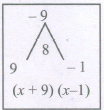
Since cannot be negative, x = 1
\(\therefore { p }_{ 0 }=\frac { x+3 }{ 2 } =\frac { 1+3 }{ 2 } =\frac { 4 }{ 2 } =2\)
∴ p0x0 = 2(1) = 2
Consumer's Surplus
\((CS)=\int _{ 0 }^{ x }{ f(x)dx-{ p }_{ 0 }{ x }_{ 0 } } \)
\(=\int _{ 0 }^{ 1 }{ \left( \frac { 8 }{ x+1 } -2 \right) } dx-2\)
\(={ \left[ 8 \log(x+1)-2x \right] }_{ 0 }^{ 1 }-2\)
= 8 log (2) - 8log (1) - 2 - 2
= 8 log2-8(0)-4
[∵ log 1 = 0]
= (8 log 2-4) units
Producer's Surplus PS = \({ p }_{ 0 }{ x }_{ 0 }-\int _{ 0 }^{ x }{ g(x)dx } \)
\(=2-\int _{ 0 }^{ 1 }{ \frac { x+3 }{ 2 } dx } \)
\(=2-\frac { 1 }{ 2 } { \left[ \frac { { x }^{ 2 } }{ 2 } +3x \right] }_{ 0 }^{ 1 }\)
\(=2-\frac { 1 }{ 2 } \left[ \frac { { 1 }^{ 2 } }{ 2 } +3(1) \right] \)
\(=2-\frac { 1 }{ 2 } \left( \frac { 1 }{ 2 } +3 \right) =12-\frac { 1 }{ 2 } \left( \frac { 7 }{ 2 } \right) \)
\(=2-\frac { 7 }{ 4 } =\frac { 8-7 }{ 2 } \)
PS = \(\frac{1}{4}\)units
8.
Given Pd = 18− 2x − x2 ; Ps = 2x − 3
We know that at equilibrium prices pd = ps
18− 2x − x2 = 2x – 3
x2 + 4x −21 = 0
(x − 3) (x + 7) = 0
x = –7 or 3
The value of x cannot be negative, x = 3
When x0 = 3
ஃ p0 = 18 − 2(3) − (3)2 = 3
CS = \(\int _{ 0 }^{ { x }_{ o } }{ f(x) } \) dx - x0p0
= \(\int _{ 0 }^{ 3 }{ (18-2x-{ x }^{ 2 }) } \)dx - 3 x 3
= \({ \left[ 18x-{ x }^{ 2 }-\frac { { x }^{ 3 } }{ 3 } \right] }_{ 0 }^{ 3 }\)- 9
= 18(3) - (3)2 - \(\left( \frac { { 3 }^{ 3 } }{ 3 } \right) \) - 9
CS = 27 units
PS = x0P0 - \(\int _{ 0 }^{ { x }_{ o } }{ g(x) } \)
= (3 \(\times\) 3) - \(\int _{ 0 }^{ 3 }{ (2x-3) } \)
= 9 - \(({ { { x }^{ 2 }-3x) } }_{ 0 }^{ 3 }\)
= 9 units
Hence at equilibrium price,
(i) the consumer’s surplus is 27 units
(ii) the producer’s surplus is 9 units.
9.
Given MC = \(\frac{dC}{dx}\alpha x\)
\(\Rightarrow \frac { dC }{ dx } ={ k }_{ 1 }x\)
\(\Rightarrow dC={ k }_{ 1 }xdx\)
\(\Rightarrow \int { dC={ k }_{ 1 }\int { x } dx } \)
\(\Rightarrow C={ k }_{ 1 }\frac { { x }^{ 2 } }{ 2 } +{ k }_{ 2 }...(1)\)
Given fixed cost is Rs. 5000
∴ When x = 0, C = 5000
⇒ 5000 = k1(0) + k2 = 5000
∴ (1)becomes C=k1\(\frac{x^2}{2}+5000\) ...(2)
Also it is given that when x = 50, C = Rs. 5625
\(\therefore (2)5625={ k }_{ 1 }\frac { { x }^{ 2 } }{ 2 } +5000\)
\(\Rightarrow 5625-5000={ k }_{ 1 }\times \frac { { (50) }^{ 2 } }{ 2 } \)
\(\Rightarrow 625={ k }_{ 1 }\times \frac { (50)\times (50) }{ 2 } \)
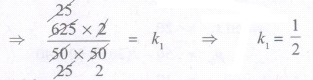
\(C=\frac { 1 }{ 2 } \left( \frac { { x }^{ 2 } }{ 2 } \right) +5000\)
⇒C = \(\frac{x^2}{4}\) + 5000
10.
Given C'(x) = 5 + 0.13x
R'(x) = 18
Fixed cost is Rs. 120
C'(x) = 5 + 0.13x
⇒ ∫C'(x) = ∫(5+0.13x)dx
⇒ C(x) = 5x \(+\frac { 0.13{ x }^{ 2 } }{ 2 } +{ k }_{ 1 }\)
Since fixed cost is Rs.120 ⇒ k1 = 120
\(\therefore C(x)=5x+\frac { 0.13{ x }^{ 2 } }{ 2 } +120\) ...(1)
Also R'(x) = 18
⇒ ∫R'(x) = ∫18dx
⇒ R(x) = 18x+k2
When x = 0, R = 0 ⇒ k2= 0
∴ R(x) = 18x ...(2)
Profit function ⇒ P(x) = R(x) - C(x)
\(=18x-5x-\frac { 0.13{ x }^{ 2 } }{ 2 } -120\)
[from (1) & (2)]
P(x) = 13x-0.065x2-120
11.
Given marginal revenue function.
\(MR=\frac { DR }{ dx } =20{ e }^{ \frac { -x }{ 10 } }\left( 1-\frac { x }{ 10 } \right) \)
\(dR={ 20e }^{ \frac { -x }{ 10 } }\left( 1-\frac { x }{ 10 } \right) dx\)
\(R=\int { { 20e }^{ \frac { -x }{ 10 } } } \left( 1-\frac { x }{ 10 } \right) dx\)
We know that \(\int { { e }^{ ax }[af(x)+f'(x)]dx={ e }^{ ax }f(x) } +c\)
Here \(\\ a=\frac { -1 }{ 10 } ,f(x)=x,\quad f'(x)=1\)
\(R=20\int { { e }^{ \frac { -x }{ 10 } } } \left[ -\frac { 1 }{ 10 } x+1 \right] dx=20{ e }^{ \frac { -x }{ 10 } }x+k\)
\(\Rightarrow R=20{ e }^{ \frac { -x }{ 10 } }x+k\quad ...(1)\)
When x = 0, R = 0
0 = 0 + k ⇒ k = 0
(1) becomes
\(R=20x{ e }^{ \frac { -x }{ 10 } }\)
Demand function P
\(=\frac { R }{ x } =\frac { 20x{ e }^{ \frac { -x }{ 10 } } }{ x } \)
\(\Rightarrow P=20{ e }^{ \frac { -x }{ 10 } }\)
12.
\(\eta _{ d }=\frac { p+2{ p }^{ 2 } }{ 100-p-{ p }^{ 2 } } \)
\(\frac { -p }{ x } \frac { dx }{ dp } =\frac { p(2p+1) }{ 100-p-{ p }^{ 2 } } \)
\(\frac { -dx }{ x } =\frac { -(2p+1) }{ { p }^{ 2 }+p-100 } dp\)
\(\int { \frac { dx }{ x } } =\int { \frac { 2p+1 }{ { p }^{ 2 }+p-100 } } dp\)
log x = log(p2 + p = 100) + log k
ஃ x = k(p2 + p −100)
When x = 70, p = 5,
70 = k(25 + 5 − 100)
⇒ k = –1
Hence x = 100 − p − p2
R = px
Revenue = p(100 – p – p2)
13.
\(\frac { { E }_{ y } }{ { E }_{ x } } =\frac { x }{ x-2 } \)
\(\frac { { xd }_{ y } }{ { yd }_{ x } } =\frac { x }{ x-2 } \)
\(\frac { dy }{ y } =\frac { x }{ x-2 } .\frac { dx }{ x } \)
\(\int { \frac { dy }{ y } } =\int { \frac { dx }{ x-2 } } \)
log y = log(x − 2) + log k
y = k(x–2)
when x = 6, y = 16 ⇒ 16 = k(6–2)
k = 4
y = 4 (x–2)
14.
Given elasticity of demand \(=\frac { (4-x) }{ x } \)
We know that \({ \eta }^{ 2 }=\frac { -p }{ x } \frac { dx }{ dp } \)
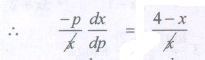
\(\Rightarrow \frac { dx }{ 4-x } =\frac { -dp }{ p } \)
\(\Rightarrow \int { \frac { dx }{ 4-x } =-\int { \frac { dp }{ p } } } \)
\(\Rightarrow log\frac { |4-x| }{ -1 } =-logp+logk\)
\(\Rightarrow -log|4-x|=log\left( \frac { k }{ p } \right) \)
\(\Rightarrow log{ (4-x) }^{ -1 }=log\left( \frac { k }{ p } \right) \)
\(\Rightarrow \frac { 1 }{ 4-x } =\frac { k }{ p } \Rightarrow p=k(4-x)\) ...(1)
When x = 2 and p = 4
4 = k(4-2) ⇒ 4 = k(2)
⇒\(\frac{4}{2}\)= k
⇒ k = 2
∴ (1) becomes
p = 2(4-x)
⇒ p = 8-2x
Also, R = px
⇒ R = (8 - 2x)x
⇒ R = 8x-2x2
Hence, the demand function is 8 - 2x and the revenue function is 8x - 2x2.
15.
\(\frac { EY }{ Ex } =\frac { -7x }{ (1-2x)(2+3x) } \)
\(\frac { 7 }{ (2x-1)(3x+2) } =\frac { A }{ 2x-1 } +\frac { B }{ 3x+2 } \)
7 = A(3x+2)+B(2x-1)
\(Put\ x=\frac { -2 }{ 3 } 7=B\left( \frac { -4 }{ 3 } -1 \right) 7=B\left( \frac { -7 }{ 3 } \right) \)
\(Put\ x=\frac { 1 }{ 2 } 7=A\left( \frac { 3 }{ 2 } +2 \right) \Rightarrow 7=A\left( \frac { 7 }{ 2 } \right) \)
\(\therefore \frac { 7 }{ (2x-1)(3x+2) } =\frac { 2 }{ 2x-1 } -\frac { 3 }{ 3x+2 } \)
Also, it is given that x = 2, when y \(=\frac{3}{8}\)
\(\Rightarrow \frac { x }{ y } \frac { dy }{ dx } =\frac { -7x }{ (1-2x)(2+3x) } \)

\(=\frac { -7dx }{ (1-2x)(2+3x) } \)
\(\Rightarrow \frac { dy }{ y } =\frac { 7dx }{ (2x+1)(3x+2) } \)
\(\int { \frac { dy }{ y } =\int { \frac { 7dx }{ (2x-)(3x+2) } } } \)
\(\int { \frac { dy }{ y } =\int { \left( \frac { 2 }{ 2x-1 } -\frac { 3 }{ 3x+2 } \right) dx } } \)
\(log\quad y=2\int { \frac { 1 }{ 2x-1 } dx-3\int { \frac { dx }{ 3x+2 } } } \)
\(=2\frac { log|2x-1| }{ 2 } -3\frac { log|3x+2| }{ 3 } +logc\)
\(=log\quad y-log\quad c=log\left| \frac { 2x-1 }{ 3x+2 } \right| \)
\(\Rightarrow log\left| \left( \frac { y }{ c } \right) \right| =log\left| \frac { 2x-1 }{ 3x+2 } \right| \)
\(\Rightarrow \frac { y }{ c } =\frac { 2x-1 }{ 3x+2 } y=c\left( \frac { 2x-1 }{ 3x+2 } \right) \) ....(1)
When \(x=2,y=\frac { 3 }{ 8 } \)
\(\Rightarrow \frac { 3 }{ 8 } =c\left( \frac { 4-1 }{ 8 } \right) \)
\(\frac { 3 }{ 8 } =c\left( \frac { 3 }{ 8 } \right) =c=1\)
\(y=\left( \frac { 2x-1 }{ 3x+2 } \right) \)
\(\Rightarrow y= \frac { 2x-1 }{ 3x+2 }\)
16.
The present value of payment for t year = \(\int _{ 0 }^{ t }{ { 72000e }^{ -0.09t } } dt\)
Present value of 12 years = \(\int _{ 0 }^{ t }{ { 72000e }^{ -0.09t } } dt\)
= 72000\({ \left[ \frac { { e }^{ -0.09t } }{ { -0.09 } } \right] }_{ 0 }^{ \\ 12 }\)
= \(\frac { 72000 }{ -0.09 } \left[ { e }^{ -0.09(12) }-{ e }^{ 0 } \right] \)
= \(-8,00,000[{ e }^{ -1.08 }-{ e }^{ 0 }]\)
= −8,00,000 [0.3396 −1]
= 5,28,320
Cost of the machine = 5,00,000 − 30,000
= 4,70,000
Hence it not advisable to rent the machine
It is better to buy the machine.
17.
Given, Marginal revenue R'(x) = 10 + e−0.05x
Total revenue from sale of 100 units is
\(R=\int _{ 0 }^{ 100 }{ (10+{ e }^{ -0.05x }) } dx\)
= \({ \left[ 10x+\frac { { e }^{ -0.05x } }{ -0.05 } \right] }_{ 0 }^{ 100 }\)
= \(\left( 1000-\frac { { e }^{ 5 } }{ 0.05 } \right) -\left( 0-\frac { 100 }{ 5 } \right) \)
= 1000 + 20 − (20 × 0.0067)
= 1019.87
Total revenue = 1019.87 × 1000
= Rs. 10,19,870
18.
Given MC = 8 + 6x
\(C(x)=\int { (8+6x)dx } \) + k1
= 8x + 3x2 + k1 ...(1)
But given when x = 0, C = 0 ⇒ k1 = 0
ஃ C(x) = 8x + 3x2 ....(2)
Given that MR = 24
R(x) = \(\int { MR } \) dx + k2
= \(\int { 24 } \) dx + k2
= \(\int { 24 } \) + k2
Revenue = 0, when x = 0 ⇒ k2 = 0
R(x) = 24x ...(3)
Total Profit functions P(x) = R(x) – C(x)
P(x) = 24x − 8x − 3x2
= 16x − 3x2
19.
Given C(x) = \(\int { C' } (x)dx+\)k1
= \(\int { \left( 50+\frac { x }{ 50 } \right) } \)dx +k1
C(x) = 50x + \(\frac{x^2}{100}\)+k1
When quantity produced is zero, then the fixed cost is 200.
i.e. When x = 0, c = 200
⇒ k1 = 200
Cost function is C(x) = 50x + \(\frac{x^2}{100}\) + 200 (1)
The Revenue R'(x) = 60
R(x) = \(\int { R' } (x)dx\) + k2
\(\int { 60 } dx\)+ k2
= 60x + k2
When no product is sold, revenue = 0
i.e. When x = 0, R = 0
Revenue R(x) = 60x (2)
Profit P = Total Revenue – Total cost
= 60x - 50x - \(\frac { { x }^{ 2 } }{ 100 } \) - 200
= 10x - \(\frac { { x }^{ 2 } }{ 100 } \) - 200
\(\frac { dp }{ dx } =10-\frac { x }{ 50 } \)
To get profit maximum, \(\frac { dp }{ dx } \) = 0 ⇒ x = 500
\(\frac { { d }^{ 2 }P }{ { dx }^{ 2 } } =\frac { -1 }{ 50 } <0\)
ஃ Profit is maximum when x = 500 and
Maximum Profit is P = 10(500) - \(\frac { { (500) }^{ 2 } }{ 100 } \) - 200
= 5000 – 2500 – 200
= 2300
Profit = Rs. 2,300.
20.
21.
Assume that F(t) is the total sales after t months, sales rate is \(\frac { d }{ dt } F(t)=f(t)\)
∴ F(t) = \(\int _{ 0 }^{ t }{ f(t) } dt\)
Total cumulative sales after 4 months.
F(4) = \(\int _{ 0 }^{ 4 }{ f(t) } dt\)
= \(\int _{ 0 }^{ 4 }{ 3000 } { e }^{ -0.3t }dt\)
= 3000 \({ \left[ \frac { { e }^{ -0.3t } }{ -0.3 } \right] }_{ 0 }^{ 4 }\)
= -10,000 \([{ e }^{ -1.2 }-{ e }^{ 0 }]\)
= −10,000 [0.3012 −1]
= 6988 units
(ii) Sales during the 5th month
= \(\int _{ 0 }^{ 4 }{ 3000 } { e }^{ -0.3t }dt\)
= 3000 \({ \left[ \frac { { e }^{ -0.3t } }{ -0.3 } \right] }_{ 0 }^{ 4 }\)
= -10,000 \([{ e }^{ -1.2 }-{ e }^{ 0 }]\)
= −10,000 [0.2231− 0.3012]
= 781 units
Total sales due to the advertisement campaign
= \(\int _{ 0 }^{ 4 }{ 3000 } { e }^{ -0.3t }dt=\frac { 3000 }{ -0.3 } { \left[ { e }^{ -0.3t } \right] }_{ 0 }^{ \infty }\)
= −10000 [0 −1]
= 10,000 untis.
22.
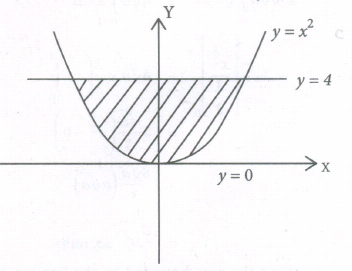
Since y = x2 is symmetric
about Y-axis, the required
Area = \(2\int _{ 0 }^{ 4 }{ x\quad dy } \)
When \(y={ x }^{ 2 }\Rightarrow x=\sqrt { y } \)
∴ Area \(=2\int _{ 0 }^{ 4 }{ \sqrt { y } dy } \)
\(=2\int _{ 0 }^{ 4 }{ { y }^{ \frac { 1 }{ 2 } }dy } \)
\(=2\times \frac { 2 }{ 2 } { \left[ { y }^{ \frac { 3 }{ 2 } } \right] }_{ 0 }^{ 4 }\)
\(=\frac { 4 }{ 3 } \left[ { 4 }^{ \frac { 3 }{ 2 } }-{ 0 }^{ \frac { 3 }{ 2 } } \right] \)
\(=\frac { 4 }{ 3 } \left[ { 4 }^{ \frac { 3 }{ 2 } } \right] \)
\(=\frac { 4 }{ 3 } \times { ({ 2 }^{ 2 }) }^{ \frac { 3 }{ 2 } }=\frac { 4 }{ 3 } \times { 2 }^{ 3 }\)
\(A=\frac { 4 }{ 3 } \times 8=\frac { 32 }{ 3 } \) sq.units
23.
24.
The equation y2 = 16x represents a parabola (Open rightward)
Required Area = 2\(\int _{ a }^{ b }{ y } dx\)
\(=2\int _{ 0 }^{ 4 }{ \sqrt { 16x } } \ dx\)
\(=8\int _{ 0 }^{ 4 }{ { x }^{ \frac { 1 }{ 2 } } } dx=8{ \left[ { \frac { { x }^{ { \frac { 3 }{ 2 } } } }{ \frac { 3 }{ 2 } } } \right] }_{ 0 }^{ 4 }=\frac { 16 }{ 3 } \left( { \left( 4 \right) }^{ \frac { 3 }{ 2 } } \right) =\frac { 128 }{ 3 } \) sq.units
25.
Equation of the required circle is \({ x }^{ 2 }+{ y }^{ 2 }={ a }^{ 2 }\) (1)
put \(y=0\), \({ x }^{ 2 }={ a }^{ 2 }\)
⇒ \(x=\pm a\)
Since equation (1) is symmetrical about both the axes
The required area = 4 [Area in the first quadrant between the limit 0 and a.]
\(=4\int _{ 0 }^{ a }{ y } \ dx\)
\(=4\int _{ 0 }^{ a }\sqrt { { a }^{ 2 }-{ x }^{ 2 } } dx=4{ \left[ \frac { x }{ 2 } \sqrt { { a }^{ 2 }-{ x }^{ 2 } } +\frac { { a }^{ 2 } }{ 2 } \sin ^{ -1 }{ \frac { x }{ a } } \right] }_{ 0 }^{ a }\)
\(=4{ \left[ 0+\frac { { a }^{ 2 } }{ 2 } \sin ^{ -1 }{( \frac { a }{ a } )} \right] }=4{ \left[ \frac { { a }^{ 2 } }{ 2 } \sin ^{ -1 }{( 1)} \right] }=4.\frac { { a }^{ 2 } }{ 2 }\frac { {π} }{ 2 }\)
= πa2 sq. units
26.
\(y=\left| x+3 \right| =\begin{cases} x+3\quad if\quad x\ge -3\quad \\ -(x+3)\quad if\quad x<-3 \end{cases}\)
Required area = \(\int _{ b }^{ a }{ y } dx=\int _{ -6 }^{ 0 }{ y } dx\)
= \(\int _{ -6 }^{ -3 }{y}\ dx+\int _{ -3 }^{ 0 }{ y} dx\)
= \(\int _{ -6 }^{ -3 }{ -(x+3) } dx+\int _{ -3 }^{ 0 }{ (x+3) } dx\)
= \(-{ \left[ \frac { { (x+3) }^{ 2 } }{ 2 } \right] }_{ -6 }^{ -3 }{ +\left[ \frac { { (x+3) }^{ 2 } }{ 2 } \right] }_{ -3 }^{ 0 }\)
\(=-\left[ 0-\frac { 9 }{ 2 } \right] +\left[ \frac { 9 }{ 2 } -0 \right] \)
= 9 sq. units
27.
\({ y }^{ 2 }=8x\) (1)
Comparing this with the standard form \({ y }^{ 2 }=4x\),
4a = 8
a = 2
Equation of latus rectum is x = 2
Since equation (1) is symmetrical about x- axis
Required Area = 2[Area in the first quadrant between the limits x = 0 and x = 2]
\(=2\int _{ 0 }^{ 2 }{ y } dx\)
\(2\int _{ 0 }^{ 2 }{ \sqrt { 8xdx } } =2(2\sqrt { 2 } )\int _{ 0 }^{ 2 }{ { x }^{ 1/2 } } dx\)
\(=4\sqrt { 2 } { \left[ \frac { { 2x }^{ \frac { 3 }{ 2 } } }{ 3 } \right] }_{ 0 }^{ 2 }=4\sqrt { 2 } \times 2 \times \frac { { 2 }^{ \frac { 3 }{ 2 } } }{ 3 } \)
\(=\frac { 32 }{ 3 } \) sq. units.
28.
Area = \(\int _{ 1 }^{ 4 }{ ydx } \)
= \(\int _{ 1 }^{ 4 }{ (4x+3)dx } \)
= \([{ { 2x }^{ 2 }+3x] }_{ 1 }^{ 4 }\) = 32 +12 − 2 − 3
= 39 sq.units

12th Standard Syllabus & Materials
12th Standard
TN 12th Computer Applications வலையமைப்பு வடமிடல் Sample Question Papers Study Material - QB365 Set A
NEW12th Standard
TN 12th Computer Applications களப்பெயர் முறைமை (DNS) Sample Question Papers Study Material - QB365 Set A
NEW12th Standard
TN 12th Computer Applications வலையமைப்பு எடுத்துக்காட்டுகள் மற்றும் நெறிமுறைகள் Sample Question Papers Study Material - QB365 Set A
NEW12th Standard
TN 12th Computer Applications கணினி வலையமைப்பு ஓர் அறிமுகம் Sample Question Papers Study Material - QB365 Set A



Tamilnadu Stateboard 12th Standard Subjects

Maths

Chemistry

Physics

Biology

Computer Science
Business Maths and Statistics

Economics

Commerce

Accountancy

History

Computer Applications
Biology
Computer Technology
Computer Applications
Computer Science
Business Maths and Statistics
Commerce
Economics
Maths
Chemistry
Physics
Computer Technology
History
Accountancy

Tamil

English

French
Tamilnadu Stateboard Standards
