
 100% FREE ACCESS
12th Standard Syllabus & Materials
12th Standard
TN 12th Computer Applications மின்னணு தரவு பரிமாற்றம் Sample Question Papers Study Material - QB365 Set A
NEW12th Standard
TN 12th Computer Applications மின் - வணிக பாதுகாப்பு அமைப்புகள் Sample Question Papers Study Material - QB365 Set A
NEW12th Standard
TN 12th Computer Applications மின்னணு செலுத்தல் முறைகள் Sample Question Papers Study Material - QB365 Set A
NEW12th Standard
TN 12th Computer Applications மின் - வணிகம் Sample Question Papers Study Material - QB365 Set A
NEW12th Standard
TN 12th Computer Applications திறந்த மூல கருத்துருக்கள் Sample Question Papers Study Material - QB365 Set A
NEW12th Standard
TN 12th Computer Applications வலையமைப்பு வடமிடல் Sample Question Papers Study Material - QB365 Set A

Published on: 01/09/2020
12th Standard Business Maths English Medium Model 3 Mark Book Back Questions (New Syllabus) 2020
Download Tamil Nadu 12th Standard Business Maths and Statistics question papers, model tests, one-mark questions, important questions, and public exam papers in PDF format. Free study materials and answer keys for TN State Board students.
Questions + Answers key
Take MCQ Business Maths and Statistics Test
1.
A second degree polynomial passes though the point (1,-1) (2,-1) (3,1) (4,5). Find the polynomial.
2.
Evaluate ∆(log ax).
3.
A farmer wants to decide which of the three crops he should plant on his 100-acre farm. The profit from each is dependent on the rainfall during the growing season. The farmer has categorized the amount of rainfall as high medium and low. His estimated profit for each is shown in the table.
| Rainfall | Estimated Conditional Profit(Rs.) | ||
| crop A | crop B | crop C | |
| High | 8000 | 3500 | 5000 |
| Medium | 4500 | 4500 | 5000 |
| Low | 2000 | 5000 | 4000 |
If the farmer wishes to plant only crop, decide which should be his best crop using
(i) Maximin
(ii) Minimax
4.
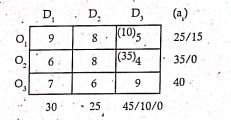
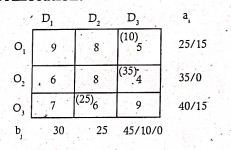
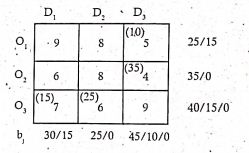
Obtain an initial basic feasible solution to the following transportation problem by using least- cost method.
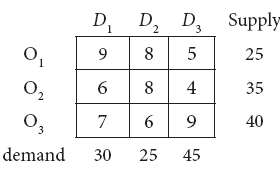
5.
Solve the following assignment problem.
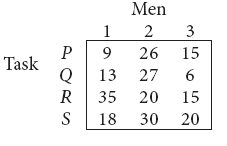
6.
Solve x \(\frac{dy}{dx}\) + 2y = x4
7.
An Enquiry was made into the budgets of the middle class families in a city gave the following information.
| Expenditure | Food | Rent | Clothing | Fuel | Rice |
| Price(2010) | 150 | 50 | 100 | 20 | 60 |
| Price(2011) | 174 | 60 | 125 | 25 | 90 |
| Weights | 35 | 15 | 20 | 10 | 20 |
What changes in the cost of living have taken place in the middle class families of a city?
8.
Find the differential equation corresponding to y = ae4x + be−x where a, b are arbitrary constants.
9.
Calculate three-yearly moving averages of number of students studying in a higher secondary school in a particular village from the following data.
| Year | 1995 | 1996 | 1997 | 1998 | 1999 | 2000 | 2001 | 2002 | 2003 | 2004 |
| Number of students | 332 | 317 | 357 | 392 | 402 | 405 | 410 | 427 | 435 | 438 |
10.
Evaluate the following integrals:
ഽ(x +1)2 log x dx
11.
Find the sample size for the given standard deviation 10 and the standard error with respect of sample mean is 3.
12.
Evaluate the following: f(x) = \(\begin{cases} cx, \\ 0, \end{cases}\begin{matrix} 0 < x < 1 \\ \text{otherwise} \end{matrix}\)
13.
Assume that a drug causes a serious side effect at a rate of three patients per one hundred. What is the probability that atleast one person will have side effects in a random sample of ten patients taking the drug?
14.
Evaluate \(\int _{ 0 }^{ 1 }{ [{ e }^{ a \log x }+{ e }^{ x \log a }] } dx\)
15.
Integrate the following with respect to x
\(\frac { { x }^{ 3 } }{ \sqrt { { x }^{ 8 }-1 } } \)
16.
Evaluate ഽ\(\frac { { x }^{ 3 }dx }{ \sqrt { x^{ 8 }+1 } } \)
17.
The probability that a student get the degree is 0.4 Determine the probability that out of 5 students
(i) one will be graduate
(ii) atleast one will be graduate
18.
Integrate the following with respect to x.
\(\frac { { x }^{ e-1 }+{ e }^{ x-1 } }{ { x }^{ e }+{ e }^{ x } } \)
19.
A manufacture’s marginal revenue function is given by MR = 275 − x − 0.3x2. Find the increase in the manufactures total revenue if the production is increased from 10 to 20 units.
20.
The time to failure in thousands of hours of an important piece of electronic equipment used in a manufactured DVD player has the density function.\(f(x)= \begin{cases}3e^{-3x} & x > 0 \\ 0, & \text { otherwise }\end{cases}\)
Find the expected life of the piece of equipment.
21.
Let X be a discrete random variable with the following p.m.f
\(p(x) = \begin{cases}0.3 & \text { for } x =3 \\ 0.2, & \text { for } x = 5 \\ 0.3, & \text { for } x = 8 \\ 0.2, & \text { for} x = 10 \\ 0, & \text { otherwise } \\ \end{cases}\)
Find and plot the c.d.f. of X.
22.
In year 2000 world gold production was 2547 metric tons and it was growing exponentially at the rate of 0.6% per year. If the growth continues at this rate, how many tons of gold will be produced from 2000 to 2013? [e0.078 = 1.0811)
23.
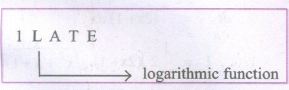
Integrate the following with respect to x.
xn log x
24.
Evaluate \(\int { } \)cos3 x dx
25.
Evaluate \(\int { \frac { 7x-1 }{ { x }^{ 2 }-5x+6 } dx } \)
26.
Evaluate \(\int \frac{a x^{2}+b x+c}{\sqrt{x}} d x\)
27.
Find the rank of the matrix A =\(\left( \begin{matrix} 4 & 5 & 2 \\ 3 & 2 & 1 \\ 4 & 4 & 8 \end{matrix}\begin{matrix} 2 \\ 6 \\ 0 \end{matrix} \right) \)
28.
The total cost of 11 pencils and 3 erasers is Rs. 64 and the total cost of 8 pencils and 3 erasers is Rs. 49. Find the cost of each pencil and each eraser by Cramer’s rule.
29.
Find the rank of the matrix \(\left( \begin{matrix} 0 & -1 & 5 \\ 2 & 4 & -6 \\ 1 & 1 & 5 \end{matrix} \right) \)
1.
Given values are
| x | 1 | 2 | 3 | 4 |
| y | -1 | -1 | 1 | 5 |
The difference table is
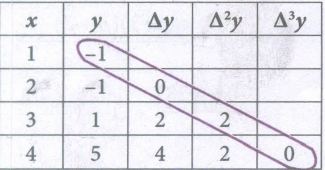
x0 + nh = x ⇒ 1 + n = x ⇒ n = x - 1
∴ By Newton's forward interpolation formula,
y= y0\(\frac { n }{ 1! } { \triangle y }_{ 0 }+\frac { n(n+1) }{ 2! } { \triangle }^{ 2 }{ y }_{ 0 }+\frac { n(n+1)(n+2) }{ 3! } { \triangle }^{ 3 }{ y }_{ 0 }\)
JPG.JPG)
[∵ Δ3y0 = 0]
⇒ y = -1 + 0 + x2 - 3x + 2
⇒ y = x2 - 3x + 1
Hence, the required second degree polynomial is y = x2 - 3x + 1
2.
Δ(log ax) = log (ax + h) -log (ax)
= log\(\left( \frac { ax+h }{ ax } \right) \)
=log \(\left( \frac { ax }{ ax } +\frac { h }{ ax } \right) \)
= log \(\left( 1+\frac { h }{ ax } \right) \)
∴ ∆ (log ax) = log \(\left( 1+\frac { h }{ ax } \right) \)
3.
| Estimated Conditional Profit 0 | |||||
| Rainfall | High | Medium | Low | Minimum payoff | Maximum payoff |
| Crop A | 8000 | 4500 | 2000 | 2000 | 8000 |
| Crop B | 3500 | 4500 | 5000 | 3500 | 5000 |
| Crop C | 5000 | 5000 | 4000 | 4000 | 5000 |
(i) Max (2000,3500,4000) = 4000
∴ Crop C is the best according to maximin criteria
(ii) Min (8000,5000,5000) = 5000
∴ Crop B and C are best according to minimax criteria
4.
First allocation:
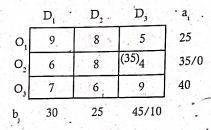
Second allocation:
Third allocation:
Fourth allocation:
Final allocation:
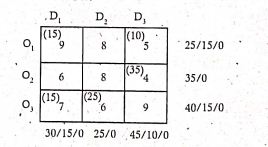
The total transportation cost is
\( =(15 \times 9)+(10 \times 5)+(35 \times 4) +(15 \times 7)+(25 \times 6) \)
= 135 + 50 + 140 + 105 + 150 = Rs. 580
5.
Since the number of columns is less than the number of rows, given assignment problem is unbalanced one. To balance it , introduce a dummy column with all the entries zero. The revised assignment problem is
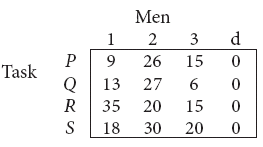
Here only 3 tasks can be assigned to 3 men.
Step 1: Its not necessary, since each row contains zero entry. Go to Step 2.
Step 2:
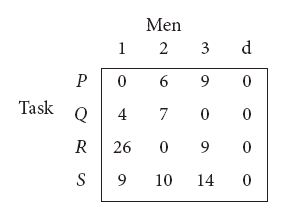
Step 3 (Assignment) :
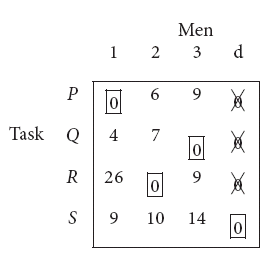
Since each row and each columncontains exactly one assignment,all the three men have been assigned a task. But task S is not assigned to any Man. The optimal assignment schedule and total cost is
| Task | Men | cost |
| P | 1 | 9 |
| Q | 3 | 6 |
| R | 2 | 20 |
| s | d | 0 |
| Total cost | 35 | |
The optimal assignment (minimum) cost = Rs. 35
6.
\(\frac { dy }{ dx } +\frac { 2 }{ y } y\) = x3
The given differential equation is of this form [Divided by x]
\(\frac { dy }{ dx } \)+Py = Q where
P =\(\int { \frac { 2 }{ x } } \) and Q = x3
∴ \(\int { P } dx=\int { \frac { 2 }{ x } dx } \) = 2 log x = log x2
∴ Integrating factor (I. F) =\(e^{ \int { p } dx }=e^{ logx^{ 2 } }\)= x2
Hence the solution is
\(ye^{ \int { p } dx }=\int { Q } .e^{ \int { p.dx } }dx+c\)
⇒ y.x2=\(\int { { x }^{ 3 }.{ x }^{ 2 } } dx+c\)
⇒ x2y=\(\\ \int { { x }^{ 5 }dx } +c\)
⇒ x2y = \(\frac { { x }^{ 6 } }{ 6 } \) + c
7.
| Expenditure | Weights (V) | Rent 2010 (p0) | Price 2011 (p1) | P = \(\frac {p_{1}}{p_{0}} \times 100\) | PV |
| Food | 35 | 150 | 174 | 116 | 4060 |
| Rent | 15 | 50 | 60 | 120 | 1800 |
| Clothing | 20 | 100 | 125 | 125 | 2500 |
| Fuel | 10 | 20 | 25 | 125 | 1250 |
| Rice | 20 | 60 | 90 | 150 | 3000 |
| 100 | 12610 |
Cost of living index number = \(\frac {\sum PV}{\sum V}\) = \(\frac {12610}{100}\) = 126.10
∴ The cost ofliving has increased upto 26.10% in 2011 as compared to 2010.
8.
Given y = ae4x + be−x. (1)
Here a and b are arbitrary constants
From (1), \(\frac { dy }{ dx } \) = 4ae4x− be−x (2)
and \(\frac { { d }^{ 2 }y }{ { dx }^{ 2 } } \) = 16ae4x+ be−x (3)
(1) + (2) ⇒ \(y+\frac { dy }{ dx } \) = 5ae4x (4)
= (2) + (3) ⇒ \(\frac { dy }{ dx } +\frac { { d }^{ 2 }y }{ { dx }^{ 2 } } \) = 20ae4x
= 4(5ae4x)
= \(4\left( y+\frac { dy }{ dx } \right) \)
\(\frac { dy }{ dx } +\frac { { d }^{ 2 }y }{ { dx }^{ 2 } } =4y+4\frac { dy }{ dx } \)
⇒ \(\frac { { d }^{ 2 }y }{ { dx }^{ 2 } } -3\frac { dy }{ dx } -4y=0\) which is the required differential equation
9.
Computation of three- yearly moving averages.
| Year | Number of students | 3-yearly moving total | 3-yearly moving Averages |
| 1995 | 332 | --- | --- |
| 1996 | 317 | 1006 | 335.33 |
| 1997 | 357 | 1066 | 355.33 |
| 1998 | 392 | 1151 | 383.67 |
| 1999 | 402 | 1199 | 399.67 |
| 2000 | 410 | 1242 | 405.67 |
| 2001 | 410 | 1242 | 414.00 |
| 2002 | 427 | 1272 | 424.00 |
| 2003 | 435 | 1300 | 433.33 |
| 2004 | 438 | --- | --- |
10.
Let I = ഽ(x +1)2 log x dx
Let u = logx dv = (x+1)2dx
\(du=\cfrac { 1 }{ x } dx\quad v=\cfrac { \left( x+1 \right) ^{ 3 } }{ 3 } \)
\(\therefore\) Using integration by parts,
\(I=\int { udv } =uv-\int { vdu } \)
\(I=\int { \left( x+1 \right) ^{ 2 }\log xdx } \)
= \(\cfrac { (x+1)^{ 3 } }{ 3 } \log x-\int { \cfrac { \left( x+1 \right) ^{ 3 } }{ 3 } .\cfrac { 1 }{ x } dx } \)
= \(\cfrac { \left( x+1 \right) ^{ 3 } }{ 3 } \log x-\cfrac { 1 }{ 3 } \int { \cfrac { { x }^{ 3 }+{ 3x }^{ 2 }+3x+1 }{ x } } \)
= \(\cfrac { \left( x+1 \right) ^{ 3 } }{ 3 } \log x-\cfrac { 1 }{ 3 } \int { \left( { x }^{ 2 }+3x+3+\cfrac { 1 }{ x } \right) dx } \)
= \(\cfrac { \left( x+1 \right) ^{ 3 } }{ 3 } \log x-\cfrac { 1 }{ 3 } \left[ \cfrac { { x }^{ 3 } }{ 3 } +\cfrac { { 3x }^{ 2 } }{ 2 } +3x+\log|x| \right] +c\)
= \(\left[ \left( x+1 \right) ^{ 3 }\log x-\cfrac { { x }^{ 3 } }{ 3 } -\cfrac { { 3x }^{ 2 } }{ 2 } -3x-log|x| \right] +c\)
11.
Given \(\sigma\) = 10, S.E. \(\bar { X } \) = 3
We know that S.E = \(\frac { \sigma }{ \sqrt { n } } \)
Therefore, \(3=\frac { 10 }{ \sqrt { n } } \Rightarrow \sqrt { n } =\frac { 10 }{ 3 } \)
Taking Squaring on both sides we get
\(n=\left(\frac{10}{3}\right)^{2}=\frac{100}{9}=11.11 \cong 11\),
The required sample size is 11.
12.
Given \(\begin{cases} cx, \\ 0, \end{cases}\begin{matrix} 0 < x < 1 \\ \text{otherwise} \end{matrix}\)
Also, Given \(\int _{ 0 }^{ 1 }{ f\left( x \right) } dx=2\)
\(\Rightarrow \int _{ 0 }^{ 1 }{ cx } dx=2\)
\(\Rightarrow c{ \left[ \frac { { x }^{ 2 } }{ 2 } \right] }_{ 0 }^{ 1 }=2\)
\(\Rightarrow \frac { c }{ 2 } \left[ { 1 }^{ 2 }-{ 0 }^{ 2 } \right] =2\)
\(\Rightarrow \frac { c }{ 2 } \left( 1-0 \right) =2\)
\(\Rightarrow \frac { c }{ 2 } =2\)
⇒ c = 2
13.
Let p be the probability of drug's side effect
∴ p = \(\frac { 3 }{ 100 } \) =.03
⇒ q = 1-p = 1-0.03 = 0.97 and n = 10
P (atleast one person will have side effect)
= P(X ≥ 1)
= 1 - P(X < 1)
= 1 - [P(X =0)] ∵ p(x) =nCx pxqn-x, n=10, x=0
= 1-[10C0 (0.03)0 (0.97)10 ]
= 1-(0.97)10 [∵ 10C0 = 1 and (0.03)0 = 1]
= 1-0.7374
P(X≥1) = 0.2626
14.
\(\int _{ 0 }^{ 1 }{ [{ e }^{ a \log x }+{ e }^{ x \log a }] } dx=\int _{ 0 }^{ 1 }{ ({ x }^{ a }+{ a }^{ x }) } dx\)
\(={ \left[ \frac { { x }^{ a+1 } }{ a+1 } +\frac { { a }^{ x } }{ \log a } \right] }_{ 0 }^{ 1 }\)
\(=\left( \frac { 1 }{ a+1 } +\frac { a }{ \log a } \right) -\left( 0+\frac { 1 }{ \log a } \right) \)
\(=\frac { 1 }{ a+1 } +\frac { a }{ \log a } -\frac { 1 }{ \log a } \)
\(=\frac { 1 }{ a+1 } +\frac { (a-1) }{ \log a } \)
15.
\(\int { \frac { { x }^{ 3 }dx }{ \sqrt { { x }^{ 8 }-1 } } } \)
\(=\int { \frac { { x }^{ 3 }dx }{ \sqrt { { \left( { x }^{ 4 } \right) }^{ 2 }-1 } } } \)
\(Put\quad { x }^{ 4 }=t\Rightarrow { 4x }^{ 3 }dx=dt\Rightarrow { x }^{ 3 }dx=\frac { dt }{ 4 } \)
\(=\frac { 1 }{ 4 } \int { \frac { dt }{ \sqrt { { t }^{ 2 } } -1 } } \)
\(=\frac { 1 }{ 4 } \int { \frac { dt }{ \sqrt { { t }^{ 2 }-{ 1 }^{ 2 } } } } \)
\(=\frac { 1 }{ 4 } \log { \left| t+\sqrt { { t }^{ 2 }-1 } \right| } +c\)
\(\left[ \because \int { \frac { dx }{ \sqrt { { x }^{ 2 }+{ a }^{ 2 } } } =\log { \left| x+\sqrt { { x }^{ 2 }+{ a }^{ 2 } } \right| +c } } \right] \)
\(=\frac { 1 }{ 4 } \log { \left| { x }^{ 4 }+\sqrt { { x }^{ 8 }-1 } \right| } +c\)
16.
ഽ\(\frac { { x }^{ 3 }dx }{ \sqrt { x^{ 8 }+1 } } \) = \(\frac { 1 }{ 4 } \)ഽ\(\frac { { 4x }^{ 3 } }{ \sqrt { { \left( { x }^{ 4 } \right) }^{ 2 }+{ 1 }^{ 2 } } } \)
= \(\frac { 1 }{ 4 } \log\left| { x }^{ 4 }+\sqrt { { \left( { x }^{ 4 } \right) }^{ 2 }+{ 1 }^{ 2 } } \right| +c\)
= \(\frac { 1 }{ 4 } \log\left| { x }^{ 4 }+\sqrt { { x }^{ 8 }+1 } \right| +c\)
17.
Probability of getting a degree p = 0.4
∴ q = 1– p
= 1 - 0.4
= 0.6
(i) P (one will be a graduate) = P(X = 1) = 5C1 (0.4)(0.6)4
= 0.2592
(ii) P ( atleast one will be a graduate) = 1–P (none will be a graduate)
= 1-5C0(P0)(Q)5-0
= 1-5C0(0.4)0(0.6)5
= 1-0.0777
= 0.9222
18.
\(Let\ I=\int { \frac { { x }^{ e-1 }+{ e }^{ x-1 } }{ { x }^{ e }+{ e }^{ x } } } dx\)
\(put\ t={ x }^{ e }+{ e }^{ x }\)
\(\Rightarrow dt=\left( e{ x }^{ e-1 }+{ e }^{ x } \right) dx\)
\(dt=e\left( { x }^{ e-1 }+{ e }^{ x-1 } \right) dx\)
\(\Rightarrow \frac { dt }{ e } =\left( { x }^{ e-1 }+{ e }^{ x-1 } \right) dx\)
\(\therefore I=\int { \frac { dt }{ e(t) } } =\frac { 1 }{ e } \int { \frac { dt }{ t } } \)
\(=\frac { 1 }{ e } \log { \left| t \right| } +c\)
\(=\frac { 1 }{ e } \log { \left| { x }^{ e }+{ e }^{ x } \right| } +c\quad \left[ \because t={ x }^{ e }+{ e }^{ x } \right] \)
19.
Given MR = 275 - x - 0.3x2
ഽMR = f(275 - x - 0.3x2)dx
To find the total revenue, when it is increased from 10 to 20 units
\(R=\int _{ 10 }^{ 20 }{ (275-x-0.3{ x }^{ 2 })dx } \)
\(={ \left( 275x-\frac { { x }^{ 2 } }{ 2 } -0.3\frac { { x }^{ 3 } }{ 3 } \right) }_{ 10 }^{ 20 }\)
\(={ \left( 275x-\frac { { x }^{ 2 } }{ 2 } -0.1{ x }^{ 3 } \right) }_{ 10 }^{ 20 }\)
\(=\left[ 275(20)-\frac { { 10 }^{ 2 } }{ 2 } -0.1({ 10 }^{ 3 }) \right] \)
= [5500 - 200 - 800] - [2750 - 50 - 100]
= [5500 - 1000] - [2750 - 150]
= 4500-2600 = 1,900
R = Rs. 1,900
20.
We know that,
\(E(X)=\int _{ -\infty }^{ \infty }{ xf(x)dx } \)
\(=\int _{ 0 }^{ \infty }{ x{ e }^{ -3x } } dx\)
\(=3\int _{ 0 }^{ \infty }{ { xe }^{ -3x }dx } \)
\(=3\left\{ { \left[ \frac { { xe }^{ -3x } }{ -3 } \right] }_{ 0 }^{ \infty }\int _{ 0 }^{ \infty }{ \frac { { e }^{ -3x } }{ -3 } dx } \right\} \)( ∵ ∫udv = uv - ∫ vdu)
\(=\int _{ 0 }^{ \infty }{ { e }^{ -3x }dx } \)
\(=\frac{1}{3}\)
Therefore, the expected life of the piece of equipment is \(=\frac{1}{3}\)hrs (in thousands).
21.
Given probability mass function is
| X=x | 3 | 5 | 8 | 10 |
| P(X=x) | 0.3 | 0.2 | 0.3 | 0.2 |
∴ The cumulative distribution function Fx(x) is
Fx(0) = 0 if x < 3
Fx(3) = P(X = 3) = 0.3, for 3 ≤x<5
Fx(5) = P(X = 3)+P(X = 5) = 0.3+0.2 = 0.5, for 5≤X<8
Fx(8) = P(X = 3)+P(X+5)+P(X = 8)
= 0.3+0.2+0.3
= 0.8,8≤x<10
Fx(10) = P(X = 3)+P(X = 5)+P(X = 8)+P(X = 10)
= 0.3+0.2+0.3+0.2
= 1 for x ≥10
\(F_{x}(x)= \begin{cases}0, & \text { if } x<3 \\ 0.3, & \text { if } 3 \leq x < 1 \\ 0.5, & \text { if } 5 \leq x < 8 \\ 0.8, & \text { if } 8 \leq x < 10 \\ 1, & \text { if } x ≥ 10 \\ \end{cases}\)
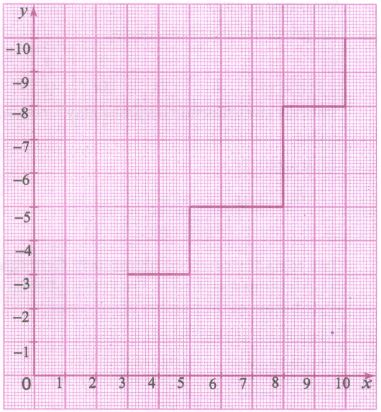
22.
Annual consumption at timet = 0 (In the year 2000) = p0 = 2547 metric ton.
Total production of Gold from 2000 to 2013 = \(\int _{ 0 }^{ 13 }{ 2547e^{ 0.006t } } dt\)
= \(\frac { 2547 }{ 0.006 } \left[ e^{ 0.006t } \right] _{ 0 }^{ 13 }\)
= 424500 (e0.078 −1)
= 34,426.95 metric tons approximately.
23.
Let I = ∫ xn log x dx
Let u = log x; dv = xn dx
\(du=\frac { 1 }{ x } dx;v=\frac { { x }^{ n+1 } }{ n+1 } \)
Using integration by parts we get,
∫ udv = uv - ∫ vdu
⇒ ∫ xn log x dx
\(=\frac { { x }^{ n+1 } }{ n+1 } \log\ x-\int { \frac { { x }^{ n+1 } }{ n+1 } } dx\)
\(=\frac { { x }^{ n+1 } }{ n+1 } \log\ x-\frac { 1 }{ n+1 } \int { { x }^{ n+1-1 }dx } \)
\(=\frac { { x }^{ n+1 } }{ n+1 } \log\ x-\frac { 1 }{ n+1 } \int { { x }^{ n } } dx\)
\(=\frac { { x }^{ n+1 } }{ n+1 } \log\ x-\frac { 1 }{ n+1 } \frac { { x }^{ n+1 } }{ n+1 } +c\)
\(=\frac { { x }^{ n+1 } }{ n+1 } \left( \log\ x-\frac { 1 }{ n+1 } \right) +c\)
24.
\(\int { \cos^{ 3 }xdx } =\frac { 1 }{ 4 } \int { \cos 3xdx+\frac { 3 }{ 4 } } \int { \cos x dx } \)
\(=\frac { \sin 3x }{ 12 } +\frac { 3 \sin\ x }{ 4 } +c\)
[Change into simple integrands
cos3x = 4cos3 x − 3cos x
\({ \cos }^{ 3 }x=\frac { 1 }{ 4 } [\cos 3x+3 \cos x]\)
\(=\frac { 1 }{ 4 } \cos 3x+\frac { 3 }{ 4 } \cos x\)
25.
\(\int { \frac { 7x-1 }{ { x }^{ 2 }-5x+6 } dx } =\int { \left[ \frac { 20 }{ x-3 } -\frac { 13 }{ x-2 } \right] dx } \)
\(=20\int { \frac { dx }{ x-3 } -13\int { \frac { dx }{ x-2 } } } \)
\(20log\left| x-3 \right| -13 \log\left| x-2 \right| +c\)
[ By partial fractions,
\(\frac { 7x-1 }{ { x }^{ 2 }-5x+6 } =\frac { A }{ x-3 } +\frac { B }{ x-2 } \Rightarrow \frac { 7x-1 }{ { x }^{ 2 }-5x+6 } =\frac { 20 }{ x-3 } -\frac { 13 }{ x-2 } \)]
26.
\(\int { \frac { { ax }^{ 2 }+bx+c }{ \sqrt { x } } dx } \)
=\(\int { \left( { ax }^{ \frac { 2 }{ 3 } }+{ bx }^{ \frac { 2 }{ 3 } }+{ cx }^{ -\frac { 1 }{ 2 } } \right) dx } \)
=\(a\int { { x }^{ \frac { 3 }{ 2 } }dx+b\int { { x }^{ \frac { 1 }{ 2 } }+c\int { { x }^{ -\frac { 1 }{ 2 } }dx } } } \)
=\(\frac { { 2ax }^{ \frac { 5 }{ 2 } } }{ 5 } +\frac { { 2bx }^{ \frac { 3 }{ 2 } } }{ 3 } +{ 2cx }^{ \frac { 1 }{ 2 } }+k\)
27.
Given A =\(\left( \begin{matrix} 4 & 5 & 2 \\ 3 & 2 & 1 \\ 4 & 4 & 8 \end{matrix}\begin{matrix} 2 \\ 6 \\ 0 \end{matrix} \right) \)
\(\left( \begin{matrix} 4 & 5 & 2 \\ 3 & 2 & 1 \\ 1 & 1 & 2 \end{matrix}\begin{matrix} 2 \\ 6 \\ 0 \end{matrix} \right) { R }_{ 3 }\rightarrow { R }_{ 3 }\div 4\)
\(\left( \begin{matrix} 1 & 1 & 2 \\ 3 & 2 & 1 \\ 4 & 5 & 2 \end{matrix}\begin{matrix} 0 \\ 6 \\ 2 \end{matrix} \right) { R }_{ 1 }\leftrightarrow { R }_{ 3 }\)
\(\left( \begin{matrix} 1 & 1 & 2 \\ 0 & -1 & -5 \\ 0 & 1 & -6 \end{matrix}\begin{matrix} 0 \\ 6 \\ 2 \end{matrix} \right) \)\({ R }_{ 2 }\rightarrow { R }_{ 2 }-3{ R }_{ 1 }\)
\(\left( \begin{matrix} 1 & 1 & 2 \\ 0 & -1 & -5 \\ 0 & 1 & -6 \end{matrix}\begin{matrix} 0 \\ 6 \\ 2 \end{matrix} \right) \begin{matrix} { R }_{ 2 }\rightarrow { R }_{ 2 }-3{ R }_{ 1 } \\ { R }_{ 3 }\rightarrow { R }_{ 3 }-4{ R }_{ 1 } \end{matrix}\)
\(\left( \begin{matrix} 1 & 1 & 2 \\ 0 & -1 & -5 \\ 0 & 0 & -11 \end{matrix}\begin{matrix} 0 \\ 6 \\ 8 \end{matrix} \right) { R }_{ 3 }\rightarrow { R }_{ 3 }+{ R }_{ 2 }\)
The last equivalent matrix is in echelon form and there are 3 non-zero rows
\(\therefore \rho (A)=3\)
28.
Let ‘x’ be the cost of a pencil
Let ‘y’ be the cost of an eraser
\(\therefore \) By given data, we get the following equations
11x + 3y = 64
8x + 3y = 49
\(\triangle =\left| \begin{matrix} 11 & 3 \\ 8 & 3 \end{matrix} \right| =9\neq 0,\) It has unique solution.
\({ \triangle }_{ x }\left| \begin{matrix} 64 & 3 \\ 49 & 3 \end{matrix} \right| =45\)
\({ \triangle }_{ y }\left| \begin{matrix} 11 & 64 \\ 8 & 49 \end{matrix} \right| =27\)
\(\therefore \) By Cramer’s rule
\(x={ \frac { \triangle x }{ \triangle } =\frac { 45 }{ 9 } =5 }\)
\(y={ \frac { \triangle y }{ \triangle } =\frac { 27 }{ 9 } =3 }\)
\(\therefore \) The cost of a pencil is Rs. 5 and the cost of an eraser is Rs. 3.
29.
Let A =\(\left( \begin{matrix} 0 & -1 & 5 \\ 2 & 4 & -6 \\ 1 & 1 & 5 \end{matrix} \right) \)
Order of A is 3 \(\times\) 3
∴ \(\rho \)(A)\(\le \)3
Consider the third order minor \(\left| \begin{matrix} 0 & -1 & 5 \\ 2 & 4 & -6 \\ 1 & 1 & 5 \end{matrix} \right| =6\neq 0\)
There is a minor of order 3, which is not zero
\(\therefore \rho (A)=3\)

12th Standard Syllabus & Materials
12th Standard
TN 12th Computer Applications களப்பெயர் முறைமை (DNS) Sample Question Papers Study Material - QB365 Set A
NEW12th Standard
TN 12th Computer Applications வலையமைப்பு எடுத்துக்காட்டுகள் மற்றும் நெறிமுறைகள் Sample Question Papers Study Material - QB365 Set A
NEW12th Standard
TN 12th Computer Applications கணினி வலையமைப்பு ஓர் அறிமுகம் Sample Question Papers Study Material - QB365 Set A
NEW12th Standard
TN 12th Computer Applications PHP-உடன் MySQL-ஐ இணைத்தல் Sample Question Papers Study Material - QB365 Set A



Tamilnadu Stateboard 12th Standard Subjects

Maths

Chemistry

Physics

Biology

Computer Science
Business Maths and Statistics

Economics

Commerce

Accountancy

History

Computer Applications
Biology
Computer Technology
Computer Applications
Computer Science
Business Maths and Statistics
Commerce
Economics
Maths
Chemistry
Physics
Computer Technology
History
Accountancy

Tamil

English

French
Tamilnadu Stateboard Standards
