
 100% FREE ACCESS
12th Standard Syllabus & Materials
12th Standard
TN 12th Maths Applications of Matrices and Determinants Sample Question Papers Study Material - QB365 Set A
NEW12th Standard
TN 12th Computer Applications மின்னணு தரவு பரிமாற்றம் Sample Question Papers Study Material - QB365 Set A
NEW12th Standard
TN 12th Computer Applications மின் - வணிக பாதுகாப்பு அமைப்புகள் Sample Question Papers Study Material - QB365 Set A
NEW12th Standard
TN 12th Computer Applications மின்னணு செலுத்தல் முறைகள் Sample Question Papers Study Material - QB365 Set A
NEW12th Standard
TN 12th Computer Applications மின் - வணிகம் Sample Question Papers Study Material - QB365 Set A
NEW12th Standard
TN 12th Computer Applications திறந்த மூல கருத்துருக்கள் Sample Question Papers Study Material - QB365 Set A

Published on: 01/09/2020
12th Standard Business Maths English Medium Model 3 Mark Creative Questions (New Syllabus) 2020
Download Tamil Nadu 12th Standard Business Maths and Statistics question papers, model tests, one-mark questions, important questions, and public exam papers in PDF format. Free study materials and answer keys for TN State Board students.
Questions + Answers key
Take MCQ Business Maths and Statistics Test
1.
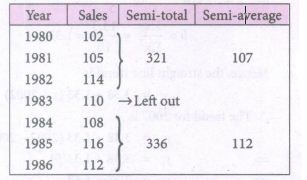
Find a trend line to the following data by the method of sami-averages.
| Years | 1980 | 1981 | 1982 | 1983 | 1984 | 1985 | 1986 |
| Sales | 102 | 105 | 114 | 110 | 108 | 116 | 112 |
2.
A company market car tyres. Their lives are normally distributed with a mean of 50,000 kms and standard derivation of 2000 kms. A test sample of 64 tyres has a mean life of 51250 km. Can you conclude that the sample mean differs significantly from the population mean? (Test at 5% level).
3.
The life of army shoes is normally distributed with mean 8 months and standard deviation 2 months. If 5000 pairs are issued, how many pairs would be expected to need replacement within 12 months.
4.
The standard deviation of a binomial distribution (q +p)16 is 2. Find its mean.
5.
If a continuous random variable. X has the p.d.f. f(x) = 4k(x-1)3, 1 ≤ x ≤ 3 then find p[-2 ≤ X ≤ 2]
6.
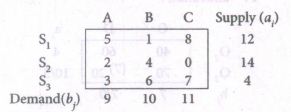
Find the initial basic feasible solution for the following transportation problem by Vogel's approximation method.
7.
For the given pay-off matrix, choose the best alternative for the given states of nature under
(i) Maximin (ii) Minimax princple
| Alternative | States of Nature | ||
| Good | Fair | Bad | |
| A | 100 | 60 | +50 |
| B | 80 | 50 | +10 |
| C | 40 | 20 | +5 |
8.
Evaluate ഽ sin3 x cos x dx
9.
Solve: (x+y)2\(\frac { dy }{ dx } \) = 1
10.
Estimate the population for the year 1995.
| year (x) | 1961 | 1971 | 1981 | 1991 | 2001 |
| population in thousands (y) | 46 | 66 | 81 | 93 | 101 |
11.
Find the area bounded by one arc of the curve y = sin ax and the x-axis.
12.
If \(\left[ \begin{matrix} 1 & 0 & 0 \\ 0 & 0 & 1 \\ 0 & 1 & 0 \end{matrix} \right] \left[ \begin{matrix} x \\ y \\ z \end{matrix} \right] =\left[ \begin{matrix} 2 \\ -1 \\ 3 \end{matrix} \right] \) find x,y and z
1.
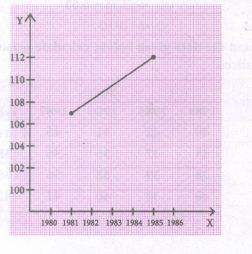
No of years = 7 (odd), by omitting the middle year we have
2.
Given sample size n = 64
Sample mean \(\bar { x } \) = 51250
Null hypotheses: H0: Population mean μ = 50000 Alternative hypotheses: H1 : μ≠ 50,000
The test statistic, z = \(\frac { \bar { x } -\mu }{ \frac { \sigma }{ \sqrt { n } } } =\frac { 51250-50000 }{ \frac { 2000 }{ \sqrt { 64 } } } \)=5
∴ z = 5
As the significance level is α = 0.05, \(Z_{ \frac { \alpha }{ 2 } }\) = 1.96
Here z > zα as 5 < 1.96
Inference: As z > zα, H0 is rejected. Hence, we can conclude that the sample mean differs significantly from the population mean.
3.
Let X denote the life of army shoes.
Given μ = 8, σ = 2 and N = 5000
When μ = 12, Z = \(\frac { X-\mu }{ \sigma } =\frac { 12-8 }{ 2 } \) = 2
∴ P(X≤12) = P(Z≤2)
= P(-∞
P(X≤12) = 0.9772
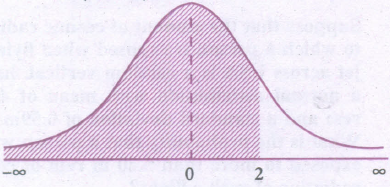
∴ The probability for a shoe need to be replaces is 0.9772.
∴ Out of 5000 pairs of shoes, number of pairs need to be replaced = 5000 \(\times\) 0.9772
= 4886.
4.
Given n = 16, S.D = 2 ⇒ \(\sqrt { npq } \) =2
⇒ npq = 4
∴ 16(pq) = 4 ⇒ pq =\(\frac { 4 }{ 16 } =\frac { 1 }{ 4 } \)
⇒ q = \(\frac { 1 }{ 4p } \)...(1)
Since p + q = 1 ⇒ p+\(\frac { 1 }{ 4p } \)=1
⇒ \(\frac { 4{ p }^{ 2 }+1 }{ 4p } \) = 1
⇒ 4p2+1 = 4p ⇒ 4p2 -4p+1 = 0
⇒ (2p-1)2 = 0 ⇒ 2p-1 = 0
⇒ 2p = 1 ⇒ p = \(\frac { 1 }{ 2 } \)
∴ q = 1-p = \(1-\frac { 1 }{ 2 } =\frac { 1 }{ 2 } \)
Mean = np = 16 x \(\frac { 1 }{ 2 } \) = 8
5.
Given f(x) = 4k(x-1)3,1 ≤ x ≤ 3
Since f(x) is a p.d.f., \(\int _{ 1 }^{ 3 }{ f(x)dx=1 } \)
\(\Rightarrow \int _{ 1 }^{ 3 }{ 4k({ x-1) }^{ 3 }dx=1\Rightarrow { \left[ \frac { 4k(x-1{ ) }^{ 4 } }{ 4 } \right] }_{ 1 }^{ 3 }=1 } \)
\(\Rightarrow k({ 2 }^{ 4 }-{ 0 }^{ 4 })=1\Rightarrow k(16)=1\)
\(\Rightarrow k=\frac { 1 }{ 16 } \)
\(p(-2\le x\le 2)=\int _{ -2 }^{ 2 }{ f(x)dx } \)
\(=\int _{ 1 }^{ 2 }{ 4k({ x-1) }^{ 3 }dx } \)
\(=\frac { 4 }{ 16 } \int _{ 1 }^{ 2 }{ { (x-1) }^{ 3 }dx } \)
\([\therefore k=\frac { 1 }{ 16 } ]\)
\(=\frac { 1 }{ 4 } { \left[ \frac { { (x-1) }^{ 4 } }{ 4 } \right] }_{ 1 }^{ 2 }\)
\(=\frac { 1 }{ 16 } ({ 1 }^{ 4 }-0)=\frac { 1 }{ 16 } \)
6.
Σai = 12 + 14 + 4 = 30
Σbj = 9 + 10 + 11 = 30
Σai = Σbj
∴ The given problem is a balanced transportation problem.
Hence, there exists a feasible solution to the given problem.
I - allocation :
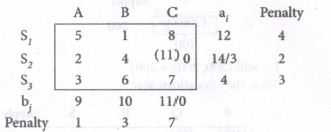
[∵ the highest penalty is 7, In C, least cost is 0 & min (11, 14) = 11]
II - allocation :
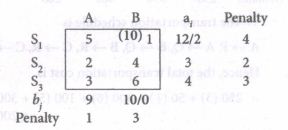
[∵ the highest penalty is 4, In S1'least cost is 1& min (10, 12) = 10]
III - allocation :
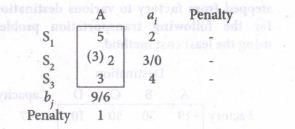
[∵ In A, least cost is 2 & min (9, 3) = 3]
IV - allocation :
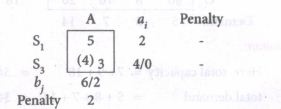
[∵ In A, least cost is 3 & min (6,4) = 4]
V - allocation :
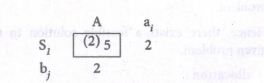
[∵ min (2, 2) = 2]
Thus, the allocations are
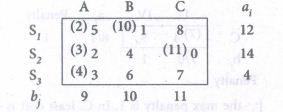
∴ The transportation schedule is
S1 → A, S1 → B, S2 → A, S2 → C S3 → A
Hence, the total transportation cost is
= 2(5) + 10(1) + 3(2) + 11(0) + 4(3)
= 10 + 10 + 6 + 0 + 12 = Rs. 38
7.
| Alternative | States of Nature | Minimum | Maximum | ||
| Good | Fair | Bad | |||
| A | 100 | 60 | +50 | +50 | 100 |
| B | 80 | 50 | +10 | 10 | 80 |
| C | 40 | 20 | +5 | 5 | 40 |
(i) Max (50, 10, 5) = 50
∴ A is the best alternative under maximin principle
(ii) Min (100, 80,40) = 40
∴ C is the best alternative under minimax principle
8.
Let I = ഽ sin3 x cos x dx
Put t = sin x
⇒ dt = cos x dx
∵ I = t3.dt = \(\frac { { t }^{ 4 } }{ 4 } +c\)
= \(\frac { { sin }^{ 4 }x }{ 4 } +c\)
9.
Given (x+y)2\(\frac { dy }{ dx } \) = 1
put x+y = z
⇒ 1+\(\frac { dy }{ dx } =\frac { dz }{ dx } \)
\(\frac { dy }{ dx } =\frac { dz }{ dx } \)-1
∴ (1) becomes,
z2\(\left( \frac { dz }{ dx } -1 \right) \)= 1
⇒ z2\(\frac { dz }{ dx } \)-z2 = 1
⇒ z2\(\frac { dz }{ dx } \) = 1 + z2
Separating the variables we get,
\(\left( \frac { { z }^{ 2 } }{ 1+{ z }^{ 2 } } \right) \)dz = dx
Adding and Subtracting 1 in the numerator, we get
\(\left( \frac { 1+{ z }^{ 2 }-1 }{ 1+{ z }^{ 2 } } \right) \)dz = dx
⇒ \(\left( \frac { 1+{ z }^{ 2 } }{ 1+{ z }^{ 2 } } -\frac { 1 }{ 1+{ z }^{ 2 } } \right) \)dz = dx
⇒ \(\left( z-\frac { 1 }{ 1+{ z }^{ 2 } } \right) \)dz = dx
Integrating, \(\int { dz } -\int { \frac { dz }{ 1+{ z }^{ 2 } } } \)
[∵ \(\int { \frac { dz }{ 1+{ z }^{ 2 } } } \) = tan-1x+y]
⇒ (z-tan-1(2) = x+C
⇒ (x+y)-tan-1(x+y) = x + C
⇒ y-tan-1(x+y) = C
10.
Since 1995 lies at the table of the table, use Newton's backward interpolation formula.
Also, xn + nh ⇒ x 2001 + n (10) = 1995
⇒ 10n = 1995 - 2001 ⇒ n = \(\frac{-6}{10}\) ⇒ n = -0.6
\(\Rightarrow { y }_{ n }+\frac { n }{ n! } \nabla { y }_{ n }+\frac { n(n+1) }{ 2! } { \nabla }^{ 2 }{ y }_{ n }+\frac { n(n+1)(n-2) }{ 3! } { \nabla }^{ 3 }{ (y }_{ n })\)
The difference table is
| x | y | ∇y | ∇2y | ∇3y | ∇4y |
|---|---|---|---|---|---|
| 1961 | 46 | ||||
| 1971 | 66 | 20 | |||
| 1981 | 81 | 15 | -5 | ||
| 1991 | 93 | 12 | -3 | -2 | |
| 2001 | 101 | 8 | -4 | -1 | -3 |
∴ \(y=101+\frac { (0.6) }{ 1! } (8)+\frac { (-0.6)(-0.6+1) }{ 2! } (-4)+\frac { (-0.6)(-0.6+1)(-0.6+2) }{ 3! } (-1)+\frac { (-0.6)(-0.6+1)(-0.6+2)(-0.6+3) }{ 4! } (-3)\)
= 101 - (0.6)8 + \(\frac { (-0.6)(0.4) }{ 2 } (-4)+\frac { (-0.6)(0.4)(1.4) }{ 6 } (-1)+\frac { (0.6)(0.4)(1.4)(2.4)(-3) }{ 24 } \)
= 96.8368
Hence, population for the year 1995 is 96.837 thousands.
11.
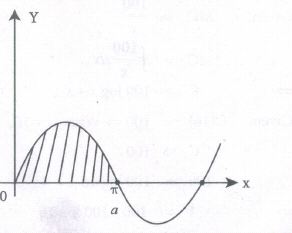
The limits for one arch of the curve y = sin ax When y = 0 ⇒Sin ax = 0
⇒ sin ax = sin 0, sin \(\pi\)
⇒ ax = 0 or ax = \(\pi\)
⇒ x = 0, x = \(\frac{\pi}{a}\)
∴ The limits are from x = 0 to x = \(\frac{\pi}{a}\)
∴ Area =\(\int _{ a }^{ b }{ ydx } \)
\(=\int _{ 0 }^{ a }{ sin\quad ax\quad dx } \)
\(={ \left[ -\frac { cos\quad ax }{ a } \right] }_{ 0 }^{ \frac { \pi }{ a } }\)
\(=-\frac { 1 }{ a } \left[ cos\quad a\times \frac { \pi }{ a } -cos(a)(0) \right] \)
\(=-\frac { 1 }{ a } \left[ cos\quad \pi -cos0 \right] \)
\(=-\frac { 1 }{ a } (-1-1)[\because cos0=1\ cos\pi =-1]\)
\(A=\frac { 2 }{ a } \) sq.units.
12.
\(\left[ \begin{matrix} 1 & 0 & 0 \\ 0 & 0 & 1 \\ 0 & 1 & 0 \end{matrix} \right] \left[ \begin{matrix} x \\ y \\ z \end{matrix} \right] =\left[ \begin{matrix} 2 \\ -1 \\ 3 \end{matrix} \right] \)
\(\Rightarrow \left( \begin{matrix} x0+0 \\ 0+0+z \\ 0+y+0 \end{matrix} \right) =\left( \begin{matrix} 2 \\ -1 \\ 3 \end{matrix} \right) \)
\(\Rightarrow \left( \begin{matrix} x \\ y \\ z \end{matrix} \right) =\left( \begin{matrix} 2 \\ -1 \\ 3 \end{matrix} \right) \)
\(\Rightarrow x=2\quad z=-1\quad y=3\)
\(\therefore\) Solution set is {2,3, -1}

12th Standard Syllabus & Materials
12th Standard
TN 12th Computer Applications வலையமைப்பு வடமிடல் Sample Question Papers Study Material - QB365 Set A
NEW12th Standard
TN 12th Computer Applications களப்பெயர் முறைமை (DNS) Sample Question Papers Study Material - QB365 Set A
NEW12th Standard
TN 12th Computer Applications வலையமைப்பு எடுத்துக்காட்டுகள் மற்றும் நெறிமுறைகள் Sample Question Papers Study Material - QB365 Set A
NEW12th Standard
TN 12th Computer Applications கணினி வலையமைப்பு ஓர் அறிமுகம் Sample Question Papers Study Material - QB365 Set A



Tamilnadu Stateboard 12th Standard Subjects

Maths

Chemistry

Physics

Biology

Computer Science
Business Maths and Statistics

Economics

Commerce

Accountancy

History

Computer Applications
Biology
Computer Technology
Computer Applications
Computer Science
Business Maths and Statistics
Commerce
Economics
Maths
Chemistry
Physics
Computer Technology
History
Accountancy

Tamil

English

French
Tamilnadu Stateboard Standards
