
 100% FREE ACCESS
12th Standard Syllabus & Materials
12th Standard
TN 12th Computer Applications மின்னணு தரவு பரிமாற்றம் Sample Question Papers Study Material - QB365 Set A
NEW12th Standard
TN 12th Computer Applications மின் - வணிக பாதுகாப்பு அமைப்புகள் Sample Question Papers Study Material - QB365 Set A
NEW12th Standard
TN 12th Computer Applications மின்னணு செலுத்தல் முறைகள் Sample Question Papers Study Material - QB365 Set A
NEW12th Standard
TN 12th Computer Applications மின் - வணிகம் Sample Question Papers Study Material - QB365 Set A
NEW12th Standard
TN 12th Computer Applications திறந்த மூல கருத்துருக்கள் Sample Question Papers Study Material - QB365 Set A
NEW12th Standard
TN 12th Computer Applications வலையமைப்பு வடமிடல் Sample Question Papers Study Material - QB365 Set A

Published on: 30/09/2020
12th Standard Business Maths English Medium Model 5 Mark Book Back Questions (New Syllabus 2020)
Download Tamil Nadu 12th Standard Business Maths and Statistics question papers, model tests, one-mark questions, important questions, and public exam papers in PDF format. Free study materials and answer keys for TN State Board students.
Questions + Answers key
Take MCQ Business Maths and Statistics Test
1.
The probability function of a random variable X is given by
\(p(x)=\left\{\begin{array}{l} \frac{1}{4}, \text { for } x=-2 \\ \frac{1}{4}, \text { for } x=0 \\ \frac{1}{2}, \text { for } x=10 \\ 0, \text { elsewhere } \end{array}\right.\)
Evaluate the following probabilities.
P(X<0)
2.
Using Lagrange’s interpolation formula find a polynomial which passes through the points (0, –12), (1, 0), (3, 6) and (4,12).
3.
Find f(2.8) from the following table.
| x | 0 | 1 | 2 | 3 |
| f(x) | 1 | 2 | 11 | 34 |
4.
Find the missing entries from the following
| x | 0 | 1 | 2 | 3 | 4 | 5 |
| y = f(x) | 0 | - | 8 | 15 | - | 35 |
5.
The population of a certain town is as follows
| Year : x | 1941 | 1951 | 1961 | 1971 | 1981 | 1991 |
| Population in lakhs:y | 20 | 24 | 29 | 36 | 46 | 51 |
Using appropriate interpolation formula, estimate the population during the period 1946.
6.
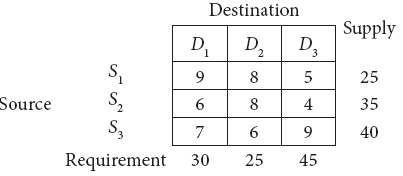
Determine an initial basic feasible solution to the following transportation problem by using North West Corner rule
7.
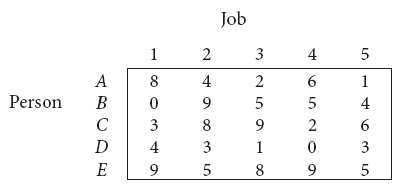
Consider the problem of assigning five jobs to five persons. The assignment costs are given as follows. Determine the optimum assignment schedule.
8.
Solve \(\frac { dy }{ dx } +ycosx+x=2cosx\).
9.
Solve the following differential equations (3D2 + D − 14)y = 13e2x
10.
Using the following data, construct Fisher’s Ideal Index Number and Show that it satisfies Factor Reversal Test and Time Reversal Test?
| Commodities | Price | Quantity | ||
| Base Year | Current year | Base Year | Current year | |
| Wheat | 6 | 10 | 50 | 56 |
| Ghee | 2 | 2 | 100 | 120 |
| Firewood | 4 | 6 | 60 | 60 |
| Sugar | 10 | 12 | 30 | 24 |
| Cloth | 8 | 12 | 40 | 36 |
11.
\(\frac { dy }{ dx } +\frac { y }{ x } ={ xe }^{ x }\)
12.
Solve \(\frac { dy }{ dx } \) −3ycot x = sin 2x given that y = 2 when x = \(\frac { \pi }{ 2 } \)
13.
A quality control inspector has taken ten samples of size four packets each from a potato chips company. The contents of the sample are given below, Calculate the control limits for mean and range chart.
| Sample Number | Observations | |||
| 1 | 2 | 3 | 4 | |
| 1 | 12.5 | 12.3 | 12.6 | 12.7 |
| 2 | 12.8 | 12.4 | 12.4 | 12.8 |
| 3 | 12.1 | 12.6 | 12.5 | 12.4 |
| 4 | 12.2 | 12.6 | 12.5 | 12.3 |
| 5 | 12.4 | 12.5 | 12.5 | 12.5 |
| 6 | 12.3 | 12.4 | 12.6 | 12.6 |
| 7 | 12.6 | 12.7 | 12.5 | 12.8 |
| 8 | 12.4 | 12.3 | 12.6 | 12.5 |
| 9 | 12.6 | 12.5 | 12.3 | 12.6 |
| 10 | 12.1 | 12.7 | 12.5 | 12.8 |
(Given for n = 5, A2 = 0.58, D3 = 0 and D4 = 2.115)
14.
Using Fisher’s Ideal Formula, compute price index number for 1999 with 1996 as base year, given the following:
| Year | Commodity: A | Commodity: B | Commodity: C | |||
| Price (Rs.) | Quantity (Kg) | Price (Rs.) | Quantity (Kg) | Price (Rs.) | Quantity (Kg) | |
| 1996 | 5 | 10 | 8 | 6 | 6 | 3 |
| 1999 | 4 | 12 | 7 | 7 | 5 | 4 |
15.
Solve the following homogeneous differential equations.
\((x-y)\frac { dy }{ dx } =x+3y\).
16.
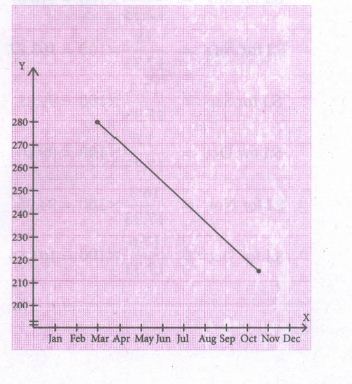
The sales of a commodity in tones varied from January 2010 to December 2010 as follows:
| In year 2010 | Jan | Feb | Mar | Apr | May | Jun | Jul | Aug | Sep | Oct | Nov | Dec |
| Sales (in tones) | 280 | 240 | 270 | 300 | 280 | 290 | 210 | 200 | 230 | 200 | 230 | 210 |
Fit a trend line by the method of semi-average.
17.
Calculate the cost of living index number by consumer price index number for the year 2016 with respect to base year 2011 of the following data
\(\begin{array}{|c|c|c|c|} \hline & {\text { Price }} & \\ \begin{array}{c} \text { Commodities } \\ \text { } \end{array} & \begin{array}{c} \text { Base } \\ \text { year } \end{array} & \begin{array}{c} \text { Current } \\ \text { year } \end{array} & \text { Quantity } \\ \hline \text { Rice } & 32 & 48 & 25 \\ \hline \text { Sugar } & 25 & 42 & 10 \\ \hline \text { Oil } & 54 & 85 & 6 \\ \hline \text { Coffee } & 250 & 460 & 1 \\ \hline \text { Tea } & 175 & 275 & 2 \\ \hline \end{array}\)
18.
Calculate Fisher’s price index number and show that it satisfies both Time Reversal Test and Factor Reversal Test for data given below.
| Commodities | Price | Quandity | ||
| 2003 | 2009 | 2003 | 2009 | |
| Rice | 10 | 13 | 4 | 6 |
| Wheat | 125 | 18 | 7 | 8 |
| Rent | 25 | 29 | 5 | 9 |
| Fuel | 11 | 14 | 8 | 10 |
| Miscellaneous | 14 | 17 | 6 | 7 |
19.
The normal lines to a given curve at each point(x,y) on the curve pass through the point (1, 0). The curve passes through the point (1, 2). Formulate the differential equation representing the problem and hence find the equation of the curve.
20.
Given below are the data relating to the sales of a product in a district.
Fit a straight line trend by the method of least squares and tabulate the trend values.
| Year | 1995 | 1996 | 1997 | 1998 | 1999 | 2000 | 2001 | 2002 |
| Sales | 6.7 | 5.3 | 4.3 | 6.1 | 5.6 | 7.9 | 5.8 | 6.1 |
21.
A random sample of 60 observations was drawn from a large population and its standard deviation was found to be 2.5. Calculate the suitable standard error that this sample is taken from a population with standard deviation 3?
22.
Evaluate the following integrals as the limit of the sum:
\(\int _{ 1 }^{ 3 }{ xdx } \)
23.
A machine produces a component of a product with a standard deviation of 1.6 cm in length. A random sample of 64 componentsvwas selected from the output and this sample has a mean length of 90 cm. The customer will reject the part if it is either less than 88 cm or more than 92 cm. Does the 95% confidence interval for the true mean length of all the components produced ensure acceptance by the customer?
24.
A manufacturer of metal pistons finds that on the average, 12% of his pistons are rejected because they are either oversize or undersize. What is the probability that a batch of 10 pistons will contain
(a) no more than 2 rejects?
(b) at least 2 rejects?
25.
The average number of customers, who appear in a counter of a certain bank per minute is two. Find the probability that during a given minute
(i) No customer appears
(ii) three or more customers appear
26.
If 5% of the items produced turn out to be defective, then find out the probability that out of 20 items selected at random there are
(i) exactly three defectives
(ii) atleast two defectives
(iii) exactly 4 defectives
(iv) find the mean and variance
27.
If the probability that an individual suffers a bad reaction from injection of a given serum is 0.001, determines the probability that out of 2,000 individuals
(a) exactly 3, and
(b) more than 2 individuals will suffer a bad reaction.
28.
The demand equation for a product is pd = 20 − 5x and the supply equation is ps = 4x + 8. Determine the consumer’s surplus and producer’s surplus under market equilibrium.
29.
Determine the mean and variance of a discrete random variable, given its distribution as follows.
| X = x | 1 | 2 | 3 | 4 | 5 | 6 |
| Fx(x) | \(\frac{1}{6}\) | \(\frac{2}{6}\) | \(\frac{3}{6}\) | \(\frac{4}{6}\) | \(\frac{5}{6}\) | 1 |
30.
The marginal cost of production of a firm is given by C'(x) = 5 + 0.13x, the marginal revenue is given by R'(x) = 18 and the fixed cost is Rs. 120. Find the profit function.
31.
A continuous random variable X has the following distribution function:
\(f(x)=\left\{\begin{array}{l} 0 , \text{if} \ x \leq1 \\ k(x-1)^4, \text{if} \ 1< x \leq 3 \\ 1, \text{if} \ x > 3 \end{array}\right.\)
Find (i) k and (ii) the probability density function.
32.
The price of a machine is Rs. 5,00,000 with an estimated life of 12 years. The estimated salvage value is Rs. 30,000. The machine can be rented at Rs. 72,000 per year. The present value of the rental payment is calculated at 9% interest rate. Find out whether it is advisable to rent the machine.(e−1.08 = 0.3396).
33.
A continuous random variable X has p.d.f
f(x) = 5x4, 0\(\le\)x\(\le\)1
Find a1 and a2 such that
i) P[X\(\le\)a1] = P[X>a1]
ii) P[X>a2] = 0.05
34.
Using integration find the area of the circle whose center is at the origin and the radius is a units.
35.
Integrate the following with respect to x.
\(\frac { { 3x }^{ 2 }-2x+5 }{ { \left( x-1 \right) }\left( x^{ 2 }+5 \right) } \)
36.
Find k if the equations x + y + z = 1, 3x − y − z = 4, x+ 5y + 5z = k are inconsistent.
37.
A total of Rs. 8,500 was invested in three interest earning accounts. The interest rates were 2%, 3% and 6% if the total simple interest for one year was Rs. 380 and the amount, invested at 6% was equal to the sum of the amounts in the other two accounts, then how much was invested in each account? (use Cramer’s rule).
38.
Find k, if the equations x + y + z = 7, x + 2y + 3z = 18, y + kz = 6 are inconsistent
39.
Evaluate \(\int _{ 1 }^{ e }{ \log x } \) dx
1.
Given probability function is
\(p(x)=\left\{\begin{array}{l} \frac{1}{4}, \text { for } x=-2 \\ \frac{1}{4}, \text { for } x=0 \\ \frac{1}{2}, \text { for } x=10 \\ 0, \text { elsewhere } \end{array}\right.\)
| X=x | -2 | 0 | 10 |
| P(X=x) | \(\frac{1}{4}\) | \(\frac{1}{4}\) | \(\frac{1}{2}\) |
P(X<0)=P(X=-2)
= 1/4
2.
Given
| x | 0 | 1 | 3 | 4 |
| y | -12 | 0 | 6 | 12 |
Here the intervals are unequal
∴ By Lagranges interpolation formula, we have
x0 = 0, x1 = 1, x2 = 3, x3 = 4
y0 = -12, y1 = 0, y2 = 6, y3 = 12 and x = x.
∴ y = f(x) = \(\frac { (x-{ x }_{ 1 })(x-{ x }_{ 2 })(x-{ x }_{ 3 }) }{ ({ x }_{ 0 }-{ x }_{ 1 })({ x }_{ 0 }-{ x }_{ 2 })({ x }_{ 0 }-{ x }_{ 3 }) } \times { y }_{ 0 }+\frac { (x-{ x }_{ 0 })(x-{ x }_{ 2 })(x-{ x }_{ 3 }) }{ ({ x }_{ 1 }-{ x }_{ 0 })({ x }_{ 1 }-{ x }_{ 2 })(x_{ 1 }-{ x }_{ 3 }) } \times { y }_{ 1 }+\frac { (x-{ x }_{ 0 })(x-{ x }_{ 1 })(x-{ x }_{ 3 }) }{ ({ x }_{ 2 }-{ x }_{ 0 })({ x }_{ 2 }-{ x }_{ 1 })({ x }_{ 2 }-{ x }_{ 3 }) } \times { y }_{ 2 }+\frac { (x-{ x }_{ 0 })(x-{ x }_{ 1 })(x-{ x }_{ 2 }) }{ ({ x }_{ 3 }-{ x }_{ 0 })({ x }_{ 3 }-{ x }_{ 1 })({ x }_{ 3 }-{ x }_{ 2 }) } \times { y }_{ 3 }\)
= \(\frac { (x-1)(x-3)(x-4) }{ (0-1)(0-3)(0-4) } (-12)+\frac { (x-0)(x-3)(x-4) }{ (1-0)(1-3)(1-4) } (0)+\frac { (x-0)(x-1)(x-4) }{ (3-0)(3-1)(3-4) } (6)+\frac { (x-1)(x-3)(x-4) }{ (4-0)(4-1)(4-3) } (12)\)
= \(\frac { (x-1)(x-3)(x-4) }{ (-1)(-3)(-4) } (-12)+0+\frac { x(x-1)(x-4) }{ (3)(2)(-1) } (6)+\frac { x(x-1)(x-3) }{ (4)(3)(1) } (12)\)
= +[(x - 1)(x - 3)(x - 4)] - x (x - 1)(x - 4) + x(x - 1)(x - 3)
= +[(x3-4x+3)(x-4)] -x(x2-5x+4) + x(x2-4x + 3)
= - (x3 - 8x2+ 19x - 12) - 4x2 + 3x
= (x - 4)(x2 - 4x + 3) - x (x2 - 5x + 4) + x(x2 - 4x + 3)

= x3 - 7x2 + 19x - 12.
3.
Given
| x | 0 | 1 | 2 | 3 |
| f(x) | 1 | 2 | 11 | 34 |
Find f(2.8)
Since the required value 2.8 is at the end of the table, apply Newton's backward interpolation formula.
xn + nh = 2.8 ⇒ 3 + n (1) = 2.8
⇒ n = 2.8 - 3 = -0.2
The difference table is
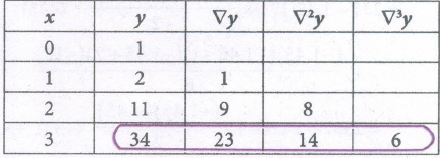
Newton's backward interpolation formula is
y(x = xn + nh) = \(\frac { n }{ 1! } { \triangledown y }_{ n }+\frac { n(n+1) }{ 2! } { \triangledown }^{ 2 }{ y }_{ n }+\frac { n(n+1)(n+2) }{ 3! } { \triangledown }^{ 3 }{ y }_{ n }\)
⇒ y(2.8) = 34 + (-0.2) (23) + \(\frac { (-0.2)(-0.2+1) }{ 2 } (14)+\frac { (0.2)(-0.2+1)(-0.2+2) }{ 6 } \)(16)
⇒ y(2.8) = 34 - 4.6 + (-0.2) (0.8) (7) + (-0.2) (0.8) (1.8)
⇒ y(2.8) = 34 - 4.6 - 1.12- 0.288
⇒ y(2.8) = 27.992
4.
Let the missing entries by y1 and y4
Since only four values of f(x) are given, the polynomial which fits the data is of degree 3.
Hence fourth differences are zero.
∴ Δ4yk = 0 ⇒ (E - 1)4yk = 0
(E4 - 4E3 + 6E2- 4E + 1) yk = 0
Put k = 0 in (1) we get,
(E4 - 4E3 + 6E2 - 4E + 1)y0 = 0
⇒ y4 - 4y3 + 5y2 - 4y1 + y0 = 0
⇒ y4 - 4(15) + 6(8) - 4(y1) + 0 = 0
⇒ y4 - 60 + 48 - 4y1 = 0
⇒ y4 - 4y1 - 12 = 0
⇒ y4 - 4y1 = 12 (2)
put k = 1 in (1) we get
(E4- 4E3 + 6E2 - 4E + 1) y1 = 0
⇒ y5 - 4y4 + 6y3 - 4y2 + y1 = 0
⇒ 35 - 4y4 + 6 (15) - 4 (8) +y1 = 0
⇒ 35 - 4y4 + 90 - 32 +y1 = 0
⇒ 4y4 +y1 = -93 (3)
| (2) x 4 ➝ | 4y4 - 16y1 | = 48 |
| (3) ➝ | -4y4 + y1 | = -93 |
| Adding | -15y1 | = -45 |
⇒ y1 = \(\frac{-45}{-15}\) = 3
⇒ y1 = 3.
Substituting y1 = 3 in (2) we get,
y4 - 4(3) = 12
y4 - 12 = 12
⇒ y4 = 12 + 12
⇒ y4 = 24
Hence the missing entries are 3 and 24.
5.
| x | 1941 | 1951 | 1961 | 1971 | 1981 | 1991 |
| y | 20 | 24 | 29 | 36 | 46 | 51 |
Here we find the population for year 1946. (i.e) the value of y at x = 1946. Since the value of y is required near the beginning of the table, we use the Newton’s forward interpolation formula.
\({ y }_{ \left( x={ x }_{ 0 }+nh \right) }={ y }_{ 0 }+\frac { n }{ n! } \Delta { y }_{ 0 }+\frac { n(n-1) }{ 2! } { \Delta }^{ 2 }{ y }_{ 0 }+\frac { n(n-)(n-2) }{ 3! } { \Delta }^{ 3 }{ y }_{ 0 }+..\)
To find y at x = 1946
\(\therefore\) x0 + nh = 1946, x0 = 1941, h = 10
1941 + n(10) = 1946 \(\Rightarrow\) n = 0.5
| x | y | \(\Delta y\) | \(\Delta ^{ 2 }y\) | \(\Delta ^{ 3 }y\) | \(\Delta ^{ 4 }y\) | \(\Delta ^{ 5 }y\) |
| 1941 | 20 | |||||
| 4 | ||||||
| 1951 | 24 | 1 | ||||
| 5 | 1 | |||||
| 1961 | 29 | 2 | 0 | |||
| 7 | 1 | -9 | ||||
| 1971 | 36 | 3 | -9 | |||
| 10 | -8 | |||||
| 1981 | 46 | -5 | ||||
| 5 | ||||||
| 1991 | 51 |
Here we find the population for year 1946. (i.e) the value of y at x = 1946. Since the value of y is required near the beginning of the table, we use the Newton’s forward interpolation formula.
\({ y }_{ \left( x=1946 \right) }=20+\frac { 0.5 }{ 1! } (4)+\frac { 0.5(0.5-1) }{ 2! } (1)+\frac { 0.5(0.5-1)(0.5-2) }{ 3! } (1)+\frac { 0.5(0.5-1)(0.5-2)(0.5-3) }{ 4! } (0)+\frac { 0.5(0.5-1)(0.5-2)(0.5-3)(0.5-4) }{ 5! } (-9)\)
= 20+2-0.125+0.0625-0.24609
= 21.69 lakhs
6.
Here total supply = 25 + 35 + 40 = 100
total requirement = 30 + 25 + 45 100
total supply = total requirement
∴ The given problem is a balanced transportation problem.
Hence, there exists a feasible solution for the given transportation problem.
North West Corner Rule:
I - allocation:
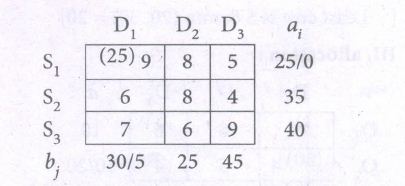
[∵ min (25, 30) = 25]
II - allocation:
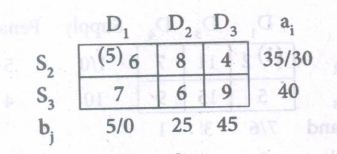
[∵ min (5, 35) = 5]
III - allocation:
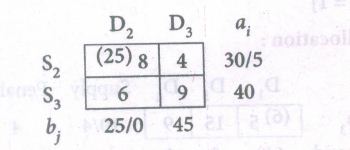
[∵ min (25, 30) = 25]
IV - allocation:
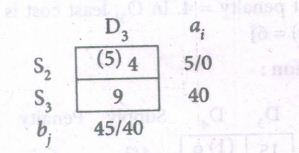
[∵ min (5, 45) = 5]
V - allocation:
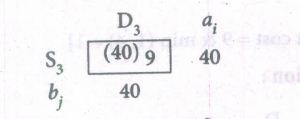
[∵ min (40, 40) = 40]
Thus, the allocations are
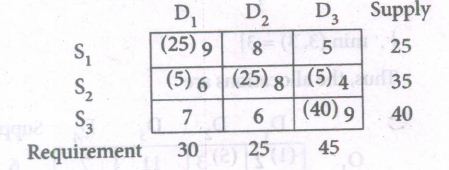
∴ The transportation schedule is
S1 → D1, S2 → D1, S2 → D2, S2 → D3, S3 → D3
Hence, the total transportation cost
= 25(9) + 5(6) + 25(8) + 5(4) + 40(9)
= 225 + 30 + 200 + 20 + 360
= Rs. 835
7.
Here the number of rows and columns are equal.
\(\therefore\) The given assignment problem is balanced.
Now let us find the solution.
Step 1: Select a smallest element in each row and subtract this from all the elements in its row.
The cost matrix of the given assignment problem is
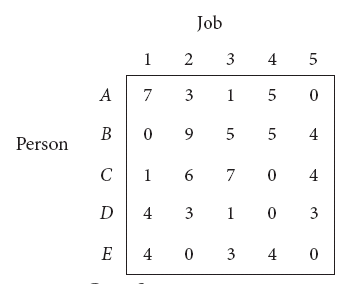
Column 3 contains no zero. Go to Step 2.
Step 2: Select the smallest element in each column and subtract this from all the elements in its column.
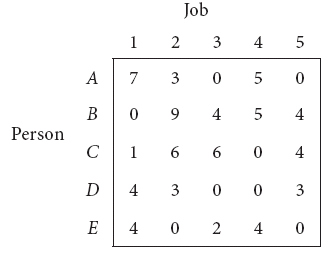
Since each row and column contains atleast one zero, assignments can be made.
Step 3: (Assignment):
Examine the rows with exactly one zero. Row B contains exactly one zero. Mark that zero by \(\square\) (i.e) Person B is assigned to Job 1. Mark other zeros in its column by ×.
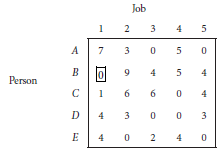
Now, Row C contains exactly one zero. Mark that zero by \(\square\). Mark other zeros in its column by × .
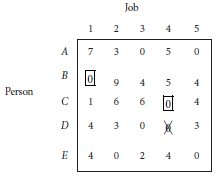
Now, Row D contains exactly one zero. Mark that zero by \(\square\) . Mark other zeros in its column by × .
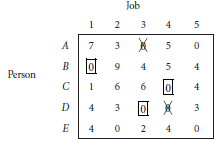
Row E contains more than one zero, now proceed column wise. In column 1, there is an assignment. Go to column 2. There is exactly one zero. Mark that zero by \(\square\) . Mark other zeros in its row by × .
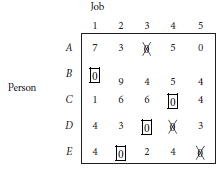
There is an assignment in Column 3 and column 4. Go to Column 5. There is exactly one zero. Mark that zero by \(\square\) . Mark other zeros in its row by × .
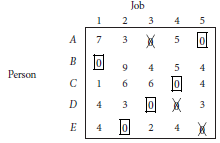
Thus all the five assignments have been made. The Optimal assignment schedule and total cost is
| Person | Job | cost |
| A | 5 | 1 |
| B | 1 | 0 |
| C | 4 | 2 |
| D | 3 | 1 |
| E | 2 | 5 |
| Total cost | 9 | |
The optimal assignment (minimum) cost = Rs. 9
8.
\(\frac { dy }{ dx } \)+y cosx = 2 cosx
This is of the form \(\frac { dy }{ dx } \)+Py = Q where
P = cos x and Q = 2 cos x
\(\int { P } dx=\int { cosx } dx\) = sinx
Integrating factor (I.F.) = \(e^{ \int { P } dm }=e^{ sinx }\)
∴ The Solution is
\(ye^{ \int { P } dm }=\int { Q } e^{ \int { P } dm }dx\)
⇒ y esinx =\(\int { (2cosx){ e }^{ sinx } } dx\)+C
⇒ y esinx = 2\(\int { cosx } e^{ sinx }dx\)+C
⇒ y esinx = 2I1+C ..(1)
I1=\(\int { cosx } e^{ sinx }dx\)
put sin x = t ⇒ cos dx = dt
∴ It =\(\int { { e }^{ t } } dt\) = et = esinx
∴ (1) becomes, y esinx = 2.esinx + C
9.
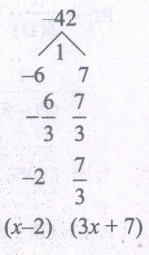
The auxiliary equation is 3m2 + m -14 = 0
(m-2)\(\frac { 7 }{ 3 } \) = 0
⇒ m = 2, -\(\frac { 7 }{ 3 } \)
The roots are real and different
∴ CF is Ae2x+\(Be^{ -\frac { 7 }{ 3 } x }\)
Particular Integral PI = \(\frac { 1 }{ \phi (D) } \).f(x)
PI = \(\frac { 1 }{ (3D^{ 2 }+D-14) } \).13 e2x
= \(\frac { 13.e^{ 2x } }{ 3D^{ 2 }+D-14 } \)
= \(\frac { 13e^{ 2x } }{ (D-2)(3D+7) } =\frac { 13e^{ 2x } }{ 3(D-2)\left( D+\frac { 7 }{ 3 } \right) } \)
= \(\frac { 13x{ e }^{ 2x } }{ 3\left( 2+\frac { 7 }{ 3 } \right) } \)
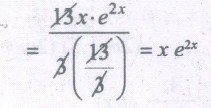
∴ y = CF + PI
∴ The general solution is
y = Ae2x+\({ Be }^{ -\frac { 7 }{ 3 } x }\) + xe2x
10.
| Commodities | Price | Quantity | ||
| Base year (p0) | Current year (p1) | q0 | q1 | |
| Wheat | 6 | 10 | 50 | 56 |
| Ghee | 2 | 2 | 60 | 60 |
| Firewood | 4 | 6 | 60 | 60 |
| Sugar | 10 | 12 | 30 | 24 |
| Cloth | 8 | 12 | 40 | 36 |
| p0q0 | p1q1 | p0q1 | p1q0 |
| 300 | 560 | 336 | 500 |
| 200 | 240 | 240 | 200 |
| 240 | 360 | 240 | 360 |
| 300 | 288 | 240 | 360 |
| 320 | 432 | 288 | 480 |
| 1360 | 1880 | 1344 | 1900 |
Fisher's price index number
\(P^{F}_{01}\) = \(\sqrt{ \frac {\sum p_{1}q_{0}}{\sum p_{0}q_{0}} \times \frac{ {\sum p_{1}q_{1}} }{{\sum p_{0}q_{1}}}{}}\times 100\)
= \(\sqrt\frac {1900 \times 1880}{1360 \times 1344} \times 100\)
= \(\sqrt\frac {3572000}{1827840} \times 100\)
= \(\sqrt {1.954} \times 100\)
\(P^{F}_{01}\) = 139.8
Time reversal test:
\(P _{01} \times P_{10}\) = \(\sqrt{ \frac {\sum p_{1}q_{0}\times \sum p_{1}q_{1}\times \sum p_{0}q_{1}\times \sum p_{0}q_{0}}{\sum p_{0}q_{0}\times \sum p_{0}q_{1}\times \sum p_{1}q_{1} \times \sum p_{1}q_{0}} }\)
= 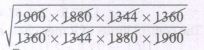
= \(\sqrt {1}\) = 1
∴ \(P _{01} \times P_{10}\) = 1
Factor reversal test:
\(P _{01} \times Q_{01}\) = \(\sqrt{ \frac {\sum p_{1}q_{0}\times \sum p_{1}q_{1}\times \sum q_{1}p_{0}\times \sum q_{1}p_{1}}{\sum p_{0}q_{0}\times \sum p_{0}q_{1}\times \sum q_{0}p_{0} \times \sum q_{0}p_{1}} }\)
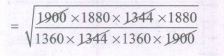
= \(\frac {1880}{1360} = \frac {\sum p_{1}q_{1}}{\sum p_{0}q_{0}}\)
Hence, it satisfies time reversal test and factor reversal test.
11.
The given differential equation is of the form
\(\frac { dy }{ dx } \)+ Py = Q where
P =\(\frac { 1 }{ x } \); Q = xex
∴ \(\int { p } dx=\int { \frac { 1 }{ x } } \) = logx
∴ Integratin'cg tactor (I. F) = \(e^{ \int { p } dx }=e^{ logx }=x\)
Hence the solution is
\(ye^{ \int { p } dx }=\int { Q } .e^{ \int { p } dx }dx+c\)
⇒ yx =\(\int { x{ e }^{ x }dx+c } \)
⇒ xy = \(\int { x{ e }^{ x }dx+c } \) ....(1)
Let u = x2; dv = ex
u' = 2x; v = ex
u" = 2; v1 = ex
v2 = ex
Using Bernoulli's formula,
\(\int { u } dv\) = uv - u'v1+ u"v2
∴ (1) becomes
xy = x2ex - 2xex + 2ex+c
⇒ xy = ex(x2-2x+2) + c
12.
Given \(\frac { dy }{ dx } \) − (3 cot x) y = sin 2x
It is of the form \(\frac { dy }{ dx } \) + Py = Q
Here P= − 3 cot x,Q = sin 2x
ഽPdx = ഽ-3 cot xdx = -3 log sin x = - log sin3x = log \(\frac { 1 }{ { sin }^{ 3 }x } \)
I.F. = \({ e }^{ log\frac { 1 }{ { sin }^{ 3 }x } }=\frac { 1 }{ { sin }^{ 3 }x } \)
The required solution is y (I.F) = ഽQ(I.F)dx+c
\(y\frac { 1 }{ { sin }^{ 3 }x } =\int { sin2x } \frac { 1 }{ { sin }^{ 3 }x } dx+c\)
\(\int { \frac { 1 }{ { sin }^{ 3 }x } } =\int { 2sinxcosx\times \frac { 1 }{ { sin }^{ 3 }x } } dx+c\)
= \(2\int { \frac { 1 }{ sinx } \times \frac { cosx }{ sinx } } dx+c\)
= ഽcos ecx cot xdx + c
\(y\frac { 1 }{ { sin }^{ 3 }x } =-2cosecx+c\)
Now y = 2 when x = \(\frac { \pi }{ 2 } \)
(1) ⇒ 2\(\frac {1 }{ 1 } \) = −2×1+c ⇒ c= 4
∴ (1) ⇒ \(y\frac { 1 }{ { sin }^{ 3 }x } \) = −2cosecx + 4
13.
| Sample No | Observations | Total | \(\overline {X}\) | R = x max - xmin | |||
| 1 | 2 | 3 | 4 | ||||
| 1 | 12.5 | 12.3 | 12.6 | 12.7 | 50.1 | \(\frac {50.1}{4} = 12.5\) | 12.7-12.3 = 0.4 |
| 2 | 12.8 | 12.4 | 12.4 | 12.8 | 50.4 | \(\frac {50.4}{4} = 12.6\) | 12.8-12.4 = 0.4 |
| 3 | 12.1 | 12.6 | 12.5 | 12.4 | 49.6 | \(\frac {49.6}{4} = 12.4\) | 12.6-12.1 = 0.5 |
| 4 | 12.2 | 12.6 | 12.5 | 12.3 | 49.6 | \(\frac {49.6}{4} = 12.4\) | 12.6-12.2 = 0.4 |
| 5 | 12.4 | 12.5 | 12.5 | 12.5 | 49.9 | \(\frac {49.9}{4} = 12.5\) | 12.6-12.4 = 0.1 |
| 6 | 12.3 | 12.4 | 12.6 | 12.6 | 49.9 | \(\frac {49.9}{4} = 12.5\) | 12.6-12.3 = 0.3 |
| 7 | 12.6 | 12.7 | 12.5 | 12.8 | 50.6 | \(\frac {50.6}{4} = 12.7\) | 12.6-12.5 = 0.3 |
| 8 | 12.4 | 12.3 | 12.6 | 12.5 | 49.8 | \(\frac {49.8}{4} = 12.5\) | 12.6-12.3 =.3 |
| 9 | 12.6 | 12.5 | 12.3 | 12.6 | 50 | \(\frac {50}{4} = 12.5\) | 12.6-12.3 =.3 |
| 10 | 12.1 | 12.7 | 12.5 | 12.8 | 50.1 | \(\frac {50.1}{4} = 12.5\) |
12.8-12.1 =.7 |
| 125.1 | 3.7 | ||||||
\(\overline {\overline{X}} = \frac {125.1}{10}\) = 12.51
\(\overline{R} = \frac {3.7}{10}\) = 0.37
Control limits for \(\overline {X}\) - chart
UCL = \(\overline {\overline{X}} + A_{2} \overline {R}\)
= [when n = 4, A2 = .729]
= 12.51 + .729 (0.37)
= 12.51 + 0.27 = 12.78
CL = \(\overline {\overline{X}}\) = 12.51
LCL = \(\overline {\overline{X}} - A_{2} \overline {R}\)
= 12.51 - 0.27 = 12.24
Control limits for R-chart
UCL = D4 \(\overline{R}\)
= 2.282(0.37) = 0.84
[when n = 4, D4 = 2.282]
CL = \(\overline{R}\) = 0.37
LCL = D3 \(\overline{R}\) = 0
[When n = 4, D3 = 0]
\(\overline {X}\) - chart
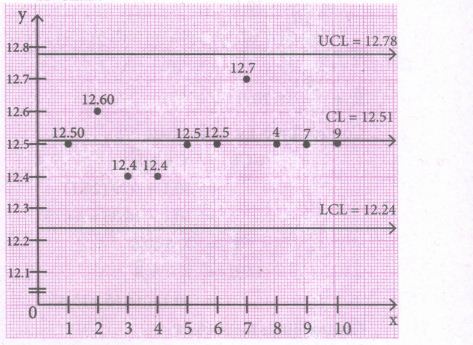
\(\overline {R}\) - chart
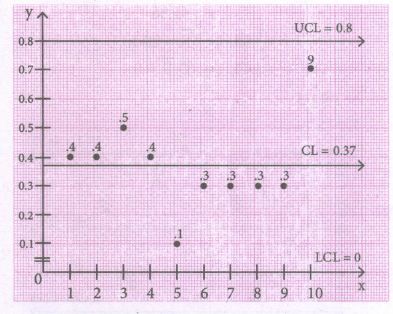
Conclusion: The above diagram shows all the control lines with the data points plotted.
Since all the points lie within the control limits, we can say that the process is in control.
14.
| Commodity | p0 | p1 | q0 | q1 |
| A | 5 | 4 | 10 | 12 |
| B | 8 | 7 | 6 | 7 |
| C | 6 | 5 | 3 | 4 |
| p0q0 | p0q1 | p1q0 | p1q1 |
| 50 | 60 | 40 | 48 |
| 48 | 56 | 42 | 49 |
| 18 | 24 | 15 | 20 |
| 116 | 140 | 97 | 117 |
Fisher's price index number
\(P^{F}_{01}\) = \(\sqrt \frac {\sum p_{1}q_{0}\times \sum p_{1}q_{1}}{{\sum p_{0}q_{0}\times \sum p_{0}q_{1}}}\) × 100
= \(\sqrt \frac {97\times117}{116\times140} \times 100\)
= \(\sqrt \frac {11349}{16240} \times 100\)
= \(\sqrt {0.6988}\times100\)
\(P^{F}_{01}\) = 83.59
15.
\(\frac { dy }{ dx } =\frac { x+3y }{ x-y } \)
Since the numerator and denominator are homogeneous functions of degree 1,
put y = vx and \(\frac { dy }{ dx } \) = v + x\(\frac { dv}{ dx } \)
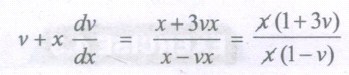
⇒ x\(\frac { dv }{ dx } =\frac { 1+3v }{ 1-v } -v=\frac { 1+3v-v(1-v) }{ 1-v } \)
= \(\frac { 1+3v-v+v^{ 2 } }{ 1-v } \)
⇒ \(x\frac { dv }{ dx } =\frac { 1+2v+v^{ 2 } }{ 1-v } \)
separating the variables we get,
\(\frac { 1-v }{ 1+2v+{ v }^{ 2 } } dv=\frac { dx }{ x } \)
⇒ \(\int { \frac { (1-v)dv }{ { v }^{ 2 }+2v+1 } } =\int { \frac { dx }{ x } } \)
⇒ \(\int { \frac { (1-v)dv }{ (v+1)^{ 2 } } } \) = log x + log c
\(\frac { 1-v }{ (v+1)^{ 2 } } =\frac { A }{ v+1 } +\frac { B }{ (v+1)^{ 2 } } \)
1-v = A(v+1)+B
put v = -1,
2 = B
1 = A + B ⇒ 1 = A+2
⇒ A = -1
∴ \(\frac { 1-v }{ (v+1)^{ 2 } } =\frac { -1 }{ v+1 } +\frac { 2 }{ (v+1) } \)
⇒ \(\int { \frac { -1 }{ v+1 } } dv+\int { \frac { 2 }{ (v+1)^{ 2 } } } dv\) = log xc
⇒ -log (v+1) - \(\frac { 2 }{ v+1 } \) = log xc
⇒ \(\frac { -2 }{ v+1 } \) = log xc + log(v+1)
⇒ \(\frac { -2 }{ v+1 } \) = log xc(v+1)
Replace v by \(\frac{y}{x}\) we get,
\(\frac { -2 }{ \frac { y }{ x } +1 } =logxc\left( \frac { y }{ x } +1 \right) \)
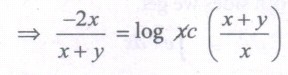
⇒ \(\frac { -2x }{ x+y } \) = logc (x+y)
⇒ e-2x/x+y = c(x+y)
⇒ x+y = \(\frac { 1 }{ c } \) e-2x/x+y
⇒ x+y = ke-2x+x+y where k = \(\frac { 1 }{ c } \).
16.
| Year 2010 | Sales (in tones) |
|---|---|
| Jan | 280 |
| Feb | 240 |
| Mar | 270 |
| Apr | 300 |
| May | 280 |
| June | 290 |
Average
\(\frac {280 + 240 + 270 + 300 + 280 + 290}{6}\) = \(\frac {1660}{6}\) = 276.6666
| Year 2010 | Sales (in tones) |
|---|---|
| Jul | 210 |
| Aug | 200 |
| Sep | 230 |
| Oct | 200 |
| Nov | 230 |
| Dec | 210 |
\(\frac {210+ 200+ 230+ 200+ 230+ 210}{6}\) = \(\frac {1280}{6}\) = 213.333
Since the number of years is even (12), we can equally divide the given data into two equal parts and obtain the averages of first 6 months and last 6 months.
17.
Here the base year quantities are given, therefore we can apply Aggregate Expenditure Method.
| Commodities | Price | Quantity (q0) |
p0q0 | p1q0 | |
| Base year (P0) | Current year (P1) | ||||
| Rice | 32 | 48 | 25 | 800 | 1200 |
| Sugar | 25 | 42 | 10 | 250 | 420 |
| Oil | 54 | 85 | 6 | 324 | 510 |
| Coffe | 250 | 460 | 1 | 250 | 460 |
| Tea | 175 | 275 | 2 | 350 | 550 |
| Total | 1974 | 3140 | |||
Cost of Living Index Number=\(\frac { \sum { { p }_{ 1 }{ q }_{ 0 } } }{ \sum { { p }_{ 0 }{ q }_{ 0 } } } \times 100=\frac { 3140 }{ 1974 } \times 100 = 159.0679\)
Hence, the Cost of Living Index Number for a particular class of people for the year 2016 is increased by 59.0679 % as compared to the year 2011.
18.
| Commodities | Price | Quandity | p0q0 | p0q1 | p1q0 | p1q1 | ||
| 2003 (p0) |
2009 (q1) |
2003 (p0) |
2009 (q1) |
|||||
| Rice | 10 | 13 | 4 | 6 | 40 | 60 | 52 | 78 |
| Wheat | 125 | 18 | 7 | 8 | 105 | 120 | 126 | 144 |
| Rent | 25 | 29 | 5 | 9 | 125 | 225 | 145 | 261 |
| Fuel | 11 | 14 | 8 | 10 | 88 | 110 | 140 | 140 |
| Miscellaneous | 14 | 17 | 6 | 7 | 84 | 98 | 102 | 119 |
| Total | 442 | 613 | 537 | 742 | ||||
Fisher’s price index number
\({ P }_{ 01 }^{ F }=\left( \sqrt { \frac { \sum { { p }_{ 1 }{ q }_{ 10 } } \times \sum { { p }_{ 1 }{ q }_{ 1 } } }{ \sum { { p }_{ 0 }{ q }_{ 0 } } \times \sum { { p }_{ 0 }{ q }_{ 1 } } } } \right) \times 100=\left( \sqrt { \frac { 537\times 742 }{ 442\times 613 } } \right) \times 100=121.2684\)
Time Reversal Test:P01\(\times\) P10 = 1
\({ P }_{ 01 }\times { P }_{ 10 }=\sqrt { \left( \frac { \sum { { p }_{ 1 }{ q }_{ 0 } } \times \sum { { p }_{ 1 }{ q }_{ 1 } } \times \sum { { p }_{ 0 }{ q }_{ 1 } } \times \sum { { p }_{ 0 }{ q }_{ 0 } } }{ \sum { { p }_{ 0 }{ q }_{ 0 } } \times \sum { { p }_{ 0 }{ q }_{ 1 } } \times \sum { { p }_{ 1 }{ q }_{ 1 } } \times \sum { { p }_{ 1 }{ q }_{ 0 } } } \right) } \)
\({ P }_{ 01 }\times { P }_{ 10 }=\sqrt { \left( \frac { 537\times 742\times 613\times 442 }{ 442\times 613\times 742\times 537 } \right) } \)
\({ P }_{ 01 }\times { P }_{ 10 }=1\)
Factor Reversal Test
\({ P }_{ 01 }\times { Q }_{ 01 }=\frac { \sum { { p }_{ 1 }{ q }_{ 1 } } }{ \sum { { p }_{ 0 }{ q }_{ 0 } } } \)
\({ P }_{ 01 }\times { P }_{ 01 }=\sqrt { \left( \frac { \sum { { p }_{ 1 }{ q }_{ 0 } } \times \sum { { p }_{ 1 }{ q }_{ 1 } } \times \sum { { p }_{ 1 }{ q }_{ 0 } } \times \sum { { p }_{ 1 }{ q }_{ 1 } } }{ \sum { { p }_{ 0 }{ q }_{ 0 } } \times \sum { { p }_{ 0 }{ q }_{ 1 } } \times \sum { { p }_{ 0 }{ q }_{ 0 } } \times \sum { { p }_{ 0 }{ q }_{ 1 } } } \right) } \)
\({ P }_{ 01 }\times { P }_{ 01 }=\sqrt { \left( \frac { 537\times 742\times 613\times 742 }{ 442\times 613\times 442\times 537 } \right) } \)
\({ P }_{ 01 }\times { P }_{ 01 }=\sqrt { \left( \frac { 742\times 742 }{ 442\times 442 } \right) } =\frac { 742 }{ 442 } \Rightarrow { P }_{ 01 }\times { P }_{ 01 }=\frac { \sum { { p }_{ 1 }{ q }_{ 1 } } }{ \sum { { p }_{ 0 }{ q }_{ 0 } } } \)
19.
Slope of the normal at any point P(x, y) = -\(\frac { dx }{ dy } \)
Let Q be (1, 0)
Slope of the normal PQ is \(\frac { { y }_{ 2 }-{ y }_{ 1 } }{ { x }_{ 2 }-{ x }_{ 1 } } \)
i.e, \(\frac { y-0 }{ x-1 } =\frac { y }{ x-1 } \)
∴ \(\frac { dx }{ dy } =\frac { y }{ x-1 } \) ⇒ \(\frac { dx }{ dy } =\frac { y }{ 1-x } \), which is the differential equation
i.e., (1− x)dx = ydy
ഽ(1−x)dx = ഽydy + c
\(x-\frac { { x }^{ 2 } }{ 2 } =\frac { { y }^{ 2 } }{ 2 } +c\) ....(1)
Since it passes through (1,2)
1 - \(\frac { 1 }{ 2 } =\frac { 4 }{ 2 } +c\)
\(c=\frac { 1 }{ 2 } -2=\frac { 4 }{ 2 } +c\)
Put \(c = \frac { -3 }{ 2 } \) in (1)
\(x-\frac { { x }^{ 2 } }{ 2 } =\frac { { y }^{ 2 } }{ 2 } -\frac { 3 }{ 2 } \)
2x − x2 = y2 − 3
⇒ y2 = 2x−x2 + 3, which is the equation of the curve
20.
Computation of trend values by the method of least squares.
In case of EVEN number of years, let us consider
\(X=\frac{\text{(x-Arithimetic mean of two middle years)}}{0.5}\)
| Year(x) | Sales(Y) | X=\(\frac{(x-1998.5)}{0.5}\) | XY | X2 | Trend Values (Yt) |
| 1995 | 6.7 | -7 | -46.9 | 49 | 5.6166 |
| 1996 | 5.3 | -5 | -26.5 | 25 | 5.7190 |
| 1997 | 4.3 | -3 | -12.9 | 9 | 5.8214 |
| 1998 | 6.1 | -1 | -6.1 | 1 | 5.9238 |
| 1999 | 5.6 | 1 | 5.6 | 1 | 6.0261 |
| 2000 | 7.9 | 3 | 23.7 | 9 | 6.1285 |
| 2001 | 5.8 | 5 | 29.0 | 25 | 6.2309 |
| 2002 | 6.1 | 7 | 42.7 | 49 | 6.3333 |
| N = 8 | 47.8 | \(\sum X\) = 0 | 8.6 | 168 |
\(a=\frac { \sum { Y } }{ n } =\frac { 47.8 }{ 8 } =5.975;\quad b=\frac { \sum { XY } }{ { \sum { X } }^{ 2 } } =\frac { 8.6 }{ 168 } =0.05119\)
Therefore, the required equation of the straight line trend is given by
Y = a + bX; Y = 5.975 + 0.05119 X.
When X = 1995, Yt = 5.975 + 0.05119\(\left( \frac { 1995-1998.5 }{ 0.5 } \right) =5.6166\)
When X = 1996, Yt = 5.975 + 0.05119\(\left( \frac { 1996-1998.5 }{ 0.5 } \right) =5.7190\)
similarly other values can be obtained.
21.
Sample size n = 60
Population standard deviation σ = 3
The standard error for sample standard deviation
\(=\sqrt { \frac { { \sigma }^{ 2 } }{ 2n } } \)
\(=\sqrt { \frac { { 3 }^{ 2 } }{ 2(60) } } =\sqrt { \frac { 9 }{ 120 } } =\sqrt { 0.075 } \)
S.E.of sample standard deviation = 0.2739
22.
\(\int _{ a }^{ b }{ f\left( x \right) } dx=\lim _{ n\rightarrow \infty \\ h\rightarrow 0 }{ \sum _{ r=1 }^{ n }{ h.f(a+rh) } } \)
Here a = 1, b = 3
\(h=\frac { b-a }{ n } =\frac { 3-1 }{ n } =\frac { 2 }{ n } \)
and f (x) = x
Now \(f(a+rh)=f\left( 1+r\cfrac { 2 }{ n } \right) =f\left( 1+\cfrac { 2r }{ n } \right) \)
\(\therefore \int _{ 1 }^{ 3 }{ xdx } =\underset { n\rightarrow \infty }{ lim } .\cfrac { 2 }{ n } \left( 1+\cfrac { 2r }{ n } \right) \)
= \(\underset { n\rightarrow \infty }{ lim } \sum _{ r=1 }^{ n }{ \left( \cfrac { 2 }{ n } +\cfrac { 4r }{ { n }^{ 2 } } \right) } \)
= \(\underset { n\rightarrow \infty }{ lim } \left( \cfrac { 2 }{ n } .\sum _{ r=1 }^{ n }{ .1+\cfrac { 4 }{ { n }^{ 2 } } .\sum _{ r=1 }^{ n }{ .r } } \right) \)
\(\left( \because \sum _{ r=1 }^{ n }{ 1=n } \right) \)
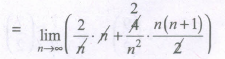
\(\left[ \sum _{ r=1 }^{ n }{ r } =\cfrac { n(n+1) }{ 2 } \right] \)
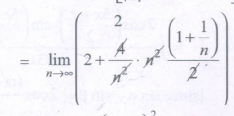
= \(2+\underset { n\rightarrow \infty }{ lim } \left( 1+\cfrac { 1 }{ n } \right) ^{ 2 }\)
= \(2+n\underset { n\rightarrow \infty }{ lim } \left( 2+\cfrac { 2 }{ n } \right) \)
= \(2+2\underset { n\rightarrow \infty }{ +lim } \left( 2+\cfrac { 2 }{ n } \right) \)
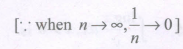
= 2 + 2 + 0
= 4
23.
Here φ is the mean length of the components in the population.
The formula for the confidence interval is
\(\bar{x}-Z_{\alpha / 2} \frac{\sigma}{\sqrt{n}}<\mu<\bar{x}+Z_{\alpha / 2} \frac{\sigma}{\sqrt{n}}\)
\({ Here } \ \sigma=1.6, Z_{\alpha / 2}=1.96, \bar{x}=90 \text { and } \mathrm{n}=64\)
Then \(S.E=\frac { \sigma }{ \sqrt { n } } =\frac { 1.6 }{ \sqrt { 64 } } =0.2\)
Therefore, 90 - (1.96 x 0.2)\(\le φ \le\) 90 + (1.96 x 0.2)
\(\text { i.e. } \ (89.61 \leq \varphi \leq 90.39)\)
This implies that the probability that the true value of the population mean length of the components will fall in this interval (89.61,90.39) at 95% . Hence we concluded that 95% confidence interval ensures acceptance of the component by the consumer.
24.
Let p be the probability getting his piston rejected
Given p = 12% = \(\frac { 12 }{ 100 } \) = 0.12
∴ q = 1-p = 1-0.12 = 0.88
n = 10
(a) P (not more than 2 rejects)
= P(X≤2) = P(X = 0) + P(X = 1) + P(X = 2)
= 10C0(0.12)0 (0.88)10 + 10C1 (0.12)1 (0.88)9 + 10C2 (0.12)2 (0.88)8
[∵ P(x) = nCx pxqn-x]
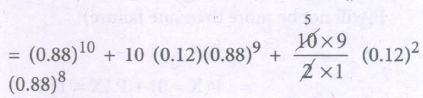
= (0.88)8 [(0.88)2 + 10(0.12) (0.88) + 45 (0.12)2]
= (0.88)8 [0.7744 + 1.056 + 0.648]
= (0.3596) (2.4784) = 0.8913
∴ Probability of not more than 2 rejects = 0.8913
b) P(at least 2 rejects)
= P(X ≥ 2) = 1 - P (X < 2)
= 1 - [P(X = 0) + P (X = 1)]
= 1-[10C0(0.12)0 (0.88)10 + 10C1 (0.12)1 (0.88)9 ]
= 1 - [(0.88)10 + 10 (0.12) (0.88)9]
= 1 - (0.88)9 [0.88 + 1.2] = 1 - (0.31647) (2.08)
= 1 - 0.6583 = 0.34173
P (atleast 2 rejects) = 0.34173
25.
Given average number of customers, appear in a counter
λ = 2
∴ X follows a poisson distribution with
p(x,λ) = \(\frac { e^{ -\lambda }.{ \lambda }^{ x } }{ x! } \)
(i) P (no customer appears)
= P(X = 0) = \(\frac { { e }^{ -\lambda }.{ \lambda }^{ 0 } }{ 0! } \) = e-λ = e-2 = 0.1353 [∵ e-2 = 0.1353]
(ii) P(3 or more customer appear)
= P(X≥3)
= 1-P(X<3)
= 1 - [P(X = 0) + P(X = 1) + P(X = 2)]
= 1-\(\left[ \frac { { e }^{ -\lambda }.{ \lambda }^{ 0 } }{ 0! } +\frac { { e }^{ -\lambda }.{ \lambda }^{ 1 } }{ 1! } +\frac { { e }^{ -\lambda }.{ \lambda }^{ 2 } }{ 2! } \right] \)
= 1-e-λ (1+λ+\(\frac { \lambda ^{ 2 } }{ 2 } \))
= 1-e-2 (1+2+\(\frac { 4 }{ 2 } \))
= 1-e-2 (5) = 1 - 0.1353(5)
= 1 - 0.6765 = 0.3235
Hence, probability of three or more customers appear in a counter of a certain bank is 0.3235.
26.
Given that probability of getting defective item
p = 5% = \(\frac { 5 }{ 100 } \) ⇒ q = 1-p = \(1-\frac { 5 }{ 100 } =\frac { 95 }{ 100 } \)
n = 20
p(x) = \({ n }_{ C_{ x } }{ p }^{ x }{ q }^{ n-x }\), x = 0,1,2....n
(i) P(Exactly 3 defectives)
= \({ 20 }_{ { C }_{ 3 } }\left( \frac { 5 }{ 100 } \right) ^{ 3 }\left( \frac { 95 }{ 100 } \right) ^{ 20-3 }\)
= \(\\ { 20 }_{ { C }_{ 3 } }\)(0.05)3(0.95)17
= \(\\ \frac { 20\times 19\times 18 }{ 3\times 2\times 1 } \) (0.05)3(0.95)5(0.95)5(0.95)5(0.95)2
= (60 x 19) (0.000125)(0.7738)(0.7738)(0.7738)(0.9025)
= 0.059
(ii) P(atleast 2 defectives)
= P(X≥2) =1-P(X<2)
= 1-[P(X=0) + P(X=1)]
= 1-[\(\\ { 20 }_{ { C }_{ 0 } }\)(0.05)0(0.95)20 + \(\\ { 20 }_{ { C }_{ 1 } }\)(0.05)1(0.95)19]
= 1 - [(0.95)20 + 20 (0.05) (0.95)19]
= 1 - [0.3585 + (0.3774)]
= 1 - [0.7359] = 0.2641.
(iii) P (exactly 4 defectives)
P(X = 4) = \(\\ { 20 }_{ { C }_{ 4 } }\) (0.05)4(0.95)16
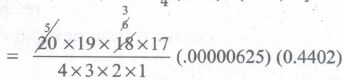
= (15 x 17 x 19) (0.00000625) (0.4402)
= 0.0133
(iv) Find the mean and variance
Mean = np =\(20\times \frac { 5 }{ 100 } =\frac { 100 }{ 100 } \) = 1
Variance =npq = \(20\times \frac { 5 }{ 100 } =\frac { 95 }{ 100 } \) = 0.95
27.
Consider a 2,000 individuals getting injection of a given serum , n = 2000
Let X be the number of individuals suffering a bad reaction.
Let p be the probability that an individual suffers a bad reaction = 0.001
and q = 1– p = 1– 0.001 = 0.999
Since n is large and p is small, Binomial Distribtuion approximated to poisson distribution
So, λ = np = 2000 × 0.001 = 2
(i) Probability out of 2000, exactly 3 will suffer a bad reaction is
\(P(X=3)=\frac { { e }^{ -\lambda }{ \lambda }^{ x } }{ x! } =\frac { { e }^{ -2 }{ 2 }^{ 3 } }{ 3! } =0.1804\)
(ii) Probability out of 2000, more than 2 individuals will suffer a bad reaction
= P(X > 2)
1-[P(X\(\le\)2)]
= 1 – [P(x = 0) + P(x = 1) + P(x = 2)]
\(=1-\left[ \frac { { e }^{ -2 }{ 2 }^{ 0 } }{ 0! } +\frac { { e }^{ -2 }{ 2 }^{ 1 } }{ 1! } +\frac { { e }^{ -2 }{ 2 }^{ 2 } }{ 2! } \right] \)
\(=1-{ e }^{ 2 }\left( \frac { { 2 }^{ 0 } }{ 0! } +\frac { { 2 }^{ 1 } }{ 1! } +\frac { { 2 }^{ 2 } }{ 2! } \right) \)
= 0.323
28.
Given demand function Pd = 20 - 5x and
Supply function Ps = 4x + 8
Under market equilibrium ps = Pd
⇒ 20-5x = 4x+8
⇒ 20-8 = 4x+5x
⇒ 12 = 9x
\(\Rightarrow x=\frac{\not 12}{\not 9}=\frac{4}{3}\)
When \({ x }_{ 0 }=\frac { 4 }{ 3 } ,{ p }_{ 0 }=20-5\left( \frac { 4 }{ 3 } \right) =20-\frac { 20 }{ 3 } \)
\(=\frac { 60-20 }{ 3 } =\frac { 40 }{ 3 } \)
\(\therefore { p }_{ 0 }{ x }_{ 0 }=\frac { 40 }{ 3 } \times \frac { 4 }{ 3 } =\frac { 160 }{ 9 } \)
Consumer Surplus (CS)
\(=\int _{ 0 }^{ x }{ f(x)dx } -{ p }_{ 0 }{ x }_{ 0 }\)
\(=\int _{ 0 }^{ \frac { 4 }{ 3 } }{ (20-5x)dx } \)
\(={ \left[ 20x-\frac { { 5x }^{ 2 } }{ 2 } \right] }_{ 0 }^{ \frac { 4 }{ 3 } }-\frac { 160 }{ 9 } \)
\(=20\left( \frac { 4 }{ 3 } \right) -\frac { 5 }{ 2 } \left( \frac { 16 }{ 9 } \right) -\frac { 160 }{ 9 } \)
\(=\frac { 80 }{ 3 } -\frac { 40 }{ 9 } -\frac { 160 }{ 9 } \)
\(=\frac { 240-40-160 }{ 9 } =\frac { 40 }{ 9 } \)
\(\therefore CS=\frac { 40 }{ 9 }\)units
Producer's Surplus
\((PS)={ p }_{ 0 }{ x }_{ 0 }-\int _{ 0 }^{ x }{ g(x)dx } \)
\(=\frac { 160 }{ 9 } -\int _{ 0 }^{ \frac { 4 }{ 3 } }{ (4x+8)dx } \)
\(=\frac { 160 }{ 9 } -{ \left[ \frac { { 4x }^{ 2 } }{ 2 } +8x \right] }_{ 0 }^{ \frac { 4 }{ 3 } }\)
\(=\frac { 160 }{ 9 } -\left( 2\left( \frac { 16 }{ 9 } \right) +8\left( \frac { 4 }{ 3 } \right) \right) \)
\(=\frac { 160 }{ 9 } -\left( \frac { 32 }{ 9 } +\frac { 32 }{ 3 } \right) \)
\(=\frac { 160 }{ 9 } -\frac { 32 }{ 9 } -\frac { 32 }{ 3 } \)
\(PS=\frac { 160-32-96 }{ 9 } =\frac { 32 }{ 9 } \)units
29.
From the given data, you first calculate the probability distribution of the random variable. Then using it you calculate mean and variance.
X p(x)
1 F(1) = \(\frac{1}{6}\)
2 F(2)-F(1) = \(\frac{2}{6}\)-\(\frac{1}{6}\) = \(\frac{1}{6}\)
3 F(3)-F(2) = \(\frac{3}{6}\)-\(\frac{2}{6}\) = \(\frac{1}{6}\)
4 F(4)-F(3) = \(\frac{4}{6}\)-\(\frac{3}{6}\) = \(\frac{1}{6}\)
5 F(5)-F(4) = \(\frac{5}{6}\)-\(\frac{4}{6}\) = \(\frac{1}{6}\)
6 F(6)-F(5) = 1-\(\frac{5}{6}\) = \(\frac{1}{6}\)
The probability mass function is
| X = x | 1 | 2 | 3 | 4 | 5 | 6 |
| P(x) | \(\frac{1}{6}\) | \(\frac{1}{6}\) | \(\frac{1}{6}\) | \(\frac{1}{6}\) | \(\frac{1}{6}\) | \(\frac{1}{6}\) |
Mean of the random variable X = E(X)\(\sum _{ x }^{ }{ x } { P }_{ X }(x)\)
\(=\left( 1\times \frac { 1 }{ 6 } \right) +\left( 2\times \frac { 1 }{ 6 } \right) +\left( 3\times \frac { 1 }{ 6 } \right) +\left( 4\times \frac { 1 }{ 6 } \right) +\left( 5\times \frac { 1 }{ 6 } \right) +\left( 6\times \frac { 1 }{ 6 } \right) \)
\(=\frac { 1 }{ 6 } (1+2+3+4+5+6)\)
= 7/2
\(E({ X }^{ 2 })=\sum _{ x }^{ }{ { x }^{ 2 } } { P }_{ X }(x)\)
\(=\left( { 1 }^{ 2 }\times \frac { 1 }{ 6 } \right) +\left( { 2 }^{ 2 }\times \frac { 1 }{ 6 } \right) +\left( { 3 }^{ 2 }\times \frac { 1 }{ 6 } \right) +\left( { 4 }^{ 2 }\times \frac { 1 }{ 6 } \right) +\left( { 5 }^{ 2 }\times \frac { 1 }{ 6 } \right) +\left( { 6 }^{ 2 }\times \frac { 1 }{ 6 } \right) \)
\(=\frac { 1 }{ 6 } ({ 1 }^{ 2 }+{ 2 }^{ 2 }+{ 3 }^{ 2 }+{ 4 }^{ 2 }+{ 5 }^{ 2 }+{ 6 }^{ 2 })\)
\(=\frac { 91 }{ 6 } \)
Variance of the Random Variable \(X=V(X)=E\left( { X }^{ 2 } \right) -{ [E(X)] }^{ 2 }\)
\(=\frac { 91 }{ 6 } -{ \left( \frac { 7 }{ 2 } \right) }^{ 2 }\)
\(=\frac { 35 }{ 12 } \)
30.
Given C'(x) = 5 + 0.13x
R'(x) = 18
Fixed cost is Rs. 120
C'(x) = 5 + 0.13x
⇒ ∫C'(x) = ∫(5+0.13x)dx
⇒ C(x) = 5x \(+\frac { 0.13{ x }^{ 2 } }{ 2 } +{ k }_{ 1 }\)
Since fixed cost is Rs.120 ⇒ k1 = 120
\(\therefore C(x)=5x+\frac { 0.13{ x }^{ 2 } }{ 2 } +120\) ...(1)
Also R'(x) = 18
⇒ ∫R'(x) = ∫18dx
⇒ R(x) = 18x+k2
When x = 0, R = 0 ⇒ k2= 0
∴ R(x) = 18x ...(2)
Profit function ⇒ P(x) = R(x) - C(x)
\(=18x-5x-\frac { 0.13{ x }^{ 2 } }{ 2 } -120\)
[from (1) & (2)]
P(x) = 13x-0.065x2-120
31.
We have F(x) = f(x) ≥ 0, where F(x) is the distribution function and f(x) is the probability density function.
Here F(x) = 0 for x ≤ 1 f(x) = 0 for x ≤ 1
Again F(x) = 1 for x > 3
f(x) = d/dx (1) = 0 for x > 3
In 1 < x ≤ 3, F(x) = k(x – 1)4
f(x) = d/dx (k(x – 1)4) = 4k(x – 1)3
\(\therefore f(x)=4k{ (x-1) }^{ 3 }for\quad 1\le x\le 3\)
i) Since f(x) is a probability density function,
\(\int _{ 1 }^{ 3 }{ f(x)dx=1 } \)
\(\Rightarrow \int _{ 1 }^{ 3 }{ { 4k(x-1) }^{ 3 }dx=1 } \)
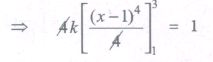
\(\Rightarrow k[{ (3-1) }^{ 4 }-{ (0) }^{ 4 }]=1\)
\(\Rightarrow k({ 2 }^{ 4 })=1\Rightarrow k(16)=1\)
\(\Rightarrow k=\frac { 1 }{ 16 } \)
ii) \(\therefore\)p.d.f
\(f(x)=\frac { 4\times 1 }{ 16 } { (x-1) }^{ 3 }for\quad 1\le x\le 3\)
\(f(x)=\frac { 1 }{ 4 } { (x-1) }^{ 3 }for\quad 1\le x\le 3\)
32.
The present value of payment for t year = \(\int _{ 0 }^{ t }{ { 72000e }^{ -0.09t } } dt\)
Present value of 12 years = \(\int _{ 0 }^{ t }{ { 72000e }^{ -0.09t } } dt\)
= 72000\({ \left[ \frac { { e }^{ -0.09t } }{ { -0.09 } } \right] }_{ 0 }^{ \\ 12 }\)
= \(\frac { 72000 }{ -0.09 } \left[ { e }^{ -0.09(12) }-{ e }^{ 0 } \right] \)
= \(-8,00,000[{ e }^{ -1.08 }-{ e }^{ 0 }]\)
= −8,00,000 [0.3396 −1]
= 5,28,320
Cost of the machine = 5,00,000 − 30,000
= 4,70,000
Hence it not advisable to rent the machine
It is better to buy the machine.
33.
i) Since P[X\(\le\)a1] = P[X>a1]
\(P[X\le { a }_{ 1 }]=\frac { 1 }{ 2 } \)
\(i.e., \int _{ 0 }^{ { a }_{ 1 } }{ f(x)dx } =\frac { 1 }{ 2 } \)
\(i.e., \int _{ 0 }^{ { a }_{ 1 } }{ { 5x }^{ 4 } } dx=\frac { 1 }{ 2 } \)
\(5{ { \left[ \frac { { x }^{ 5 } }{ 5 } \right] } }_{ { 0 }_{ } }^{ a1 }=1/2\)
\({ a }_{ 1 }={ (0.5) }^{ \frac { 1 }{ 5 } }\)
ii) \(P[X>{ a }_{ 2 }]=0.05\)
\(\int _{ { a }_{ 2 } }^{ 1 }{ { f(x })dx=0.05 } \)
\(\int _{ { a }_{ 2 } }^{ 1 }{ { 5x }^{ 4 }dx=0.05 } \)
\(5{ { \left[ \frac { { x }^{ 5 } }{ 5 } \right] } }_{ { a }_{ 2 } }^{ 1 }=0.05\)
\({ a }_{ 2 }={ [0.95] }^{ \frac { 1 }{ 5 } }\)
34.
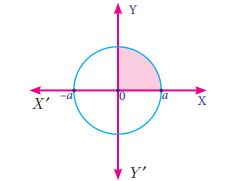
Equation of the required circle is \({ x }^{ 2 }+{ y }^{ 2 }={ a }^{ 2 }\) (1)
put \(y=0\), \({ x }^{ 2 }={ a }^{ 2 }\)
⇒ \(x=\pm a\)
Since equation (1) is symmetrical about both the axes
The required area = 4 [Area in the first quadrant between the limit 0 and a.]
\(=4\int _{ 0 }^{ a }{ y } \ dx\)
\(=4\int _{ 0 }^{ a }\sqrt { { a }^{ 2 }-{ x }^{ 2 } } dx=4{ \left[ \frac { x }{ 2 } \sqrt { { a }^{ 2 }-{ x }^{ 2 } } +\frac { { a }^{ 2 } }{ 2 } \sin ^{ -1 }{ \frac { x }{ a } } \right] }_{ 0 }^{ a }\)
\(=4{ \left[ 0+\frac { { a }^{ 2 } }{ 2 } \sin ^{ -1 }{( \frac { a }{ a } )} \right] }=4{ \left[ \frac { { a }^{ 2 } }{ 2 } \sin ^{ -1 }{( 1)} \right] }=4.\frac { { a }^{ 2 } }{ 2 }\frac { {π} }{ 2 }\)
= πa2 sq. units
35.
\(\int { \frac { { 3x }^{ 2 }-2x56 }{ \left( x-1 \right) -\left( { x }^{ 2 }+5 \right) } } dx\)
⇒ 3x2-2x+5 = A (x2+5) + (Bx+c) (x-1)
Putting x =1,
3 - 2+5 = A (1+ 5)
⇒ 6 = A (6)
⇒ A = 1
Putting x = 0,
5 = 5 A - C
⇒ 5 = 5 - C [∵ A = 1]
⇒ C = 5 - 5 ⇒ C = 0
Putting x = -1,
3 + 2+ 5 = A (6) + (C-B) (-2)
⇒ 10 = 6A + 2B - 2C
⇒ 10 = 6 + 2B + 0
⇒ 10 - 6 = 2B ⇒ 4 = 2B
⇒ B = 2
\(=\int { \left( \frac { A }{ x-1 } +\frac { Bx+c }{ { x }^{ 2 }+5 } \right) } dx\)
\(=\int { \left( \frac { 1 }{ x-1 } +\frac { 2x+0 }{ { x }^{ 2 }+5 } \right) } dx\)
\(=\int { \frac { 1 }{ x-1 } } dx+\int { \frac { 2x }{ { x }^{ 2 }+5 } } dx\)
\(=\log { \left| x-1 \right| } +\log { \left| { x }^{ 2 }+5 \right| } +c\)
\(\left[ \because \int { \frac { { f }^{ 1 }(x) }{ f(x) } dx=\log { \left| f\left( x \right) \right| +c } } \right] \)
\(=\log { \left| \left( { x }^{ 2 }+5 \right) \left( x-1 \right) \right| } +c\)
[∵ log m + log n = log mn]
\(=\log { \left| { x }^{ 3 }-{ x }^{ 2 }+5x-5 \right| } +c\)
\(=\frac { { 3x }^{ 2 }-2x+5 }{ \left( x-1 \right) \left( { x }^{ 2 }+5 \right) } =\frac { A }{ (x-1) } +\frac { Bx+C }{ \left( { x }^{ 2 }+5 \right) } \)
36.
x +y + z = 1, 3x - y - z = 4, x + 5y + 5z = k
| Augmented matrix [A,B] |
Elementary Transformation |
|---|---|
| \(\left( \begin{matrix} 1 & 1 & 1 \\ 3 & -1 & -1 \\ 1 & 5 & 5 \end{matrix}\begin{matrix} 1 \\ 4 \\ k \end{matrix} \right) \) | |
| \(\sim \left( \begin{matrix} 1 & 1 & 1 \\ 0 & -4 & -4 \\ 0 & 4 & 4 \end{matrix}\begin{matrix} 1 \\ 1 \\ k-1 \end{matrix} \right) \) | \({ R }_{ 2 }\rightarrow { R }_{ 3 }-3{ R }_{ 1 }\) \({ R }_{ 3 }\rightarrow { R }_{ 3 }-{ R }_{ 1 }\) |
| \(\sim \left( \begin{matrix} 1 & 1 & 1 \\ 0 & -4 & -4 \\ 0 & 0 & 0 \end{matrix}\begin{matrix} 1 \\ 1 \\ k \end{matrix} \right) \) | \({ R }_{ 3 }\rightarrow { R }_{ 3 }+{ R }_{ 2 }\) |
Here clearly \(\rho (A)=2\)
Since the given system is inconsistent \(\rho (A)\neq \rho (A,B)\)
This can take any value other than zero.
\(\therefore\) k can take any value other than zero.
37.
Let the amount invested in the rate of 2%, 3% and 6% be Rs. x, Rs. y and Rs. z respectively
By the given data,
x+ y+z = 8500
\(\cfrac { 2x }{ 100 } +\cfrac { 3y }{ 100 } +\cfrac { 6z }{ 100 } =380\)
\(\Rightarrow \cfrac { 2x+3y+6z }{ 100 } =380\)
\(\because Interest=\cfrac { PNR }{ 100 } =\cfrac { x\times 1\times 2 }{ 100 } =\cfrac { 2x }{ 100 } \)
\(\Rightarrow 2x+3y+6z=38000\)
Also,z = x+y
x+y-z =0
\(\Delta =\left| \begin{matrix} 1 & 1 & 1 \\ 2 & 3 & 6 \\ 1 & 1 & -1 \end{matrix} \right| \)
\(1\left| \begin{matrix} 3 & 6 \\ 1 & -1 \end{matrix} \right| -1\left| \begin{matrix} 2 & 6 \\ 1 & -1 \end{matrix} \right| +1\left| \begin{matrix} 2 & 3 \\ 1 & 1 \end{matrix} \right| \)
= 1(-3 - 6) - 1(-2 -6) + 1 (2 - 3)
= 1(-9) - 1 (-8) + 1(-1)
= -9 + 8 - 1 = 2 \(\neq \) 0
Since \(\Delta \neq 0\),Cramer's rule can be applied and the system is consistent with unique solution
\({ \Delta x }=\left| \begin{matrix} 8500 & 1 & 1 \\ 38000 & 3 & 6 \\ 0 & 1 & -1 \end{matrix} \right| \)
= \(8500\left| \begin{matrix} 3 & 6 \\ 1 & -1 \end{matrix} \right| -1\left| \begin{matrix} 38000 & 6 \\ 1 & -1 \end{matrix} \right| +1\left| \begin{matrix} 38000 & 3 \\ 0 & 1 \end{matrix} \right| \)
= 8500 (- 3 - 6) - 1(-38000 -0) + 1(38000 - 0)
= 8500(-9) - 1(-38000) + 1(38000)
= - 76500 + 38000 + 38000
= -500
\(\Delta y=\left| \begin{matrix} 1 & 8500 & 1 \\ 2 & 38000 & 6 \\ 1 & 0 & -1 \end{matrix} \right| \)
= \(1\left| \begin{matrix} 38000 & 6 \\ 0 & -1 \end{matrix} \right| -8500\left| \begin{matrix} 2 & 6 \\ 1 & -1 \end{matrix} \right| +1\left| \begin{matrix} 2 & 38000 \\ 1 & 0 \end{matrix} \right| \)
= 1 (-38000 - 0) - 8500 (-2 -6) + 1(0 - 38000)
= - 38000 - 8500 (-8) - 38000
= - 38000 + 68000 - 38000
= - 8000
\(\Delta z=\left| \begin{matrix} 1 & 1 & 8500 \\ 2 & 3 & 38000 \\ 1 & 1 & 0 \end{matrix} \right| \)
= \(1\left| \begin{matrix} 38000 & 6 \\ 0 & -1 \end{matrix} \right| -1\left| \begin{matrix} 2 & 38000 \\ 1 & 0 \end{matrix} \right| +8500\left| \begin{matrix} 2 & 3 \\ 1 & 1 \end{matrix} \right| \)
= 1 (0 - 38000) - 1(0 -38000) +85000 (2 - 3)
= - 38000 + 38000 + 8500 (-1)
= - 8500
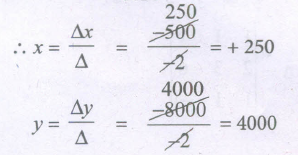
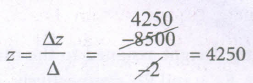
Hence, the amount invested in the three accounts are Rs. 250, Rs. 4000 and Rs. 4250 respectively.
38.
The matrix equation corresponding to the given system is
\(\left( \begin{matrix} 1 & 1 & 1 \\ 1 & 2 & 3 \\ 0 & 1 & k \end{matrix} \right) \left( \begin{matrix} X \\ Y \\ Z \end{matrix} \right) =\left( \begin{matrix} 7 \\ 18 \\ 6 \end{matrix} \right) \)
AX = B
| Augmented matrix [A,B] | Elementary Transformation |
|
\(\left( \begin{matrix} 1 & 1 & 1 \\ 1 & 2 & 3 \\ 0 & 1 & k \end{matrix}\begin{matrix} 7 \\ 18 \\ 6 \end{matrix} \right) \) ρ(A) = 2 or 3, ρ([A]) = 3 |
\({ R }_{ 2 }\rightarrow { R }_{ 2 }-{ R }_{ 1 }\) \({ R }_{ 3 }\rightarrow { R }_{ 3 }-{ R }_{ 2 }\) |
For the equations to be inconsistent
\(\rho ([A,B])\neq \rho (A)\)
It is possible if k − 2 = 0.
\(\therefore \) k = 2
39.
\(\int _{ 1 }^{ e }{ \log x } dx=\int _{ 1 }^{ e }{ udv } \)
= \({ \left[ uv \right] }_{ 1 }^{ e }-\int _{ 1 }^{ e }{ vdu } \)
= \({ \left[ x\log x \right] }_{ 1 }^{ e }-\int _{ 1 }^{ e }{ x\frac { 1 }{ x } } dx\)
= ( e log e −1 log 1) - \({ [x] }_{ 1 }^{ e }\)
= (e − 0) − (e −1)
= 1
| Take u = log x Differentiate \(du=\frac { 1 }{ x } dx\) |
dv = dx Integrate v = x |

12th Standard Syllabus & Materials
12th Standard
TN 12th Computer Applications களப்பெயர் முறைமை (DNS) Sample Question Papers Study Material - QB365 Set A
NEW12th Standard
TN 12th Computer Applications வலையமைப்பு எடுத்துக்காட்டுகள் மற்றும் நெறிமுறைகள் Sample Question Papers Study Material - QB365 Set A
NEW12th Standard
TN 12th Computer Applications கணினி வலையமைப்பு ஓர் அறிமுகம் Sample Question Papers Study Material - QB365 Set A
NEW12th Standard
TN 12th Computer Applications PHP-உடன் MySQL-ஐ இணைத்தல் Sample Question Papers Study Material - QB365 Set A



Tamilnadu Stateboard 12th Standard Subjects

Maths

Chemistry

Physics

Biology

Computer Science
Business Maths and Statistics

Economics

Commerce

Accountancy

History

Computer Applications
Biology
Computer Technology
Computer Applications
Computer Science
Business Maths and Statistics
Commerce
Economics
Maths
Chemistry
Physics
Computer Technology
History
Accountancy

Tamil

English

French
Tamilnadu Stateboard Standards
