
 100% FREE ACCESS
12th Standard Syllabus & Materials
12th Standard
TN 12th Computer Applications மின்னணு தரவு பரிமாற்றம் Sample Question Papers Study Material - QB365 Set A
NEW12th Standard
TN 12th Computer Applications மின் - வணிக பாதுகாப்பு அமைப்புகள் Sample Question Papers Study Material - QB365 Set A
NEW12th Standard
TN 12th Computer Applications மின்னணு செலுத்தல் முறைகள் Sample Question Papers Study Material - QB365 Set A
NEW12th Standard
TN 12th Computer Applications மின் - வணிகம் Sample Question Papers Study Material - QB365 Set A
NEW12th Standard
TN 12th Computer Applications திறந்த மூல கருத்துருக்கள் Sample Question Papers Study Material - QB365 Set A
NEW12th Standard
TN 12th Computer Applications வலையமைப்பு வடமிடல் Sample Question Papers Study Material - QB365 Set A

Published on: 02/09/2022
QB365 provides a detailed and simple solution for every Possible Creative Questions in Class 12 Business Maths Subject - Numerical Methods, English Medium. It will help Students to get more practice questions, Students can Practice these question papers in addition to score best marks.
Download Tamil Nadu 12th Standard Business Maths and Statistics question papers, model tests, one-mark questions, important questions, and public exam papers in PDF format. Free study materials and answer keys for TN State Board students.
Questions + Answers key
Take MCQ Business Maths and Statistics Test
1.
Write the relationship between
(i) \(\Delta \) and E
(ii) \(\nabla \text { and } E\)
2.
Show that \(\Delta=\mathrm{E}-1\)
3.
Construct a forward difference table for the following data f(0) = 1, f(1) = 3, f(3) = 55.
4.
Construct a forward difference table for \(\mathrm{y}=\mathrm{f}(x)=x^{2}+2 x+2 \text { for } x=1,2,3,4\)
5.
Calculate a forward difference table for the following data
| x | 20 | 30 | 40 | 50 |
| y | 51 | 43 | 34 | 24 |
6.
Prove that \(f(3)=f(2)+\Delta I(1)+\Delta^{2} f(1)\) by taking 1 will givea- as the interval of differencing.
7.
Evaluate \(\Delta\left(\frac{1}{x}\right)\) y taking 1 as the interval of differencing.
8.
Find \(\Delta \log (a x) .\)
9.
Find \(\Delta^{2} e^{x x}\)
10.
Find \(\Delta e^{x}\)
11.
Find the second order backward differences of f(x).
12.
When h = 1, find Δ (x3).
13.
Find the missing term from the following data
| x | 1 | 2 | 3 | 4 |
| f(x) | 100 | - | 126 | 157 |
14.
If f(0) = 5, f(1) = 6, f(3) = 50, find f(2) by using Lagrange's formula.
15.
Find the missing term from the following data.
| x | 20 | 30 | 40 |
| y | 51 | - | 34 |
1.
(i) \(\Delta \equiv E-1 \text { (or) } E \equiv 1+\Delta\)
(ii) \(
\mathrm{E} \Delta \equiv \Delta \mathrm{E}
\)
(iii) \( \nabla \equiv \frac{\mathrm{E}-1}{\mathrm{~F}}\)
2.
\(\Delta \mathrm{f}(x)=\mathrm{f}(x+\mathrm{h})-\mathrm{f}(x) \text { and } \mathrm{E} \mathrm{f}(x)=\mathrm{f}(x+\mathrm{h})\)
Hence h is equal gap
\(
\therefore \Delta =\Delta \mathrm{f}(x)=\mathrm{f}(x+\mathrm{h})-\mathrm{f}(x)
\)
\(\Delta \mathrm{f}(x) =\mathrm{E} f(x)-\mathrm{f}(x)
\)
\(\Delta \mathrm{f}(x) =(\mathrm{E}-1) \mathrm{f}(x)
\)
\(\therefore \Delta =\mathrm{E}-1\)
3.
f(0) = 1; f(1) = 3; f(3) = 55
| x | 0 | 1 | 3 |
| y | 1 | 3 | 55 |
Forward difference table:
| x | y | \(\Delta y\) | \(\Delta^2 y\) |
| 0 | 1 | ||
| 2 | |||
| 1 | 3 | 50 | |
| 52 | |||
| 3 | 55 | -1 |
4.
\(\mathrm{y}=\mathrm{f}(x)=x^{2}+2 x+2\)
| x | y | \(\Delta y\) | \(\Delta^2 y\) | \(\Delta^3 y\) |
| 1 | 5 | |||
| 5 | ||||
| 2 | 10 | 2 | ||
| 7 | ||||
| 3 | 17 | 2 | ||
| 9 | 0 | |||
| 4 | 26 | 2 | ||
| 11 | ||||
| 5 | 37 |
5.
| x | y | \(\Delta y\) | \(\Delta^2 y\) | \(\Delta^3 y\) |
| 20 | 51 | |||
| -8 | ||||
| 30 | 43 | -1 | ||
| -9 | 0 | |||
| 40 | 34 | -1 | ||
| -10 | ||||
| 50 | 42 |
6.
We know that \(f(3)-f(2)=\Delta f(2)\)
\( \because \mathrm{f}(2)-\mathrm{f}(1) =\Delta \mathrm{f}(1) \)
\(\Delta \mathrm{f}(2) =\Delta[\mathrm{f}(1)+\Delta \mathrm{f}(1)] \)
\( =\Delta \mathrm{f}(1)+\Delta^{2} \mathrm{f}(1) \)
\(\mathrm{f}(3) =\mathrm{f}(2)+\Delta \mathrm{f}(1)+\Delta^{2} \mathrm{f}(1)\)
7.
\(
\Delta\left(\frac{1}{x}\right) =\left(\frac{1}{x+1}-\frac{1}{x}\right)
\)
\(=\frac{x-x-1}{(x+1)(x)}=\frac{-1}{(x)(x+1)}
\)
8.
\(
\Delta \log a x =\log a(x+h)-\log a x
\)
\( =\log \left(\frac{a x+a h}{a x}\right)
\)
\( =\log \left(\frac{a x}{a x}+\frac{a h}{a x}\right)
\)
\( =\log \left(1+\frac{h}{x}\right)
\)
9.
\(
\Delta^{2} \mathrm{e}^{a x} =\Delta\left[\Delta \mathrm{e}^{a x}\right]
\)
\(=\Delta\left[a^{a(x+h)}-e^{a x}\right]
\)
\( =\Delta e^{a x}\left[e^{a h}-1\right]
\)
\( =\left(e^{a h}-1\right) \Delta e^{a x}
\)
\(=\left(e^{a h}-1\right)\left(e^{a(x+h)}-e^{a x}\right)
\)
\( =\left(e^{a h}-1\right) e^{a x}\left(e^{a h}-1\right)=\left(e^{a h}-1\right)^{2} e^{a x}\)
10.
\(\Delta \mathrm{e}^{x}=\mathrm{e}^{x+h}-e^{x}=e^{x}\left(e^{h}-1\right)\)
11.
We know f(x), ∇f(x + h), ∇f(x + 2h),... are the first order differences of f(x).
= f(x) - 2f(x - h) + f(x - 2h)
Consider ∇2f(x) = ∇[∇f(x))]
= ∇[f(x) - f(x - h)]
= ∇ f(X) - ∇ f(x - h)
= [f(x) - f(x - h)] - [f(x - h) - f(x - 2h)]
= f(x) - f(x - h) - f(x - h) - f(x - 2h)
∴ ∇2 f(x), ∇2 f(x + h), ∇2 f(x + 2h) ... are the second order differences of f(x).
12.
We know Δ (f(x)) = f(x + h) -f(x)
Since h = 1, ∆ (f)) = f(x + 1) - f(x)
[∵ (x + 1)3 = x3 + 3x2 + 3x + 1]
⇒ Δ (x3) = (x + 1)3 - x3

⇒ Δ (x3) = 3x2 + 3x + 1
13.
Since three values of f(x) are given, we assume that the polynomial is of degree two.
⇒ Δ3(f(x0)) = 0
⇒ ∆3(yo) = 0
⇒ (E - 1)3 yo= 0
⇒ (E3 - 3E2 + 3E - 1) yo= 0
⇒ y3- 3y2+ 3y1 - yo= 0
⇒ 157 - 3 (126) + 3y1 - 100 = 0
⇒ y1 = 107
∴ The missing term is 107.
14.
By data we have,
x0 = 0, x1 = 1, x2 = 3
y0 = 5, y1 = 6, y2 = 50 and x = 2
Using Lagrange's formula, we get
\(y=\frac { (x-{ x }_{ 1 })(x-{ x }_{ 2 }) }{ ({ x }_{ 0 }-{ x }_{ 1 })({ x }_{ 0 }-{ x }_{ 2 }) } { y }_{ 0 }+\frac { (x-{ x }_{ 1 })(x-{ x }_{ 2 }) }{ ({ x }_{ 0 }-{ x }_{ 1 })({ x }_{ 0 }-{ x }_{ 2 }) } { y }_{ 1 }+\frac { (x-{ x }_{ 0 })(x-{ x }_{ 1 }) }{ ({ x }_{ 2 }-{ x }_{ 0 })({ x }_{ 0 }-{ x }_{ 1 }) } { y }_{ 2 }\)
= \(5\times \frac { (2-0)(2-3) }{ (0-1)(0-3) } +6\times \frac { (2-0)(2-3) }{ (1-0)(1-3) } +50\times \frac { (2-0)(2-1) }{ (3-0)(3-1) } \)
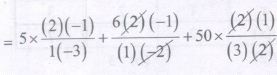
= \(\frac { 10 }{ 3 } -6+\frac { 50 }{ 3 } =\frac { 60 }{ 3 } -6=20-6=14\)
∴ f(2) = 14
15.
Since only two values of yare given, the polynomial which fits the data is of degree 1.
Hence 2nd differences are zeros
∴ Δ2(y0) = 0
⇒ (E-1)2yo=0
⇒(E2 - 2E + 1) yo = 0
⇒y2 - 2y1 +yo = 0
⇒34 - 2y1 + 51 = 0
⇒85 - 2y1 =0
⇒2y1 + 85 ⇒ y1 = \(\frac{85}{2}\)
⇒y1 = 42.5

12th Standard Syllabus & Materials
12th Standard
TN 12th Computer Applications களப்பெயர் முறைமை (DNS) Sample Question Papers Study Material - QB365 Set A
NEW12th Standard
TN 12th Computer Applications வலையமைப்பு எடுத்துக்காட்டுகள் மற்றும் நெறிமுறைகள் Sample Question Papers Study Material - QB365 Set A
NEW12th Standard
TN 12th Computer Applications கணினி வலையமைப்பு ஓர் அறிமுகம் Sample Question Papers Study Material - QB365 Set A
NEW12th Standard
TN 12th Computer Applications PHP-உடன் MySQL-ஐ இணைத்தல் Sample Question Papers Study Material - QB365 Set A



Tamilnadu Stateboard 12th Standard Subjects

Maths

Chemistry

Physics

Biology

Computer Science
Business Maths and Statistics

Economics

Commerce

Accountancy

History

Computer Applications
Biology
Computer Technology
Computer Applications
Computer Science
Business Maths and Statistics
Commerce
Economics
Maths
Chemistry
Physics
Computer Technology
History
Accountancy

Tamil

English

French
Tamilnadu Stateboard Standards
