
 100% FREE ACCESS
12th Standard Syllabus & Materials
12th Standard
TN 12th Computer Applications மின்னணு தரவு பரிமாற்றம் Sample Question Papers Study Material - QB365 Set A
NEW12th Standard
TN 12th Computer Applications மின் - வணிக பாதுகாப்பு அமைப்புகள் Sample Question Papers Study Material - QB365 Set A
NEW12th Standard
TN 12th Computer Applications மின்னணு செலுத்தல் முறைகள் Sample Question Papers Study Material - QB365 Set A
NEW12th Standard
TN 12th Computer Applications மின் - வணிகம் Sample Question Papers Study Material - QB365 Set A
NEW12th Standard
TN 12th Computer Applications திறந்த மூல கருத்துருக்கள் Sample Question Papers Study Material - QB365 Set A
NEW12th Standard
TN 12th Computer Applications வலையமைப்பு வடமிடல் Sample Question Papers Study Material - QB365 Set A

Published on: 02/09/2022
QB365 provides a detailed and simple solution for every Possible Creative Questions in Class 12 Business Maths Subject - Numerical Methods, English Medium. It will help Students to get more practice questions, Students can Practice these question papers in addition to score best marks.
Download Tamil Nadu 12th Standard Business Maths and Statistics question papers, model tests, one-mark questions, important questions, and public exam papers in PDF format. Free study materials and answer keys for TN State Board students.
Questions + Answers key
Take MCQ Business Maths and Statistics Test
1.
Apply Lagrange's formula to find y when x = 5 is given that
| x | 1 | 2 | 3 | 4 | 7 |
| y | 2 | 4 | 8 | 16 | 128 |
2.
If f(0) = 5, f(1) = 6, f(3) = 50, f(4) = 105, find f(2) by using Lagrange's formula
3.
Using Lagrange's formula find the value of y when x = 42 from the following table
| x | 40 | 50 | 60 | 70 |
| y | 31 | 73 | 124 | 159 |
4.
From the table estimate the premium fora policy maturity at the age of 58
| Age(x) | 40 | 45 | 50 | 55 | 60 |
| Premium y | 46 | 66 | 81 | 93 | 101 |
5.
Using Newton's formula estimate the population of town for the year 1995
| year(x) | 1961 | 1971 | 1981 | 1991 | 2001 |
| Population (y) (in thousands | 46 | 66 | 81 | 93 | 101 |
6.
Find the number of men getting wages between Rs. 30 and Rs. 35 from the following table
7.
From the data find the number of students whose height is between 80 cm and 90 cm.
| Height in cm's | 40-60 | 60-80 | 80-100 | 100-120 | 120-140 |
| No. of students y | 240 | 120 | 100 | 70 | 50 |
8.
From the following data find e1.75,
| x | 1.7 | 1.8 | 1.9 | 2 | 2.1 |
| y | 5.474 | 6.05 | 6.686 | 7.389 | 8.166 |
9.
Find y when x = 0.2 given that
| x | 0 | 1 | 2 | 3 | 4 |
| y | 176 | 185 | 194 | 202 | 212 |
10.
Estimate the production for 1962 and 1965 from the following data
| year | 1961 | 1962 | 1963 | 1964 | 1965 | 1966 | 1967 |
| production (in tonnes) | 200 | - | 260 | 306 | - | 390 | 430 |
11.
Using Lagrange's formula find the value of y when x = 4 from the following table.
| x | 0 | 3 | 5 | 6 | 8 |
| y | 276 | 460 | 414 | 343 | 110 |
12.
From the following table, estimate the premium for a policy maturing at the age of 58.
| Age (x) | 40 | 45 | 50 | 55 | 60 |
| Premium (y) | 114.84 | 96.16 | 83.32 | 74.48 | 68.48 |
13.
From the data, find the number of students whose height is between 80 cm and 90 cm
| Height in cm (x) | 40-60 | 60-80 | 80 - 100 | 100-120 | 120-140 |
| No. of. students (y) | 250 | 120 | 100 | 70 | 50 |
14.
From the following data, calculate the value of e1.75
| x | 1.7 | 1.8 | 1.9 | 2.0 | 2.1 |
| ex | 5.474 | 6.050 | 6.686 | 7.386 | 8.166 |
15.
Estimate the production for 1962 and 1965 from the following data
| year | 1961 | 1962 | 1963 | 1964 | 1965 | 1966 | 1967 |
| Production in tonnes | 200 | - | 260 | 306 | - | 390 | 430 |
1.
\(x_{0}=1, x_{1}=2, x_{2}=3, x_{3}=4, x_{4}=7, x=5\)
\(y_{0}=2, y_{1}=4, y_{2}=8, y_{3}=16, y_{4}=128\)
Applying in Lagrange's formula we get
\(
=-0.666+6.4-24+42.6666+8.533 \\
=32.933
\)
2.
\(x_{0}=0, x_{0}=1, x_{0}=3, x_{3}=4, x=2\)
\(
=\frac{5(1)(-1)(-2)}{(-1)(-3)(-1)}-\frac{(2(2)(-1)(-2)}{(1)(-2)(-3)}-
(50) \frac{2(1)(-2)}{3(2)(-1)}-\frac{4105 /(2)(1)(-1)}{4(3)(1)}\)
\(=-0.833 \div 4 \div 33.333-17.5=19\)
3.
\( x_{0}=40, x_{1}=50, x_{2}=60, x_{3}=70, x=42 \)
\(y_{0}=31, y_{2}=73, y_{2}=124, y_{3}=159 \)
\( y=j_{6} \frac{\left(x-x_{2}\right)\left(x-x_{2}\right)\left(x-x_{1}\right)}{\left(x-x_{2}\right)\left(x_{3}-x_{2}\right)\left(x_{2}-x_{1}\right)}-x_{3} \frac{\left(x-x_{3}\right)\left(x-x_{2}\right)\left(x-x_{2}\right)}{\left(x_{2}-x_{0}\right)\left(x_{2}-x_{2}\right)\left(x_{2}-x_{0}\right)} -1=\frac{\left(x-x^{2}\right)\left(x-x_{1}\right)\left(x-x_{2}\right)}{\left(x_{2}-x_{2}\right)\left(x_{2}-x_{2}\right)\left(x_{2}-x_{2}\right)}-t_{2} \frac{\left(x-x_{1}\right)\left(x-x_{2}\right)\left(x-x_{2}\right)}{\left(x_{2}-x_{0}\right)\left(x_{3}-x_{1}\right)\left(x_{3}-x_{2}\right)} \)
\(=\frac{31(-8)(-18)(-28)}{(-10)(-20)(-301}-\frac{73(2)(-18)(-28)}{(10)(-10)(-20)}+124 \frac{(2)(-8)(-28)}{(20)(-10)(-10)} -\frac{159(2)(-8)(-18)}{(301(20)(10)} \)
= 20.832 + 36.792 - 27.776 + 7.632
= 37.48
4.
\(x_{\mathrm{n}}=60, \mathrm{~h}=5, x_{\mathrm{n}}+\mathrm{nh}=58\)
\(5 n=-2 \Rightarrow n=\frac{-2}{5}=-0.4\)
| x | y | \(\nabla y\) | \(\Delta^2y\) | \(\Delta^3y\) | \(\Delta^4y\) |
| 40 | 114.86 | ||||
| -18.68 | |||||
| 45 | 96.16 | 5 | |||
| 12.84 | -1.84 | ||||
| 50 | 83.32 | 4 | 0.68 | ||
| -8.84 | -1.16 | ||||
| 55 | 74.48 | 2.84 | |||
| -6 | |||||
| 60 | 68.48 |
\(
\frac{m(n-1)(n-2)(n-3)}{4 !} \Gamma^{i} y
\) \( y=68.4 \mathrm{~s}+\frac{(-0.4)}{1 !}(-6)+\frac{(-0.4)(-0.4+1)}{2 !}(2.4)
-\frac{(-0.4)(-0.4-1)(-0.4+2)}{3 !}(-1.16)
-\frac{(-0.4)(-0.4-1)(-0.4-2)(-0.4-3)}{4 !}(0.68 )
\)
\(=68.48+24-0.3408+0.07424-0.028288\\
=70.5851\
\)
\( \therefore \text { If } x=58, y=70.59
\)
5.
\(x_{\mathrm{n}}=2001, \mathrm{~h} \doteq 10, x_{\mathrm{n}}+\mathrm{nh}=1995\)
\(n=\frac{-6}{10}=-0.6\)
| x | y | \(\nabla y\) | \(\Delta^2y\) | \(\Delta^3y\) | \(\Delta^4y\) |
| 1961 | 46 | ||||
| 20 | |||||
| 1971 | 66 | 5 | |||
| 15 | 2 | ||||
| 1981 | 81 | -3 | -3 | ||
| 12 | -1 | ||||
| 1991 | 93 | -4 | |||
| 8 | |||||
| 2001 | 101 |
\(
\mathrm{y}= y_{n}+\frac{n}{1 !} \nabla y_{n}+\frac{n(\mathrm{n}+1)}{2 !} \nabla^{2} y_{n}+
\frac{n(\mathrm{n}+1)(\mathrm{n}+2)}{3 !} \nabla^{3} y_{s}+\frac{n(n+1)(\mathrm{n}+2)(\mathrm{n}+3)}{4 !} \nabla^{4} y_{n}
\)
\(\mathrm{y}= 101+\frac{(-0.6)}{1 !}(8)+\frac{(-0.6)(-0.6+1)}{2 !}(-4)+\frac{(-0.6)(-0.6+1)(-0.6+2)}{3 !}(-1)
\ +\frac{(-0.6)(-0.6+1)(-0.6+2)(-0.6+3)}{4 !}(-3)
\)
= 101-4.8+0.48+0.056+0.1008
= 96.8368
6.
| Wages(x) | 20-30 | 30-40 | 40-50 | 5-60 |
| No.of men y | 9 | 30 | 35 | 42 |
\(
x_{0} =30, \mathrm{~h}=10, x_{0}+\mathrm{nh}=35
\)
10n = 5
n = 0.5
| x | y | \(\nabla y\) | \(\Delta^2y\) | \(\Delta^3y\) |
| Below 30 | 9 | |||
| 30 | ||||
| Below 40 | 39 | 5 | ||
| 35 | 2 | |||
| Below 50 | 74 | 7 | ||
| 42 | ||||
| Below 60 | 116 |
\(
y =y_{0}+\frac{n}{1 !} \Delta y+\frac{n(n-1)}{2 !} \Delta^{2} y+\frac{n(n-1)(n-2)}{3 !} \Delta^{3} y_{n}
\)
\(=9+\frac{(0.5)(30)}{1 !}+\frac{(0.5)(0.5-1)}{2 !}(5)+\frac{(0.5)(0.5-1)(0.5-2)}{3 !}(2)
\)
= 9+15-0.6+0.1
= 24
Number of men getting wages between
30 and 35 is y(35) - y(30) = 24-9 = 15
7.
\( x_{0} =60, \mathrm{~h}=20, x_{0}+\mathrm{nh}=90 \\ 20 \mathrm{n} =30 \Rightarrow \mathrm{n}=1.5 \)
| x | y | \(\nabla y\) | \(\Delta^{2} y\) | \(\Delta^{3} y\) | \(\Delta^{4} y\) |
| Below 60 | 250 | ||||
| 120 | |||||
| Below 80 | 370 | -20 | |||
| 100 | -10 | ||||
| Below 100 | 470 | -30 | 20 | ||
| 70 | 10 | ||||
| Below 120 | 540 | -20 | |||
| 50 | |||||
| Below 140 | 590 |
\( y=y_{0}+\frac{n}{1 !} \Delta y_{6}+\frac{n(n-1)}{2 !} \Delta^{2} y_{0}+\frac{n(n-1)(n-2)}{3 !} \Delta^{3} y_{0}
\) \(+\frac{n(n-1)(n-2)(n-3)}{4 !} \Delta^{4} y_{0} \)
\( y(90)= 250+\frac{(1.5)}{1 !}(250)+\frac{(1.5)(1.5-1)}{2 !}(-20) +\frac{(1.5)(1.5-1)(1.5-2)}{3 !}(-10)+\frac{(1.5)(1.5-1)(1.5-2)(1.5-3)}{4 !}(20)\)
= 250+180.7 .5+0.625+0.46875
\(
=423.59 \sim 424
\)
8.
\(
x_{0} =1.7, \mathrm{~h}=0.1, x=x_{0}+\mathrm{nh}=1.75
\)
\(\mathrm{n}(0.1) =1.75-1.7 \\
\mathrm{n} =\frac{0.05}{0.1}=0.5\)
| x | y | \(\nabla y\) | \(\Delta^{2} y\) | \(\Delta^{3} y\) | \(\Delta^{4} y\) |
| 1.7 | 5.474 | ||||
| 0.576 | 0 | ||||
| 1.8 | 6.05 | 0.060 | |||
| 0.636 | 0.007 | ||||
| 1.9 | 6.686 | 0.067 | 0 | ||
| 0.703 | 0.007 | ||||
| 2 | 7.389 | 0.074 | |||
| 0.777 | |||||
| 2.1 | 8.166 |
\(
\mathrm{y} =y_{0}+\frac{n}{1 !} \Delta y+\frac{n(\mathrm{n}-1)}{2 !} \Delta^{2} y_{0}+\frac{n(\mathrm{n}-1)(\mathrm{n}-2)}{3 !} \Delta^{\prime} y_{0}
\)
\(=5.474+\frac{0.5}{1 !}(0.576)+\frac{(0.5)(0.5-1)}{2 !}(0.06)
\ +\frac{(0.5)(0.5-1)(0.5-2)}{3 !}(0.007)
\)
= 5.474+0.288-0.0075+0.0004375
= 5.7549375
9.
\(x_{0}=0, \mathrm{~h}=1, x_{0}+\mathrm{nh}=0.2, \mathrm{n}=0.2\)
| x | y | \(\nabla y\) | \(\Delta^{2} y\) | \(\Delta^{3} y\) | \(\Delta^{4} y\) |
| 0 | 176 | 9 | |||
| 0 | |||||
| 1 | 185 | -1 | |||
| 9 | 4 | ||||
| 2 | 194 | -1 | |||
| 8 | 3 | ||||
| 3 | 202 | 2 | |||
| 10 | |||||
| 4 | 212 |
\(
y =1.6+\frac{0.2}{1 !}(9)+\frac{(0.2)(0.2-1)}{2 !}(0)+\frac{(0.2)(0.2-1)(0.2-2)}{3 !}(-1)
+\frac{(0.2)(0.2-1)(0.2-2)(0.2-3)}{4 !}(4)
\)
= 176+1.8-0.048-0.1344
= 177.6176
10.
Since 5 values of f(x) are given
\( \Delta^{5} y_{0} =0 \)
\((E-1)^{5} y_{0} =0 \)
\(\left(E^{3}-5 E^{4}+10 E^{3}-10 E^{2}+5 E-1\right) y_{0} =0 \)
\(y_{5}-5 y_{4}+10 y_{3}-10 y_{2}+5 y_{1}-y_{0} =0 \)
\(390-5 y_{4}+10(306)-10(260)+5 y_{1}-200 =0 \)
\(y_{1}-y_{4} =-130 \quad \ldots(1) \)
\(\Delta^{5} y_{1} =0 \)
\((E-1)^{5} y_{1} =0 \)
\(\left(E^{5}-5 \mathrm{E}^{4}+10 \mathrm{E}^{3}-10 \mathrm{E}^{2}+5 \mathrm{E}-1\right) \mathrm{y}_{1} =0 \)
\(\mathrm{y}_{6}-5 \mathrm{y}_{5}+10 \mathrm{y}_{4}-10 \mathrm{y}_{3}+5 \mathrm{y}_{2}-\mathrm{y}_{1} =0 \)
\(430-5(390)+10 \mathrm{y}_{4}-10(306)+5(260)-\mathrm{y}_{1} =0 \)
\(10 \mathrm{y}_{4}-\mathrm{y}_{1} =3280 \)...(2)
Solving (1) and (2) we get
y1 = 220 tons and y2 = 350 tons
11.
Given xo = 0, x1 = 3, x2 = 5, x3 = 6, x4 = 8
yo = 276, y1 = 460, y2 = 414, y3 = 343, y4 = 110
Lagrange's formula is
y = \(\frac { (x-{ x }_{ 1 })(x-{ x }_{ 2 })(x-{ x }_{ 3 })(x-{ x }_{ 4 }) }{ ({ x }_{ 0 }-{ x }_{ 1 })({ x }_{ 0 }-{ x }_{ 2 })({ x }_{ 0 }-{ x }_{ 3 })({ x }_{ 0 }-{ x }_{ 4 }) } { y }_{ 0 }+\frac { (x-{ x }_{ 0 })(x-{ x }_{ 2 })(x-{ x }_{ 3 })(x-{ x }_{ 4 }) }{ ({ x }_{ 1 }-{ x }_{ 0 })({ x }_{ 1 }-{ x }_{ 2 })({ x }_{ 1 }-{ x }_{ 3 })({ x }_{ 1 }-{ x }_{ 4 }) } { y }_{ 1 }+\frac { (x-{ x }_{ 0 })(x-{ x }_{ 1 })(x-{ x }_{ 3 })(x-{ x }_{ 4 }) }{ ({ x }_{ 2 }-{ x }_{ 0 })({ x }_{ 2 }-{ x }_{ 1 })({ x }_{ 2 }-{ x }_{ 3 })({ x }_{ 2 }-{ x }_{ 4 }) } { y }_{ 2 }+\frac { (x-{ x }_{ 0 })(x-{ x }_{ 1 })(x-{ x }_{ 3 })(x-{ x }_{ 4 }) }{ ({ x }_{ 3 }-{ x }_{ 0 })({ x }_{ 3 }-{ x }_{ 1 })({ x }_{ 3 }-{ x }_{ 2 })({ x }_{ 3 }-{ x }_{ 4 }) } { y }_{ 3 }+\frac { (x-{ x }_{ 0 })(x-{ x }_{ 2 })(x-{ x }_{ 3 })(x-{ x }_{ 4 }) }{ ({ x }_{ 4 }-{ x }_{ 0 })({ x }_{ 4 }-{ x }_{ 2 })({ x }_{ 4 }-{ x }_{ 3 })({ x }_{ 4 }-{ x }_{ 4 }) } { y }_{ 4 }\)
⇒ 276 \(\frac { (1)(-1)(-2)(-4) }{ (-3)(-5)(-6)(-8) } +460\frac { (4)(-1)(-2)(-4) }{ (3)(-2)(-3)(-5) } +414\frac { (4)(1)(-1)(-4) }{ (5)(2)(-1)(-3) } +343\frac { (4)(1)(-1)(-2) }{ (6)(3)(1)(-2) } +110\frac { (4)(1)(-1)(-2) }{ (8)(5)(3)(2) } \)
⇒ y = -3.066 + 163.555 + 441.6 - 152.44 + 3.666
⇒ y = 453.311.
12.
Using Newton's backward interpolation formula,
we can find y when x = 58.
∴ x + nh = x ⇒ 60 + n(5) = 58
⇒ 5n = 58 - 60 = -2
⇒ n = \(\frac{-2}{5}\)= -0.4
and y(58) = \({ y }_{ n }+\frac { n }{ n! } \nabla { y }_{ n }+\frac { n(n+1) }{ 2! } { \nabla }^{ 2 }{ y }_{ n }+\frac { n(n+1)(n-2) }{ 3! } { \nabla }^{ 3 }{ (y }_{ n })+\) .....
The difference table is
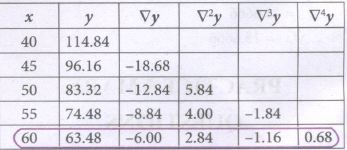
\(y(58)=68.48+\frac { (-0.4) }{ 1! } (-6)+\frac { (0.4)(-0.4+1) }{ 2! } (2.84)+\frac { (-0.4)(-0.4+1)(-0.4+2) }{ 3! } (-1.16)+\frac { (-0.4)(-0.4+2)(-0.4+2)(-0.4+3) }{ 3! } (0.68)\)
=68.48 + (0.4)(6) + \(\frac { (-0.4)(0.6) }{ 2 } (2.84)+\frac { (-0.4)(0.6)(1.6) }{ 6 } (-1.16)+\frac { (-0.4)(0.6)(1.6)(2.6) }{ 24 } (0.68)\)
= 68.48 + 2.4 - 0.3408 + 0.07424 - 0.028288
= 70.5851052
⇒ y(58) = 70.59
∴ Hence, premium for a policy maluting at the age of 58 is 70.59.
13.
Let us calculate the number of students whose height is less than 90 ern using Newton's forward interpolation formula.
xo+ nh = x ⇒ 60 + n(20) = 90 ⇒ 20n = 30
⇒ n = \(\frac32\) = 1.5
\({ y }_{ x }={ y }_{ o }+\frac { n }{ n! } \triangle { y }_{ o }+\frac { n(n+1) }{ 2! } { \triangle }^{ 2 }{ y }_{ o }+\frac { n(n+1)(n-2) }{ 3! } { \triangle }^{ 3 }{ (y }_{ o })+.......\)
The difference table is as follows:
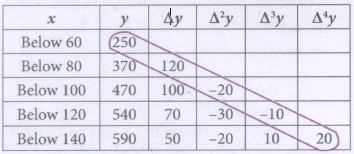
∴y(90) = 250 + (1.5)(120)\(\frac { (1.5)(1.5-1) }{ 2! } (20)+\frac { (1.5)(1.5-1)(1.5-2) }{ 3! } (-10)+\frac { (1.5)(1.5-1)(1.5-2)(1.56-3) }{ 4! } (20)\)
= 250 + 180 - 7.5 + 0.625 + 0.46875
= 423.59 = 424 (app)
ஃ Number of students whose height is between 80 cm and 90 cm is y(90) - y(80)
= 424 - 370
= 54.
14.
Since e1.75 lies at the beginning of the table, we can use Newton's forward interpolation formula
∴ xo + nh = x ⇒ 1.7 + n(0.1) = 1.75
⇒ n(0.1) = 1.75 - 1.7 = 0.05
⇒ n = \(\frac{0.05}{0.1}\) = 0.5
\({ y }_{ x }={ y }_{ o }+\frac { n }{ n! } \triangle { y }_{ o }+\frac { n(n+1) }{ 2! } { \triangle }^{ 2 }{ y }_{ o }+\frac { n(n+1)(n-2) }{ 3! } { \triangle }^{ 3 }{ (y }_{ o })+.......\)
The difference table is
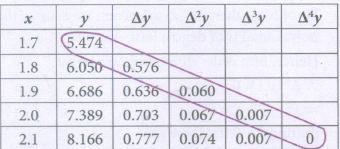
∴ \(y\left( { e }^{ 1.75 } \right) =5.74+\frac { 0.5 }{ 1! } (0.576)+\frac { (0.5)(0.5-1) }{ 2! } (0.06)+\frac { (0.5)(0.5-1)(0.5-2) }{ 3! } (0.007)\)
y(e1.75) = 5.474 + 0.288 - 0.0075 + 0.0004375
= 5.7549375
15.
Since five values of f(x) are given, we assume that polynomial is of degree four.
Hence, fifth order differences are zeros.
∴ ∆5(yk) = 0
⇒ (E - 1)5yk = 0 (1)
Putting k = 0 in (1) we get
(E - 1)5yo = 0 ⇒ (E5- 5E4 + 10E3 - 10E2+ 5E - 1)yo = 0
⇒ y5 - 5y4 + 10y3 - 10y2 + 5y1 - yo = 0
⇒ 390 - 5y4 + 10y3 - 10y2 + 5y1 - yo = 0
⇒ y1 - y4 = -130 (2)
Putting k = 1 in (1) we get,
(E - 1)5y1 = 0
⇒ (E5 - 5E4 + 10E3 - 10P + 5E -1) y1 = 0
⇒ y6 - 5y5 + 10y4 - 10y3 + 5y2 - y1 = 0
⇒ 430 - 5(390) + 10y4 - 10(306) + 5(260) - y1 = 0
⇒ 10y4 - y1 = 3280

⇒ 9y4 = 3150
⇒ y4 = 350
Substituting y4 = 350 in (2) we get,
y1 - 350 = - 130 ⇒ y1 = -130 + 350
⇒ y1 = 220
∴ The productions for 1962 and 1965 are 220 The productions for 1962 and 1965 are 220

12th Standard Syllabus & Materials
12th Standard
TN 12th Computer Applications களப்பெயர் முறைமை (DNS) Sample Question Papers Study Material - QB365 Set A
NEW12th Standard
TN 12th Computer Applications வலையமைப்பு எடுத்துக்காட்டுகள் மற்றும் நெறிமுறைகள் Sample Question Papers Study Material - QB365 Set A
NEW12th Standard
TN 12th Computer Applications கணினி வலையமைப்பு ஓர் அறிமுகம் Sample Question Papers Study Material - QB365 Set A
NEW12th Standard
TN 12th Computer Applications PHP-உடன் MySQL-ஐ இணைத்தல் Sample Question Papers Study Material - QB365 Set A



Tamilnadu Stateboard 12th Standard Subjects

Maths

Chemistry

Physics

Biology

Computer Science
Business Maths and Statistics

Economics

Commerce

Accountancy

History

Computer Applications
Biology
Computer Technology
Computer Applications
Computer Science
Business Maths and Statistics
Commerce
Economics
Maths
Chemistry
Physics
Computer Technology
History
Accountancy

Tamil

English

French
Tamilnadu Stateboard Standards
