
 100% FREE ACCESS
12th Standard Syllabus & Materials
12th Standard
TN 12th Computer Applications மின்னணு தரவு பரிமாற்றம் Sample Question Papers Study Material - QB365 Set A
NEW12th Standard
TN 12th Computer Applications மின் - வணிக பாதுகாப்பு அமைப்புகள் Sample Question Papers Study Material - QB365 Set A
NEW12th Standard
TN 12th Computer Applications மின்னணு செலுத்தல் முறைகள் Sample Question Papers Study Material - QB365 Set A
NEW12th Standard
TN 12th Computer Applications மின் - வணிகம் Sample Question Papers Study Material - QB365 Set A
NEW12th Standard
TN 12th Computer Applications திறந்த மூல கருத்துருக்கள் Sample Question Papers Study Material - QB365 Set A
NEW12th Standard
TN 12th Computer Applications வலையமைப்பு வடமிடல் Sample Question Papers Study Material - QB365 Set A

Published on: 03/09/2022
QB365 provides a detailed and simple solution for every Possible Creative Questions in Class 12 Business Maths Subject - Operations Research, English Medium. It will help Students to get more practice questions, Students can Practice these question papers in addition to score best marks.
Download Tamil Nadu 12th Standard Business Maths and Statistics question papers, model tests, one-mark questions, important questions, and public exam papers in PDF format. Free study materials and answer keys for TN State Board students.
Questions + Answers key
Take MCQ Business Maths and Statistics Test
1.
What are the steps used in Hungarian Method of Solving assignment problem?.
2.
A conmpany wishes to assign 4 salesman to 4 districts the volume of sales matrix is given below column. Make optimal assignment which results in maximum volume of sales.
| Salesman | District | |||
| A | B | C | D | |
| 1 | 250 | 300 | 420 | 400 |
| 2 | 350 | 400 | 200 | 250 |
| 3 | 500 | 375 | 400 | 350 |
| 4 | 400 | 350 | 420 | 300 |
3.
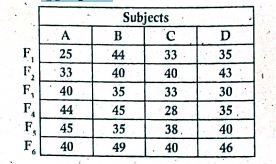
Anuniversity wants to allocate the 4 subjects and six teachers claim that they have the required competencies/knowledge to teach all the subjects. The dean believes that the failure in the course is reflection of faculty nembers performance. Allocate the subject to appropriate member.
4.
Find the assignment of operation to appropriate job with lowest possible time to complete the jobs.
| Job | Operator | ||||
| 1 | 2 | 3 | 4 | 5 | |
| J1 | 5 | 6 | 8 | 6 | 4 |
| J2 | 4 | 8 | 7 | 7 | 5 |
| J3 | 7 | 7 | 4 | 5 | 4 |
| J4 | 6 | 5 | 6 | 7 | 5 |
| J5 | 4 | 7 | 8 | 6 | 8 |
5.
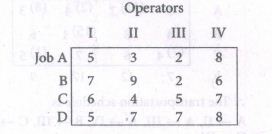
Solve the following assignment problem. Cell values represent cost of assigning job A, B, C and D to the operators I, II, III and IV.
6.
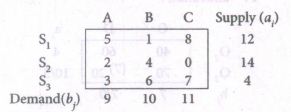
Find the initial basic feasible solution for the following transportation problem by Vogel's approximation method.
7.
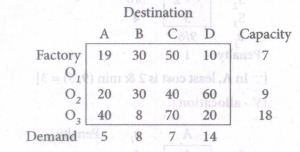
Determine how much quantity should be stepped from factory to various destinations for the following transportation problem using the least cost method.
8.
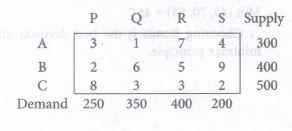
Determine an initial basic feasible solution to the following transportation problem using North West corner rule.
9.
For the given pay-off matrix, choose the best alternative for the given states of nature under
(i) Maximin (ii) Minimax princple
| Alternative | States of Nature | ||
| Good | Fair | Bad | |
| A | 100 | 60 | +50 |
| B | 80 | 50 | +10 |
| C | 40 | 20 | +5 |
1.
First check whether the number of rows in equal to the numbers of columns, if it is so, the assignment problem is said to be balanced.
Step 1: Choose the least element in,each row and subtract it from all the elements of that row.
Step 2: Choose the least element in each column and subtract it from all the elements of that column. Step 2 has to be performed from the table olblained in step 1.
Step 3: Check whether there is atleast o ir results in maximunm volume of sales. each row and each column and make an assignment as follows.
(i) Examine the rows successively until a row with exactly one zero is found. Mark that zero by \(\square\), that means an assignment is made there. Cross (x) all other zeros in its column. Continue this until all the rows have been examined.
(ii) Examine the columns successively until a columns with exactly one zero is found. Mark that zero by \(\square\), that means an assignment is made there. Cross (x) all other zeros in its row. Continue this until all the columns have been examined.
Step 4: If each row and each column contains exactly one assignment, then the solution is optimal.
2.
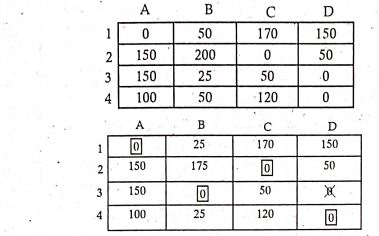
The optimal solution is
| Salesman | ||
| District | Sales | |
| 1 | A | 250 |
| 2 | C | 200 |
| 3 | B | 375 |
| 4 | 0 | 300 |
| Total Sales | 1125 | |
3.
Number of rows \(\neq\) number of columns.
Hence we add 2 dummy columns E and F.
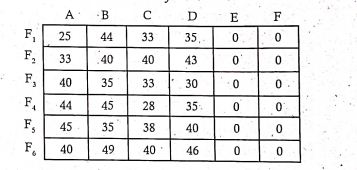
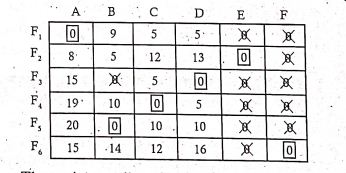
The optimum allocation is
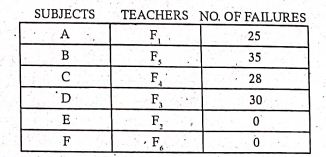
Total failure 118
4.
| Job | |||||
| 1 | 2 | 3 | 4 | 5 | |
| J1 | 1 | 2 | 4 | 2 | 0 |
| J2 | 0 | 4 | 3 | 3 | 1 |
| J3 | 3 | 3 | 0 | 1 | 0 |
| J4 | 1 | 0 | 1 | 2 | 0 |
| J5 | 0 | 3 | 4 | 2 | 4 |
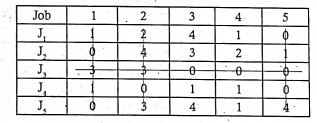
Number of lines = 4 <5 (no. of rows)
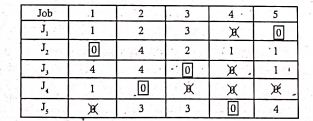
| Job | ||
| Operator | Cost | |
| J1 | 5 | 4 |
| J2 | 1 | 4 |
| J3 | 3 | 4 |
| J4 | 0 | 5 |
| J5 | 0 | 6 |
Total allocation cost = 23.
5.
Here the number of rows and columns are equal.
∴ The given assignment problem is balanced.
Step 1 :
Select a minimum element in each row and subtract this from all the elements in its row.
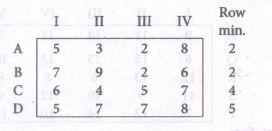
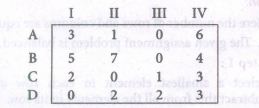
Here IV column has no zero. Go to step 2.
Step 2:
Select the minimum element in each column and subtract this from all the elements in its column.
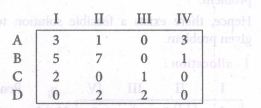
Since each row and column contains atleast one zero, assignments can be made.
Step 3:
Examine the rows with only one zero. Mark that. zero by and draw a vertical line.
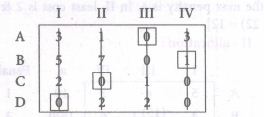
Thus, all the assignments have been made.
The optimal assignment schedule and total cost is
| Job | Operator | Cost |
|---|---|---|
| A | III | 2 |
| B | IV | 6 |
| C | II | 4 |
| D | I | 5 |
| Total Cost | Rs. 17 | |
6.
Σai = 12 + 14 + 4 = 30
Σbj = 9 + 10 + 11 = 30
Σai = Σbj
∴ The given problem is a balanced transportation problem.
Hence, there exists a feasible solution to the given problem.
I - allocation :
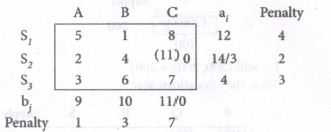
[∵ the highest penalty is 7, In C, least cost is 0 & min (11, 14) = 11]
II - allocation :
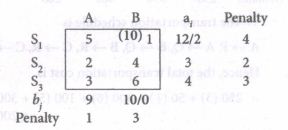
[∵ the highest penalty is 4, In S1'least cost is 1& min (10, 12) = 10]
III - allocation :
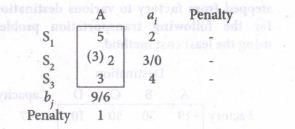
[∵ In A, least cost is 2 & min (9, 3) = 3]
IV - allocation :
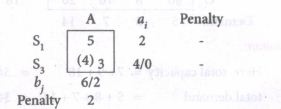
[∵ In A, least cost is 3 & min (6,4) = 4]
V - allocation :
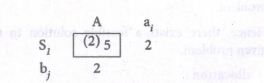
[∵ min (2, 2) = 2]
Thus, the allocations are
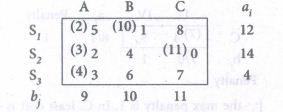
∴ The transportation schedule is
S1 → A, S1 → B, S2 → A, S2 → C S3 → A
Hence, the total transportation cost is
= 2(5) + 10(1) + 3(2) + 11(0) + 4(3)
= 10 + 10 + 6 + 0 + 12 = Rs. 38
7.
Here, total capacity = 7+ 9 + 18 = 34
total demand = 5 + 8 + 7 + 14 = 34
Total capacity = Total demand
∴ The given problem is a balanced transportation problem.
Hence, there exists a feasible solution to the given problem,
I - allocation:
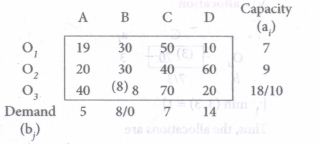
[∵ The least cost is 8 & min (8, 18) = 8]
II - allocation:
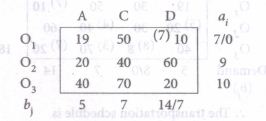
[∵ The least cost is 7 & min (7,14) = 7]
III - allocation:
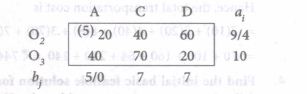
[∵ The least cost is 20 & min (5, 9) = 5]
IV - allocation:
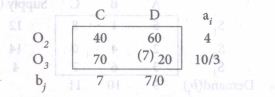
[∵ The least cost is 40 & min (4, 7) = 4]
VI - allocation:
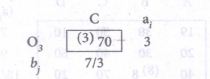
[∵ min (3, 3) = 1]
Thus, the allocations are
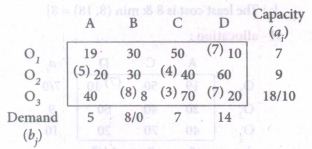
∴ The transportation schedule is
O1 → D1, O2 → A1, O2 → C1, O3 → B1 , O3 → C1, O3 → D1,
Hence, the total transportation cost is
= 7(10) + 5(20) + 4(40) + 8(8) + 3(70) + 7(20)
= 70+ 100+ 160+64+210+ 140 = Rs. 744
8.
Here total supply = 300 + 400 + 500 = 1200
Total demand = 250 + 350 + 400 + 200 =1200
∴ Total supply = total demand
The given problem is a balanced transportation problem.
Hence, there exists a feasible solution to the given problem
I-allocation:
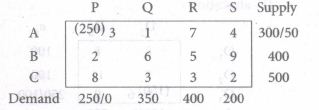
[∵ Min (250, 300) = 250]
II-allocation:
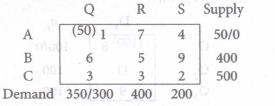
[∵ Min (50,350) = 50]
III-allocation:
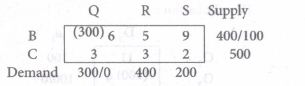
[∵ Min (300,400) = 300]
IV-allocation:
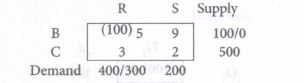
[∵ Min (400,100) = 100]
V-allocation:
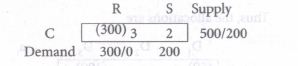
[∵ Min (300, 500) = 300]
VI-allocation:
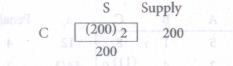
[∵ Min (200, 200) = 200]
Thus, the allocations are
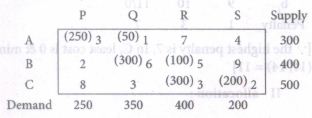
∴ The transportation schedule is
A → P, A → Q, B → Q, B → R, C → R, C → S
Hence, the total transportation cost is
= 250 (3) + 50 (1) + 300 (6) + 100 (5) + 300 (3) + 200 (2)
= 750 + 50 + 1800 + 500 + 900 + 400
= Rs. 4400
9.
| Alternative | States of Nature | Minimum | Maximum | ||
| Good | Fair | Bad | |||
| A | 100 | 60 | +50 | +50 | 100 |
| B | 80 | 50 | +10 | 10 | 80 |
| C | 40 | 20 | +5 | 5 | 40 |
(i) Max (50, 10, 5) = 50
∴ A is the best alternative under maximin principle
(ii) Min (100, 80,40) = 40
∴ C is the best alternative under minimax principle

12th Standard Syllabus & Materials
12th Standard
TN 12th Computer Applications களப்பெயர் முறைமை (DNS) Sample Question Papers Study Material - QB365 Set A
NEW12th Standard
TN 12th Computer Applications வலையமைப்பு எடுத்துக்காட்டுகள் மற்றும் நெறிமுறைகள் Sample Question Papers Study Material - QB365 Set A
NEW12th Standard
TN 12th Computer Applications கணினி வலையமைப்பு ஓர் அறிமுகம் Sample Question Papers Study Material - QB365 Set A
NEW12th Standard
TN 12th Computer Applications PHP-உடன் MySQL-ஐ இணைத்தல் Sample Question Papers Study Material - QB365 Set A



Tamilnadu Stateboard 12th Standard Subjects

Maths

Chemistry

Physics

Biology

Computer Science
Business Maths and Statistics

Economics

Commerce

Accountancy

History

Computer Applications
Biology
Computer Technology
Computer Applications
Computer Science
Business Maths and Statistics
Commerce
Economics
Maths
Chemistry
Physics
Computer Technology
History
Accountancy

Tamil

English

French
Tamilnadu Stateboard Standards
