
 100% FREE ACCESS
12th Standard Syllabus & Materials
12th Standard
TN 12th Maths Applications of Matrices and Determinants Sample Question Papers Study Material - QB365 Set A
NEW12th Standard
TN 12th Computer Applications மின்னணு தரவு பரிமாற்றம் Sample Question Papers Study Material - QB365 Set A
NEW12th Standard
TN 12th Computer Applications மின் - வணிக பாதுகாப்பு அமைப்புகள் Sample Question Papers Study Material - QB365 Set A
NEW12th Standard
TN 12th Computer Applications மின்னணு செலுத்தல் முறைகள் Sample Question Papers Study Material - QB365 Set A
NEW12th Standard
TN 12th Computer Applications மின் - வணிகம் Sample Question Papers Study Material - QB365 Set A
NEW12th Standard
TN 12th Computer Applications திறந்த மூல கருத்துருக்கள் Sample Question Papers Study Material - QB365 Set A

Published on: 02/09/2022
QB365 provides a detailed and simple solution for every Possible Book Back Questions in Class 12 Business Maths Subject -Probability Distributions, English Medium. It will help Students to get more practice questions, Students can Practice these question papers in addition to score best marks.
Download Tamil Nadu 12th Standard Business Maths and Statistics question papers, model tests, one-mark questions, important questions, and public exam papers in PDF format. Free study materials and answer keys for TN State Board students.
Questions + Answers key
Take MCQ Business Maths and Statistics Test
1.
Write down the conditions in which the Normal distribution is a limiting case of binomial distribution.
2.
Define Standard normal variate.
3.
Define Normal distribution.
4.
Mention the properties of poisson distribution.
5.
Write the conditions for which the poisson distribution is a limiting case of binomial distribution.
6.
Write any 2 examples for Poisson distribution.
7.
Define Poisson distribution.
8.
The mean of a binomial distribution is 5 and standard deviation is 2. Determine the distribution.
9.
A pair of dice is thrown 4 times. If getting a doublet is considered a success, find the probability of 2 successes.
10.
If the probability of success is 0.09, how many trials are needed to have a probability of atleast one success as 1/3 or more ?
11.
In a family of 3 children, what is the probability that there will be exactly 2 girls?
12.
Write down the conditions for which the binomial distribution can be used.
13.
Define Bernoulli trials.
14.
Define Binomial distribution.
15.
In a book of 520 pages, 390 typo-graphical errors occur. Assuming Poisson law for the number of errors per page, find the probability that a random sample of 5 pages will contain no error.
16.
In a Poisson distribution the first probability term is 0.2725. Find the next Probability term
17.
In tossing of a five fair coin, find the chance of getting exactly 3 heads.
18.
Verfy the following statement:
The mean of a Binomial distribution is 12 and its standard deviation is 4.
19.
1.
Normal distribution is a limiting case of Binomial distribution under the following conditions.
(i) n, the number of trials is infinitely large i.e. n ⟶ ∞
(ii) Neither p(or q) is very small.
2.
A random variable Z = \(\frac { X-\mu }{ \sigma } \) follows the standard normal distribution is called the standard normal variate with mean 0 and standard deviation 1. i.e. Z~ N(0,1). Its,probability density function is given by:
\(\varphi(Z)=\frac{1}{\sqrt{2 \pi}} e^{-\frac{Z^{2}}{2}},-\infty< Z< \infty
\)
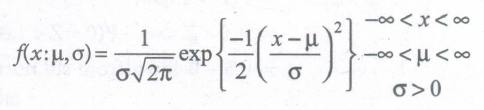
3.
A random variable X is said to follow a normal distribution with parameters mean μ and variance σ2, if its probability density function is given by
4.
Poisson distribution is the only distribution in which the mean and variance are equal.
5.
Poisson distribution is a limiting case of binomial distribution under the following conditions.
(i) n, the number of trials is indefinitely large ie., n⟶∞.
(ii) p, the constant probability of success in each trial is very small ie., p ⟶0.
(iii) np = λ is finite.Thus p = λ/n and q = 1 -(λ/n) where λ is a positive real number.
6.
(i) Number of lightnings per second.
(ii) Number of printing mistakes per page in a textbook.
7.
A random variable X is said to follow a Poisson distribution with parameter λ if it assumes only non-negative values and it probability mass function is given by
P(x,λ) = P(X = x) {\(=\begin{cases} \begin{matrix} \frac { e^{-λ}{ \lambda }^{ x } }{ x! } , & x=0,1,2,....,\lambda >0 \\ 0, & otherwise \end{matrix} \end{cases}\)
8.
Given mean of a binomial distribution is 5
np = 5 ....(1)
Also, standard deviation is 2 ⇒ Variance = 22 = 4
∴ npq = 4...(2)
(2) \(\div \) (1) given, \(\frac { npq }{ np } \)=\(\frac { 4 }{ 5 } \)
⇒ q = \(\frac { 4 }{ 5 } \)
p = 1-q = \(1-\frac { 4 }{ 5 } =\frac { 1 }{ 5 } \)
Substituting p = \(\frac { 1 }{ 5 } \) in (1) we get
n\(\left( \frac { 1 }{ 5 } \right) \) = 5 ⇒ n = 25
∴ The binomial distribution is nCx pxqn-x, x = 0,1,2,....n
⇒ 25Cx \(\left( \frac { 1 }{ 5 } \right) ^{ x }\left( \frac { 4 }{ 5 } \right) ^{ 25-x }\), x = 0,1,2,....25.
9.
Let p be the probability of getting doublet in a pair of dice.
∴ p = \(\frac { 6 }{ 36 } \) [∵ favourable events are (1, 1) (2,2) (3,3) (4,4) (5,5) (6,6) and n(S) = 36]
⇒ p = \(\frac { 1 }{ 6 } \) ∴ q=1-p =\(1-\frac { 1 }{ 6 } =\frac { 5 }{ 6 } \)]
∴ P (getting 2 success) = P(X = 2)
=4C2 \(\left( \frac { 1 }{ 6 } \right) ^{ 2 }\left( \frac { 5 }{ 6 } \right) ^{ 2 }\) [∵ p(x) =nCx pxqn-x, n = 4, x = 2 ]
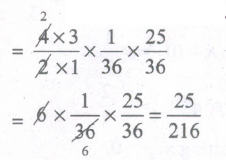
∴ P(X = 2) =\(\frac { 25 }{ 216 } \).
10.
Given probability of success p = 0.09
∴ q = 1 - p = 1 - 0.09 = 0.91
n = 1
Also P(atleast one success) = \(\frac { 1 }{ 3 } \) or more
∴ P(X≥1) = \(\frac { 1 }{ 3 } \)
⇒ 1-P(X < 1) = \(\frac { 1 }{ 3 } \)
⇒ P(X<1) =\(1-\frac { 1 }{ 3 } =\frac { 2 }{ 3 } \)
⇒ P(X = 0) =\(\frac { 2 }{ 3 } \)
⇒ nCx pxqn-x = \(\frac { 2 }{ 3 } \)
Putting x = 0,
nC0 (0.09)0 (0.91)n-0 = \(\frac { 2 }{ 3 } \)
⇒ (0.91)n = \(\frac { 2 }{ 3 } \) =0.6666
when (0.91) is Jultiplied 5 times we are getting 0.6240
∴ n = 5 or more
Here number of trails are 5 or more.
11.
Let p he the probability of getting a girls
∴ p = \(\frac { 1 }{ 2 } \) [∵ one favourable event and total no of events is 2]
⇒ q = 1-p = 1-\(\frac { 1 }{ 2 } \) = \(\frac { 1 }{ 2 } \) and n = 3
∴ (getting exactly 2 girls)
= P(X = 2)
= 3C2\(\left( \frac { 1 }{ 2 } \right) ^{ 2 }\left( \frac { 1 }{ 2 } \right) ^{ 1 }\) [∵ p(x) = nCx pxqn-x, n = 3 and x = 2]
= \(3\left( \frac { 1 }{ 2 } \right) ^{ 3 }=3\times \left( \frac { 1 }{ 2 } \right) ^{ 3 }=3\times \frac { 1 }{ 8 } \) = 0.375
P (getting exactly 2 girls) = 0.375.
12.
The binomial distribution can be used under the following conditions.
(i) The number of trials en' is finite,
(ii) The trials are independent of each other.
(iii) The probability of success 'p' is constant for each trial.
(iv) In every trial there are only two possible outcomes namely success or failure.
13.
A random experiment whose outcomes are of two types namely success S and failure P, occurring with probabilities p and q is called a Bernoulli trial.
14.
A random variable X is said to follow binomial distribution with parameter n and p, if it assumes only non-negative value and its probability mass function is given by
P(X = x) = P(x) = q = 1-p \(=\begin{cases} \begin{matrix} { { n }_{ C } }_{ x }P^{ x }{ q }^{ n-x },x=0,1,2,...n; \end{matrix} \\ \begin{matrix} 0, & otherwise \end{matrix} \end{cases}\)
15.
The average number of typographical errors per page in the book is given by \(\lambda\) = (390/520) = 0.75.
Hence using Poisson probability law, the probability of x errors per page is given by
\(P(X=x)=\frac { { e }^{ -\lambda }{ \lambda }^{ x } }{ x! } ={ e }^{ -0.75 }=\frac{(0.75)^x}{x!}\) x = 0,1,2,3……
The required probability that a random sample of 5 pages will contain no error is given by :
[P(X = 0)]5 = (e-0.75)5 = e-3.75
16.
Given that p(0) = 0.2725
\(\frac { { e }^{ -\lambda }{ \lambda }^{ 0 } }{ 0! } =0.2725\)
⇒ e-\(\lambda\) = 0.2725 (by using exponent table)
\(\lambda\) = 1.3
∴ p(X=1) = e-1.3(1.3)/1!
= e-1.3(1.3)
= 0.2725 x 1.3
= 0.3543
17.
Let X be a random variable follows binomial distribution with p = q = 1/2
P (3 heads) = \(5{ C }_{ x }{ \left( \frac { 1 }{ 2 } \right) }^{ x }{ \left( \frac { 1 }{ 2 } \right) }^{ 5-x }\)
\(={ 5C }_{ 3 }{ \left( \frac { 1 }{ 2 } \right) }^{ 3 }{ \left( \frac { 1 }{ 2 } \right) }^{ 5-3 }\)
\(=5{ C }_{ 3 }{ \left( \frac { 1 }{ 2 } \right) }^{ 5 }\)
\(=\frac { 5 }{ 16 } \)
18.
Mean: np = 12
\(SD=\sqrt { npq } =4\)
\(npq={ 4 }^{ 2 }=16,\frac { np }{ npq } =\frac { 12 }{ 16 } =\frac { 3 }{ 4 } \)
\(q=\frac { 4 }{ 3 } >1\)
Since p + q cannot be greater than unity, the Statement is wrong
19.

12th Standard Syllabus & Materials
12th Standard
TN 12th Computer Applications வலையமைப்பு வடமிடல் Sample Question Papers Study Material - QB365 Set A
NEW12th Standard
TN 12th Computer Applications களப்பெயர் முறைமை (DNS) Sample Question Papers Study Material - QB365 Set A
NEW12th Standard
TN 12th Computer Applications வலையமைப்பு எடுத்துக்காட்டுகள் மற்றும் நெறிமுறைகள் Sample Question Papers Study Material - QB365 Set A
NEW12th Standard
TN 12th Computer Applications கணினி வலையமைப்பு ஓர் அறிமுகம் Sample Question Papers Study Material - QB365 Set A



Tamilnadu Stateboard 12th Standard Subjects

Maths

Chemistry

Physics

Biology

Computer Science
Business Maths and Statistics

Economics

Commerce

Accountancy

History

Computer Applications
Biology
Computer Technology
Computer Applications
Computer Science
Business Maths and Statistics
Commerce
Economics
Maths
Chemistry
Physics
Computer Technology
History
Accountancy

Tamil

English

French
Tamilnadu Stateboard Standards
