
 100% FREE ACCESS
12th Standard Syllabus & Materials
12th Standard
TN 12th Maths Applications of Matrices and Determinants Sample Question Papers Study Material - QB365 Set A
NEW12th Standard
TN 12th Computer Applications மின்னணு தரவு பரிமாற்றம் Sample Question Papers Study Material - QB365 Set A
NEW12th Standard
TN 12th Computer Applications மின் - வணிக பாதுகாப்பு அமைப்புகள் Sample Question Papers Study Material - QB365 Set A
NEW12th Standard
TN 12th Computer Applications மின்னணு செலுத்தல் முறைகள் Sample Question Papers Study Material - QB365 Set A
NEW12th Standard
TN 12th Computer Applications மின் - வணிகம் Sample Question Papers Study Material - QB365 Set A
NEW12th Standard
TN 12th Computer Applications திறந்த மூல கருத்துருக்கள் Sample Question Papers Study Material - QB365 Set A

Published on: 02/09/2022
QB365 provides a detailed and simple solution for every Possible Creative Questions in Class 12 Business Maths Subject -Probability Distributions, English Medium. It will help Students to get more practice questions, Students can Practice these question papers in addition to score best marks.
Download Tamil Nadu 12th Standard Business Maths and Statistics question papers, model tests, one-mark questions, important questions, and public exam papers in PDF format. Free study materials and answer keys for TN State Board students.
Questions + Answers key
Take MCQ Business Maths and Statistics Test
1.
A die is tossed thrice. Getting an even number is considered as success what is the variance of a binomial distribution?
2.
A die is thrown 20 times. Getting a number greater than 4 is considered as success. Find the mean and variance of the number of success.
3.
An unbiased die is thrown again and again until three sixes are obtained. Find the probability of obtaining 3rd six in the sixth throw of the die.
4.
Five dice are thrown simultaneously. If thee Occurrence of an even number in a single die is considered a success, find the probability of atmost 3 successes.
5.
In a hurdles race, a player has to cross 10 hurdles. The probability that he will clear each hurdle \(\frac{5}{6}\) is what is the probability that he will knock down fewer than 2 hurdles?
6.
The probability of the happening of an event X is 0.002 in an experiment. If an experiment is reported 1000 times, find the probability that the event X happens exactly twice? (e-2 = 0.1353)
7.
If you buy a lottery ticket in 50 lotteries, in each which your chance of winning a prize is \(\frac { 1 }{ 100 } \). What is the approximate probability that you will win a prize at least once (e-0.5 = 0.6066).
8.
The random variable X has the normal distribution f(x) = \(C{ e }^{ -\left( \frac { x-100 }{ 50 } \right) ^{ 2 } }\), then find the value of C.
9.
In a packet of 50 pens, 10 are defective, 10 pens are selected at random. What is the probability that atleast one is defective.
10.
Students of a class were given an aptitude test. Marks were found to be normally distributed with mean 60 and S.D. 5. Find the percentage of students who scored more than 60 marks.
11.
If 10 coins are tossed, find the probability that exactly 5 heads appears.
12.
Suppose X is a binomial variate X ~ B (5, p) and P(X = 2) = P(X = 3), then find p.
13.
If the mean of the binomial distribution is 20 and standard deviation is 4, then find the number of events.
14.
If the mean of the binomial distribution with 9 trial is 6, then find the variance.
15.
In a Poisson distribution 3 P(X = 2) = P(X = 4), then find the parameter of the distribution.
1.
n = 3
probability of getting an even number
\(
=\frac{3}{6}=\frac{1}{2}
\)
\( q=1-p=1-\frac{1}{2}=\frac{1}{2}\)
variance = \(\mathrm{npq}=3\left(\frac{1}{2}\right)\left(\frac{1}{2}\right)=\frac{3}{4}\)
2.
n = 20; p = Probability of getting a number greater than \(4=\frac{2}{6}=\frac{1}{3}\)
\(
q=1-p=1-\frac{1}{3}=\frac{2}{3}
\)
\(\text {Mean }=n p=20\left(\frac{1}{3}\right)=\frac{20}{3}
\)
\(\text {Variance npq }=20\left(\frac{1}{3}\right)\left(\frac{2}{3}\right)=\frac{40}{9}\)
3.
p = Probability of getting a six = \(\frac{1}{6}\)
\(q=1-\frac{1}{6}=\frac{5}{6}\)
Obtaining 3rd six in the sixth throw of the die means that is the first five throws there are 2 sixes and the 3rd six is obtained in the sixth throw.
Required probability = P(Getting 2 sixes in first 5 throws) P (Getting six in 6th throws)
\(=5 C_{2}\left(\frac{1}{6}\right)^{2}\left(\frac{5}{6}\right)^{3}\left(\frac{1}{6}\right)=\frac{625}{23328}\)
4.
Let X be the random variable denoting the number of successes
\(
\mathrm{n} =5, \mathrm{p}=\frac{3}{6}=\frac{1}{2}, \mathrm{q}=\frac{1}{2}
\)
\(\mathrm{P}(\mathrm{X} =\mathrm{x})=n C_{x} p^{x} q^{n-x}
\)
\(\mathrm{P}(x \leq 3) =1-\mathrm{P}(\mathrm{X}>3)
\)
\( =1-[\mathrm{P}(\mathrm{X}=4)+\mathrm{P}(\mathrm{X}=5)]
\)
\( =1-\left[5 C_{4}\left(\frac{1}{2}\right)^{5}+5 C_{5}\left(\frac{1}{2}\right)^{5}\right]
\)
\( =1-\left[\frac{5}{32}+\frac{1}{32}\right]=1-\frac{6}{32}=\frac{13}{16}
\)
5.
Let X be the random variable denoting the number of hurdles knocked down by the players. Then X follows binomial distribution with
\(n=10, p=1-\frac{5}{6}=\frac{1}{6}, q=\frac{5}{6}\)
\( \mathrm{P}(\mathrm{X}=\mathrm{x}) =\mathrm{nC}_{\mathrm{x}} \mathrm{p}^{\mathrm{x}} \mathrm{q}^{\mathrm{n}-\mathrm{x}} \)
\(=10 C_{x}\left(\frac{1}{6}\right)^{x}\left(\frac{5}{6}\right)^{10-x} \)
\(\mathrm{P}(\mathrm{X}<2) =\mathrm{P}(\mathrm{X}=0)+\mathrm{P}(\mathrm{X}=1) \)
\( =\left(\frac{5}{6}\right)^{10}+10 C_{1}\left(\frac{1}{6}\right)\left(\frac{5}{6}\right)^{9} \)
\( =\left(\frac{5}{6}\right)^{9}\left[\frac{5}{6}+\frac{10}{6}\right]=\frac{5^{10}}{2 \times 6^{9}}\)
6.
Let p be the probability of happening of an event.
Given p = 0.002 = \(\frac { 2 }{ 1000 } \)
Also n = 1000
∴ Mean = np = \(1000\times \frac { 2 }{ 1000 } \) = 2
Hence, X follows Poisson distribution with
P(x,λ) = \(\frac { e^{ -\lambda }.{ \lambda }^{ 0 } }{ x! } \)
∴ P( event happens exactly twice)
= P(X = 2)
= \(\frac { e^{ -\lambda }.{ \lambda }^{ 2 } }{ 2! } =\frac { e^{ -2 }.{ (2 }^{ 2 }) }{ 2 } \)
= e-2(2) = 2(0.1353) = 0.2706
∴ P(X = 2) = 0.2706
7.
Let p be the probability of winning the prize
Given p = \(\\ \frac { 1 }{ 100 } \) and n = 50
∴ Mean = np = \(\frac { 1 }{ 100 } \times 50=\frac { 1 }{ 2 } \)
∴ λ = 0.5
Hence, X follows Poisson distribution with
P(x,λ) = \(\frac { e^{ -\lambda }.{ \lambda }^{ 0 } }{ x! } \)
∴ P(winning the prize at least once) = P(X ≥ 1)
= 1-P(X < 1)
= 1-P(X = 0)
= 1-\(\frac { e^{ -\lambda }.{ \lambda }^{ 0 } }{ x! } \) = 1-e-0.5
= 1-0.6066
∴ P(X≥1) = 0.3934
8.
The probability function for the normal distribution is
f(x) = \(\frac { 1 }{ \sigma \sqrt { 2\pi } } e^{ -\frac { 1 }{ 2 } \left( \frac { x-\mu }{ \sigma } \right) ^{ 2 } }\), -∞
= \(C{ e }^{ -\frac { 1 }{ 2 } \left( \frac { x-100 }{ 25 } \right) ^{ 2 } }\)
= \(C{ e }^{ -\frac { 1 }{ 2 } \left( \frac { x-100 }{ 5 } \right) ^{ 2 } }\) ...(2)
Comparing (1) and (2), μ =100, σ = 5 and
C = \(\frac { 1 }{ \sigma \sqrt { 2\pi } } =\frac { 1 }{ 5\sqrt { 2\pi } } \)
∴ C = \(\frac { 1 }{ 5\sqrt { 2\pi } } \).
9.
Given n = 10
Probability of selecting a defective pen = p
= \(\frac { 10 }{ 50 } =\frac { 1 }{ 5 } \)
q = 1-p = \(1-\frac { 1 }{ 5 } =\frac { 4 }{ 5 } \)
∴ P(X = x) = nCx pxqn-x
P (at least one pen is defective)
= P(X≥1) = 1-P(X<1)
= 1-P(X = 0)
= 1-10C0 \(\left( \frac { 1 }{ 5 } \right) ^{ 0 }\left( \frac { 4 }{ 5 } \right) ^{ 10 }\)
= 1-\(\frac { { 4 }^{ 10 } }{ { 5 }^{ 10 } } \)
10.
Given mean μ = 60 and S.D. σ = 5
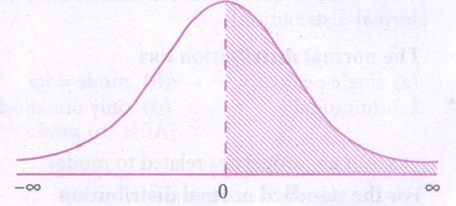
To find P(X > 60)
When X = 60, Z =\(\frac { X-\mu }{ \sigma } =\frac { 60-60 }{ 5 } \) = 0
∴ P(X > 60) = P(Z > 0) = P (0 < Z < ∞)
= 0.5
∴ 50% of students scored more than 60 marks
11.
Given n = 10, P(H) = \(\frac { 1 }{ 2 } \) ⇒ p =\(\frac { 1 }{ 2 } \)
q=1-p = \(1-\frac { 1 }{ 2 } =\frac { 1 }{ 2 } \)
P(X = x) = nCx pxqn-x
∴ P(X = 5) = 10C5 p5q5
= \(\frac { 10\times 9\times 8\times 7\times 6 }{ 5\times 4\times 3\times 2\times 1 } \left( \frac { 1 }{ 2 } \right) ^{ 5 }\left( \frac { 1 }{ 2 } \right) ^{ 10 }\)
= \(\frac { 6\times 7\times 6 }{ 2^{ 10 } } \)
= \(\frac { 2\times 3\times 7\times 2\times 3 }{ 2^{ 10 } } =\frac { 63 }{ { 2 }^{ 8 } } \)
= \(\frac { 63 }{ 256 } \).
12.
Since X is a binomial variate X ~ B (5, p)
n = 5 and P(X = x) = nCx px qn-x
Given P[X = 2] = P[X = 3]
⇒ 5C2 p2q3 = 5C3 p3q2
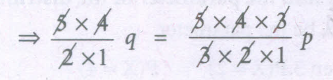
⇒ q=p
we know p+q = 1 ⇒ p+p =1
⇒ 2p = 1⇒ p =\(\frac { 1 }{ 2 } =\frac { 1 }{ 2 } \).
13.
Given mean 20 ⇒ np = 20
S.D = 4 ⇒ \(\sqrt { npq } \) = 4
∴ \(\frac { npq }{ np } =\frac { 16 }{ 20 } \Rightarrow q=\frac { 4 }{ 5 } \)
P = 1-q =\(1-\frac { 4 }{ 5 } =\frac { 1 }{ 5 } \)
Substitutingp and q in npq = 16, we get
\(n\times \frac { 1 }{ 5 } \times \frac { 4 }{ 5 } \) =16
n = \(\frac { 16\times 5\times 5 }{ 4 } \) = 100
∴ Number of events = 100
14.
Given n = 9 and mean = 6 ⇒ np = 6
9p = 6 ⇒ \(\frac { 6 }{ 9 } =\frac { 2 }{ 3 } \)
∴ q=1-p = \(1-\frac { 2 }{ 3 } =\frac { 1 }{ 3 } \)
Variance = npq = \(9\times \frac { 2 }{ 3 } \times \frac { 1 }{ 3 } \) = 2
15.
Let λ be the parameter
Given 3. P(X = 2) = P(X = 4)
⇒ 3. \(\frac { { e }^{ -\lambda }.{ \lambda }^{ 2 } }{ 2! } =\frac { e^{ -\lambda }.{ \lambda }^{ 4 } }{ 4! } \)
\(\frac { 3{ \lambda }^{ 2 } }{ 2 } =\frac { { \lambda }^{ 4 } }{ 4\times 3\times 2 } \)
⇒ 36λ2 = λ4
λ4-36λ2 = 0
⇒ λ2(λ2-36) = 0
⇒ λ2 = 0 or λ2 = 36
⇒ λ = 6 since λ > 0

12th Standard Syllabus & Materials
12th Standard
TN 12th Computer Applications வலையமைப்பு வடமிடல் Sample Question Papers Study Material - QB365 Set A
NEW12th Standard
TN 12th Computer Applications களப்பெயர் முறைமை (DNS) Sample Question Papers Study Material - QB365 Set A
NEW12th Standard
TN 12th Computer Applications வலையமைப்பு எடுத்துக்காட்டுகள் மற்றும் நெறிமுறைகள் Sample Question Papers Study Material - QB365 Set A
NEW12th Standard
TN 12th Computer Applications கணினி வலையமைப்பு ஓர் அறிமுகம் Sample Question Papers Study Material - QB365 Set A



Tamilnadu Stateboard 12th Standard Subjects

Maths

Chemistry

Physics

Biology

Computer Science
Business Maths and Statistics

Economics

Commerce

Accountancy

History

Computer Applications
Biology
Computer Technology
Computer Applications
Computer Science
Business Maths and Statistics
Commerce
Economics
Maths
Chemistry
Physics
Computer Technology
History
Accountancy

Tamil

English

French
Tamilnadu Stateboard Standards
