
 100% FREE ACCESS
12th Standard Syllabus & Materials
12th Standard
TN 12th Maths Applications of Matrices and Determinants Sample Question Papers Study Material - QB365 Set A
NEW12th Standard
TN 12th Computer Applications மின்னணு தரவு பரிமாற்றம் Sample Question Papers Study Material - QB365 Set A
NEW12th Standard
TN 12th Computer Applications மின் - வணிக பாதுகாப்பு அமைப்புகள் Sample Question Papers Study Material - QB365 Set A
NEW12th Standard
TN 12th Computer Applications மின்னணு செலுத்தல் முறைகள் Sample Question Papers Study Material - QB365 Set A
NEW12th Standard
TN 12th Computer Applications மின் - வணிகம் Sample Question Papers Study Material - QB365 Set A
NEW12th Standard
TN 12th Computer Applications திறந்த மூல கருத்துருக்கள் Sample Question Papers Study Material - QB365 Set A

Published on: 02/09/2022
QB365 provides a detailed and simple solution for every Possible Book Back Questions in Class 12 Business Maths Subject -Probability Distributions, English Medium. It will help Students to get more practice questions, Students can Practice these question papers in addition to score best marks.
Download Tamil Nadu 12th Standard Business Maths and Statistics question papers, model tests, one-mark questions, important questions, and public exam papers in PDF format. Free study materials and answer keys for TN State Board students.
Questions + Answers key
Take MCQ Business Maths and Statistics Test
1.
X is a normally normally distributed variable with mean μ = 30 and standard deviation σ = 4. Find
(a) P(x < 40)
(b) P(x > 21)
(c) P(30 < x < 35)
2.
The annual salaries of employees in a large company are approximately normally distributed with a mean of Dallor. 50,000 and a standard deviation of Dallor.20,000.
(a) What percent of people earn less than Dallor.40,000?
(b) What percent of people earn between Dallor.45,000 and Dallor.65,000?
(c) What percent of people earn more than Dallor.70,00
3.
The time taken to assemble a car in a certain plant is a random variable having a normal distribution of 20 hours and a standard deviation of 2 hours. What is the probability that a car can be assembled at this plant in a period of time .
a) less than 19.5 hours?
b) between 20 and 22 hours?
4.
Vehicles pass through a junction on a busy road at an average rate of 300 per hour.
1. Find the probability that none passes in a given minute.
2. What is the expected number passing in two minutes?
5.
A manufacturer of metal pistons finds that on the average, 12% of his pistons are rejected because they are either oversize or undersize. What is the probability that a batch of 10 pistons will contain
(a) no more than 2 rejects?
(b) at least 2 rejects?
6.
Time taken by a construction company to construct a flyover is a normal variate with mean 400 labour days and standard deviation of 100 labour days. If the company promises to construct the flyover in 450 days or less and agree to pay a penalty of Rs. 10,000 for each labour day spent in excess of 450. What is the probability that
(i) the company pays a penalty of atleast Rs. 2,00,000?
(ii) the company takes at most 500 days to complete the flyover?
7.
In a photographic process, the developing time of prints may be looked upon as a random variable having the normal distribution with a mean of 16.28 seconds and a standard deviation of 0.12 second. Find the probability that it will take less than 16.35 seconds to develop prints.
8.
If the heights of 500 students are normally distributed with mean 68.0 inches and standard deviation 3.0 inches , how many students have height
(a) greater than 72 inches
(b) less than or equal to 64 inches
(c) between 65 and 71 inches
9.
X is normally distributed with mean 12 and sd 4. Find P(X ≤ 20) and P(0 ≤ X ≤ 12)
10.
In a distribution 30% of the items are under 50 and 10% are over 86. Find the mean and standard deviation of the distribution.
11.
In a test on 2,000 electric bulbs, it was found that bulbs of a particular make, was normally distributed with an average life of 2,040 hours and standard deviation of 60 hours. Estimate the number of bulbs likely to burn for
(i) more than 2,150 hours
(ii) less than 1,950 hours
(iii) more 1,920 hours but less than 2,100 hours.
12.
Write down any five chief characteristics of Normal probability curve.
13.
The average number of customers, who appear in a counter of a certain bank per minute is two. Find the probability that during a given minute
(i) No customer appears
(ii) three or more customers appear
14.
The distribution of the number of road accidents per day in a city is poisson with mean 4. Find the number of days out of 100 days when there will be
(i) no accident
(ii) atleast 2 accidents and
(iii) at most 3 accidents.
15.
The average number of phone calls per minute into the switch board of a company between 10.00 am and 2.30 pm is 2.5. Find the probability that during one particular minute there will be
(i) no phone at all
(ii) exactly 3 calls
(iii) atleast 5 calls
16.
A car hiring firm has two cars. The demand for cars on each day is distributed as a Poisson variate, with mean 1.5. Calculate the proportion of days on which
(i) Neither car is used
(ii) Some demand is refused
17.
Derive the mean and variance of poisson distribution.
18.
An experiment succeeds twice as often as it fails, what is the probability that in next five trials there will be
(i) three successes and
(ii) at least three successes
19.
Forty percent of business travellers carry a laptop. In a sample of 15 business travelers,
(i) what is the probability that 3 will have a laptop?
(ii) what is the probability that 12 of the travelers will not have a laptop?
(iii) what is the probability that atleast three of the travelers have a laptop?
20.
21.
If 18% of the bolts produced by a machine are defective, determine the probability that out of the 4 bolts chosen at random
(i) exactly one will be defective
(ii) none will be defective
(iii) atmost 2 will be defective
22.
In a particular university 40% of the students are having news paper reading habit. Nine university students are selected to find their views on reading habit. Find the probability that
(i) none of those selected have news paper reading habit
(ii) all those selected have news paper reading habit
(iii) atleast two third have news paper reading habit.
23.
If 5% of the items produced turn out to be defective, then find out the probability that out of 20 items selected at random there are
(i) exactly three defectives
(ii) atleast two defectives
(iii) exactly 4 defectives
(iv) find the mean and variance
24.
Derive the mean and variance of binomial distribution.
25.
A sample of 125 dry battery cells tested to find the length of life produced the following resultd with mean 12 and SD 3 hours. Assuming that the data to be normal distributed , what percentage of battery cells are expected to have life
(i) more than 13 hours
(ii) less than 5 hours
(iii) between 9 and 14 hours
26.
A bank manager has observed that the length of time the customers have to wait for being attended by the teller is normally distributed with mean time of 5 minutes and standard deviation of 0.6 minutes. Find the probability that a customer has to wait
(i) for less than 6 minutes
(ii) between 3.5 and 6.5 minutes
27.
900 light bulbs with a mean life of 125 days are installed in a new factory. Their length of life is normally distributed with a standard deviation of 18 days. What is the expected number of bulbs expire in less than 95 days?
28.
The marks obtained in a certain exam follow normal distribution with mean 45 and SD 10. If 1,300 students appeared at the examination, calculate the number of students scoring
(i) less than 35 marks and
(ii) more than 65 marks.
29.
The average daily sale of 550 branch offices was Rs.150 thousand and standard deviation is Rs. 15 thousand. Assuming the distribution to be normal, indicate how many branches have sales between
(i) Rs. 1,25,000 and Rs. 1, 45, 000
(ii) Rs. 1,40,000 and Rs. 1,60,000
30.
If X is a normal variate with mean 30 and SD 5. Find the probabilities that
(i) 26 ≤ X ≤ 40
(ii) X > 45
31.
What is the probability that a standard normal variate Z will be
(i) greater than 1.09
(ii) less than -1.65
(iii) lying between -1.00 and 1.96
(iv) lying between 1.25 and 2.75
32.
If the probability that an individual suffers a bad reaction from injection of a given serum is 0.001, determines the probability that out of 2,000 individuals
(a) exactly 3, and
(b) more than 2 individuals will suffer a bad reaction.
33.
One fifth percent of the the blades produced by a blade manufacturing factory turn out to be defective. The blades are supplied in packets of 10. Use Poisson distribution to calculate the approximate number of packets containing no defective, one defective and two defective blades respectively in a consignment of 1,00,000 packets (e–0.2 =.9802)
34.
An insurance company has discovered that only about 0.1 per cent of the population is involved in a certain type of accident each year. If its 10,000 policy holders were randomly selected from the population, what is the probability that not more than 5 of its clients are involved in such an accident next year? (e−10=.000045)
35.
The sum and product of the mean and variance of a binomial distribution are 24 and 128. Find the distribution.
36.
If the average rain falls on 9 days in every thirty days, find the probability that rain will fall on atleast two days of a given week.
1.
Given μ = 30, σ = 4
(a) P(X < 40)
When X = 40, Z = \(\frac { X-\mu }{ \sigma } \)
=\(\frac { 40-30 }{ 4 } =\frac { 10 }{ 4 } \) = 2.5
∴ P(X<40) = P(Z<2.5)
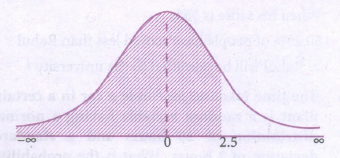
P(X<40) = 0.9938
(b) P(X>21)
When X = 21, Z = \(\frac { 21-30 }{ 4 } \quad \)
= \(\frac { -9 }{ 4 } \) = -2.25
∴ P(X>21) = P(Z>-2.25)
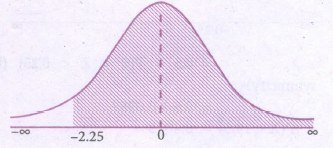
= 0.4878 + 0.5
P(X > 21) = 0.9878
(c) P(30
When X = 35, Z2 = \(\frac { 35-30 }{ 4 } \) = 1.25
P(30
2.
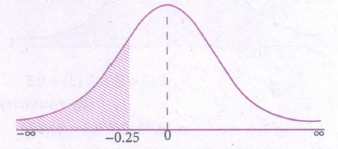
(a) P(X<40,000)
When X = 40,000.
Z = \(\frac { X-\mu }{ \sigma } \)
= \(\frac { 40,000-50,000 }{ 20,000 } \) = -0.5
∴ P(X<40,000) = P(Z<-0.5)
= P(-∞
= 0.5-0.1915 = 0.3085
∴ 30.85 % pf people earn less than $40,000
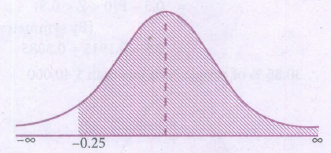
(b) P(45,000 < X < 65,000)
When X = 45,000
Z1 = \(\frac { 45,000-50,000 }{ 20,000 } \) = -0.25
When X=65,000
Z=\(\frac { 65,000-50,000 }{ 20,000 } \)=0.75
∴ P(45000 < X < 65,000) = P(-0.25 < Z < 0.75)
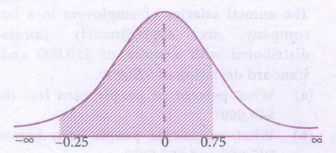
= P (-0.25 < Z < 0) + P(0 < Z < 0.75)
= P(0 < Z < 0.25) + P (0 < Z < 0.75)
= 0.0987 + 0.2734 = 0.3721
Hence, 37.21% of people earn between Dallor 45,000 and Dallor 65,000.
(c) P(X>7000)
When X = 7000
Z = \(\frac { 75000-50,000 }{ 20,000 } \) = 1.25
∴ P(X > 7000) = P(Z > 1.25)
= 0.5 - 0.3944
= 0.1056
3.
Given μ = 20, σ = 2
a) P(X<19.5)
When X = 19.5, Z = \(\frac { X-\mu }{ \sigma } \)
= \(\frac { 19.5-20 }{ 20 } \) = -0.25
∴ P(Z<-0.25) = P(-∞
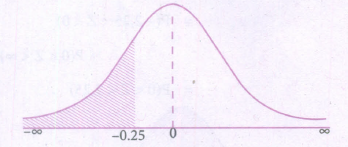
= 0.5-P(0
P(X<19.5) = 0.4013
b) P(between 20 and 22 hours)
= P(20
When X = 22, Z2 = \(\frac { 22-20 }{ 2 } \) = 1
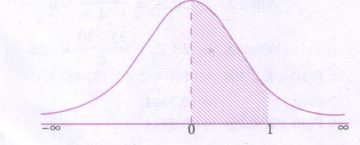
∴ P (20 < X < 22) - P(0 < Z < 1)
∴ P (20 < X < 22) = 0.3413
4.
Given λ average = 300 per hour
= \(\frac { 300 }{ 60 } \) per minutes
∴ λ = 5
∴ X follows a poisson distribution
(i) P (none passes in a minute) = P (X = 0)
= \(\frac { { e }^{ -\lambda }.{ \lambda }^{ 0 } }{ 0! } \)
[∵ P(x, λ) = \(\frac { { e }^{ -\lambda }.{ \lambda }^{ x } }{ x! } \)]
P(X=0) = \(\frac { { e }^{ -5 }.{ (-5) }^{ 0 } }{ 0! } \)
= e-5 = 0.0067379
(ii) P(X = 2) = \(\frac { { e }^{ -\lambda }.{ \lambda }^{ 2 } }{ 2! } =\frac { { e }^{ -5 }.(5)^{ 2 } }{ 2 } \)
= \(\frac { (0.0067379)(25) }{ 2 } \)
= 0.08422
∴ Probability of expected number passing in 2 minutes = .08422
5.
Let p be the probability getting his piston rejected
Given p = 12% = \(\frac { 12 }{ 100 } \) = 0.12
∴ q = 1-p = 1-0.12 = 0.88
n = 10
(a) P (not more than 2 rejects)
= P(X≤2) = P(X = 0) + P(X = 1) + P(X = 2)
= 10C0(0.12)0 (0.88)10 + 10C1 (0.12)1 (0.88)9 + 10C2 (0.12)2 (0.88)8
[∵ P(x) = nCx pxqn-x]
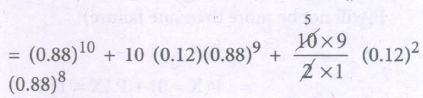
= (0.88)8 [(0.88)2 + 10(0.12) (0.88) + 45 (0.12)2]
= (0.88)8 [0.7744 + 1.056 + 0.648]
= (0.3596) (2.4784) = 0.8913
∴ Probability of not more than 2 rejects = 0.8913
b) P(at least 2 rejects)
= P(X ≥ 2) = 1 - P (X < 2)
= 1 - [P(X = 0) + P (X = 1)]
= 1-[10C0(0.12)0 (0.88)10 + 10C1 (0.12)1 (0.88)9 ]
= 1 - [(0.88)10 + 10 (0.12) (0.88)9]
= 1 - (0.88)9 [0.88 + 1.2] = 1 - (0.31647) (2.08)
= 1 - 0.6583 = 0.34173
P (atleast 2 rejects) = 0.34173
6.
Given μ = 400, σ = 100
(i) Company pays a penalty of atleast Rs. 2,00,000
Penalty per day = Rs.10,000
Number of days = \(\frac { 2,00,000 }{ 10,000 } \) = 20
Hence, the company has taken excess of 20 days
∴ P(atleast 470 days) [∵ 450 + 20 = 470]
= P(X ≥ 470)
When X = 470, Z = \(\frac { X-\mu }{ \sigma } \)
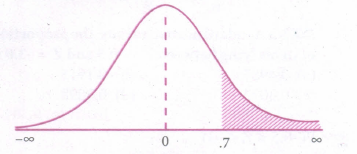
= \(\frac { 470-400 }{ 100 } =\frac { 70 }{ 100 } \) = 0.7
∴ P(X ≥ 470) = P(Z ≥ 0.7)
= P(0.7
P(X ≥ 470) = 0.2420
(ii) P (atmost 500 days) = P(X≤500)
When X = 500, Z = \(\frac { X-\mu }{ \sigma } \)
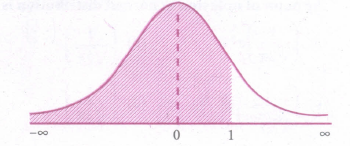
= \(\frac { 500-400 }{ 100 } =\frac { 100 }{ 100 } \)=1
∴ P(X ≤ 500) = P(Z≤1)
= P(-∞
= 0.8413
P(X ≤ 500) = 0.8413
7.
Given μ = 16.28 seconds and σ = 0.12 second
P(X<16.35)
When X = 16.35, Z = \(\frac { X-\mu }{ \sigma } \)
= \(\frac { 16.35-16.28 }{ 0.12 } \)
= \(\frac { 0.007 }{ 0.12 } \) = 0.583
∴ P(X < 16.35) = (Z < 0.583)
= P(-∞
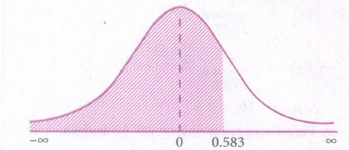
∴ Probability that it will take less than 16.35 sec to develop prints = 0.719.
8.
Given μ = 68.0, σ = 3.0
(a) P(X>72)
When X = 72, Z = \(\frac { X-\mu }{ \sigma } \)
= \(\frac { 72-68 }{ 3 } =\frac { 4 }{ 3 } \) = 1.33
∴ P(X>72) = P(Z>1.33)
= P(0
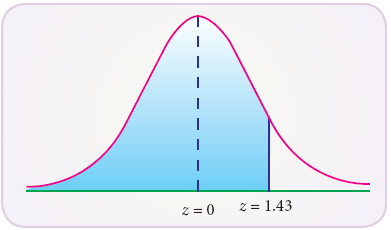
∴ Prob of 1 student having height more than 72 inches is 0.0918.
Out of 500 students, number of students having height more than 72 inches is 0.0918 x 500 = 45.9
= 0.46 (approximately).
(b) P(X ≤ 64)
When X = 64, Z = \(\frac { X-\mu }{ \sigma } \)
= \(\frac { 64-68 }{ 3 } =\frac { -4 }{ 3 } \) = -1.33
∴ P(X≤64) = P(Z≤-1.33)
= P(-∞
= 0.0918
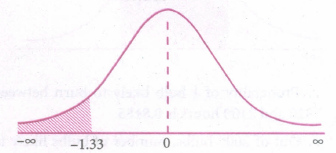
∴ Probability of 1 student having height less than 64 inches is 0.0918
∴ Out of 500 students, number of students having height less than 64 inches is = 0.0918 x 500 = 45.9 = 46 (approximately).
(c) P(65
= \(\frac { 65-68 }{ 3 } =\frac { 3 }{ 3 } \) = 1
When X = 71, Z = \(\frac { X-\mu }{ \sigma } \)
= \(\frac { 71-68 }{ 3 } =\frac { 3 }{ 3 } \) = 1
∴ P(65
= 2. P(0
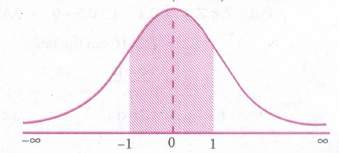
∴ Probability of 1 student having height between 65 and 71 inches is 0.6826
∴ Out of 500 students, number of students having height between 65 and 71 inches is 0.6826 x 500 = 341.37
= 342 (approximately)
9.
Given μ = 12 and σ = 4
(1) P( ≤ 20)
When X = 20, Z = \(\frac { X-\mu }{ \sigma } \)
= \(\frac { 20-12 }{ 4 } =\frac { 8 }{ 4 } \) = 2
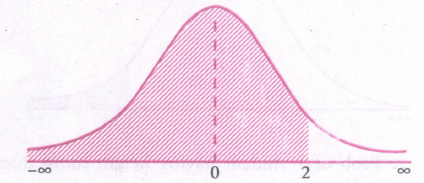
∴ P(X≤20) = P(Z≤2)
= P(-∞
P(X≤20) = 0.9772
(ii) P(0≤X≤12)
When X=0, Z=\(\frac { X-\mu }{ \sigma } \)
\(\frac { 0-12 }{ 4 } =\frac { -12 }{ 4 } \)=-3
When X=12, Z=\(\frac { X-\mu }{ \sigma } \)
=\(\frac { 12-12 }{ 4 } =\frac { 0 }{ 4 } \)=0
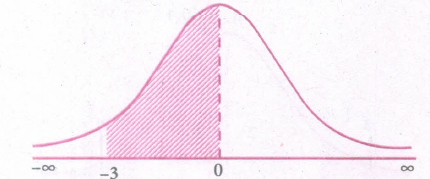
∴ P(0≤X≤12) = P(-3≤Z≤0)
= P(0≤Z≤3) (By symmetry)
P(0≤X≤12) = 0.4987.
10.
Plot the variable X = 50 on the left side and
X = 86 on the right side of the curve.
Given P( -∞< Z1 < -Z1) = 0.3
⇒ P(-Z1 < Z < Z1) = 0.2 [∵ 0.5 - 0.3 = 0.2]
⇒ P(0 < Z < Z1) = 0.2 [By symmetry]
⇒ Z1 = -0.52 [From the normal distribution table 'and it lies on the negative side]
⇒ -0.52 = \(\frac { X-\mu }{ \sigma } \) ⇒ -0.52 σ = 50-μ
⇒ 50-μ = -0.52 σ ....(1)
Also given P(Z2
⇒ Z2 = 1.28 (from the table)
⇒ 1.28 =\(\frac { 86-\mu }{ \sigma } \)
⇒ 86-μ = 1.28 σ ...(2)
Substituting σ = 20 in (2) we get,
86-μ = (1.28)(20)
86-μ = 25.6
μ = 86-25.6
μ = 60.4
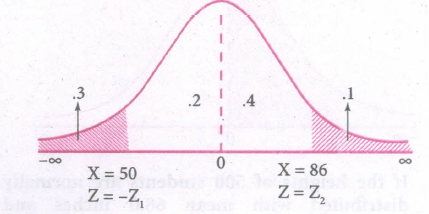
Hence, the mean is 60.4 and standard deviation is 20.
11.
Given mean μ = 2040 and σ = 60.
Let X denote the number of bulbs likely to burn.
(i) P(X > 2150)
When X = 2150, Z = \(\frac { X-\mu }{ \sigma } \)
= \(\frac { 1950-2040 }{ 50 } \) = \(\frac { 110 }{ 60 } \) = 1.833
∴ P(X>2150) = P(Z>1.833)
= P(0
= 0.0336.
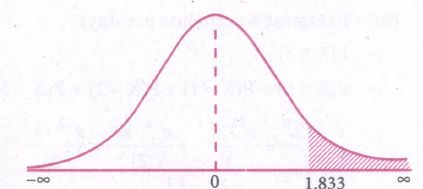
∴ Probability of 1 bulb likely to burn for more than 2150 hours is 0.0336.
∴ Out of 2000 bulbs, number of bulbs likely to burn for more than 2150 hours is 0.0336 x 2000.
= 67.2
(ii) P (less than 1950 hours) = P( X < 1950)
when X = 1950, Z = \(\frac { X-\mu }{ \sigma } \)
= \(\frac { 1950-2040 }{ 50 } \) = -1.5
∴ P(X<1950) = P(Z<-1.5)
= P(-∞
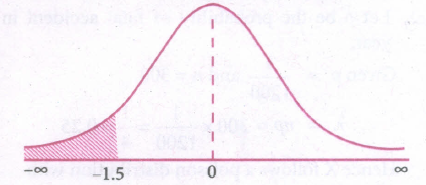
∴ Probability of 1bulb likely to burn forless than 1950 hours is 0.0668.
∴ Out of 2000 bulbs, number of bulbs likely to burn for less than 1950 hours is 0.0668 x 2000.
= 133.6
(iii) P (more than 1920 hours but less than 2100 hours)
= P(1920 < X < 2100)
When X = 1920,
Z = \(\frac { 1920-2040 }{ 60 } \) = -2
When X = 2100
Z = \(\frac { 2100-2040 }{ 60 } \) = 1
∴ P(1920
= 0.4772 + 0.3413
= 0.8185
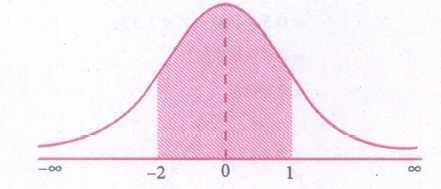
∴ Probability of 1 bulb likely to burn between 1920 and 2100 hours is 0.8185.
∴ Out of 2000 bulbs, number of bulbs likely to burn more than 1920 hours and less than 2100 hours is 0.8185 x 2000.
= 1637
12.
(i) The curve is bell shaped and symmetrical about the line x = μ.
(ii) Mean, median and mode of the distribution coincide.
(lii) X-axis is an asymptote to the curve.
(iv) The points of inflexion of the curve are x = μ ± σ.
(v) The curve is unimodal.
13.
Given average number of customers, appear in a counter
λ = 2
∴ X follows a poisson distribution with
p(x,λ) = \(\frac { e^{ -\lambda }.{ \lambda }^{ x } }{ x! } \)
(i) P (no customer appears)
= P(X = 0) = \(\frac { { e }^{ -\lambda }.{ \lambda }^{ 0 } }{ 0! } \) = e-λ = e-2 = 0.1353 [∵ e-2 = 0.1353]
(ii) P(3 or more customer appear)
= P(X≥3)
= 1-P(X<3)
= 1 - [P(X = 0) + P(X = 1) + P(X = 2)]
= 1-\(\left[ \frac { { e }^{ -\lambda }.{ \lambda }^{ 0 } }{ 0! } +\frac { { e }^{ -\lambda }.{ \lambda }^{ 1 } }{ 1! } +\frac { { e }^{ -\lambda }.{ \lambda }^{ 2 } }{ 2! } \right] \)
= 1-e-λ (1+λ+\(\frac { \lambda ^{ 2 } }{ 2 } \))
= 1-e-2 (1+2+\(\frac { 4 }{ 2 } \))
= 1-e-2 (5) = 1 - 0.1353(5)
= 1 - 0.6765 = 0.3235
Hence, probability of three or more customers appear in a counter of a certain bank is 0.3235.
14.
Given mean = 4
∴ λ = 4
X follows Poisson distribution with p(x, λ)
= \(\frac { { e }^{ -\lambda }.{ \lambda }^{ x } }{ x! } \)
P (no accident per day) = P(X = 0)
(i) P(X = 0) = \(\frac { { e }^{ -4 }.(4)^{ 0 } }{ 0! } \)
= e-4 = 0.0183 [∵ e-4 = 0.0183]
∴ Probability of no accident in 1 day = 0.0183
∴ Probability of no accidents in 100 days
= 0.0183 \(\times\) 100 = 1.83 days
= 2 days (approximately)
(ii) P (atleast 2 accidents per day) = P(X≥2)
P(X≥2) = 1-P(X<2)
=1 - [P(X = 0) + P(X = 1)]
=1-\(\left[ \frac { { e }^{ -\lambda }.{ \lambda }^{ 0 } }{ 0! } +\frac { { e }^{ -\lambda }.{ \lambda }^{ 1 } }{ 1! } \right] \)
= 1-e-λ [1+λ]
= 1-e-4 (1+4) =1-e-4 (5)
= 1 - 0.0183(5) = 1 - 0.0915
= 0.0985.
∴ Probability of atleast 2 accidents in 1 day
= 0.9085
Hence, probability of atleast 2 accidents in 100 days
= 0.9085 x 100
= 90.85 days
= 91 days (approximately)
(iii) P (atmost 3 accidents per day)
= P(X≤3)
= P(X = 0) + P(X = 1) + P(X = 2) + P(X = 3)
= \(\left[ \frac { { e }^{ -\lambda }.{ \lambda }^{ 0 } }{ 0! } +\frac { { e }^{ -\lambda }.{ \lambda }^{ 1 } }{ 1! } +\frac { { e }^{ -\lambda }.{ \lambda }^{ 2 } }{ 2! } +\frac { { e }^{ -\lambda }.{ \lambda }^{ 3 } }{ 3! } +\frac { { e }^{ -\lambda }.{ \lambda }^{ 4 } }{ 4! } \right] \)
= e-λ \(\left( 1+\lambda +\frac { { \lambda }^{ 2 } }{ 2 } +\frac { { \lambda }^{ 3 } }{ 6 } \right) \)
= e-4 (1+4+\(\frac { 16 }{ 2 } +\frac { 64 }{ 6 } \))
= e-4 (1+4+8+\(\frac { 32 }{ 3 } \))
= 0.0183 (23.666) = 0.4331
∴ Probability of atmost 3 accidents in 1 day = 0.4331
Hence, probability of atmost 3 accidents in 100 days = 43.31
= 43 days (approximately).
15.
Given average number of phone calls between 10 am and 2.30,pm per minute is 2.5.
∴ λ = 2.5
Hence X follows a Poisson distribution with
p(x, λ) = \(\frac { { e }^{ -\lambda }.{ \lambda }^{ x } }{ x! } \)
(i) P (no phone at all) = P(X = 0)
P(X = 0) = \(\frac { { e }^{ -2.5 }.(2.5)^{ 0 } }{ 0! } \) = e-2.5
= 0.08208 [∵ e-2.5 = 0.08208]
(ii) P (exactly 3 calls)
P(X = 3) = \(\frac { { e }^{ -2.5 }.(2.5)^{ 3 } }{ 3! } \) [∵ λ = 2.5 and x=3]
= \(\frac { (0.08208)(2.5)^{ 3 } }{ 3\times 2 } \) = 0.21375
∴ P(X = 3) = 0.2138
(iii) P (atleast 5 calls) = P(X ≥ 5)
P(X≥5) = 1-P(X<5)
=1 - [P(X = 0) + P(X = 1) + P(X = 2) + P(X = 3) + P(X = 4)]
= 1-\(\left[ \frac { { e }^{ -\lambda }.{ \lambda }^{ 0 } }{ 0! } +\frac { { e }^{ -\lambda }.{ \lambda }^{ 1 } }{ 1! } +\frac { { e }^{ -\lambda }.{ \lambda }^{ 2 } }{ 2! } +\frac { { e }^{ -\lambda }.{ \lambda }^{ 3 } }{ 3! } +\frac { { e }^{ -\lambda }.{ \lambda }^{ 4 } }{ 4! } \right] \)
= 1-e-λ \(\left( 1+\lambda +\frac { { \lambda }^{ 2 } }{ 2 } +\frac { { \lambda }^{ 3 } }{ 6 } +\frac { { \lambda }^{ 4 } }{ 24 } \right) \)
= 1-e-2.5 (1+2.5+\(\frac { ({ 2.5) }^{ 2 } }{ 2 } +\frac { (2.5)^{ 3 } }{ 6 } +\frac { (2.5)^{ 4 } }{ 24 } \))
= 1-e-2.5 (1 + 2.5 + 3.125 + 2.604) + 1.6276)
= 1-e-2.5 (10.8566)
= 1 - 0.08208 (10.8566) = 1 - 0.89111
P(X ≥ 5) = 0.1089.
16.
Given mean = λ = 1.5
X follows poisson distribution with
p(x,λ) = \(\frac { e^{ -\lambda }.{ \lambda }^{ x } }{ x! } \)
(i) ∴ P(neither car is used)
= P(X = 0) = \(\frac { e^{ -1.5 }.(1.5)^{ 0 } }{ 0! } \) =e-1.5
= 0.2231 [∵ e-1.5 =0.2231]
(ii) P (Some demand is refused)
The demand may be either 0 car, 1 car or 2 cars
∴ P (Some demand is refused) = 1 - P(X ≤ 2)
= 1 - [P(X = 0) + P (X = 1) + P(X = 2)]
= 1-\(\left[ \frac { e^{ -\lambda }.{ \lambda }^{ 0 } }{ 0! } +\frac { e^{ -\lambda }.{ \lambda }^{ 1 } }{ 1! } +\frac { e^{ -\lambda }.{ \lambda }^{ 2 } }{ 2! } \right] \)
= 1-e-λ (1+λ+\(\frac { { \lambda }^{ 2 } }{ 2 } \))
= 1-e-1.5 (1+1.5+\(\frac { (1.5)^{ 2 } }{ 2 } \))
= 1 - 0.2231 (3.625) = 1 - 0.8087 = 0.1912
∴ Probability of some demand is refused = 0.1912.
17.
Mean E(X) =\(\overset { \infty }{ \underset { x=0 }{ \Sigma } } x.p(x,\lambda )\)
= \(\overset { \infty }{ \underset { x=0 }{ \Sigma } } x.\frac { e^{ -\lambda }.\lambda ^{ x } }{ x! } \)
Taking out λ from the numerator and x from the denominator

= \(\lambda .{ e }^{ -\lambda }\overset { \infty }{ \underset { x=1 }{ \Sigma } } \frac { { \lambda }^{ x-1 } }{ (x-1)! } \)
= \(\lambda .e^{ -\lambda }(1+\lambda +\frac { { \lambda }^{ 2 } }{ 2! } +...)\)
= \(\lambda .e^{ -\lambda }.e^{ \lambda }\) [∵ ex =1+x+\(\frac { x^{ 2 } }{ 2! } \)+..]
= λ.e0 =λ(1) =λ
∴ E(X) = λ
E(X2) = \(\overset { \infty }{ \underset { x=0 }{ \Sigma } } p(x,\lambda )\)
= \(\overset { \infty }{ \underset { x=0 }{ \Sigma } } { x }^{ 2 }.\frac { e^{ -\lambda }.{ \lambda }^{ x } }{ x! } \)
=\(\overset { \infty }{ \underset { x=0 }{ \Sigma } } (x(x-1)+x)\frac { e^{ -\lambda }{ \lambda }^{ x } }{ x! } \)
[∵ x(x-1)+x = x2-x+x = x2]
=\(\overset { \infty }{ \underset { x=0 }{ \Sigma } } (x(x-1).\frac { e^{ -\lambda }{ \lambda }^{ x } }{ x! } +\overset { \infty }{ \underset { x=0 }{ \Sigma } } \frac { x.e^{ -\lambda }{ \lambda }^{ x } }{ x! } \)
Taking λ2 from the numerator and x(x-1) from. the denominator we get,
E(X2)=\(\overset { \infty }{ \underset { x=0 }{ \Sigma } } \frac { { \lambda }^{ 2 } }{ x(x-1) } .(x)(x-1).\frac { { e }^{ -\lambda }.{ \lambda }^{ x-2 } }{ (x-2)! } +E(X)\)
= \({ \lambda }^{ 2 }.e^{ -\lambda }\overset { \infty }{ \underset { x=0 }{ \Sigma } } \frac { { \lambda }^{ x-2 } }{ (x-2)! } +\lambda \) [∵ E(X)=λ]
= λ2.e-λ.eλ+λ [∵ eλ =1+λ+\(\frac { { \lambda }^{ 2 } }{ 2! } \)+....]
= λ2+λ
V(X) = E(X2)-[E(X)]2 = λ2+ λ - λ2 = λ
∴ Mean = Variance = λ
18.
Let p be the probability of success and q be the probability of failure.
Given p = 2q
p = 2(1-p) [∵ p + q = 1]
p = 2-2p ⇒ 3p = 2
p = \(\frac{2}{3}\)
∴ q = 1-p = 1-\(\frac{2}{3}\) = \(\frac{1}{3}\) and n = 5
(i) P (3 successes) = P(X = 3)
= 5C3 \(\left( \frac { 2 }{ 3 } \right) ^{ 3 }\left( \frac { 1 }{ 3 } \right) ^{ 2 }\) ∵ p(x) = nCx pxqn-x, n = 5, x = 3
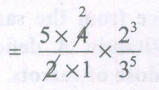
=\(\frac { 10\times 8 }{ 243 } =\frac { 80 }{ 243 } \)
(ii) P (atleast 3 successes)
= P(X ≥ 3)
= 1-P(X < 3)
= 1 - [P(X = 0) + P(X = 1) + P(X = 2)]
= 1-[5C0\(\left( \frac { 2 }{ 3 } \right) ^{ 0 }\left( \frac { 1 }{ 3 } \right) ^{ 5 }\) + 5C1\(\left( \frac { 2 }{ 3 } \right) ^{ 1 }\left( \frac { 1 }{ 3 } \right) ^{ 4 }\) + 5C2\(\left( \frac { 2 }{ 3 } \right) ^{ 2 }\left( \frac { 1 }{ 3 } \right) ^{ 3 }\)]
= 1-\(\left[ \left( \frac { 1 }{ 3 } \right) ^{ 5 }+5\left( \frac { 2 }{ 3 } \right) \left( \frac { 1 }{ { 3 }^{ 4 } } \right) +10\left( \frac { { 2 }^{ 2 } }{ { 3 }^{ 2 } } \right) \left( \frac { 1 }{ { 3 }^{ 3 } } \right) \right] \)
= 1-\(\frac { 1 }{ { 3 }^{ 5 } } \)(1+10+40) = \(1-\frac { 1 }{ 243 } \)(51)
= \(\frac { 243-51 }{ 243 } =\frac { 192 }{ 243 } \).
19.
Let p be the probability of having a laptop
Given p = \(\frac { 40 }{ 100 } \) = 0.4 ⇒ q = 1-p = 1-0.4 = 0.6
n = 15
(i) P(X = 3)
=15C3 (0.4)3 (0.6)12 ∵ p(x) =nCx pxqn-x, n = 15, x = 3
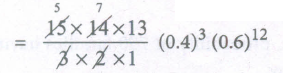
= 455 (0.064) (0.002176) = 0.0634
(ii) P (12 travellers not having laptop)
= P (3 travellers having laptop)
[∵ n = 15 and 15 - 12 = 3]
= P(X = 3)
= 0.0634.
(iii) P (atleast 3 travellers have laptop)
= P (X ≥ 3) = 1 - P(X < 3)
= 1 - [P(X = 0) + P(X = 1) + P(X = 2)]
=1-[15C0 (0.4)0 (0.6)15 + 15C1 (0.4)2 (0.6)13 (0.6)14]
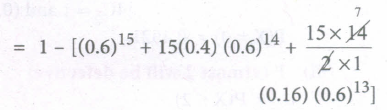
= 1 - (0.6)13 [(0.6)2 + 6(0.6)1 + 105(0.16)]
= 1 - (0.6)13 [0.36 + 3.6 + 16.8]
= 1 - (0.0013) (20.76) = 1 - 0.0270
= 0.9730.
20.
21.
(i) P (Exactly one defective bolt)
= P(X = 1)
= 4C1 (0.18)1 (0.82)3 [p(x) = nCx pxqn-x, n = 4, x = 1]
= 4(0.18) (0.82)3
= (0.72) (0.5513)
P(X = 1) = 0.3969
(ii) P (none will be defective)
= P(X = 0)
=4C0 (0.18)0 (0.82)4 [p(x) = nCx pxqn-x, n = 4, x = 0]
= (0.82)4
[4C0 = 1 and (0.18)0 = 1]
P(X = 0) = 0.4521.
(iii) P (atmost 2 will be defective)
= P(X≤2)
= P(X = 0) + P(X = 1) + P(X = 2)
= 0.4521 + 0.3969 + 4C2 (0.18)2 (0.82)2
= 0.849 + 6(0.18)2 (0.82)2
= 0.849 + 0.1307 = 0.9797.
22.
Let the probability of student having reading habit
p = 40% = \(\frac { 40 }{ 100 } \) = 0.4
⇒ q = 1-p = 1-0.4 = 0.6
n = 9
(i) P (none of those who have selected having reading habit)
= P(X = 0)
= 9C0(0.4)0 (0.6)9
= (1)(1)(0.6)9 [∵ nCx pxqn-x = p(x), n = 9, x = 0]
= (0.6)9 [ ∵ 9C0 = 1 ]
= 0.01008
(ii) P (all those who have selected have newspaper reading habit)
= P(X = 9)
= 9C9(0.4)9 (0.6)0 [∵ p(x) =nCx pxqn-x, n = 9, x = 9]
= (0.4)9 [ ∵ 9C9 = 1 ]
= 0.000261
(iii) Two thirds of 9 = \(\frac{2}{3}\) x 9 = 6
∴ P(atleast two third have newspaper reading habit)
= P (atleast 6 have newspaper reading habit)
= P(X≥6)
= P(X = 6)+P(X = 7)+P(X = 8)+P(X = 9)
= 9C6 (0.4)6 (0.6)3 + 9C7 (0.4)7 (0.6)2 + 9C8 (0.4)8 (0.6)1 + 9C9 (0.4)9 (0.6)0
= (0.4)6 [9C6 (0.6)3 + 9C7 (0.4) (0.6)2 + 9C8 (0.4)2 (0.6) + (0.4)3 ]
= (0.4)6 [9C3 (0.216) + 9C2 (0.144) + 9C1 (0.096)+0.64 [∵ nCr = nCn-r ]
= (0.4)6 \(\left[ \frac { 9\times 8\times 7 }{ 3\times 2\times 1 } (0.216)+\frac { 9\times 8 }{ 2\times 1 } (0.144)+9(0.096)+.064 \right] \)
= (0.4)6 [18.144 + 5.184 + 0.864 + 0.064]
= (0.4)6 [24.256] = (0.0041) (24.256)
∴ P(X≥6) = 0.0994
23.
Given that probability of getting defective item
p = 5% = \(\frac { 5 }{ 100 } \) ⇒ q = 1-p = \(1-\frac { 5 }{ 100 } =\frac { 95 }{ 100 } \)
n = 20
p(x) = \({ n }_{ C_{ x } }{ p }^{ x }{ q }^{ n-x }\), x = 0,1,2....n
(i) P(Exactly 3 defectives)
= \({ 20 }_{ { C }_{ 3 } }\left( \frac { 5 }{ 100 } \right) ^{ 3 }\left( \frac { 95 }{ 100 } \right) ^{ 20-3 }\)
= \(\\ { 20 }_{ { C }_{ 3 } }\)(0.05)3(0.95)17
= \(\\ \frac { 20\times 19\times 18 }{ 3\times 2\times 1 } \) (0.05)3(0.95)5(0.95)5(0.95)5(0.95)2
= (60 x 19) (0.000125)(0.7738)(0.7738)(0.7738)(0.9025)
= 0.059
(ii) P(atleast 2 defectives)
= P(X≥2) =1-P(X<2)
= 1-[P(X=0) + P(X=1)]
= 1-[\(\\ { 20 }_{ { C }_{ 0 } }\)(0.05)0(0.95)20 + \(\\ { 20 }_{ { C }_{ 1 } }\)(0.05)1(0.95)19]
= 1 - [(0.95)20 + 20 (0.05) (0.95)19]
= 1 - [0.3585 + (0.3774)]
= 1 - [0.7359] = 0.2641.
(iii) P (exactly 4 defectives)
P(X = 4) = \(\\ { 20 }_{ { C }_{ 4 } }\) (0.05)4(0.95)16
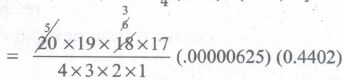
= (15 x 17 x 19) (0.00000625) (0.4402)
= 0.0133
(iv) Find the mean and variance
Mean = np =\(20\times \frac { 5 }{ 100 } =\frac { 100 }{ 100 } \) = 1
Variance =npq = \(20\times \frac { 5 }{ 100 } =\frac { 95 }{ 100 } \) = 0.95
24.
The mean of the binomial distribution
Ex = \(\overset { n }{ \underset { x=0 }{ \Sigma } } x.p(x)=\overset { n }{ \underset { x=0 }{ \Sigma } } \left( \begin{matrix} n \\ x \end{matrix} \right) { p }^{ x }q^{ n-x }\)
= \(p.\overset { n }{ \underset { x=0 }{ \Sigma } } x.\left( \begin{matrix} n \\ x \end{matrix} \right) { p }^{ x-1 }q^{ n-x }\)
[Take p common]
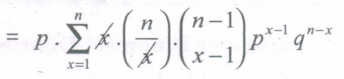
= \(np.\overset { n }{ \underset { x=1 }{ \Sigma } } \left( \begin{matrix} n-1 \\ x-1 \end{matrix} \right) { p }^{ x-1 }q^{ n-x }\)
= np (q +p)n-1 [using binomial theorem]
(x+a)n = \({ x }^{ n }+{ n }_{ { C }_{ 1 } }{ x }^{ n-1 }{ a }^{ 1 }+...+{ a }^{ n }\)
= np(1)n-1 [∵ p+q=1]
= np
∴ Mean = E(x) = np..(1)
Now, E(X2) =\(\overset { n }{ \underset { x=0 }{ \Sigma } } { x }^{ 2 }.\left( \begin{matrix} n \\ x \end{matrix} \right) { p }^{ x }q^{ n-x }\)
=\(\overset { n }{ \underset { x=0 }{ \Sigma } } \{ x(x-1)+x\} \left( \begin{matrix} n \\ x \end{matrix} \right) { p }^{ x }q^{ n-x }\)
=\(\overset { n }{ \underset { x=0 }{ \Sigma } } x(x-1).\left( \begin{matrix} n \\ x \end{matrix} \right) { p }^{ x }q^{ n-x }+{ \Sigma }_{ x }.\left( \begin{matrix} n \\ x \end{matrix} \right) { p }^{ x }q^{ n-x }\)
=\(\overset { n }{ \underset { x=2 }{ \Sigma } } x(x-1)\frac { n(n-1) }{ x(x-1) } \left( \begin{matrix} n-2 \\ n-2 \end{matrix} \right) { p }^{ x-2 }{ q }^{ n-x }\)+\(\Sigma x\left( \begin{matrix} n \\ x \end{matrix} \right) { p }^{ x }q^{ n-x }\)
= \(n(n-1){ p }^{ 2 }\left\{ \Sigma \left( \begin{matrix} n-2 \\ n-2 \end{matrix} \right) { p }^{ x-2 }{ q }^{ n-x } \right\} \) +np (using (1))
= n(n-1)p2 (q+p)n-2 + np
[using binomial theory]
= n(n-1)p2 (1) + np ∴ p+ q = 1
= n(n-1)p2+ np .... (2)
Variance = E(X2) - [E(X)]2
= n(n-1)p2+np-(np)2
[From (1) & (2)]

= np (1-p) = npq [ ∵ p+q = 1⇒ q = 1-p]
∴ Mean = np and variance = npq
25.
Let X denote the length of life of dry battery cells follows normal distribution with mean 12 and SD 3 hours
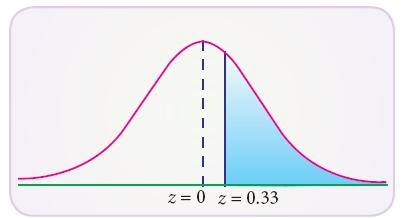
(i) more than 13 hours
P(X > 13)
When X = 13
\(Z=\frac { X-\mu }{ \sigma } =\frac { 13-12 }{ 3 } =0.333\)
P(X > 13) = P(Z > 0.333) = 0.5 – 0.1293 = 0.3707
The expected battery cells life to have more than 13 hours is 125 × 0.3707 = 46.34%
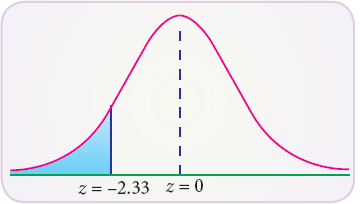
(ii) less than 5 hours
P(X < 5)
When X = 5
\(Z=\frac { X-\mu }{ \sigma } =\frac { 5-12 }{ 3 } =-2.333\)
P(X < 5) = P(Z < –2.333) = P(Z > 2.333)
= 0.5 – 0.4901 = 0.0099
The expected battery cells life to have more than 13 hours is 125 × 0.0099 = 1.23%
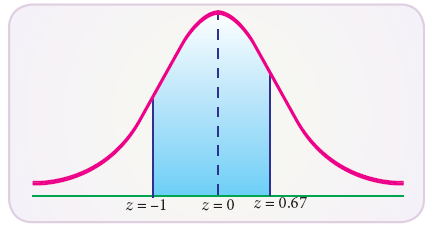
(iii) between 9 and 14 hours
When X = 9
\(Z=\frac { X-\mu }{ \sigma } =\frac { 9-12 }{ 3 } =-1\)
When X = 14
\(Z=\frac { X-\mu }{ \sigma } =\frac { 14-12 }{ 3 } =0.667\)
P(9 < X < 14) = P(–1 < Z < 0.667)
= P(0 < Z < 1) + P(0 < Z < 0.667)
= 0.3413 + 0.2486
= 0.5899
The expected battery cells life to have more than 13 hours is 125 x 0.5899 = 73.73%
26.
Let X be the waiting time of a customer in the queue and it is normally distributed with mean 5 and SD 0.7.
(i) for less than 6 minutes
\(Z=\frac { X-\mu }{ \sigma } =\frac { 6-5 }{ 0.7 } =1.4285\)
P(X < 6) = P(Z < 1.43)
= 0.5 + 0.4236
= 0.9236
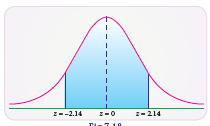
(ii) between 3.5 and 6.5 minutes
When X = 3.5
\(Z=\frac { X-\mu }{ \sigma } =\frac { 3.5-5 }{ 0.7 } =2.1429\)
When X = 6.5
\(Z=\frac { X-\mu }{ \sigma } =\frac { 6.5-5 }{ 0.7 } =2.1429\)
P(3.5 < X < 6.5)
= P (–2.1429 < Z < 2.1429)
= P(0 < Z < 2.1429) + P(0 < Z < 2.1429)
= 2 P(0 < Z < 2.1429)
= 2 x .4838
= 0.9676
27.
Let X be the normal variate of life of light bulbs with mean 125 and standard deviation 18.
(i) less than 95 days
When X = 95
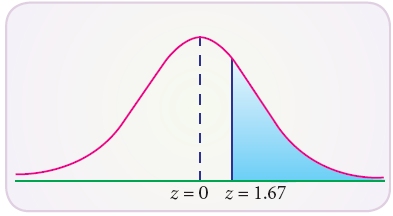
\(Z=\frac{X-\mu}{\sigma}=\frac{95-125}{18}=-1.667\)
\(P(X<95)=P(Z<-1.667)\)
= 0.5 – P(0 < Z < 1.67)
= 0.5 – 0.4525
= 0.0475
No. of bulbs expected to expire in less than 95 days out of 900 bulbs 900 × .0475 = 43 bulbs
28.
Let X be the normal variate showing the score of the candidate with mean 45 and standard deviation 10.
(i) less than 35 marks
When X = 35
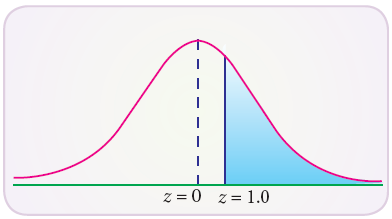
\(Z=\frac { X-\mu }{ \sigma } =\frac { 35-45 }{ 10 } =-1\)
P(X < 35) = P(Z < –1)
P(Z > 1) = 0.5 – P(0 < Z < 1)
= 0.5 – 0.3413
= 0.1587
Expected number of students scoring less than 35 marks are 0.1587 × 1300
= 206
(ii) more than 65 marks
When X = 65
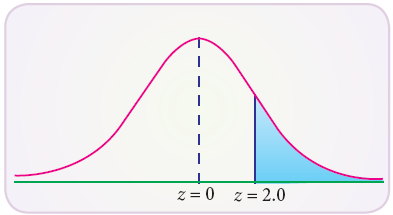
\(Z=\frac { X-\mu }{ \sigma } =\frac { 65-45 }{ 10 } =2.0\)
P(X > 65) = P(Z > 2.0)
0.5 – P(0 < Z < 2.0)
0.5 – 0.4772
= 0.0228
Expected number of students scoring more than 65 marks are 0.0228 x 1300 = 30
29.
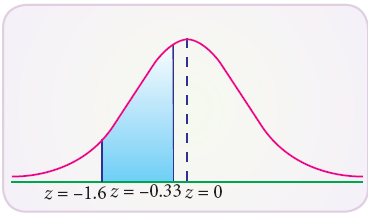
Given that mean μ = 150 and standard deviation σ = 15
(i) when X = 125 thousand
\(Z=\frac { X-\mu }{ \sigma } =\frac { 125-150 }{ 15 } =-1.667\)
When X = 145 thousand
\(Z=\frac { X-\mu }{ \sigma } =\frac { 145-150 }{ 15 } =-0.33\)
Area between Z = 0 and Z = -1.67 is 0.4525
Area between Z = 0 and Z = -0.33 is 0.1293
P(–1.667 ≤ Z ≤ –0.33) = 0.4525 – 0.1293
= 0.3232
Therefore the number of branches having sales between 125 thousand and 145 thousand is 550 × 0.3232 = 178
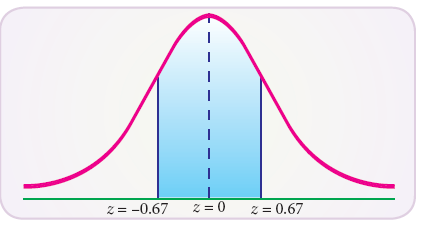
(ii) When X = 140 thousand
\(Z=\frac { X-\mu }{ \sigma } =\frac { 140-150 }{ 15 } =-0.67\)
When X = 160 thousand
\(Z=\frac { X-\mu }{ \sigma } =\frac { 160-150 }{ 15 } =0.67\)
P(–0.67 < Z < 0.67) = P(–0.67 < Z < 0) + P(0 < Z < 0.67)
= P(0 < Z < 0.67) + P(0 < Z < 0.67)
= 2 P(0 < Z < < 0.67)
= 2 × 0.2486
= 0.4972
Therefore, the number of branches having sales between Rs. 140 thousand and Rs. 160 thousand = 550 × 0.4972 = 273
30.
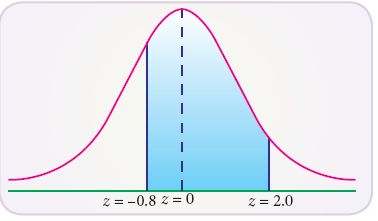
Here mean μ= 30 and standard deviation σ = 5
(i) When X = 26 Z=(X−μ)/\(\sigma \) = (26 – 30)/5 = –0.8
And when X = 40 , z =\(\frac{40-30}{5}=2\)
Therefore,
P(26 < x < 40))
= P(–0.8 ≤ Z ≤ 0) + p(0 ≤ Z ≤ 2)
= P(0 ≤ Z ≤ 0.8) + P(0 ≤ Z ≤ 2)
= 0.2881 + 0.4772 (By tables)
= 0.7653
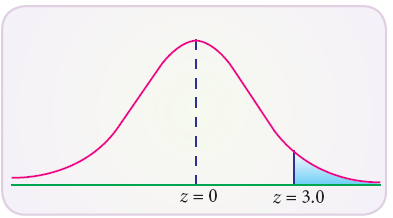
(ii) The probability that X≥45
When X = 45
\(z=\frac { X-\mu }{ \sigma } =\frac { 45-30 }{ 5 } =3\)
P( X ≥ 45) = P(Z ≥ 3)
= 0.5 – 0.49865
= 0.00135
31.
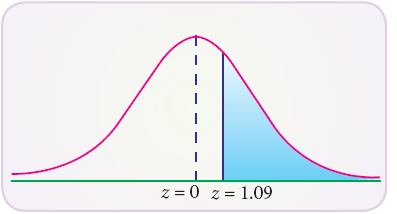
(i) greater than 1.09
The total area under the curve is equal to 1 , so that the total area to the right Z = 0 is 0.5 (since the curve is symmetrical). The area between Z = 0 and 1.09 (from tables) is 0.3621
P(Z > 1.09) = 0.5000 - 0.3621 = 0.1379
The shaded area to the right of Z = 1.09 is the probability that Z will be greater than 1.09
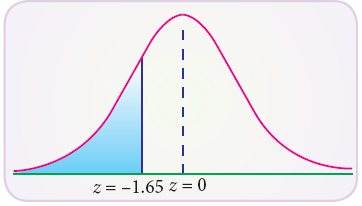
(ii) less than –1.65
The area between -1.65 and 0 is the same as area between 0 and 1.65. In the table the area between zero and 1.65 is 0.4505 (from the table). Since the area to the left of zero is 0.5 , P(Z< 1.65) = 0.5000 – 0.4505 = 0.0495.
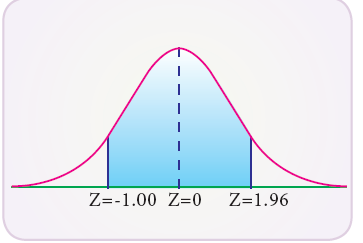
(iii) lying between -1.00 and 1.96
The probability that the random variable Z in between -1.00 and 1.96 is found by adding the corresponding areas :
Area between -1.00 and 1.96 = area between (-1.00 and 0) + area betwn (0 and 1.96)
P(–1.00 < Z < 1.96) = P(–1.00 < Z < 0) + P(0 < Z < 1.96)
= 0.3413 + 0.4750 (by tables)
= 0.8163
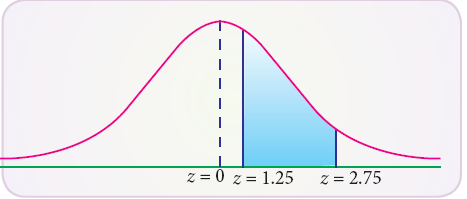
(iv) lying between 1.25 and 2.75
Area between Z = 1.25 and 2.75 = area betwn (z = 0 and z = 2.75)
– area betwn (z=0 and z = 1.25)
P(1.25 < Z < 2.75) = P(0 < Z < 2.75) – P(0 < Z < 1.25)
= 0.4970 - 0.3944 = 0.1026
32.
Consider a 2,000 individuals getting injection of a given serum , n = 2000
Let X be the number of individuals suffering a bad reaction.
Let p be the probability that an individual suffers a bad reaction = 0.001
and q = 1– p = 1– 0.001 = 0.999
Since n is large and p is small, Binomial Distribtuion approximated to poisson distribution
So, λ = np = 2000 × 0.001 = 2
(i) Probability out of 2000, exactly 3 will suffer a bad reaction is
\(P(X=3)=\frac { { e }^{ -\lambda }{ \lambda }^{ x } }{ x! } =\frac { { e }^{ -2 }{ 2 }^{ 3 } }{ 3! } =0.1804\)
(ii) Probability out of 2000, more than 2 individuals will suffer a bad reaction
= P(X > 2)
1-[P(X\(\le\)2)]
= 1 – [P(x = 0) + P(x = 1) + P(x = 2)]
\(=1-\left[ \frac { { e }^{ -2 }{ 2 }^{ 0 } }{ 0! } +\frac { { e }^{ -2 }{ 2 }^{ 1 } }{ 1! } +\frac { { e }^{ -2 }{ 2 }^{ 2 } }{ 2! } \right] \)
\(=1-{ e }^{ 2 }\left( \frac { { 2 }^{ 0 } }{ 0! } +\frac { { 2 }^{ 1 } }{ 1! } +\frac { { 2 }^{ 2 } }{ 2! } \right) \)
= 0.323
33.
P = 1/5/100 = 1/500 = 0.002 n = 10 λ = np = 0.02
\(p(x)=\frac { { e }^{ -\lambda }{ \lambda }^{ x } }{ x! } =\frac { { e }^{ -0.02 }{ (0.02) }^{ x } }{ x! } \)
(i) Number of packets containing no defective = N p(o) = 1,00,000 × e–0.02
= 98020
(ii) Number of packets containing one defective = N p(1) = 1,00,000 × 0.9802 × 0.02
= 1960
(iii) Number of packets containing 2 defectives = N p(2) = 20
34.
p = probability that a person will involve in an accident in a year
= 0.1/100 = 1/1000
given n = 10,000
so, \(\lambda\) = np = 10000\((\frac{1}{10000})\) = 10
Probability that not more than 5 will involve in such an accident in a year
P(X \(\le\) 5) = P(X = 0)+P(X = 1)+P(X = 2)+P(X = 3)+P(X = 4)+P(X = 5)
\(={ e }^{ -10 }[1+\frac { 10 }{ 1! } +\frac { { 10 }^{ 2 } }{ 2! } +\frac { { 10 }^{ 3 } }{ 3! } +\frac { { 10 }^{ 4 } }{ 4! } +\frac { { 10 }^{ 5 } }{ 5! } ]\)
= 0.06651
35.
For Binomial Distribution the mean is np and varaiance is npq
Given values are np + npq = 24 np(1 + q) = 24 – (1)
Other term np × npq = 128 n2p2q = 128-(2)
From (1) we get np = 24/(1+q) which implies n2p2 = (24/(1+q))2
Substitute this value in equation (2) we get
\({ \left( \frac { 24 }{ 1+q } \right) }^{ 2 }q=128\) which implies 9q = 2(1+2q+q2)
(2q – 1)(q – 2) = 0
Where q =\(\frac{1}{2}\) and p =\(\frac{1}{2}\)
Substitute in (1) we get n = 32
Hence the binomial distribution \({ 32C }_{ x }{ \left( \frac { 1 }{ 2 } \right) }^{ x }{ \left( \frac { 1 }{ 2 } \right) }^{ 32-x }\)
36.
Probability of raining on a particular day is given by p = 9/30 = 3/10 and q = 1–p = 7/10.
The binomial distribution is P(X = x) = nCx px qn–x
There are 7 days in a week
P(X = x) =\(\left( \begin{matrix} 7 \\ x \end{matrix} \right) { \left( \frac { 3 }{ 10 } \right) }^{ x }{ \left( \frac { 7 }{ 10 } \right) }^{ 7-x }\)
The probability of raining for atleast 2 days is given by
P(X\(\ge\)2) = 1-P(X<2)
= 1-[P(X = 0)+P(X = 1)]
Here, P(X = 0)\(\left( \begin{matrix} 7 \\ 0 \end{matrix} \right) { \left( \frac { 3 }{ 10 } \right) }^{ 0 }{ \left( \frac { 7 }{ 10 } \right) }^{ 7-0 }\)
= 0.0823
and \(P(X=1)=\left( \begin{matrix} 7 \\ 1 \end{matrix} \right) \left( \frac { 3 }{ 10 } \right) { \left( \frac { 7 }{ 10 } \right) }^{ 7-1 }\)
= 0.2471
Therefore the required probability = 1– [P(x = 0) +P(x = 1)]
= 1– [0.082+ 0.247]
= 0.6706

12th Standard Syllabus & Materials
12th Standard
TN 12th Computer Applications வலையமைப்பு வடமிடல் Sample Question Papers Study Material - QB365 Set A
NEW12th Standard
TN 12th Computer Applications களப்பெயர் முறைமை (DNS) Sample Question Papers Study Material - QB365 Set A
NEW12th Standard
TN 12th Computer Applications வலையமைப்பு எடுத்துக்காட்டுகள் மற்றும் நெறிமுறைகள் Sample Question Papers Study Material - QB365 Set A
NEW12th Standard
TN 12th Computer Applications கணினி வலையமைப்பு ஓர் அறிமுகம் Sample Question Papers Study Material - QB365 Set A



Tamilnadu Stateboard 12th Standard Subjects

Maths

Chemistry

Physics

Biology

Computer Science
Business Maths and Statistics

Economics

Commerce

Accountancy

History

Computer Applications
Biology
Computer Technology
Computer Applications
Computer Science
Business Maths and Statistics
Commerce
Economics
Maths
Chemistry
Physics
Computer Technology
History
Accountancy

Tamil

English

French
Tamilnadu Stateboard Standards
