
 100% FREE ACCESS
12th Standard Syllabus & Materials
12th Standard
TN 12th Maths Applications of Matrices and Determinants Sample Question Papers Study Material - QB365 Set A
NEW12th Standard
TN 12th Computer Applications மின்னணு தரவு பரிமாற்றம் Sample Question Papers Study Material - QB365 Set A
NEW12th Standard
TN 12th Computer Applications மின் - வணிக பாதுகாப்பு அமைப்புகள் Sample Question Papers Study Material - QB365 Set A
NEW12th Standard
TN 12th Computer Applications மின்னணு செலுத்தல் முறைகள் Sample Question Papers Study Material - QB365 Set A
NEW12th Standard
TN 12th Computer Applications மின் - வணிகம் Sample Question Papers Study Material - QB365 Set A
NEW12th Standard
TN 12th Computer Applications திறந்த மூல கருத்துருக்கள் Sample Question Papers Study Material - QB365 Set A

Published on: 02/09/2022
QB365 provides a detailed and simple solution for every Possible Creative Questions in Class 12 Business Maths Subject -Probability Distributions, English Medium. It will help Students to get more practice questions, Students can Practice these question papers in addition to score best marks.
Download Tamil Nadu 12th Standard Business Maths and Statistics question papers, model tests, one-mark questions, important questions, and public exam papers in PDF format. Free study materials and answer keys for TN State Board students.
Questions + Answers key
Take MCQ Business Maths and Statistics Test
1.
If X is a normal variable with mean 100 and variance 36. Find
(i) P(X > 112)
(ii) P(X < 106)
(iii) P(94
2.
What is the probability that Z
(a) lies between 0 and 1.83
(b) is greater than 1.54
(c) is greater than -0.86
(d) lies between 0.43 and 1.12
(e) is less than 0.77
3.
An insurance company insured 4000 people against loss of both eyes in car accident. Based on previous data, the rates were computed on the assumption that on the average 10 person in 1,00,000 will have car accidents cactch year that result in this type of injury. What is the probability that more than 3 of the injured will collect on their policy in a given year(e-0.4 = 0.6703)
4.
The number of accidents in a year attributed to taxi drivers in a city follows poisson distribution with mean 3. Out of 1000 taxi drivers find
(i) the approximate number of drivers with no accident in a year
(ii) more than 3 accidents in a year
5.
Find the probability that atmost 5 defective fuses wil be found in a box of 200 fuses if experience shows that 2 percent of such fuses are defective. (e-4 = 0.0183)
6.
For a Binomial distribution with parameters n = 5 and p = 0.3, find the probability of getting
(i) atleast 3 successes
(ii) at most 3 successes.
7.
A die is thrown 6 times. If "getting an odd number" is a success what is the probability of
(i) 5 successes
(ii) atleast 5 success
(iii) at most 5 successes
(iv) atleast one success x = 0
(v) no success
8.
A pair of dice in thrown 7 times. If getting a total of 7 is considered a success, what is the probability of
(i) no success
(ii) 6 success
(iii) atleast 6 successes
(iv) atmost 6 successes
9.
The sum and product of the mean and variance of a binomial distribution are 24 and 128 respectively.Find their distribution.
10.
If x follows binomial distribution with mean 4 and variance 2, find \(P(|X-4| \leq 2)\).
11.
Marks in an aptitude test given to 800 students of a school was found to be normally distributed 10% of the students scored below 40 marks and 10% of the students scored above 90 marks. Find the number of students scored between 40 and 90?
12.
If the height of 300 students are normally distributed with mean 64.5 inches and standard deviation 3.3 inches find the height below which 99% of the student lie?
13.
The mean weight of 500 male students in a certain college is 151 pounds and the S.D is 15 pounds. Assuming the weights are normally distributed, find how many students weight
(i) between 120 and 155 pounds
(ii) more than 185 pounds.
14.
20% of the bolts produced in a factory are found to be defective. Find the probability that in a sample of 10 bolts chosen at random exactly 2 will be defective using
(i) Binomial distribution
(ii) Poisson distribution (e-2 = 0.1353)
15.
Four coins are tossed simultaneously. What is the probability of getting
a) atleast 2 heads
b) atmost 2 heads.
1.
\(\mu=100, \sigma^{2}=36, \quad \sigma=6, Z=\frac{X-\mu}{\sigma}\)
\(\text {(i) } \mathrm{Z}=\frac{112-100}{6}=2\)
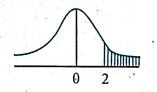
\( \mathrm{P}(\mathrm{X}>112) =\mathrm{P}(\mathrm{Z}>2) \)
\( =0.5-\mathrm{P}(0<\mathrm{Z}<2) \)
= 0.5-0.4772
= 0.0228
\(\text { (ii) } Z=\frac{106-100}{6}=1\)
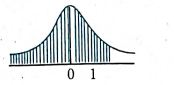
\( \mathrm{P}(\mathrm{X}<106) =\mathrm{P}(\mathrm{Z}<1) \)
\(=0.5+\mathrm{P}(0<\mathrm{Z}<1) \)
= 0.5 + 0.3413
= 0.8413
\(\text {(iii) } \mathrm{Z}=\frac{94-100}{6}=-1\)
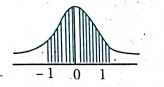
\(\mathrm{Z}=\frac{106-100}{6}=1\)
\( \mathrm{P}(94 \leq X \leq 106) =\mathrm{P}(-1 \leq Z \leq 1) \)
\( =2 \mathrm{P}(0 \leq Z \leq 1) \)
= 2(0.3413)
= 0.6826
2.
\(\text {(a) } \mathrm{P}(0 \leq Z \leq 1.83)=0.4664\)
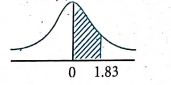
\(\text {(b) } \mathrm{P}(Z \geq 1.154)\)
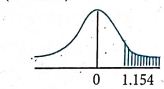
\( =0.5-p(0 \leq Z \leq 1.154) \)
\(=0.5-0.4382=0.0618\)
\(\text {(c) } \mathrm{P}(Z \geq-0.86)\)
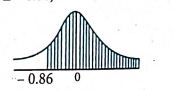
\( =0.5+\mathrm{P}(-0.86 \leq \mathrm{Z} \leq 0) \)
\(=0.5+0.3051=0.8051\)
\(\text {(d) } \mathrm{P}^{\prime}(0.43 \leq Z \leq 1.12)\)
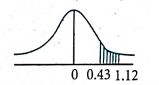
\( =\mathrm{P}(0 \leq Z \leq 1.12)-\mathrm{P}(0 \leq Z \leq 0.43) \)
= 0.3686-0.1664
= 0.2022
\(\text {(e) } \mathrm{P}(\mathrm{Z} \leq 0.77)=0.5+\mathrm{P}(0 \leq Z \leq 0.77)\)
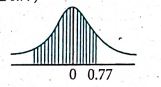
= 0.5 + 0.2794
= 0.7794
3.
Let X be a random variable denoting the number of injured persons who will collect their policy.
\(\lambda=\mathrm{np}=4000 \times \frac{10}{100000}=0.4\)
\(
\mathrm{P}(\mathrm{X}=\mathrm{X}) =\frac{e^{-\lambda} \lambda^{x}}{x !}
\)
\(\mathrm{P}(\mathrm{X}>3) =1-\mathrm{P}(\mathrm{X} \leq 3)
\)
\(=1-[\mathrm{P}(\mathrm{X}=0)+\mathrm{P}(\mathrm{X}=1)+
\mathrm{P}(\mathrm{X}=2)+\mathrm{P}(\mathrm{X}=3)]
\)
\(=1-\mathrm{e}^{-0.4}\left[1+\frac{0.4}{1 !}+\frac{0.4}{2 !}+\frac{(0.4)^{3}}{3 !}\right]\)
4.
Let X be the random variable denoting the number of accidents in a year
\( \lambda=3 \)
\(\mathrm{P}(\mathrm{X}=\mathrm{x})=\frac{e^{-\lambda} \lambda^{x}}{x !} \)
\(\text {(i) } \mathrm{P}(\mathrm{X}=0)=\frac{e^{-3} 3^{0}}{0 !}=\mathrm{e}^{-3}=0.05\)
Number of drivers with no accident
\(=1000 \times 0.05=50\)
\((ii)\ \mathrm{P}(\mathrm{X}>3)=1-\mathrm{P}(X \leq 3)^{\prime} \)
\(=1-[\mathrm{P}(\mathrm{X}=0)+\mathrm{P}(\mathrm{X}=1)+ \quad \mathrm{P}(\mathrm{X}=2)]+\mathrm{P}(\mathrm{X}=3)] \)
\(=1-\mathrm{e}^{-3}\left[1+3+\frac{3^{2}}{2 !}+\frac{3^{3}}{3 !}\right] \)
\(=1-\mathrm{e}^{-3}[1+3+4.5+4.5] \)
\(=1-\mathrm{e}^{-3}(13)=1-0.65=0.35\)
Number of drivers with more than 3 accidents = 1000 \(\times\) 3.5 = 350
5.
Let X be the random variable denoting the number of fuses.
\(
\mathrm{p}=\frac{2}{100} ; \mathrm{n}=200
\)
\(\lambda=\mathrm{np}=4
\)
\(
\mathrm{P}(\mathrm{X}=\mathrm{x})=\frac{e^{-\lambda} \lambda^{x}}{n !}
\)
\(\mathrm{P}(\mathrm{X} \leq 5)= \mathrm{P}(\mathrm{X}=0)+\mathrm{P}(\mathrm{X}=1)+
\mathrm{P}(\mathrm{X}=2)+\mathrm{P}(\mathrm{X}=3)+\mathrm{P}(\mathrm{X}=4)
+\mathrm{P}(\mathrm{X}=5)
\)
\(= \frac{e^{-4} 4^{0}}{0 !}+\frac{e^{-4} 4^{1}}{1 !}+\frac{e^{-1} 4^{2}}{2 !}+\frac{e^{-4} 4^{3}}{3 !}
+\frac{e^{-1} 4^{4}}{4 !}+\frac{e^{-4} 4^{5}}{5 !}
\)
\(= e^{-4}\left[1+\frac{4}{1 !}+\frac{4^{2}}{2 !}+\frac{4^{3}}{3 !}+\frac{4^{4}}{4 !}+\frac{4^{5}}{5 !}\right]
\)
\(=(0.0183) \times \frac{643}{15}=0.785\)
6.
Let x be the random variable denoting the number of successes.
\( \mathrm{P}(\mathrm{X}=\mathrm{x})=n C_{x} p^{x} q^{n-x} \)
\(\mathrm{n}=5, \mathrm{p}=0.3, \mathrm{q}=0.7 \)
\(=5 C_{3}(0.3)^{3}(0.7)^{2}+5 C_{4}(0.3)^{4}(0.7) +5 \mathrm{C}_{5}(0.3)^{5} \)
\(=0.1631 \)
\(\text {(ii) } \mathrm{P}(\mathrm{X} \leq 3)=\mathrm{P}(\mathrm{X}=0)+\mathrm{P}(\mathrm{X}=1)^{\circ}+\mathrm{P}(\mathrm{X}=2) +\mathrm{P}(\mathrm{X}=3) \)
\(=5 C_{0}(0.3)^{0} \cdot(0.7)^{5}+ 5 \mathrm{C}_{1}(0.3)^{1}(0.7)^{4}+5 \mathrm{C}_{2}(0.3)^{2}(0.7)^{3} \cdots+5 \mathrm{C}_{3}(0.3)^{3}(0.7)^{2} \)
= 0.9692
7.
Let X be the random variable denoting the number of successes.
p probability of getting an odd number
\(
=\frac{3}{6}=\frac{1}{2}
\)
\( \mathrm{q}=1-\mathrm{p}=1-\frac{1}{2}=\frac{1}{2}
\)
\( \mathrm{n}=6
\)
\( \mathrm{P}(\mathrm{X}=\mathrm{x})=n C_{x} p^{x} q^{n-x}
\)
\(
(i)\ \mathrm{P}(\mathrm{X}=5)=6 C_{5}\left(\frac{1}{2}\right)^{6}=\frac{6}{64}=\frac{3}{32}
\)
\((ii)\ \mathrm{P}(X \geq 5)=\mathrm{P}(\mathrm{X}=5)+\mathrm{P}(\mathrm{X}=6)
\)
\(
=6 C_{5}\left(\frac{1}{2}\right)^{6}+6 C_{6}\left(\frac{1}{2}\right)^{6}
\)
\(=\frac{1}{64}\left[6 C_{1}+1\right]=\frac{7}{64}\)
\(\text {(iii) }
\mathrm{P}(X \leq 5) =1-\mathrm{P}(\mathrm{X}>5)
\)
\(=1-\mathrm{P}(\mathrm{X}=6)
\)
\(=1-6 \mathrm{C}_{6}\left(\frac{1}{2}\right)^{6}=\frac{63}{64}
\)
\((iv) \ \mathrm{P}(X \geq 1)=1-\mathrm{P}(\mathrm{X}<1)
\)
\(
=1-P(X=0)
\)
\(=1-6 C_{0}\left(\frac{1}{2}\right)^{6}=1-\frac{1}{64}=\frac{63}{64}
\)
\((v)\ \mathrm{P}(\mathrm{X}=0)=6 C_{0} \frac{1}{2^{6}}=\frac{1}{64}\)
8.
Let X be the random variable denoting the number of successes
p = probability of getting a total of 7 in a single throw of a pair of dice
= {(1, 6), (6, 1), (2, 5) (5, 2), (3, 4) (4, 3)}
\(
=\frac{6}{36}=\frac{1}{6}
\)
\(q =\frac{5}{6}
\)
\(
\mathrm{P}(\mathrm{X}=\mathrm{x})=n C_{x} p^{x} q^{n-x}
\)
\((i)\ \mathrm{P}(\mathrm{X}=0)=7 C_{0}\left(\frac{1}{6}\right)^{0}\left(\frac{5}{6}\right)^{7}=\left(\frac{5}{6}\right)^{7}
\)
\((ii)\ \mathrm{P}(\mathrm{X}=6)=7 C_{6}\left(\frac{1}{6}\right)^{6}\left(\frac{5}{6}\right)^{1}=35\left(\frac{1}{6}\right)^{7} \)
\(
\text {(iii) } \mathrm{P}(X \geq 6)=\mathrm{P}(\mathrm{X}=6)+\mathrm{P}(\mathrm{X}=7)
\)
\( =7 C_{6}\left(\frac{1}{6}\right)^{6}\left(\frac{5}{6}\right)^{1}+7 C_{-}\left(\frac{1}{6}\right)^{7}
\)
\( =\frac{1}{6^{7}}\left[7 C_{1}(5)+1\right]=\frac{36}{6^{7}}=\frac{1}{6^{5}}
\)
\( \text {(iv) } \mathrm{P}(X \leq 6)=1-\mathrm{P}(\mathrm{X}>6)
\)
\( =1-\mathrm{P}(\mathrm{X}=7)
\)
\( =1-7 C_{-}\left(\frac{1}{6}\right)^{-}=1-\frac{1}{6^{7}}
\)
9.
Mean+ Variance = 24
np+ npq = 24
\(
\mathrm{np}(1+\mathrm{q}) =24 \Rightarrow \mathrm{np}=\frac{24}{1+q}
\)
\(\text {Mean }(\text {variance }) =128
\)
\(\mathrm{np}(\mathrm{npq}) =128
\)
\(\mathrm{n}^{2} \mathrm{p}^{2} =\frac{128}{q}
\)
\(\left(\frac{24}{1+q}\right)^{2} =\frac{128}{q}
\)
\(9 \mathrm{q} =2\left(1+2 \mathrm{q}+\mathrm{q}^{2}\right)\)
\(
2 q^{2}-5 q+2 =0
\)
\((2 q-1)(q-2) =0 \Rightarrow q=\frac{1}{2} ; p=\frac{1}{2}
\)
\(n p(1+q) =24
\)
\(n\left(\frac{1}{2}\right)\left(1+\frac{1}{2}\right) =24
\)
\(\mathrm{n} =\frac{24 \times 2 \times 2}{3}=32\)
The Binomial distribution n
\(
\mathrm{P}(\mathrm{X}=\mathrm{x}) =n C_{x} p^{x} q^{n-x}
\)
\(= 32 C_{x}\left(\frac{1}{2}\right)^{x}\left(\frac{1}{x}\right)^{32-x},
\mathrm{x}=0,1,2 \ldots 32
\)
10.
Mean = np = 4
Variance = npq = 2
\(
\Rightarrow \ \mathrm{q} =2 \Rightarrow \mathrm{q}=\frac{2}{4}=\frac{1}{2}
\)
\(\mathrm{p}= \frac{1}{2}
\)
\(n\left(\frac{1}{2}\right)= 4 \Rightarrow \mathrm{n}=8
\)
\(\mathrm{P}(\mathrm{X}= \mathrm{x})=n C_{x} p^{x} q^{n-x}
\)
\(\mathrm{P}(|\mathrm{X}-4| \leq 2)= \mathrm{P}^{\mathrm{P}}(-2 \leq \mathrm{X}-4 \leq 2)=\mathrm{P}(2 \leq X \leq 6)
\)
\(= \mathrm{P}(\mathrm{X}=2)+\mathrm{P}(\mathrm{X}=3)
+\mathrm{P}(\mathrm{X}=4)+\mathrm{P}(\mathrm{X}=5)+\mathrm{P}(\mathrm{X}=6)
\)
\(= 8 C_{2}\left(\frac{1}{2}\right)^{8}+8 C_{3}\left(\frac{1}{2}\right)^{8}+8 C_{4}\left(\frac{1}{2}\right)^{8}+
8 C_{5}\left(\frac{1}{2}\right)^{8}+8 C_{6}\left(\frac{1}{2}\right)^{8}
\)
\(= \frac{1}{2^{8}}\left[8 C_{2}+8 C_{3}+8 C_{4}+8 C_{5}+8 C_{6}\right]
\)
\(= \frac{119}{128}
\)
11.
Let X denote the height of the student
Given P (X < 40) = 10% = \(\frac { 10 }{ 100 } \) =0.1
P(X> 90) = 10% = \(\frac { 10 }{ 100 } \) =0.1
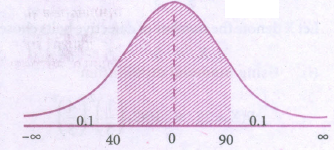
∴ P(40 < X < 90) = P(-∞ < X < ∞) - [P(X < 40) + P(X < 90)]
= 1 - (0.1 + 0.1)
= 1 - 0.2 = 0.8
∴ out of 800 students, number of students scored between 40 and 90 = 800 x 0.8
= 640 students.
12.
Let X denote the height of the student
Given μ = 64.5 inches and σ = 3.3 inches
Given that P(-∞ < Z < C) = 0.99
⇒ P( -∞ < Z < 0) + P (0 < Z < C) = 0.99
⇒ 0.5 + P (0 < Z < C) = 0.99
⇒ P(0 < Z < C) = 0.99 - 0.5 = 0.49...(1)
From the standard normal distribution table
P(0 < Z < 2.33) = 0.49...(2)
From (1) & (2), C = 2.33
we know that Z = \(\frac { X-\mu }{ \sigma } \)
⇒ 2.33 = \(\frac { X-64.5 }{ 3.3 } \)
⇒ X = (2.33) (3.3) + 64.5
⇒ X = 72.19 inches
Hence, the height below which 99% of the student lie is 72.19 inches.
13.
Let X denotes the weight of the male students
Given μ = 151, σ = 15 and N = 500
(i) between 120 and 155 pounds
P(120 < X < 155)
When X = 120, Z = \(\frac { X-\mu }{ \sigma } \)
= \(\frac { 120-151 }{ 15 } \)
= \(\frac { -31 }{ 15 } \) = -2.067
When x = 155, Z = \(\frac { 155-151 }{ 15 } \)
= \(\frac { 4 }{ 15 } \) = 0.2667
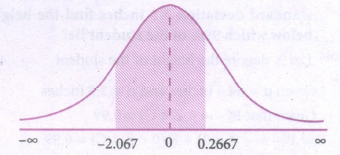
∴ P(120< X < 155) = P(-2.067 < X < 0.2667)
= P (-2.067 < Z < 0) + P (0 < Z < 0.2667)
= P (0 < Z < 2.067) + P (0 < Z < 0.2667)
(By symmetry)
= 0.4803 + 0.1026 = 0.5829
Probability for a student weigh between 120 and 155 pounds is 0.5829
∴ Out of 500 students, number of students weighing between 120 and 155 pounds
= 500 \(\times\) 0.5829 = 291 students
(ii) more than 185 pounds
P(X > 185)
When X = 185, Z = \(\frac { 185-151 }{ 15 } \)
=\(\frac { 34 }{ 15 } \) = 2.2667
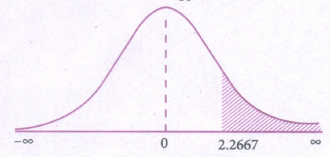
∴ P(X >185) = P (Z > 2.2667)
= P (2.2667 < Z < ∞)
= P(0 < Z < ∞) - (0 < Z < 2.2667)
= 0.5 - 0.4881
= 0.0119
i.e Probability for a student weighing above 185 is 0.0119
∴ out of 500 male students, number of students weighing more than 185 pounds.
= 500 \(\times\) 0.0119 = 6 students.
14.
Given n = 10, p = \(\frac { 20 }{ 100 } =\frac { 1 }{ 5 } \)
∴ q = 1-p = \(1-\frac { 1 }{ 5 } =\frac { 4 }{ 5 } \)
Let
X denote the number of defective bolts chosen
∴ X = 2
(i) Using binomial distribution
P(X = 2) = \(10{ C }_{ 2 }\left( \frac { 1 }{ 5 } \right) ^{ 2 }\left( \frac { 4 }{ 5 } \right) ^{ 8 }\)
= \(\frac { 10\times 9 }{ 2\times 1 } \left( \frac { { 4 }^{ 8 } }{ { 5 }^{ 10 } } \right) =45\left( \frac { 4^{ 8 } }{ { 5 }^{ 10 } } \right) \)
(ii) Using Poisson distribution
λ = np = 10 \(\times\) \(\frac { 1 }{ 5 } \) = 2
P(X = x) \(\times\)\(\frac { { e }^{ -\lambda }.{ \lambda }^{ 0 } }{ x! } \)
x = 0,1,2,......n
∴ P(X = 2) = \(\frac { e^{ -2 }(2^{ 2 }) }{ 2 } =e^{ -2 }\left( \frac { 4 }{ 2 } \right) \)
= 2e-2
= 2(0.1353) = 0.2706
∴ P(X = 2) = 0.2706
15.
Given n = 4
p = probability of getting a head when a coin is tossed
= \(\frac { 1 }{ 2 } \)
∴ q=1-p =\(1-\frac { 1 }{ 2 } =\frac { 1 }{ 2 } \)
X is a ran dom verticical having
p(X = x) = nCx pxqn-x, x = 0,1,2,3,4
a) atleast 2 heads
P(X ≥ 2) = 1-P(X<2)
= 1- [P(X = 0) + P(X = 1)]
=1-\(\left[ 4C_{ 0 }\left( \frac { 1 }{ 2 } \right) ^{ 0 }\left( \frac { 1 }{ 2 } \right) ^{ 4 }+4C_{ 1 }\left( \frac { 1 }{ 2 } \right) ^{ 1 }\left( \frac { 1 }{ 2 } \right) ^{ 3 } \right] \)
=1-\(\left[ 1\left( \frac { 1 }{ 16 } \right) +4\left( \frac { 1 }{ 8 } \right) \left( \frac { 1 }{ 2 } \right) \right] \)
=1-\(1-\left( \frac { 4 }{ 16 } +\frac { 1 }{ 16 } \right) =1-\frac { 5 }{ 16 } =\frac { 11 }{ 16 } \)
P(X ≥ 2) = \(\frac { 11 }{ 16 } \)
b) atmost 2 heads
P(X≤2) = 1-P(X>2)
= 1 - [P(X = 3) + P (X = 4)]
= 1-\(\left[ { 4C }_{ 3 }\left( \frac { 1 }{ 2 } \right) ^{ 3 }\left( \frac { 1 }{ 2 } \right) ^{ 1 }+{ 4C }_{ 4 }\left( \frac { 1 }{ 2 } \right) ^{ 4 }\left( \frac { 1 }{ 2 } \right) ^{ 0 } \right] \)
= 1-\(\left[ 4\left( \frac { 1 }{ 8 } \right) \left( \frac { 1 }{ 2 } \right) +1\left( \frac { 1 }{ 16 } \right) \right] \)
= \(1-\left( \frac { 4 }{ 16 } +\frac { 1 }{ 16 } \right) =1-\frac { 5 }{ 16 } =\frac { 11 }{ 16 } \)
P(X≤2) =\(\frac { 11 }{ 16 } \).

12th Standard Syllabus & Materials
12th Standard
TN 12th Computer Applications வலையமைப்பு வடமிடல் Sample Question Papers Study Material - QB365 Set A
NEW12th Standard
TN 12th Computer Applications களப்பெயர் முறைமை (DNS) Sample Question Papers Study Material - QB365 Set A
NEW12th Standard
TN 12th Computer Applications வலையமைப்பு எடுத்துக்காட்டுகள் மற்றும் நெறிமுறைகள் Sample Question Papers Study Material - QB365 Set A
NEW12th Standard
TN 12th Computer Applications கணினி வலையமைப்பு ஓர் அறிமுகம் Sample Question Papers Study Material - QB365 Set A



Tamilnadu Stateboard 12th Standard Subjects

Maths

Chemistry

Physics

Biology

Computer Science
Business Maths and Statistics

Economics

Commerce

Accountancy

History

Computer Applications
Biology
Computer Technology
Computer Applications
Computer Science
Business Maths and Statistics
Commerce
Economics
Maths
Chemistry
Physics
Computer Technology
History
Accountancy

Tamil

English

French
Tamilnadu Stateboard Standards
