
 100% FREE ACCESS
12th Standard Syllabus & Materials
12th Standard
TN 12th Maths Applications of Matrices and Determinants Sample Question Papers Study Material - QB365 Set A
NEW12th Standard
TN 12th Computer Applications மின்னணு தரவு பரிமாற்றம் Sample Question Papers Study Material - QB365 Set A
NEW12th Standard
TN 12th Computer Applications மின் - வணிக பாதுகாப்பு அமைப்புகள் Sample Question Papers Study Material - QB365 Set A
NEW12th Standard
TN 12th Computer Applications மின்னணு செலுத்தல் முறைகள் Sample Question Papers Study Material - QB365 Set A
NEW12th Standard
TN 12th Computer Applications மின் - வணிகம் Sample Question Papers Study Material - QB365 Set A
NEW12th Standard
TN 12th Computer Applications திறந்த மூல கருத்துருக்கள் Sample Question Papers Study Material - QB365 Set A

Published on: 02/09/2022
QB365 provides a detailed and simple solution for every Possible Book Back Questions in Class 12 Business Maths Subject -Random Variable and Mathematical Expectation, English Medium. It will help Students to get more practice questions, Students can Practice these question papers in addition to score best marks.
Download Tamil Nadu 12th Standard Business Maths and Statistics question papers, model tests, one-mark questions, important questions, and public exam papers in PDF format. Free study materials and answer keys for TN State Board students.
Questions + Answers key
Take MCQ Business Maths and Statistics Test
1.
The probability function of a random variable X is given by
\(p(x)=\left\{\begin{array}{l} \frac{1}{4}, \text { for } x=-2 \\ \frac{1}{4}, \text { for } x=0 \\ \frac{1}{2}, \text { for } x=10 \\ 0, \text { elsewhere } \end{array}\right.\)
Evaluate the following probabilities.
P(0\(\le\)X\(\le\)10)
2.
The probability function of a random variable X is given by
\(p(x)=\left\{\begin{array}{l} \frac{1}{4}, \text { for } x=-2 \\ \frac{1}{4}, \text { for } x=0 \\ \frac{1}{2}, \text { for } x=10 \\ 0, \text { elsewhere } \end{array}\right.\)
Evaluate the following probabilities.
P(|X|\(\le\)2)
3.
The probability function of a random variable X is given by
\(p(x)=\left\{\begin{array}{l} \frac{1}{4}, \text { for } x=-2 \\ \frac{1}{4}, \text { for } x=0 \\ \frac{1}{2}, \text { for } x=10 \\ 0, \text { elsewhere } \end{array}\right.\)
Evaluate the following probabilities.
P(X<0)
4.
The probability density function of a continuous random variable X is
\(f(x)=\left\{\begin{array}{l} a+b x^{2}, 0 \leq x \leq 1 \\ 0, \text { otherwise } \end{array}\right.\)
where a and b are some constants. Find
(i) a and b if E(X)\(\frac{3}{5}\)
(ii) Var(X).
5.
Let X be a random variable with cumulative distribution function
\(F(x)=\left\{\begin{array}{l} 0, \text { if } x<0 \\ \frac{x}{8}, \text { if } 0 \leq x<1 \\ \frac{1}{4}+\frac{x}{8}, \text { if } 1 \leq x<2 \\ \frac{3}{4}+\frac{x}{12}, \text { if } 2 \leq x<3 \\ 1, \text { for } 3 \leq x \end{array}\right.\)
(a) Compute: (i) P(1\(\le\)X\(\le\)2) and
(ii) P(X=3)
(b) Is X a discrete random variable? Justify your answer.
6.
The probability function of a random variable X is given by
\(p(x)=\left\{\begin{array}{l} \frac{1}{4}, \text { for } x=-2 \\ \frac{1}{4}, \text { for } x=0 \\ \frac{1}{2}, \text { for } x=10 \\ 0, \text { elsewhere } \end{array}\right.\)
Evaluate the following probabilities.
P(\(\le\))0
7.
The probability density function of a random variable X is f(x) = ke-|x|, -∞ < x < ∞
8.
Suppose the life in hours of a radio tube has the probability density function
\(f(x)=\left\{\begin{array}{l} e^{-\frac{x}{100}}, \text { when } x \geq 100 \\ 0, \quad \text { when } x<100 \end{array}\right.\)
Find the mean of the life of a radio tube.
9.
Determine the mean and variance of a discrete random variable, given its distribution as follows.
| X = x | 1 | 2 | 3 | 4 | 5 | 6 |
| Fx(x) | \(\frac{1}{6}\) | \(\frac{2}{6}\) | \(\frac{3}{6}\) | \(\frac{4}{6}\) | \(\frac{5}{6}\) | 1 |
10.
Determine the mean and variance of the random variable X having the following probability distribution.
| X=x | 1 | 2 | 3 | 4 | 5 | 6 | 7 | 8 | 9 | 10 |
| P(x) | 0.15 | 0.10 | 0.10 | 0.01 | 0.08 | 0.01 | 0.05 | 0.02 | 0.28 | 0.20 |
11.
Suppose that the time in minutes that a person has to wait at a certain station for a train is found to be a random phenomenon with a probability function specified by the distribution function\(F(x)\begin{cases} 0,\quad \text{for}\quad x<0 \\ \frac { 1 }{ 2 } ,\quad \text{for}\quad 0\le x<1 \\ 0,\quad \text{for}\quad 1\le x<2\quad \\ \frac { 1 }{ 4 } ,\quad \text{for}\quad 2\le x<4 \\ 0,\quad \text{for}\quad x\ge 4 \end{cases}\)
(a) Is the distribution function continuous? If so, give its probability density function?
(b) What is the probability that a person will have to wait
(i) more than 3 minutes,
(ii) less than 3 minutes and
(iii) between 1 and 3 minutes?
12.
The length of time (in minutes) that a certain person speaks on the telephone is found to be random phenomenon, with a probability function specified by the probability density function f(x) as \( f(x)\begin{cases} { Ae }^{ -x/5 },\quad \text{for}\quad x\ge 0 \\ 0 \quad ,\quad \text{otherwise }\end{cases}\)
(a) Find the value of A that makes fix) a p.d.f,
(b) What is the probability that the number of minutes that person will talk over the phone is
(i) more than 10 minutes
(ii) less than 5 minutes and
(iii) between 5 and 10 minutes.
13.
A continuous random variable X has the following distribution function:
\(f(x)=\left\{\begin{array}{l} 0 , \text{if} \ x \leq1 \\ k(x-1)^4, \text{if} \ 1< x \leq 3 \\ 1, \text{if} \ x > 3 \end{array}\right.\)
Find (i) k and (ii) the probability density function.
14.
The distribution of a continuous random variable X in range (–3, 3) is given by p.d.f.
\(f(x)=\left\{\begin{array}{l} \frac{1}{16}(3+x)^{2},-3 \leq x \leq-1 \\ \frac{1}{16}\left(6-2 x^{2}\right),-1 \leq x \leq 1 \\ \frac{1}{16}(3-x)^{2}, 1 \leq x \leq 3 \end{array}\right.\)
Verify that the area under the curve is unity.
15.
A continuous random variable X has the following probability function
| Value of X = x | 0 | 1 | 2 | 3 | 4 | 5 | 6 | 7 |
| P(x) | 0 | k | 2k | 2k | 3k | k2 | 2k2 | 7k2+k |
(i) Find k
(ii) Ealuate p(x<6), p(x\(\ge \)6) and p(0)
(iii) If P(X\(\le\)x).\(\frac{1}{2}\), then find the minimum value of x.
16.
The amount of bread (in hundreds of pounds) x that a certain bakery is able to sell in a day is found to be a numerical valued random phenomenon, with a probability function specified by the probability density function f(x) is given by
\(f(x)=\left\{\begin{array}{l} Ax,for \ 0≤x10 \\ A(20−x),for \ 10 ≤x< 20 \\ 0,\quad \quad \quad otherwise \end{array}\right.\)
(a) Find the value of A.
(b) What is the probability that the number of pounds of bread that will be sold tomorrow is
(i) More than 10 pounds,
(ii) Less than 10 pounds, and
(iii) Between 5 and 15 pounds?
17.
A continuous random variable X has p.d.f
f(x) = 5x4, 0\(\le\)x\(\le\)1
Find a1 and a2 such that
i) P[X\(\le\)a1] = P[X>a1]
ii) P[X>a2] = 0.05
18.
Construct the distribution function for the discrete random variable X whose probability distribution is given below. Also draw a graph of p(x) and F(x).
| X = x | 1 | 2 | 3 | 4 | 5 | 6 | 7 |
| P(x) | 0.10 | 0.12 | 0.20 | 0.30 | 0.15 | 0.08 | 0.05 |
19.
A random variable X has the following probability function
| Values of X | 0 | 1 | 2 | 3 | 4 | 5 | 6 | 7 |
| p(x) | 0 | a | 2a | 2a | 3a | a2 | 2a2 | 7a2+a |
(i) Find a, Evaluate
(ii) P(X < 3),
(iii) P(X > 2) and
(iv) P(2 < X \(\leq\) 5).
1.
Given probability function is
\(p(x)=\left\{\begin{array}{l} \frac{1}{4}, \text { for } x=-2 \\ \frac{1}{4}, \text { for } x=0 \\ \frac{1}{2}, \text { for } x=10 \\ 0, \text { elsewhere } \end{array}\right.\)
| X=x | -2 | 0 | 10 |
| P(X=x) | \(\frac{1}{4}\) | \(\frac{1}{4}\) | \(\frac{1}{2}\) |
P(0≤X≤10)=P(X=0)+P(X=10)
\(\frac{1}{4}+\frac{1}{2}=\frac{3}{4}\)
2.
Given probability function is
\(p(x)=\left\{\begin{array}{l} \frac{1}{4}, \text { for } x=-2 \\ \frac{1}{4}, \text { for } x=0 \\ \frac{1}{2}, \text { for } x=10 \\ 0, \text { elsewhere } \end{array}\right.\)
| X=x | -2 | 0 | 10 |
| P(X=x) | \(\frac{1}{4}\) | \(\frac{1}{4}\) | \(\frac{1}{2}\) |
P(|X|≤2)=P(-2
\(\frac{1}{4}+\frac{1}{4}=\frac{1}{2}\)
3.
Given probability function is
\(p(x)=\left\{\begin{array}{l} \frac{1}{4}, \text { for } x=-2 \\ \frac{1}{4}, \text { for } x=0 \\ \frac{1}{2}, \text { for } x=10 \\ 0, \text { elsewhere } \end{array}\right.\)
| X=x | -2 | 0 | 10 |
| P(X=x) | \(\frac{1}{4}\) | \(\frac{1}{4}\) | \(\frac{1}{2}\) |
P(X<0)=P(X=-2)
= 1/4
4.
Given p.d.f is = \(f(x)=\left\{\begin{array}{l} a+b x^{2}, 0 \leq x \leq 1 \\ 0, \text { otherwise } \end{array}\right.\)
Since f(x) is a p.d.f.\(\\ \int _{ -\infty }^{ \infty }{ f(x)dx=1 } \)
\(\Rightarrow \int _{ 0 }^{ 1 }{ (a+{ bx }^{ 2 })dx=1 } \)
\(\Rightarrow { \left[ ax+\frac { { bx }^{ 3 } }{ 3 } \right] }_{ 0 }^{ 1 }=1\Rightarrow a+\frac { b }{ 3 } =1\)
3a+b = 3 [multiplied by 3] ...(1)
Also it is given that E(X) = \(\frac{3}{5}\)
\(\Rightarrow \int _{ 0 }^{ 1 }{ x.f(x)dx=\frac { 3 }{ 5 } } \)
\(\Rightarrow \int _{ 0 }^{ 1 }{ (a+{ bx }^{ 2 })dx=\frac { 3 }{ 5 } } \)
\(\Rightarrow \int _{ 0 }^{ 1 }{ (ax+{ bx }^{ 3 })dx=\frac { 3 }{ 5 } } \)
\(\Rightarrow { \left[ \frac { { ax }^{ 2 } }{ 2 } +\frac { { bx }^{ 4 } }{ 4 } \right] }_{ 0 }^{ 1 }=\frac { 3 }{ 5 } \Rightarrow \frac { a }{ 2 } +\frac { b }{ 4 } =\frac { 3 }{ 5 } \)
\(\Rightarrow 2a+b=\frac { 12 }{ 5 } \) [Multiplies by 4] ...(2)
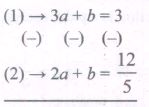
\(a=3-\frac { 12 }{ 5 } =\frac { 15-12 }{ 5 } =\frac { 3 }{ 5 } \)
Substituting a=\(\frac{3}{5}\) in(2) we get,
\(2(\frac { 3 }{ 5 } )+b=\frac { 12 }{ 5 } \Rightarrow \frac { 6 }{ 5 } +b=\frac { 12 }{ 5 } \)
\(\Rightarrow b=\frac { 12 }{ 5 } -\frac { 6 }{ 5 } =\frac { 6 }{ 5 } \)
\(\therefore a=\frac { 3 }{ 5 } ,b=\frac { 6 }{ 5 } \)
ii) \(E({ X }^{ 2 })=\int _{ 0 }^{ 1 }{ { x }^{ 2 }f(x)dx=\int _{ 0 }^{ 1 }{ { x }^{ 2 }\left( \frac { 3 }{ 5 } +\frac { 6 }{ 5 } { x }^{ 2 } \right) dx } } \)
\(\left[ \because a=\frac { 3 }{ 5 } ,b=\frac { 6 }{ 5 } \right] \)
\(=\int _{ 0 }^{ 1 }{ \left( \frac { 3 }{ 5 } { x }^{ 2 }+\frac { 6 }{ 5 } { x }^{ 4 } \right) dx } \)
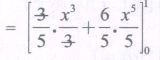
\(=\frac { 1 }{ 5 } (1-0)+\frac { 6 }{ 25 } (1-0)\)
\(=\frac { 1 }{ 5 } +\frac { 6 }{ 25 } =\frac { 5+6 }{ 25 } =\frac { 11 }{ 25 } \)
\(\therefore\) Var (X) = E(X2)-[E(X)]2
\(=\frac { 11 }{ 25 } -{ \left( \frac { 3 }{ 5 } \right) }^{ 2 }\)
\(=\frac { 11 }{ 25 } -\frac { 9 }{ 25 } =\frac { 2 }{ 25 } \)
\(\therefore\) Var (X) =\(\frac{2}{25}\)
5.
Given probability distribution function is
∴ \(F(x)=\left\{\begin{array}{l} 0, \text { if } x<0 \\ \frac{x}{8}, \text { if } 0 \leq x<1 \\ \frac{1}{4}+\frac{x}{8}, \text { if } 1 \leq x<2 \\ \frac{3}{4}+\frac{x}{12}, \text { if } 2 \leq x<3 \\ 1, \text { for } 3 \leq x \end{array}\right.\)
a) i) P(1≤X≤2)
\(\int _{ 1 }^{ 2 }{ f(x)dx=\int _{ 1 }^{ 2 }{ \frac { 1 }{ 8 } } dx{ |\frac { 1 }{ 8 } x| }_{ 1 }^{ 2 } } \)
\(=\frac { 1 }{ 8 } (2-1)=\frac { 1 }{ 8 } (1)\)
ii) \(P(x=3)=0\quad if \ \int _{ 3 }^{ 3 }{ f(x)dx=0 } \)
b) X is not a discrete random variable since E is not a step function
6.
Given probability function is
\(p(x)=\left\{\begin{array}{l} \frac{1}{4}, \text { for } x=-2 \\ \frac{1}{4}, \text { for } x=0 \\ \frac{1}{2}, \text { for } x=10 \\ 0, \text { elsewhere } \end{array}\right.\)
| X=x | -2 | 0 | 10 |
| P(X=x) | \(\frac{1}{4}\) | \(\frac{1}{4}\) | \(\frac{1}{2}\) |
P(X≤0)=P(X=-2)+P(X=0)
=\(\frac{1}{4}\)+\(\frac{1}{4}\)=\(\frac{1}{2}\)
7.
We know that,
\(\int _{ -\infty }^{ \infty }{ f(x)dx=1 } \)
\(\int _{ -\infty }^{ \infty }{ { ke }^{ -|x| }dx=1 } \)
\(k\int _{ -\infty }^{ \infty }{ { ke }^{ -|x| }dx=1 } \)
\(2k\int _{ -\infty }^{ \infty }{ { e }^{ -|x| }dx=1 } \) (\(\because { x }^{ 2 }{ e }^{ -|x| }\) is an function)
\(2k\int _{ 0 }^{ \infty }{ { \left[ \frac { { e }^{ -x } }{ -1 } \right] }_{ 0 }^{ \infty } } =1\)
\(k=\frac { 1 }{ 2 } \)
Mean of the random variable is
\(E(X)=\int _{ -\infty }^{ \infty }{ xf(x)dx } \)
\(E(X)=\int _{ -\infty }^{ \infty }{ xk{ e }^{ -|x| }dx } \) (\(\because { xe }^{ -|x| }\) is an odd function of x)
\(=\frac { 1 }{ 2 } \int _{ -\infty }^{ \infty }{ { xe }^{ -|x| } } \)
= 0
\(E\left( { x }^{ 2 } \right) =\int _{ -\infty }^{ \infty }{ { x }^{ 2 } } f(x)dx\)
\(=\int _{ -\infty }^{ \infty }{ { x }^{ 2 } } { ke }^{ -|x| }dx\)
\(=\frac { 1 }{ 2 } \int _{ -\infty }^{ \infty }{ { x }^{ 2 } } { e }^{ -|x| }dx\)
\(=\int _{ 0 }^{ \infty }{ { x }^{ 2 } } { e }^{ -x }\) (\(\because { x }^{ 2 }{ e }^{ -|x| }\) is an even function)
\(=\Gamma 3\left( \because \Gamma \left( \alpha \right) =\int _{ 0 }^{ \infty }{ { x }^{ \alpha -1 } } { e }^{ -x }dx,\alpha >0;\Gamma n=(n-1)! \right) \)
= 2
\(V(X)=E\left( { x }^{ 2 } \right) -{ \left[ E(X) \right] }^{ 2 }\)
\(=2-{ \left[ 0 \right] }^{ 2 }\)
= 2
8.
We know that, the expected random variable
\(E(X)=\int _{ -\infty }^{ \infty }{ xf(x) } dx\)
\(=\int _{ 100 }^{ \infty }{ { xe }^{ -\frac { x }{ 100 } }dx } \)
\(=\left\{ { \left[ x\left( \frac { { e }^{ \frac { x }{ 100 } } }{ -\frac { 1 }{ 100 } } \right) \right] }_{ 100 }^{ \infty }-\int _{ 100 }^{ \infty }{ \left( \frac { { e }^{ \frac { x }{ 100 } } }{ -\frac { 1 }{ 100 } } \right) dx } \right\} (\because \int { udv=uv-\int { vdu } } )\)
\(=\left[ \left( 10000 \right) \left( { e }^{ -1 } \right) +\left( 10000 \right) \left( { e }^{ -1 } \right) \right] \)
\(=\left[ \left( 10000 \right) \left( 0.3679 \right) +\left( 10000 \right) (0.3679) \right] \)
= 7358 hours
Therefore, the mean life of a radio tube is 7,358 hours.
9.
From the given data, you first calculate the probability distribution of the random variable. Then using it you calculate mean and variance.
X p(x)
1 F(1) = \(\frac{1}{6}\)
2 F(2)-F(1) = \(\frac{2}{6}\)-\(\frac{1}{6}\) = \(\frac{1}{6}\)
3 F(3)-F(2) = \(\frac{3}{6}\)-\(\frac{2}{6}\) = \(\frac{1}{6}\)
4 F(4)-F(3) = \(\frac{4}{6}\)-\(\frac{3}{6}\) = \(\frac{1}{6}\)
5 F(5)-F(4) = \(\frac{5}{6}\)-\(\frac{4}{6}\) = \(\frac{1}{6}\)
6 F(6)-F(5) = 1-\(\frac{5}{6}\) = \(\frac{1}{6}\)
The probability mass function is
| X = x | 1 | 2 | 3 | 4 | 5 | 6 |
| P(x) | \(\frac{1}{6}\) | \(\frac{1}{6}\) | \(\frac{1}{6}\) | \(\frac{1}{6}\) | \(\frac{1}{6}\) | \(\frac{1}{6}\) |
Mean of the random variable X = E(X)\(\sum _{ x }^{ }{ x } { P }_{ X }(x)\)
\(=\left( 1\times \frac { 1 }{ 6 } \right) +\left( 2\times \frac { 1 }{ 6 } \right) +\left( 3\times \frac { 1 }{ 6 } \right) +\left( 4\times \frac { 1 }{ 6 } \right) +\left( 5\times \frac { 1 }{ 6 } \right) +\left( 6\times \frac { 1 }{ 6 } \right) \)
\(=\frac { 1 }{ 6 } (1+2+3+4+5+6)\)
= 7/2
\(E({ X }^{ 2 })=\sum _{ x }^{ }{ { x }^{ 2 } } { P }_{ X }(x)\)
\(=\left( { 1 }^{ 2 }\times \frac { 1 }{ 6 } \right) +\left( { 2 }^{ 2 }\times \frac { 1 }{ 6 } \right) +\left( { 3 }^{ 2 }\times \frac { 1 }{ 6 } \right) +\left( { 4 }^{ 2 }\times \frac { 1 }{ 6 } \right) +\left( { 5 }^{ 2 }\times \frac { 1 }{ 6 } \right) +\left( { 6 }^{ 2 }\times \frac { 1 }{ 6 } \right) \)
\(=\frac { 1 }{ 6 } ({ 1 }^{ 2 }+{ 2 }^{ 2 }+{ 3 }^{ 2 }+{ 4 }^{ 2 }+{ 5 }^{ 2 }+{ 6 }^{ 2 })\)
\(=\frac { 91 }{ 6 } \)
Variance of the Random Variable \(X=V(X)=E\left( { X }^{ 2 } \right) -{ [E(X)] }^{ 2 }\)
\(=\frac { 91 }{ 6 } -{ \left( \frac { 7 }{ 2 } \right) }^{ 2 }\)
\(=\frac { 35 }{ 12 } \)
10.
Mean of the random variableX = E(X) = \({ \sum_x { x{ P }_{ x }(x) } } \)
= (1 × 0.15) + (2 × 0.10) + (3 × 0.10) + (4 × 0.01) + (5 × 0.08) + (6 × 0.01) +(7 × 0.05) + (8 × 0.02) + (9 × 0.28) + (10 × 0.20)
E(X) = 6.18
E(X2) = \(\sum _{ x }^{ }{ { x }^{ 2 } } { P }_{ X }(x)\)
= (12 × 0.15) + (22 × 0.10) + (32 × 0.10) + (42 × 0.01) + (52 × 0.08) + (62 × 0.01) + (72 × 0.05) + (82 × 0.02) + (92 × 0.28) + (102 × 0.20).
= 50.38
Variance of the Random Variagble X = V(X) = E(X2)-[E(X)]2
=50.38-(6.56)2
= 12.19
Therefore, the mean and variance of the given discrete distribution are 6.18 and 12.19 respectively.
11.
Given probability distribution function
\(F(x)\begin{cases} 0,\quad \text{for}\quad x<0 \\ \frac { 1 }{ 2 } ,\quad \text{for}\quad 0\le x<1 \\ 0,\quad \text{for}\quad 1\le x<2\quad \\ \frac { 1 }{ 4 } ,\quad \text{for}\quad 2\le x<4 \\ 0,\quad \text{for}\quad x\ge 4 \end{cases}\)
a) The distribution function F(x) is continuous since it is a step function
We know f'(x) = f(x)
∴ Probability density function
\(F(x)\begin{cases} 0,\quad \text{for}\quad x\le 0 \\ \frac { 1 }{ 2 } ,\quad \text{for}\quad 0\le x<1 \\ 0,\quad \text{for}\quad 1\le x<2\quad \\ \frac { 1 }{ 4 } ,\quad \text{for}\quad 2\le x<4 \\ 0,\quad \text{for}\quad x\ge 4 \end{cases}...(1)\)
(b) (i) Probability that a person will have to wait more than 3 minutes is P(X > 3)
∴ P(X>3) = P(3≤X<4)+P(X≥4)
\(\frac{1}{4}+0=\frac{1}{4}\) [from (1)]
ii) Probability that a person will have to wait less than 3 minutes is P(X < 3)
∴ P(X<3) = P(X≤0)+P(0≤x≤1)+P(1≤x≤2)+P(2≤x≤3)
0 + \(\frac{1}{2}+0+\frac{1}{4}\)[from (1)]
∴ P(X<3) = \(\frac{3}{4}\)
= P(1≤X<2)+P(2≤X<3)
= 0 +\(\frac{1}{4}=\frac{1}{4}\) [from (1)]
12.
Given \( f(x)\begin{cases} { Ae }^{ -x/5 },\quad \text{for}\quad x\ge 0 \\ 0 \quad ,\quad \text{otherwise }\end{cases}\)
a) since f(x) is a p.d.f.,
\(\int _{ 0 }^{ \infty }{ { Ae }^{ \frac { -x }{ 5 } }dx=1\Rightarrow A.\frac { { \left[ { e }^{ \frac { -x }{ 5 } } \right] }_{ 0 }^{ \infty } }{ \frac { - }{ 5 } } =1 } \)
\(\Rightarrow -5A[{ e }^{ -\infty }-{ e }^{ 0 }]=1\)
\(\Rightarrow -5A[0-1]=1\quad [\because { e }^{ -\infty }=0\quad and\quad { e }^{ 0 }=1]\)
\(\Rightarrow 5A=1\Rightarrow A=\frac { 1 }{ 5 } \)
\(\therefore A=\frac { 1 }{ 5 } \)
b) i) Probability that the person will talk over the phone more than 10 minutes is P(X >10)
∴ P(X>10) =\(\\ \int _{ 10 }^{ \infty }{ \frac { 1 }{ 5 } { e }^{ \frac { -x }{ 5 } }dx } [\because A=\frac { 1 }{ 5 } ]\)
\(={ \frac { 1 }{ 5 } \left[ \frac { { e }^{ \frac { -x }{ 5 } } }{ \frac { -1 }{ 5 } } \right] }_{ 10 }^{ \infty }\)
\(=-\left[ { e }^{ -\infty }-{ e }^{ \frac { -10 }{ 5 } } \right] =-\left[ 0-{ e }^{ -2 } \right] \)
\(={ e }^{ -2 }=\frac { 1 }{ { e }^{ 2 } } \left[ \because { e }^{ -\infty }=0 \right] \)
ii) Probability that the person will take over the phone less that 5 minutes is P(X < 5)
\(\therefore P(X<5)=\int _{ 0 }^{ 5 }{ { e }^{ \frac { -x }{ 5 } }dx } [\because A=\frac { 1 }{ 5 } ]\)
\(=\frac { 1 }{ 5 } { \left[ \frac { { e }^{ \frac { -x }{ 4 } } }{ \frac { -1 }{ 5 } } \right] }_{ 0 }^{ 5 }=-{ e }^{ \frac { -5 }{ 5 } }{ -e }^{ 0 }\)
\(=-\left( { e }^{ -1 }-1 \right) \left[ \because { e }^{ 0 }=1 \right] \)
\(=1-{ e }^{ -1 }-\frac { 1 }{ e } =\frac { e-1 }{ e } \)
\(\therefore P(X<5)=\frac { e-1 }{ e } \)
iii) The probability that the person will take over the phone between 5 and 10 minutes is P(5 < X < 10)
\(=-\left[ { e }^{ \frac { -10 }{ 5 } }-{ e }^{ \frac { -5 }{ 5 } } \right] \)
\(=-\left[ { e }^{ -2 }-{ e }^{ -1 } \right] \)
\(={ e }^{ -1 }-{ e }^{ -2 }=\frac { 1 }{ e } -\frac { 1 }{ { e }^{ 2 } } \)
13.
We have F(x) = f(x) ≥ 0, where F(x) is the distribution function and f(x) is the probability density function.
Here F(x) = 0 for x ≤ 1 f(x) = 0 for x ≤ 1
Again F(x) = 1 for x > 3
f(x) = d/dx (1) = 0 for x > 3
In 1 < x ≤ 3, F(x) = k(x – 1)4
f(x) = d/dx (k(x – 1)4) = 4k(x – 1)3
\(\therefore f(x)=4k{ (x-1) }^{ 3 }for\quad 1\le x\le 3\)
i) Since f(x) is a probability density function,
\(\int _{ 1 }^{ 3 }{ f(x)dx=1 } \)
\(\Rightarrow \int _{ 1 }^{ 3 }{ { 4k(x-1) }^{ 3 }dx=1 } \)
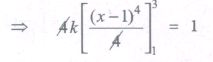
\(\Rightarrow k[{ (3-1) }^{ 4 }-{ (0) }^{ 4 }]=1\)
\(\Rightarrow k({ 2 }^{ 4 })=1\Rightarrow k(16)=1\)
\(\Rightarrow k=\frac { 1 }{ 16 } \)
ii) \(\therefore\)p.d.f
\(f(x)=\frac { 4\times 1 }{ 16 } { (x-1) }^{ 3 }for\quad 1\le x\le 3\)
\(f(x)=\frac { 1 }{ 4 } { (x-1) }^{ 3 }for\quad 1\le x\le 3\)
14.
Given p.d.f is
\(f(x)=\begin{cases} \begin{matrix} \frac { 1 }{ 16 } { (3+x) }^{ 2 }, & -3\le x\le -1 \end{matrix} \\ \begin{matrix} \frac { 1 }{ 16 } (6-2{ x }^{ 2 }), & -1\le x\le 1 \end{matrix} \\ \begin{matrix} \frac { 1 }{ 16 } { (3-x) }^{ 2 }, & 1\le x\le 3 \end{matrix} \end{cases}\)
Area under the given curve
\(\int _{ -3 }^{ 3 }{ f(c)dx=\int _{ -3 }^{ -1 }{ \frac { 1 }{ 16 } { (3+x) }^{ 2 }+\int _{ -1 }^{ 1 }{ \frac { 1 }{ 16 } (6-2{ x }^{ 2 })dx } } +\int _{ 1 }^{ 3 }{ \frac { 1 }{ 16 } { (3-x) }^{ 2 }dx } } \)
\(=\frac { 1 }{ 16 } { \left[ \frac { (3+x{ ) }^{ 3 } }{ 3 } \right] }_{ -3 }^{ -1 }+\frac { 1 }{ 16 } { \left( 6x-\frac { { 2x }^{ 3 } }{ 3 } \right) }_{ -1 }^{ 1 }+\frac { 1 }{ 16 } { \left( \frac { { (3-x) }^{ 3 } }{ -3 } \right) }_{ 1 }^{ 3 }\)
\(=\frac { 1 }{ 16 } \left[ \left( \frac { { 2 }^{ 3 } }{ 3 } -0 \right) +\left( 6-\frac { 2 }{ 3 } \right) -\left( -6+\frac { 2 }{ 3 } \right) -\frac { 1 }{ 3 } \left( 0-({ 2 }^{ 3 }) \right) \right] \)
\(=\frac { 1 }{ 6 } \left[ \frac { 8 }{ 3 } +\frac { 16 }{ 3 } -\left( \frac { -16 }{ 3 } \right) +\frac { 8 }{ 3 } \right] \)
\(\\ =\frac { 1 }{ 16 } \left[ \frac { 8 }{ 3 } +\frac { 16 }{ 3 } +\frac { 16 }{ 3 } +\frac { 8 }{ 3 } \right] \)
\(=\frac { 1 }{ 16 } \left[ \frac { 8+16+16+8 }{ 3 } \right] \)
\(=\frac { 1 }{ 16 } \times \frac { 48 }{ 3 } =\frac { 1 }{ 16 } \times 16=1\)
Hence, area under the given curve is unity.
15.
Given probability function is
| Value of X = x | 0 | 1 | 2 | 3 | 4 | 5 | 6 | 7 |
| P(x) | 0 | k | 2k | 2k | 3k | k2 | 2k2 | 7k2+k |
i) Since the given function is a probability function, each ρi>0 and Σρi=1
⇒ 0+k+2k+2k+3k+k2+2k2+7k2+k = 1
⇒ 10k2+9k = 1
⇒10k2+9k-1 = 0
on factoring we get
(k+1)(10k-1) = 0
⇒k = -1 or k = \(\frac{1}{10}\)
k = -1 is not possible [each ρi>0]
we get k = \(\frac{1}{10}\)
ii) P(X<6) = P(X = 0)+P(X = 1)+P(X=2+P(X=3)+P(X=4)+P(X=5)
P(X<6) = 0 + k + 2k + 2k + 3k + k2
= 8k+k2
= \(8\left( \frac { 1 }{ 10 } \right) { \left( \frac { 1 }{ 10 } \right) }^{ 2 }\)
\(=\frac { 8 }{ 10 } +\frac { 1 }{ 100 } =\frac { 80+1 }{ 100 } =\frac { 81 }{ 100 } \)
\(\therefore P(X<6)=\frac { 81 }{ 100 } \)
Now P(X≥6) = P(X=6)+P(X=7)
= 2k2+7k2+k
= 9k2+k
\(=9{ \left( \frac { 1 }{ 10 } \right) }^{ 2 }+\frac { 1 }{ 10 } \)
\(=\frac { 9 }{ 100 } +\frac { 1 }{ 10 } =\frac { 9+10 }{ 100 } =\frac { 19 }{ 100 } \)
\(\therefore P(X\ge 6)=\frac { 19 }{ 100 } \)
And P(0X<5) = P(X = 1)+P(X = 2)+P(X = 3)+P(X = 4)
= k+2k+2k+3k
\(8k=8\left( \frac { 1 }{ 10 } \right) =\frac { 8 }{ 10 } \)
\( \therefore P(0\))
iii) Given P(X ≤ x) ≥ \(\frac{1}{2}\)
⇒P(X = 0)+P(X = 1)+P(X = 2)+P(X = 3)+P(X = 4)
= 0+k+2k+2k+3k
\(=8k=8\left( \frac { 1 }{ 10 } \right) =\frac { 8 }{ 10 } =\frac { 4 }{ 5 } >\frac { 1 }{ 2 } \)
\(\therefore P(X\le 4)\frac { 1 }{ 2 } \le x=4\)
∴ The minimum value of x is 4.
16.
(a) We know that
\(\int _{ -\infty }^{ \infty }{ f(x) } dx=1\)
\(\int _{ 0 }^{ 10 }{ Axdx } +\int _{ 10 }^{ 20 }{ A(20-x)dx=1 } \)
\(A\left\{ { \left[ \frac { { x }^{ 2 } }{ 2 } \right] }_{ 0 }^{ 10 }+{ \left[ 20x-\frac { { x }^{ 2 } }{ 2 } \right] }_{ 10 }^{ 20 } \right\} =1\)
A[(50-0)+(400-200)-(200-50)] = 1
\(A=\frac{1}{100}\)
(b) (i) The probability that the number of pounds of bread that will be sold tomorrow is more than 10 pounds is given by
\(P(10\le X\le 20)=\int _{ 10 }^{ 20 }{ \frac { 1 }{ 100 } (20-x) } dx\)
\(=\frac { 1 }{ 100 } { \left[ 20x-\frac { { x }^{ 2 } }{ 2 } \right] }_{ 10 }^{ 20 }\)
\(=\frac { 1 }{ 100 } [(400-200)-(200-50)]\)
= 0.5
(ii) The probability that the number of pounds of bread that will be sold tomorrow is less than 10 pounds, is given by
\(P(0\le X\le 20)=\int _{ 0 }^{ 10 }{ \frac { 1 }{ 100 } } xdx\)
\(=\frac { 1 }{ 100 } { \left[ \frac { { x }^{ 2 } }{ 2 } \right] }_{ 0 }^{ 10 }\)
\(=\frac { 1 }{ 100 } (50-0)\)
= 0.5
(ii) The probability that the number of pounds of bread that will be sold tomorrow is between 5 and 15 pounds is
\(P(5\le X \le15)=\int _{ 5 }^{ 10 }{ \frac { 1 }{ 100 } xdx } +\int _{ 10 }^{ 15 }{ \frac { 1 }{ 100 } (20-x)dx } \)
\(=\frac { 1 }{ 100 } { \left[ \frac { { x }^{ 2 } }{ 2 } \right] }_{ 5 }^{ 10 }+\frac { 1 }{ 100 } { \left[ 20x-\frac { { x }^{ 2 } }{ 2 } \right] }_{ 10 }^{ 15 }\)
= 0.75
17.
i) Since P[X\(\le\)a1] = P[X>a1]
\(P[X\le { a }_{ 1 }]=\frac { 1 }{ 2 } \)
\(i.e., \int _{ 0 }^{ { a }_{ 1 } }{ f(x)dx } =\frac { 1 }{ 2 } \)
\(i.e., \int _{ 0 }^{ { a }_{ 1 } }{ { 5x }^{ 4 } } dx=\frac { 1 }{ 2 } \)
\(5{ { \left[ \frac { { x }^{ 5 } }{ 5 } \right] } }_{ { 0 }_{ } }^{ a1 }=1/2\)
\({ a }_{ 1 }={ (0.5) }^{ \frac { 1 }{ 5 } }\)
ii) \(P[X>{ a }_{ 2 }]=0.05\)
\(\int _{ { a }_{ 2 } }^{ 1 }{ { f(x })dx=0.05 } \)
\(\int _{ { a }_{ 2 } }^{ 1 }{ { 5x }^{ 4 }dx=0.05 } \)
\(5{ { \left[ \frac { { x }^{ 5 } }{ 5 } \right] } }_{ { a }_{ 2 } }^{ 1 }=0.05\)
\({ a }_{ 2 }={ [0.95] }^{ \frac { 1 }{ 5 } }\)
18.
From the values of p(x) given in the probability distribution, we obtain
F(1) = P(x\(\le\)1) = P(1) = 0.10
F(2) = P(x\(\le\)2) = P(1) + P(2)
= 0.10+0.12 = 0.22
F(3) = P(x\(\le\)3) = P(1)+P(2)+P(3)
= F(2)+P(3)
= 0.22+0.20
= 0.42
F(4) = F(3)+P(4)
= 0.42+0.30
= 0.72
F(5) = F(4)+P(5)
= 0.72+0.15
= 0.87
F(6) = F(5)+P(6)
= 0.87+0.08
= 0.95
F(7) = F(6)+P(7)
= 0.95+0.05
= 1.00
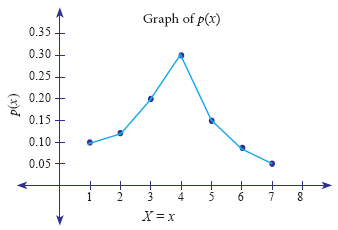
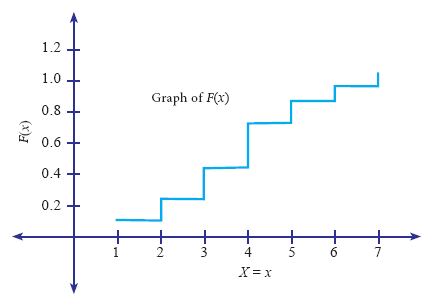
\(F(x) \text { is } F_{x}(x)= \begin{cases}0, & \text { if } x<1 \\ 0.10, & \text { if } x \leq 1 \\ 0.22, & \text { if } x \leq 2 \\ 0.42, & \text { if } x \leq 3 \\ 0.72, & \text { if } x \leq 4 \\ 0.87, & \text { if } x \leq 5 \\ 0.95, & \text { if } x \leq 6 \\ 1, & \text { if } x \leq 7\end{cases}\)
19.
\(\sum _{ i=1 }^{ \infty }{ p({ x }_{ i }) } =1\)
\(\therefore\) \(\sum _{ i=0 }^{ 7 }{ p({ x }_{ i }) } =1\)
0+a+2a+2a+3a+a2+2a2+7a2+a = 1
10a2+9a–1 = 0
(10a–1)(a+1) = 0
a = \(\frac{1}{10}\)and -1
Since p(x) cannot be negative, a = – 1 is not applicable. Hence, a = \(\frac{1}{10}\)
ii) P(X<3) = P(X = 0)+P(X=1)+P(X = 2)
= 0+a+2a
= 3a
\(\\ =\frac { 3 }{ 10 } \left( \because a=\frac { 1 }{ 10 } \right) \)
(iii) P(X>2) = 1-P(X\(\le\)2)
= 1-[P(X = 0)+P(X=1)+P(X=2)
= 1-\(\frac{3}{10}\)
= \(\frac{7}{10}\)
iv) P(2< x
= 2a+3a+a2
= 5a+a2
= \(\frac{5}{10}+\frac{1}{100}\)
\(=\frac{51}{100}\)

12th Standard Syllabus & Materials
12th Standard
TN 12th Computer Applications வலையமைப்பு வடமிடல் Sample Question Papers Study Material - QB365 Set A
NEW12th Standard
TN 12th Computer Applications களப்பெயர் முறைமை (DNS) Sample Question Papers Study Material - QB365 Set A
NEW12th Standard
TN 12th Computer Applications வலையமைப்பு எடுத்துக்காட்டுகள் மற்றும் நெறிமுறைகள் Sample Question Papers Study Material - QB365 Set A
NEW12th Standard
TN 12th Computer Applications கணினி வலையமைப்பு ஓர் அறிமுகம் Sample Question Papers Study Material - QB365 Set A



Tamilnadu Stateboard 12th Standard Subjects

Maths

Chemistry

Physics

Biology

Computer Science
Business Maths and Statistics

Economics

Commerce

Accountancy

History

Computer Applications
Biology
Computer Technology
Computer Applications
Computer Science
Business Maths and Statistics
Commerce
Economics
Maths
Chemistry
Physics
Computer Technology
History
Accountancy

Tamil

English

French
Tamilnadu Stateboard Standards
