
 100% FREE ACCESS
12th Standard Syllabus & Materials
12th Standard
TN 12th Computer Applications மின்னணு தரவு பரிமாற்றம் Sample Question Papers Study Material - QB365 Set A
NEW12th Standard
TN 12th Computer Applications மின் - வணிக பாதுகாப்பு அமைப்புகள் Sample Question Papers Study Material - QB365 Set A
NEW12th Standard
TN 12th Computer Applications மின்னணு செலுத்தல் முறைகள் Sample Question Papers Study Material - QB365 Set A
NEW12th Standard
TN 12th Computer Applications மின் - வணிகம் Sample Question Papers Study Material - QB365 Set A
NEW12th Standard
TN 12th Computer Applications திறந்த மூல கருத்துருக்கள் Sample Question Papers Study Material - QB365 Set A
NEW12th Standard
TN 12th Computer Applications வலையமைப்பு வடமிடல் Sample Question Papers Study Material - QB365 Set A

Published on: 01/09/2020
12th Standard Business Maths English Medium Sample 3 Mark Book Back Questions (New Syllabus) 2020
Download Tamil Nadu 12th Standard Business Maths and Statistics question papers, model tests, one-mark questions, important questions, and public exam papers in PDF format. Free study materials and answer keys for TN State Board students.
Questions + Answers key
Take MCQ Business Maths and Statistics Test
1.
Using graphic method, find the value of y when x = 48 from the following data:
| x | 40 | 50 | 60 | 70 |
| y | 6.2 | 7.2 | 9.1 | 12 |
2.
A farmer wants to decide which of the three crops he should plant on his 100-acre farm. The profit from each is dependent on the rainfall during the growing season. The farmer has categorized the amount of rainfall as high medium and low. His estimated profit for each is shown in the table.
| Rainfall | Estimated Conditional Profit(Rs.) | ||
| crop A | crop B | crop C | |
| High | 8000 | 3500 | 5000 |
| Medium | 4500 | 4500 | 5000 |
| Low | 2000 | 5000 | 4000 |
If the farmer wishes to plant only crop, decide which should be his best crop using
(i) Maximin
(ii) Minimax
3.
By constructing a difference table and using the second order differences as constant, find the sixth term of the series 8,12,19,29,42…
4.
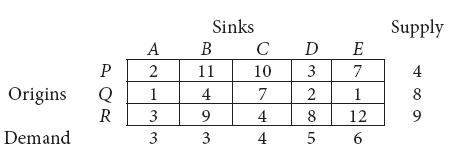
Determine basic feasible solution to the following transportation problem using North west Corner rule.
5.
Consider the following pay-off matrix
| Alternative | Pay – offs (Conditional events) | |||
| A1 | A2 | A3 | A4 | |
| E1 | 7 | 12 | 20 | 27 |
| E2 | 10 | 9 | 10 | 25 |
| E3 | 23 | 20 | 14 | 23 |
| E4 | 32 | 24 | 21 | 17 |
Using minmax principle, determine the best alternative.
6.
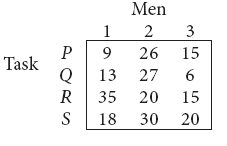
Solve the following assignment problem.
7.
Determine an initial basic feasible solution to the following transportation problem using North West corner rule.
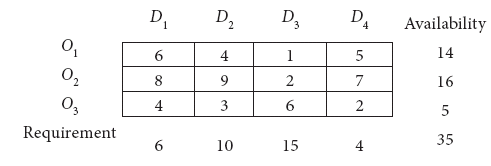
Here Oi and Dj represent ith origin and jth destination.
8.
(D2−2D−15)y = 0 given that \(\frac{dy}{dx}\)= 0 and \(\frac{d^2 y}{dx^2}\) = 2 when x = 0
9.
Using three yearly moving averages, Determine the trend values from the following data.
| Year | Profit | Year | Profit |
| 2001 | 142 | 2007 | 241 |
| 2002 | 148 | 2008 | 263 |
| 2003 | 154 | 2009 | 280 |
| 2004 | 146 | 2010 | 302 |
| 2005 | 157 | 2011 | 326 |
| 2006 | 202 | 2012 | 353 |
10.
Find the differential equation of the family of curves y = ex (acos x + bsin x) where a and b are arbitrary constants.
11.
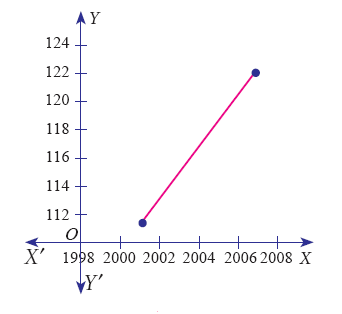
Fit a trend line by the method of semi-averages for the given data.
| Year | 2000 | 2001 | 2002 | 2003 | 2004 | 2005 | 2006 |
| Production | 105 | 115 | 120 | 100 | 110 | 125 | 135 |
12.
Evaluate the following integrals:
ഽ(x +1)2 log x dx
13.
14.
Evaluate the following: f(x) = \(\begin{cases} cx, \\ 0, \end{cases}\begin{matrix} 0 < x < 1 \\ \text{otherwise} \end{matrix}\)
15.
The birth weight of babies is Normally distributed with mean 3,500 g and standard deviation 500 g. What is the probability that a baby is born that weighs less than 3,100 g?
16.
Consider five mice from the same litter, all suffering from Vitamin A deficiency. They are fed a certain dose of carrots. The positive reaction means recovery from the disease. Assume that the probability of recovery is 0.73. What is the probability that atleast 3 of the 5 mice recover.
17.
Evaluate \(\int _{ 0 }^{ 1 }{ [{ e }^{ a \log x }+{ e }^{ x \log a }] } dx\)
18.
Integrate the following with respect to x
\(\frac { 1 }{ { x }^{ 2 }-x-2 } \)
19.
What is the probability of guessing correctly atleast six of the ten answers in a TRUE/FALSE objective test?
20.
Integrate the following with respect to x.
\(\frac { { x }^{ e-1 }+{ e }^{ x-1 } }{ { x }^{ e }+{ e }^{ x } } \)
21.
A person tosses a coin and is to receive Rs. 4 for a head and is to pay Rs. 2 for a tail. Find the expectation and variance of his gains.
22.
If f (x) is defined by f(x)=ke-2x, 0\(\le\)x<\(\infty\) is a density function. Determine the constant k and also find mean.
23.
The demand and supply functions under perfect competition are pd = 1600 − x2 and ps = 2x2 + 400 respectively. Find the producer’s surplus.
24.
The marginal cost function of a product is given by \(\frac { dC }{ dx } \) = 100 −10x + 0.1x2 where x is the output. Obtain the total and the average cost function of the firm under the assumption, that its fixed cost is Rs. 500.
25.
A continuous random variable X has the following p.d.f f(x) = ax, 0\(\le\)x\(\le\)1
Determine the constant a and also find P\(\\ \left[ X\le \frac { 1 }{ 2 } \right] \)
26.
The marginal cost function MC = 2 + 5ex Find C if C (0)=100
27.
Integrate the following with respect to x.
x log x
28.
Integrate the following with respect to x.
\(\frac { { e }^{ 3x }+{ e }^{ 5x } }{ { e }^{ x }+{ e }^{ -x } } \)
29.
Evaluate \(\int { \frac { { 2x }^{ 2 }-14x+24 }{ x-3 } dx } \)
30.
Find the rank of the matrix A =\(\left( \begin{matrix} 4 & 5 & 2 \\ 3 & 2 & 1 \\ 4 & 4 & 8 \end{matrix}\begin{matrix} 2 \\ 6 \\ 0 \end{matrix} \right) \)
31.
A total of Rs. 8,600 was invested in two accounts. One account earned \(4\frac { 3 }{ 4 } %\)% annual interest and the other earned \(6\frac { 1 }{ 2 } %\)% annual interest. If the total interest for one year was Rs. 431.25, how much was invested in each account? (Use determinant method).
32.
Find the rank of the matrix A = \(\left( \begin{matrix} 1 & 1 & 1 \\ 3 & 4 & 5 \\ 2 & 3 & 4 \end{matrix}\begin{matrix} 1 \\ 2 \\ 0 \end{matrix} \right) \)
1.
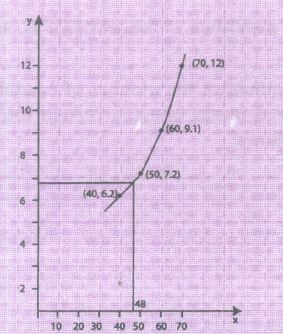
Scale:
In x axis 1 cm = 10 units
In y axis 1 cm = 2 units
Plot the points (40, 6.2), (50, 7.2), (60, 9.1) and (70, 12). At x = 48, draw a vertical line to the graph and from the intersecting point, draw a horizontal line to meet the y-axis
From the graph, we find that when x = 48, the value of Y is equal to 6.8.
2.
| Estimated Conditional Profit 0 | |||||
| Rainfall | High | Medium | Low | Minimum payoff | Maximum payoff |
| Crop A | 8000 | 4500 | 2000 | 2000 | 8000 |
| Crop B | 3500 | 4500 | 5000 | 3500 | 5000 |
| Crop C | 5000 | 5000 | 4000 | 4000 | 5000 |
(i) Max (2000,3500,4000) = 4000
∴ Crop C is the best according to maximin criteria
(ii) Min (8000,5000,5000) = 5000
∴ Crop B and C are best according to minimax criteria
3.
Let k be the sixth term of the series in the difference table.
First we find the forward differences
| x | y | ∆ | ∆2 |
| 1 | 8 | ||
| 4 | |||
| 2 | 12 | 3 | |
| 7 | |||
| 3 | 19 | 3 | |
| 10 | |||
| 4 | 29 | 3 | |
| 13 | |||
| 5 | 42 | k-55 | |
| k-42 | |||
| 6 | k |
Given that the second differences are constant
∴ k – 55 = 3
k = 58
∴ the sixth term of the series is 58
4.
First allocation :
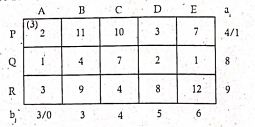
Second allocation :
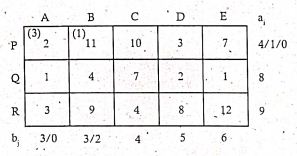
Third allocation :
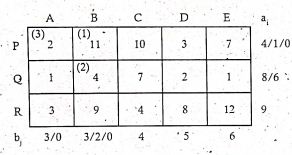
Fourth allocation :
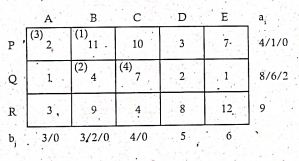
Fifth allocation :
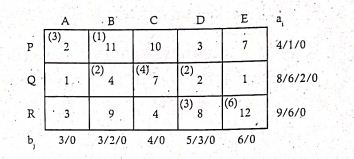
Sixth allocation :
\( =(3 \times 2)+(1 \times 11)+(2 \times 4)+(4 \times 7)+ (2 \times 2)+(3 \times 8)+(6 \times 12) \)
= 6 + 11 + 8 + 28 + 4 + 24 + 72 = Rs. 153
Total Cost = 153
5.
| Alternative | Pay – offs (Conditional events) | Minimum pay off | |||
| A1 | A2 | A3 | A4 | ||
| E1 | 7 | 12 | 20 | 27 | 27 |
| E2 | 10 | 9 | 10 | 25 | 25 |
| E3 | 23 | 20 | 14 | 23 | 23 |
| E4 | 32 | 24 | 21 | 17 | 32 |
min( 27, 25, 23, 32) = 23. Since the minimum cost is 23, the best alternative is E3 according to minimax principle.
6.
Since the number of columns is less than the number of rows, given assignment problem is unbalanced one. To balance it , introduce a dummy column with all the entries zero. The revised assignment problem is
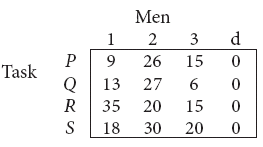
Here only 3 tasks can be assigned to 3 men.
Step 1: Its not necessary, since each row contains zero entry. Go to Step 2.
Step 2:
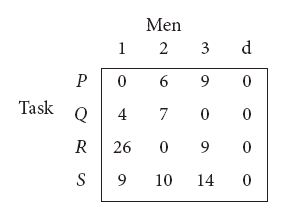
Step 3 (Assignment) :
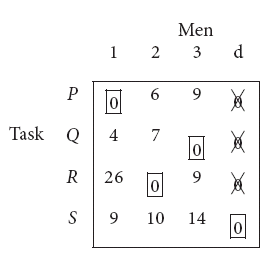
Since each row and each columncontains exactly one assignment,all the three men have been assigned a task. But task S is not assigned to any Man. The optimal assignment schedule and total cost is
| Task | Men | cost |
| P | 1 | 9 |
| Q | 3 | 6 |
| R | 2 | 20 |
| s | d | 0 |
| Total cost | 35 | |
The optimal assignment (minimum) cost = Rs. 35
7.
Given transportation table is
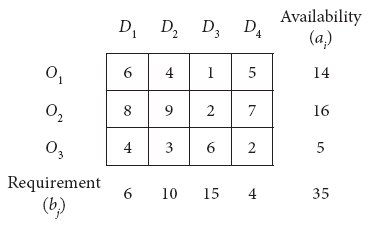
Total Availability = Total Requirement
Therefore the given problem is balanced transportation problem.
Hence there exists a feasible solution to the given problem.
First allocation :
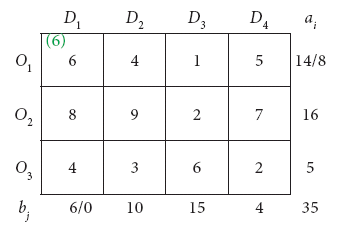
Second allocation :
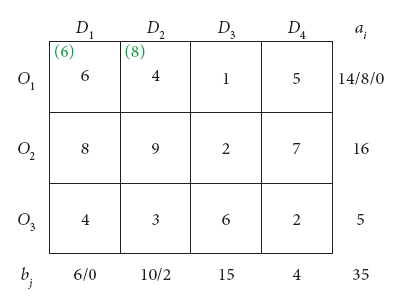
Third Allocation :
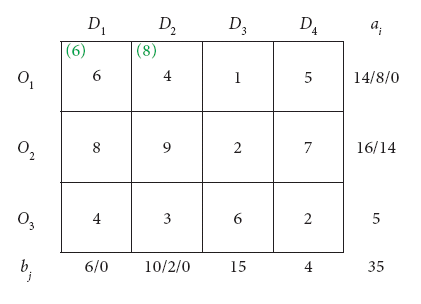
Fourth Allocation :
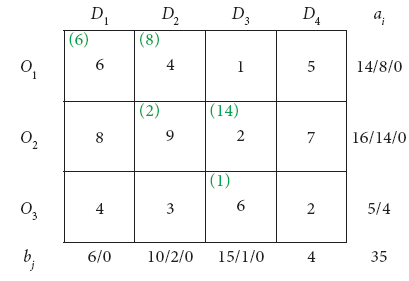
Fifth allocation :
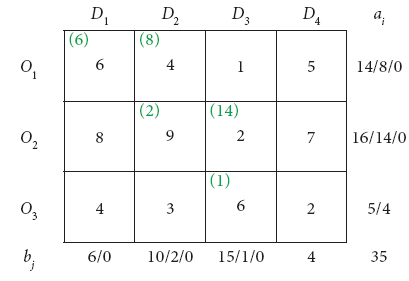
Final allocation :
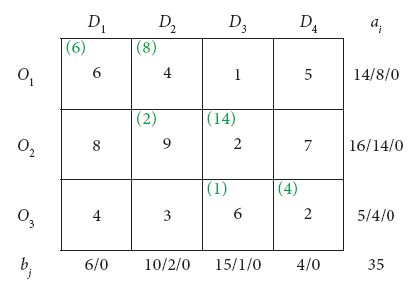
Transportation schedule : O1⟶D1, O1⟶D2, O2⟶D2, O2⟶D3, O3⟶D3,O3⟶D3.
The transportation cost
= (6\(\times\)6)+(8\(\times\)4)+(2\(\times\)9)+(14\(\times\)2)+(1\(\times\)6)+(4\(\times\)2)
= Rs.128
8.
The auxiliary equation is m2 - 2m -15 = 0
⇒ (m - 5) (m + 3) = 0
⇒ m = 5,-3
∴ Complementary function CF is Ae-3x + Be5x
∴ The general solution is y = Ae-3x + Be5x...(1)
Given \(\frac { dy }{ dx } \) = 0 when x = 0
Differentiating (1) w.r.t 'x' we get,
\(\frac { dy }{ dx } \)=-3Ae-3x+5Be5x
0= -3Ae0 + 5Beo ⇒ 0 = -3A + 5B...(2)
[∵ e0= 1]
Differentiating again w.r.t 'x' we get,
\(\frac { { d }^{ 2 }y }{ dx^{ 2 } } \) = 9Ae-3x + 25Be5x
Also, it is given that \(\frac { { d }^{ 2 }y }{ dx^{ 2 } } \) = 2 when x = 0
∴ 2 = 9A + 25B .....(3)
(2) x 3 ⇒ 0=-9A +15B
(3) ⇒ \(\frac { 2=9A+25B }{ 2=40B } \)
⇒ B = \(\frac { 2 }{ 40 } =\frac { 1 }{ 20 } \)
From (2) ⇒ 0 = -A+\(\frac { 5 }{ 20 } \)
⇒ 3A=\(\frac { 1 }{ 4 } \Rightarrow A=\frac { 1 }{ 12 } \)
Substituting A = \(\frac { 1 }{ 12 } \), B = \(\frac { 1 }{ 20 } \) in (1) we get
y=\(\frac { 1 }{ 12 } e^{ -3x }+\frac { 1 }{ 20 } \)e5x.
9.
| Year | Profit | 3-year moving total | 3-year moving trend |
| 2001 | 142 | - | - |
| 2002 | 148 | 444 | 148 |
| 2003 | 154 | 448 | 149.33 |
| 2004 | 146 | 457 | 152.33 |
| 2005 | 157 | 505 | 168.33 |
| 2006 | 202 | 600 | 200.00 |
| 2007 | 241 | 706 | 235.33 |
| 2008 | 263 | 784 | 261.33 |
| 2009 | 280 | 845 | 281.67 |
| 2010 | 302 | 908 | 302.67 |
| 2011 | 326 | 981 | 327 |
| 2012 | 353 | - | - |
10.
y = ex (acos x + bsin x) (1)
Differentiating (1) w.r.t x, we get
\(\frac { dy }{ dx } \) = ex (acos x + bsin x)+ ex (−a sin x + b cos x)
= y + ex (−asin x + bcos x) (from (1))
⇒ \(\frac { dy }{ dx } \) - y = ex (−a sin x + bcos x) (2)
Again differentiating, we get
\(\frac { { d }^{ 2 }y }{ { dx }^{ 2 } } -\frac { dy }{ dx } \) = ex (−a sin x + b cos x) + ex (−a cos x − b sin x)
\(\frac { { d }^{ 2 }y }{ { dx }^{ 2 } } -\frac { dy }{ dx } \)= ex (−a sin x + bcos x) − ex (a cos x + b sin x)
\(\frac { { d }^{ 2 }y }{ { dx }^{ 2 } } -\frac { dy }{ dx } \) = \(\left( \frac { dy }{ dx } -y \right) -y\) (from (1) and (2))
⇒\(\frac { { d }^{ 2 }y }{ { dx }^{ 2 } } -\frac { dy }{ dx } \)+2y = 0, which is the requited differential equation.
11.
Since the number of years is odd(seven), we will leave the middle year’s production value and obtain the averages of first three years and last three years.
| Year | Production | Average |
| 2000 | 105 | \(\frac{105+115+120}{3}=113.33\) |
| 2001 | 115 | |
| 2002 | 120 | |
| 2003 | 100(left out) | |
| 2004 | 110 | \(\frac{110+125+135}{3}=123.33\) |
| 2005 | 125 | |
| 2006 | 135 |
12.
Let I = ഽ(x +1)2 log x dx
Let u = logx dv = (x+1)2dx
\(du=\cfrac { 1 }{ x } dx\quad v=\cfrac { \left( x+1 \right) ^{ 3 } }{ 3 } \)
\(\therefore\) Using integration by parts,
\(I=\int { udv } =uv-\int { vdu } \)
\(I=\int { \left( x+1 \right) ^{ 2 }\log xdx } \)
= \(\cfrac { (x+1)^{ 3 } }{ 3 } \log x-\int { \cfrac { \left( x+1 \right) ^{ 3 } }{ 3 } .\cfrac { 1 }{ x } dx } \)
= \(\cfrac { \left( x+1 \right) ^{ 3 } }{ 3 } \log x-\cfrac { 1 }{ 3 } \int { \cfrac { { x }^{ 3 }+{ 3x }^{ 2 }+3x+1 }{ x } } \)
= \(\cfrac { \left( x+1 \right) ^{ 3 } }{ 3 } \log x-\cfrac { 1 }{ 3 } \int { \left( { x }^{ 2 }+3x+3+\cfrac { 1 }{ x } \right) dx } \)
= \(\cfrac { \left( x+1 \right) ^{ 3 } }{ 3 } \log x-\cfrac { 1 }{ 3 } \left[ \cfrac { { x }^{ 3 } }{ 3 } +\cfrac { { 3x }^{ 2 } }{ 2 } +3x+\log|x| \right] +c\)
= \(\left[ \left( x+1 \right) ^{ 3 }\log x-\cfrac { { x }^{ 3 } }{ 3 } -\cfrac { { 3x }^{ 2 } }{ 2 } -3x-log|x| \right] +c\)
13.
14.
Given \(\begin{cases} cx, \\ 0, \end{cases}\begin{matrix} 0 < x < 1 \\ \text{otherwise} \end{matrix}\)
Also, Given \(\int _{ 0 }^{ 1 }{ f\left( x \right) } dx=2\)
\(\Rightarrow \int _{ 0 }^{ 1 }{ cx } dx=2\)
\(\Rightarrow c{ \left[ \frac { { x }^{ 2 } }{ 2 } \right] }_{ 0 }^{ 1 }=2\)
\(\Rightarrow \frac { c }{ 2 } \left[ { 1 }^{ 2 }-{ 0 }^{ 2 } \right] =2\)
\(\Rightarrow \frac { c }{ 2 } \left( 1-0 \right) =2\)
\(\Rightarrow \frac { c }{ 2 } =2\)
⇒ c = 2
15.
Given μ = 3500, σ = 500
P(X<3100)
When X = 3100,
Z = \(\frac { X-\mu }{ \sigma } =\frac { 3100-3500 }{ 500 } \)
= -0.8
∴ P(X<3100) = P(Z<-0.8)
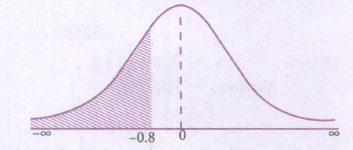
= 0.5-0.2881= 0.2119
Hence, the probability that a baby is born with weight less than 3100g is 0.2119.
16.
Let p be the probability of mice recovering from vitamin A deficiency
Given p = 0.73 ⇒ q = 1 - 0.73 = 0.27 and n = 5
∴ P (atleast 3 mice recover) = P(X ≥ 3)
P(X≥3) = 1-P(X<3)
= 1 - [P(X = 0) + P(X = 1) + P (X = 2)]
= 1-[5C0 (0.73)0 (0.27)5 + 5C1 (0.73)1 (0.27)4 + 5C2 (0.73)2 (0.27)3 ]
= 1-[(0.27)5 + 5(0.73)(0.27)4 + \(\frac { 5\times 4 }{ 2\times 1 } \)+(0.73)2 (0.27)3 ]
= 1 - [0.00143 + 0.01939 + 0.10489]
= 1 - 0.1257
P(X≥3) = 0.8743
17.
\(\int _{ 0 }^{ 1 }{ [{ e }^{ a \log x }+{ e }^{ x \log a }] } dx=\int _{ 0 }^{ 1 }{ ({ x }^{ a }+{ a }^{ x }) } dx\)
\(={ \left[ \frac { { x }^{ a+1 } }{ a+1 } +\frac { { a }^{ x } }{ \log a } \right] }_{ 0 }^{ 1 }\)
\(=\left( \frac { 1 }{ a+1 } +\frac { a }{ \log a } \right) -\left( 0+\frac { 1 }{ \log a } \right) \)
\(=\frac { 1 }{ a+1 } +\frac { a }{ \log a } -\frac { 1 }{ \log a } \)
\(=\frac { 1 }{ a+1 } +\frac { (a-1) }{ \log a } \)
18.
\(\int { \frac { dx }{ { x }^{ 2 }-x-2 } } \)
\(=\int { \frac { dx }{ { x }^{ 2 }-x+\frac { 1 }{ 4 } -\frac { 1 }{ 4 } -2 } } \)
Adding and subtracting
\(\frac { 1 }{ 2 } { \left[\text{ co-effective of x }\right] }^{ 2 }\)
\(={ \left[ \frac { 1 }{ 2 } (-1) \right] }^{ 2 }=\frac { 1 }{ 4 } \)
\(=\int { \frac { dx }{ { \left( { x }^{ 2 }-\frac { 1 }{ 2 } \right) }^{ 2 }-\frac { 9 }{ 4 } } } \)
\(=\int { \frac { dx }{ { \left( x-\frac { 1 }{ 2 } \right) }^{ 2 }-{ \left( \frac { 3 }{ 2 } \right) }^{ 2 } } } \)
\(\left[ \because \int { \frac { dx }{ { x }^{ 2 }-{ a }^{ 2 } } =\frac { 1 }{ 2a } \log { \left| \frac { x-a }{ x+a } \right| } +c } \right] \)
\(=\frac { 1 }{ 2\left( \frac { 3 }{ 2 } \right) } \log { \left| \frac { x-\frac { 1 }{ 2 } -\frac { 3 }{ 2 } }{ x-\frac { 1 }{ 2 } +\frac { 3 }{ 2 } } \right| } +c\)
\(=\frac { 1 }{ 3 } \log { \left| \frac { x-2 }{ x+1 } \right| } +c\)
19.
Probability p of guessing an answer correctly is p = \(\frac{1}{2}\)
⇒ q = \(\frac{1}{2}\)
Probability of guessing correctly x answers in 10 questions
\(P(X=x)=p(x)^{ n }{ C }_{ x }{ q }^{ n-x }=10Cx\left( \frac { 1 }{ 2 } \right) \left( \frac { 1 }{ 2 } \right) \)
The required probability P(X ≥ 6) = P(6) + P(7) + P(8) + P(9) + P(10)
\(={ \left( \frac { 1 }{ 2 } \right) }^{ 10 }\left[ { 10C }_{ 6 }+{ 10C }_{ 7 }+{ 10C }_{ 8 }+{ 10C }_{ 9 }+{ 10C }_{ 10 } \right] \)
\(=\left[ \frac { 1 }{ 1024 } \right] [210+120+45+10+1]\)
\(=\frac { 193 }{ 512 } \)
20.
\(Let\ I=\int { \frac { { x }^{ e-1 }+{ e }^{ x-1 } }{ { x }^{ e }+{ e }^{ x } } } dx\)
\(put\ t={ x }^{ e }+{ e }^{ x }\)
\(\Rightarrow dt=\left( e{ x }^{ e-1 }+{ e }^{ x } \right) dx\)
\(dt=e\left( { x }^{ e-1 }+{ e }^{ x-1 } \right) dx\)
\(\Rightarrow \frac { dt }{ e } =\left( { x }^{ e-1 }+{ e }^{ x-1 } \right) dx\)
\(\therefore I=\int { \frac { dt }{ e(t) } } =\frac { 1 }{ e } \int { \frac { dt }{ t } } \)
\(=\frac { 1 }{ e } \log { \left| t \right| } +c\)
\(=\frac { 1 }{ e } \log { \left| { x }^{ e }+{ e }^{ x } \right| } +c\quad \left[ \because t={ x }^{ e }+{ e }^{ x } \right] \)
21.
When a coin is tossed, sample space S = {H, T}
Since he is receiving Rs. 4 for a head and pays Rs. 2 for a tail,
∴ X take values 4 and -2.
∴ Probability for getting a head is \(\frac{1}{2}\) and probability for getting a tail is \(\frac{1}{2}\).
The probability mass function is
| X = x | 4 | -2 |
| P(X = x) | \(\frac{1}{2}\) | \(\frac{1}{2}\) |
∴ Expectation E(X) = Σxp(x)
= 4(\(\frac{1}{2}\)) - 2(\(\frac{1}{2}\))
= 2-1 = 1
∴ His expectation is Rs. 1
E(x2) = ∑x2p(x)
= 42(\(\frac{1}{2}\)) + (-2)2(\(\frac{1}{2}\))
= 16(\(\frac{1}{2}\)) + 4(\(\frac{1}{2}\))
= 8 + 2 = 10
Variance (X) = E(X2)-[E(X)]2
= 10-12 = 9
∴ Variance of his gains Rs. 9
22.
We know that
\(\int _{ -\infty }^{ \infty }{ f(x)dx=1 } \),since f(x) is a density function
\(\int _{ 0 }^{ \infty }{ { ke }^{ -2x } } dx=1\)
\(k\int _{ 0 }^{ \infty }{ { ke }^{ -2x } } dx=1\)
\(k{ \left[ \frac { { e }^{ -2x } }{ -2 } \right] }_{ 0 }^{ \infty }=1\)
⇒ k = 2
\(E(X)=\int _{ -\infty }^{ \infty }{ xf(x)dx } \)
\(=\int _{ 0 }^{ \infty }{ x{ e }^{ -2x } } dx\)
\(=2\int _{ 0 }^{ \infty }{ { xe }^{ -2x }dx } \)
\(=2\left\{ { \left[ \frac { { xe }^{ -2x } }{ -2 } \right] }_{ 0 }^{ \infty }\int _{ 0 }^{ \infty }{ \frac { { e }^{ -2x } }{ -2 } dx } \right\} \)
\((\because \int { udv=uv-\int { udv } } )\)
\(=\int _{ 0 }^{ \infty }{ { e }^{ -2x }dx } \) \(=\frac { 1 }{ 2 } \)
23.
Given demand function Pd = 1600 - x2 and
Supply function Ps = 2x2 + 400
Under perfect competition pd = ps
⇒ 1600 - x2 = 2x2 + 400
⇒ 1600-400 = 2x2 + x2
⇒ 1200 = 3x2
\(\Rightarrow \frac { 1200 }{ 3 } ={ x }^{ 2 } \Rightarrow { x }^{ 2 }=400\)
\(\Rightarrow x=\pm \sqrt { 400 } =+20\quad or-20\)
Since x cannot be negative, x0 = 20
∴ p0 = 1600 - (20)2 = 1600 - 400
= 1200
∴ p0x0 = (1200) (20) = 24000
Producer's Surplus PS = Poxo -\(\int _{ 0 }^{ x }{ g(x)dx } \)
\(=24000-\int _{ 0 }^{ 20 }{ ({ 2x }^{ 2 }+400)dx } \)
\(=24000-{ \left[ \frac { { 2x }^{ 3 } }{ 3 } +400x \right] }_{ 0 }^{ 20 }\)
\(=24000-\left[ \frac { { 2(20) }^{ 3 } }{ 3 } +400(20) \right] \)
\(=24000-\left[ \frac { 16000 }{ 3 } +8000 \right] \)
\(=24000-\left[ \frac { 16000+24000 }{ 3 } \right] \)
\(=24000-\left[ \frac { 40000 }{ 3 } \right] \)
\(=\frac { 72000-40000 }{ 3 } \)
PS = \( \frac{32000}{3}\)units
24.
Given marginal cost function
\(MC=\frac { dc }{ dx } =100-10x+0.1{ x }^{ 2 }\)
\(\Rightarrow C=\int { (100-10x+0.1{ x }^{ 2 })dx } \)
\(\Rightarrow C=100x-\frac { { 10x }^{ 2 } }{ 2 } +\frac { { 0.1x }^{ 3 } }{ 3 } +k\) ...(1)
Given fixed cost is Rs. 500 ⇒ k = 500
∴ (1) becomes,
\(C=100x-5{ x }^{ 2 }+\frac { { 0.1x }^{ 3 } }{ 3 } +500\)
Average cost function
\(AC=\frac { C }{ x } =\frac { 100x-{ 5x }^{ 2 }+\frac { { 0.1x }^{ 3 } }{ 3 } }{ x } +500\)
\(AC=100-5x+\frac { { 0.1x }^{ 2 } }{ 3 } +\frac { 500 }{ x } \)
25.
We know that
\(\int _{ -\infty }^{ \infty }{ f(x)dx=1 } \)
\(\int _{ 0 }^{ -\infty }{ ax\quad dx } \Rightarrow a\int _{ 0 }^{ 1 }{ xdx=1 } \)
\(\Rightarrow a{ \left( \frac { { x }^{ 2 } }{ 2 } \right) }^{ 1 }=1\)
\(\Rightarrow \frac { a }{ 2 } (1-0)=1\)
\(\Rightarrow\)a = 2
\(P\left[ x\le \frac { 1 }{ 2 } \right] =\int _{ -\infty }^{ \frac { 1 }{ 2 } }{ f(x)dx } \)
\(=\int _{ 0 }^{ \frac { 1 }{ 2 } }{ axdx } \)
\(=\int _{ 0 }^{ \frac { 1 }{ 2 } }{ 2xdx } \)
\(=\frac { 1 }{ 4 } \)
26.
Given MC = 2 + 5ex
\(C=\int { MC } dx+k\)
\(=\int { (2+5{ e }^{ x })dx } +k\)
= 2x + 5ex + k
x = 0 ⇒ C = 100,
100 = 2(0)+ 5(e0 )+ k
k = 95
C = 2x + 5 ex + 95.
27.
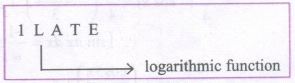
Let I = ∫ x logx dx
Let u = log x; dv = x dx
\(du=\frac { 1 }{ x } dx;v=\frac { { x }^{ 2 } }{ 2 } \)
Using integration by parts,
∫ udv = uv - ∫ vdu
\(\Rightarrow \int { x\ \log\ x\ dx=\log x\left( \frac { { x }^{ 2 } }{ 2 } \right) } -\int { \frac { { x }^{ 2 } }{ 2 } } \frac { 1 }{ x } dx\)
\(=\frac { { x }^{ 2 } }{ 2 } \log x\frac { 1 }{ 2 } \int { x } dx\)
\(=\frac { { x }^{ 2 } }{ 2 } \log x-\frac { 1 }{ 2 } \frac { { x }^{ 2 } }{ 2 } +c\)
\(=\frac { { x }^{ 2 } }{ 2 } \log x-\frac { { x }^{ 2 } }{ 4 } +c\)
\(=\frac { { x }^{ 2 } }{ 2 } \left( \log\ x-\frac { 1 }{ 2 } \right) +c\)
28.
\(\int { \frac { { e }^{ 3x }+{ e }^{ 5x } }{ { e }^{ x }+{ e }^{ -x } } } dx\)
\(=\int { \left( \frac { { e }^{ 3x }+{ e }^{ 5x } }{ { e }^{ x }+\frac { 1 }{ { e }^{ x } } } \right) } dx\quad =\quad \int { \frac { { e }^{ 3x }+{ e }^{ 5x } }{ \frac { { e }^{ 2x }+1 }{ { e }^{ x } } } } dx\)
\(=\int { \frac { { e }^{ x }\left( { e }^{ 3x }+{ e }^{ 5x } \right) }{ { e }^{ 2x }+1 } } dx\)
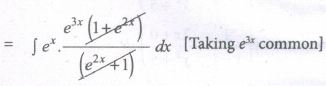
\(=\int { { e }^{ 4x } } dx=\frac { { e }^{ 4x } }{ 4 } +c\)
29.
By factorisation,
2x2 −14x + 24 = (x − 3)(2x − 8)
\(\int { \frac { { 2x }^{ 2 }-14x+24 }{ x-3 } dx } =\int { \frac { \left( x-3 \right) \left( 2x-8 \right) }{ x-3 } } dx\)
\(=\int { \left( 2x-8 \right) } dx\)
\(={ x }^{ 2 }-8x+c\)
30.
Given A =\(\left( \begin{matrix} 4 & 5 & 2 \\ 3 & 2 & 1 \\ 4 & 4 & 8 \end{matrix}\begin{matrix} 2 \\ 6 \\ 0 \end{matrix} \right) \)
\(\left( \begin{matrix} 4 & 5 & 2 \\ 3 & 2 & 1 \\ 1 & 1 & 2 \end{matrix}\begin{matrix} 2 \\ 6 \\ 0 \end{matrix} \right) { R }_{ 3 }\rightarrow { R }_{ 3 }\div 4\)
\(\left( \begin{matrix} 1 & 1 & 2 \\ 3 & 2 & 1 \\ 4 & 5 & 2 \end{matrix}\begin{matrix} 0 \\ 6 \\ 2 \end{matrix} \right) { R }_{ 1 }\leftrightarrow { R }_{ 3 }\)
\(\left( \begin{matrix} 1 & 1 & 2 \\ 0 & -1 & -5 \\ 0 & 1 & -6 \end{matrix}\begin{matrix} 0 \\ 6 \\ 2 \end{matrix} \right) \)\({ R }_{ 2 }\rightarrow { R }_{ 2 }-3{ R }_{ 1 }\)
\(\left( \begin{matrix} 1 & 1 & 2 \\ 0 & -1 & -5 \\ 0 & 1 & -6 \end{matrix}\begin{matrix} 0 \\ 6 \\ 2 \end{matrix} \right) \begin{matrix} { R }_{ 2 }\rightarrow { R }_{ 2 }-3{ R }_{ 1 } \\ { R }_{ 3 }\rightarrow { R }_{ 3 }-4{ R }_{ 1 } \end{matrix}\)
\(\left( \begin{matrix} 1 & 1 & 2 \\ 0 & -1 & -5 \\ 0 & 0 & -11 \end{matrix}\begin{matrix} 0 \\ 6 \\ 8 \end{matrix} \right) { R }_{ 3 }\rightarrow { R }_{ 3 }+{ R }_{ 2 }\)
The last equivalent matrix is in echelon form and there are 3 non-zero rows
\(\therefore \rho (A)=3\)
31.
Let the amount invested in the two accounts be Rs. x and Rs. y respectively
By the given data, x + y = 8600 ..(1)
\(4\cfrac { 3 }{ 4 } \times \cfrac { x }{ 100 } +6\cfrac { 1 }{ 2 } \times \cfrac { y }{ 100 } =431.25\) \(\left[ \therefore interest=\cfrac { PNR }{ 100 } \right] \)
\(\Rightarrow \cfrac { 19x }{ 400 } +\cfrac { 13y }{ 3200 } =431.25\)
\(\Rightarrow \cfrac { 19x+26y }{ 400 } =431.25\)
19x + 26y = 172500 ...(2)
\(\Delta =\left| \begin{matrix} 1 & 1 \\ 19 & 26 \end{matrix} \right| =1(26)-1(19)\)
= 26-19 =7
\({ \Delta }x=\left| \begin{matrix} 8600 & 1 \\ 172500 & 26 \end{matrix} \right| =8600(26)-1(172500)\)
= 223600 - 172500 = 51100
\(\Delta y=\left| \begin{matrix} 1 & 8600 \\ 19 & 172500 \end{matrix} \right| =1(172500)-19(8600)\)
= 172500 - 163400 = 9100
\(x=\cfrac { \Delta x }{ \Delta } -\cfrac { 51100 }{ 7 } =7300\)
\(y=\cfrac { \Delta y }{ \Delta } =\cfrac { 9100 }{ 7 } =1300\)
\(\therefore\) Investment in the interest of \(4\frac { 3 }{ 4 } \) % account is Rs. 7300 and investment in the rate of \(6\frac { 1 }{ 2 } \) account is Rs.1300.
32.
The order of A is 3 \(\times\) 4.
\(\therefore \) \(\rho (A)\le 3.\)
Let us transform the matrix A to an echelon form
| Matrix A | Elementary Transformation |
| \(A=\left( \begin{matrix} 1 & 1 & 1 \\ 3 & 4 & 5 \\ 2 & 3 & 4 \end{matrix}\begin{matrix} 1 \\ 2 \\ 0 \end{matrix} \right) \) \(\sim \left( \begin{matrix} 1 & 1 & 1 \\ 0 & 1 & 2 \\ 0 & 1 & 2 \end{matrix}\begin{matrix} 1 \\ -1 \\ -2 \end{matrix} \right) \) \(\sim \left( \begin{matrix} 1 & 1 & 1 \\ 0 & -1 & -2 \\ 0 & 0 & 0 \end{matrix}\begin{matrix} 1 \\ 1 \\ -1 \end{matrix} \right) \) |
\({ R }_{ 2 }\rightarrow { R }_{ 2 }-{ 3R }_{ 1 }\) \({ R }_{ 3 }\rightarrow { R }_{ 3 }-{ 2R }_{ 1 }\) \({ R }_{ 3 }\rightarrow { R }_{ 3 }-{ R }_{ 2 }\) |
The number of non zero rows is 3.
\(\therefore \) \(\rho (A)=3.\)

12th Standard Syllabus & Materials
12th Standard
TN 12th Computer Applications களப்பெயர் முறைமை (DNS) Sample Question Papers Study Material - QB365 Set A
NEW12th Standard
TN 12th Computer Applications வலையமைப்பு எடுத்துக்காட்டுகள் மற்றும் நெறிமுறைகள் Sample Question Papers Study Material - QB365 Set A
NEW12th Standard
TN 12th Computer Applications கணினி வலையமைப்பு ஓர் அறிமுகம் Sample Question Papers Study Material - QB365 Set A
NEW12th Standard
TN 12th Computer Applications PHP-உடன் MySQL-ஐ இணைத்தல் Sample Question Papers Study Material - QB365 Set A



Tamilnadu Stateboard 12th Standard Subjects

Maths

Chemistry

Physics

Biology

Computer Science
Business Maths and Statistics

Economics

Commerce

Accountancy

History

Computer Applications
Biology
Computer Technology
Computer Applications
Computer Science
Business Maths and Statistics
Commerce
Economics
Maths
Chemistry
Physics
Computer Technology
History
Accountancy

Tamil

English

French
Tamilnadu Stateboard Standards
