
 100% FREE ACCESS
12th Standard Syllabus & Materials
12th Standard
TN 12th Maths Applications of Matrices and Determinants Sample Question Papers Study Material - QB365 Set A
NEW12th Standard
TN 12th Computer Applications மின்னணு தரவு பரிமாற்றம் Sample Question Papers Study Material - QB365 Set A
NEW12th Standard
TN 12th Computer Applications மின் - வணிக பாதுகாப்பு அமைப்புகள் Sample Question Papers Study Material - QB365 Set A
NEW12th Standard
TN 12th Computer Applications மின்னணு செலுத்தல் முறைகள் Sample Question Papers Study Material - QB365 Set A
NEW12th Standard
TN 12th Computer Applications மின் - வணிகம் Sample Question Papers Study Material - QB365 Set A
NEW12th Standard
TN 12th Computer Applications திறந்த மூல கருத்துருக்கள் Sample Question Papers Study Material - QB365 Set A

Published on: 01/09/2020
12th Standard Business Maths English Medium Sample 3 Mark Creative Questions (New Syllabus) 2020
Download Tamil Nadu 12th Standard Business Maths and Statistics question papers, model tests, one-mark questions, important questions, and public exam papers in PDF format. Free study materials and answer keys for TN State Board students.
Questions + Answers key
Take MCQ Business Maths and Statistics Test
1.
Calculate the seasonal indices for the following data by the method of simple average.
| Year | Quarters | |||
| I | II | III | IV | |
| 1994 | 78 | 66 | 84 | 80 |
| 1995 | 76 | 74 | 82 | 78 |
| 1996 | 72 | 68 | 80 | 70 |
| 1997 | 74 | 70 | 84 | 74 |
| 1998 | 76 | 74 | 86 | 82 |
2.
The mean life time of 50 electric bulbs produced by a manufacturing company is estimated to be 825 hours with the S.D. of 110 hours. If II is the mean life time of all the bulbs produced by the company, test the hypothesis that μ = 900 hours at 5% level of significance.
3.
A die is thrown 120 times and getting 1 or 5 is considered a success. Find the mean and variance of the number of successes.
4.
A player tosses two unbiased coins. He wins Rs. 5 if two heads appear, Rs. 2 if one head appear and Rs.1 if no head appear. Find the expected amount to win.
5.
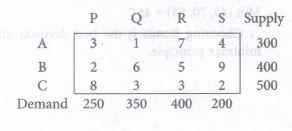
Determine an initial basic feasible solution to the following transportation problem using North West corner rule.
6.
Evaluate \(\int { \frac { cos2x-cos2\alpha }{ cosx-cos\alpha } } dx\)
7.
Solve: (x2-yx2)dy + (y2+xy2)dx = 0
8.
Find the number of men getting wages between Rs. 30 and Rs. 35 from the following table.
| Wages (x) | 20 - 30 | 30 - 40 | 40 - 50 | 50 - 60 |
| No. of men (y) | 9 | 30 | 35 | 42 |
9.
Find the area under the demand curve xy = 1 bounded by the ordinates x = 3, x = 9 and x-axis
10.
Show that the equations x + 2y = 3, y - z = 2, x + y + z = 1 are consistent and have infinite sets of solution.
1.
| Year | Quarters | |||
| I | II | III | IV | |
| 1994 | 78 | 66 | 84 | 80 |
| 1995 | 76 | 74 | 82 | 78 |
| 1996 | 72 | 68 | 80 | 70 |
| 1997 | 74 | 70 | 84 | 74 |
| 1998 | 76 | 74 | 86 | 82 |
| Total | 376 | 352 | 416 | 384 |
| Average | 75.2 | 70.4 | 83.2 | 76.8 |
Grand average = \(\frac {75.2+70.4+83.2+76.8}{4}\)
= \(\frac {305.6}{4}\) = 76.4
Seasonal index S.I = \(\frac {Quarterly average}{Grand average} \times 100\)
Hence, S.I for I quarter = \(\frac {75.2}{76.4} \times 100\) = 98.4
S.I for II quarter = \(\frac {70.4}{76.4} \times 100\) = 92.14
S.I for III quarter = \(\frac {83.2}{76.4} \times 100\) = 108.9
S.I for IV quarter = \(\frac {76.8}{76.4} \times 100\) = 100.5
2.
Given sample size n = 50
Sample mean \(\bar { x }\) = 825
Population mean μ = 900
Population S.D. σ = 110
Null hypotheses: H0: μ = 900
Alternative hypotheses: H1: μ ≠ 900
The test statistic, z = \(\frac { \bar { x } -\mu }{ \frac { \sigma }{ \sqrt { n } } } \)
=\(\frac { 825-900 }{ \frac { 110 }{ \sqrt { 50 } } } \) = -4.82
∴ |z| = -4.82
As the significance level is α = 0.05, \(Z_{ \frac { \alpha }{ 2 } }\) = 1.96
Here |z| > \(Z_{ \frac { \alpha }{ 2 } }\) as 4.82 > 1.96
Inference: As |z| > \(Z_{ \frac { \alpha }{ 2 } }\), H0 is rejected. Hence, we can conclude that mean life time of the population of electric bulbs cannot be taken as 900 hours.
3.
Given n = 20
P(getting 1 or 5) = \(\frac { 2 }{ 6 } \Rightarrow p=\frac { 1 }{ 3 } \)
∴ q = 1 - p = \(1-\frac { 1 }{ 3 } =\frac { 2 }{ 3 } \)
Using Binomial distribution,
Mean = np = 120 \(\times\) \(\frac { 1 }{ 3 } \) = 40
Variance = npq = 40 \(\times\) \(\frac { 2 }{ 3 } =\frac { 80 }{ 3 } \)
4.
When 2 coins are tossed, sample space S={HH, HT, TH, TT} ⇒ n(s) = 4
∴P(X = 5) = p(getting 2 heads) =\(\frac{1}{4}\)
P(X = 2) = p(getting 1 head) = \(\frac{2}{4}=\frac{1}{2}\)
P(X = 1) = p(getting no head) = \(\frac{1}{4}\)
Hence the probability distribution function is
| X | 1 | 2 | 5 |
| P(X=x) | \(\frac{1}{4}\) | \(\frac{1}{2}\) | \(\frac{1}{4}\) |
\(\therefore E(x)=\sum { { x }_{ i }{ p }_{ i }=1(\frac { 1 }{ 4 } ) } +2(\frac { 1 }{ 2 } )+5(\frac { 1 }{ 4 } )\)
\(=\frac { 1 }{ 4 } +1+\frac { 5 }{ 4 } =\frac { 1+4+5 }{ 4 } \)
\(=\frac { 10 }{ 4 } =2.50\)
Hence the expected money to win is Rs. 2.50
5.
Here total supply = 300 + 400 + 500 = 1200
Total demand = 250 + 350 + 400 + 200 =1200
∴ Total supply = total demand
The given problem is a balanced transportation problem.
Hence, there exists a feasible solution to the given problem
I-allocation:
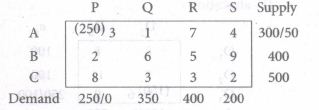
[∵ Min (250, 300) = 250]
II-allocation:
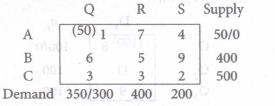
[∵ Min (50,350) = 50]
III-allocation:
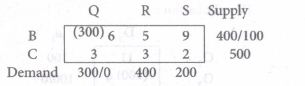
[∵ Min (300,400) = 300]
IV-allocation:
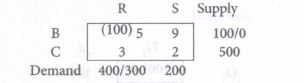
[∵ Min (400,100) = 100]
V-allocation:
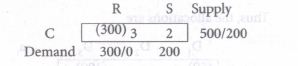
[∵ Min (300, 500) = 300]
VI-allocation:
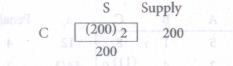
[∵ Min (200, 200) = 200]
Thus, the allocations are
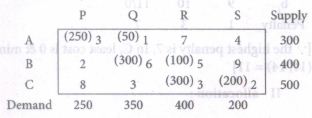
∴ The transportation schedule is
A → P, A → Q, B → Q, B → R, C → R, C → S
Hence, the total transportation cost is
= 250 (3) + 50 (1) + 300 (6) + 100 (5) + 300 (3) + 200 (2)
= 750 + 50 + 1800 + 500 + 900 + 400
= Rs. 4400
6.
\(\int { \frac { cos2x-cos2\alpha }{ cosx-cos\alpha } } dx\)
= \(\frac { ({ 2cos }^{ 2 }x-1)-({ 2cos }^{ 2 }\alpha -1) }{ cos\quad x-cos\alpha } dx\)
= \(\frac { { 2cos }^{ 2 }x-cos^{ 2 }\alpha }{ cos\quad x-cos\alpha } \)
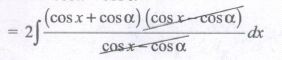
= \(2\int { (cos\quad x+cos\alpha )dx } \)
= \(2[sinx+cos\alpha .x]+c\)
= \(2sinx+2xcos\alpha +c\)
7.
Given (x2-yx2)dy + (y2+xy2)dx = 0
⇒ x2(1-y)dy+y2(1+x)dx = 0
⇒ x2(1-y)dy = -y2(1+x)dx
Separating the variables we get,
\(\frac { (1-y) }{ y^{ 2 } } dy=-\frac { (1+x) }{ x^{ 2 } } \)dx
⇒ \(\frac { 1 }{ { y }^{ 2 } } dy-\frac { 1 }{ y } dy=-\frac { 1 }{ x^{ 2 } } dx-\frac { 1 }{ x } dx\)
Integrating, \(\int { { y }^{ -2 } } dy-\int { \frac { 1 }{ y } } dy=-\int { \frac { 1 }{ x^{ 2 } } } dx-\int { \frac { 1 }{ x } } \)
\(-\frac { 1 }{ y } -logy=\frac { 1 }{ x } \) -log x + C
⇒ log x - log y = \(\frac { 1 }{ x } +\frac { 1 }{ y } \)+C
⇒ log \(log\left( \frac { x }{ y } \right) =\frac { x+y }{ xy } \)+C
⇒ \(\frac { x }{ y } =e^{ \frac { x+y }{ xy } +C }\)
⇒ \(\frac { x }{ y } =K.e^{ \frac { x+y }{ xy } }\) [where eC = K]
8.
Let us calculate the number of men whose wages is less than Rs. 35 by using Newton's forward interpolation formula
xo + nh = x ⇒ 30 + n (10) = 35
⇒ 10n = 35 - 30 = 5
⇒ n = \(\frac{5}{10}\) = 0.5
The difference table is
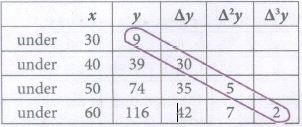
\(\Rightarrow { y }_{ o }+\frac { n }{ n! } \triangle { y }_{ o }+\frac { n(n+1) }{ 2! } { \triangle }^{ 2 }{ y }_{ o }+\frac { n(n+1)(n-2) }{ 3! } { \triangle }^{ 3 }{ (y }_{ o })\)
\(y(35)=9+\frac { 0.5 }{ 1! } (30)+\frac { (0.5)(0.5-1) }{ 2 } (5)+\frac { (0.5)(0.5-1)(0.5-2) }{ 6 } (2)\)
= 9 + 15 - 0.6 + 0.1 = 24 (approximately)
∴ Number of men getting wages between Rs. 30 and Rs. 35 is y(35) - y(30) = 24 - 9 = 15.
9.
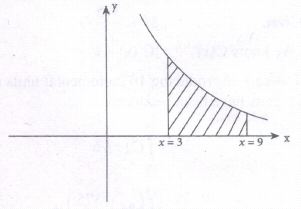
Area \(=\int _{ a }^{ b }{ ydx } \)
\(=\int _{ 3 }^{ 9 }{ \frac { 1 }{ x } dx } \)
\(={ [log\quad x] }_{ 3 }^{ 9 }\)
= log9-log3
\(=log\left( \frac { 9 }{ 3 } \right) \)
A = log 3 sq.units.
10.
Given non-homogeneous equations are
x + 2y = 3,y - z = 2,x + Y + z = 1
| Augmented matrix [A, B] |
Elementary Transformation |
|---|---|
| \(\left( \begin{matrix} 1 & 2 & 0 \\ 0 & 1 & -1 \\ 1 & 1 & 1 \end{matrix}\begin{matrix} 3 \\ 2 \\ 1 \end{matrix} \right) \) | |
| \(\sim \left( \begin{matrix} 1 & 2 & 0 \\ 0 & 1 & -1 \\ 0 & -1 & 1 \end{matrix}\begin{matrix} 3 \\ 2 \\ -2 \end{matrix} \right) \) | \({ R }_{ 3 }\rightarrow { R }_{ 3 }+{ R }_{ 2 }\) |
| \(\sim \left( \begin{matrix} 1 & 2 & 0 \\ 0 & 1 & -1 \\ 0 & 0 & 0 \end{matrix}\begin{matrix} 3 \\ 2 \\ 0 \end{matrix} \right) \) | \({ R }_{ 3 }\rightarrow { R }_{ 3 }+{ R }_{ 2 }\) |
Obviously,\(\rho (A)=2\) and \(\rho (A,B)\)
Hence \(\rho (A)=2\quad \rho\) (A, B) = 2
\(\therefore\) The system is consistent and has infinite number of solutions.

12th Standard Syllabus & Materials
12th Standard
TN 12th Computer Applications வலையமைப்பு வடமிடல் Sample Question Papers Study Material - QB365 Set A
NEW12th Standard
TN 12th Computer Applications களப்பெயர் முறைமை (DNS) Sample Question Papers Study Material - QB365 Set A
NEW12th Standard
TN 12th Computer Applications வலையமைப்பு எடுத்துக்காட்டுகள் மற்றும் நெறிமுறைகள் Sample Question Papers Study Material - QB365 Set A
NEW12th Standard
TN 12th Computer Applications கணினி வலையமைப்பு ஓர் அறிமுகம் Sample Question Papers Study Material - QB365 Set A



Tamilnadu Stateboard 12th Standard Subjects

Maths

Chemistry

Physics

Biology

Computer Science
Business Maths and Statistics

Economics

Commerce

Accountancy

History

Computer Applications
Biology
Computer Technology
Computer Applications
Computer Science
Business Maths and Statistics
Commerce
Economics
Maths
Chemistry
Physics
Computer Technology
History
Accountancy

Tamil

English

French
Tamilnadu Stateboard Standards
