
 100% FREE ACCESS
12th Standard Syllabus & Materials
12th Standard
TN 12th Computer Applications மின்னணு தரவு பரிமாற்றம் Sample Question Papers Study Material - QB365 Set A
NEW12th Standard
TN 12th Computer Applications மின் - வணிக பாதுகாப்பு அமைப்புகள் Sample Question Papers Study Material - QB365 Set A
NEW12th Standard
TN 12th Computer Applications மின்னணு செலுத்தல் முறைகள் Sample Question Papers Study Material - QB365 Set A
NEW12th Standard
TN 12th Computer Applications மின் - வணிகம் Sample Question Papers Study Material - QB365 Set A
NEW12th Standard
TN 12th Computer Applications திறந்த மூல கருத்துருக்கள் Sample Question Papers Study Material - QB365 Set A
NEW12th Standard
TN 12th Computer Applications வலையமைப்பு வடமிடல் Sample Question Papers Study Material - QB365 Set A

Published on: 30/09/2020
12th Standard Business Maths English Medium Sample 5 Mark Creative Questions (New Syllabus 2020)
Download Tamil Nadu 12th Standard Business Maths and Statistics question papers, model tests, one-mark questions, important questions, and public exam papers in PDF format. Free study materials and answer keys for TN State Board students.
Questions + Answers key
Take MCQ Business Maths and Statistics Test
1.
Calculate Fisher's ideal index from the following data and verify that it satisfies both time reversal and factor reversal test
| Commodity | Price | Quantity | ||
| 1985 | 1986 | 1985 | 1986 | |
| A | 8 | 20 | 50 | 60 |
| B | 2 | 6 | 15 | 10 |
| C | 1 | 2 | 20 | 25 |
| D | 2 | 5 | 10 | 8 |
| E | 1 | 5 | 40 | 30 |
2.
A sample poll of 100 voters chosen at random from all voters in a given district indicated that 55% of them were in favour of a particular candidate. Find
(a) 95% confidence limits
(b) 99% confidence limits for the proportion to all voters in favour of this candidate.
3.
The mean weight of 500 male students in a certain college is 151 pounds and the S.D is 15 pounds. Assuming the weights are normally distributed, find how many students weight
(i) between 120 and 155 pounds
(ii) more than 185 pounds.
4.
The probability distribution of the discrete random variables X and Y are given below
| X | 0 | 1 | 2 | 3 |
| P(X) | \(\frac{1}{5}\) | \(\frac{2}{5}\) | \(\frac{1}{5}\) | \(\frac{1}{5}\) |
| Y | 0 | 1 | 2 | 3 |
| P(Y) | \(\frac{1}{5}\) | \(\frac{3}{10}\) | \(\frac{2}{5}\) | \(\frac{1}{10}\) |
Prove that E(Y2) = 2E(X).
5.
Evaluate ഽ sin (log x) + cos (log x) dx
6.
The net profit p and quantity x satisfy the differential equation \(\frac { dp }{ dx } =\frac { 2{ p }^{ 3 }-{ x }^{ 3 } }{ 3x{ p }^{ 2 } } \). Find the relationship between the net profit and demand given that p = 20, when x = 10.
7.
From the data, find the number of students whose height is between 80 cm and 90 cm
| Height in cm (x) | 40-60 | 60-80 | 80 - 100 | 100-120 | 120-140 |
| No. of. students (y) | 250 | 120 | 100 | 70 | 50 |
8.
The marginal cost C' (x) and marginal revenue R' (x) are given by C' (x) = 20 +\(\frac{x}{20}\) and R' (x) = 30. The fixed cost is Rs.200. Determine the maximum profit.
9.
Using determinants, find the quadratic defined by f(x) = ax2 + bx + c if
f(1) = 0,
f(2) = - 2 and
f(3) = -6.
1.
| Commodity | 1985 | 1986 | ||
| p0 | q0 | p1 | q1 | |
| A | 8 | 50 | 20 | 60 |
| B | 2 | 15 | 6 | 10 |
| C | 1 | 20 | 2 | 25 |
| D | 2 | 10 | 5 | 8 |
| E | 1 | 40 | 5 | 30 |
| p1q0 | p0q0 | p1q1 | p0q1 |
| 1000 | 410 | 1200 | 480 |
| 90 | 30 | 60 | 20 |
| 40 | 20 | 50 | 25 |
| 50 | 20 | 40 | 16 |
| 200 | 40 | 150 | 30 |
| 1380 | 510 | 1500 | 571 |
Fisher's Ideal Index = \(\sqrt\frac{{\Sigma p_1q_0}\times{\Sigma p_1q_1}}{{\Sigma p_0q_0}\times{\Sigma p_0q_1}}\times100\)
\(= \sqrt\frac{1380\times1500}{510\times571}\times100\)
= 266.61
Time reversaltest:
\(P_{01}\times P_{10}=\sqrt\frac{{\Sigma p_1q_0}\times{\Sigma p_1q_1}\times{\Sigma p_0q_1}\times{\Sigma p_0q_0}}{{\Sigma p_0q_0}\times{\Sigma p_0q_1}\times{\Sigma p_1q_1}\times{\Sigma p_1q_0}}\)
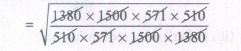
= \(\sqrt{1}=1\)
Hence, time reversal test is satisfied.
Factor reversaltest:
\(P_{01}\times Q_{01}=\sqrt\frac{{\Sigma p_1q_0}\times{\Sigma p_1q_1}\times{\Sigma q_1p_0}\times{\Sigma q_1p_1}}{{\Sigma p_0q_0}\times{\Sigma p_0q_1}\times{\Sigma q_0p_0}\times{\Sigma q_0p_1}}\)

\(P_{01}\times Q_{01}=\frac{{\Sigma p_1q_1}}{{\Sigma p_0q_0}}\)
Hence, Fisher's ideal index satisfies factor reversal test also.
2.
Given p = \(\frac { 55 }{ 100 } \)
∴ q = \(\frac { 45 }{ 100 } \) and n = 100
Standard error = \(\sqrt { \frac { pq }{ n } } =\sqrt { \frac { \frac { 55 }{ 100 } \times \frac { 45 }{ 100 } }{ 100 } } \)
= 0.0497
(a) As the level of significance α = 0.05 \(Z_{ \frac { \alpha }{ 2 } }\) = 1.96
∴ 95% confidence limits for proportion is given by \(p-Z_{ \frac { \alpha }{ 2 } }(S.E)\le p\ge p+Z_{ \frac { \alpha }{ 2 } }(S.E)\)
⇒ 0.55 - (1.96) (0.0497) ≤ p ≤ 0.55 + (1.96) (0.0497)
⇒ 0.453 ≤ p ≤ 0.647
∴ 95% confidence interval for proportion is (0.45, 0.65)
(b) As the level of significance is α = 0.01, \(Z_{ \frac { \alpha }{ 2 } }\) = 2.58
∴ 99% confidence limits for proportion is given by \(p-Z_{ \frac { \alpha }{ 2 } }(S.E)\le p\ge p+Z_{ \frac { \alpha }{ 2 } }(S.E)\)
⇒ 0.55 - (2.58) (0.0497) ≤ p ≤ 0.55 + (2.58) (0.0497)
⇒ 0.422 ≤ p ≤ 0.678
Hence, 99% confidence interval for proportion is (0.42, 0.68).
3.
Let X denotes the weight of the male students
Given μ = 151, σ = 15 and N = 500
(i) between 120 and 155 pounds
P(120 < X < 155)
When X = 120, Z = \(\frac { X-\mu }{ \sigma } \)
= \(\frac { 120-151 }{ 15 } \)
= \(\frac { -31 }{ 15 } \) = -2.067
When x = 155, Z = \(\frac { 155-151 }{ 15 } \)
= \(\frac { 4 }{ 15 } \) = 0.2667
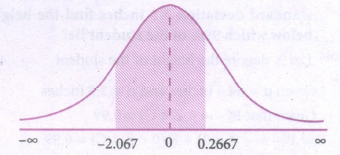
∴ P(120< X < 155) = P(-2.067 < X < 0.2667)
= P (-2.067 < Z < 0) + P (0 < Z < 0.2667)
= P (0 < Z < 2.067) + P (0 < Z < 0.2667)
(By symmetry)
= 0.4803 + 0.1026 = 0.5829
Probability for a student weigh between 120 and 155 pounds is 0.5829
∴ Out of 500 students, number of students weighing between 120 and 155 pounds
= 500 \(\times\) 0.5829 = 291 students
(ii) more than 185 pounds
P(X > 185)
When X = 185, Z = \(\frac { 185-151 }{ 15 } \)
=\(\frac { 34 }{ 15 } \) = 2.2667
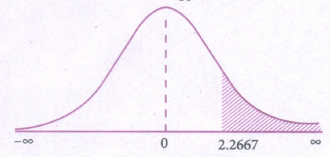
∴ P(X >185) = P (Z > 2.2667)
= P (2.2667 < Z < ∞)
= P(0 < Z < ∞) - (0 < Z < 2.2667)
= 0.5 - 0.4881
= 0.0119
i.e Probability for a student weighing above 185 is 0.0119
∴ out of 500 male students, number of students weighing more than 185 pounds.
= 500 \(\times\) 0.0119 = 6 students.
4.
\(E(X)=0\times \frac { 1 }{ 5 } +1(\frac { 2 }{ 5 } )+2\left( \frac { 1 }{ 5 } \right) +3\times \frac { 1 }{ 5 } \)
\(=\frac { 2 }{ 5 } +\frac { 2 }{ 5 } +\frac { 3 }{ 25 } =\frac { 7 }{ 5 } \)
\(\\ \therefore 2E(X)=\frac { 14 }{ 5 } ...(1)\)
\(E({ Y }^{ 2 })=0\times \frac { 1 }{ 5 } +{ 1 }^{ 2 }(\frac { 3 }{ 10 } )+{ 2 }^{ 2 }(\frac { 2 }{ 5 } )+{ 3 }^{ 2 }(\frac { 1 }{ 10 } )\)
\(=\frac { 3 }{ 10 } +\frac { 8 }{ 5 } +\frac { 9 }{ 10 } =\frac { 3+16+9 }{ 10 } \)
\(=\frac { 28 }{ 10 } =\frac { 14 }{ 5 } ..(2)\)
From (1) and (2), E(Y2) = 2 E(X).
5.
Let I = [sin (log x) + cos (log x)] dx
Put log x = t ⇒ x = et
⇒ dx = et. dt
I = ഽ(sin t + cos t). et dt
= ഽ et (sin t + cos t) dt
Let f(t) = sin t ⇒ f' (t) = cos t
I = ഽet (f (t) + f' (t)) dx
= et . f(t) +c
[∵ ഽ et [ (f (t) +f' (t) ] dt = et . f (t) +c]
= elog x. sin (log x) +c
= x sin (log x) +c [∵ elog x =x]
6.
Given \(\frac { dp }{ dx } =\frac { 2{ p }^{ 3 }-{ x }^{ 3 } }{ 3x{ p }^{ 2 } } \)
The numerator and denominator are homogeneous functions of 3,
∴ Put p=vx and \(\frac { dp }{ dx } =v+x\frac { dv }{ dx } \)
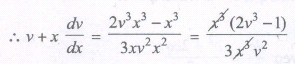
= \(\frac { 2{ v }^{ 3 }-1 }{ 3{ v }^{ 2 } } \)
⇒ \(\frac { dv }{ dx } =\frac { 2{ v }^{ 3 }-1 }{ 3{ v }^{ 2 } } -v=\frac { 2{ v }^{ 3 }-1-3{ v }^{ 3 } }{ 3{ v }^{ 2 } } \)
= \(\frac { -1-{ v }^{ 3 } }{ 3{ v }^{ 2 } } \)
⇒ \(\left( \frac { 3{ v }^{ 2 } }{ 1+{ v }^{ 3 } } \right) dv=-\frac { dx }{ x } \)
Integrating, \(\int { \frac { 3{ v }^{ 2 } }{ 1+{ v }^{ 3 } } } dv=-\int { \frac { dx }{ x } } \)
⇒ log(1+v3) = -log x + log c
⇒ 1+v3 = \(\frac { c }{ x } \)
Replacing v by \(\frac { p }{ x } \) we get
\(1+\frac { { p }^{ 3 } }{ { x }^{ 3 } } =\frac { c }{ x } \Rightarrow \frac { { x }^{ 3 }+{ p }^{ 3 } }{ { x }^{ 3 } } =\frac { c }{ x } \)
⇒ \(\frac { { x }^{ 3 }+{ p }^{ 3 } }{ { x }^{ 2 } } \)= c ⇒ x3+p3 = cx2...(1)
When x = 10, p = 20
⇒ 103 + 203 = c(10)2 ⇒ 1000 + 8000 = 100 c
⇒ 9000 = 100 c
⇒ c = 90
∴ (1) becomes,
x3+p3 = 90x2
⇒ p3 = 90x2-x3
⇒ p3 = x2(90-x) which is the required relationship.
7.
Let us calculate the number of students whose height is less than 90 ern using Newton's forward interpolation formula.
xo+ nh = x ⇒ 60 + n(20) = 90 ⇒ 20n = 30
⇒ n = \(\frac32\) = 1.5
\({ y }_{ x }={ y }_{ o }+\frac { n }{ n! } \triangle { y }_{ o }+\frac { n(n+1) }{ 2! } { \triangle }^{ 2 }{ y }_{ o }+\frac { n(n+1)(n-2) }{ 3! } { \triangle }^{ 3 }{ (y }_{ o })+.......\)
The difference table is as follows:
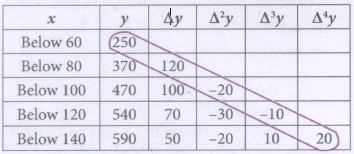
∴y(90) = 250 + (1.5)(120)\(\frac { (1.5)(1.5-1) }{ 2! } (20)+\frac { (1.5)(1.5-1)(1.5-2) }{ 3! } (-10)+\frac { (1.5)(1.5-1)(1.5-2)(1.56-3) }{ 4! } (20)\)
= 250 + 180 - 7.5 + 0.625 + 0.46875
= 423.59 = 424 (app)
ஃ Number of students whose height is between 80 cm and 90 cm is y(90) - y(80)
= 424 - 370
= 54.
8.
Given \(C'(x)=20+\frac { x }{ 20 } \)
\(\Rightarrow \int { C'(x)dx= } \int { \left( 20+\frac { x }{ 20 } \right) dx } \)
\(C(x)=20x+\frac { { x }^{ 2 } }{ 40 } +{ k }_{ 1 }\)
Given when x = 0, C = 200
⇒ k1 = 200
\(\therefore C(x)=20x+\frac { { x }^{ 2 } }{ 40 } +200\quad ---(1)\)
Also, R'(x) = 30
\(R(x)=\int { 30dx } +{ k }_{ 2 }=30x+{ k }_{ 2 }\)
When x = 0 R = 0 ⇒ K2 = 0
∴ R(x) = 30x ----(2)
Profit = Total revenue - total cost
\(=30x-20x-\frac { { x }^{ 2 } }{ 40 } -200\)
\(\therefore P=10x-\frac { { x }^{ 2 } }{ 40 } -200---(3)\)
\(\frac { dp }{ dx } =10-\frac { 2x }{ 40 } =10-\frac { x }{ 20 } \)
\(\frac { dp }{ dx } =0\)
\(\Rightarrow 10-\frac { x }{ 20 } =0\)
\(\Rightarrow 10=\frac { x }{ 20 } \Rightarrow x=200\)
\(\frac { d^{ 2 }p }{ { dx }^{ 2 } } =-\frac { 1 }{ 20 } <0\)
∴ Profit is maximum when x= 200
∴ maximum profit \(P=10(200)-\frac { { (200) }^{ 2 } }{ 40 } -200[From(3)]\)
P = 2000 -1000 - 200
2000 - 1200
P = Rs .800.
Hence, the maximum profit is Rs. 800.
9.
fix) = ax2 + bx + c
\(f(1)=0\Rightarrow a\left( 1 \right) ^{ 2 }+b(1)+c=0\Rightarrow a+b+c=0\) ...(1)
\(f(2)=-2\Rightarrow a\left( { 2 }^{ 2 } \right) +b(2)+c=-2\Rightarrow 4a+2b+c=2\)..(2)
\(f(3)-6\Rightarrow a(3^{ 2 })+b(3)+c=-6\Rightarrow 9a+3b+c=-6\)
Now \(\Delta =\left| \begin{matrix} 1 & 1 & 1 \\ 4 & 2 & 1 \\ 9 & 3 & 1 \end{matrix} \right| \)
= 1(2 - 3) - 1(4 - 9) + 1(12 - 18)
= \(-1+5-6=-2\neq 0\)
Since \(\Delta \neq 0\) Cramer's rule can be applied and the system has unique solution
\(\Delta a=\left| \begin{matrix} 0 & 1 & 1 \\ -2 & 2 & 1 \\ -6 & 3 & 1 \end{matrix} \right| \)
= 0-1(-2+6)+ 1(-6+ 12)
= -4 + 6 = 2
\(\Delta b=\left| \begin{matrix} 1 & 0 & 1 \\ 4 & -2 & 1 \\ 9 & -6 & 1 \end{matrix} \right| \)
= 1(-2+6)+0+1(-24+ 18)
= 4 - 6 = -2
\(\Delta c=\left| \begin{matrix} 1 & 1 & 0 \\ 4 & 2 & -2 \\ 9 & 3 & -6 \end{matrix} \right| \)
= 1 (-12 + 6) - 1( - 24 + 18) + 0
= -6 + 6 = 0
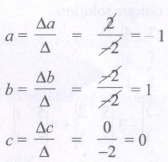
f(n) = (-1)x2 + 1(x) + 0
f(x) = x2+ x.

12th Standard Syllabus & Materials
12th Standard
TN 12th Computer Applications களப்பெயர் முறைமை (DNS) Sample Question Papers Study Material - QB365 Set A
NEW12th Standard
TN 12th Computer Applications வலையமைப்பு எடுத்துக்காட்டுகள் மற்றும் நெறிமுறைகள் Sample Question Papers Study Material - QB365 Set A
NEW12th Standard
TN 12th Computer Applications கணினி வலையமைப்பு ஓர் அறிமுகம் Sample Question Papers Study Material - QB365 Set A
NEW12th Standard
TN 12th Computer Applications PHP-உடன் MySQL-ஐ இணைத்தல் Sample Question Papers Study Material - QB365 Set A



Tamilnadu Stateboard 12th Standard Subjects

Maths

Chemistry

Physics

Biology

Computer Science
Business Maths and Statistics

Economics

Commerce

Accountancy

History

Computer Applications
Biology
Computer Technology
Computer Applications
Computer Science
Business Maths and Statistics
Commerce
Economics
Maths
Chemistry
Physics
Computer Technology
History
Accountancy

Tamil

English

French
Tamilnadu Stateboard Standards
