
 100% FREE ACCESS
12th Standard Syllabus & Materials
12th Standard
TN 12th Computer Applications மின்னணு தரவு பரிமாற்றம் Sample Question Papers Study Material - QB365 Set A
NEW12th Standard
TN 12th Computer Applications மின் - வணிக பாதுகாப்பு அமைப்புகள் Sample Question Papers Study Material - QB365 Set A
NEW12th Standard
TN 12th Computer Applications மின்னணு செலுத்தல் முறைகள் Sample Question Papers Study Material - QB365 Set A
NEW12th Standard
TN 12th Computer Applications மின் - வணிகம் Sample Question Papers Study Material - QB365 Set A
NEW12th Standard
TN 12th Computer Applications திறந்த மூல கருத்துருக்கள் Sample Question Papers Study Material - QB365 Set A
NEW12th Standard
TN 12th Computer Applications வலையமைப்பு வடமிடல் Sample Question Papers Study Material - QB365 Set A

Published on: 01/08/2019
Download Tamil Nadu 12th Standard Business Maths and Statistics question papers, model tests, one-mark questions, important questions, and public exam papers in PDF format. Free study materials and answer keys for TN State Board students.
Questions + Answers key
Take MCQ Business Maths and Statistics Test
1.
Determine the cost of producing 3000 units of commodity if the marginal cost in rupees per unit is C'(x) = \(\frac{x}{3000}+2.50\)
2.
Solve: 2x + 3y = 5, 6x + 5y = 11
3.
Find the revenue function and the demand function if the marginal revenue for x units is MR = 10 + 3x − x2.
4.
Integrate the following with respect to x.
\(\frac { { x }^{ 3 } }{ x+2 } \)
5.
Find the rank of the matrix \(\left( \begin{matrix} 0 & -1 & 5 \\ 2 & 4 & -6 \\ 1 & 1 & 5 \end{matrix} \right) \)
6.
Find the area of the region bounded by the parabola y2 = 4x and the line 2x - y = 4.
7.
The marginal revenue function (in thousand of rupees ) of a commodity is 10 + e−0.05x Where x is the number of units sold. Find the total revenue from the sale of 100 units (e−5 = 0.0067)
8.
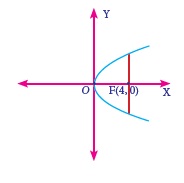
Using integration find the area of the region bounded between the line x = 4 and the parabola y2 = 16x.
9.
Solve by Cramer’s rule x + y + z = 4, 2x − y + 3z = 1, 3x + 2y − z = 1
10.
11.
If MR = 15 - 8x, then the revenue function is _________
15x - 4x2 + k
\(\frac{15}{x}-8\)
-8
15x - 8
12.
ഽ\(\sqrt { { e }^{ x } } \) dx is _______.
\(\sqrt { { e }^{ x } } +c\)
\(2\sqrt { { e }^{ x } } \) + c
\(\frac12\sqrt { { e }^{ x } } +c\)
\(\frac { 1 }{ 2\sqrt { { e }^{ x } } } +c\)
13.
The given demand and supply function are given by D(x) = 20 − 5x and S(x) = 4x + 8 if they are under perfect competition then the equilibrium demand is ________.
40
\(\frac{41}{2}\)
\(\frac{40}{3}\)
\(\frac{41}{5}\)
14.
If the number of variables in a non-homogeneous system AX = B is n, then the system possesses a unique solution only when _______.
\(\rho (A)=\rho (A,B)>n\)
\(\rho(A)=\rho(A, B)=n\)
\(\rho (A)=\rho (A,B) < n\)
none of these
15.
The rank of m x n matrix whose elements are unity is ________.
0
1
m
n
16.
Evaluate \(\int { \frac { 2+3cosx }{ { sin }^{ 2 }x } } dx\)
17.
Evaluate ഽ\(\frac { dx }{ { 4x }^{ 2 }-1 } \)
18.
Find the rank of the matrix A =\(\left( \begin{matrix} 1 & -3 \\ 9 & 1 \end{matrix}\begin{matrix} 4 & 7 \\ 2 & 0 \end{matrix} \right) \)
19.
\(\int _{ 0 }^{ 1 }{ { e }^{ -t } } dt\quad \)
20.
Amount of annuity after N payments
21.
ഽ(2 + 5ex) dx
22.
Cost function
23.
If \(\rho (A,B)\neq \rho (A)\) then the system is
1.
Given, marginal cost, C' (x) \(\frac{x}{3000}+2.50\)
\(\int { C'(x) } =\int { \left( \frac { x }{ 300 } +2.50 \right) dx } \)
\(C(x)=\frac { { x }^{ 2 } }{ 6000 } +2.50x+k\)
When x = 0, c = 0 ⇒ k = 0
∴ c(x) = \(\frac{x^2}{6000}+2.50x\)
When x = 3000
Cost of production
\(=\frac { { (3000) }^{ 2 } }{ 6000 } +2.50(3000)\)
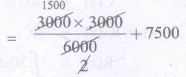
= 1500 + 7500
= Rs. 9000
2.
Given non-homogeneous equations are
2x + 3y = 5 6X + 5y = 11
\(\Delta =\left| \begin{matrix} 2 & 3 \\ 6 & 5 \end{matrix} \right| =10-18=-8\)
Since \(\Delta \neq 0\) Cramer's rule can be applied and the system is consistent with unique solution
\(\Delta x=\left| \begin{matrix} 5 & 3 \\ 11 & 5 \end{matrix} \right| =25-33=-8\)
\(\Delta y=\left| \begin{matrix} 2 & 5 \\ 6 & 11 \end{matrix} \right| =22-30=-8\)
\(\therefore x=\cfrac { \Delta x }{ \Delta } =\cfrac { -8 }{ -8 } =1\)
\(y=\cfrac { \Delta y }{ \Delta } =\cfrac { -8 }{ -8 } =1\)
\(\therefore \) Solution set is {1, 1}
3.
Given
\(MR=10+3x-{ x }^{ 2 }\)
\(\frac { dR }{ dx } =10+3x-{ x }^{ 2 }\)
\(\Rightarrow dR=(10+3x-{ x }^{ 2 })dx\)
\(\Rightarrow \int { dR } =\int { (10+3x-{ x }^{ 2 }) } dx\)
\(\Rightarrow R=10x+\frac { { 3x }^{ 2 } }{ 2 } -\frac { { x }^{ 3 } }{ 3 } +k\)
When x = 0, R = 0 ⇒ k = 0
\(\Rightarrow R=10x+\frac { { 3x }^{ 2 } }{ 2 } -\frac { { x }^{ 2 } }{ 3 } \)
Demand function\(P=\frac { R }{ x } =\frac { 10x+\frac { { 3x }^{ 2 } }{ 2 } -\frac { { x }^{ 3 } }{ 3 } }{ x } \)
P = 10 + \(\frac { { 3x }^{ 2 } }{ 2 } -\frac { { x }^{ 3 } }{ 3 } \)
4.
\(\int { \frac { { x }^{ 3 } }{ x+2 } } dx\)
\(=\int { \left( { x }^{ 2 }-2x+4-\frac { 8 }{ x+2 } \right) } dx\)
.JPG)
\(=\frac { { x }^{ 3 } }{ 3 } -{ x }^{ 2 }+4x-8\log\left| x+2 \right| +c\)
).JPG)
5.
Let A =\(\left( \begin{matrix} 0 & -1 & 5 \\ 2 & 4 & -6 \\ 1 & 1 & 5 \end{matrix} \right) \)
Order of A is 3 \(\times\) 3
∴ \(\rho \)(A)\(\le \)3
Consider the third order minor \(\left| \begin{matrix} 0 & -1 & 5 \\ 2 & 4 & -6 \\ 1 & 1 & 5 \end{matrix} \right| =6\neq 0\)
There is a minor of order 3, which is not zero
\(\therefore \rho (A)=3\)
6.
2x-y = 4
| x | 0 | 2 |
| y | -4 | 0 |
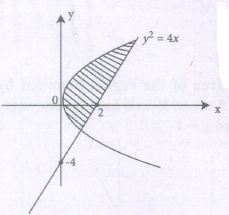
y2 = 4x and 2x = 4 + y ⇒ 4x = 8 + 2y
y2 = 8+2y ⇒ y2-2y-8 = 0
(y-4)(y+2) = 0
y = -2, 4.
Required area \(=\int _{ -2 }^{ 4 }{ ({ x }_{ 1 }-{ x }_{ 2 })dy } \)
\(=\int _{ -2 }^{ 4 }{ \left( \frac { y+4 }{ 2 } -\frac { { y }^{ 2 } }{ 4 } \right) dy } \)
Where x1 is the line x2 is the parabola
\(=\int _{ -2 }^{ 4 }{ \frac { y+4 }{ 2 } dy } -\frac { 1 }{ 4 } \int _{ -2 }^{ 4 }{ { y }^{ 2 }dy } \)
\(=\frac { 1 }{ 2 } { \left[ \frac { { y }^{ 2 } }{ 2 } +4y \right] }_{ -2 }^{ 4 }-\frac { 1 }{ 4 } { \left[ \frac { { y }^{ 3 } }{ 3 } \right] }_{ -2 }^{ 4 }\\ \)
\(=\frac { 1 }{ 2 } \left[ \left( \frac { 16 }{ 2 } +16 \right) -\left( \frac { 4 }{ 2 } -8 \right) \right] -\frac { 1 }{ 4 } \left[ \frac { 64 }{ 3 } +\frac { 8 }{ 3 } \right] \)
\(=\frac { 1 }{ 2 } \left[ 24+6 \right] -\frac { 1 }{ 4 } \left[ \frac { 64+8 }{ 3 } \right] \)
\(=\frac { 1 }{ 2 } (30)-\frac { 1 }{ 4 } \left( \frac { 72 }{ 3 } \right) \)
\(=15-\frac { 1 }{ 4 } (24)=15-6\)
= 9 sq.units.
7.
Given, Marginal revenue R'(x) = 10 + e−0.05x
Total revenue from sale of 100 units is
\(R=\int _{ 0 }^{ 100 }{ (10+{ e }^{ -0.05x }) } dx\)
= \({ \left[ 10x+\frac { { e }^{ -0.05x } }{ -0.05 } \right] }_{ 0 }^{ 100 }\)
= \(\left( 1000-\frac { { e }^{ 5 } }{ 0.05 } \right) -\left( 0-\frac { 100 }{ 5 } \right) \)
= 1000 + 20 − (20 × 0.0067)
= 1019.87
Total revenue = 1019.87 × 1000
= Rs. 10,19,870
8.
The equation y2 = 16x represents a parabola (Open rightward)
Required Area = 2\(\int _{ a }^{ b }{ y } dx\)
\(=2\int _{ 0 }^{ 4 }{ \sqrt { 16x } } \ dx\)
\(=8\int _{ 0 }^{ 4 }{ { x }^{ \frac { 1 }{ 2 } } } dx=8{ \left[ { \frac { { x }^{ { \frac { 3 }{ 2 } } } }{ \frac { 3 }{ 2 } } } \right] }_{ 0 }^{ 4 }=\frac { 16 }{ 3 } \left( { \left( 4 \right) }^{ \frac { 3 }{ 2 } } \right) =\frac { 128 }{ 3 } \) sq.units
9.
Here \(\triangle =\left| \begin{matrix} 1 & 1 & 1 \\ 2 & -1 & 3 \\ 3 & 2 & -1 \end{matrix} \right| =13\neq 0\)
\(\therefore \) We can apply Cramer’s Rule and the system is consistent and it has unique solution.
\({ \triangle }_{ x }=\left| \begin{matrix} 1 & 1 & 1 \\ 2 & -1 & 3 \\ 3 & 2 & -1 \end{matrix} \right| =-13\)
\( { \triangle }_{ y }=\left| \begin{matrix} 1 & 4 & 1 \\ 2 & 1 & 3 \\ 3 & 1 & -1 \end{matrix} \right| =39\)
\( { \triangle }_{ z }=\left| \begin{matrix} 1 & 1 & 4 \\ 2 & -1 & 1 \\ 3 & 2 & 1 \end{matrix} \right| =26\)
\(\therefore \) By Cramer’s rule
\(x=\frac { { \triangle }x }{ { \triangle } } =\frac { -13 }{ 13 } =-1\)
\( y=\frac { { \triangle }y }{ { \triangle } } =\frac { 39 }{ 13 } =3\)
\( z=\frac { { \triangle }z }{ { \triangle } } =\frac { 26 }{ 13 } =2\)
\(\therefore \) The solution is (x, y, z) = (−1, 3, 2)
10.
11.
(a)
15x - 4x2 + k
12.
(b)
\(2\sqrt { { e }^{ x } } \) + c
13.
(c)
\(\frac{40}{3}\)
14.
(b)
\(\rho(A)=\rho(A, B)=n\)
15.
(b)
1
16.
\(\int { \frac { 2+3cosx }{ { sin }^{ 2 }x } } dx\) = \(\int { \frac { 2 }{ { sin }^{ 2 }x } } dx\) + \(\int { \frac { 3cosx }{ { sin }^{ 2 }x } } dx\)
= 2 \(\int { \frac { 1 }{ { sin }^{ 2 }x } } dx\) + 3 \(\int { \frac { cosx }{ { sin }x } .\frac { 1 }{ sinx } } dx\)
= 2 ∫ cosec2 x dx + 3 ∫ cot x cosec x dx
= -2 cot x - 3 cosec x + c
17.
ഽ\(\frac { dx }{ { 4x }^{ 2 }-1 } \) = ഽ\(\frac { dx }{ 4\left( { x }^{ 2 }-\frac { 1 }{ 4 } \right) } \)
= \(\frac { 1 }{ 4 } \)ഽ\(\frac { dx }{ { x }^{ 2 }-{ \left( \frac { 1 }{ 2 } \right) }^{ 2 } } \)
= \(\frac { 1 }{ 4 } \left[ \frac { 1 }{ 2\left( \frac { 1 }{ 2 } \right) } \log\left| \frac { x-\frac { 1 }{ 2 } }{ x-\frac { 1 }{ 2 } } \right| \right] +c\)
= \(\frac { 1 }{ 4 } \log\left| \frac { 2x-1 }{ 2x+1 } \right| \) + c
18.
Given A =\(\left( \begin{matrix} 1 & -3 \\ 9 & 1 \end{matrix}\begin{matrix} 4 & 7 \\ 2 & 0 \end{matrix} \right) \)
\(\left( \begin{matrix} 1 & -3 \\ 0 & 28 \end{matrix}\begin{matrix} 4 & 0 \\ -34 & -63 \end{matrix} \right) { R }_{ 2 }\rightarrow { R }_{ 2 }-9{ R }_{ 1 }\)
\(-\left( \begin{matrix} 1 & -3 \\ 0 & 0 \end{matrix}\begin{matrix} 4 & 0 \\ \frac { 10 }{ 3 } & -63 \end{matrix} \right) { R }_{ 2 }\rightarrow { R }_{ 2 }+\frac { 28 }{ 3 } .{ R }_{ 1 }\)
The last equivalent matrix is in echelon form and there are 2 non-zero rows
\(\therefore \rho (A)=2\)
19.
proper definite integer
20.
\(\int _{ 0 }^{ N }{ { Pe }^{ rt }dt } \)
21.
2x + 5ex + k
22.
ഽmc dx+k
23.
inconsistent

12th Standard Syllabus & Materials
12th Standard
TN 12th Computer Applications களப்பெயர் முறைமை (DNS) Sample Question Papers Study Material - QB365 Set A
NEW12th Standard
TN 12th Computer Applications வலையமைப்பு எடுத்துக்காட்டுகள் மற்றும் நெறிமுறைகள் Sample Question Papers Study Material - QB365 Set A
NEW12th Standard
TN 12th Computer Applications கணினி வலையமைப்பு ஓர் அறிமுகம் Sample Question Papers Study Material - QB365 Set A
NEW12th Standard
TN 12th Computer Applications PHP-உடன் MySQL-ஐ இணைத்தல் Sample Question Papers Study Material - QB365 Set A



Tamilnadu Stateboard 12th Standard Subjects

Maths

Chemistry

Physics

Biology

Computer Science
Business Maths and Statistics

Economics

Commerce

Accountancy

History

Computer Applications
Biology
Computer Technology
Computer Applications
Computer Science
Business Maths and Statistics
Commerce
Economics
Maths
Chemistry
Physics
Computer Technology
History
Accountancy

Tamil

English

French
Tamilnadu Stateboard Standards
