
 100% FREE ACCESS
12th Standard Syllabus & Materials
12th Standard
TN 12th Maths Applications of Matrices and Determinants Sample Question Papers Study Material - QB365 Set A
NEW12th Standard
TN 12th Computer Applications மின்னணு தரவு பரிமாற்றம் Sample Question Papers Study Material - QB365 Set A
NEW12th Standard
TN 12th Computer Applications மின் - வணிக பாதுகாப்பு அமைப்புகள் Sample Question Papers Study Material - QB365 Set A
NEW12th Standard
TN 12th Computer Applications மின்னணு செலுத்தல் முறைகள் Sample Question Papers Study Material - QB365 Set A
NEW12th Standard
TN 12th Computer Applications மின் - வணிகம் Sample Question Papers Study Material - QB365 Set A
NEW12th Standard
TN 12th Computer Applications திறந்த மூல கருத்துருக்கள் Sample Question Papers Study Material - QB365 Set A

Published on: 19/10/2019
Operations Research
Download Tamil Nadu 12th Standard Business Maths and Statistics question papers, model tests, one-mark questions, important questions, and public exam papers in PDF format. Free study materials and answer keys for TN State Board students.
Questions + Answers key
Take MCQ Business Maths and Statistics Test
1.
Following pay-off matrix, which is the optimal decision under each of the following rule
(i) maxmin
(ii) minimax
| Act | States of nature | |||
| S1 | S2 | S3 | S4 | |
| A1 | 14 | 9 | 10 | 5 |
| A2 | 11 | 10 | 8 | 7 |
| A3 | 9 | 10 | 10 | 11 |
| A4 | 8 | 10 | 11 | 13 |
2.
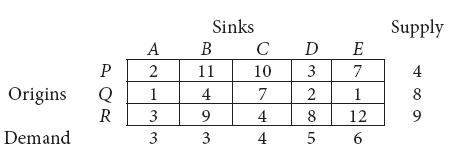
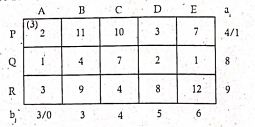
Determine basic feasible solution to the following transportation problem using North west Corner rule.
3.
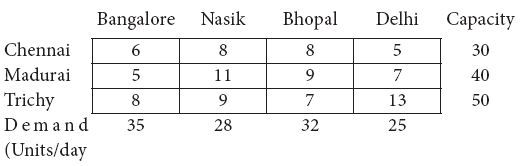
Determine an initial basic feasible solution of the following transportation problem by north west corner method
4.
Consider the following pay-off matrix
| Alternative | Pay – offs (Conditional events) | |||
| A1 | A2 | A3 | A4 | |
| E1 | 7 | 12 | 20 | 27 |
| E2 | 10 | 9 | 10 | 25 |
| E3 | 23 | 20 | 14 | 23 |
| E4 | 32 | 24 | 21 | 17 |
Using minmax principle, determine the best alternative.
5.
Consider the following pay-off (profit) matrix Action States
| Action | States | |||
| (s1) | (s2) | (s3) | (s4) | |
| A1 | 5 | 10 | 18 | 25 |
| A2 | 8 | 7 | 8 | 23 |
| A3 | 21 | 18 | 12 | 21 |
| A4 | 30 | 22 | 19 | 15 |
Determine best action using maximin principle.
6.
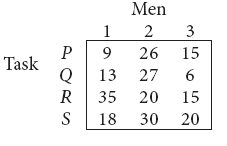
Solve the following assignment problem.
7.
Determine how much quantity should be stepped from factory to various destinations for the following transportation problem using the least cost method
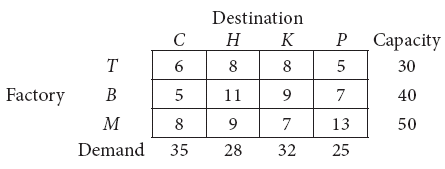
Cost are expressed in terms of rupees per unit shipped.
8.
Determine an initial basic feasible solution to the following transportation problem using North West corner rule.
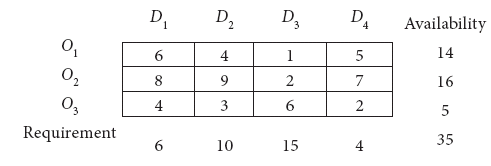
Here Oi and Dj represent ith origin and jth destination.
9.
What is the difference between Assignment Problem and Transportation Problem?
10.
What is the Assignment problem?
11.
What do you mean by balanced transportation problem?
12.
What is feasible solution and non degenerate solution in transportation problem?
13.
What is transportation problem?
14.
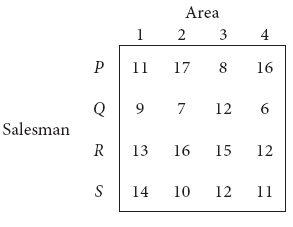
Find the optimal solution for the assignment problem with the following cost matrix.
15.
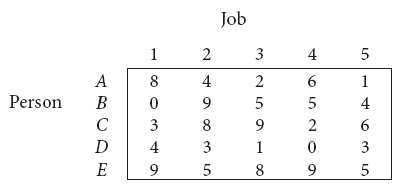
Consider the problem of assigning five jobs to five persons. The assignment costs are given as follows. Determine the optimum assignment schedule.
16.
A type of decision –making environment is _______.
certainty
uncertainty
risk
all of the above
17.
In an assignment problem involving four workers and three jobs, total number of assignments possible are _______.
4
3
7
12
18.
The purpose of a dummy row or column in an assignment problem is to _______.
prevent a solution from becoming degenerate
balance between total activities and total resources
provide a means of representing a dummy problem
none of the above
19.
If number of sources is not equal to number of destinations, the assignment problem is called______.
balanced
unsymmetric
symmetric
unbalanced
20.
21.
North-West Corner refers to ________.
top left corner
top right corner
bottom right corner
bottom left corner
22.
Number of basic allocation in any row or column in an assignment problem can be _______.
Exactly one
at least one
at most one
none of these
23.
The Penalty in VAM represents difference between the first ________.
Two largest costs
Largest and Smallest costs
Smallest two costs
None of these
24.
In a non – degenerate solution number of allocations is _______.
Equal to m+n–1
Equal to m+n+1
Not equal to m+n–1
Not equal to m+n+1
25.
1.
| Act | States of Nature | Minimum payoff | Maximum payoff | |||
| Rainfall | S1 | S2 | S3 | S4 | ||
| A1 | 14 | 9 | 10 | 5 | 5 | 14 |
| A2 | 11 | 10 | 8 | 7 | 7 | 11 |
| A3 | 9 | 10 | 10 | 11 | 9 | 11 |
| A4 | 8 | 10 | 11 | 13 | 8 | 13 |
(i) Max (5, 7, 9, 8) = 9
∴ A3 is the optimal decision according to maximin principle
(ii) Min (14, 11, 11, 13) = 11
∴ A2 and A3 are optimal decisions according to minimax principle
2.
First allocation :
Second allocation :
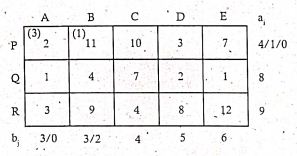
Third allocation :
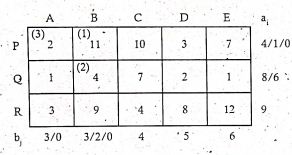
Fourth allocation :
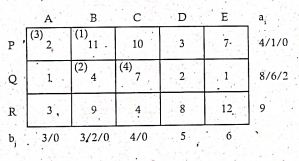
Fifth allocation :
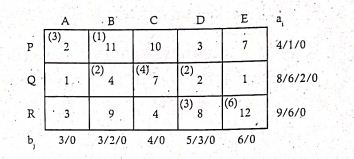
Sixth allocation :
\( =(3 \times 2)+(1 \times 11)+(2 \times 4)+(4 \times 7)+ (2 \times 2)+(3 \times 8)+(6 \times 12) \)
= 6 + 11 + 8 + 28 + 4 + 24 + 72 = Rs. 153
Total Cost = 153
3.
First allocation:
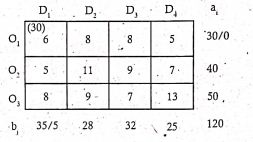
Second allocation:
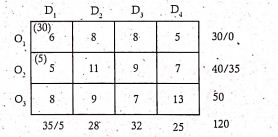
Third allocation:
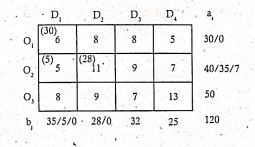
Fourth allocation:
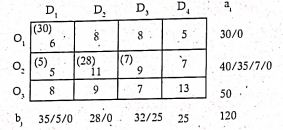
Fifth allocation:
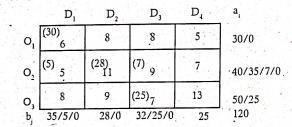
Final allocation:
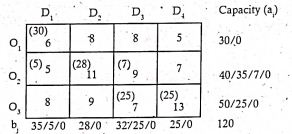
The transportation cost is
\( = (30 \times 6)+(5 \times 5)+(28 \times 11)+ (7 \times 9)+(25 \times 7)+(25 \times 13) \)
= 180 + 25 + 308 + 63 + 175 + 325
= Rs. 1076
4.
| Alternative | Pay – offs (Conditional events) | Minimum pay off | |||
| A1 | A2 | A3 | A4 | ||
| E1 | 7 | 12 | 20 | 27 | 27 |
| E2 | 10 | 9 | 10 | 25 | 25 |
| E3 | 23 | 20 | 14 | 23 | 23 |
| E4 | 32 | 24 | 21 | 17 | 32 |
min( 27, 25, 23, 32) = 23. Since the minimum cost is 23, the best alternative is E3 according to minimax principle.
5.
| Action | States | Minimum | |||
| (s1) | (s2) | (s3) | (s4) | ||
| A1 | 5 | 10 | 18 | 25 | 5 |
| A2 | 8 | 7 | 8 | 23 | 7 |
| A3 | 21 | 18 | 12 | 21 | 12 |
| A4 | 30 | 22 | 19 | 15 | 15 |
Max (5,7,12,15) = 15 ஃ Action A4 is the best
6.
Since the number of columns is less than the number of rows, given assignment problem is unbalanced one. To balance it , introduce a dummy column with all the entries zero. The revised assignment problem is
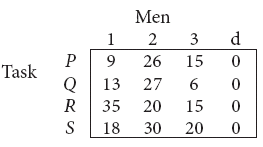
Here only 3 tasks can be assigned to 3 men.
Step 1: Its not necessary, since each row contains zero entry. Go to Step 2.
Step 2:
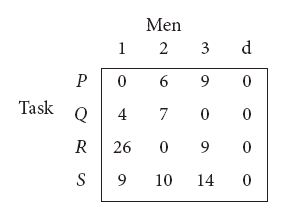
Step 3 (Assignment) :
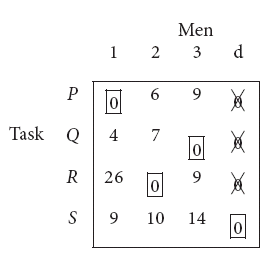
Since each row and each columncontains exactly one assignment,all the three men have been assigned a task. But task S is not assigned to any Man. The optimal assignment schedule and total cost is
| Task | Men | cost |
| P | 1 | 9 |
| Q | 3 | 6 |
| R | 2 | 20 |
| s | d | 0 |
| Total cost | 35 | |
The optimal assignment (minimum) cost = Rs. 35
7.
Total Capacity = Total Demand
\(\therefore\) The given problem is balanced transportation problem.
Hence there exists a feasible solution to the given problem.
Given Transportation Problem is
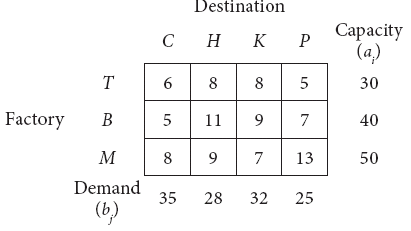
First Allocation:
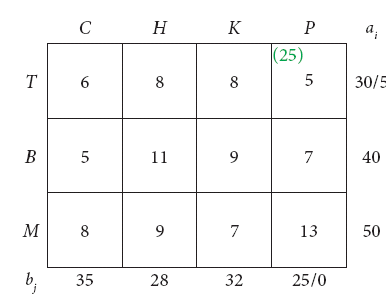
Second Allocation:
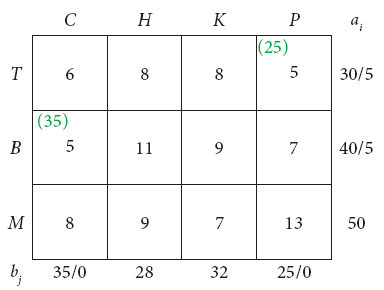
Third Allocation:
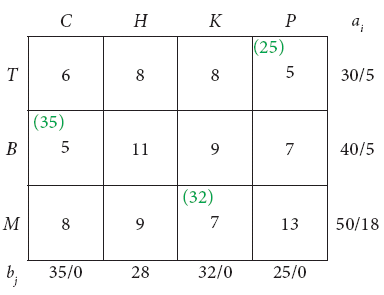
Fourth Allocation:
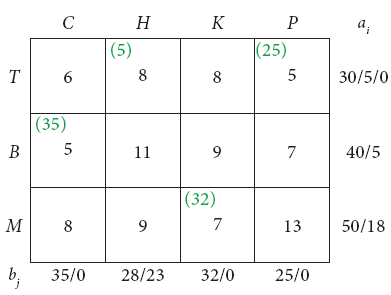
Fifth Allocation:
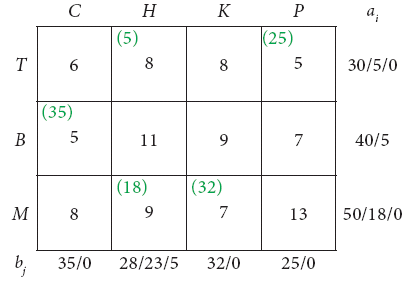
Sixth Allocation:
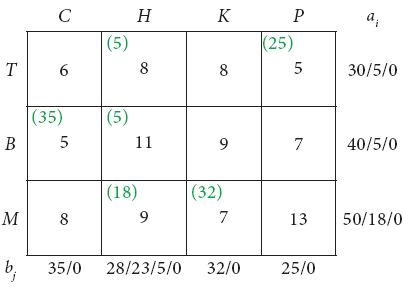
Transportation schedule :
T⟶H,T⟶P,B⟶C,B⟶H,M⟶H,M⟶K
The total Transportation cost = ( 5×8) + (25×5)+ (35×5) + (5×11)+ (18×9) + (32×7)
= 40+125+175+55+162+224
= Rs.781
8.
Given transportation table is
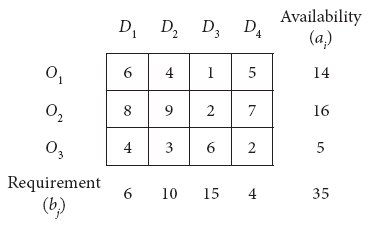
Total Availability = Total Requirement
Therefore the given problem is balanced transportation problem.
Hence there exists a feasible solution to the given problem.
First allocation :
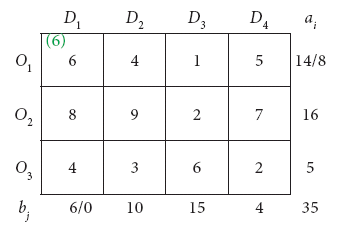
Second allocation :
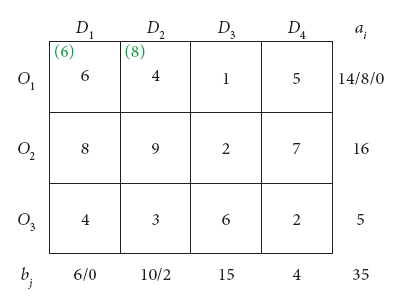
Third Allocation :
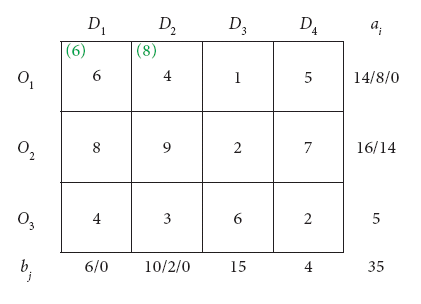
Fourth Allocation :
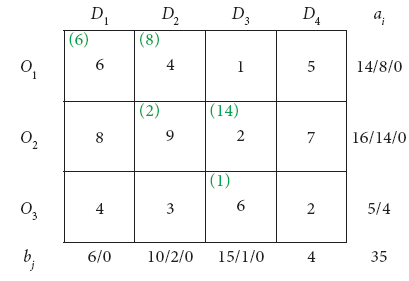
Fifth allocation :
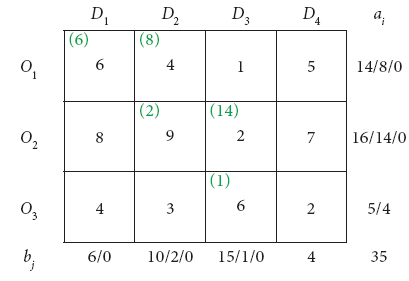
Final allocation :
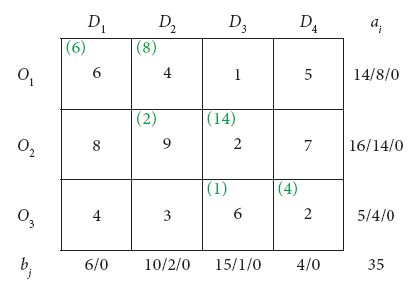
Transportation schedule : O1⟶D1, O1⟶D2, O2⟶D2, O2⟶D3, O3⟶D3,O3⟶D3.
The transportation cost
= (6\(\times\)6)+(8\(\times\)4)+(2\(\times\)9)+(14\(\times\)2)+(1\(\times\)6)+(4\(\times\)2)
= Rs.128
9.
The assignment problem is a special case of transportation problem where the number of sources and destinations are equal. Here, jobs represent sources and machines represent destinations.
10.
To assign the different jobs to the different machines (one job per machine) to minimize the overall cost is known as assignment problem.
11.
If the total supply = total demand, then the given problem is a balanced transportation problem.
12.
A feasible solution to a transportation problem is a set of non negative values xij (i = 1, 2, m, j = 1, 2, ....... n) that satisfies the constraints.
If a basic feasible solution to a transportation problem contains exactly m + n - l allocations. in independent positions, it is called a non degenerate basic feasible solution. Here m is the number of rows and n is the number of columns in a transportation problem.
13.
A transportation problem is to determine the amount to be transported from each origin to each destinations such that the total transportation cost is minimized.
14.
Here, the number of rows and columns are equal.
∴ The given assignment problem is balanced.
Step 1 : Select a smallest element in each row and subtract this from all the elements in its row.
∴ The cost matrix: of the given assignment problem is
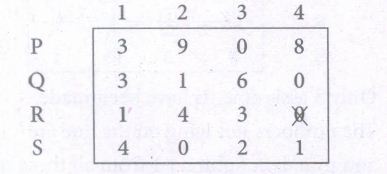
Column 1 contains no zero. Go to step 2.
Step 2 : Select the smallest element (1) in column 1 and subtract this from all the elements in its column.
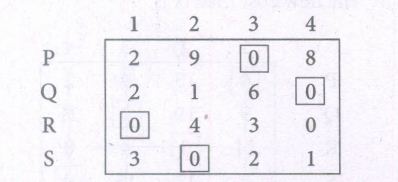
Since each row and column contains atleast one zero, assignments can be made.
Step 3 : Examine the rows with only one zero.
Row P, Q and S contains exactly one zero, mark them by 0 and mark the other zeros in the column byX.
Thus, all the four assignments have been made.
∴ The optimal assignment schedule and total cost is
| Salesman | Area | Cost |
|---|---|---|
| P | 3 | 8 |
| Q | 4 | 6 |
| R | 1 | 13 |
| S | 2 | 10 |
| Total Cost | Rs. 37 | |
15.
Here the number of rows and columns are equal.
\(\therefore\) The given assignment problem is balanced.
Now let us find the solution.
Step 1: Select a smallest element in each row and subtract this from all the elements in its row.
The cost matrix of the given assignment problem is
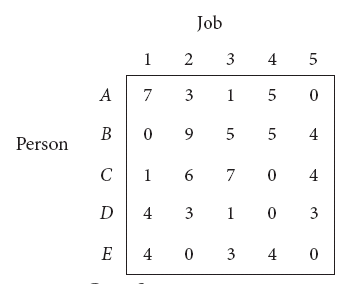
Column 3 contains no zero. Go to Step 2.
Step 2: Select the smallest element in each column and subtract this from all the elements in its column.
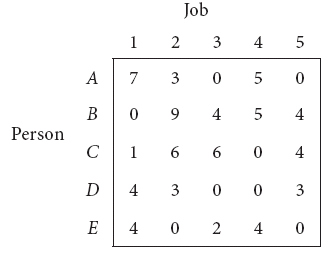
Since each row and column contains atleast one zero, assignments can be made.
Step 3: (Assignment):
Examine the rows with exactly one zero. Row B contains exactly one zero. Mark that zero by \(\square\) (i.e) Person B is assigned to Job 1. Mark other zeros in its column by ×.
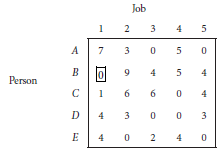
Now, Row C contains exactly one zero. Mark that zero by \(\square\). Mark other zeros in its column by × .
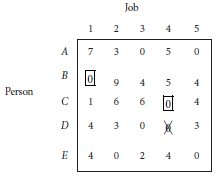
Now, Row D contains exactly one zero. Mark that zero by \(\square\) . Mark other zeros in its column by × .
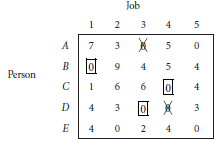
Row E contains more than one zero, now proceed column wise. In column 1, there is an assignment. Go to column 2. There is exactly one zero. Mark that zero by \(\square\) . Mark other zeros in its row by × .
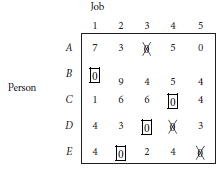
There is an assignment in Column 3 and column 4. Go to Column 5. There is exactly one zero. Mark that zero by \(\square\) . Mark other zeros in its row by × .
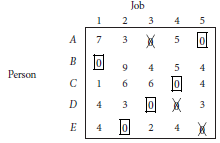
Thus all the five assignments have been made. The Optimal assignment schedule and total cost is
| Person | Job | cost |
| A | 5 | 1 |
| B | 1 | 0 |
| C | 4 | 2 |
| D | 3 | 1 |
| E | 2 | 5 |
| Total cost | 9 | |
The optimal assignment (minimum) cost = Rs. 9
16.
(d)
all of the above
17.
(b)
3
18.
(b)
balance between total activities and total resources
19.
(d)
unbalanced
20.
(c)
21.
(a)
top left corner
22.
(a)
Exactly one
23.
(c)
Smallest two costs
24.
(a)
Equal to m+n–1
25.
(a)

12th Standard Syllabus & Materials
12th Standard
TN 12th Computer Applications வலையமைப்பு வடமிடல் Sample Question Papers Study Material - QB365 Set A
NEW12th Standard
TN 12th Computer Applications களப்பெயர் முறைமை (DNS) Sample Question Papers Study Material - QB365 Set A
NEW12th Standard
TN 12th Computer Applications வலையமைப்பு எடுத்துக்காட்டுகள் மற்றும் நெறிமுறைகள் Sample Question Papers Study Material - QB365 Set A
NEW12th Standard
TN 12th Computer Applications கணினி வலையமைப்பு ஓர் அறிமுகம் Sample Question Papers Study Material - QB365 Set A



Tamilnadu Stateboard 12th Standard Subjects

Maths

Chemistry

Physics

Biology

Computer Science
Business Maths and Statistics

Economics

Commerce

Accountancy

History

Computer Applications
Biology
Computer Technology
Computer Applications
Computer Science
Business Maths and Statistics
Commerce
Economics
Maths
Chemistry
Physics
Computer Technology
History
Accountancy

Tamil

English

French
Tamilnadu Stateboard Standards
