
 100% FREE ACCESS
12th Standard Syllabus & Materials
12th Standard
TN 12th Computer Applications மின்னணு தரவு பரிமாற்றம் Sample Question Papers Study Material - QB365 Set A
NEW12th Standard
TN 12th Computer Applications மின் - வணிக பாதுகாப்பு அமைப்புகள் Sample Question Papers Study Material - QB365 Set A
NEW12th Standard
TN 12th Computer Applications மின்னணு செலுத்தல் முறைகள் Sample Question Papers Study Material - QB365 Set A
NEW12th Standard
TN 12th Computer Applications மின் - வணிகம் Sample Question Papers Study Material - QB365 Set A
NEW12th Standard
TN 12th Computer Applications திறந்த மூல கருத்துருக்கள் Sample Question Papers Study Material - QB365 Set A
NEW12th Standard
TN 12th Computer Applications வலையமைப்பு வடமிடல் Sample Question Papers Study Material - QB365 Set A

Published on: 09/10/2019
Random Variable and Mathematical Expectation
Download Tamil Nadu 12th Standard Business Maths and Statistics question papers, model tests, one-mark questions, important questions, and public exam papers in PDF format. Free study materials and answer keys for TN State Board students.
Questions + Answers key
Take MCQ Business Maths and Statistics Test
1.
What do you understand by Mathematical expectation?
2.
Distinguish between discrete and continuous random variable.
3.
Define random variable.
4.
The discrete random variable X has the probability function
| X | 1 | 2 | 3 | 4 |
| P(X=x) | k | 2k | 3k | 4k |
Show that k = 0.1.
5.
Construct cumulative distribution function for the given probability distribution.
| X | 0 | 1 | 2 | 3 |
| P(X = x) | 0.3 | 0.2 | 0.4 | 0.1 |
6.
The number of cars in a household is given below.
| No. of cars | 0 | 1 | 2 | 3 | 4 |
| No. of Household | 30 | 320 | 380 | 190 | 80 |
Estimate the probability mass function. Verify p(xi ) is a probability mass function.
7.
A person tosses a coin and is to receive Rs. 4 for a head and is to pay Rs. 2 for a tail. Find the expectation and variance of his gains.
8.
The following table is describing about the probability mass function of the random variable X
| x | 3 | 4 | 5 |
| P(x) | 0.1 | 0.1 | 0.2 |
Find the standard deviation of x.
9.
A commuter train arrives punctually at a station every 25 minutes. Each morning, a commuter leaves his house and casually walks to the train station. Let X denote the amount of time, in minutes, that commuter waits for the train from the time he reaches the train station. It is known that the probability density function of X is
\(f(x)= \begin{cases}\frac{1}{25}, \text { for } & 0 < x < 25 \\ 0, & \text { otherwise }\end{cases}\)
10.
State the properties of distribution function.
11.
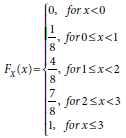
A coin is tossed thrice. Let X be the number of observed heads. Find the cumulative distribution function of X.
12.
If you toss a fair coin three times, the outcome of an experiment consider as random variable which counts the number of heads on the upturned faces. Find out the probability mass function and check the properties of the probability mass function.
13.
Determine the mean and variance of a discrete random variable, given its distribution as follows.
| X = x | 1 | 2 | 3 | 4 | 5 | 6 |
| Fx(x) | \(\frac{1}{6}\) | \(\frac{2}{6}\) | \(\frac{3}{6}\) | \(\frac{4}{6}\) | \(\frac{5}{6}\) | 1 |
14.
The length of time (in minutes) that a certain person speaks on the telephone is found to be random phenomenon, with a probability function specified by the probability density function f(x) as \( f(x)\begin{cases} { Ae }^{ -x/5 },\quad \text{for}\quad x\ge 0 \\ 0 \quad ,\quad \text{otherwise }\end{cases}\)
(a) Find the value of A that makes fix) a p.d.f,
(b) What is the probability that the number of minutes that person will talk over the phone is
(i) more than 10 minutes
(ii) less than 5 minutes and
(iii) between 5 and 10 minutes.
15.
A continuous random variable X has p.d.f
f(x) = 5x4, 0\(\le\)x\(\le\)1
Find a1 and a2 such that
i) P[X\(\le\)a1] = P[X>a1]
ii) P[X>a2] = 0.05
16.
The distribution function F(x) is equal to ________.
\(P(X=x)\)
P(X\(\le\)x)
P(X\(\ge\)x)
all of these
17.
The probability density function p(x) cannot exceed ________.
zero
one
mean
infinity
18.
In a discrete probability distribution the sum of all the probabilities is always equal to ________.
zero
one
minimum
maximum
19.
If p(x) =\(\frac{1}{10}\), c = 10, then E(X) is ________.
zero
\(\frac{6}{8}\)
1
-1
20.
\(\int _{ -\infty }^{ \infty }{ f(x)dx } \) is always equal to ________.
zero
one
E(X)
f(x)+1
21.
E[X-E(X)] is equal to ________.
E(X)
V(X)
0
E(X)-X
22.
If c is a constant, then E(c) is ________.
0
1
c f (c)
c
23.
A variable that can assume any possible value between two points is called ________.
discrete random variable
continuous random variable
discrete sample space
random variable
24.
25.
Value which is obtained by multiplying possible values of random variable with probability of occurrence and is equal to weighted average is called ________.
Discrete value
Weighted value
Expected value
Cumulative value
1.
Mathematical expectation E(X) is an average of the values, that the random variable takes on, where each value is weighted by the probability that the random variable is equal to that value. Values that are most probable receive more weight. Each value x is multiplied by the approximate probability that X equals the valuex.
2.
| Discrete random variable | Continuous random variable | |
| 1. | Finite number of possible values | Takes any value in the interval |
| 2. | p(xi) ≥ 0 ∀i, \(\sum _{ i=1 }^{ n }{ p({ x }_{ i })=1 } \) |
f(x) ≥ 0 ∀x and \(\\ \int _{ -\infty }^{ \infty }{ f(x)dx=1 } \) |
3.
A random variable is a real valued function defined on a sample space S and taking values in (-∞, ∞) or whose possible values are numerical outcomes of a random experiment.
4.
The given probability function is
| X | 1 | 2 | 3 | 4 |
| P(X = x) | k | 2k | 3k | 4k |
Since the given function is a probability function, each ρi>0 and Σρi = 1
⇒ k + 2k + 3k + 4k = 1
⇒10k = 1 ⇒ k = \(\frac{1}{10}\)
⇒ k = 0.1
5.
We know Fx (x) = P(X ≤ x) for all x ∈ R
∴ F(0) = P(X ≤ 0) = P(0) = 0.3
F(1) = P(X ≤ 1) = P(0)+P(l)
= 0.3 + 0.2 = 0.5
F(2) = P(X ≤ 2) = P(0) + P(1) + P(2)
= 0.3 + 0.2 + 0.4 = 0.9
F(3) = P(X ≤ 3) = P(0) + P(1) + P(2) + P(3)
= 0.3 + 0.2 + 0.4 + 0.1 = 1
∴ Cumulative distribution function for the given probability distribution is 1
6.
Let X be the number of cars
| X=xi | Number of Household | P(xi) |
| 0 | 30 | 0.03 |
| 1 | 320 | 0.32 |
| 2 | 380 | 0.38 |
| 3 | 190 | 0.19 |
| 4 | 80 | 0.08 |
| Total | 1000 | 1.00 |
i) P(xi)\(\ge\)0\(\forall \) i and
ii) \(\sum _{ i=1 }^{ \infty }{ P({ x }_{ i })=p(0)+p(1)+p(3)+p(4) } \)
= 0.03+0.32+0.38+0.19+0.08 = 1
Hence p(xi) is a probability mass function.
7.
When a coin is tossed, sample space S = {H, T}
Since he is receiving Rs. 4 for a head and pays Rs. 2 for a tail,
∴ X take values 4 and -2.
∴ Probability for getting a head is \(\frac{1}{2}\) and probability for getting a tail is \(\frac{1}{2}\).
The probability mass function is
| X = x | 4 | -2 |
| P(X = x) | \(\frac{1}{2}\) | \(\frac{1}{2}\) |
∴ Expectation E(X) = Σxp(x)
= 4(\(\frac{1}{2}\)) - 2(\(\frac{1}{2}\))
= 2-1 = 1
∴ His expectation is Rs. 1
E(x2) = ∑x2p(x)
= 42(\(\frac{1}{2}\)) + (-2)2(\(\frac{1}{2}\))
= 16(\(\frac{1}{2}\)) + 4(\(\frac{1}{2}\))
= 8 + 2 = 10
Variance (X) = E(X2)-[E(X)]2
= 10-12 = 9
∴ Variance of his gains Rs. 9
8.
Given probability mass function is
| x | 3 | 4 | 5 |
| P(x) | 0.1 | 0.1 | 0.2 |
\(E(X)=\sum _{ x=3 }^{ 4,5 }{ xp(x) } \)
= 0.6+ 1.2 +2.5
E(X2) = Σx2p(x)
= 9(0.2) + 16(0.3) +25(0.5)
= 1.8 + 4.8 + 12.5
= 19.1
Var(X) = E(X2)-[E(X)]2
= 19.1-(4.3)2
19.1- 18.49
V(X) = 0.61
Stdard deviation = \(\sqrt{Variance}=\sqrt{0 .61}\)
= 0.78
9.
Expected value of the random variable is
\(E(X)=\int _{ -\infty }^{ \infty }{ xf(x) } dx\)
\(=\int _{ 0 }^{ 25 }{ x \frac{1}{25}dx } \)
\(=\frac { 1 }{ 25 } \int _{ 0 }^{ 25 }{ xdx } \)
\(=\frac { 1 }{ 25 } { \left[ \frac { { x }^{ 2 } }{ 2 } \right] }_{ 0 }^{ 25 }\)
= 12.5
Therefore, the expected waiting time of the commuter is 12.5 minutes.
10.
1) 0≤F(x)≤1, -∞
2) F(-∞) = 0 and F(∞) = 1
3) is a non-decreasing function, F(a) ≤F(b) for a
4) \(\underset { h\rightarrow 0 }{ lim } \) F(x+h) = F(x), since F(x) is continuous from the right
5) F'(x) = f(x)≥0
6) P(a≤x≤b) = F(b)-F(a)
11.
The sample space (S) = { (HHH), (HHT), (HTH), (HTT), (THH), (THT), (TTH), (TTT)}
X takes the values: 3, 2, 2, 1, 2, 1, 1, and 0
| Range of X(Rx) | 0 | 1 | 2 | 3 |
| Px(x) | \(\frac{1}{8}\) | \(\frac{3}{8}\) | \(\frac{3}{8}\) | \(\frac{1}{8}\) |
| Fx(x) | \(\frac{1}{8}\) | \(\frac{4}{8}\) | \(\frac{7}{8}\) | 1 |
Thus, we have
12.
Let X is the random variable which counts the number of heads on the upturned faces. The outcomes are stated below
| Outcomes | (HHH) | (HHT) | (HTH) | (THH) | (THT) | (TTH) | (HTT) | (TTT) |
| Values of X | 3 | 2 | 2 | 2 | 1 | 1 | 1 | 0 |
These values are summarized in the following probability table.
| Value of X | 0 | 1 | 2 | 3 | Total |
| P(xi) | \(\frac{1}{8}\) | \(\frac{3}{8}\) | \(\frac{3}{8}\) | \(\frac{1}{8}\) | \(\sum _{ i=0 }^{ 3 }{ p({ x }_{ i })=1 } \) |
(i) p(xi) \(\ge\)0\(\forall \) i and
(ii) \(\sum _{ i=0 }^{ 3 }{ p({ x }_{ i })=1 } \)
Hence, p(xi) is a probability mass function.
13.
From the given data, you first calculate the probability distribution of the random variable. Then using it you calculate mean and variance.
X p(x)
1 F(1) = \(\frac{1}{6}\)
2 F(2)-F(1) = \(\frac{2}{6}\)-\(\frac{1}{6}\) = \(\frac{1}{6}\)
3 F(3)-F(2) = \(\frac{3}{6}\)-\(\frac{2}{6}\) = \(\frac{1}{6}\)
4 F(4)-F(3) = \(\frac{4}{6}\)-\(\frac{3}{6}\) = \(\frac{1}{6}\)
5 F(5)-F(4) = \(\frac{5}{6}\)-\(\frac{4}{6}\) = \(\frac{1}{6}\)
6 F(6)-F(5) = 1-\(\frac{5}{6}\) = \(\frac{1}{6}\)
The probability mass function is
| X = x | 1 | 2 | 3 | 4 | 5 | 6 |
| P(x) | \(\frac{1}{6}\) | \(\frac{1}{6}\) | \(\frac{1}{6}\) | \(\frac{1}{6}\) | \(\frac{1}{6}\) | \(\frac{1}{6}\) |
Mean of the random variable X = E(X)\(\sum _{ x }^{ }{ x } { P }_{ X }(x)\)
\(=\left( 1\times \frac { 1 }{ 6 } \right) +\left( 2\times \frac { 1 }{ 6 } \right) +\left( 3\times \frac { 1 }{ 6 } \right) +\left( 4\times \frac { 1 }{ 6 } \right) +\left( 5\times \frac { 1 }{ 6 } \right) +\left( 6\times \frac { 1 }{ 6 } \right) \)
\(=\frac { 1 }{ 6 } (1+2+3+4+5+6)\)
= 7/2
\(E({ X }^{ 2 })=\sum _{ x }^{ }{ { x }^{ 2 } } { P }_{ X }(x)\)
\(=\left( { 1 }^{ 2 }\times \frac { 1 }{ 6 } \right) +\left( { 2 }^{ 2 }\times \frac { 1 }{ 6 } \right) +\left( { 3 }^{ 2 }\times \frac { 1 }{ 6 } \right) +\left( { 4 }^{ 2 }\times \frac { 1 }{ 6 } \right) +\left( { 5 }^{ 2 }\times \frac { 1 }{ 6 } \right) +\left( { 6 }^{ 2 }\times \frac { 1 }{ 6 } \right) \)
\(=\frac { 1 }{ 6 } ({ 1 }^{ 2 }+{ 2 }^{ 2 }+{ 3 }^{ 2 }+{ 4 }^{ 2 }+{ 5 }^{ 2 }+{ 6 }^{ 2 })\)
\(=\frac { 91 }{ 6 } \)
Variance of the Random Variable \(X=V(X)=E\left( { X }^{ 2 } \right) -{ [E(X)] }^{ 2 }\)
\(=\frac { 91 }{ 6 } -{ \left( \frac { 7 }{ 2 } \right) }^{ 2 }\)
\(=\frac { 35 }{ 12 } \)
14.
Given \( f(x)\begin{cases} { Ae }^{ -x/5 },\quad \text{for}\quad x\ge 0 \\ 0 \quad ,\quad \text{otherwise }\end{cases}\)
a) since f(x) is a p.d.f.,
\(\int _{ 0 }^{ \infty }{ { Ae }^{ \frac { -x }{ 5 } }dx=1\Rightarrow A.\frac { { \left[ { e }^{ \frac { -x }{ 5 } } \right] }_{ 0 }^{ \infty } }{ \frac { - }{ 5 } } =1 } \)
\(\Rightarrow -5A[{ e }^{ -\infty }-{ e }^{ 0 }]=1\)
\(\Rightarrow -5A[0-1]=1\quad [\because { e }^{ -\infty }=0\quad and\quad { e }^{ 0 }=1]\)
\(\Rightarrow 5A=1\Rightarrow A=\frac { 1 }{ 5 } \)
\(\therefore A=\frac { 1 }{ 5 } \)
b) i) Probability that the person will talk over the phone more than 10 minutes is P(X >10)
∴ P(X>10) =\(\\ \int _{ 10 }^{ \infty }{ \frac { 1 }{ 5 } { e }^{ \frac { -x }{ 5 } }dx } [\because A=\frac { 1 }{ 5 } ]\)
\(={ \frac { 1 }{ 5 } \left[ \frac { { e }^{ \frac { -x }{ 5 } } }{ \frac { -1 }{ 5 } } \right] }_{ 10 }^{ \infty }\)
\(=-\left[ { e }^{ -\infty }-{ e }^{ \frac { -10 }{ 5 } } \right] =-\left[ 0-{ e }^{ -2 } \right] \)
\(={ e }^{ -2 }=\frac { 1 }{ { e }^{ 2 } } \left[ \because { e }^{ -\infty }=0 \right] \)
ii) Probability that the person will take over the phone less that 5 minutes is P(X < 5)
\(\therefore P(X<5)=\int _{ 0 }^{ 5 }{ { e }^{ \frac { -x }{ 5 } }dx } [\because A=\frac { 1 }{ 5 } ]\)
\(=\frac { 1 }{ 5 } { \left[ \frac { { e }^{ \frac { -x }{ 4 } } }{ \frac { -1 }{ 5 } } \right] }_{ 0 }^{ 5 }=-{ e }^{ \frac { -5 }{ 5 } }{ -e }^{ 0 }\)
\(=-\left( { e }^{ -1 }-1 \right) \left[ \because { e }^{ 0 }=1 \right] \)
\(=1-{ e }^{ -1 }-\frac { 1 }{ e } =\frac { e-1 }{ e } \)
\(\therefore P(X<5)=\frac { e-1 }{ e } \)
iii) The probability that the person will take over the phone between 5 and 10 minutes is P(5 < X < 10)
\(=-\left[ { e }^{ \frac { -10 }{ 5 } }-{ e }^{ \frac { -5 }{ 5 } } \right] \)
\(=-\left[ { e }^{ -2 }-{ e }^{ -1 } \right] \)
\(={ e }^{ -1 }-{ e }^{ -2 }=\frac { 1 }{ e } -\frac { 1 }{ { e }^{ 2 } } \)
15.
i) Since P[X\(\le\)a1] = P[X>a1]
\(P[X\le { a }_{ 1 }]=\frac { 1 }{ 2 } \)
\(i.e., \int _{ 0 }^{ { a }_{ 1 } }{ f(x)dx } =\frac { 1 }{ 2 } \)
\(i.e., \int _{ 0 }^{ { a }_{ 1 } }{ { 5x }^{ 4 } } dx=\frac { 1 }{ 2 } \)
\(5{ { \left[ \frac { { x }^{ 5 } }{ 5 } \right] } }_{ { 0 }_{ } }^{ a1 }=1/2\)
\({ a }_{ 1 }={ (0.5) }^{ \frac { 1 }{ 5 } }\)
ii) \(P[X>{ a }_{ 2 }]=0.05\)
\(\int _{ { a }_{ 2 } }^{ 1 }{ { f(x })dx=0.05 } \)
\(\int _{ { a }_{ 2 } }^{ 1 }{ { 5x }^{ 4 }dx=0.05 } \)
\(5{ { \left[ \frac { { x }^{ 5 } }{ 5 } \right] } }_{ { a }_{ 2 } }^{ 1 }=0.05\)
\({ a }_{ 2 }={ [0.95] }^{ \frac { 1 }{ 5 } }\)
16.
(b)
P(X\(\le\)x)
17.
(b)
one
18.
(b)
one
19.
(c)
1
20.
(b)
one
21.
(c)
0
22.
(d)
c
23.
(b)
continuous random variable
24.
(b)
25.
(c)
Expected value

12th Standard Syllabus & Materials
12th Standard
TN 12th Computer Applications களப்பெயர் முறைமை (DNS) Sample Question Papers Study Material - QB365 Set A
NEW12th Standard
TN 12th Computer Applications வலையமைப்பு எடுத்துக்காட்டுகள் மற்றும் நெறிமுறைகள் Sample Question Papers Study Material - QB365 Set A
NEW12th Standard
TN 12th Computer Applications கணினி வலையமைப்பு ஓர் அறிமுகம் Sample Question Papers Study Material - QB365 Set A
NEW12th Standard
TN 12th Computer Applications PHP-உடன் MySQL-ஐ இணைத்தல் Sample Question Papers Study Material - QB365 Set A



Tamilnadu Stateboard 12th Standard Subjects

Maths

Chemistry

Physics

Biology

Computer Science
Business Maths and Statistics

Economics

Commerce

Accountancy

History

Computer Applications
Biology
Computer Technology
Computer Applications
Computer Science
Business Maths and Statistics
Commerce
Economics
Maths
Chemistry
Physics
Computer Technology
History
Accountancy

Tamil

English

French
Tamilnadu Stateboard Standards
