
 100% FREE ACCESS
12th Standard Syllabus & Materials
12th Standard
TN 12th Computer Applications மின்னணு தரவு பரிமாற்றம் Sample Question Papers Study Material - QB365 Set A
NEW12th Standard
TN 12th Computer Applications மின் - வணிக பாதுகாப்பு அமைப்புகள் Sample Question Papers Study Material - QB365 Set A
NEW12th Standard
TN 12th Computer Applications மின்னணு செலுத்தல் முறைகள் Sample Question Papers Study Material - QB365 Set A
NEW12th Standard
TN 12th Computer Applications மின் - வணிகம் Sample Question Papers Study Material - QB365 Set A
NEW12th Standard
TN 12th Computer Applications திறந்த மூல கருத்துருக்கள் Sample Question Papers Study Material - QB365 Set A
NEW12th Standard
TN 12th Computer Applications வலையமைப்பு வடமிடல் Sample Question Papers Study Material - QB365 Set A

Published on: 30/08/2019
Applications of Matrices and Determinants
Download Tamil Nadu 12th Standard Business Maths and Statistics question papers, model tests, one-mark questions, important questions, and public exam papers in PDF format. Free study materials and answer keys for TN State Board students.
Questions + Answers key
Take MCQ Business Maths and Statistics Test
1.
Solve the following equation by using Cramer’s rule
x + 4y + 3z = 2, 2x−6y + 6z = −3, 5x− 2y + 3z = −5
2.
Solve the following equation by using Cramer’s rule
x + y + z = 6, 2x + 3y− z =5, 6x−2y− 3z = −7
3.
Solve the following equation by using Cramer’s rule
2x + y −z = 3, x + y + z =1, x− 2y− 3z = 4
4.
80% of students who do maths work during one study period, will do the maths work at the next study period. 30% of students who do english work during one study period, will do the english work at the next study period. Initially there were 60 students do maths work and 40 students do english work.
Calculate,
(i) The transition probability matrix
(ii) The number of students who do maths work, english work for the next subsequent 2 study periods.
5.
An automobile company uses three types of Steel S1, S2 and S3 for providing three different types of Cars C1, C2 and C3. Steel requirement R (in tonnes) for each type of car and total available steel of all the three types are summarized in the following table.
| Types of Steel | Types of Car | Total Steel available | ||
| C1 | C2 | C3 | ||
| S1 | 3 | 2 | 4 | 28 |
| S2 | 1 | 1 | 2 | 13 |
| S3 | 2 | 2 | 2 | 14 |
Determine the number of Cars of each type which can be produced by Cramer’s rule.
6.
Solve by Cramer’s rule x + y + z = 4, 2x − y + 3z = 1, 3x + 2y − z = 1
7.
Akash bats according to the following traits. If he makes a hit (S), there is a 25% chance that he will make a hit his next time at bat. If he fails to hit (F), there is a 35% chance that he will make a hit his next time at bat. Find the transition probability matrix for the data and determine Akash’s long- range batting average.
8.
Parithi is either sad (S) or happy (H) each day. If he is happy in one day, he is sad on the next day by four times out of five. If he is sad on one day, he is happy on the next day by two times out of three. Over a long run, what are the chances that Parithi is happy on any given day?
9.
Rank of a null matrix is _______.
0
-1
\(\infty \)
1
10.
\(\left| { A }_{ n\times n } \right| \) = 3 \(\left| adjA \right| \) = 243 then the value n is _______.
4
5
6
7
11.
If \(\frac { { a }_{ 1 } }{ x } +\frac { { b }_{ 1 } }{ y } ={ c }_{ 1 },\frac { { a }_{ 2 } }{ x } +\frac { { b }_{ 2 } }{ y } ={ c }_{ 2 },\) \({ \triangle }_{ 1= }\begin{vmatrix} { a }_{ 1 } & { b }_{ 1 } \\ { a }_{ 2 } & { b }_{ 2 } \end{vmatrix}, \ { \triangle }_{ 2 }=\begin{vmatrix} { b }_{ 1 } & { c }_{ 1 } \\ { b }_{ 2 } & { c }_{ 2 } \end{vmatrix}{ \triangle }_{ 3 }=\begin{vmatrix} { c }_{ 1 } & { a }_{ 1 } \\ { c }_{ 2 } & a_{ 2 } \end{vmatrix}\) then (x, y) is _______.
\(\left( \frac { { \triangle }_{ 2 } }{ { \triangle }_{ 1 } } ,\frac { { \triangle }_{ 3 } }{ { \triangle }_{ 1 } } \right) \)
\(\left( \frac { { \triangle }_{ 3 } }{ { \triangle }_{ 1 } }, \frac { { \triangle }_{ 2 } }{ { \triangle }_{ 1 } } \right) \)
\(\left( \frac { { \triangle }_{ 1 } }{ { \triangle }_{ 2 } } ,\frac { { \triangle }_{ 1 } }{ { \triangle }_{ 3 } } \right) \)
\(\left( \frac { { -\triangle }_{ 1 } }{ { \triangle }_{ 2 } }, \frac { {- \triangle }_{ 1 } }{ { \triangle }_{ 3 } } \right) \)
12.
Cramer’s rule is applicable only to get an unique solution when _______.
\({ \triangle }_{ z }\neq 0\)
\({ \triangle }_{ x }\neq 0\)
\({ \triangle } \neq 0\)
\({ \triangle }_{ y }\neq 0\)
13.
The system of linear equations x + y + z = 2, 2x + y − z = 3, 3x + 2y + k = 4 has unique solution, if k is not equal to _______.
4
0
-4
1
1.
\(\Delta =\left| \begin{matrix} 1 & 4 & 3 \\ 2 & -6 & 6 \\ 5 & -2 & 3 \end{matrix} \right| \)
= \(1\left| \begin{matrix} -6 & 6 \\ -2 & 3 \end{matrix} \right| -4\left| \begin{matrix} 2 & 6 \\ 5 & 3 \end{matrix} \right| +3\left| \begin{matrix} 2 & -6 \\ 5 & -2 \end{matrix} \right| \)
= 1(-18 + 12) - 4(6 - 30) +3 (- 4 +30)
= 1(- 6) - 4(- 24) + 3(26)
= - 6 + 96 + 78 = 168 \(\neq \) 0
Since \(\Delta \neq 0\) the system is consistent with unique solution and Cramer's rule can be applied
\(\Delta x=\left| \begin{matrix} 2 & 4 & 3 \\ -3 & -6 & 6 \\ -5 & -2 & 3 \end{matrix} \right| \)
= \(2\left| \begin{matrix} -6 & 6 \\ -2 & 3 \end{matrix} \right| -4\left| \begin{matrix} -3 & 6 \\ -5 & 3 \end{matrix} \right| +3\left| \begin{matrix} -3 & -6 \\ -5 & -2 \end{matrix} \right| \)
= 2 (- 18 + 12) - 4(- 9 +30) + 3(6 -30)
= 2(- 6) - 4(21) + 3(- 24)
= -12-84-72 =-168
\(\Delta y=\left| \begin{matrix} 1 & 2 & 3 \\ 2 & - & 6 \\ 5 & -5 & 3 \end{matrix} \right| =1\left| \begin{matrix} -3 & 6 \\ -5 & 3 \end{matrix} \right| -2\left| \begin{matrix} 2 & 6 \\ 5 & 3 \end{matrix} \right| +3\left| \begin{matrix} 2 & -3 \\ 5 & -5 \end{matrix} \right| \)
= 1 (-9+30)-2(6-30)+3(- 10+ 15)
= 1(21) - 2(- 24) + 3(5)
= 21 + 48 + 15 = 84
\(\Delta z=\left| \begin{matrix} 1 & 4 & 2 \\ 2 & -6 & -3 \\ 5 & -2 & -5 \end{matrix} \right| \)
= \(1\left| \begin{matrix} -6 & -3 \\ -2 & -5 \end{matrix} \right| -4\left| \begin{matrix} 2 & -3 \\ 5 & -5 \end{matrix} \right| +2\left| \begin{matrix} 2 & -6 \\ 5 & -2 \end{matrix} \right| \)
= 1(30-6)-4(-10+ 15)+2(-4+30)
= 24 - 4(5) + 2(26)
= 24 - 20 + 52 = 56
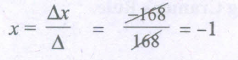
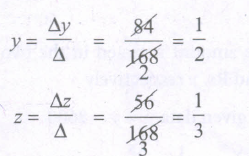
Solution set is \(\left\{ -1,\frac { 1 }{ 2 } ,\frac { 1, }{ 3 } \right\} \)
2.
\(\Delta =\left| \begin{matrix} 1 & 1 & 1 \\ 2 & 3 & -1 \\ 6 & -2 & -3 \end{matrix} \right| \)
= \(1\left| \begin{matrix} 3 & -1 \\ -2 & -3 \end{matrix} \right| -1\left| \begin{matrix} 2 & -1 \\ 6 & 3 \end{matrix} \right| +1\left| \begin{matrix} 2 & 3 \\ 6 & -2 \end{matrix} \right| \)
= 1(-9 -2) -1(-6 +6) + 1(-4 -18)
= 1(-11) -1(0) +1(-22)
= -11 -22 = -33 \(\neq \)0
Since \(\Delta \neq 0\)
Cramer's rule can be applied and the system is consistent with unique solution
\(\Delta x=\left| \begin{matrix} 6 & 1 & 1 \\ 5 & 3 & -1 \\ -7 & -2 & -3 \end{matrix} \right| \)
= \(6\left| \begin{matrix} 3 & -1 \\ -2 & -3 \end{matrix} \right| -1\left| \begin{matrix} 5 & -1 \\ -7 & -3 \end{matrix} \right| +1\left| \begin{matrix} 5 & 3 \\ -7 & -2 \end{matrix} \right| \)
= 6 (-9 -2) -1(-15 -7) + 1(-10 +21)
= 6 (-11) -1 (-22) + 1 (11)
= -66 + 22 + 11= - 33
\(\Delta y=\left| \begin{matrix} 1 & 6 & 1 \\ 2 & 5 & -1 \\ 6 & -7 & -3 \end{matrix} \right| \)
= \(1\left| \begin{matrix} 5 & -1 \\ -7 & -3 \end{matrix} \right| -6\left| \begin{matrix} 2 & -1 \\ 6 & -3 \end{matrix} \right| +1\left| \begin{matrix} 2 & 5 \\ 6 & -7 \end{matrix} \right| \)
= 1(-15 -7) -6(-6 +6) + 1(-14 -30)
= 1(-22) -6(0) + 1 (-44)
= -22 - 44 = - 66
\(\Delta z=\left| \begin{matrix} 1 & 1 & 6 \\ 2 & 3 & 5 \\ 6 & -2 & -7 \end{matrix} \right| \)
= \(=1\left| \begin{matrix} 3 & 5 \\ -2 & -7 \end{matrix} \right| -1\left| \begin{matrix} 2 & 5 \\ 6 & -7 \end{matrix} \right| +6\left| \begin{matrix} 2 & 3 \\ 6 & -2 \end{matrix} \right| \)
= 1(-21 +10) -1(-14 -30) +6 (-4 -18)
=1(-11) -1(-44) +6(-22)
= -11 + 44 - 132 = - 99
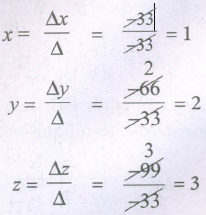
\(\therefore\) Solution set is {1, 2, 3}
3.
\(\Delta =\left| \begin{matrix} 2 & 1 & -1 \\ 1 & 1 & 1 \\ 1 & -2 & 3 \end{matrix} \right| =2\)
\(\left| \begin{matrix} 1 & 1 \\ -2 & -3 \end{matrix} \right| -1\left| \begin{matrix} 1 & 1 \\ 1 & -3 \end{matrix} \right| -1\left| \begin{matrix} 1 & 1 \\ 1 & -2 \end{matrix} \right| \)
= 2 (-3+2) - 1 (-3 -1) -1 (-2-1)
= 2(-1) -1 (-4) -1 (-3)
= -2 + 4 + 3 = 5.
Since\(\Delta \neq 0\),
we can apply Cramer's rule and the system is consistent with unique solution.
\(x=\left| \begin{matrix} 3 & 1 & -1 \\ 1 & 1 & 1 \\ 4 & -2 & 3 \end{matrix} \right| =3\left| \begin{matrix} 1 & 1 \\ -2 & -3 \end{matrix} \right| -1\left| \begin{matrix} 1 & 1 \\ 4 & -3 \end{matrix} \right| -1\left| \begin{matrix} 1 & 1 \\ 4 & -2 \end{matrix} \right| \)
= 3(-3 + 2) -1(-3 -4) -1(-2 -4)
= 3 (-1) -1 (-7) -1 (-6)
= -3 + 7 + 6 = 10.
\(\Delta y=\left| \begin{matrix} 2 & 3 & -1 \\ 1 & 1 & 1 \\ 1 & 4 & -3 \end{matrix} \right| =2\left| \begin{matrix} 1 & 1 \\ 4 & -3 \end{matrix} \right| -3\left| \begin{matrix} 1 & 1 \\ 1 & -3 \end{matrix} \right| -1\left| \begin{matrix} 1 & 1 \\ 1 & 4 \end{matrix} \right| \)
= 2(-3 -4) -3 (-3 -1) -1 (4-1)
= 2 (-7) -3 (-4) -1(3)
= 14 + 12 - 3 = -5
\(\Delta z=\left| \begin{matrix} 2 & 1 & 3 \\ 1 & 1 & 1 \\ 1 & -2 & 4 \end{matrix} \right| \)
= \(2\left| \begin{matrix} 1 & 1 \\ -2 & 4 \end{matrix} \right| -1\left| \begin{matrix} 1 & 1 \\ 1 & 4 \end{matrix} \right| +3\left| \begin{matrix} 1 & 1 \\ 1 & -2 \end{matrix} \right| \)
= 2(4 + 2) -1(4 -1) + 3(-2 -1)
= 2(6) -1(3) + 3(-3)
= 12 - 3 - 9
= 0
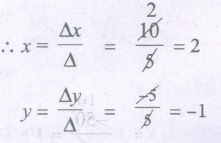
\(z=\cfrac { \Delta z }{ \Delta } =\cfrac { 0 }{ 5 } =0\)
\(\therefore\)Solution set is (2, -1, 0)
4.
(i) Transition probability matrix T = \(_{ E }^{ M }\left( \begin{matrix} \overset { M }{ 0.8 } & \overset { E }{ 0.2 } \\ 0.7 & 0.3 \end{matrix} \right) \)
After one study period, \(\left( \overset { M }{ 60\quad } \overset { E }{ 40 } \right) \) \(_{ E }^{ M }\left( \begin{matrix} \overset { M }{ 0.8 } & \overset { E }{ 0.2 } \\ 0.7 & 0.3 \end{matrix} \right) \) =\(\left( \overset { M }{ 76\quad } \overset { E }{ 24 } \right) \)
So in the very next study period, there will be 76 students do maths work and 24 students do the English work.
After two study periods,
\(\left( \overset { M }{ 76\quad } \overset { E }{ 24 } \right) \) \(_{ E }^{ M }\left( \begin{matrix} \overset { M }{ 0.8 } & \overset { E }{ 0.2 } \\ 0.7 & 0.3 \end{matrix} \right) \)
= (60.8+16.8 15.2+7.2)
= (77.6 22.4)
After two study periods there will be 78 (approx) students do maths work and 22 (approx) students do English work.
5.
Let ‘x’ be the number of cars of type C1
Let ‘y’ be the number of cars of type C2
Let ‘z’ be the number of cars of type C3
3x + 2y + 4z = 28
x + y + 2z =13
2x + 2y + z =14
Here \({ \triangle }=\left| \begin{matrix} 3 & 2 & 4 \\ 1 & 1 & 2 \\ 2 & 2 & 1 \end{matrix} \right| =-3\neq 0\)
\({ \triangle }_{ x }=\left| \begin{matrix} 28 & 2 & 4 \\ 13 & 1 & 2 \\ 14 & 2 & 1 \end{matrix} \right| =-6\)
\({ \triangle }_{ y }=\left| \begin{matrix} 3 & 28 & 4 \\ 1 & 1 & 2 \\ 2 & 2 & 1 \end{matrix} \right| =-9\)
\({ \triangle }_{ z }=\left| \begin{matrix} 3 & 2 & 28 \\ 1 & 1 & 13 \\ 2 & 2 & 14 \end{matrix} \right| =-12\)
\(\therefore \) By Cramer’s rule
\(x=\frac { { \triangle }x }{ { \triangle } } =\frac { -6 }{ -3 } =2\)
\(y=\frac { { \triangle }y }{ { \triangle } } =\frac { -9 }{ -3 } =3\)
\(z=\frac { { \triangle }z }{ { \triangle } } =\frac { -12 }{ -3 } =4\)
\(\therefore \) The number of cars of each type which can be produced are 2, 3 and 4.
6.
Here \(\triangle =\left| \begin{matrix} 1 & 1 & 1 \\ 2 & -1 & 3 \\ 3 & 2 & -1 \end{matrix} \right| =13\neq 0\)
\(\therefore \) We can apply Cramer’s Rule and the system is consistent and it has unique solution.
\({ \triangle }_{ x }=\left| \begin{matrix} 1 & 1 & 1 \\ 2 & -1 & 3 \\ 3 & 2 & -1 \end{matrix} \right| =-13\)
\( { \triangle }_{ y }=\left| \begin{matrix} 1 & 4 & 1 \\ 2 & 1 & 3 \\ 3 & 1 & -1 \end{matrix} \right| =39\)
\( { \triangle }_{ z }=\left| \begin{matrix} 1 & 1 & 4 \\ 2 & -1 & 1 \\ 3 & 2 & 1 \end{matrix} \right| =26\)
\(\therefore \) By Cramer’s rule
\(x=\frac { { \triangle }x }{ { \triangle } } =\frac { -13 }{ 13 } =-1\)
\( y=\frac { { \triangle }y }{ { \triangle } } =\frac { 39 }{ 13 } =3\)
\( z=\frac { { \triangle }z }{ { \triangle } } =\frac { 26 }{ 13 } =2\)
\(\therefore \) The solution is (x, y, z) = (−1, 3, 2)
7.
The Transition probability matrix is T = \(\left( \begin{matrix} 0.25 & 0.75 \\ 0.35 & 0.65 \end{matrix} \right) \)
At equilibrium, (S F) \(\left( \begin{matrix} 0.25 & 0.75 \\ 0.35 & 0.65 \end{matrix} \right) \) = (S F)
where S + F = 1
0.25 S + 0.35 F = S
0.25 S + 0.35 (1 – S) = S
On solving this, we get S = \(\frac { 0.35 }{ 1.10 } \)
⇒ S = 0.318 and F = 0.682
\(\therefore \) Akash’s batting average is 31.8%
8.
The transition porbability matrix is T = \(\left( \begin{matrix} \frac { 1 }{ 3 } & \frac { 2 }{ 3 } \\ \frac { 4 }{ 5 } & \frac { 1 }{ 5 } \end{matrix} \right) \)
At equilibrium, (S H) \(\left( \begin{matrix} \frac { 1 }{ 3 } & \frac { 2 }{ 3 } \\ \frac { 4 }{ 5 } & \frac { 1 }{ 5 } \end{matrix} \right) \) = (S H)
where S + H = 1
\(\frac { 4 }{ 5 } S+\frac { 1 }{ 3 } H=S\)
\(\frac { 1 }{ 3 } (1 - H)+\frac { 4 }{ 5 } H= 1- H\)
On solving this, we get S = \(\frac { 6 }{ 11 } \) and H = \(\frac { 5 }{ 11 } \)
In the long run, on a randomly selected day, his chances of being happy is \(\frac { 5 }{ 11 } \)
9.
(a)
0
10.
(c)
6
11.
(d)
\(\left( \frac { { -\triangle }_{ 1 } }{ { \triangle }_{ 2 } }, \frac { {- \triangle }_{ 1 } }{ { \triangle }_{ 3 } } \right) \)
12.
(c)
\({ \triangle } \neq 0\)
13.
(b)
0

12th Standard Syllabus & Materials
12th Standard
TN 12th Computer Applications களப்பெயர் முறைமை (DNS) Sample Question Papers Study Material - QB365 Set A
NEW12th Standard
TN 12th Computer Applications வலையமைப்பு எடுத்துக்காட்டுகள் மற்றும் நெறிமுறைகள் Sample Question Papers Study Material - QB365 Set A
NEW12th Standard
TN 12th Computer Applications கணினி வலையமைப்பு ஓர் அறிமுகம் Sample Question Papers Study Material - QB365 Set A
NEW12th Standard
TN 12th Computer Applications PHP-உடன் MySQL-ஐ இணைத்தல் Sample Question Papers Study Material - QB365 Set A



Tamilnadu Stateboard 12th Standard Subjects

Maths

Chemistry

Physics

Biology

Computer Science
Business Maths and Statistics

Economics

Commerce

Accountancy

History

Computer Applications
Biology
Computer Technology
Computer Applications
Computer Science
Business Maths and Statistics
Commerce
Economics
Maths
Chemistry
Physics
Computer Technology
History
Accountancy

Tamil

English

French
Tamilnadu Stateboard Standards
