
 100% FREE ACCESS
12th Standard Syllabus & Materials
12th Standard
TN 12th Computer Applications மின்னணு தரவு பரிமாற்றம் Sample Question Papers Study Material - QB365 Set A
NEW12th Standard
TN 12th Computer Applications மின் - வணிக பாதுகாப்பு அமைப்புகள் Sample Question Papers Study Material - QB365 Set A
NEW12th Standard
TN 12th Computer Applications மின்னணு செலுத்தல் முறைகள் Sample Question Papers Study Material - QB365 Set A
NEW12th Standard
TN 12th Computer Applications மின் - வணிகம் Sample Question Papers Study Material - QB365 Set A
NEW12th Standard
TN 12th Computer Applications திறந்த மூல கருத்துருக்கள் Sample Question Papers Study Material - QB365 Set A
NEW12th Standard
TN 12th Computer Applications வலையமைப்பு வடமிடல் Sample Question Papers Study Material - QB365 Set A

Published on: 21/02/2020
12th Standard Chemistry Book Back and Creative Important Questions All Chapter I 2019-2020
Download Tamil Nadu 12th Standard Chemistry question papers, model tests, one-mark questions, important questions, and public exam papers in PDF format. Free study materials and answer keys for TN State Board students.
Questions + Answers key
Take MCQ Chemistry Test
1.
\({ CH }_{ 3 }CO{ CH }_{ 3 }\overset { { conc.H }_{ 2 }{ SO }_{ 4 } }{ \longrightarrow } ?\) The product is __________.
mesitylene
mesity oxide
phorone
paraldehyde
2.
Unit of resistivity is ______.
ohm metre
siemen
sm-1
mho
3.
The maximum work that can be derived from a chemical reaction is ______.
Wmax = ΔH
Wmax = ΔG
Wmax = ΔE
Wmax = ΔS
4.
With respect to the reagents given below, pick out the odd one _________.
P2O3
P2O5
H2SO4
K2Cr2O7
5.
Ionic conductance at infinite dilution of Al3+ and SO2-4 are 1890 ohm-1 cm2 gm equiv-1 and 1600 ohm-1 cm-2 gm equiv-1 respectively. The equivalent conductance is ______.
143 mho cm2 gm equiv-1
850 mho cm2 gm equir-1
153 mho cm2 gm equiv-1
314 mho cm2 gm equir-1
6.
The formation of cyanohydrin from a ketone is an example of _______.
electrophilic addition
nucleophilic addition
nucleophilic substitution
electrophilic substitution
7.
An example of lyophilic colloid is________.
sulphur in water
phosphorus in water
starch
all of these
8.
The emulsifying agent used in O/W type is _______.
lamp black
alcohols
gums
heavy metal salts of fatty acids
9.
A substance which destroys the activity of a catalyst is_______.
negative catalyst
catalytic poison
both (a) and (b)
promoter
10.
According to Lowry - Bronsted theory, an acid is a _________.
electron donor
electron acceptor
proton donor
prof on acceptor
11.
On heating, peroxides are ________.
stable
unstable
decomposes violently
both (b) and (c)
12.
\({ X }_{ m }{ Y }_{ n(s) }\overset { { H }_{ 2 }O }{ \rightleftharpoons } { mX }_{ (aq) }^{ n+ }+{ nY }_{ (aq) }^{ m- }\)
\({ [{ X }^{ n+ }] }^{ m }{ [Y^{ m- }] }^{ n }\)
\({ [X }^{ n+ }][{ Y }^{ m- }]\)
\({ [{ X }^{ n+ }] }^{ m }/{ [Y^{ m- }] }^{ n }\)
\({ [X }^{ n+ }]/[{ Y }^{ m- }]\)
13.
An example of basic buffer is _______.
NH4OH and NH4CI
NH4OH and NaOH
NaOH and NH4Cl
NaOH and KOH
14.
Oxidation of ethylene glycol with HIO4 gives _______.
\(\overset { CHO }{ \underset { { CH }_{ 2 } }{ | } }\)
\(\overset { CH }{ \underset { CHO }{ | } } \)
\(\overset { COOH }{ \underset { COOH }{ | } } \)
HCHO
15.
Predict the structure of propane-1,2 diol ______.
CH2 (OH) - CH2CH2OH
HOCH2 - CH2OH
CH3CH (OH) CH2OH
None of these
16.
The reagent used to distinguish between acetaldehyde and benzaldehyde is _______.
Tollens reagent
Fehling’s solution
2,4 – dinitrophenyl hydrazine
semicarbazide
17.
Benzoic acid \(\overset { i){ NH }_{ 3 } }{ \underset { ii)\Delta }{ \longrightarrow } } A\overset { NaOBr }{ \longrightarrow } B\overset { NaN{ O }_{ 2 }/HCl }{ \longrightarrow } \) C 'C' is ______.
anilinium chloride
O – nitro aniline
benzene diazonium chloride
m– nitro benzoic acid
18.
The reaction

Can be classified as ______.
dehydration
Williams on alcoholsynthesis
Williamson ether synthesis
dehydrogenation of alcohol
19.
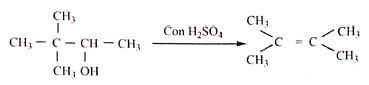
(CH3)3-C-CH(OH) CH3 \(\overset { con{ H }_{ 2 }{ SO }_{ 4 } }{ \longrightarrow } \)X (major product)
(CH3)3 CCH = CH2
(CH3)2C = C (CH3)2
CH2= C(CH3)CH2-CH2- CH3
CH2= C (CH3) - CH2- CH2- CH3
20.
Collodion is a 4% solution of which one of the following compounds in alcohol – ether mixture?
Nitroglycerine
Cellulose acetate
Glycoldinitrate
Nitrocellulose
21.
Fog is colloidal solution of _______.
solid in gas
gas in gas
liquid in gas
gas in liquid
22.
The equivalent conductance of M/36 solution of a weak monobasic acid is 6 mho cm2 equivalent-1 and at infinite dilution is 400 mho cm2 equivalent-1. The dissociation constant of this acid is ______.
1.25 x 10⁻⁶
6.25 x 10⁻⁶
1.25 x 10⁻⁴
6.25 x 10 -5
23.
Among the following cells
I) Leclanche cell
II) Nickel – Cadmium cell
III) Lead storage battery
IV) Mercury cell
Primary cells are ____.
I and IV
I and III
III and IV
II and III
24.
pH of a saturated solution of Ca(OH)2 is 9. The Solubility product (Ksp) of Ca(OH)2 _______.
0.5 × 10⁻¹⁵
0.25 × 10⁻¹⁰
0.125 × 10⁻¹⁵
0.5 × 10⁻¹⁰
25.
The solubility of BaSO4 in water is 2.42 × 10⁻³gL-1 at 298K. The value of its solubility product(Ksp) will be (Given molar mass of BaSO4 =233g mol-1)
1.08 × 10⁻¹⁴mol2L-2
1.08 × 10⁻¹²mol2L-2
1.08 × 10⁻¹⁰mol2L-2
1.08 × 10⁻⁸mol2L-2
26.
What will be the rate constant of a order reaction if its half life is given to be 20 min?
13.86 min-1
28.86 min-1
3.47 x 10⁻² min-1
None of these
27.
For an exothermic chemical process occurring in 2 steps as
(i) A +B ⟶ X (slow) ;
(ii) X ⟶ AB (fast)
The progress of the reaction can be best described by (x- intermediate).
.JPG)
.JPG)
.JPG)
None of these
28.
Which order reaction obeys the expression \({ t }_{ \frac { 1 }{ 2 } }\alpha \frac { 1 }{ \left[ A \right] } ?\)
First
Second
Third
Zero
29.
The incorrect statement regarding structure of ozone is______.
Bond angle is less than 120°
It is linear
The two oxygen-oxygen bond length in ozone are identical
Both (b) and (c).
30.
The hybridisation and shape of SF6 is respectively?
sp3d2, square planar
sp3d2, octahedral
sp3d see-saw
sp3d, trigonal bipyramidal
31.
Which is dibasic?
Orthophosphoric acid
Pyrophosphoric acid
Orthophosphorus acid
Hypophosphorous acid
32.
Crystals of NaCI has yellow colour due the presence of_________.
cation vacancy
F centres
both (a) and (b)
neither (a) nor (b)
33.
Iodine crystals are ________.
covalent
ionic
metallic
molecular
34.
The site labelled as 'X' in FCC arrangement is_______.
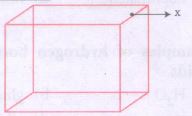
Face with 1/4 contribution
Edge with 1/4 contribution
Corner with 1/4 contribution
Tetrahedral void with 1/8 contribution
35.
Allotropy is due to ______.
difference in chemical properties
difference in the number of atoms in the molecules
difference in the arrangement of atoms in the molecules in the crystal
None of these
36.
Boron compounds behave as Lewis acid, because of their _______.
ionisation property
acidic nature
covalent nature
electron deficient nature
37.
Graphite has _______.
2-d sheet structure
Vander waals force between successive layers of carbon sheets
Sp2 hybridised carbon linked with other three carbon atoms in hexagonal planar structure
all the above
38.
Equivalent weight of KMnO4 in acidic medium is _______.
3.16
31.6
158
52.67
39.
The general electronic configuration of d-block elements can be written as ________.
[Noble gas]n - 1d1-10 ns1-2
[Noble gas]n - 1d-10 n1-6
[Noble gas]n - 2 d10 ns1-2
[Noble gas]n - 2 d10 ns1-6
40.
CrO3 is coloured due to_______.
Low L.E
Crystal defects
Charge transfer spectra
Unpaired electrons
41.
Metal oxide is converted into metal by the _______ process.
Calcination
roasting
smelting
bessemerisation
42.
\({ Zn }_{ (s) }+2\left[ Au(CN)_{ 2 } \right] ^{ - }_{ (aq) }\longrightarrow \left[ Zn(CN)_{ 4 } \right] ^{ 2- }_{ (aq) }+2A{ { u }_{ (s) } }\) In the above equation the oxidation state of metallic gold is_______
1
0
+2
-2
43.
Which one of the following element is present as a impurity in pig iron?
Phosphorus
Manganese
Carbon
Silicon
44.
______is used as an antitumor drug in cancer treatment.
Ca - EDTA
Cis - platin
Sodium thio sulphate
Nickel chloride
45.
An example of ambidentate ligand is _________.
cyano
nitro
chloro
triphenylphosphine
46.
The ligand capable of coordinating in two or more ways with the central metal ion are called _______ ligands.
didentate
tridentate
ambidentate
none of the above
47.
The half life period of a radioactive element is 140 days. After 560 days, 1 g of element will be reduced to
\(\left( \frac { 1 }{ 2 } \right) g\)
\(\left( \frac { 1 }{ 4 } \right) g\)
\(\left( \frac { 1 }{ 8 } \right) g\)
\(\left( \frac { 1 }{ 16 } \right) g\)
48.
49.
CsCl has bcc arrangement, its unit cell edge length is 400pm, its inter atomic distance is ________.
400pm
800pm
\(\sqrt { 3 } \times 100pm\)
\(\left( \frac { \sqrt { 3 } }{ 2 } \right) \times 400pm\)
50.
Solid CO2 is an example of ________.
Covalent solid
metallic solid
molecular solid
ionic solid
51.
How many geometrical isomers are possible for [Pt(Py)(NH3)(Br)(Cl)]
3
4
0
15
52.
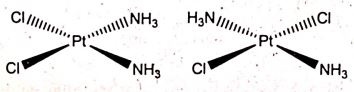
Which type of isomerism is exhibited by [Pt(NH3)2Cl2]?
Coordination isomerism
Linkage isomerism
Optical isomerism
Geometrical isomerism
53.
The actinoid elements which show the highest oxidation state of +7 are _______.
Np, Pu, Am
U, Fm, Th
U, Th, Md
Es, No, Lr
54.
Which one of the following ions has the same number of unpaired electrons as present in V3+?
Ti3+
Fe3+
Ni2+
Cr3+
55.
| Column-I | Column-II | ||
| A | Borazole | 1 | B(OH)3 |
| B | Boric acid | 2 | B3N3H6 |
| C | Quartz | 3 | Na2[B4O5(OH)4]8H2O |
| D | Borax | 4 | SiO2 |
| A | B | C | D |
| 2 | 1 | 4 | 3 |
| A | B | C | D |
| 1 | 2 | 4 | 3 |
| A | B | C | D |
| 1 | 2 | 4 | 3 |
None of these
56.
Which of the following statements is not correct?
Beryl is a cyclic silicate
Mg2SiO4 is an orthosilicate
SiO44−is the basic structural unit of silicates
Feldspar is not aluminosilicate
57.
On oxidation with iodine, sulphite ion is transformed to _______.
S4O62-
S2O62-
SO42-
SO32-
58.
Electrochemical process is used to extract_______.
Iron
Lead
Sodium
silver
59.
Bauxite has the composition ______.
Al2O3
Al2O3.nH2O
Fe2O3.2H2O
None of these
60.
Write the structural formula of
(i) p - methyl benzaldehyde
(ii) 2 - methyl cyclohexanone
61.
Complete the following reaction

62.
Which will adsorb more gas, a lump of charcoal or its powder and why?
63.
Write a note on dialysis.
64.
Higher the standard reduction potential lesser is corrosion. Give reason.
65.
On what does the emf of a lead storage battery depend?
66.
Preparation of ethers by intermolecular dehydration of alcohols in the presence of an add is not a suitable method for mixed ethers. Give reason.
67.
Give reasons: Methanol is miscible with water while iodo-methane is not.
68.
How is common ion effect related to the solubility of the electrolyte?
69.
Define Buffer solution.
70.
Calculate the molar conductance of 0.025M aqueous solution of calcium chloride at 25°C. The specific conductance of calcium chloride is 12.04 x 10⁻² Sm-1.
71.
Calculate the pH of 0.001M HCl solution
72.
Calculate the concentration of OH- in a fruit juice which contains \(2\times10^{-3}\) M, H3O+ ion. Identify the nature of the solution.
73.
Define pH.
74.
A poster suggests the following life style on the part of families / individuals.
(i) Which environmental values are promoted through these life style?
(ii) Suggest one additional life style action for promotion of green chemistry.
(iii) Give reason for the bleaching action of KMnO4
75.
Many industrial processes use transition metal or their compounds as catalyst. Why?
76.
If the rate of a reaction gets doubled as the temperature is increased from 27oC to 37oC. Find the activation energy of reaction?
77.
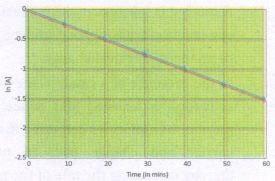
For a chemical reaction, Variation in the concentration In[A] Vs time in seconds is given as
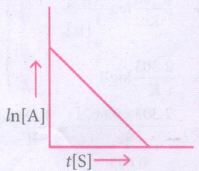
(i) What is the order of the reaction?
(ii) What is the unit of rate constant K?
(iii) Give the relationship between k and \({ t }_{ \frac { 1 }{ 2 } }\)
78.
Why hydrides of oxygen is a liquid whereas hydride of sulphur is a gas?
79.
Elements of group 16 show lower value of first ionization enthalpy compared to group 15, why?
80.
NaCI has a sharp melting point but glass does not - Justify.
81.
Classify the following as amorphous or crystalline solids. Polyurethane, Naphthalene, Benzoic acid, Teflon, Potassium nitrate, Cellophane, Polyvinyl chloride, Fiber glass, Copper.
82.
Name the building block of zeolites. Why zeolites have high porosity?
83.
What happens to CO2 when dissolved in water?
84.
Write the chemical reactions involved in the extraction of gold by cyanide process. Also give the role of zinc in the extraction.
85.
Name the metals that are obtained from their oxides using hydrogen as reducing agent.
86.
What is the coordination number of central metal ion in [Fe(C2O4)3]3-?
87.
Write a neutral molecule in which the central atom is Sp3d2 hybridised.
88.
Identify the order for the following reactions
(i) Rusting of Iron
(ii) Radioactive disintegration of 92U238
(iii) 2A+3B⟶ products ;rate = k[A]1/2[B]2
89.
Explain why compounds of Cu2+ are coloured but those of Zn2+ are colourless.
90.
Explain the oxidation states of 4d series elements.
91.
Why tetrahedral complexes do not exhibit geometrical isomerism.
92.
[Ti(H2O)6]3+ is coloured, while [Sc(H2O)6]3+ is colourless- explain.
93.
Calculate the ratio of \(\frac { \left[ { Ag }^{ + } \right] }{ \left[ Ag\left( NH_{ 3 } \right) _{ 2 } \right] ^{ + } } \) in 0.2 M solution of NH3. If the stability constant for the complex \([Ag(NH_{ 3 })_{ 2 }]^{ + }\) is 1.7 x 10⁷
94.
95.
Complete the following reactions.
a. \(B(OH)_3 + NH_3\longrightarrow \)
b. \(Na_{ 2 }B_{ 4 }{ O }_{ 7 }+{ { H }_{ 2 }{ SO }_{ 4 }+{ 5H }_{ 2 }O\longrightarrow }\)
c. \({ B }_{ 2 }{ H }_{ 6 }+2NaOH+2{ H }_{ 2 }O\longrightarrow \)
d. \({ B }_{ 2 }{ H }_{ 6 }+6{ CH }_{ 3 }OH\longrightarrow \)
e. \(4{ BF }_{ 3 }+3{ H }_{ 2 }O\longrightarrow \)
f. \(HCOOH+{ H }_{ 2 }{ SO }_{ 4 }\longrightarrow \)
g. \(2SiCl_{ 4 }+NH\)3
h. SiCl4 + 4C2H5OH \(\rightarrow\)
i. 2\(B+6NaOH\longrightarrow \)
j. \({ H }_{ 2 }{ B }_{ 4 }{ O }_{ 7 }\overset { Red\ hot }{ \rightarrow } \)
96.
Give the oxidation state of halogen in the following.
a) OF2
b) O2F2
c) Cl2O3
d) I2O4
97.
What is inert pair effect?
98.
Give the structure of CO and CO2.
99.
What is the role of quick lime in the extraction of Iron from its oxide Fe2O3?
100.
Write short notes on Popoff's rule.
101.
Halo alkane are easily prepared from alcohols while alkyl halides cannot be prepared from phenol. Justify.
102.
Write a note on auto catalysis?
103.
Give the oxidation and reduction half cell reaction taking place in the Daniel cell.
104.
Based on Arrhenius concept, defame acid and bases and give an example for each.
105.
Write the mechanism of acid catalysed dehydration of ethanol to give ethene.
106.
The rate constant for a first order reaction is 60 S-1. How much time will it take to reduce the initial concentration of the reactant to its \({ \frac { 1 }{ 16 } }^{ th }\) value?
107.
What is meant by lanthanoid contraction?
108.
Explain the commercial method of preparation of nitric acid.
109.
Why are solids incompressible?
110.
Account for the following:
(i) CO is used in the extraction of metals.
(ii) CO is poisonous
(iii) CO2 is used in refrigeration
111.
What is meant by aluminothermic process?
112.
Match the common name with formula and the IUPAC ligand name.
| Common name | Formula | IUPAC ligand name |
|---|---|---|
| Bromide | C2O42- | Carbonato |
| Nitrate | Br- | Oxalato |
| hydroxide | NO3- | hydroxido |
| Carbonate | OH- | bromido |
| Oxalate | CO32- | nitrato |
113.
The rate law for a reaction of A, B and C has been found to be rate = k[A]2[B][L]3/2 How would the rate of reaction change when
(i) Concentration of [L] is quadrupled
(ii) Concentration of both [A] and [B] are doubled
(iii) Concentration of [A] is halved
(iv) Concentration of [A] is reduced to \(\left(\frac{1}{3}\right)\) and concentration of [L] is quadrupled.
114.
Describe the graphical representation of first order reaction.
115.
Explain the variation in E0M3+/M2+ 3d series.
116.
117.
118.
Compound (A) with Molecular formula C7H6O does not reduce Fehling's solution. Compound (A) reacts with acetone in the presence of NaOH to give a compound (B) which is an α, β-unsaturated compound. Further (A) reacts with dimethyl aniline in the presence of cone, H2SO4 to give compound (C) which is a dye. Identify (A) (B) and (C). Explain the reactions.
119.
What are ethers? Write note on simple and mixed ethers with examples.
120.
Explain electrodialysis
121.
Specific conductance of 1M KNO3 solution is oberved to be 5.55 x 10⁻³ mho cm2. What is the equivalent conductance of KNO3 when one litre of the solution is used?
122.
Derive the relationship between pH and pOH.
123.
What are the factors which influence the adsorption of a gas on a solid?
124.
The conductivity of a 0.01M solution of a 1 :1 weak electrolyte at 298K is 1.5\(\times\)10-4 S cm−1.
i) molar conductivity of the solution
ii) degree of dissociation and the dissociation constant of the weak electrolyte
Given that
\(\lambda^{0}_{cation}=248.2 \ S\) cm2 mol-1
\(\lambda^{0}_{anlon}=51.8 \ S\) cm2 mol-1
125.
Describe the construction of Daniel cell. Write the cell reaction.
126.
Complete the following reactions
(i) Cr2O72- ⟶
(ii) Cr2O72- + 6I-+ 14H+ ⟶
(iii) Cr2O72-+ 3S2-+ 14H+ ⟶
(iv) Cr2O72- + 3SO2 + 2H+ ⟶
(v) Cr2O72- + 3Sn2+ + 14H+ ⟶
(vi) K2Cr2O7 + 8H2SO4 + 3CH3CH2OH ⟶
(vii) 2MnO4- + 5(COO)2- + 6H+ ⟶
(viii) 2MnO4- + 10I- + 16H+ ⟶
(ix) 2MnO4- + 5S2-+ 16H+ ⟶
(x) 2MnO4- + 5NO2- + 6H+ ⟶
(xi) 2KMnO4 + 3H2SO4 + 5CH3CH2OH ⟶
(xii) 2MnO4- + 5SO32- + 6H+ ⟶
127.
State the characteristics of order of reactions.
128.
How is sulphuric acid manufacture by contact process?
129.
How can you determine the atomic mass of an unknown metal if you know its density and the dimension of its unit cell? Explain.
130.
What are the various methods by which carbon-di-oxide is prepared?
131.
List out the application of aluminum.
132.
For the complex [NiCI4]2- write (i) the IUPAC name (ii) The hybridisation type (iii) The shape of the complex
1.
(a)
mesitylene
2.
(a)
ohm metre
3.
(b)
Wmax = ΔG
4.
(d)
K2Cr2O7
5.
(a)
143 mho cm2 gm equiv-1
6.
(b)
nucleophilic addition
7.
(c)
starch
8.
(c)
gums
9.
(b)
catalytic poison
10.
(c)
proton donor
11.
(d)
both (b) and (c)
12.
(c)
\({ [{ X }^{ n+ }] }^{ m }/{ [Y^{ m- }] }^{ n }\)
13.
(a)
NH4OH and NH4CI
14.
(d)
HCHO
15.
(c)
CH3CH (OH) CH2OH
16.
(b)
Fehling’s solution
17.

18.
Cyclic alcolhol → sodium cyclic alkoxide- Williamson ether synthesis.
19.
(CH3)2C = C (CH3)2
20.
Pyroxylin(nitro cellulose)
21.
dispersion medium-gas
dispersed phase-liquid
22.
α = Λ/Λo
= 6/400
Ka = α2C
\(= \frac{6}{400} \times \frac{6}{400} \times \frac{1}{36}\)
= 6.25 x 10⁻⁶
23.
(a)
I and IV
24.
Ca(OH)2 ⇌ Ca2+ + 2OH-
Given that pH = 9
pOH = 14 - 9 = 5
[pOH = - log10 [OH]]
[OH-] = 10 [pOH]
[OH] = 10-5 M
Ksp = [Ca2+] [OH-]
= 10-5/2 x (10-5)2 = 0.5 x 10⁻¹⁵
25.
BaSO4 ⇌ Ba2+ + SO42-
Ksp = (s) (s)
Ksp = (s)2
= (2.42 × 10⁻³gL-1)2
\(=\frac{2.42 \times 10^{-3} gL^{-1}}{233 \text{ g mol}^{-1}}\)
= (0.01038 x 10⁻³)2
= (1.038 x x 10-5)2
= 1.077 x 10-10
= 1.08 × 10⁻¹⁰mol2L-2
26.
(c)
3.47 x 10⁻² min-1
27.
(c)
28.
(b)
Second
29.
(b)
It is linear
30.
(b)
sp3d2, octahedral
31.
(c)
Orthophosphorus acid
32.
(b)
F centres
33.
(d)
molecular
34.
(c)
Corner with 1/4 contribution
35.
(c)
difference in the arrangement of atoms in the molecules in the crystal
36.
(d)
electron deficient nature
37.
(d)
all the above
38.
(b)
31.6
39.
(a)
[Noble gas]n - 1d1-10 ns1-2
40.
(c)
Charge transfer spectra
41.
(c)
smelting
42.
(b)
0
43.
(c)
Carbon
44.
(b)
Cis - platin
45.
(b)
nitro
46.
(c)
ambidentate
47.
In 140days ⇒ initial concentration reduced to (1/2) g
In 280 days ⇒ initial concentration reduced to (1/4) g
In 420 days ⇒ initial concentration reduced to (1/8) g
In 560 days ⇒ initial concentration reduced to (1/16) g
48.
(d)
49.
\(3 \sqrt{a} = r_{C_{s+}} + 2r_{C_{f-}} + r_{C_{s+}} \)
\(\left( \frac { \sqrt { 3 } }{ 2 } \right) a = r_{C_{s+}} + r_{C_{f-}} \)
\(\left( \frac { \sqrt { 3 } }{ 2 } \right) \times 400\)= inter ionic distance
50.
Lattice points are occupied by CO2 molecules
51.
Three isomers. If we consider any one of the ligands as reference (say Py), the arrangement of other three ligands (NH3, Br- and Cl-) with respect to (Py) gives three geometrical isomers.
52.
53.
(a)
Np, Pu, Am
54.
(c)
Ni2+
55.
(a)
| A | B | C | D |
| 2 | 1 | 4 | 3 |
56.
(d)
Feldspar is not aluminosilicate
57.
(c)
SO42-
58.
(c)
Sodium
59.
(b)
Al2O3.nH2O
60.
(i)
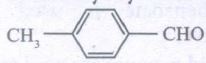
(ii)
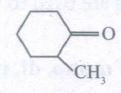
61.
HCHO + CaCO3
62.
Powdered charcoal will adsorb more gas because of its larger surface area than a lump of charcoal.
63.
(i) In this method, the colloidal solution is taken in a bag made up of semipermeable membrane.
(ii) It is suspended in a trough of flowing water, the electrolytes diffuse out of the membrane and they are carried away by II water.
64.
The greater the Eo value means greater is the tendency shown by the species to accepts I electrons and undergo reduction. So higher the (Eo) values lesser is the tendency to undergo corrosion.
65.
The emf of the cell depends on the concentration of H2SO4 As the cell reaction uses \({ SO }_{ 4 }^{ 2- }\) ions, the concentration H2SO4 decreases. When the cell potential falls to about 1.8V; the cell has to be recharged.
66.
This method is useful for the preparation of simple ethers and not suitable for preparing mixed ethers. If a mixture of two different alcohols is used, mixture of different ethers will be formed and they are difficult to separate.
67.
(i) Methanol (CH3OH) is miscible with water because it is able to form hydrogen bonding with water due whereas iodo-methane (CH3I)does not contain -OH group.
(ii) Since it is not able to form hydrogen bonding with water it is insoluble in water.
68.
Common ion effect decreases the solubility of the electrolyte.
69.
Buffer is a solution which consists of a mixture of a weak acid and its conjugate base (or) a weak base and its conjugate acid.
70.
Molar conductance = Λm = \( \frac{k\ (Sm^{-1})\times10^{-3}}{M} mol^{-1}m^{3} \)
\(= \frac{(12.04 \times 10^{-2} Sm^{-1}) \times 10^{-3} (mol^{-1}m^{3})} {0.025}\)
= 481.6 x 10⁻⁵ Sm2mol-1
71.
\(\underset{0.001M}{HCl}\overset{H_{2}O}{\rightleftharpoons }\underset{0.001M}{H_{3}O^{+}}+\underset{0.001M}{Cl^{-}}\)
H3O+ from the auto ionisation of H2O (10-7M) is negligible when compared to the H3O+ from 10-3M HCl.
Hence [H3O+] = 0.001 mol dm-3
pH = -log10 [H3O+]
= -log10(0.001)
= -log10(10-3) = 3
72.
Given that H3O+ = \(2\times10^{-3}M\)
\(K_{w}=[H_{3}O^{+}][OH^{-}]\)
\(\therefore [OH^{-}]=\frac{K_{w}}{[H_{3}O^{+}]}=\frac{1\times10^{-14}}{2\times10^{-3}}=0.5\times10^{-11}M\)
\(2\times10^{-3} >>0.5\times10^{-11}\)
i.e., [H3O+]>>[OH-], hence the juice is acidic in nature
73.
(i) pH = -log10 [H3O+]
(ii) The pH of a solution is defined as the negative logarithm of base 10 of the molar concentration of the hydronium ions present in the solution.
74.
(i) Environmental conservation
(ii) Use jute bags or cloth bags in place of polythene bags.
(iii) KMnO4 acts as a strong oxidising agent.
75.
Transition metal has energetically available d orbitals that can accept electrons from reactant molecule or metal can form bond with reactant molecule using its d electrons. For example, in the catalytic hydrogenation of an alkene, the alkene bonds to an active site by using its π electrons with an empty d orbital of the catalyst.
76.
In \(\frac { { k }_{ 2 } }{ { k }_{ 1 } } =\frac { { E }_{ a } }{ R } \left[ \frac { { T }_{ 2 }-{ T }_{ 1 } }{ { T }_{ 1 }{ T }_{ 2 } } \right] \)
In 2 = \(\frac { { E }_{ a } }{ R } \) \(\left[ \frac { 10 }{ 300\times 310 } \right] \)
Ea = 9300 R In 2
= 53.4 kJ mol-1
77.
(i) I Order reaction
(ii) S-1
(iii) \({ t }_{ \frac { 1 }{ 2 } }\) = 0.693/k
78.
(i) H2O undergoes extensive H-bonding due to high electronegativity of O-atom and hence exist as an associated molecule.
(ii) Therefore H2O is a liquid. On the other hand H2O does not undergo H-bonding and hence exists as a discrete molecules and as a gas.
79.
Element of group 15 have stable half-filled p-orbitals hence large amount of energy is required to remove electrons as compared to group 16, which has an incomplete p subshell.
80.
NaCl is a crystalline solid so possess sharp melting points where as glass is amorphous in nature so does not have sharp melting point.
81.
| Amorphous Solids | Crystalline solids |
| Polyurethane | Naphthalene |
| Teflon | Benzoic acid |
| Cellophane | Potassium nitrate |
| Polyvinyl chloride | Copper |
| Fiber glass |
82.
(i) Zeolites have a three dimensional crystalline structure looks like a honeycomb consisting of a network of interconnected tunnels and cages.
(ii) Water molecules moves freely in and out of these pores hence they are highly porous.
83.
The aqueous solution of carbon dioxide is slightly acidic as it forms carbonic acid.
CO2 + H2O ⇌ H2CO3 ⇌ H+ + HCO3-
84.
(i) Gold is usually found in native state
(ii) The leaching process is intended to concentrate the gold metal
\(4Au_{ (s) }+8Na{ CN }_{ (aq) }^{ - }+2{ H }_{ 2 }O_{ (aq) }+{ O }_{ 2(g) }\longrightarrow 4Na[Au\left( CN \right) _{ 2 }]^{ - }_{ (aq) }+4NaO{ H }^{ -1 }_{ (aq) }\)
\(2Na\left[ Au(CN)_{ 2 } \right] +Zn\longrightarrow { Na }_{ 2 }\left[ Zn\left( CN \right) \right] +2Au\downarrow \)
(iii) In this reaction, Zn acts as a reducing agent.
85.
Iron, Lead and Copper
86.
Six
87.
K3[CoF6]
88.
(i) First order reaction
(ii) First order reaction
(iii) \(\frac{1}{2}+2=2 \frac{1}{2}\); Pseudo first order reaction
89.
(i) The compounds of Cu2+ are coloured as it has one free electron its valence shell which absorb I radiation of visible region and get excited to emit its complementary colour.
(ii) Zn has no free electron it has fully filled shells. Due to extra stable orbitals electron can't be excited by radiations of visible light, hence its compounds are colourless.
90.
The oxidation states of 4d metals vary from +3 for Y to +8 for Ru and Os.
The highest oxidation state of 4d elements are found in their compounds with the higher electronegative elements like O, F & Cl.
Example: In RuO4, OsO4 & WCl6
The oxidation state of Ru and Os is +8.
The oxidation state of W is +6.
Generally in going down a group, a stability of higher oxidation state increases while that of lower oxidation state decreases.
4d series (5th period) - Yttrium to Cadmium (10 elements)
| Elements | Oxidation states |
|---|---|
| Y | +3 |
| Zr | +3, +4 |
| Nb | +2, +3, +4, +5 |
| Mo | +2, +3, +4, +5, +6 |
| Tc | +2, +4, +5, +7 |
| Ru | +2, +3, +4, +5, +6, +7 +8 |
| Rh | +2, +3, +4, +6 |
| Pd | +2, +3, +4 |
| Ag | +1, +2, +3 |
| Cd | +2 |
91.
Tetrahedral complexes do not exhibit geometrical isomerism. Because the relative position of donor atoms of ligand the unidentate Iigands (donor atom) attached to the central atom are same with respect to each other.
92.
\({ }_{22} \mathrm{Ti}-{ }_{18}[\mathrm{Ar}] 4 \mathrm{s}^{2} 3 \mathrm{d}^{2} / {}_{21}\mathrm{Sc}-{ }_{18}[\mathrm{Ar}] 4 \mathrm{~s}^{2} 3 \mathrm{~d} \)
\({ }_{22} \mathrm{Ti}^{3+}-{ }_{18}[\mathrm{Ar}] 3 \mathrm{~d}^{1} /{ }_{18} \mathrm{Sc}^{3+}{ }_{18}[\mathrm{Ar}] 3 \mathrm{~d}^{0}\)
(i) In this complex the central metal ion is Ti3+, which has d1 configuration. This single electron occupies one of the t2g orbitals in the octahedral aqua ligand field. When white light falls on this complex the electron absorbs light and promotes itself to eg level. The spectral data show the absorption maximum is at 20000 cm-1 corresponding to the crystal field splitting energy \(\left(\Delta_{o}\right)\) 239.7 kJmol-1. The transmitted colour associated with this absorption is purple and hence the complex appears purple in colour.
(ii) Thus in \(\left[\mathrm{Ti}\left(\mathrm{H}_{2} \mathrm{O}\right)_{6}\right]^{3+} \mathrm{d}-\mathrm{d}\) transition takes place.
(iii) But in \(\left[\mathrm{Sc}\left(\mathrm{H}_{2} \mathrm{O}\right)_{6}\right]^{3+} \mathrm{Sc}^{3+}\) has the outer electronic configuration of 3d0 where d-d transition is not possible and it is colourless.
93.
\({ Ag }^{ + }2N{ H }_{ 3 }\rightleftharpoons { \left[ { Ag\left( { { NH }_{ 3 } } \right) }_{ 2 } \right] }^{ + }\)
\(k=\frac { { \left[ { Ag\left( { { NH }_{ 3 } } \right) }_{ 2 } \right] }^{ + } }{ \left[ { Ag }^{ + } \right] { \left[ { NH }^{ 3+ } \right] }^{ 2 } } \)
\(=\frac { \left[ { Ag }^{ + } \right] }{ { \left[ { Ag\left( { NH }_{ 3 } \right) }_{ 2 } \right] }^{ + } } =\frac { 1 }{ k{ \left( { NH }_{ 3 } \right) }^{ 2 } } \)
\(=\frac { 1 }{ 1.7\times { 10 }^{ 7 }\times { \left( 0.2 \right) }^{ 2 } } =\frac { { 10 }^{ -7 } }{ 1.7\times 4\times { 10 }^{ -2 } } \)
\(=\frac { { 10 }^{ -5 } }{ 6.8 } =1.47\times { 10 }^{ -5 }\)
94.
95.
(a) B(OH)3 + NH3\(\overset { \Delta }{ \longrightarrow } \) BN + 3H2O
(Boron nitride)
(b) Na2B4O7 + H2SO4 + 5H2O \(\longrightarrow \) 4H3BO3 + Na2SO4
(Boric acid)
(c) B2H6 + 2NaOH + 2H2O \(\longrightarrow \)2NaBO2 + 6H2
(Sodium metaborate)
(d) B2H6 + 6CH3OH \(\longrightarrow \)2B(OCH3)3 + 6H2O
(Trimethyl borate)
(e) 4BF3 + 3H2O \(\longrightarrow \) H3BO3 + 3H+ + 3[BF4]-
(Boric acid)
(f) HCOOH + H2SO4 \(\longrightarrow \)CO + H2SO4. H2O
(Carbon monoxide)
(g) 2SiCl4 + NH3 \(\overset { 330K }{ \underset { ether }{ \longrightarrow } } \)Cl3Si- NH - SiCl3 + 2HCl
(Chlorosilazane)
(h) SiCl4 + 4C2H5OH\(\longrightarrow \)Si(OC2H5)4 + 4HCI
(Tetraethoxysilane)
(i) 2B + 6NaOH\(\longrightarrow \) 2Na3BO3 + 3H2
(j) H2B4O7 \(\xrightarrow[]{Redhot}\) 2B2O3 + H2O
96.
(a) OF2
+ 2 + 2(x) = 0
+2 = -2x
2 x = -2 ⇒ x = -1
(b) O2F2
2(+1) + 2x = 0
2x = -2
x = -1
(c) Cl2O3
2(x) + 3(-2) = 0
2x = +6
x = +3
(d) I2O4
2(x) + 4(-2) = 0
2x = +8
x = +4
97.
(i) In heavier post transition metals, the outers electrons (ns) have a tendency to remain inert and show reluctance to take part in the bonding, which is known as inert pair effect.
(ii) This effect is also observed in groups 14, 15 and 16.
98.
| Oxides of Carbon | Structure | Parameters |
| CO |  |
Three electron pairs are shared between carbon and oxygen. The C-O bond distance is 1.128\(\overset{o}{A}\). |
| CO2 |  |
Equal bond distance for the both C-O bonds. Two C-O sigma bond, It has 3c-4e bond. |
99.
In this extraction, a basic flux, quick lime (CaO) is used, since the silica gangue present in the ore is acidic in nature. The quick lime combines with it to form calcium silicate (slag).
CaO(s) + Sio2(s) ⟶ CaSio3(s)
Flux Gangue Slag
100.
During oxidation of unsymmetric ketones with oxidising agent which brings about the cleavage of C-C bond, the smaller alkyl group goes preferentially with the carbonyl group resulting in the carboxylic acids.
\({ CH }_{ 3 }-{ CH }_{ 2 }-{ CH }_{ 2 }-\underset { \overset { || }{ O } }{ C } -{ CH }_{ 3 }\overset { (O) }{ \underset { Con.HNO_{ 3 } }{ \longrightarrow } } \underset { Propanoic\ acid }{ { CH }_{ 3 }{ CH }_{ 2 }-COOH } +\underset { acetic\ acid }{ { CH }_{ 3 }COOH } \)
101.
(i) Alcohols are weakly basic in nature so easily in presence of strong acids.
(ii) Due to the presence of +ve charge on the oxygen atom, C-O in protonated alcohols became weak hence easily cleaved by halide ions to form alkyl halides.
(iii) Where as phenols are much weaker bases due to delocalisation of the lone pair of electrons on the oxygen atom due to resonance and so are not easily protonated.
(iv) The C-O bond in phenols has some double bond character; hence not easily cleaved by halide ions to form respective alkyl halides.
102.
(i) In certain reactions one of the products formed acts as a catalyst to the reaction.
(ii) Initially the rate of reaction will be very slow but with the increase in time the rate of reaction increases.
(iii) Auto catalysis is observed in the following reactions.
\({ CH }_{ 3 }COO{ C }_{ 2 }{ H }_{ 5 }+{ H }_{ 2 }O\longrightarrow CH_{ 3 }COOH+{ C }_{ 2 }{ H }_{ 5 }OH\)
Acetic acid acts as the auto catalyst.
(iv) \(2As{ H }_{ 3 }\longrightarrow 2As+{ 3H }_{ 2 }\)
Arsenic acts as an autocatalyst.
103.
Zinc is oxidised to Zn2+ ions and the Cu2+ ions are reduced to metallic copper. The half reactions are represented as below.
\( { Zn }_{ (s) }\rightarrow { Zn }_{ (aq) }^{ + }+2e^{ - }\) (oxiation)
Loss of election oxidation
\({ Cu }_{ (aq) }^{ 2+ }+{ 2e }^{ - }\rightarrow { Cu }_{ (s) }\) (reduction)
Gain of electron oxidation.
104.
According to Arrhenius, an acid is a substance that dissociates to give hydrogen ions in water. For example, HCl, H2SO4 etc., are acids. Their dissociation in aqueous solution is expressed as
\({ HCl }_{ (g) }\overset { { H }_{ 2 }O }{ \rightleftharpoons } { H }_{ (aq) }^{ + }+{ Cl }_{ (aq) }^{ - }\)
Similarly a base is a substance that dissociates to give hydroxyl ions in water. For example, substances like NaOH, Ca(OH)2 etc., are bases.
\({ Ca(OH) }_{ 2 }\overset { { H }_{ 2 }O }{ \rightleftharpoons } { Ca }_{ (aq) }^{ 2+ }+{ 2OH^- }_{ (aq) }\)
105.
\({ CH }_{ 3 }-{ CH }_{ 2 }-OH\overset { { H }_{ 2 }{ SO }_{ 4 } }{ \underset { 443k }{ \longrightarrow } } { CH }_{ 2 }={ CH }_{ 2 }+{ H }_{ 2 }O\)
Mechanism
Primary alcohols undergo dehydration by E2 mechanism

106.
It is know that,
\(t=\frac { 2.303 }{ k } \log { \frac { { \left[ R \right] }_{ 0 } }{ \left[ R \right] } } \)
= \(\frac { 2.303 }{ 60{ s }^{ -1 } } \log\frac { 1 }{ \frac { 1 }{ 16 } } \)
= \(\frac { 2.303 }{ 60{ s }^{ -1 } } \log16\)
= 4.6 x 10⁻² s (approximately)
Hence the required time is 4.6 x 10⁻² s
107.
The steady decrease in the atomic/ionic radius from La3+ to Lu3+ is called lanthanoid contraction.
108.
Commercial method of preparation
(i) Nitric acid prepared in large scales using Ostwald's process. In this method ammonia from Haber's process is mixed about 10 times, of air.
(ii) This mixture is preheated and passed into the catalyst chamber where they come in contact with platinum gauze.
(iii) The temperature rises to about 1275 K and the metallic gauze brings about the rapid catalytic oxidation of ammonia resulting in the formation of NO, which then oxidised to nitrogen dioxide.
\({ 4NH }_{ 3 }+{ 5O }_{ 2 }\longrightarrow 4NO+6{ H }_{ 2 }O+120KJ\)
\(2NO+{ O }_{ 2 }\longrightarrow { 2NO }_{ 2 }\)
(iv) The nitrogen dioxide produced is passed through a series of adsorption towers. It reacts with water to give nitric acid. Nitric acid formed is bleached by blowing air.
\({ 6NO }_{ 2 }+3{ H }_{ 2 }O\longrightarrow { 4HNO }_{ 3 }+2NO+{ H }_{ 2 }O\)
109.
(i) Compressibility is the ability of the substance to change its shape by applying external pressure.
(ii) Solids form closed packed structure with negligible intermolecular space and possesses very strong intermolecular forces of attraction.
(iii) Thus, they do not change their shape in the presence of external pressure.
110.
(i) CO being a good reducing agent, reduces several metal oxides into crude metal. Hence it is used in extraction of metals.
(ii) CO forms carboxy-hemoglobin complex with hemoglobin of blood which is about 300 times mores stable than oxygen - hemoglobin complex and thus it stops the supply of oxygen and hence, leads to death of the person.
(iii) Solid CO2, produce cooling and sublimes directly into vapour state, hence used for refrigeration.
111.
(i) Metallic oxides such as Cr2O3 can be reduced by an aluminothermic process.
(ii) In this process, the metal oxide is mixed with aluminum powder and placed in a fire clay crucible.
(iii)To initiate the reduction process, an ignition mixture (usually magnesium and barium peroxide is used
\({ BaO }_{ 2 }+Mg\longrightarrow Bao+MgO\)
(iv) During the above reaction a large amount of heat is evolved (temperature up to 2400°C, is generated and the reaction enthalpy is: 852 kJ mol-1 which facilitates the reduction of Cr2O3 by aluminium power.
\({ Cr }_{ 2 }{ O }_{ 3 }+2Al\overset { \Delta }{ \longrightarrow } 2Cr+{ Al }_{ 2 }{ O }_{ 3 }\)
112.
| Common name | Formula | IUPAC ligand name |
|---|---|---|
| Bromide | Br- | bromido |
| Nitrate | NO3- | nitrato |
| hydroxide | OH- | hydroxido |
| Carbonate | CO32- | Carbonato |
| Oxalate | C2O42- | Oxalato |
113.
(i) Reaction Rate = \(k{ \left[ A \right] }^{ 2 }{ \left[ B \right] }{ \left[ L \right] }^{ 3/2 }\) ...(1)
When [L] = [4L]
Rate = \(k{ \left[ A \right] }^{ 2 }{ \left[ B \right] }{ \left[ 4L \right] }^{ 3/2 }\)
The Reaction Rate = \(8(k{ \left[ A \right] }^{ 2 }{ \left[ B \right] }{ \left[ L \right] }^{ 3/2 })\) ...(2)
Comparing (1) and (2) rate is increased by 8 times
(ii) [A] = [2A] and [B] = [2B]
Reaction Rate = \(k{ \left[ 2A \right] }^{ 2 }\left[ 2B \right] { \left[ L \right] }^{ 3/2 }\)
Reaction Rate = \(\\ 8(k{ \left[ A \right] }^{ 2 }{ \left[ B \right] }{ \left[ L \right] }^{ 3/2 })\) ...(3)
Comparing (1) and (3) rate is increased by 8 times
(iii) \(\left[ A \right] =\left[ \frac { A }{ 2 } \right] \)
Reaction Rate = \(k{ \left[ \frac { A }{ 2 } \right] }^{ 2 }{ \left[ B \right] }{ \left[ L \right] }^{ 3/2 }\)
Reaction Rate = \(\frac { 1 }{ 4 } \left( k\left[ { A }^{ 2 } \right] { \left[ B \right] }{ \left[ L \right] }^{ 3/2 } \right) \) ...(4)
Comparing (1) and (4); rate is reduced to (1/4) times.
(iv) \(\left[ A \right] =\left[ \frac { 1 }{ 3 }A \right] and\left[ L \right] =\left[ 4L \right] \)
Rate = \(k{ \left[ \frac { 1 }{ 3 }A \right] }^{ 2 }{ \left[ B \right] }{ \left[ 4L \right] }^{ 3/2 }\)
Rate = \(\left( \frac { 8 }{ 9 } \right) \left( k{ \left[ A \right] }^{ 2 }{ \left[ B \right] }{ \left[ L \right] }^{ 3/2 } \right)\) ...(5)
Comparing (1) and (5); rate is reduced to \(\frac { 8 }{ 9 } \) times.
114.
A Reaction whose rate depends on the reactant concentration raised to the first power is called a first order reaction. For a first order reaction,
A ⟶ product
Rate law can be expressed as
Rate = k[A]-1
\(\frac { -d\left[ A \right] }{ \left[ A \right] } =k dt\) ...(1)
Integrate the above equation between the limits of time t = 0 and time equal to t, while the concentration varies from the initial: concentration [Ao] to [A] at the later time.
\(\int _{ { [A }_{ 0 }] }^{ [A] }{ \frac { -d\left[ A \right] }{ \left[ A \right] } } =k\int _{ 0 }^{ t }{ dt } \)
\({ \left( -In\left[ A \right] \right) }_{ \left[ { A }_{ 0 } \right] }^{ \left[ A \right] }=k{ \left( t \right) }_{ 0 }^{ t }\)
\(-In\left[ A \right] -\left( In\left[ { A }_{ 0 } \right] \right) =k\left( t-0 \right) \)
\(-In\left[ A \right] -\left( In\left[ { A }_{ 0 } \right] \right) =kt\)
\(In\left( \frac { \left[ { A }_{ 0 } \right] }{ \left[ A \right] } \right) =kt\) ...(2)
This equation is in natural logarithm. To convert it into usual logarithm with base 10, we have to multiply the term by 2.303.
\(2.303\quad log\left( \frac { \left[ { A }_{ 0 } \right] }{ \left[ A \right] } \right) =kt\)
\(k=\frac { 2.303 }{ t } log\left( \frac { \left[ { A }_{ 0 } \right] }{ \left[ A \right] } \right) \) ...(3)
Equation (2) can be written in the form
y = mx+c as below
In [A0]-In[A] = kt
In[A] = In[A0]-kt
⇒ y = c + mx
If we follow the reaction by measuring the concentration of the reactants at regular time interval 't' a plot of In[A] against 't' yields a straight line with a negative slope. From this, the rate constant is calculated.
115.
(i) In transition series, as we move down from Ti to Zn, the standard reduction potential E0M2+/M3 value is approaching towards less negative value and copper has a positive reduction potential, i. e. elemental copper is more stable than Cu2+.
(ii) E0M2+/M value for manganese and zinc are more negative than regular trend. It is due to extra stability arises due to the half filled d5 configuration in Mn2+ and completely filled d10 configuration in Zn2+.
(iii) The standard electrode potential for the M3+/M2+ half cell gives the relative stability between M3+ and M2+.
(iv) The high reduction potential of Mn3+/Mn2+ indicates Mn2+ is more stable than Mn3+.
(v) Mn3+ has a 3d4 configuration while that of Mn2+ is 3d5. The extra stability associated with a half filled d sub-shell makes the reduction of Mn3+ very feasible \(\left[\mathrm{E}^{\circ}=+1.51 \mathrm{~V}\right]\).
116.
117.
(d)
118.
(i) Compound (A) does not reduce Fehling's solution, so it is benzaldehyde.
(ii) Benzaldehyde (A) reacts with acetone in the presence of NaOH to give on a, p unsaturated compound (B).
\(\\ \\ \\ \underset { (A) }{ { C }_{ 6 }{ H }_{ 5 }CHO } +{ CH }_{ 3 }-{ COCH }_{ 3 }\overset { NaoH }{ \longrightarrow } \underset { (B) }{ { C }_{ 6 }{ H }_{ 5 } } -\underset { Acetone }{ CH=CH-{ COCH }_{ 3 } } \)
(iii) (A) reacts with dimethyl aniline in the presence of conc. H2SO4 to give compound (C).
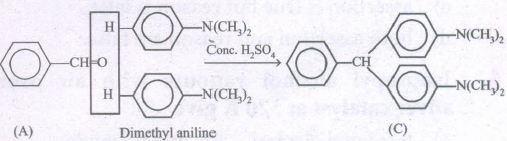
| Compound | Compound Name | Formula |
| A | Benzaldehyde | C6H5CHO |
| B | Benzal acetone | C6H5CH = CH-COCH3 |
| C | Triphenyl methane dye | 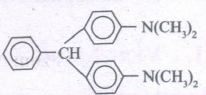 |
119.
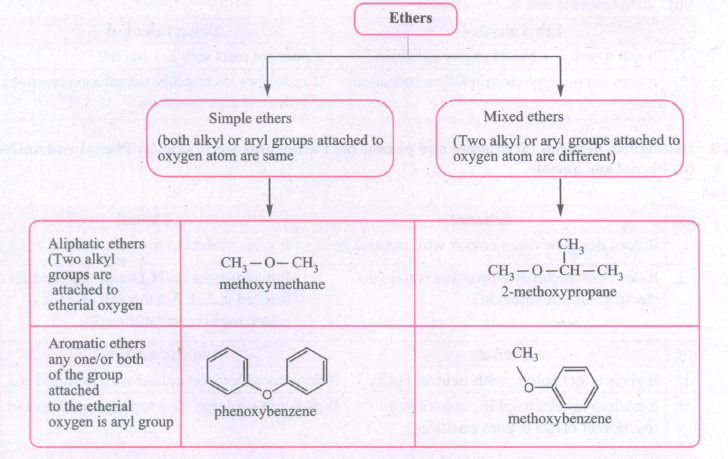
Ethers are a class of organic compound in which an oxygen atom is connected to two alkyl/aryl groups Ethers can be considered as the derivatives of hydrocarbon in which one hydrogen atom is replaced by an alkoxy (-OR) or an aryloxy (-OAr ) group. The general formula of aliphatic ether is CnH2n+2O.
Classification:
120.
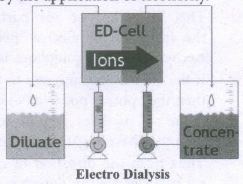
(i) The presence of electric field increases the speed of removal of electrolytes from colloidal solution.
(ii) The colloidal solution containing an electrolyte as impurity is placed between two dialysing membranes enclosed into two compartments filled with water.
(iii) When current is passed, the impurities pass into water compartment and get removed periodically.
(iv) This process is faster then dialysis, as the rate of diffusion of electrolytes is increased by the application of electricity.
121.
Given:
Specific conductance = K = 5.55 x 10⁻³ mho cm-1
Concentration C = 1M
Volume = 1 litre.
Formula: Equivalent conductance = K x V
= \(\frac { k\times 1000 }{ C } \)
Solution:
\(\frac { { 5.55\times 10 }^{ -3 }\times 1000 }{ 1 } =5.55\times { 10 }^{ -3 }\times { 10 }^{ -3 }\)
122.
A relation between pH and pOH can be established using their following definitions
pH = -log10 [H3O+] ....(1)
pOH = -log10 [OH-] ...(2)
Adding equation (1) and (2)
pH + pOH = -log10 [H3O+] -log10[OH-]
= -(log10 [H3O+] +log10[OH-])
pH + pOH = -log10 [H3O+] [OH-]
[∵ log a + log b = log ab]
We know that [H3O+][OH-] = Kw
⇒ pH + pOH = -log10 Kw
⇒ pH + pOR = pKw
[∵ pKw = -log10Kw ]
at 25°C, the ionic product of water,
pKw= 1 x 10-14
pKw = -log10 10-14= 14log10 10
= 14
∴ (2) ⇒ ∴ At 25°C, pH + pOH = 14.
123.
Factors affecting adsorption
Qualitatively, the extent of surface adsorption depends on
(i) Nature of adsorbent
(ii) Nature of adsorbate
(iii) Pressure
(iv) Concentration at a given temperature.
1. Surface area of adsorbent:
As the adsorption is a surface phenomenon it depends on the surface area of adsorbent. i.e., higher the surface area, higher is the amount adsorbed.
2. Nature of adsorbate:
The nature of adsorbate can influence the adsorption. Gases like SO2, NH3, HCl and CO2 are easily liquefiable as have greater vander waal's force of attraction. On the other hand, permanent gases like H2, N2 and O2 cannot be liquefied easily. These permanent gases are having low critical temperature and adsorbed slowly, while gases with high critical temperature are adsorbed readily.
3. Effect of temperature:
When temperature is raised chemisorption first increases and then decreases. whereas physisorption decreases with increases in temperature.
4. Effect of Pressure:
Chemical adsorption is fast with increase in pressure, it cannot alter the amount of adsorption. In physisorption, the extend of adsorption increases with increase in pressure.
124.
i) Molar conductivity
Given : C = 0.01 M;
\(\kappa=1.5 \times 10^{-4} \mathrm{~S} \mathrm{~cm}^{-1} \)
\(=1.5 \times 10^{-2} \mathrm{~S} \mathrm{~m}^{-1} \)
\(\lambda_{\text {cation }}^{0}=248.2 \mathrm{~S} \mathrm{~cm}^{2} \mathrm{~mol}^{-1} \)
\(\lambda_{\text {anion }}^{0}=51.8 \mathrm{~S} \mathrm{~cm}^{2} \mathrm{~mol}^{-1} \)
\(\Lambda_{m}^{0}=\frac{\kappa \times 10^{-3}}{C} \mathrm{~S} \mathrm{~m}^{2} \mathrm{~mol}^{-1} \)
\(=\frac{1.5 \times 10^{-2} \times 10^{-3}}{0.01} \)
\(=1.5 \times 10^{-3} \mathrm{~S} \mathrm{~m}^{2} \mathrm{~mol}^{-1}\)
ii) \(\alpha=\frac{\Lambda_{m}}{\Lambda_{m}^{0}}\)
\(\Lambda_{\mathrm{m}}^{0}=\lambda_{\text {cation }}^{0}+\lambda_{\text {anion }}^{0} \)
\(=(248.2+51.8) \mathrm{S} \mathrm{cm}^{2} \mathrm{~mol}^{-1} \)
\(=300 \mathrm{~S} \mathrm{~cm}^{2} \mathrm{~mol}^{-1}\)
\(=300 \times 10^{-4} \mathrm{Sm}^{2} \mathrm{~mol}^{-1} \)
\(\alpha =\frac{1.5 \times 10^{-3}}{300 \times 10^{-4}}=0.05\)
iii) \(\mathrm{K}_{\mathrm{a}} =\frac{\alpha^{2} \mathrm{C}}{1-\alpha} \)
\(\mathrm{K}_{\mathrm{a}} =\frac{(0.05)^{2} \times(0.01)}{1-0.05}=2.6 \times 10^{-5} \)
(or)
\(\mathrm{K}_{\mathrm{a}} =\alpha^{2} \mathrm{C} \)
\(=(0.05)^{2} \times(0.01) \)
\(\mathrm{K}_{\mathrm{a}} =2.5 \times 10^{-5}\)
125.
1. Daniel cell is a galvanic cell. This is a voltaic cell also.
(a) The separation of half reaction is the basis for the construction of Daniel cell. It consists of two half cells.
(i) Oxidation half cell: A metallic zinc strip that dips into an aqueous solution of zinc sulphate taken in a beaker, as shown in Figure
(ii) Reduction half cell: A copper strip that dips into an aqueous solution of copper sulphate taken in a beaker, as shown in Figure
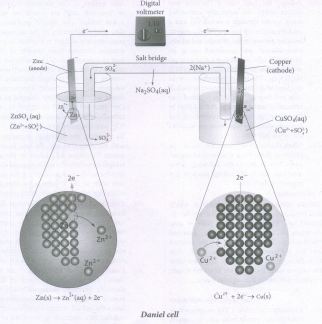
(iii) Joining the half cells:
(a) The zinc and copper strips are externally connected using a wire through a switch (k) and a load (example: volt meter). The electrolytic solution present in the cathodic and anodic compartment are connected using an inverted U tube containing a agar-agar gel mixed with an inert electrolyte such as KCI, Na2SO4 etc.,
(b) The ions of inert electrolyte do not react with other ions present in the half I cells and they are not either oxidised (or) reduced at the electrodes. The solution in the salt bridge cannot get poured out, but through which the ions can move into (or) out of the half cells.
(c) When the switch (k) closes the circuit, the electrons flows from zinc strip to copper strip. This is due to the following redox reactions which are taking place at the respective electrodes.
(iv) Anodic oxidation:
(i) zinc strip acts as the anode.
(ii) Here,oxidation occurs.
The electrode at which the oxidation occur is called the anode. In Daniel cell, the oxidation take place at zinc electrode, i.e., zinc is oxidised to Zn2+ ions and the electrons.
The Zn2+ ions enters the solution and the electrons enter the zinc metal, then flow through the external wire and then enter the copper strip.
Electrons are liberated at zinc electrode and hence it is negative (-ve).
\(Zn_{ (s) }\longrightarrow { { Zn }^{ 2+ }_{ (aq) }+{ 2e }^{ - } } \) (loss of electron-oxidation)
(v) Cathodic reduction:
As discussed earlier. the electrons flow through the circuit from zinc to copper, where the Cu2+ ions in the solution accept the electrons, get reduced to copper and the same get deposited on the electrode Here, the electrons are consumed and hence it is positive (+ve).
\({ Cu }_{ (aq) }^{ 2+ }+{ 2e }^{ - }\longrightarrow { { Cu }_{ (s) } } \)(gain of electron - reduction)
b) When a Zinc metal strip is placed in a copper sulphate solution, the blue colour of the solution fades and the copper is deposited on the zinc strip as red - brown crust due to the following spontaneous chemical reaction.
\(\mathrm{Zn}_{(\mathrm{s})}+\mathrm{CuSO}_{4(\mathrm{aq})} \rightarrow \mathrm{ZnSO}_{4(\mathrm{aq})}+\mathrm{Cu}_{(\mathrm{s})}\)
The energy produced in the above reaction is lost to the surroundings as heat.
In the above redox reaction, Zinc is oxidised to Zn2+ ions and the Cu2+ ions are reduced to metallic copper. The half reactions are represented as below.
\(\mathrm{Zn}_{(\mathrm{s})} \rightarrow \mathrm{Zn}^{2+}{ }_{(\mathrm{aq})}+2 \mathrm{e}^{-} \text {(oxidation) } \)
\(\mathrm{Cu}^{2+}{ }_{(\mathrm{aq})}+2 \mathrm{e}^{-} \rightarrow \mathrm{Cu}_{(\mathrm{s})} \text { (reduction) }\)
If we perform the above two half reactions separately in an apparatus as shown in figure, some of the energy produced in the reaction will be converted into electrical energy.
126.
(i) It oxidises ferrous salts to ferric salts.
Cr2O72- + 6Fe2++ 14H+ ⟶ 2Cr3+ + 6Fe3+ + 7H2O
(ii) It oxidises iodide ions to iodine
Cr2O72- + 6I-+ 14H+ ⟶ 2Cr3+ + 3I2 + 7H2O
(iii) It oxidises sulphide ion to sulphur
Cr2O72- + 3S2-+ 14H+ ⟶ 2Cr3+ + 3S + 7H2O
(iv) It oxidises sulphur dioxide to sulphate ion
Cr2O72- + 3SO2+ 2H+ ⟶ 2Cr3+ + 3SO42- + H2O
(v) It oxidises stannous salts to stannic salt
Cr2O72- + 3Sn2+ + 14H+ ⟶ 2Cr3+ + 3Sn4+ + 7H2O
(vi) It oxidises alcohols to acids
2K2Cr2O7 + 8H2SO4 + 3CH3CH2OH ⟶ 2K2SO4 +2Cr2(SO4)3+ 3CH3COOH + 11H2O
(vii) It oxidises oxalic acid to CO2
2MnO4- + 5(COO)2- + 6H+ ⟶ 2Mn2++ 10CO2 + 8H2O
(viii) It oxidises iodide ions to iodine
2MnO4- + 10I- + 16H+ ⟶ 2Mn2++ 5I2+ 8H2O
(ix) It oxidises sulphide ion to sulphur
2MnO4- + 5S2-+ 16H+ ⟶ 2Mn2++ 5S + 8H2O
(x) It oxidises nitrites to nitrates
2MnO4- + 5NO2- + 6H+ ⟶ 2Mn2++ 5NO3- + 3H2O
(xi) It oxidises alcohols to aldehydes.
2KMnO4 + 3H2SO4 + 5CH3CH2OH ⟶ 2K2SO4 + 2MnSO4 + 5CH3CHO + 8H2O
(xii) It oxidises sulphite to sulphate
2MnO4- + 5SO32- + 6H+ ⟶ 2Mn2+ + 5SO42- + 3H2O
127.
(i) The magnitude of order of a reaction may be zero or fractional or integral values. Order is never fractional for elementary reaction.
(ii) It should be determined only by experiments.
(iii) Simple reactions possess low values of order like n = 0, 1, 2 reactions with order greater than or equal to 3.0 are called complex reactions.
(iv) Some reactions show fractional order depending on rate.
(v) Higher order reactions may be experimentally converted into simpler order (pseudo) reactions by using excess concentrations of one or more reactants.
128.
Manufacture of sulphuric acid by contact process:
The contact process involves the following steps.
(i) Initially sulphur dioxide is produced by burning sulphur or iron pyrites in oxygen/ air.
\(S+{ O }_{ 2 }\longrightarrow { SO }_{ 2 }\)
\({ 4FeS }_{ 2 }+{ 11O }_{ 2 }\longrightarrow { 2Fe }_{ 2 }{ { O }_{ 3 } }+8{ SO }_{ 2 }\)
(ii) Sulphur dioxide formed is oxidised to sulphur trioxide by air in the presence of a catalyst such as V2O5 or platinised asbestos.
(iii) The sulphur trioxide is absorbed in concentrated sulphuric acid and produces oleum (H2S2O7). The oleum is converted into sulphuric acid by diluting it with water.
\(\mathrm{SO}_{3}+\mathrm{H}_{2} \mathrm{SO}_{4} \longrightarrow \mathrm{H}_{2} \mathrm{~S}_{2} \mathrm{O}_{7} \stackrel{\mathrm{H}_{2} \mathrm{O}}{\longrightarrow} 2 \mathrm{H}_{2} \mathrm{SO}_{4}\)
(iv) To maximise the yield the plant is operated at 2 bar pressure and 720 K. The sulphuric acid obtained in this process is over 96 % pure.
129.
(i) By knowing the density of an unknown metal and the dimension of its unit cell, the atomic mass of the metal can be: determined.
(ii) Let 'a' be the edge length of a unit cell of a crystal, 'd' be the density of the metal, 'm' be the atomic mass of the metal and 'z' be the number of atoms in the unit cell.
(iii) Now,
Density of the unit cell
\(=\frac{Mass\ of\ the\ unit\ cell}{Volume\ of\ the\ unit\ cell}\)
\(d=\frac{Z\times m}{a^3}\) ...(1)
[Since, mass of the unit cell = Number of atoms in the unit cell x Atomic mass]
[Volume of the unit cell = (edge length of the cubic unit cell)3]
(iv) From equation (1), We have
\(m=\frac{d\times a^3}{Z}\) ....(2)
(v) Now,
Mass of the metal (M) \(=\frac{Atomic\ mass(M)}{Avogadro's\ number(N_A)}\)
M=\(\frac{d\times a^3 \times N_A}{Z}\)
(vi) From equation (3), we can determine the atomic mass of the unknown metal.
130.
(i) Carbon monoxide can be prepared by the reaction of carbon with limited amount of oxygen.
2C + O2 ⟶ 2CO
(ii) (a) On industrial scale carbon monoxide is produced by the reaction of carbon with air.
(b) The carbon monoxide formed will contain nitrogen gas also and the mixture of nitrogen and carbon monoxide is called producer gas.
(c) \(2C+{ O }_{ 2 }/{ N }_{ 2 }(air)\longrightarrow \underset { Producers \ Gas }{ 2CO } +{ N }_{ 2 }\)
(d) The producer gas is then passed through a solution of copper(I) chloride under pressure which results in the formation of CuCI(CO).2H2O.
(e) At reduced pressures this solution releases the pure carbon monoxide.
(iii) Pure carbon monoxide is prepared by warming methanoic acid with concentrated sulphuric acid which acts as a dehydrating agent.
HCOOH + H2SO4 ⟶ CO + H2O + H2SO4
131.
(i) Many heat exchangers/sinks and our day to day cooking vessels are made of aluminum.
(ii) It is used as wraps (aluminum foils) and is used in packing materials for food items.
(iii) Aluminum alloys with copper, manganese, magnesium and silicon are light weight and strong and they are used in design of aeroplanes and other forms of transport.
(iv) Aluminum shows high resistance, to corrosion, so it is used in the design of chemical reactors, medical equipments, refrigeration units and gas pipelines.
(v) Aluminium is a good electrical conductor and cheap, hence used in electrical overhead electric cables with steel core for strength.
132.
(i) [NiCI4]2-
IUPAC name - Tetrachloridonickelate (II) ion
(ii) Ni2+ = 3d8,4s0
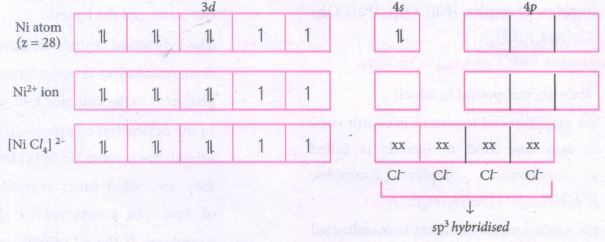
Cl- being a weak field ligand cannot pair up the unpaired electron. So, it is sp3 hybridised, and it has tetrahedral geometry.

12th Standard Syllabus & Materials
12th Standard
TN 12th Computer Applications களப்பெயர் முறைமை (DNS) Sample Question Papers Study Material - QB365 Set A
NEW12th Standard
TN 12th Computer Applications வலையமைப்பு எடுத்துக்காட்டுகள் மற்றும் நெறிமுறைகள் Sample Question Papers Study Material - QB365 Set A
NEW12th Standard
TN 12th Computer Applications கணினி வலையமைப்பு ஓர் அறிமுகம் Sample Question Papers Study Material - QB365 Set A
NEW12th Standard
TN 12th Computer Applications PHP-உடன் MySQL-ஐ இணைத்தல் Sample Question Papers Study Material - QB365 Set A



Tamilnadu Stateboard 12th Standard Subjects

Maths
Chemistry

Physics

Biology

Computer Science

Business Maths and Statistics

Economics

Commerce

Accountancy

History

Computer Applications
Biology
Computer Technology
Computer Applications
Computer Science
Business Maths and Statistics
Commerce
Economics
Maths
Chemistry
Physics
Computer Technology
History
Accountancy

Tamil

English

French
Tamilnadu Stateboard Standards
