
 100% FREE ACCESS
12th Standard Syllabus & Materials
12th Standard
TN 12th Computer Applications மின்னணு தரவு பரிமாற்றம் Sample Question Papers Study Material - QB365 Set A
NEW12th Standard
TN 12th Computer Applications மின் - வணிக பாதுகாப்பு அமைப்புகள் Sample Question Papers Study Material - QB365 Set A
NEW12th Standard
TN 12th Computer Applications மின்னணு செலுத்தல் முறைகள் Sample Question Papers Study Material - QB365 Set A
NEW12th Standard
TN 12th Computer Applications மின் - வணிகம் Sample Question Papers Study Material - QB365 Set A
NEW12th Standard
TN 12th Computer Applications திறந்த மூல கருத்துருக்கள் Sample Question Papers Study Material - QB365 Set A
NEW12th Standard
TN 12th Computer Applications வலையமைப்பு வடமிடல் Sample Question Papers Study Material - QB365 Set A

Published on: 21/02/2020
12th Standard Chemistry Book Back and Creative Important Questions I 2020
Download Tamil Nadu 12th Standard Chemistry question papers, model tests, one-mark questions, important questions, and public exam papers in PDF format. Free study materials and answer keys for TN State Board students.
Questions + Answers key
Take MCQ Chemistry Test
1.
Low molar conductivity at high concentration is due to _______.
High attractive force between oppositely charged ions
Viscous drag due to greater solvation
Both High attractive force between oppositely charged ions and Viscous drag due to greater solvation
Neither High attractive force between oppositely charged ions and Viscous drag due to greater solvation
2.
The cathode in Leclanche cell is ______.
Zinc container
Spongy lead
Graphite rod in contact with MnO2
HgO mixed with graphite
3.
1 F equals to _____.
96500 moles
96500 C
1.6 x 10⁻¹⁹ C
1.6 x 10⁻¹⁹ moles
4.
The number of N-N bond in urotropine is ________.
6
4
2
0
5.
Lower members of carboxylic acid family are _______.
waxy solids
pleasant smelling liquids
foul smelling liquids
inert gases
6.
Ketones when reduced in the presence of Pt forms _______.
primary alcohols
secondary alcohol
tertiary alcohols
acids
7.
The process of separation of emulsion into two separate layers is called ________.
Emulsification
Deemulsification
Coagulation
Flocculation
8.
When temperature is raised, chemisorption______.
increases
decreases
first decreases and then increases
first increases and then decreases
9.
Oxidation of ethylene glycol with HIO4 gives _______.
\(\overset { CHO }{ \underset { { CH }_{ 2 } }{ | } }\)
\(\overset { CH }{ \underset { CHO }{ | } } \)
\(\overset { COOH }{ \underset { COOH }{ | } } \)
HCHO
10.
Ionic product of water increases when _______.
Pressure decreases
H+ ions are added
OH- ions are added
temperature increases
11.
Pick out the incorrect statement regarding Lewis acids and bases
A Lewis acid is a electron deficient molecule
Lewis bases is one which donates an electron pair
Lewis base is a cation
Lewis acid is a electron deficient molecule and Lewis base is a cation
12.
Pick the strongest conjugate base among the following
Cl-
\({ NO }_{ 2 }^{ - }\)
\({ SO }_{ 4 }^{ 2- }\)
CH3COO-
13.
RX + NaOH(aq) \(\overset { \triangle }{ \longrightarrow } \) ROH + NaX. The above reaction proceed by _______ mechanism.
nucleophilic addition
elimination
electrophilic substitution
nucleophilic substitution
14.
Which one of the following is correctly matched?
Emulsion - Mayonnaise
Foam - Cream
Solid aerosol - Fog
Solid sol - Pumice stone
15.
Which among the following statement are correct with regard to alkyl halides?
Alkyl halides on heating with aq NaOH gives alcohols
10 alkyl halides proceed by SN2 mechanism
20 and 30 alkyl halides undergo substitution by SN1 mechanism
all the above
16.
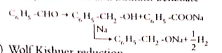
Phenyl methanal is reacted with concentrated NaOH to give two products X and Y. X reacts with metallic sodium to liberate hydrogen X and Y are ________.
sodium benzoate and phenol
Sodium benzoate and phenyl methanol
phenyl methanol and sodium benzoate
none of these
17.
CH3Br \(\overset { KCN }{ \longrightarrow } (A)\overset { { H }_{ 2 }{ O }^{ + } }{ \longrightarrow } (B)\overset { { PCl }_{ 5 } }{ \longrightarrow } \) (C) product (c) is ______.
acetylchloride
chloro acetic acid
\(\alpha\)- chlorocyano ethanoic acid
none of these
18.
The reactions
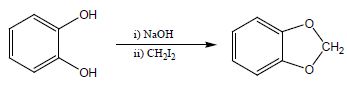 is an example of ______.
Wurtz reaction
cyclic reaction
Williamson reaction
Kolbe reactions
19.
20.
Match the following
| a | V2O5 | i | High density polyethylene |
| b | Ziegler – Natta | ii | PAN |
| c | Peroxide | iii | NH3 |
| d | Finely divided Fe | iv | H2SO4 |
| A | B | C | D |
| iv | i | ii | iii |
| A | B | C | D |
| i | ii | iv | iii |
| A | B | C | D |
| ii | iii | iv | i |
| A | B | C | D |
| iii | iv | ii | i |
21.
Which one of the following characteristics are associated with adsorption?
\(\Delta\)G and \(\Delta\)H are negative but \(\Delta\)S is positive
\(\Delta\)G and \(\Delta\)S are negative but \(\Delta\)H is positive
\(\Delta\)G is negative but \(\Delta\)H and \(\Delta\)S are positive
\(\Delta\)G, \(\Delta\)H and \(\Delta\)S all are negative.
22.
Which of the following electrolytic solution has the least specific conductance?
2N
0.002N
0.02N
0.2N
23.
Which of these is not likely to act as Lewis base?
BF3
PF3
CO
F–
24.
Which will make basic buffer?
50 mL of 0.1M NaOH+25mL of 0.1M CH3COOH
100 mL of 0.1M CH3COOH+100 mL of 0.1M NH4OH
100 mL of 0.1M HCl+200 mL of 0.1M NH4OH
100 mL of 0.1M HCl+100 mL of 0.1M NaOH
25.
By the order of reaction we mean _______.
the sum of powers to which the concentration terms are raised in the rate equation
the number of reactants take part in the reaction
the number of concentration terms in the velocity equation for the reaction
the least number of product molecule needed for the reaction
26.
Compound A reacts by first order kineties. At 25oC, the rate constant of the reaction is 0.60 sec. What is the half life of A?
1.15 sec
0.4158 sec
0.093 sec
1.29 sec
27.
For the following reaction, identify the order of reaction and dimension of the rate constant.
H2O2(aq) +3I-(aq) + 2H+ ⟶ 2H2O(1) + I3- ; Rate = k[H2O2] [I]-
2, L mol-1 s-1
1. s-1
\(\frac { 3 }{ 2 } \), L1/2 mol-1/2 s-1
None of these
28.
Oxidation states of P in H4P2O5, H4P2O6, H4P2O7 are respectively _______.
+3, +4, +5
+3, +5, +4
+5, +3, +4
+5, +4, +3
29.
S-S bond is present in _______.
H2S2O7
H2SO5
H2S2O6
H2S2O6
30.
Catenation property of group 15 elements, follow the order _______.
N < P < As < Sb < Bi
P >> N > As > Sb > Bi
P < N < As < Sb < Bi
N>> P > As > Sb > Bi
31.
The coordination number of Zn in ZnO and Zn in ZnS are respectively________.
4 and 6
4 and 4
2 and 4
4 and 3
32.
The total number of elements of symmetry in a cubic crystal is________.
9
23
10
14
33.
Which one of the following statements is not true?
The heat of vaporisation of ionic crystals are high
Ionic crystals are soluble in non-polar solvent
Ionic crystals are hard and brittle
Ionic crystals are conductors in solution state
34.
Group 14 elements have general electronic configuration _______.
ns2
ns2np4
ns2np6
ns2np2
35.
All elements except carbon have the tendency to show maximum covalency of six ______
due to presence of vacant d-orbitals
due to absence of vacant d-orbitals
due to presence of partially filled d-orbitals
due to presence of completely filled d-orbitals
36.
Identify the electron - deficient species
(BH3)2
(SiH3)2
PH3
(CH3)2
37.
Which of the following ions will exhibit colour in aqueous solutions?
SC3+(Z=21)
Ti3+(Z =22)
La3+(Z=57)
Lu3+(Z=71)
38.
The colour of K2Cr2O7 and Fe2+ ions are respectively due to_______.
Crystal defects and charge transfer spectra
d-d transition and charge transfer spectra
Charge transfer spectra and crystal defects
Charge transfer spectra and d-d transition
39.
Which of the following is coloured due to charge transfer?
MnO4-
CrO42-
Cu2O
All of these
40.
\(ZnS+{ 3O }_{ 2 }\overset { \Delta }{ \longrightarrow } 2ZnO+{ 2SO }_{ 2 }\uparrow \) . The above equation is an example for________.
calcination
reduction
roasting
leaching
41.
Which metal is used for extraction of Au and Ag and also for galvanisation of iron objects?
Mg
Zn
Cr
Co
42.
The ligand capable of coordinating in two or more ways with the central metal ion are called _______ ligands.
didentate
tridentate
ambidentate
none of the above
43.
What is the electronic configuration of Cr in K3[Cr(C2 O4)3] 3H2O?
d3
d2
d1
d0
44.
The oxidation number of nickel in complex ion, [NiCI4]2- is _______.
+1
-1
+2
-2
45.
46.
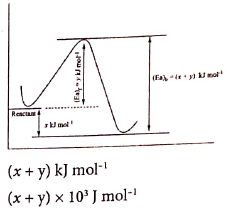
In a reversible reaction, the enthalpy change and the activation energy in the forward direction are respectively −x kJ mol-1 and y kJ mol-1. Therefore, the energy of activation in the backward direction is _______.
(y-x) kJ mol-1
(x+y) J mol-1
(x-y) KJ mol-1
(x+y) x 103J mol-1
47.
If ‘a’ is the length of the side of the cube, the distance between the body centered atom and one corner atom in the cube will be_________.
\(\left( \cfrac { 2 }{ \sqrt { 3 } } \right) a\)
\(\left( \cfrac { 4 }{ \sqrt { 3 } } \right) a\)
\(\left( \cfrac { \sqrt { 3 } }{ 4 } \right) a\)
\(\left( \cfrac { \sqrt { 3 } }{ 2 } \right) a\)
48.
CsCl has bcc arrangement, its unit cell edge length is 400pm, its inter atomic distance is ________.
400pm
800pm
\(\sqrt { 3 } \times 100pm\)
\(\left( \frac { \sqrt { 3 } }{ 2 } \right) \times 400pm\)
49.
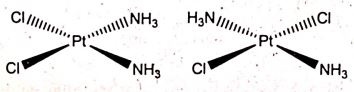
Which type of isomerism is exhibited by [Pt(NH3)2Cl2]?
Coordination isomerism
Linkage isomerism
Optical isomerism
Geometrical isomerism
50.
Which one of the following will give a pair of enantiomorphs?
[Cr(NH3)6][Co(CN)6]
[Co(en)2Cl2]Cl
[Pt(NH3)4][PtCl4]
[Co(NH3)4Cl2]NO2
51.
The actinoid elements which show the highest oxidation state of +7 are _______.
Np, Pu, Am
U, Fm, Th
U, Th, Md
Es, No, Lr
52.
The catalytic behaviour of transition metals and their compounds is ascribed mainly due to _______.
their magnetic behaviour
their unfilled d orbitals
their ability to adopt variable oxidation states
their chemical reactivity
53.
Which of the following is strongest acid among all?
HI
HF
HBr
HCl
54.
XeF6 on complete hydrolysis produces________.
XeOF4
XeO2F2
XeO3
XeO2
55.
The basic structural unit of silicates is _______.
\(\left( SiO_{ 3 } \right) ^{ 2- }\)
\(\left( SiO_{ 4 } \right) ^{ 2- }\)
\(\left( Sio \right) ^{ - }\)
\(\left( SiO_{ 4 } \right) ^{ 4- }\)
56.
Which among the following is not a borane?
B2H6
B3H6
B4H10
none of these
57.
Flux is a substance which is used to convert_______.
Mineral into silicate
Infusible impurities to soluble impurities
Soluble impurities to infusible impurities
All of these
58.
Which one of the following is not feasible
Zn(s) + Cu2+(aq) \(\rightarrow\) Cu(s) + Zn2+(aq)
Cu(s)+ Zn2+(aq)\(\rightarrow\) Zn(s) + Cu2+(aq)
Cu(s) + 2Ag+(ag)\(\rightarrow\) 2Ag(s) + Cu2+(aq)
Fe(s) + Cu2+(aq) \(\rightarrow\) Cu(s)+ Fe2+(aq)
59.
Name the reagent used in the reaction given below.
\(\\ \\ \\ \underset { Sodium\ acetate }{ { CH }_{ 3 }-\overset { \underset { || }{ O } }{ C } -ONa } +\overset { ? }{ \longrightarrow } \underset { Metahne }{ { CH }_{ 4 }+{ Na }_{ 2 }{ CO }_{ 3 } } \)
60.
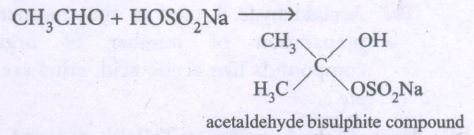
Give nucleophilic addition reaction of acetaldehyde with NaHSO3.
61.
Explain the kinetic property of colloids.
62.
What are the two types of catalysis?
63.
Write the oxidation, reduction and overall redox reaction taking place in the Lithium ion battery.
64.
On dilution of 0.1 M of Na2SO4, what will happen to its
(a) Conductance (C)
(b) Conductivity K
(c) Molar conductance \({ \Lambda }_{ m }\)
(d) Equivalent conductance \({ \Lambda }\)
65.
Which of the following does not give iodoform reaction?

66.
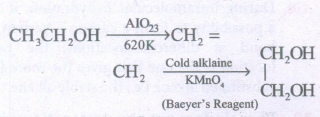
How is the following conversion effected? Ethyl alcohol ⟶ Ethylene glycol
67.
BF3 is termed as an acid though it does not contain H+ ions. Explain.
68.
Give the Limitations of Arrhenius concept theory of acids and bases.
69.
A conductivity cell has two platinum electrodes separated by a distance 1.5 cm and the cross sectional area of each electrode is 4.5 sq cm. Using this cell, the resistance of 0.5 N electrolytic solution was measured as 15 Ω. Find the specific conductance of the solution.
70.
Calculate the pH of 0.001M HCl solution
71.
What is the difference between a sol and a gel?
72.
Why does conductivity of a solution decrease on dilution of the solution.
73.
A lab assistant prepared a solution by adding a calculated quantity of HCl gas 250C to get a solution with [H3O+] = 4\(\times\)10-5M. Is the solution neutral (or) acidic (or) basic.
74.
The rate of the reaction X + 2y→ product is 4 x 10⁻³ mol L-1S-1, if [X] = [Y] = 0.2M and rate constant at 400K is 2 x 10⁻²s-1, What is the overall order of the reaction.
75.
Mention the factors that affected the rate of a chemical reaction.
76.
In a reaction, 2A \(\longrightarrow \) products, the concentration of A decreases from 0.5 mol L-1 to 0.4 mol L-1 in 10 minutes. Calculate the rate during this interval?
77.
Give the reason for bleaching action of Cl2.
78.
What is the reaction of Phosphorous with alkali?
79.
Frenkel defect is not show by alkali metal halides but silver halides do. Give reason.
80.
Define void.
81.
What is crystal field splitting?
82.
What are the uses of silicon tetra chloride?
83.
Write the outer electronic configuration of Cr atom (Z=24).
84.
What are coinage metals?
85.
What is the role of graphite rods in the electro metallurgy of aluminium?
86.
What is Co-ordination sphere?
87.
Name some depressing agents.
88.
Define 'Ligand' Give an example of neutral ligand.
89.
Identify the order for the following reactions
(i) Rusting of Iron
(ii) Radioactive disintegration of 92U238
(iii) 2A+3B⟶ products ;rate = k[A]1/2[B]2
90.
Explain why compounds of Cu2+ are coloured but those of Zn2+ are colourless.
91.
Explain the oxidation states of 4d series elements.
92.
Why tetrahedral complexes do not exhibit geometrical isomerism.
93.
[CuCl4]2- exists while [Cul4]2- does not exist why?
94.
How will you prepare chlorine in the laboratory?
95.
Chalcogens belongs to p-block. Give reason.
96.
What is inert pair effect?
97.
What is catenation ? describe briefly the catenation property of carbon.
98.
Give the basic requirement for vapour phase refining.
99.
Out of coke and CO, which is better reducing agent for the reduction of ZnO? Why?
100.
What is the role of quick lime in the extraction of Iron from its oxide Fe2O3?
101.
Write a note on
(i) Perkin's reaction, and
(ii) Knoevenagal reaction.
102.
What are the oxidation products of glycerol?
103.
Explain the advantages of using nano catalyst.
104.
Write the reactions taking place in anode and cathode of a mercury button cell. Give the over all redox reaction of the cell with the emf generation
105.
What do you mean by buffer action?
106.
Write Kolbe’s reaction.
107.
Why is AC current used instead of DC in measuring the electrolytic conductance?
108.
50ml of 0.05M HNO3 is added to 50ml of 0.025M KOH. Calculate the pH of the resultant solution.
109.
Why Hcl and HNO3 cannot be used for making the KMnO4 medium acidic?
110.
Prove that the time required for the completion \({ \frac { 3 }{ 4 } }^{ th }\) of the reaction of a first order is twice the time required for the completion of a half of the reaction.
111.
Explain the characteristic properties of hydrogen halides.
112.
Write a note on the assignment of atoms per unit cell in fcc.
113.
Describe the structure of carbon nanotubes.
114.
Explain alkali leaching in the extraction of aluminum.
115.
Match the common name with formula and the IUPAC ligand name.
| Common name | Formula | IUPAC ligand name |
|---|---|---|
| Bromide | C2O42- | Carbonato |
| Nitrate | Br- | Oxalato |
| hydroxide | NO3- | hydroxido |
| Carbonate | OH- | bromido |
| Oxalate | CO32- | nitrato |
116.
The rate law for a reaction of A, B and C has been found to be rate = k[A]2[B][L]3/2 How would the rate of reaction change when
(i) Concentration of [L] is quadrupled
(ii) Concentration of both [A] and [B] are doubled
(iii) Concentration of [A] is halved
(iv) Concentration of [A] is reduced to \(\left(\frac{1}{3}\right)\) and concentration of [L] is quadrupled.
117.
Compare the ionization enthalpies of first series of the transition elements.
118.
Based on VB theory explain why [Cr(NH3)6]3+ is paramagnetic, while [Ni(CN)4]2- is diamagnetic.
119.
Write a note on metallic nature of p-block elements.
120.
121.
Illustrate the reducing property of acetaldehyde with examples
122.
How would you distinguish between (i) methyl alcohol and ethyl alcohol (ii) benzyl alcohol and phenol, (iii) ethyl alcohol and benzyl alcohol?
123.
Write a note on Freundlich adsorption isotherm.
124.
Derive a relationship between dissociation constant Ka and molar conductivity \({ \Lambda }_{ m }\)
125.
A 0.02 M solution of a weak mono basic acid is 5% ionised. Calculate the ionisation constant of the acid.
126.
The conversion of molecules x to y follows second order kinetics. Its concentration of x is increased to three times how will it affect the rate of formation of y?
For the reaction x ➝ y as it follows second order kinetics wherefore the rate of formation of y?
127.
Write a note on the ionization enthalpy of transition elements.
128.
Explain the oxidising and reducing property of SO2·
129.
How can you determine the atomic mass of an unknown metal if you know its density and the dimension of its unit cell? Explain.
130.
Distinguish between diamond and graphite.
131.
How can you separate alumina from silica in a bauxite ore.
132.
What is meant by stability of a co-ordination compound in solution? State the factors which govern stability of complexes.
133.
Assertion: pure iron when heated in dry air is converted with a layer of rust.
Reason: Rust has the composition Fe3 O4
Codes:
a) if both assertion and reason are true and reason is the correct explanation of assertion
b) if both assertion and reason are true but reason is not the correct explanation of assertion
c) assertion is true but reason is false
d) both assertion and reason are false
if both assertion and reason are true and reason is the correct explanation of assertion
if both assertion and reason are true but reason is not the correct explanation of assertion
assertion is true but reason is false
both assertion and reason are false
1.
(c)
Both High attractive force between oppositely charged ions and Viscous drag due to greater solvation
2.
(b)
Spongy lead
3.
(b)
96500 C
4.
(d)
0
5.
(b)
pleasant smelling liquids
6.
(b)
secondary alcohol
7.
(b)
Deemulsification
8.
(d)
first increases and then decreases
9.
(d)
HCHO
10.
(d)
temperature increases
11.
(c)
Lewis base is a cation
12.
(d)
CH3COO-
13.
(d)
nucleophilic substitution
14.
(a)
Emulsion - Mayonnaise
15.
(d)
all the above
16.
17.

18.
(c)
Williamson reaction
19.
(c)
20.
(a)
| A | B | C | D |
| iv | i | ii | iii |
21.
Adsorption leads to decrease in randomnes (entropy).i.e, ΔS < 0 for the adsorption to occur, ΔG slhould be -ve. We know that ΔG = ΔH - TΔS if ΔS is -ve, TΔS is +ve.It means that ΔG will become negative only when ΔH is -ve and ΔH > TΔS.
22.
In general, specific conductance of an electrolyte decreases with dilution.So,0.002N solution has least specific conductance.
23.
BF3 → electron deficient → Lewis acid
PF3 → electron rich → Lewis base
CO → having lone pair of electron → Lewis base
F → unshared pair of electron → Lewis base
24.
Basic buffer is the solution which has weak base and its salt.
NH4OH + HCI → NH4CI +H2O + NH4OH
200 ml 100 ml salt 100 ml weak base
25.
(a)
the sum of powers to which the concentration terms are raised in the rate equation
26.
(a)
1.15 sec
27.
(a)
2, L mol-1 s-1
28.
(a)
+3, +4, +5
29.
(d)
H2S2O6
30.
(b)
P >> N > As > Sb > Bi
31.
(b)
4 and 4
32.
(b)
23
33.
(b)
Ionic crystals are soluble in non-polar solvent
34.
(d)
ns2np2
35.
(a)
due to presence of vacant d-orbitals
36.
(a)
(BH3)2
37.
(b)
Ti3+(Z =22)
38.
(d)
Charge transfer spectra and d-d transition
39.
(d)
All of these
40.
(c)
roasting
41.
(b)
Zn
42.
(c)
ambidentate
43.
(a)
d3
44.
(c)
+2
45.
(a)
46.
47.
If a is the length of the side, then the length of the leading diagonal passing through the body centered atom is \(\sqrt{3a} \)
Required distance = \(\left( \cfrac { \sqrt { 3 } }{ 2 } \right) a\)
48.
\(3 \sqrt{a} = r_{C_{s+}} + 2r_{C_{f-}} + r_{C_{s+}} \)
\(\left( \frac { \sqrt { 3 } }{ 2 } \right) a = r_{C_{s+}} + r_{C_{f-}} \)
\(\left( \frac { \sqrt { 3 } }{ 2 } \right) \times 400\)= inter ionic distance
49.
50.
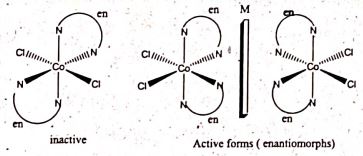
Complexes given in other options (a), (c) and (d) have symmetry elements and hence they are optically inactive.
51.
(a)
Np, Pu, Am
52.
(c)
their ability to adopt variable oxidation states
53.
(a)
HI
54.
(c)
XeO3
55.
(d)
\(\left( SiO_{ 4 } \right) ^{ 4- }\)
56.
(b)
B3H6
57.
(b)
Infusible impurities to soluble impurities
58.
(b)
Cu(s)+ Zn2+(aq)\(\rightarrow\) Zn(s) + Cu2+(aq)
59.
The reagent used is NaOH + CaO (sodalime). The reaction is a decarboxylation reaction.
60.
Addition reaction with NaHSO3.
In the addition of sodium bisulphite to give bisulphite compound - OSO2Na anion is the nucleophile.
61.
The continuous rapid, zig-zag, chaotic, random I and ceaseless movement executed by a colloidal particle in the dispersion medium is called Brownian movement of colloidal particles.
62.
The two types of catalysis are
(i) Homogeneous
(ii) Heterogeneous catalysis.
63.
At the anode oxidation occurs
Li(s) ⟶ \({ Li }_{ (aq) }^{ + }\) + e-
At the cathode reduction occurs
Li++ CoO2(s) + e- ⟶ Li CoO2(s)
Overall reactions
Li(s)+ CoO2 ⟶ LiCoO2(s)
64.
Conductivity, molar conductance and equivalent conductance increases with dilution whereas Conductance (C) decreases.
65.
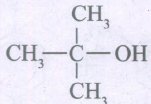 Tertiary butyl alcohol does not give iodoform reaction. All other compounds contains α H atoms and they undergo iodoform reaction.
66.
67.
According to Lewis concept of Acid and bases, any species capable of accepting an electron pair is an acid. BF3 is electron deficient so accepts a pair of electron, Hence termed as acid
68.
(i) Arrhenius theory does not explain the behaviour of acids and bases in non aqueous solvents such as acetone, Tetrahydrofuran etc ..
(ii) This theory does not account for the basicity of the substances like ammonia (NH3) which do not possess hydroxyl group.
69.
l = 1.5 cm = 1.5 × 10⁻²m
A = 4.5 cm2 = 4.5 × (10-4)m2
R = 15Ω
\(\kappa = \frac{1}{R}(\frac{l}{A})\)
\(\kappa = \frac{1}{15\Omega}\times\frac{1.5\times10^{-2}m}{4.5\times10^{-4}m^2}\)
= 2.22 ohm-1 m-1
= 2.22 Sm-1
70.
\(\underset{0.001M}{HCl}\overset{H_{2}O}{\rightleftharpoons }\underset{0.001M}{H_{3}O^{+}}+\underset{0.001M}{Cl^{-}}\)
H3O+ from the auto ionisation of H2O (10-7M) is negligible when compared to the H3O+ from 10-3M HCl.
Hence [H3O+] = 0.001 mol dm-3
pH = -log10 [H3O+]
= -log10(0.001)
= -log10(10-3) = 3
71.
| S.no | Sol | Gel |
| (a) | The liquid state of collidal solution | The solid (or) semi solid stage of a colloidal solution. |
| (b) | Very low viscosity | Very high viscosity |
| (c) | It does not have definite structure. | It possesses definite structure. |
72.
On dilution the concentration decreases. Conductivity decreases with decrease in concentration (or dilution) as the number of ions per unit volume that carry the current in a solution decrease on dilution.
73.
[H3O+] = 4 \(\times\) 10-5M
pH = - log10[H3O+]
pH=-log10[4 \(\times\) 10-5]
pH = -log10[4] - log10[10-5] log10 10 = 1
pH = -log 4 + 5log1010
= 5 - log 4
= 5 - 0.6021
=4.3979
Since pH is less than 7, the solution is acidic.
74.
Rate = K[X]n[y]m
4 x 10⁻³ mol L-1s-1= 2 x 10⁻²s-1(0.2mol L-1)n(0.2mol L-1)m
\(\frac { 4\times { 10 }^{ -3 }mol\quad { L }^{ -1 }{ s }^{ -1 } }{ 2\times { 10 }^{ -2 }{ s }^{ -1 } } =\) (0.2)n+m(mol L-1)n+m
0.2(mol L-1) = (0.2)n+m(mol L-1)n+m
Comparing the powers on both sides
The overall order of the reaction n + m = 1
75.
The rate of a reaction is affected by the following factors.
(i) Nature and state of the reactant
(ii) Concentration of the reactant
(iii) Surface area of the reactant
(iv) Temperature of the reaction
(v) Presence of a catalyst
76.
Average rate = \(-\frac { 1 }{ 2 } \frac { \triangle \left[ A \right] }{ \triangle L } \)
\(=-\frac { 1 }{ 2 } \frac { { \left[ A \right] }_{ 2 }-{ \left[ A \right] }_{ 1 } }{ { t }_{ 2 }-{ t }_{ 1 } } \)
\(=-\frac { 1 }{ 2 } \left( \frac { 0.4-0.5 }{ 10 } \right) \)
\(=-\frac { 1 }{ 2 } \left( \frac { -0.1 }{ 10 } \right) \)
= 0.005 mol L-1 min-1
= 5 x 10⁻³ M min-1
77.
(i) Bleaching action of Cl2 is due to its oxidising property.
(ii) In aqueous solution, Cl2 liberates nascent oxygen which brings about the oxidation of coloured substances present in vegetables and organic matter to colourless substances.
\(\mathrm{Cl}_{2}+\mathrm{H}_{2} \mathrm{O} \rightarrow 2 \mathrm{HCl}+\mathrm{[O}]\)
Coloured substance +[O] → colorless substance.
78.
Yellow phosphorus reacts with alkali on boiling in an inert atmosphere liberating phosphine. Phosphorus acts as a reducing agent.
\({ P }_{ 4 }+NaOH+{ H }_{ 2 }O\longrightarrow \underset { Sodiumhypophosphite }{ { 3NaH }_{ 2 }{ PO }_{ 2 } } +\underset { Phosphine }{ { PH }_{ 3 } } \uparrow \)
79.
Frenkel defect occurs in a Silver halides due to small size of Ag+ ions which occupy interstitial position. Whereas in alkali metal halides, size of the cation and anion are almost similar so alkali metal ions do not fit into the interstitial sites.
80.
The empty spaces present between the metal atom or the ions when they are packed within the crystal are called voids.
81.
In a transition metal ion, all the five d orbitals are degenerate but when it is involved in a complex formation, the degeneracy is split. This is called crystal field splitting.
82.
(i) Silicon tetrachloride is used in the production of semiconducting silicon.
(ii) It is used as a starting material in the synthesis of silica gel, silicic esters, a binder for ceramic materials.
83.
Cr(24): [Ar] 3d54s1
84.
Cu, Ag and Au which have been used in making of coins in ancient times are called coinage metals
85.
(i) Graphite rods act a anode during electrolytic reduction of alumina.
(ii) At anode, O2 gas is produced which react with the carbon of anode (rods) to produce CO2 gas.
(iii) So these graphite rods are consumed slowly and need to be replaced from time to time.
86.
(i) The complex ion of the coordination compound containing the central metal atom/ion and the ligands attached to it is collectively called coordination sphere and are usually enclosed in square brackets with the net charge.
(ii) The other ionisable ions, are written outside the bracket are called counter ions. For example, the coordination compound K4[Fe(CN)6] contains the complex ion [Fe(CN)6]4- and is referred as the coordination sphere.
(iii) The other associated ion K+ is called the counter ion.
87.
Sodium cyanide and sodium carbonate.
88.
Ligand is an atom or a group of atoms which is either negatively charged or has lone pair of electrons and from co-ordinate bond with the central metal or ion, e.g.H2O.
89.
(i) First order reaction
(ii) First order reaction
(iii) \(\frac{1}{2}+2=2 \frac{1}{2}\); Pseudo first order reaction
90.
(i) The compounds of Cu2+ are coloured as it has one free electron its valence shell which absorb I radiation of visible region and get excited to emit its complementary colour.
(ii) Zn has no free electron it has fully filled shells. Due to extra stable orbitals electron can't be excited by radiations of visible light, hence its compounds are colourless.
91.
The oxidation states of 4d metals vary from +3 for Y to +8 for Ru and Os.
The highest oxidation state of 4d elements are found in their compounds with the higher electronegative elements like O, F & Cl.
Example: In RuO4, OsO4 & WCl6
The oxidation state of Ru and Os is +8.
The oxidation state of W is +6.
Generally in going down a group, a stability of higher oxidation state increases while that of lower oxidation state decreases.
4d series (5th period) - Yttrium to Cadmium (10 elements)
| Elements | Oxidation states |
|---|---|
| Y | +3 |
| Zr | +3, +4 |
| Nb | +2, +3, +4, +5 |
| Mo | +2, +3, +4, +5, +6 |
| Tc | +2, +4, +5, +7 |
| Ru | +2, +3, +4, +5, +6, +7 +8 |
| Rh | +2, +3, +4, +6 |
| Pd | +2, +3, +4 |
| Ag | +1, +2, +3 |
| Cd | +2 |
92.
Tetrahedral complexes do not exhibit geometrical isomerism. Because the relative position of donor atoms of ligand the unidentate Iigands (donor atom) attached to the central atom are same with respect to each other.
93.
In [CuCI4]-2 Cu2+, is reduced to Cu+ by I-. Hence Cupric Iodide in converted to cuprous Iodide so [CuI4]-2 does not exist. In [CuCI4]-2 Cl- cannot effect this change and so exists.
94.
Chlorine is prepared by the action of conc. sulphuric acid on chlorides in presence of manganese dioxide
4NaCl + MnO2 + 4H2SO4 \(\longrightarrow \)Cl2+ MnCl2 +4NaHSO4 + 2H2O
95.
(i) The Chalcogens belong to group (16).
(ii) The group consists of elements: Oxygen, Sulphur, Selenium, Tellurium and Polonium.
(iii) These are ore forming elements as most of the ores are oxides and sulphides.
(iv) Chalcos meaning 'ore formers'.
96.
(i) In heavier post transition metals, the outers electrons (ns) have a tendency to remain inert and show reluctance to take part in the bonding, which is known as inert pair effect.
(ii) This effect is also observed in groups 14, 15 and 16.
97.
Catenation is an ability of an element to form chain of atoms.
The conditions for catenation.
(a) The valency of element is greater than or equal to two.
(b) Element should have an ability to bond with itself
(c) The self bond must be as strong as Its bond with other elements
(d) Kinetic inertness of catenated compound towards other molecules.
(e) Carbon possesses all the above properties and forms a wide range of compounds with itself and with other elements such as H, O, N, S and halogens.
98.
In this method, the metal is treated with a suitable reagent which can form a volatile compound with the metal.
Then the volatile compound is decomposed to give the pure metal.
99.
Ellingham diagram for the formation of ZnO and CO2 intersects around 1200 K. Above this temperature ZnO lies above Carbon which indicates Carbon is the better reducing agent CO is more effective reducing agent only below 983 K.
100.
In this extraction, a basic flux, quick lime (CaO) is used, since the silica gangue present in the ore is acidic in nature. The quick lime combines with it to form calcium silicate (slag).
CaO(s) + Sio2(s) ⟶ CaSio3(s)
Flux Gangue Slag
101.
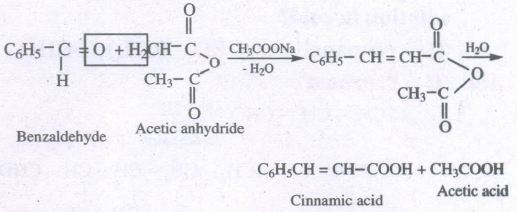
(i) Perkin's Reactions:
When an aromatic aldehyde is heated with an aliphatic acid anhydride in the presence of the sodium salt of the acid corresponding to the anhydride, condensation takes place and an α, β unsaturated acid is obtained
This reaction is known as Perkin's reaction.
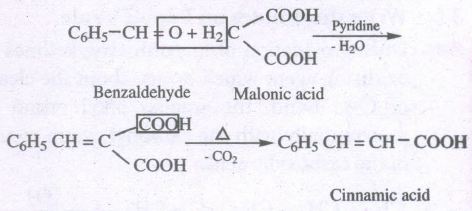
(ii) Knoevengal Reaction:
(a) Benzaldehyde condenses with malonic acid in the presence of pyridine forming cinnamic acid
(b) Catalyst - Pyridine
(c) Carbanion formed from malonic acid.
102.
Glycerol can give rise to a variety of oxidation products depending on the nature of the oxidising agent used for oxidation.
(i) Oxidation of glycerol with dil. HNO3 gives glyceric acid and tartronic acid.
(ii) Oxidation of glycerol with Cone. HNO3 gives mainly glyceric acid.
(iii) Oxidation of glycerol with bismuth nitrate gives as meso oxalic acid.
(iv) Oxidation of glycerol with Br/H2O (or) NaOBr (or) Fenton reagent (FeSO4 + H2O2) gives a mixture of glyceraldehyde I and dihydroxy acetone (This mixture is named as glycerose).
103.
(i) Nano materials such a metallic nano particles, metal oxides, etc., are used as catalyst in many chemical transformation. Nanocatalysts carry the advantages of both homogeneous and heterogeneous catalyses.
(ii) Like homogeneous catalysts, the nanocatalysts give 100% selective transformations and excellent yield and show extremely high activity.
(iii) Like the heterogeneous catalysts, nanocatalysts can be recovered and recycled.
104.
(i) Oxidation occurs at anode:
.JPG)
(ii) Reduction occurs at cathode:
.JPG)
(iii) Overall reaction:
\({ Zn }_{ (s) }+{ HgO }_{ (s) }\rightarrow { ZnO }_{ (s) }+Hg(l)\)
(iv) Cell emf: about 1.35V.
105.
(i) To resist changes in its pH on the addition of an acid (or) a base, the buffer solution should contain both acidic as well as basic components so as to neutralize the effect of added acid (or) base and at the same time, these components should not consume each other.
(ii) Let us explain the buffer action in a solution containing CH3COOH and CH3COONa.
(iii) The dissociation of the buffer components occurs as below.
\(\mathrm{CH}_{3} \mathrm{COOH}_{(\mathrm{aq})} \rightleftharpoons \mathrm{CH}_{3}-\mathrm{COO}_{(\mathrm{aq})}^{-}+\mathrm{H}_{3} \mathrm{O}_{(\mathrm{aq})}^{+} \)
\(\mathrm{CH}_{3} \mathrm{COONa}_{(\mathrm{s})} \stackrel{\mathrm{H}_{2} \mathrm{O}_{(\mathrm{l})}}{\longrightarrow} \mathrm{CH}_{3}-\mathrm{COO}_{(\mathrm{aq})}^{-}+\mathrm{Ha}_{(\mathrm{aq})}^{+}\)
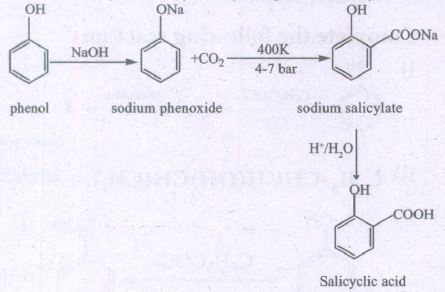
106.
In this reaction, phenol is first converted into sodium phenoxide which is more reactive than phenol towards electrophilic substitution reaction with CO2, Treatment of sodium phenoxide with CO2 at 400 K, 4-7 bar pressure followed by acid hydrolysis gives salicylic acid.
107.
(a) If we apply DC current through the conductivity cell, it will lead to the electrolysis of the solution taken in the cell.
(b) So, AC current is used for this measurement to prevent electrolysis.
108.
\(\mathrm{M} =\frac{\mathrm{V}_{1} \mathrm{M}_{1}-\mathrm{V}_{2} \mathrm{M}_{2}}{\mathrm{~V}_{1}+\mathrm{V}_{2}} \)
\(=\frac{(50 \times 0.05)-(50 \times 0.025)}{50+50} \)
\(\text { Molarity }=\frac{\text { Number of millimoles }}{\mathrm{V}_{\mathrm{m} l}}\)
\(=\frac{2.5-1.25}{100}=\frac{1.25}{100}=0.0125 \mathrm{M} \)
\(\mathrm{pH} =-\log _{10}\left[\mathrm{H}^{+}\right] \)
\(=-\log _{10} 0.0125 \)
Normality = Molarity \(\times\) basicity
\(=-\log _{10}\left(1.25 \times 10^{-2}\right) \)
\(=-\left[\log _{10} 1.25-2 \log _{10} 10\right] \)
\(=2-\log _{10} 1.25=2-0.0969 \)
pH = 1.9031
109.
(i) HCl cannot be used for making the medium acidic since it reacts with KMnO4 as follows.
2MnO4- + 10 Cl- + 16H+ ⟶ 2Mn2+ + 5Cl2+ 8H2O
(ii) HNO3 also cannot be used since it is good oxidising agent and reacts with reducing agents in the reaction.
(iii) However, H2SO4 is found to be most suitable since it does not react with potassium permanganate.
110.
\({ t }_{ \frac { 3 }{ 4 } }=\frac { 2.303 }{ K } \log { \frac { { \left[ R \right] }_{ 0 } }{ \frac { 1 }{ 4 } { \left[ R \right] }_{ 6 } } } \)
\({ t }_{ \frac { 3 }{ 4 } }=\frac { 2.303 }{ K } \log 4\)
\(=\frac { 2.303\times 0.6021 }{ K } =\frac { 1.386 }{ K } \)
\(=2\times \frac { 0.693 }{ K } \)
\(=2{ t }_{ \frac { 1 }{ 2 } }\)
111.
(i) All halogens react with hydrogen to form volatile covalent hydrides of formula HX.
(ii) These hydrides are called hydracids.
(iii) Hydracids are the reducing agents.
(iv) Except HF, all hydrogen halides are gases. HF is a liquid because of intermolecular hydrogen bonding.
H-F...H-F....H-F....H-F
(v) The acidic character of HX are in the following order.
HF < HCI < HBr < HI.
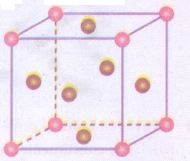
112.
(i) A face centred cubic lattice has 4 atoms per I unit cell.
(ii) The lattice has 8 atoms in the corners (Nc) and 6 atoms on the faces (Nf) (one on each face)
Contribution by atoms on the corners to unit cell =\(\frac{N_c}{8}=\frac{8}{8}=1\)
Contribution by atoms on the faces to unit cell =\(\frac{N_f}{2}=\frac{6}{2}=3\)
∴ The number of atoms per unit cell in fcc
\(=\frac { { N }_{ c } }{ 8 } +\frac { { N }_{ f } }{ 2 } =\frac { 8 }{ 8 } +\frac { 6 }{ 2 } =1+3=4\)
113.
(i) Carbon nanotubes, have graphite like tubes with fullerene ends.
(ii) Along the axis, these nanotubes are stronger than steel and conduct electricity.
(iii) These have many applications in nanoscale electronics, catalysis, polymers and medicine.
114.
(i) In this method, the ore is treated with aqueous alkali to form a soluble complex.
(ii) Bauxite, an important ore of aluminum is heated with a solution of sodium hydroxide or sodium carbonate in the temperature range 470 - 520 K at 35 atm to form soluble sodium meta-aluminate leaving behind the impurities, iron oxide and titanium oxide.
\({ Al }_{ 2 }{ O }_{ 3(s) }+2NaO{ H }_{ (aq) }+3{ H }_{ 2 }{ O }_{ (l) }\longrightarrow 2Na[Al({ OH })_{ 4 }]_{ (aq) }\)
(iii) The hot solution is decanted, cooled, and diluted. This solution is neutralised by passing CO2 gas, to the form hydrated Al2O3 precipitate
\(2Na\left[ Al\left( OH \right) _{ 4 } \right] _{ (aq) }+{ CO }_{ 2(g) }\longrightarrow { Al }_{ 2 }{ { O }_{ 3 }.x{ H }_{ 2 }O_{ (s) }+2NaHCO_{ 3(aq) } }\)
(iii) The precipitate is filtered off and heated around 1670 K to get pure alumina Al2O3
115.
| Common name | Formula | IUPAC ligand name |
|---|---|---|
| Bromide | Br- | bromido |
| Nitrate | NO3- | nitrato |
| hydroxide | OH- | hydroxido |
| Carbonate | CO32- | Carbonato |
| Oxalate | C2O42- | Oxalato |
116.
(i) Reaction Rate = \(k{ \left[ A \right] }^{ 2 }{ \left[ B \right] }{ \left[ L \right] }^{ 3/2 }\) ...(1)
When [L] = [4L]
Rate = \(k{ \left[ A \right] }^{ 2 }{ \left[ B \right] }{ \left[ 4L \right] }^{ 3/2 }\)
The Reaction Rate = \(8(k{ \left[ A \right] }^{ 2 }{ \left[ B \right] }{ \left[ L \right] }^{ 3/2 })\) ...(2)
Comparing (1) and (2) rate is increased by 8 times
(ii) [A] = [2A] and [B] = [2B]
Reaction Rate = \(k{ \left[ 2A \right] }^{ 2 }\left[ 2B \right] { \left[ L \right] }^{ 3/2 }\)
Reaction Rate = \(\\ 8(k{ \left[ A \right] }^{ 2 }{ \left[ B \right] }{ \left[ L \right] }^{ 3/2 })\) ...(3)
Comparing (1) and (3) rate is increased by 8 times
(iii) \(\left[ A \right] =\left[ \frac { A }{ 2 } \right] \)
Reaction Rate = \(k{ \left[ \frac { A }{ 2 } \right] }^{ 2 }{ \left[ B \right] }{ \left[ L \right] }^{ 3/2 }\)
Reaction Rate = \(\frac { 1 }{ 4 } \left( k\left[ { A }^{ 2 } \right] { \left[ B \right] }{ \left[ L \right] }^{ 3/2 } \right) \) ...(4)
Comparing (1) and (4); rate is reduced to (1/4) times.
(iv) \(\left[ A \right] =\left[ \frac { 1 }{ 3 }A \right] and\left[ L \right] =\left[ 4L \right] \)
Rate = \(k{ \left[ \frac { 1 }{ 3 }A \right] }^{ 2 }{ \left[ B \right] }{ \left[ 4L \right] }^{ 3/2 }\)
Rate = \(\left( \frac { 8 }{ 9 } \right) \left( k{ \left[ A \right] }^{ 2 }{ \left[ B \right] }{ \left[ L \right] }^{ 3/2 } \right)\) ...(5)
Comparing (1) and (5); rate is reduced to \(\frac { 8 }{ 9 } \) times.
117.
As we move from left to right in a transition metal series, the ionization enthalpy increases as expected. This is due to increase in the nuclear charge corresponding to the filling of d electrons. The increase in first ionisation enthalpy with increase in atomic number along a particular series is not regular. The added electron enters (n-1) d orbital and the inner electrons act as a shield and decrease the effect of nuclear charge on valence ns electrons. Therefore, it leads to variation in the ionization energy value.
118.
\(\text {(a) }\left[\mathrm{Cr}\left(\mathrm{NH}_{3}\right)_{6}\right]^{3+}:{ }_{24} \mathrm{Cr} \Rightarrow{ }_{18}[\mathrm{Ar}] 4 \mathrm{~s}^{2} 3 \mathrm{~d}^{4} \)
\({ }_{21} \mathrm{Cr}^{3+} \Rightarrow{ }_{18}[\mathrm{Ar}] 3 \mathrm{~d}^{3}\)
.JPG)
(i) d2sp3 hybridisation (octahedral)
(ii) It has three unpaired electrons (n = 3)
(iii) So it is paramagnetic
(iv) Magnetic moment \(\left(\mu_{\mathrm{s}}\right)=\sqrt{\mathrm{n}(\mathrm{n}+2)} \mathrm{BM}\)
\(=\sqrt{3(3+2)}=\sqrt{15}=3.87 \mathrm{BM}\)
\((b) \ \left[\mathrm{Ni}(\mathrm{CN})_{4}\right]^{2-:}{ }_{28} \mathrm{Ni} \Rightarrow[\mathrm{Ar}] 4 \mathrm{~s}^{2} 3 \mathrm{~d}^{8} ;{ }_{26} \mathrm{Ni}^{2+} \Rightarrow{ }_{18}[\mathrm{Ar}] 3 \mathrm{~d}^{8}\)
.JPG)
(i) dsp2 hybridisation
(ii) Geometry - square planar
(iii) No unpaired electrons- It is Diamagnetic
(iv) Magnetic moment (μs) = 0.
119.
Generally on descending a group the ionisation energy decreases and hence the metallic character increases.
120.
121.
\(\underset { Acetaldehyde }{ { CH }_{ 3 }-\underset { \overset { || }{ O } }{ C } -H+4(H) } \overset { { NH }_{ 2 }{ NH }_{ 2 } }{ \underset { { C }_{ 2 }{ H }_{ 5 }ONa }{ \longrightarrow } } \underset { Ethane }{ { CH }_{ 3 }-{ CH }_{ 3 }+{ H }_{ 2 }O+{ N }_{ 2 } } \)
(i) Clemmensen reduction: Aldehydes and Ketones when heated with zinc amalgam and concentrated hydrochloric acid gives hydrocarbons.
Example:
\(\underset { Acetald4ehyde }{ { CH }_{ 3 }-\underset { \overset { || }{ O } }{ C } -{ H }^{ + }4(H) }
\overset { Zn^{ - }Hg }{ \underset { Conc.HCl }{ \longrightarrow } }
\underset {Ethane}{{ CH }_{ 3 }-{ CH }_{ 3 }\pm { H }_{ 2 }O}\)
\(\underset { Acetone }{ { CH }_{ 3 }-\underset { \overset { || }{ O } }{ C } -{ CH }_{ 3 }+4\left( H \right) } \overset { { Zn }^{ - }Hg }{ \underset { Conc.HCl }{ \longrightarrow } } { CH }_{ 3 }{ CH }_{ 2 }{ CH }_{ 3 }+{ H }_{ 2 }O\)
(ii) Wolff-Kishner Reduction: Aldehydes and Ketones when heated with hydrazine (NH2NH2) and sodium ethoxide, hydrocarbons are formed Hydrazine acts as a reducing agent and sodium ethoxide as a catalyst.
Example :
\(\underset { Acetaldehyde }{ { CH }_{ 3 }-\underset { \overset { || }{ O } }{ C } -H+4(H) } \overset { { NH }_{ 2 }{ NH }_{ 2 } }{ \underset { { C }_{ 2 }{ H }_{ 5 }ONa }{ \longrightarrow } } \underset { Ethane }{ { CH }_{ 3 }-{ CH }_{ 3 }+{ H }_{ 2 }O+{ N }_{ 2 } } \)
\(\underset { Acetone }{ { CH }_{ 3 }-\underset { \overset { || }{ O } }{ C } -{ CH }_{ 3 }+4(H) } \overset { { NH }_{ 2 }{ NH }_{ 2 } }{ \underset { { C }_{ 2 }{ H }_{ 5 }ONa }{ \longrightarrow } } { CH }_{ 3 }{ CH }_{ 2 }{ CH }_{ 3 }+{ H }_{ 2 }O+{ N }_{ 2 }\)
Aldehyde (or) ketones is first converted to its hydrazone which on heating with strong base gives hydrocarbons.
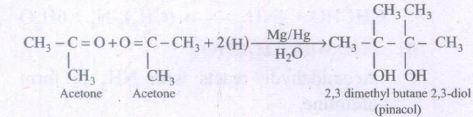
(iii) Reduction to pinacols: Ketones, on reduction with magnesium amalgam and water, are reduced to symmetrical diols known as pinacol.
122.
(i) Methyl alcohol and Ethyl alcohol
| S.No | Methyl alcohol | Ethyl alcohol |
| 1. | It does not react with cone. H2SO4 at any temperature. | It reacts with cone. H2SO4 at 410K, to produces diethyl ether and at 440K it produces ethylene products. |
| 2. | It does not react with I2 + NaOH to form iodoform. | It reacts with I2 + NaOH to produce iodoform CHI3. |
(ii) Benzyl alcohol and phenol
| S.No | Benzyl alcohol | Phenol |
| 1. | It does not give violet colour with neutral ferric chloride. |
It gives-violet colour with neutral ferric chloride |
| 2. | It does not decolourise bromin water. | It decolourise bromine water and produce 2,4,6- tribromo phenol. |
(iii) Ethyl alcohol and benzyl alcohol
| S.No | Ethyl alcohol | Benzyl alcohol |
| 1. | It reacts with I2 + NaOH to give iodoform | It does not react with I2 + NaOH |
| 2. | It does not undergo electrophilic substitution | It undergoes electrophilic substitution reactions at ortho and para positions. |
123.
Freundlich adsorption isotherm:
According to Freundlinch
\(\frac { x }{ m } =kp^{ \frac { 1 }{ n } }\)
where x is the amount of adsorbate or adsorbed on 'm' gm of adsorbent at a pressure of p. K and n are constants Value is always less than unity.
This equation is applicable for adsorption of gases on solid surfaces. The same equation becomes \(\frac { x }{ m } =Kc^{ \frac { 1 }{ n } }\) when used for adsorption in solutions with c as concentration.
These equation quantitively predict the effect of pressure(or concentration) on the adsorption of gases(or adsorbates) at constant temperature.
Taking log on both sides of equation \(\frac { x }{ m } ={ kp }^{ \frac { 1 }{ n } }\)
\(log\frac { x }{ m } =logK+\frac { 1 }{ n } logP\)
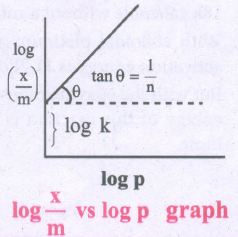
Hence the intercept represents the value of log k and the slope \(\frac { b }{ q } \) gives \(\frac { 1 }{ n } \)
This equation explains the increase of \(\frac { x }{ m } \) with increase in pressure. But experimental values show the deviation at low pressure.
124.
According to Ostwald dilution Law,
\({ K }_{ a }=\frac { { \alpha }^{ 2 }C }{ (1-\alpha ) } \) ...(1)
Substitute a value in the above expression (1)
\({ K }_{ a }=\frac { { \Lambda }_{ m }^{ 2 }C }{ { \Lambda }_{ m }^{ 2 }\left( 1-\frac { { \Lambda }_{ m } }{ { \Lambda }_{ m }^{ o } } \right) } \)
\({ K }_{ a }=\frac { { \Lambda }_{ m }^{ 2 }C }{ { \Lambda }_{ m }^{ 2 }\frac { { \Lambda }_{ m }^{ o }-{ \Lambda }_{ m } }{ { \Lambda }_{ m }^{ o } } } \)
⇒ \({ K }_{ a }=\frac { { \Lambda }_{ m }^{ 2 }C }{ { \Lambda }_{ m }^{ 2 }{ (\Lambda }_{ m }^{ o }-{ \Lambda }_{ m }) } \)
125.
The degree of ionisation and the dissociation constant of the weak acid are related by the equation.
\({ K }_{ a }=\frac { { \alpha }^{ 2 }{ C } }{ 1-\alpha } \cong { \alpha }^{ 2 }C\)
α = 5% (or) 0.05
C = 0.02M
Ka = (0.05)2 x 0.02 = 0.00005
Ka = 5 x 10⁻⁵
126.
Rate = k [x]2 = ka2
[x] = a mol-1
If the concentration of x is in cross three time, then
(x) = 3a mol L-1
Rate = R(3a)2 = 9 ka2
Hence, the rate of formation will increase by 9 times.
127.
(i) Ionization energy of transition element is intermediate between those of sand p block elements.
(ii) As we move from left to right in a transition metal series, the ionization enthalpy increases as expected.
(iii) This is due to increase in nuclear charge corresponding to the filling of d electrons.
(iv) The increase in first ionisation enthalpy with increase in atomic number along a particular series is not regular.
(v) The added electron enters (n-1)d orbital and the inner electrons act as a shield and decrease the effect of nuclear charge on valence ns electrons. Therefore, it leads to variation in the ionization energy values
128.
Oxidising property :
Sulphur dioxide, oxidises hydrogen sulphide to sulphur and magnesium to magnesium oxide.
\({ 2H }_{ 2 }S+{ SO }_{ 2 }\longrightarrow 3S+{ 2H }_{ 2 }O\)
\(2Mg+{ SO }_{ 2 }\longrightarrow 2MgO+S\)
Reducing property :
As it can readily be oxidised, it acts as a reducing agent. It reduces chlorine into hydrochloric acid.
\({ SO }_{ 2 }+2{ H }_{ 2 }O+{ { Cl }_{ 2 }\longrightarrow { H }_{ 2 }{ SO }_{ 4 }+2HCl }\)
It also reduces potassium permanganate and dichromate to Mn2+ and Cr3+ respectively.
\({ 2KMnO }_{ 4 }+5{ SO }_{ 2 }+2{ H }_{ 2 }O\longrightarrow { K }_{ 2 }{ SO }_{ 4 }+{ 2MnSO }_{ 4 }+2{ H }_{ 2 }{ SO }_{ 4 }\)
\({ K }_{ 2 }{ Cr }_{ 2 }{ O }_{ 7 }+{ 3SO }_{ 2 }+{ H }_{ 2 }{ SO }_{ 4 }\longrightarrow { K }_{ 2 }{ SO }_{ 4 }+{ Cr }_{ 2 }\left( SO_{ 4 } \right) _{ 3 }+{ H }_{ 2 }O\)
129.
(i) By knowing the density of an unknown metal and the dimension of its unit cell, the atomic mass of the metal can be: determined.
(ii) Let 'a' be the edge length of a unit cell of a crystal, 'd' be the density of the metal, 'm' be the atomic mass of the metal and 'z' be the number of atoms in the unit cell.
(iii) Now,
Density of the unit cell
\(=\frac{Mass\ of\ the\ unit\ cell}{Volume\ of\ the\ unit\ cell}\)
\(d=\frac{Z\times m}{a^3}\) ...(1)
[Since, mass of the unit cell = Number of atoms in the unit cell x Atomic mass]
[Volume of the unit cell = (edge length of the cubic unit cell)3]
(iv) From equation (1), We have
\(m=\frac{d\times a^3}{Z}\) ....(2)
(v) Now,
Mass of the metal (M) \(=\frac{Atomic\ mass(M)}{Avogadro's\ number(N_A)}\)
M=\(\frac{d\times a^3 \times N_A}{Z}\)
(vi) From equation (3), we can determine the atomic mass of the unknown metal.
130.
| DIAMOND | GRAPHITE |
| C is sp3 hybridised. | C is sp2 hybridised. |
| Three dimensional, tetrahedral structure. | Two dimensional, sheet like structure. |
| Crystalline, transparent with extra brilliance. | Crystalline, opaque and shiny substance. |
| It is hard with high density and high melting point. | It is soft with low density and high melting point. |
| Bad conductor of and electricity. | Good conductor of heat and electricity. |
131.
(i) Alumina is separated from silica in a bauxite ore through Baeyer's process, in which bauxite ore is concentrated by the method of leaching or chemical separation.
(ii) Chemical method is employed in case where the ore is to be in a very pure form, e.g., aluminium extraction. Bauxite (Al2O3), an ore of aluminium, contains SiO2 and Fe2O3 as impurities. When bauxite ore is treated with NaOH, the Al2O3 goes into solution as sodium meta aluminate leaving behind the undissolved impurities [Fe2O3, SiO2, Fe(OH)3' etc.], which are then filtered off.
\({ Al }_{ 2 }{ O }_{ 3 }+{ 2NaOH }\longrightarrow \underset { Sod.meta.aliminate\\ (In \ solution \ form) }{ { 2NaAlO }_{ 2 }+{ H }_{ 2 }O } \)
(iii) The filtrate (containing sodium meta aluminate) on dilution, and stirring gives a precipitate of aluminium hydroxide, which is filtered, and ignited to get pure alumina.
\({ NaAlO }_{ 2 }+2{ H }_{ 2 }O\longrightarrow \underset { Ppt }{ { Al(OH) }_{ 3 } } +NaOH\)
\(2Al\left( OH \right) _{ 3 }\overset { \Delta }{ \longrightarrow } \underset { Pure }{ { Al }_{ 2 }{ O }_{ 3 } } +3{ H }_{ 2 }O\)
132.
The stability of a complex or co-ordination compound refers to the extent up to which it exists in a solution as co-ordination sphere.
(i) Change on the central metal ion: Greater the charge on the central metal ion, greater the stability of complex.
(ii) Nature of the metal ion: Group 3 and 6 and inner transition elements form stable complexes when donor atoms of the ligands are N, O and F. The elements after group 6 of the transition metals form stable complex when the donor atoms of the ligands are the heavier members of N, O and F family.
(iii) Basic nature of the ligands: Greater the basic strength, greater is the stability of the complex.
(iv) Presence of chelate rings: Its presence increases the stability of the complex. it is called chelate effect. It is maximum for the 5 and 6 membered rings.
(v) Effect of multidentate cyclic ligand: If the ligands are IT multidentate and cyclic without any steric effect the stability of the complex get increased.
133.
d) both assertion and reason are false

12th Standard Syllabus & Materials
12th Standard
TN 12th Computer Applications களப்பெயர் முறைமை (DNS) Sample Question Papers Study Material - QB365 Set A
NEW12th Standard
TN 12th Computer Applications வலையமைப்பு எடுத்துக்காட்டுகள் மற்றும் நெறிமுறைகள் Sample Question Papers Study Material - QB365 Set A
NEW12th Standard
TN 12th Computer Applications கணினி வலையமைப்பு ஓர் அறிமுகம் Sample Question Papers Study Material - QB365 Set A
NEW12th Standard
TN 12th Computer Applications PHP-உடன் MySQL-ஐ இணைத்தல் Sample Question Papers Study Material - QB365 Set A



Tamilnadu Stateboard 12th Standard Subjects

Maths
Chemistry

Physics

Biology

Computer Science

Business Maths and Statistics

Economics

Commerce

Accountancy

History

Computer Applications
Biology
Computer Technology
Computer Applications
Computer Science
Business Maths and Statistics
Commerce
Economics
Maths
Chemistry
Physics
Computer Technology
History
Accountancy

Tamil

English

French
Tamilnadu Stateboard Standards
