
 100% FREE ACCESS
12th Standard Syllabus & Materials
12th Standard
TN 12th Computer Applications மின்னணு தரவு பரிமாற்றம் Sample Question Papers Study Material - QB365 Set A
NEW12th Standard
TN 12th Computer Applications மின் - வணிக பாதுகாப்பு அமைப்புகள் Sample Question Papers Study Material - QB365 Set A
NEW12th Standard
TN 12th Computer Applications மின்னணு செலுத்தல் முறைகள் Sample Question Papers Study Material - QB365 Set A
NEW12th Standard
TN 12th Computer Applications மின் - வணிகம் Sample Question Papers Study Material - QB365 Set A
NEW12th Standard
TN 12th Computer Applications திறந்த மூல கருத்துருக்கள் Sample Question Papers Study Material - QB365 Set A
NEW12th Standard
TN 12th Computer Applications வலையமைப்பு வடமிடல் Sample Question Papers Study Material - QB365 Set A

Published on: 21/02/2020
12th Standard Chemistry Book Back and Creative Important Questions II 2020
Download Tamil Nadu 12th Standard Chemistry question papers, model tests, one-mark questions, important questions, and public exam papers in PDF format. Free study materials and answer keys for TN State Board students.
Questions + Answers key
Take MCQ Chemistry Test
1.
Benzoic acid, when heated with soda lime gives _________.
C6H5COONa
C6H5COOC6H5
C6H6
C6H5OH
2.
The maximum work that can be derived from a chemical reaction is ______.
Wmax = ΔH
Wmax = ΔG
Wmax = ΔE
Wmax = ΔS
3.
What will be the equilibrium constant for the reaction between AgNO3 and metallic Zn, where Eocell = 1.56V?
6.19 x 1052
619 x 1052
0.619 x 1025
6.19 x 1025
4.
What is/are the factor(s) that govern the single electrode potential of a half cell?
concentration of ions in solution
tendency to form ions
temperature
all of these
5.
Which of the following compounds will react with NaHCO3 solution to give sodium salt and CO2?
Acetic acid
n-Hexanol
Phenol
Both (A) and (c)
6.
Aldehydes may be distinguished from ketones by the use of _______.
conc. H2SO4
Fehling's solution
pyrogallol
Lucas reagent
7.
In the complex, between boron tri fluoride and ammonia BF3 ⇽NH3, BF3 is ________.
elodron deficient
electron pair donor
Lewis acid
elodron deficient and Lewis acid
8.
The IUPAC name of phenetole is _______.
ethoxybenzene
methyl phenyl ether
diethyl ether
diphenyl ether
9.
The degree of hydrolysis of 0.1 M solution of ammonium acetate is 8.48 x 10⁻⁵. The dissociation constant of the weak base is _______.
1.39 x 10⁻⁴
1.39 x 10⁻⁵
1.45 x 10⁻¹⁰
1.45 x 10⁻⁹
10.
The test used to distinguish wish 1o, 2o and 3o alcohol is ________.
Lucas test
Victor Meyer's
dehydrogenation
all the above
11.
On oxidation of an alcohol gives an aldehyde having the same number of cabon atoms as that of alcohol is ________.
10 alcohol
20 alcohol
30 alcohol
None
12.
For two acids A and B, Ka values at 25°C are 2 x 10⁶ and 1.8 x 10⁻⁴ respectively. which among the following is true with respect to the above data _______.
A and B are equally acidic
A is stronger than B
B is stronger than A
Ka value is not a measure of acid strength
13.
Peptisation is not used to prepare _______.
silverchloridesol
ferric hydroxide sol
both (a) and (b)
colloidal platinum
14.
Colloids are purified by _______.
precipitation
coagulation
dialysis
filtration
15.
Oil soluble dye is mixed with emulsion and emulsion remains colourless then, the emulsion is _______.
O/W
W/O
O/O
W/W
16.
Identify the product formed in the reaction
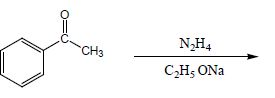
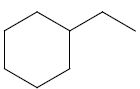
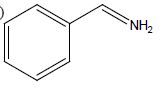
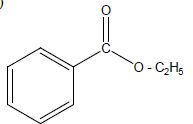
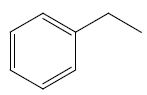
17.
On reacting with neutral ferric chloride, phenol gives ______.
red colour
violet colour
dark green colour
no colouration.
18.
Among the following ethers which one will produce methyl alcohol on treatment with hot HI?
(H3C)3C-O-CH3
(CH3-)2-CH-CH2-O-CH3
CH3-(CH2)3-O-CH3
CH3-CH2-\(\underset { \overset { | }{ { CH }_{ 3 } } }{ CH } \)-O-CH3
19.
If x is the amount of adsorb ate and m is the amount of adsorbent, which of the following relations is not related to adsorption process?
x/m = f(P) at constant T
x/m = f(T) at constant P
P = f(T) at constant x/m
x/m = PT
20.
The coagulation values in millimoles per litre of the electrolytes used for the coagulation of As2S3 are given below
(I) (NaCl) = 52
(II) ((BaCl2) = 0.69
(III) (MgSO4) = 0.22
The correct order of their coagulating power is ________.
III > II > I
I > II > III
I > III > II
II > III > I
21.
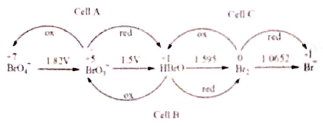
Consider the change in oxidation state of Bromine corresponding to different emf values as shown in the diagram below:
\({ BrO }_{ 4 }^{ - }\overset { 1.82V }{ \longrightarrow } { BrO }_{ 3 }^{ - }\overset { 1.5V }{ \longrightarrow } HBrO\overset { 1.595v }{ \longrightarrow } { Br }_{ 2 }\overset { 1.0652V }{ \longrightarrow } Br^{ - }\)
Then the species undergoing disproportional is
Br2
BrO4-
BrO-3
HBrO
22.
Zinc can be coated on iron to produce galvanized iron but the reverse is not possible. It is because _______.
Zinc is lighter than iron
Zinc has lower melting point than iron
Zinc has lower negative electrode potential than iron
Zinc has higher negative electrode potential than iron
23.
Which will make basic buffer?
50 mL of 0.1M NaOH+25mL of 0.1M CH3COOH
100 mL of 0.1M CH3COOH+100 mL of 0.1M NH4OH
100 mL of 0.1M HCl+200 mL of 0.1M NH4OH
100 mL of 0.1M HCl+100 mL of 0.1M NaOH
24.
Concentration of the Ag+ ions in a saturated solution of Ag2C2O4 is 2.24 ×10⁻⁴mol L-1 solubility product of Ag2C2O4 is_______.
2.42 × 10⁻⁸mol3L-3
2.66 × 10⁻¹²mol3L-3
4.5 × 10⁻¹¹mol3L-3
5.619 × 10⁻¹²mol3L-3
25.
The excess energy which a molecule must possess to become active is known as _____.
kinetic energy
threshold energy
potential energy
activation energy
26.
Which of the following does not affect the rate of reaction?
Amount of the reactant taken
Physical state of the reactant
∆H of reaction
Size of vessel
27.
What would be the activation energy of a reaction when the temperature is increased from 27oC to 37oC?
534 kJ mol-1
53.4 kJ mol-1
5.34 kJ mol-1
None of these
28.
Orthophosphorus acid on heating gives______.
Hypophosphorous
Orthophosphoric acid
Phosphine gas
both (b) and (c)
29.
Allotrope of sulphur which shows paramagnetic behaviour _______.
S8- Rhombic
S8- Monoclinic
S2- In vapour phase
Not possible
30.
Which of the following is correct?
H3PO3 is dibasic and reducing
H3PO3 is dibasic and non-reducing
H3PO4 is tribasic and reducing
H3PO3 is tribasic and non-reducing
31.
The coordination number of a metal crystallising in a hexagonal close packed structure is _______.
6
4
8
12
32.
Which one of the following is a network solid?
diamond
silicon carbide
naphthalene
both (a) and (b)
33.
Pick out the example for covalent and molecular crystal.
Ice, Diamond
Diamond, Ice
NaCl, FeS
FeS, Ice
34.
Borax is _______.
Na2[B4O5(OH)4).8H2O
Na2[B4O5(OH)6).7H2O
Na2[B4O3(OH)8].6H2O
Na2[B4O2(OH)10).5H2O
35.
Which one is correct statement for zeolite?
Zeolites are aluminosilicates having three dimensional framework
Hydrate zeolites are used as ion exchangers in hardening of soft water
Zeolites are alumino silicates
all the above
36.
Lewis acid character of boron trihalides is as a follows _______.
BF3 > BCl3 > BBr3 > BI3
BCI3 > BF3 > BBr3 > BI3
BI3 > BBr3 > BCl3 > BF3
BI3 > BF3 > BCl3 > BBr3
37.
If the standard electrode potential (Eo) of a metal is ________ and __________ the metal is a powerful reducing agent.
large, negative
large, positive
small, negative
small, positive
38.
Of these statement, which statement is incorrect in most of the transition elements are _______.
hexagonal close packed
cubic close packed
face centered cubic
symmetrical distribution
39.
Except ________ all element from Rf to Cn, are synthetically prepared and have very low half life periods.
cadmium
actinium
yttrium
cadmium
40.
Magnesite is_______.
Magnesium oxide
Magnesium carbonate
Magnesium sulphate
Magnesium chloride
41.
Ignition mixture used in aluminothermic process is ________.
Cr + AI2O3
Mg + BaO2
AI + Cr2O3
Ba + MgO
42.
\(2PbS+{ 3O }_{ 2 }\longrightarrow 2pbO+{ 2SO }_{ 2 }\) Name the process ________.
Roasting
Calcination
Smelting
Leaching
43.
_______ valencies are directional in nature.
primary
secondary
tertiary
None
44.
Which of the following is wrong about double salts?
retain their properties only in solid state
contains two or more salt in stoichiometric proportions
they don't dissociate into its constituent ions
none of the above
45.
Co-ordination isomerism is exhibited by _______.
[Cr(en)2Cl2]NO2
[Pt(NH3)4] [CuCl4]
[Cr(en)2Cl2]NO
[Co(NH3)5Cl]Cl2
46.
The decomposition of phosphine (PH3) on tungsten at low pressure is a first order reaction. It is because the _____.
rate is proportional to the surface coverage
rate is inversely proportional to the surface coverage
rate is independent of the surface coverage
rate of decomposition is slow
47.
If ‘a’ stands for the edge length of the cubic system sc, bcc, and fcc. Then the ratio of radii of spheres in these systems will be respectively ________.
\(\left( \frac { 1 }{ 2 } a;\frac { \sqrt { 3 } }{ 2 } a;\frac { \sqrt { 2 } }{ 2 } a \right) \)
\(\left( \sqrt { 1a } :\sqrt { 3a } :\sqrt { 2a } \right) \)
\(\left( \frac { 1 }{ 2 } a:\frac { \sqrt { 3 } }{ 4 } a:\frac { 1 }{ 2\sqrt { 2 } } a \right) \)
\(\frac { 1 }{ 2 } a:\sqrt { 3 } a:\frac { 1 }{ \sqrt { 2 } } a\)
48.
For a first order reaction A ⟶ B the rate constant is x min−1. If the initial concentration of A is 0.01M, the concentration of A after one hour is given by the expression.
001. e−x
1 x 10⁻²(1-e-60x)
(1 x 10⁻²)e-60x
none of these
49.
Which one of the following complexes is not expected to exhibit isomerism?
[Ni(NH3)4(H2O)2]2+
[Pt(NH3)2Cl2]
[Co(NH3)5SO4]Cl
[FeCl6]3-
50.
A complex has a molecular formula MSO4Cl.6H2O. The aqueous solution of it gives white precipitate with Barium chloride solution and no precipitate is obtained when it is treated with silver nitrate solution. If the secondary valence of the metal is six, which one of the following correctly represents the complex?
[M(H2O)4Cl]SO4.2H2O
[M(H2O)6]SO4
[M(H2O)5Cl]SO4.H2O
[M(H2O)3Cl]SO4.3H2O
51.
MnO4- react with Br- in alkaline PH to give ________.
BrO3- MnO2
Br2, MnO42-
Br2, MnO2
BrO-, MnO42-
52.
Which of the following compounds is colourless?
Fe3+
Ti4+
Co2+
Ni2+
53.
The stability of +1 oxidation state increases in the sequence ________.
Al < Ga < In < Tl
Tl < In < Ga < Al
In < Tl < Ga < Al
Ga< In < Al < Tl
54.
The geometry at which carbon atom in diamond are bonded to each other is _______.
Tetrahedral
hexagonal
Octahedral
none of these
55.
On oxidation with iodine, sulphite ion is transformed to _______.
S4O62-
S2O62-
SO42-
SO32-
56.
Among the following, which is the strongest oxidizing agent?
Cl2
F2
Br2
l2
57.
Which of the following reduction is not thermodynamically feasible?
\({ Cr }_{ 2 }{ O }_{ 3 }+2Al\longrightarrow { Al }_{ 2 }{ O }_{ 3 }+2Cr\)
\(\mathrm{Al}_2 \mathrm{O}_3+2 \mathrm{Cr} \longrightarrow \mathrm{Cr}_2 \mathrm{O}_3+2 \mathrm{Al}\)
\(3Ti{ O }_{ 2 }+4Al\longrightarrow 2A{ l }_{ 2 }{ O }_{ 3 }+3Ti\)
none of these
58.
Which of the following statements, about the advantage of roasting of sulphide ore before reduction is not true?
\(\Delta { G }_{ f }^{ 0 }\) of sulphide is greater than those for CS2 and H2S
\(\Delta { G }_{ r }^{ 0 }\) is negative for roasting of sulphide ore to oxide
Roasting of the sulphide to its oxide is thermodynamically feasible
Carbon and hydrogen are suitable reducing agents for metal sulphides
59.
Name a chemical test to distinguish between the following.
(i) 2-Pentanone, 3- Pentanone
(ii) Acetone, acetaldehyde
(iii) Benzaldehyde, butanal
60.
Ethanal is more reactive towards nucleophilic addition reaction than propanone. Why?
61.
Name the factors that affect adsorption.
62.
Define Deemulsification.
63.
Write the oxidation, reduction and overall redox reaction taking place in the Lithium ion battery.
64.
What is the value of Faraday constant? Define it.
65.
What happens when ethylene reacts with alkaline KMnO4 solution?
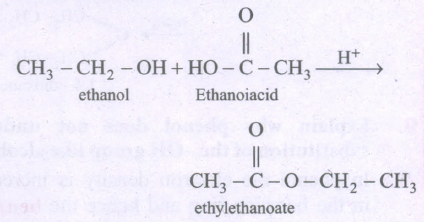
66.
Explain 'esterification' reaction with an example.
67.
Calculate the ionisation constant for the conjugate base of HF. Ionisation constant of HF at 298 K is 6.8 x 10⁻⁴
68.
Magnesium is not precipitated from a solution of its salt by a mixture of NH4OH and NH4Cl. Explain
69.
A conductivity cell has two platinum electrodes separated by a distance 1.5 cm and the cross sectional area of each electrode is 4.5 sq cm. Using this cell, the resistance of 0.5 N electrolytic solution was measured as 15 Ω. Find the specific conductance of the solution.
70.
Calculate the concentration of OH- in a fruit juice which contains \(2\times10^{-3}\) M, H3O+ ion. Identify the nature of the solution.
71.
Reduction potential of two metals M1 and M2 are \(E^{0}_{M^{2+}_{1}|M_{1}} = -2.3V\) and \(E^{0}_{M^{2+}_{1}|M_{1}} = 0.2V\) Predict which one is better for coating the surface of iron. Given : \(\mathrm{E}_{\mathrm{Fe}^{2+} \mid \mathrm{Fe}}^{\circ}=-0.44 \mathrm{~V}\)
72.
Why does conductivity of a solution decrease on dilution of the solution.
73.
74.
The rate of the reaction X + 2y→ product is 4 x 10⁻³ mol L-1S-1, if [X] = [Y] = 0.2M and rate constant at 400K is 2 x 10⁻²s-1, What is the overall order of the reaction.
75.
What are the conditions for alloy formation?
76.
Orange colour of Cr2O72- ion charges to yellow in alkali and yellow solution turns out orange on adding H+ ions. Explain why?
77.
Answer the following:
(i) Effect the adding catalyst on activation energy and Gibb's energy (ΔG).
(ii) Why do we heat the solution of oxalic acid in redox titration against KMnO4?
78.
The decomposition reaction of ammonia gas on platinum surface has a rate constant R = 2.5 x 10⁻⁴mol L-1. What is the order of the reaction.
79.
A compound forms hexagonal dosed packed structure. What is the total number of voids in 0.5 mol of it? How many of these are tetrahedral voids?
80.
Give reason for the following:
F2 is more reactive than CIF3 but CIF3 is more reactive than Cl2
81.
How would you account for the following? The electron gain enthalpy with negative sign is less for oxygen than that of sulphur.
82.
Name the seven primitive crystal systems.
83.
What happens to CO2 when dissolved in water?
84.
Explain the formation of boron trifluoride.
85.
Give reason : Extraction of copper directly from sulphide ores is less favourable than from its oxide ores through reduction.
86.
List out the commercial uses of iron.
87.
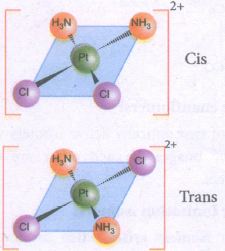
Draw the Cis and trans isomer of MA2B2 type
88.
What is a central atom or ion?
89.
Explain the oxidation states of 4d series elements.
90.
[CuCl4]2- exists while [Cul4]2- does not exist why?
91.
Write the IUPAC names for the following complexes.
92.
Write the valence shell electronic configuration of group-15 elements.
93.
Complete the following reactions.
a. \(B(OH)_3 + NH_3\longrightarrow \)
b. \(Na_{ 2 }B_{ 4 }{ O }_{ 7 }+{ { H }_{ 2 }{ SO }_{ 4 }+{ 5H }_{ 2 }O\longrightarrow }\)
c. \({ B }_{ 2 }{ H }_{ 6 }+2NaOH+2{ H }_{ 2 }O\longrightarrow \)
d. \({ B }_{ 2 }{ H }_{ 6 }+6{ CH }_{ 3 }OH\longrightarrow \)
e. \(4{ BF }_{ 3 }+3{ H }_{ 2 }O\longrightarrow \)
f. \(HCOOH+{ H }_{ 2 }{ SO }_{ 4 }\longrightarrow \)
g. \(2SiCl_{ 4 }+NH\)3
h. SiCl4 + 4C2H5OH \(\rightarrow\)
i. 2\(B+6NaOH\longrightarrow \)
j. \({ H }_{ 2 }{ B }_{ 4 }{ O }_{ 7 }\overset { Red\ hot }{ \rightarrow } \)
94.
Why fluorine is more reactive than other halogens?
95.
Give the structure of CO and CO2.
96.
Write a note on Fisher tropsch synthesis.
97.
What are the various steps involved in the extraction of pure metals from their ores?
98.
What is Rosenmund's reduction? What is the purpose of adding BaSO4 in it?
99.
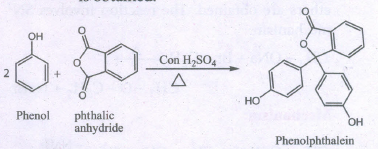
How can the following conversion be effected? (i) Phenol to phenolphthalein.
100.
How are colloidal solution of ink and graphite prepared?
101.
What are the types of changes in the cathode and anode in electrolytic and electrochemical cells?
102.
How will you calculate solubility product from molar solubility?
103.
What happens when 1-phenyl ethanol is treated with acidified KMnO4.
104.
What happens to KMnO4 when it reacts with
(i) Cold Cone. H2SO4
(ii) hot Cone H2SO4?
105.
A reaction is second order with respect to a reactant. How is the rate of reaction affected if the concentration of the reactant is
(i) doubled (ii) reduced to half
106.
Complete the following reactions
(l) Cl2+ H2O\(\longrightarrow \)?
(ii) XeF6 + 2H2O \(\longrightarrow \) ?
(Iii) XeF6 + 2H2O\(\longrightarrow \)?
107.
How do the spacings of the three planes (100), (101) and (111) of simple cubic lattice vary?
108.
How is boron trifluoride obtained from boron trioxide?
109.
How is acid leaching done for the sulphide ores?
110.
Match the common name with formula and the IUPAC ligand name.
| Common name | Formula | IUPAC ligand name |
|---|---|---|
| Bromide | C2O42- | Carbonato |
| Nitrate | Br- | Oxalato |
| hydroxide | NO3- | hydroxido |
| Carbonate | OH- | bromido |
| Oxalate | CO32- | nitrato |
111.
The rate of formation of a dimer in a second order reaction is 7.5 x 10⁻³ mol L-1 s-1 at 0.05 mol L-1 monomer concentration. Calculate the rate constant.
112.
Describe the graphical representation of first order reaction.
113.
Compare lanthanoids and actinoids.
114.
Justify the position of lanthanoids and actinoids in the periodic table.
115.
What are interhalogen compounds? Give examples.
116.
Compound A with molecular formula C7H6O reduces Tollen's reagent and also gives Cannizaro reaction. A on oxidation gives the compound B with molecular formula C7H6O2 Calcium salt of B on dry distillation gives the compound C with molecular formula CI3H10O. Find A, B and C. Explain the reaction.
117.
An organic compound A of molecular formula C3H6O on reduction with LiAlH4 gives B. Compound B gives blue colour in Victor Meyer's test and also forms a chloride C with SOCl2. The chloride on treatment with alcoholic KOH gives D. Identify A, B, C and D and explain the reactions.
118.
Explain the electrical property of colloids with a neat diagram. (or) Write a note on Helmholta electrical double layer.
119.
A zinc rod is placed in 0.095 M zinc chloride solution at 25oC. Emf of this half cell is -0.79 V. Calculate EoZn2+/Zn
120.
If a solution has a pH of 7.41, determine its H+ concentration.
121.
What are enzymes? Write a brief note on the mechanism of enzyme catalysis.
122.
Explain common ion effect with an example.
123.
The decomposition of NH3 on platinum surface is zero reaction. What are the rate of production of N2 and H2 it K = 2.5 x 10⁻⁴mol L-1 S-1?
124.
Justify the following statement.
"Elements of the first transition series possess many properties different from those of heavier transition elements".
125.
Give a detailed account on allotropes of sulphur.
126.
Explain the following: Similarities and differences between metallic and ionic crystals.
127.
How are silicates classified? Give an example for each type of silicate.
128.
Explain refining of nickel by mond's process
129.
Mention the type of hybridisation and magnetic property of the following complexes using VB theory a) [FeF6]4- b) [Fe(CN)6]4-
130.
Write the postulates of Werner’s theory.
131.
Assertion: p – N, N – dimethyl amino benzaldehyde undergoes benzoin condensation
Reason: The aldehydic (-CHO) group is meta directing.
Codes:
A) if both assertion and reason are true and reason is the correct explanation of assertion.
B) if both assertion and reason are true but reason is not the correct explanation of assertion.
C) assertion is true but reason is false
D) both assertion and reason are false
if both assertion and reason are true and reason is the correct explanation of assertion.
if both assertion and reason are true but reason is not the correct explanation of assertion.
assertion is true but reason is false
both assertion and reason are false
132.
Assertion: due to Frenkel defect, density of the crystalline solid decreases.
Reason: In Frenkel defect cation and anion leaves the crystal.
Codes:
a) Both assertion and reason are true and reason is the correct explanation of assertion
b) Both assertion and reason are true but reason is not the correct explanation of assertion
c) Assertion is true but reason is false
d) Both assertion and reason are false
Both assertion and reason are true and reason is the correct explanation of assertion
Both assertion and reason are true but reason is not the correct explanation of assertion
Assertion is true but reason is false
Both assertion and reason are false
1.
(c)
C6H6
2.
(b)
Wmax = ΔG
3.
(a)
6.19 x 1052
4.
(d)
all of these
5.
(a)
Acetic acid
6.
(b)
Fehling's solution
7.
(d)
elodron deficient and Lewis acid
8.
(a)
ethoxybenzene
9.
(b)
1.39 x 10⁻⁵
10.
(d)
all the above
11.
(a)
10 alcohol
12.
(b)
A is stronger than B
13.
(d)
colloidal platinum
14.
(c)
dialysis
15.
(a)
O/W
16.
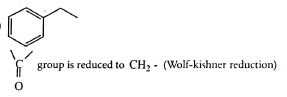
17.
(b)
violet colour
18.

19.
(d)
x/m = PT
20.
coagulating power ∝ 1/coagulation value
21.
(Ecell)A = -1.82 + 1.5 = -0.32V
(Ecell)B = -1.5 + 1.595 = + 0.095V
(Ecell)C = -1.595 + 1.0652 = -0.529V
The species undergoing disproportionation is HBrO
22.
EoZn2+[Zn] = 0.76V and EoFe2+[Fe] = -0.44V
Zinc has higher negative electrode potential than iron, iron cannot be coated on zinc
23.
Basic buffer is the solution which has weak base and its salt.
NH4OH + HCI → NH4CI +H2O + NH4OH
200 ml 100 ml salt 100 ml weak base
24.
\(\mathrm{Ag}_{2} \mathrm{C_2O_4} \rightleftharpoons 2 \mathrm{Ag}_{}^{+}+\mathrm{C_2O}_{4{}}^{2-}\)
\(\left[\mathrm{Ag}^{+}\right]=2 .24 \) ×10-4mol L-1
\(\mathrm{C_2O}_{4{}}^{2-} = \frac {2.24 \times 10 ^{-4}}{2}\) mol L-1
= 1.12 ×10⁻⁴mol L-1
Ksp = [Ag]2 [C2O42-]
= (2.24 ×10⁻⁴mol L-1) (1.12 ×10⁻⁴mol L-1)
= 5.619 × 10⁻¹²mol3L-3
25.
(d)
activation energy
26.
(c)
∆H of reaction
27.
(d)
None of these
28.
(d)
both (b) and (c)
29.
(c)
S2- In vapour phase
30.
(a)
H3PO3 is dibasic and reducing
31.
(d)
12
32.
(d)
both (a) and (b)
33.
(b)
Diamond, Ice
34.
(a)
Na2[B4O5(OH)4).8H2O
35.
(d)
all the above
36.
(c)
BI3 > BBr3 > BCl3 > BF3
37.
(a)
large, negative
38.
(d)
symmetrical distribution
39.
(b)
actinium
40.
(b)
Magnesium carbonate
41.
(b)
Mg + BaO2
42.
(a)
Roasting
43.
(d)
None
44.
(c)
they don't dissociate into its constituent ions
45.
(b)
[Pt(NH3)4] [CuCl4]
46.
Given:
At low pressure the reaction follows first order therefore,
Rate α [reactant]1
Rate α (surface area)
At high pressure due to the complete coverage of surface area, the reaction follows zero order.
Rate α [reactant]0
Therefore the rate is independent of surface area.
47.
sc ⇒ 2r = a
⇒ r = a/2
bcc ⇒ 4r = \( \sqrt{3a} \) ⇒ r = \(\frac { \sqrt{3a}} {4}\)
fcc ⇒ 4r ⇒ \( \sqrt{2a} \) ⇒ r = \(\frac { \sqrt{2a}} {4} = \frac { a} {2\sqrt{2a}}\)
\(\left( \frac { a }{ 2 } :\frac { \sqrt { 3 } }{ 4 } a:\frac { a }{ 2\sqrt { 2 } } \right) \)
48.
\(k=\frac { 2.303 }{ t } log\frac { \left[ { A }_{ 0 } \right] }{ \left[ A \right] } \)
\(k=\frac { 1 }{ t } ln \frac { \left[ { A }_{ 0 } \right] }{ \left[ A \right] } \)
\(e^{kt}=\frac { \left[ { A }_{ 0 } \right] }{ \left[ A \right] }\)
[A] = [A0] ekt
In this case
k = x min-1 and [A0] = 0.01 M = 1 x 10⁻²M
t = 1 hour = 60 min
[A] = (1 x 10⁻²)e-60x
49.
Option (a) and (b) -geometrical isomerism is possible
Option (c) - ionization isomerism is possible
Option (d) - no possibility to show either constitutional isomerism or stereo isomerism
50.
Molecular formula: MSO4Cl.6H2O
Formation of white precipitate with Barium chloride indicates that SO2-4 ions are outside the coordination sphere, and no precipitate with AgNO3 solution indicates that the Cl- ions are inside the coordination sphere. Since the coordination number of M is 6.Cl- and 5 H2O are ligands, remaining 1 H2O molecular and SO2-4 are in the outer coordination sphere.
51.
(a)
BrO3- MnO2
52.
(b)
Ti4+
53.
(a)
Al < Ga < In < Tl
54.
(a)
Tetrahedral
55.
(c)
SO42-
56.
(b)
F2
57.
(b)
\(\mathrm{Al}_2 \mathrm{O}_3+2 \mathrm{Cr} \longrightarrow \mathrm{Cr}_2 \mathrm{O}_3+2 \mathrm{Al}\)
58.
(d)
Carbon and hydrogen are suitable reducing agents for metal sulphides
59.
(i) Iodoform test
(ii) Tollens test
(iii) Bendicts test.
60.
(i) Ethanal (CH3CHO) is more reactive towards nucleophilic addition reaction than propanone (\({ CH }_{ 3 }-\underset { \overset { || }{ O } }{ C } -{ CH }_{ 3 }\)) because of steric and electronic reasons.
(ii) Greater the number of alkyl groups attached, less will be the reactivity of carbonyl compound towards nucleophilic addition.
(iii) Soethanal is more reactive than propanone.
61.
(i) Temperature
(ii) Pressure
(iii) Nature of the gas and
(iv) Nature of the adsorbent
62.
Emulsion can be separated into two separate layers. The process is called Deemulsification.
63.
At the anode oxidation occurs
Li(s) ⟶ \({ Li }_{ (aq) }^{ + }\) + e-
At the cathode reduction occurs
Li++ CoO2(s) + e- ⟶ Li CoO2(s)
Overall reactions
Li(s)+ CoO2 ⟶ LiCoO2(s)
64.
IF = 96500 C
It is defined as the quantity of electricity which deposits one gram equivalent of the substance or it is the charge carried by one mole of electrons
65.
When ethylene reacts with alkaline KMnO4 solution (Baeyer's reagent), it forms glycol (diol).

66.
Alcohols react with carboxylic acids in the presence of an acid to give esters.
67.
The conjugate base of HF is F-
For F-, \({ K }_{ b }=\frac { { K }_{ w } }{ { K }_{ a } } =\frac { { 10 }^{ -14 } }{ { 6.8\times 10 }^{ -14 } } \)
= 1.47 x 10⁻¹¹.
68.
Magnesium has to precipitate as Mg(OH)2 when treated with NH4OH, but addition of NH4CI will suppress the ionisation of NH4OH due to common ion effect. So ionic product of Mg2+ and OH- ions will be less than the solubility product (Ksp) of Mg(OH)2. Hence will not precipitate.
69.
l = 1.5 cm = 1.5 × 10⁻²m
A = 4.5 cm2 = 4.5 × (10-4)m2
R = 15Ω
\(\kappa = \frac{1}{R}(\frac{l}{A})\)
\(\kappa = \frac{1}{15\Omega}\times\frac{1.5\times10^{-2}m}{4.5\times10^{-4}m^2}\)
= 2.22 ohm-1 m-1
= 2.22 Sm-1
70.
Given that H3O+ = \(2\times10^{-3}M\)
\(K_{w}=[H_{3}O^{+}][OH^{-}]\)
\(\therefore [OH^{-}]=\frac{K_{w}}{[H_{3}O^{+}]}=\frac{1\times10^{-14}}{2\times10^{-3}}=0.5\times10^{-11}M\)
\(2\times10^{-3} >>0.5\times10^{-11}\)
i.e., [H3O+]>>[OH-], hence the juice is acidic in nature
71.
The oxidation potential of M1 is more +ve than the oxidation potential of Fe which indicates that it will prevent iron from rusting.
72.
On dilution the concentration decreases. Conductivity decreases with decrease in concentration (or dilution) as the number of ions per unit volume that carry the current in a solution decrease on dilution.
73.
74.
Rate = K[X]n[y]m
4 x 10⁻³ mol L-1s-1= 2 x 10⁻²s-1(0.2mol L-1)n(0.2mol L-1)m
\(\frac { 4\times { 10 }^{ -3 }mol\quad { L }^{ -1 }{ s }^{ -1 } }{ 2\times { 10 }^{ -2 }{ s }^{ -1 } } =\) (0.2)n+m(mol L-1)n+m
0.2(mol L-1) = (0.2)n+m(mol L-1)n+m
Comparing the powers on both sides
The overall order of the reaction n + m = 1
75.
(i) According to Hume-Rothery rule to, form a substitute alloy the difference between the atomic radii of solvent and solute is less than 15%.
(ii) Both the solvent and solute must have the same crystal structure and valence and their electro negativity difference must be close to zero.
76.
(i) When orange solution containing Cr2O72- ion is treated with an alkali, a yellow solution of Cr2O72- is obtained.
(ii) Similarly, when H+ ions are added to yellow solution, an orange solution of Cr2O72- is obtained due to interconversion.
77.
(i) Catalyst lowers the activation energy and changes the path of the reaction and thus increases the rate of the reaction. A catalyst does not alter Gibbs energy of a reaction.
(ii) Higher the temperature faster the reaction. This is because increasing the temperature increases the Kinetic energy, and hence more molecules would have energy greater than the activation energy resulting in increased rate and completion of the reaction. Hence oxalic acid should be heated in redox titration against KMnO4.
78.
The order of the reaction is zero.
79.
1 Mole of hexagonal packed structure contains 1 mole of octahedral voids and two moles of tetrahedral voids. Therefore, 0.5 moles of hexagonal packed structure contains 0.5 moles of octahedral voids and 1 mole of tetrahedral voids.
No. of tetrahedral voids = 6.022 x 10²³
No. of octahedral voids\(\frac{1}{2}\) x no. of tetrahedral voids
No. of octahedral voids = \(\frac{1}{2}\) x 6.022 x 1023
= 3.011 x 10²³
Total No. of voids = (6.022+3.011) x 1023
= 9.033 x 10²³.
80.
(i) Fluorine due to its small size high electronegativity and low F-F bond energy is more reactive than CIF3
(ii) While CI-F bond in CIF3 is weaker than CI-CI bond in Cl2 therefore, CIF3 is more reactive than Cl2.
(iii) So these graphite rods are consumed slowly and need to be replaced from time - to - time
81.
(i) The electron gain enthalpy for oxygen is less negative because of its small size due to which the electron repulsions in the relatively small 2p-subshell are comparatively large.
(ii) Hence the Incoming electrons are not accepted with the same ease as in case of sulphur as it has relatively large size.
82.
There are seven primitive crystal systems; cubic, tetragonal, orthorhombic, hexagonal, monoclinic, triclinic and rhombohedral.
83.
The aqueous solution of carbon dioxide is slightly acidic as it forms carbonic acid.
CO2 + H2O ⇌ H2CO3 ⇌ H+ + HCO3-
84.
(i) Boric acid reacts with calcium fluoride in presence of conc. sulphuric acid and gives boron trifluoride.
3CaF2 + 3H2SO4 + 2B(OH)3 ⟶ 3CaSO4 + 2BF3 + 6H2O
(ii) Borax when heated with soda ash it gives borax
Na2CO3 + 4B(OH)3 ⟶ Na2B4O7 +.CO2 + 6H2O
85.
(i) The standard free energy for the formation of CuFeS2 (copper pyrites) is greater than those of CS2 and H2S.
(ii) Hence, CuFeS2 cannot be reduced carbon or hydrogen.
(iii) However, the free energy of copper oxide less than that of CO2,
(iv) That is the reason, extraction of copper easier from its oxide through reduction.
86.
(i) Iron is used in the manufacture of wrought iron and steel.
(ii) Cast iron is used for casting stoves, railway sleepers, toys, etc.
(iii) Stainless steel is used for cycles, automobiles, utensils, pens, etc.
(iv) Chrome steel is used for cutting tools and crushing machines
87.
MA2B2
[Pt(NH3)2Cl2]
88.
(i) The central atom or ion is the one that occupies the central position in a coordination entity and binds other atoms or groups of atoms (ligands) to itself, through a coordinate covalent bond.
(ii) For example, in K4[Fe(CN)6], the central metal ion is Fe2+. In the coordination entity [Fe(CN)6]4-, the Fe2+ accepts an electron pair from each ligand, CN- and thereby forming six coordinate covalent bonds with them.
(iii) It is referred to as a Lewis acid.
89.
The oxidation states of 4d metals vary from +3 for Y to +8 for Ru and Os.
The highest oxidation state of 4d elements are found in their compounds with the higher electronegative elements like O, F & Cl.
Example: In RuO4, OsO4 & WCl6
The oxidation state of Ru and Os is +8.
The oxidation state of W is +6.
Generally in going down a group, a stability of higher oxidation state increases while that of lower oxidation state decreases.
4d series (5th period) - Yttrium to Cadmium (10 elements)
| Elements | Oxidation states |
|---|---|
| Y | +3 |
| Zr | +3, +4 |
| Nb | +2, +3, +4, +5 |
| Mo | +2, +3, +4, +5, +6 |
| Tc | +2, +4, +5, +7 |
| Ru | +2, +3, +4, +5, +6, +7 +8 |
| Rh | +2, +3, +4, +6 |
| Pd | +2, +3, +4 |
| Ag | +1, +2, +3 |
| Cd | +2 |
90.
In [CuCI4]-2 Cu2+, is reduced to Cu+ by I-. Hence Cupric Iodide in converted to cuprous Iodide so [CuI4]-2 does not exist. In [CuCI4]-2 Cl- cannot effect this change and so exists.
91.
i) Na2[Ni(EDTA)] - Sodium 2, 2', 2",2'" - (ethane-1,2 diyldinitrilo tetraacetatonickelate)(II)
ii) [Ag(CN)2]- - Dicyanido-kC-argentate (I) ion
iii) [CO(en)3]2(SO4)3 - Tris (ethane 1, 2 diamine)cobalt (III) sulphate
iv) [CO(ONO)(NH3)5]2+ - Pentaamminenitrito - KO cobalt (III) ion
v) [Pt(NH3)2Cl(NO2)] - Diammainechloridonitro - kN - platinum (II)
92.
(i) The general electronic configuration of 15 group elements is ns2np3.
(ii) Nitrogen \(\Rightarrow 2 \mathrm{~s}^{2} 2 \mathrm{p}^{3}\) (Valence shell)
(iii) Phosphorus \(\Rightarrow 3 \mathrm{~s}^{2} 3 \mathrm{p}^{3}\)
(iv) Arsenic \(\Rightarrow 4 \mathrm{~s}^{2} 4 \mathrm{p}^{3}\)
(v) Antimony \(\Rightarrow 5 s^{2} 5 p^{3}\)
(vi) Bismuth \(\Rightarrow 6 \mathrm{~s}^{2} 6 \mathrm{p}^{3}\)
93.
(a) B(OH)3 + NH3\(\overset { \Delta }{ \longrightarrow } \) BN + 3H2O
(Boron nitride)
(b) Na2B4O7 + H2SO4 + 5H2O \(\longrightarrow \) 4H3BO3 + Na2SO4
(Boric acid)
(c) B2H6 + 2NaOH + 2H2O \(\longrightarrow \)2NaBO2 + 6H2
(Sodium metaborate)
(d) B2H6 + 6CH3OH \(\longrightarrow \)2B(OCH3)3 + 6H2O
(Trimethyl borate)
(e) 4BF3 + 3H2O \(\longrightarrow \) H3BO3 + 3H+ + 3[BF4]-
(Boric acid)
(f) HCOOH + H2SO4 \(\longrightarrow \)CO + H2SO4. H2O
(Carbon monoxide)
(g) 2SiCl4 + NH3 \(\overset { 330K }{ \underset { ether }{ \longrightarrow } } \)Cl3Si- NH - SiCl3 + 2HCl
(Chlorosilazane)
(h) SiCl4 + 4C2H5OH\(\longrightarrow \)Si(OC2H5)4 + 4HCI
(Tetraethoxysilane)
(i) 2B + 6NaOH\(\longrightarrow \) 2Na3BO3 + 3H2
(j) H2B4O7 \(\xrightarrow[]{Redhot}\) 2B2O3 + H2O
94.
(i) Fluorine is more electro negative than other halogens.
(ii) Because except fluorine all the other halogens have positive oxidation state.
(iii) It has high electron affinity character
Example:
\(\mathrm{Cl}_{2}\mathrm{O} \Rightarrow+1 \text { oxidation state }(\mathrm{Cl}) \)
\(\mathrm{OF}_{2} \Rightarrow-1 \text { oxidation state }(\mathrm{F})\)
95.
| Oxides of Carbon | Structure | Parameters |
| CO |  |
Three electron pairs are shared between carbon and oxygen. The C-O bond distance is 1.128\(\overset{o}{A}\). |
| CO2 |  |
Equal bond distance for the both C-O bonds. Two C-O sigma bond, It has 3c-4e bond. |
96.
The reaction of CO with hydrogen at a pressure of less than 50 atm using metal catalysts at 500 - 700 K yields saturated and unsaturated hydrocarbons.
\(nCO+(2n+1){ H_2 }\longrightarrow C_{ n }{ H }_{ (2n+2) }+{ nH }_{ 2 }O\)
\(nCO+2n{ H }_{ 2 }\longrightarrow { C }_{ n }{ H }_{ 2n }+{ nH }_{ 2 }O\)
97.
(i) Concentration of the ore
(ii) Extraction of crude metal
(iii) Refining of crude metal
98.
(i) When reduced with hydrogen in the presence of 'poisoned' palladium catalyst, they form aldehydes. This reaction is called Rosenmund reduction.
\(\underset { acetyl\ chloride }{ { CH }_{ 3 }-\underset { \overset { || }{ O } }{ C } -Cl } +H-H\overset { Pd }{ \underset { Ba{ SO }_{ 4 } }{ \longrightarrow } } \underset { acetaldehyde }{ CH_{ 3 }-\underset { \overset { || }{ O } }{ C } -H+HCl } \)
(ii) BaSO4 is used as a catalytic poi on to stop the reduction at the stage of aldehyde.
(iii) Otherwise, the aldehyde formed will be further reduced to primary alcohol.
99.
On heating phenol with phthalic anhydride in presence of con.H2SO4 phenolphthalein is obtained.
100.
(i) Using a colloid mill, the solid is ground to colloidal dimension.
(ii) The colloid mill consists of two metal plates rotating in opposite direction at very high speed of nearly 7000 revolution I minute.
(iii) The colloidal particles of required colloidal size is obtained by adjusting the distance between two plates.
(iv) By this method, colloidal solutions of ink and graphite are prepared.
101.
| Characteristics | Electrolytic cell | Electrochemical cell | |
| (i) | Nature of electrodes | Cathode - Negatively charged Anode - Positively | Cathode - Positively charge Anode - Negatively charged |
| (ii) | Movement of electrons | Cathode ➝ Anode | Anode ➝ Cathode |
102.
Solubility can be calculated from the molar solubility i.e., the maximum number of moles of solute that can be dissolved in one litre of the solution.
For a solute XmYn,
\({ X }_{ m }{ Y }_{ n(s) }\rightleftharpoons m{ X }_{ (aq) }^{ n+ }+{ nY }_{ (aq) }^{ m- }\)
From the above stoichiometrically balanced equation we have come to know that 1 mole of Xm Yn(s) dissociated to furnish 'm' moles of Xn+ and 'n' moles of Ym- if 's' is molar solubility of XmYn then
[Xn+] = ms and [Ym-] = ns
ஃKsp = [Xn+]m [Ym-]n
Ksp = (ms)m (ns)n
Ksp = (m)m (n)n (s)m+n
103.
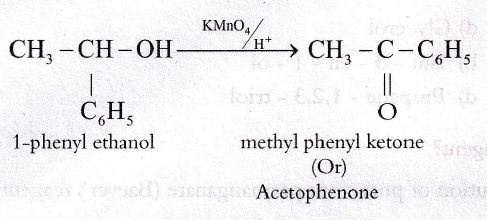
104.
Action of conc H2SO4 : On treating with cold cone H2SO4, it decomposes to form manganese heptoxide, which subsequently decomposes explosively.

But with hot Cone H2SO4, potassium permanganate give MnSO4
.JPG)
105.
Let the concentration of the reactant be [A] = a
Rate of reaction R = k [A]2
R=ka2
(i) R = k (2a)2
= 4 ka2
= 4R
∴ The rate of the reaction would increase by 4 times.
(ii) If the concentration of the reactant is reduced to half [A] = \(\frac { 1 }{ 2 } \) a than the rate of reaction would be
\(R=k\left( \frac { 1 }{ 2 } a \right) 2\)
\(=\frac { 1 }{ 4 } k{ a }^{ 2 }\)
\(=\frac { 1 }{ 4 } kR\)
∴ The rate of the reaction would reduced by \({ \frac { 1 }{ 4 } }^{ th }\)
106.
(l) Cl2+ H2O\(\longrightarrow \) HCI + HOCI
(ii) XeF6 + 2H2O \(\longrightarrow \) XeO3 + 6HF
(Iii) XeF6 + 2H2O\(\longrightarrow \) XeO2F2+ 4HF
107.
Simple Cubic Lattice
100,101,111
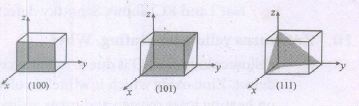
\({ d }_{ hkl }=\frac { a }{ \sqrt { { h }^{ 2 }+{ k }^{ 2 }+{ l }^{ 2 } } } \)
\({ d }_{ 100 }=\frac { 1 }{ \sqrt { { 1 }^{ 2 }+0^{ 2 }+0^{ 2 } } } =1\)
\({ d }_{ 101 }=\frac { 1 }{ \sqrt { { 1 }^{ 2 }+0^{ 2 }+0^{ 2 } } } =\frac { 1 }{ \sqrt { 2 } } \)
\({ d }_{ 111 }=\frac { 1 }{ \sqrt { { 1 }^{ 2 }+1^{ 2 }+1^{ 2 } } } =\frac { 1 }{ \sqrt { 3 } } \)
\(\\ { d }_{ 100 }:{ d }_{ 101 }:{ d }_{ 111 }=1:\frac { 1 }{ \sqrt { 2 } } :\frac { 1 }{ \sqrt { 3 } } (or)\)
=1:0.707:0.577
108.
(i) Boron trifluoride is obtained by the treatment of calcium fluoride with boron trioxide in presence of conc. sulphuric acid.
B2O3 + 3CaF2 + 3H2SO4 \(\overset { \triangle }{ \longrightarrow } \) 2BH3 + 3CaSO4 + 3H2O
(ii) It can also be obtained by treating boron trioxide with carbon and fluorine.
B2O3 + 3C + 3F2 ⟶ 2BF3 + 3CO
(iii) In the laboratory pure BF3 is prepared by the thermal decomposition of benzene diazonium tetrafluoro borate.
PhN2BF4 \(\overset { \triangle }{ \longrightarrow } \) BF3 + PhF + N2
109.
(i) Leaching of sulphide ores such as ZnS, PbS etc., can be done by treating them with hot aqueous sulphuric acid
\(2Zn{ S }_{ (s) }+{ 2H }_{ 2 }{ SO }_{ 4(aq) }+{ O }_{ 2(g) }\longrightarrow { 2ZnSO }_{ 4(aq) }+2{ S }_{ (s) }+{ H }_{ 2 }O\)
(ii) In this process the insoluble sulphide is converted into soluble sulphate and elemental sulphur
110.
| Common name | Formula | IUPAC ligand name |
|---|---|---|
| Bromide | Br- | bromido |
| Nitrate | NO3- | nitrato |
| hydroxide | OH- | hydroxido |
| Carbonate | CO32- | Carbonato |
| Oxalate | C2O42- | Oxalato |
111.
If the monomer is represented by X. Then
\(2 \mathrm{M} \rightarrow(\mathrm{M})_{2}\)
Since the reaction is of second order, the rate of reaction will be given by,
\(\text { Rate }=\mathrm{k}[\mathrm{M}]^{n} \)
\(7.5 \times 10^{-3} \mathrm{~mol} \mathrm{~L}^{-1} \mathrm{~s}^{-1}=\mathrm{k}\left(0.05 \mathrm{~mol} \mathrm{} \mathrm{~L}^{-1}\right)^{2} \)
\(\mathrm{k} =\frac{Rate}{[M]^{n}} \)
\(\mathrm{k} =\frac{7.5 \times 10^{-3}}{(0.05)^{2}} \)
\(=3 \mathrm{~mol}^{-1} \mathrm{~L} \mathrm{~s}^{-1}\)
112.
A Reaction whose rate depends on the reactant concentration raised to the first power is called a first order reaction. For a first order reaction,
A ⟶ product
Rate law can be expressed as
Rate = k[A]-1
\(\frac { -d\left[ A \right] }{ \left[ A \right] } =k dt\) ...(1)
Integrate the above equation between the limits of time t = 0 and time equal to t, while the concentration varies from the initial: concentration [Ao] to [A] at the later time.
\(\int _{ { [A }_{ 0 }] }^{ [A] }{ \frac { -d\left[ A \right] }{ \left[ A \right] } } =k\int _{ 0 }^{ t }{ dt } \)
\({ \left( -In\left[ A \right] \right) }_{ \left[ { A }_{ 0 } \right] }^{ \left[ A \right] }=k{ \left( t \right) }_{ 0 }^{ t }\)
\(-In\left[ A \right] -\left( In\left[ { A }_{ 0 } \right] \right) =k\left( t-0 \right) \)
\(-In\left[ A \right] -\left( In\left[ { A }_{ 0 } \right] \right) =kt\)
\(In\left( \frac { \left[ { A }_{ 0 } \right] }{ \left[ A \right] } \right) =kt\) ...(2)
This equation is in natural logarithm. To convert it into usual logarithm with base 10, we have to multiply the term by 2.303.
\(2.303\quad log\left( \frac { \left[ { A }_{ 0 } \right] }{ \left[ A \right] } \right) =kt\)
\(k=\frac { 2.303 }{ t } log\left( \frac { \left[ { A }_{ 0 } \right] }{ \left[ A \right] } \right) \) ...(3)
Equation (2) can be written in the form
y = mx+c as below
In [A0]-In[A] = kt
In[A] = In[A0]-kt
⇒ y = c + mx
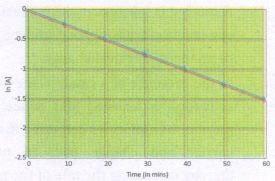
If we follow the reaction by measuring the concentration of the reactants at regular time interval 't' a plot of In[A] against 't' yields a straight line with a negative slope. From this, the rate constant is calculated.
113.
| S.No | Lanthanoids | Actinoids |
|---|---|---|
| 1. | Differentiating electron enters in 4f orbital | Differentiating electron enters in 5f orbital |
| 2. | Binding energy of 4f orbitals are higher | Binding energy of 5f orbitals are lower |
| 3. | They show less tendency to form complexes | They show greater tendency to form complexes |
| 4. | Most of the lanthanoids are colourless | Most of the actinoids are coloured For Example: U3+ (red) U4+ (green). |
| 5. | They do not form oxo cations | They do form oxo cations such as UO22+, NpO22++ etc. |
| 6. | Besides +3 oxidation states lanthanoids show +2 and +4 oxidation states in few cases | Besides +3 oxidation states actinoids show higher oxidation states such as +4, +5, +6 and +7 |
114.
(i) The actual position of Lanthanides in the periodic table is at group number 3 and period number 6. However, in the sixth period after lanthanum, the electrons are preferentially filled in inner 4f sub shell and these fourteen elements following lanthanum show similar chemical properties.
(ii) Similarly the fourteen elements following actinium resemble in their physical and chemical properties. Hence they are placed separately bottom of the modern periodic table.
115.
Each halogen combines with other halogens to form a series of compounds are called interhalogen compounds.
Example: AB type: BrF
AB3 type: ICI3
116.
(i) An organic compound (A) is identified as C6H5CHO benzaldehyde. Benzaldehyde reduces Tollen'sreagent and also undergoes.
Cannizaro reaction:
\(\\ \underset { (A) }{ { C }_{ 6 }{ H }_{ 5 }CHO } +{ Ag }_{ 2 }O\longrightarrow 2Ag+{ C }_{ 6 }{ H }_{ 5 }COOH\)
Cannizaro reaction:
\({ C }_{ 6 }{ H }_{ 5 }CHO+{ C }_{ 6 }{ H }_{ 5 }CHO\overset { NaOH }{ \longrightarrow } { C }_{ 6 }{ H }_{ 5 }{ OH }OH+\underset { (B) }{ { C }_{ 6 }{ H }_{ 5 }COOH } \)
(ii) Benzaldehyde on oxidation gives Benzoic acid C6H5COOH and it is (B).
\({ C }_{ 6 }{ H }_{ 5 }CHO\overset { (O) }{ \longrightarrow } \underset { (B) }{ { C }_{ 6 }{ H }_{ 5 }COOH } \)
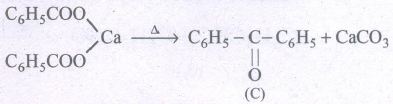
(iii) Calcium salt of benzoic acid (calcium benzoate) on dry distillation gives benzophenone C6HsCOC6Hs as (C).
| Compound | Compound Name | Formula |
|---|---|---|
| A | Benzaldehyde | C6H3CHO |
| B | Benzoic acid | C6HsCOOH |
| C | Benzophenone | \(\underset { (C) }{ { C }_{ 6 }{ H }_{ 5 }-\underset { \overset { || }{ O } }{ C } -{ C }_{ 6 }{ H }_{ 5 } } \) |
117.
(i) Compound (A) is carbonyl compound, it is acetone
(ii) (A) on reduction with LiAlH4 gives (B) it gives blue colour in Victor Meyer'stest.
\({ CH }_{ 3 }-\underset { \overset { || }{ \underset { (A) }{ O } } }{ C } -{ CH }_{ 3 }\overset { { LiAIH }_{ 4 } }{ \underset { \left[ H \right] }{ \longrightarrow } } { CH }_{ 3 }-{ CH }_{ 3 }-\underset { \overset { | }{ \underset { (B) }{ OH } } }{ CH } -{ CH }_{ 3 }\)
(iii) (B) reacts with SOCl2to give (C).
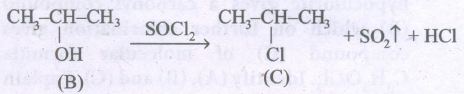
(iv) (C) on treatment with alcoholic KOH, forms (D) by elimination reaction.
\({ CH }_{ 3 }-\underset { \overset { | }{ \underset { (C) }{ Cl } } }{ C } H-{ CH }_{ 3 }\overset { alc.KOH }{ \longrightarrow } \underset { (D) }{ { CH }_{ 3 }CH={ CH }_{ 2 }+HCl } \)
| Compound | Compound Name | Formula |
| A | Acetone | \({ CH }_{ 3 }-\underset { \overset { || }{ O } }{ C } -{ CH }_{ 3 }\) |
| B | Isopropyl alcohol | \({ CH }_{ 3 }-\underset { \overset { | }{ OH } }{ CH } -{ CH }_{ 3 }\) |
| C | Isopropyl chloride | \({ CH }_{ 3 }-\underset { \overset { | }{ Cl } }{ CH } -{ CH }_{ 3 }\) |
| D | Propylene | CH3-CH=CH2 |
118.
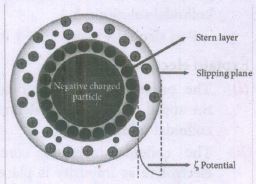
Helmholtz double layer:
(i) The surface of colloidal particle adsorbs one type of ion due to preferential adsorption.
(ii) This layer attracts the oppositely charged < ions in the medium and hence at the boundary separating the two electrical double layers are setup.
(iii) This is called as Helmholtz electrical double layer.
(iv) As the particies nearby are having similar: charges, they cannot come close and condense.
119.
Given:
E = - 0.79 V
n = 2 [Zn+] = 0.095 M
Formula: \(E={ E }^{ o }-\frac { 0.0591 }{ n } \log{ Zn }^{ 2+ }\)
Solution:
\(E={ { E }_{ { Zn }^{ 2+ }/Zn }^{ 0 } }=E+\frac { 0.0591 }{ n } \log{ Zn }^{ 2+ }\)
\(E={ { E }_{ { Zn }^{ 2+ }/Zn }^{ 0 } }=-0.76+\frac { 0.0591 }{ n } \log{ 0.095 }\)
= - 0.79 + 0.02889 = - 0.76 V
Eo = - 0.76 V.
120.
pH = -log [H+]
∴ [H+] = antilog [-pH]
= antilog [-7.41]
∴ [H+] = 3.9 x 10⁻⁸ M.
121.
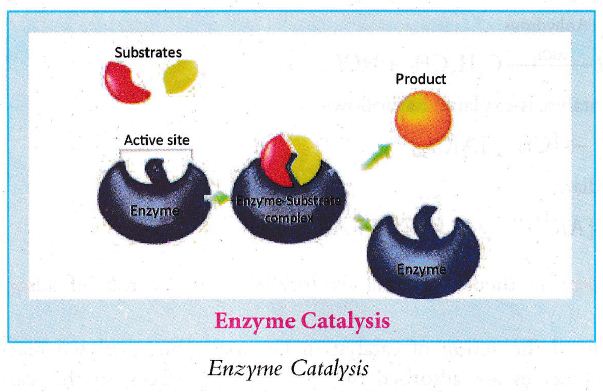
(i) Enzymes are complex protein molecules with three dimensional structures. They catalyse the chemical reaction in living organism. They are often present in colloidal state and extremely specific in catalytic action. Each enzyme produced in a particular living cell can catalyse a particular reaction in the cell.
Some common examples for enzyme catalysis:
(ii) The peptide glycyl L-glutamyl L-tyrosin is hydrolysed by an enzyme called pepsin.
(iii) The enzyme diastase hydrolyses starch into maltose
\(2\left(\mathrm{C}_{6} \mathrm{H}_{10} \mathrm{O}_{5}\right)_{\mathrm{n}}+\mathrm{nH}_{2} \mathrm{O} \rightarrow \mathrm{nC}_{12} \mathrm{H}_{22} \mathrm{O}_{11}\)
(iv) The yeast contains the enzyme zymase which converts glucose into ethanol.
\(\mathrm{C}_{6} \mathrm{H}_{12} \mathrm{O}_{6} \rightarrow 2 \mathrm{C}_{2} \mathrm{H}_{5} \mathrm{OH}+2 \mathrm{CO}_{2}\)
(v) The enzyme micoderma aceti oxidises alcohol into acetic acid.
\(\mathrm{C}_{2} \mathrm{H}_{5} \mathrm{OH}+\mathrm{O}_{2} \rightarrow \mathrm{CH}_{3} \mathrm{COOH}+\mathrm{H}_{2} \mathrm{O}\)
(vi) The enzyme urease present in soya beens hydrolyses the urea.
\(\mathrm{NH}_{2}-\mathrm{CO}-\mathrm{NH}_{2}+\mathrm{H}_{2} \mathrm{O} \rightarrow 2 \mathrm{NH}_{3}+\mathrm{CO}_{2}\)
Mechanism of enzyme catalysed reaction
(vii) The following mechanism is proposed for the enzyme catalysis
\(\mathrm{E}+\mathrm{S} \rightleftharpoons \mathrm{ES} \rightarrow \mathrm{P}+\mathrm{E}\).
(viii) Where E is the enzyme, S the substrate (reactant), ES represents activated complex and P the products.
122.
(i) The dissociation of a weak acid (CH3COOH) is suppressed in the presence of a salt (CH3COONa) containing an ion common to the weak electrolyte. It is called the common ion effect.
(ii) Consider the dissociation of a weak acid, acetic acid whose ionisation is incomplete.
CH3COOH(aq) ⇌ H+(aq) + CH3COO-(aq)
(iii) If the salt sodium acetate with common ion CH3COO- is added to the above equilibrium, it dissociates completely increasing.
CH3COONa(aq)⟶Na+(aq) + CH3COO-(aq)
(iv) Hence, the overall concentration of CH3COO- is increased, and the acid dissociation equilibrium is disturbed.
(v) So, in order to maintain the equilibrium, the excess CH3COO- ions combines with H+ ions to produce much more unionized CH3COOH i.e, the equilibrium will shift towards the left. In other words, the dissociation of CH3COOH is suppressed.
123.
The reaction is 2NH3(g) \(\overset { Pt }{ \longrightarrow } \) N2(g) + 3H2(g)
Here k = 2.5 x 10⁻⁴ mol L-1 s-1
The order of the reaction is zero i.e.,
Rate = k[Reactant]o
Rate = 2.5 x 10-4 x 1 = 2.5 x 10⁻⁴ mol L-1 s-1
\(\therefore \frac { d }{ dt } \left[ { H }_{ 2 } \right] =\frac { 1 }{ 3 } \frac { d }{ dt } \left[ { H }_{ 2 } \right] \)
The rate of formation of N2 = 2.5 x 10⁻⁴ mol L-1 s-1
\(\therefore 2.5\times { 10 }^{ -4 }=\frac { 1 }{ 3 } \frac { d }{ dt } \left[ { H }_{ 2 } \right] \)
\(\therefore \frac { d }{ dt } \left[ { H }_{ 2 } \right] \) = 7.5 x 10⁻⁴
Therefore, rate of formation of H2 = 7.5 x 10⁻⁴ mol L-1 s-1
124.
The heavier transition elements belong to fourth (4d), fifth (Sd) and sixth (6d) transition series. Their properties are expected to be different form the elements belonging to the first (3d) series due to the following reasons.
(i) Atomic radii: Size of the transition elements 94d and Sd series are larger than those of the corresponding elements of the first transition series though those of 4d and Sd series are very close to each other.
(ii) Ionisation enthalpy of Sd series are higher than the corresponding elements of 3d and 4d series.
(iii) Atomisation enthalpy of 4d and Sd series are higher than the corresponding elements of the first series.
(iv) Melting and boiling points of heavier transition elements are greater than those of the first transition series due to stronger intermetallic bonding.
(v) The elements of the first transition series generally form low or high spin complexes, depending upon the higher of ligand field. However, the heavier transition elements form low spin complexes irrespective of the strength of the ligand filed.
125.
(a) Rhombic Sulphur (α - Sulphur):
(a) It is yellow in colour.
(b) Its melting point is 385.8K and specific gravity is 2.06
(c) It is stable form of sulphur at room temperature.
(d) It is formed on evaporating the solution of sulphur in CS2.
(e) It in insoluble in water, readily soluble in CS2 and dissolves to some extent in benzene, alcohol and ether.
(b) Monoclinic sulphur \(\left( \beta -sulphur \right) \):
(a) Its melting point is 393K and specific gravity is 1.98
(b) It is prepared by melting rhombic sulphur in a dish and cooling, till crust is formed. Two holes are made in crust and remaining liquid is powered out. On removing crust, colourless needle - shaped crystals of β - sulphur is formed.
(c) Monoclinic sulphur is stable above 369K and below 369K α - sulphur is stable.
(d) At 369K both forms are stable and this temperature is called transition temperature.
(e) Both rhombic and monoclinic sulphur have S8 molecules, these are packed to give different crystal structure S8 form is puckered and has crown shape.
Several other modifications containing 6-20 sulphur atoms per ring are synthesised
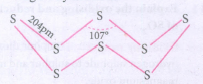
(f) In Cyclo-S6 the ng adopts chair form.
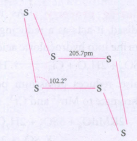
(g) At elevated temperatures (~1000K), S2 is dominant species and is, paramagnetic like O2
126.
(i) Similarities between ionic and metallic crystals:
(a) Ionic and metallic crystals have electrostatic forces of attraction.
(b) Both the crystals exhibit high melting point.
(c) The bonds in metallic and ionic crystals are non-directional.
(ii) Differences between ionic and metallic crystals:
| Property | Ionic Crystals | Metallic Crystals |
| Electrical conductivity | They conduct electricity in the molten state or in aqueous solution but not in solid state. | They conduct electricity in solid state as well as in molten state. |
| Binding forces | It is strong due to electrostatic forces of attraction. | It may be weak or strong depending upon the number of valence electrons. |
| Physical nature | Ionic crystals are hard but brittle | Metallic crystals are usually hard and malleable. |
127.
Silicates are classified into various types based on the way in which the tetrahedral units, [SiO4]4- are linked together.
(i) Ortho silicates (Neso silicates):
The simplest silicates which contain discrete [SiO4]4- tetrahedral units are called ortho silicates or nesosilicates.
Examples: Phenacite - Be2SiO4 (Be2+ ions are tetrahedrally surrounded by O2- ions)
(ii) pyro silicate (or) Soro silicates: Silicates:
Which contain [Si2O7]6- ions are called pyro silicates (or) Soro silicates.
Example: Thortveitite - Sc2Si2O7
(iii) Cyclic silicates (or Ring silicates):
Silicates which contain (SiO3)32n- ions which are formed by linking three or more tetrahedral SiO44- units cyclically are called cyclic silicates.
Example: Beryl [Be3Al2 (SiO3)6] (an aluminosilicate with each aluminium is surrounded by 6 oxygen atoms octahedrally)
(iv) Inosilicates: Silicates which contain 'n':
number of silicate units liked by sharing two or more oxygen atoms are called inosilicates.
Example: They are further classified as chain silicates and double chain silicates.
(v) Chain silicates (or pyroxenes):
These silicates contain [(SiO3)n]2n- ions formed: by linking 'n' number of tetrahedral [SiO4]4- units linearly. Each silicate unit shares two of its oxygen atoms with other units.
Example: Spodumene - LiAl(SiO3)2·
(vi) Double chain silicates (or amphiboles):
These silicates contains \(\left[ { Si }_{ 4 }{ O }_{ 11 } \right] _{ n }^{ 6n- }\) ions. In these silicates there are two different types of tetrahedra:
(a) Those sharing 3 vertices
(b) those sharing only 2 vertices.
Example:
Asbestos: These are fibrous and non-combustible silicates.
(vii) Sheet or phyllo silicates:
Silicates which contain \(({ Si }_{ 2 }{ O }_{ 5 })_{ n }^{ 2n- }\) are called sheet or phyllo silicates. In these, Each [SiO4]4- tetrahedron unit shares three oxygen atoms with others and thus by forming two dimensional sheets.
Example: Talc, Mica etc.
(viii) Three dimensional silicates (or tectosilicates):
Silicates in which all the oxygen atoms of [SiO4]4- tetrahedra are shared with other tetrahedra to form three dimensional network are called three dimensional or tectosilicates.
Example: Quartz.
128.
(i) The impure nickel is heated in a stream of carbon monoxide at around 350 K.
(ii) The nickel reacts with the CO to form a highly volatile nickel tetracarbonyl.
(iii) The solid impurities are left behind
\({ Ni }_{ (s) }+4{ CO }_{ (g) }\longrightarrow { Ni(CO) }_{ 4(g) }\)
(iv) On heating the nickel tetracarbonyl around 460 K, the complex decomposes to give pure metal.
\({ Ni(CO) }_{ 4(g) }\longrightarrow { Ni }_{ (s) }+{ 4CO }_{ (g) }\)
129.
a) [FeF6]4-: Fe atom - outer electronic configuration 3d6 4s2
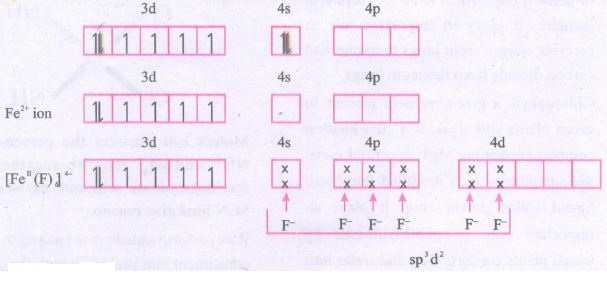
F- is weak field ligand
In [FeF6]4-the hybridisation takes place is sp3d2
The number of unpaired electrons = 4.
\(\therefore \mu =\sqrt { 4(4+2) } =\sqrt { 24 } \)
The molecule is paramagnetic due to the presence of unpaired electrons.
The geometry of the molecule is octahedral.
b) [Fe(CN)6]4-
.JPG)
In [Fe(CN)6]4- complex, the CN- ligand is a powerful ligand, it forces the unpaired electrons in the 3d level to pair up inside.
Hence the species has no unpaired electron after hybridisation So the molecule is diamagnetic.
.JPG)
The geometry of the molecule is octahedral.
130.
Most of the elements exhibit, two types of valence namely primary valence and secondary valence and each element tend to satisfy both the valences.
The primary valence is referred the oxidation state of the metal atom.
The secondary valence as the coordination number. For example, according to Werner, the primary and secondary valences of cobalt are 3 and 6 respectively.
The primary valence of a metal ions ae always satisfied by negative ions.
For example in the complex CoCI3.6NH3. The primary valence of Co is +3 and is satisfied by 3CI- ions.
The secondary valence is satisfied by negative ions, neutral molecules, positive ions or the combination of these.
For example, in CoCl3.6NH3 complex primary valence of cobalt +3 and it is satisfied by 3 CI-.
The secondary valence of cobalt is 6 and is satisfied by six neutral ammonia molecules. where as in CoCI6.NH3.
Secondary valence of Co = 5{It is satisfied five neutral molecules and a Cl- ion}
According to Werner, there are two spheres of attraction around a metal atom/ion in a complex.
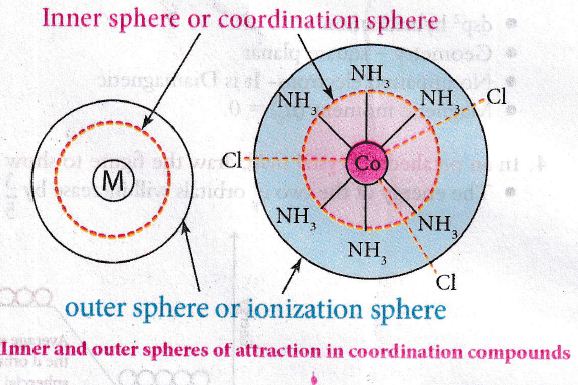
The inner /coordination sphere:
The groups present in this sphere are firmly attached to the metal.
The outer sphere / ionisation sphere:
The groups present in this sphere are loosely bound to the central metal ion and hence can be separated into ions upon dissolving the complex in a suitable solvent.
The primary valencies are non-directional. while the secondary valencies are directional.
The geometry of the complex is determined by the special arrangement of the groups which satisfy the secondary valence.
| Secondary valence | Geometry |
| 4 | Tetrahedral / Square planar |
| 6 | Octahedral |
131.

B) if both assertion and reason are true but reason is not the correct explanation of assertion.
132.
d) Both assertion and reason are false

12th Standard Syllabus & Materials
12th Standard
TN 12th Computer Applications களப்பெயர் முறைமை (DNS) Sample Question Papers Study Material - QB365 Set A
NEW12th Standard
TN 12th Computer Applications வலையமைப்பு எடுத்துக்காட்டுகள் மற்றும் நெறிமுறைகள் Sample Question Papers Study Material - QB365 Set A
NEW12th Standard
TN 12th Computer Applications கணினி வலையமைப்பு ஓர் அறிமுகம் Sample Question Papers Study Material - QB365 Set A
NEW12th Standard
TN 12th Computer Applications PHP-உடன் MySQL-ஐ இணைத்தல் Sample Question Papers Study Material - QB365 Set A



Tamilnadu Stateboard 12th Standard Subjects

Maths
Chemistry

Physics

Biology

Computer Science

Business Maths and Statistics

Economics

Commerce

Accountancy

History

Computer Applications
Biology
Computer Technology
Computer Applications
Computer Science
Business Maths and Statistics
Commerce
Economics
Maths
Chemistry
Physics
Computer Technology
History
Accountancy

Tamil

English

French
Tamilnadu Stateboard Standards
