
 100% FREE ACCESS
12th Standard Syllabus & Materials
12th Standard
TN 12th Computer Applications மின்னணு தரவு பரிமாற்றம் Sample Question Papers Study Material - QB365 Set A
NEW12th Standard
TN 12th Computer Applications மின் - வணிக பாதுகாப்பு அமைப்புகள் Sample Question Papers Study Material - QB365 Set A
NEW12th Standard
TN 12th Computer Applications மின்னணு செலுத்தல் முறைகள் Sample Question Papers Study Material - QB365 Set A
NEW12th Standard
TN 12th Computer Applications மின் - வணிகம் Sample Question Papers Study Material - QB365 Set A
NEW12th Standard
TN 12th Computer Applications திறந்த மூல கருத்துருக்கள் Sample Question Papers Study Material - QB365 Set A
NEW12th Standard
TN 12th Computer Applications வலையமைப்பு வடமிடல் Sample Question Papers Study Material - QB365 Set A

Published on: 26/07/2019
p - Block Elements - II
Download Tamil Nadu 12th Standard Chemistry question papers, model tests, one-mark questions, important questions, and public exam papers in PDF format. Free study materials and answer keys for TN State Board students.
Questions + Answers key
Take MCQ Chemistry Test
1.
Pick the wrong one among the following
F2 - Yellow
Br2 - Red
Cl2 - Colourless
I2- Violet
2.
S-S bond is present in _______.
H2S2O7
H2SO5
H2S2O6
H2S2O6
3.
An element belongs to group 15 and 3rd period of the periodic table, its electronic configuration would be_______.
1s2 2s2 2p4
1s2 2s2 2p3
1s2 2s2 2p6 3s2 3p2
1s2 2s2 2p6 3s2 3p3
4.
Which is true regarding nitrogen?
least electronegative element
has low ionisation enthalpy than oxygen
d- orbitals available
ability to form pπ-pπ bonds with itself
5.
In which of the following, NH3 is not used?
Nessler's reagent
Reagent for the analysis of IV group basic radical
Reagent for the analysis of III group basic radical
Tollen's reagent
6.
Out of H2O and H2S which one has higher bond angle and why?
7.
Write the order of thermal stability of the hydrides of group 16 elements.
8.
Discuss the anomalous nature of fluorine.
9.
Give the uses of helium.
10.
What are interhalogen compounds? Give examples.
11.
What is the reaction of Phosphorous with alkali?
12.
What is phosphorescence?
13.
How is nitrogen prepared from liquid air?
14.
Complete the following reactions.
\(1. \mathrm{NaCl}+\mathrm{MnO}_{2}+\mathrm{4H}_{2} \mathrm{SO}_{4} \longrightarrow \)
\(2. \mathrm{NaNO}_{2}+\mathrm{HCl} \longrightarrow \)
\(3.\mathrm{P}_{4}+\mathrm{3NaOH}+\mathrm{3H}_{2} \mathrm{O} \longrightarrow \)
\(4. \mathrm{AgNO}_{3}+\mathrm{PH}_{3} \longrightarrow \)
\(5. \mathrm{Mg}+\mathrm{10HNO}_{3} \longrightarrow \)
\(6. \mathrm{KClO}_{3} \stackrel{\Delta}{\longrightarrow} \)
\(7. \mathrm{Cu}+Con. \ Hot \ \mathrm{H}_{2} \mathrm{SO}_{4} \longrightarrow\)
\(8. \mathrm{Sb}+\mathrm{Cl}_2 \longrightarrow \)
\(9. \mathrm{HBr}+\mathrm{H}_2 \mathrm{SO}_4 \longrightarrow \)
\(10. \mathrm{XeF}_6+\mathrm{H}_2 \mathrm{O} \longrightarrow \)
\(11. \mathrm{XeO}_6{ }^{4-}+\mathrm{Mn}^{2+}+\mathrm{H}^{+} \longrightarrow \)
\(12. \mathrm{XeOF}_4+\mathrm{SiO}_2 \longrightarrow \)
\(13. \mathrm{Xe}+\mathrm{F}_2 \frac{\mathrm{Ni} / 200 \mathrm{~atm}}{400^{\circ} \mathrm{C}}\).
15.
Write the valence shell electronic configuration of group-15 elements.
16.
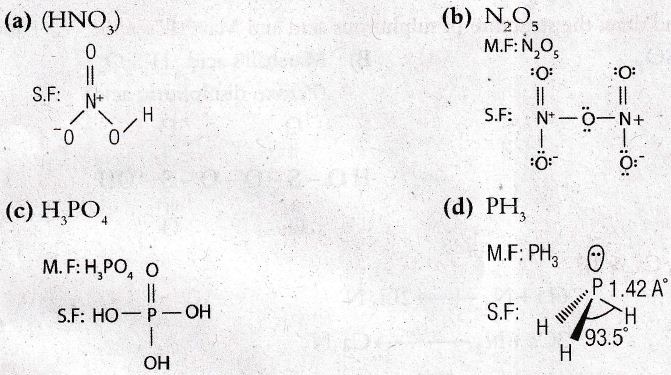
Write the molecular formula and structural formula for the following molecules.
a) Nitric acid
b) Dinitrogen pentoxide
c) phosphoric acid (PTA)
d) phosphine
17.
Sulphur dioxide
18.
Monoclinic sulphur
19.
Plastic sulphur
20.
Hydrogen Chlorate
21.
AX7
22.
How does sulphuric acid react with metals at various conditions.
23.
Give a detailed account on allotropes of sulphur.
1.
(c)
Cl2 - Colourless
2.
(d)
H2S2O6
3.
(d)
1s2 2s2 2p6 3s2 3p3
4.
(d)
ability to form pπ-pπ bonds with itself
5.
(a)
Nessler's reagent
6.
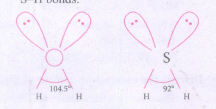
(i) Bond angel of HiX (H-O-H=104.5o) is larger than that of H2S(H-S-H=92o)
(ii) Since oxygen is more electronegative than sulphur, therefore bond pair electrons of O-H bond will be closer to oxygen which will be little away from the sulphur atom.
(iii) As a result bond pair-bond pair repulsions between bond pairs of two O-H bonds would be stronger than in the S-H bonds.
7.
(i) The thermal stability of hydrides of group 16 elements is directly proportional to the bond dissociation enthalpy of H- E bond.
(ii) On moving down the group, bond dissociation energy decreases and hence, E- H bond breaks easily.
(iii) Thus, the thermal stability of hydrides of group 16 elements decreases down the group. Hence the order of thermal stability is,
H2O > H2S > H2Se > H2Te > H2Po
8.
(i) Fluorine is the most reactive element among halogens due to minimum value of F- F bond dissociation energy.
(ii) It can form two types of salts with metals NaF and NaHF2
(iii) AgF is soluble in water but other AgX are insoluble.
(iv) HF attacks glass while others do not.
(v) Fluorine, does not form any polyhalides (absence of d - orbitals)
(vi) Fluorine exhibit only negative oxidation state (highly electronegative) while other halogens have both +ve and -ve oxidation state.
9.
(i) Helium is used to provide inert atmosphere in electric-arc welding of metals.
(ii) Helium has lowest boiling point hence used in cryogenics.
(iii) It is much less denser than air and hence used for filling air balloons.
10.
Each halogen combines with other halogens to form a series of compounds are called interhalogen compounds.
Example: AB type: BrF
AB3 type: ICI3
11.
Yellow phosphorus reacts with alkali on boiling in an inert atmosphere liberating phosphine. Phosphorus acts as a reducing agent.
\({ P }_{ 4 }+NaOH+{ H }_{ 2 }O\longrightarrow \underset { Sodiumhypophosphite }{ { 3NaH }_{ 2 }{ PO }_{ 2 } } +\underset { Phosphine }{ { PH }_{ 3 } } \uparrow \)
12.
White Phosphorous glows in the dark due to oxidation which is called as phosphorescence.
13.
(i) Nitrogen is separated industrially from liquid air by fractional distillation.
(ii) Pure nitrogen gas can be obtained by the thermal decomposition of sodium azide about 575K.
\(2Na{ N }_{ 3 }\longrightarrow 2Na+{ 3N }_{ 2 }\)
14.
\((i) \quad 4 \mathrm{NaCl}+\mathrm{MnO}_{2}+4 \mathrm{H}_{2} \mathrm{SO}_{4} \rightarrow \mathrm{Cl}_{2}+\mathrm{MnCl}_{2}+4 \mathrm{NaHSO}_{4}+2 \mathrm{H}_{2} \mathrm{O} \)
\((ii) \quad \mathrm{NaNO}_{2}+\mathrm{HCl} \rightarrow \mathrm{NaCl}+\mathrm{HNO}_{2} \)
\((iii) \quad \mathrm{P}_{4}+3 \mathrm{NaOH}+3 \mathrm{H}_{2} \mathrm{O} \rightarrow 3 \mathrm{NaH}_{2} \mathrm{PO}_{2}+\mathrm{PH}_{3} \uparrow \)
\((iv) \quad 3 \mathrm{AgNO}_{3}+\mathrm{PH}_{3} \rightarrow \mathrm{Ag}_{3} \mathrm{P}+3 \mathrm{HNO}_{3} \)
\((v) \quad 4 \mathrm{Mg}+10 \mathrm{HNO}_{3} \rightarrow 4 \mathrm{Mg}\left(\mathrm{NO}_{3}\right)_{2}+\mathrm{N}_{2} \mathrm{O}+6 \mathrm{H}_{2} \mathrm{O} \)
\((vi) \quad 2 \mathrm{KClO}_{3} \stackrel{\Delta}{\longrightarrow} 2 \mathrm{KCl}+3 \mathrm{O}_{2} \uparrow \)
\((vii) \quad \mathrm{Cu}+Con. Hot \mathrm{H}_{2} \mathrm{SO}_{4} \rightarrow \mathrm{CuSO}_{4}+2 \mathrm{H}_{2} \mathrm{O}+\mathrm{SO}_{2} \uparrow \)
\((viii) \quad 2 \mathrm{Sb}+3 \mathrm{Cl}_{2} \rightarrow 2 \mathrm{SbCl}_{3} \)
\((ix) \quad 2 \mathrm{HBr}+\mathrm{H}_{2} \mathrm{SO}_{4} \rightarrow 2 \mathrm{SO}_{2}+2 \mathrm{H}_{2} \mathrm{O}+\mathrm{Br}_{2} \)
\((x) \quad \mathrm{XeF}_{6}+3 \mathrm{H}_{2} \mathrm{O} \rightarrow \mathrm{XeO}_{3}+6 \mathrm{HF} \)
\((xi) \quad 5 \mathrm{XeO}_{6}^{4-}+2 \mathrm{Mn}^{2+}+14 \mathrm{H}^{+} \rightarrow 2 \mathrm{MnO}_{4}^{-}+5 \mathrm{XeO}_{5}+7 \mathrm{H}_{2} \mathrm{O} \)
\((xii) \quad 2 \mathrm{XeOF}_{4}+\mathrm{SiO}_{2} \rightarrow 2 \mathrm{XeO}_{2} \mathrm{~F}_{2}+\mathrm{SiF}_{4} \)
\((xiii) \quad Xe+{ 3F }_{ 2 }\overset { Ni/200atm }{ \underset { 400^{ 0 }C }{ \longrightarrow } }XeF_6\)
15.
(i) The general electronic configuration of 15 group elements is ns2np3.
(ii) Nitrogen \(\Rightarrow 2 \mathrm{~s}^{2} 2 \mathrm{p}^{3}\) (Valence shell)
(iii) Phosphorus \(\Rightarrow 3 \mathrm{~s}^{2} 3 \mathrm{p}^{3}\)
(iv) Arsenic \(\Rightarrow 4 \mathrm{~s}^{2} 4 \mathrm{p}^{3}\)
(v) Antimony \(\Rightarrow 5 s^{2} 5 p^{3}\)
(vi) Bismuth \(\Rightarrow 6 \mathrm{~s}^{2} 6 \mathrm{p}^{3}\)
16.
17.
Volcanic eruptions
18.
\(\beta \) sulphur
19.
\(\gamma \) sulphur
20.
Pungent smelling gas
21.
Pentagonal bipyramidal
22.
Reaction with metals:
(i) Sulphuric acid reacts with metals and gives different product depending on the reactants and reacting condition
(ii) Dilute sulphuric acid reacts with metals like: tin, aluminium, zinc to give corresponding: sulphates.
Zn + H2SO4\(\longrightarrow \) ZnSO4 + H2 \(\uparrow \)
2AI + 3H2SO4 \(\longrightarrow \) Al2(SO4)3+ 3H2 \(\uparrow \)
(iii) Hot concentrated sulphuric acid reacts with copper and lead to give the respective sulphates as shown below
Cu + 2H2SO4 \(\longrightarrow \) CuSO4 + 2H2O + SO2\(\uparrow \)
Pb + 2H2SO4 \(\longrightarrow \) PbSO4 + 2H2O + SO2\(\uparrow \)
(iv) Sulphuric acid doesn't react with noble metals like gold, silver and platinum.
23.
(a) Rhombic Sulphur (α - Sulphur):
(a) It is yellow in colour.
(b) Its melting point is 385.8K and specific gravity is 2.06
(c) It is stable form of sulphur at room temperature.
(d) It is formed on evaporating the solution of sulphur in CS2.
(e) It in insoluble in water, readily soluble in CS2 and dissolves to some extent in benzene, alcohol and ether.
(b) Monoclinic sulphur \(\left( \beta -sulphur \right) \):
(a) Its melting point is 393K and specific gravity is 1.98
(b) It is prepared by melting rhombic sulphur in a dish and cooling, till crust is formed. Two holes are made in crust and remaining liquid is powered out. On removing crust, colourless needle - shaped crystals of β - sulphur is formed.
(c) Monoclinic sulphur is stable above 369K and below 369K α - sulphur is stable.
(d) At 369K both forms are stable and this temperature is called transition temperature.
(e) Both rhombic and monoclinic sulphur have S8 molecules, these are packed to give different crystal structure S8 form is puckered and has crown shape.
Several other modifications containing 6-20 sulphur atoms per ring are synthesised
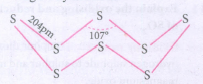
(f) In Cyclo-S6 the ng adopts chair form.
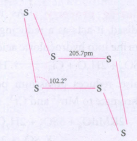
(g) At elevated temperatures (~1000K), S2 is dominant species and is, paramagnetic like O2

12th Standard Syllabus & Materials
12th Standard
TN 12th Computer Applications களப்பெயர் முறைமை (DNS) Sample Question Papers Study Material - QB365 Set A
NEW12th Standard
TN 12th Computer Applications வலையமைப்பு எடுத்துக்காட்டுகள் மற்றும் நெறிமுறைகள் Sample Question Papers Study Material - QB365 Set A
NEW12th Standard
TN 12th Computer Applications கணினி வலையமைப்பு ஓர் அறிமுகம் Sample Question Papers Study Material - QB365 Set A
NEW12th Standard
TN 12th Computer Applications PHP-உடன் MySQL-ஐ இணைத்தல் Sample Question Papers Study Material - QB365 Set A



Tamilnadu Stateboard 12th Standard Subjects

Maths
Chemistry

Physics

Biology

Computer Science

Business Maths and Statistics

Economics

Commerce

Accountancy

History

Computer Applications
Biology
Computer Technology
Computer Applications
Computer Science
Business Maths and Statistics
Commerce
Economics
Maths
Chemistry
Physics
Computer Technology
History
Accountancy

Tamil

English

French
Tamilnadu Stateboard Standards
