
 100% FREE ACCESS
12th Standard Syllabus & Materials
12th Standard
TN 12th Maths Applications of Matrices and Determinants Sample Question Papers Study Material - QB365 Set A
NEW12th Standard
TN 12th Computer Applications மின்னணு தரவு பரிமாற்றம் Sample Question Papers Study Material - QB365 Set A
NEW12th Standard
TN 12th Computer Applications மின் - வணிக பாதுகாப்பு அமைப்புகள் Sample Question Papers Study Material - QB365 Set A
NEW12th Standard
TN 12th Computer Applications மின்னணு செலுத்தல் முறைகள் Sample Question Papers Study Material - QB365 Set A
NEW12th Standard
TN 12th Computer Applications மின் - வணிகம் Sample Question Papers Study Material - QB365 Set A
NEW12th Standard
TN 12th Computer Applications திறந்த மூல கருத்துருக்கள் Sample Question Papers Study Material - QB365 Set A

Published on: 03/09/2019
Coordination Chemistry
Download Tamil Nadu 12th Standard Chemistry question papers, model tests, one-mark questions, important questions, and public exam papers in PDF format. Free study materials and answer keys for TN State Board students.
Questions + Answers key
Take MCQ Chemistry Test
1.
Write the oxidation state, coordination number , nature of ligand, magnetic property and electronic configuration in octahedral crystal field for the complex K4[Mn(CN)6]
2.
What is the coordination entity formed when excess of liquid ammonia is added to an aqueous solution of copper sulphate?
3.
Why tetrahedral complexes do not exhibit geometrical isomerism.
4.
What is linkage isomerism? Explain with an example.
5.
Give an example of coordination compound used in medicine and two examples of biologically important coordination compounds.
6.
Write the formula for the co-ordination compounds.
7.
Write the IUPAC names for the following complexes.
8.
Give the difference between double salts and coordination compounds.
9.
How many geometrical isomers are possible for [Pt(Py)(NH3)(Br)(Cl)]
3
4
0
15
10.
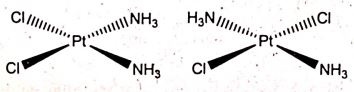
Which type of isomerism is exhibited by [Pt(NH3)2Cl2]?
Coordination isomerism
Linkage isomerism
Optical isomerism
Geometrical isomerism
11.
Crystal field stabilization energy for high spin d5 octahedral complex is _______.
-0.6\({ \Delta }_{ 0 }\)
0
2(P-\({ \Delta }_{ 0 }\))
2(P+\({ \Delta }_{ 0 }\))
12.
13.
The sum of primary valence and secondary valence of the metal M in the complex [M(en)2(Ox)]Cl is________.
3
6
-3
9
1.
(i) Oxidation state of the central metal ion : +2 (i.e) Mn2+
(ii) Co-ordination number : 6
(iii) Nature of ligand: CN- (Negative ligand)
(iv) Magnetic property: Paramagnetic nature
(v) Electronic configuration:
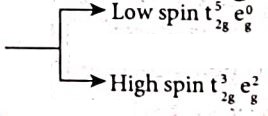
(vi) Oxidation state: +2 (or) Mn2+ of central metal ion
2.
(i) When excess of liquid ammonia is added to an aqueous solution of copper sulphate gives tetra ammine copper (II) sulphate is formed.
CUso4 + 4NH3 \(\rightarrow\) [Cu(NH3)4]SO4
(ii) The co-ordination entity is [Cu(NH3)4]2+
3.
Tetrahedral complexes do not exhibit geometrical isomerism. Because the relative position of donor atoms of ligand the unidentate Iigands (donor atom) attached to the central atom are same with respect to each other.
4.
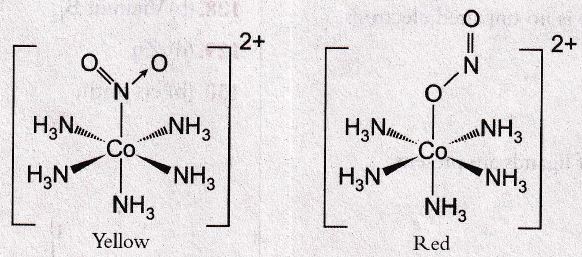
(i) This is also called as salt isomerism.
(ii) This type of isomers arises when an ambidentate ligand is bonded to the central metal atom/ion through either of its two different donor atoms. In the below mentioned examples, the nitrite ion is bound to the central metal ion Co3+ through a nitrogen atom in one complex and through oxygen atom in other complex.
\(\left[\mathrm{Co}\left(\mathrm{NH}_{3}\right)_{5}\left(\mathrm{NO}_{2}\right)\right]^{2+}\)
5.
Medicinal uses
(i) Ca-EDTA chelate, is used in the treatment of lead and radioactive poisoning.
(ii) That is for removing lead and radioactive metal ions from the body.
(iii) Cis-platin is used as an antitumor drug in cancer treatment.
Biological Importance compounds:-
(i) Fe2+ - porphyrin complex: It plays an important role in carrying oxygen from lungs to tissues and tissue carbon dioxide from to lungs.
(ii) Chlorophyll - useful in photosynthesis in plants.
6.
a) potassiumhexacyanidoferrate(II) - Potassiumhexacyanidoferrate(II) - K4[Fe(CN)6]
b) Pentacarbonyliron(0) - [Fe(CO)5]
c) Pentaamminenitrito −kNcobalt(III)ion - [Co(NH3)5(NO2)]2+
d) Hexaamminecobalt(III) Sulphate - [CO(NH3)6](SO4)3
e) Sodiumtetrafluoridodihydroxidochromate(III) - Na2[CrF4(OH)2]
7.
i) Na2[Ni(EDTA)] - Sodium 2, 2', 2",2'" - (ethane-1,2 diyldinitrilo tetraacetatonickelate)(II)
ii) [Ag(CN)2]- - Dicyanido-kC-argentate (I) ion
iii) [CO(en)3]2(SO4)3 - Tris (ethane 1, 2 diamine)cobalt (III) sulphate
iv) [CO(ONO)(NH3)5]2+ - Pentaamminenitrito - KO cobalt (III) ion
v) [Pt(NH3)2Cl(NO2)] - Diammainechloridonitro - kN - platinum (II)
8.
| S. No | Double salts | Co-ordination compound |
|---|---|---|
| 1. | They usually contain two simple salt in equimolar proportions | The simple salts from which they are formed may or may not be in equimolar proportion. |
| 2. | They exists only in the solid state. In aqueous solution they dissociate completely into ions. | They exist in the solid state as well as in aqueous solution. This is because even in solution, the complex ion does not dissociate into ions. |
| 3. | They are ionic compounds and do not contain any co-ordinate bond. | They may or may not be ion but the complex part always contain coordinate bonds |
| 4. | The properties of the double salts are same as those of its constituent compounds. | The properties of the coordination compounds are different for its constituent bonds. |
| 5. | In a double salt, the metal ion show their normal valency. | In a coordinate compound the metal ion satisfies its two types of valence called primary & secondary valenices. |
| 6. | A double salt loses its identity and dissociates into its constitute simple ions in solution. | The complex ion does not lose its identity and never dissociate to give simple ions. |
| Example: FeSO4 (NH4)2 SO4.6H2O | Example: K4[Fe(CN)6), K3[Fe(SCN)6) |
9.
Three isomers. If we consider any one of the ligands as reference (say Py), the arrangement of other three ligands (NH3, Br- and Cl-) with respect to (Py) gives three geometrical isomers.
10.
11.
The electronic configuration t2g3, e2g
[ 3 x (-0.4)+ 2(0.6)]Δ0
[-1.2 + 1.2] Δ0 = 0
12.
(d)
13.
In the complex [M(en)2(Ox)]Cl For the central metal ion M3+
The primary valence is = +3
The secondary valence = 6
sum of primary valence and secondary valence = 3 + 6 = 9

12th Standard Syllabus & Materials
12th Standard
TN 12th Computer Applications வலையமைப்பு வடமிடல் Sample Question Papers Study Material - QB365 Set A
NEW12th Standard
TN 12th Computer Applications களப்பெயர் முறைமை (DNS) Sample Question Papers Study Material - QB365 Set A
NEW12th Standard
TN 12th Computer Applications வலையமைப்பு எடுத்துக்காட்டுகள் மற்றும் நெறிமுறைகள் Sample Question Papers Study Material - QB365 Set A
NEW12th Standard
TN 12th Computer Applications கணினி வலையமைப்பு ஓர் அறிமுகம் Sample Question Papers Study Material - QB365 Set A



Tamilnadu Stateboard 12th Standard Subjects

Maths
Chemistry

Physics

Biology

Computer Science

Business Maths and Statistics

Economics

Commerce

Accountancy

History

Computer Applications
Biology
Computer Technology
Computer Applications
Computer Science
Business Maths and Statistics
Commerce
Economics
Maths
Chemistry
Physics
Computer Technology
History
Accountancy

Tamil

English

French
Tamilnadu Stateboard Standards
