
 100% FREE ACCESS
12th Standard Syllabus & Materials
12th Standard
TN 12th Computer Applications மின்னணு தரவு பரிமாற்றம் Sample Question Papers Study Material - QB365 Set A
NEW12th Standard
TN 12th Computer Applications மின் - வணிக பாதுகாப்பு அமைப்புகள் Sample Question Papers Study Material - QB365 Set A
NEW12th Standard
TN 12th Computer Applications மின்னணு செலுத்தல் முறைகள் Sample Question Papers Study Material - QB365 Set A
NEW12th Standard
TN 12th Computer Applications மின் - வணிகம் Sample Question Papers Study Material - QB365 Set A
NEW12th Standard
TN 12th Computer Applications திறந்த மூல கருத்துருக்கள் Sample Question Papers Study Material - QB365 Set A
NEW12th Standard
TN 12th Computer Applications வலையமைப்பு வடமிடல் Sample Question Papers Study Material - QB365 Set A

Published on: 13/10/2020
12th Standard Chemistry Chemical Kinetics English Medium Free Online Test One Mark Questions 2020 - 2021
Download Tamil Nadu 12th Standard Chemistry question papers, model tests, one-mark questions, important questions, and public exam papers in PDF format. Free study materials and answer keys for TN State Board students.
Questions + Answers key
Take MCQ Chemistry Test
1.
The term A in Arrhenius equation is called as _____.
Probability factor
Activation energy
Collision factor
Frequency factor
2.
During a chemical reaction, the concentration of reaction _____.
increases
decreases
remains constant
first increases and then decreases
3.
What will be the rate constant of a order reaction if its half life is given to be 20 min?
13.86 min-1
28.86 min-1
3.47 x 10⁻² min-1
None of these
4.
The given reaction 2 FeCl3 + SnCl2 ⟶ 2FeCl2 + SnCl4 is an example of ______.
I order
II order
III order
None of these
5.
The addition of a catalyst during a chemical reaction alters which of the following quantities?
Activation energy
Entropy
Internal energy
Enthalpy
6.
Which order reaction obeys the expression \({ t }_{ \frac { 1 }{ 2 } }\alpha \frac { 1 }{ \left[ A \right] } ?\)
First
Second
Third
Zero
7.
What would be the activation energy of a reaction when the temperature is increased from 27oC to 37oC?
534 kJ mol-1
53.4 kJ mol-1
5.34 kJ mol-1
None of these
8.
In pseudo-order reactions ______.
The actual order of reaction is different from that expected using rate law expression
The concentration of at least one reactant is taken in large excess.
The concentration of reactant taken in excess may be taken as constant
All of these
9.
For a reaction, 2A + B ⟶ 3C, The rate of appearance of C at time 't' is 1.2 x 10⁻⁴ mol L-1s-1. Identify the rate of reaction.
4 x 10⁻⁵mol L-1s-1
4.5 x 10⁻¹mol L-1s-1
3.6 x 10⁻⁴ mol L-1s-1
None of these
10.
2N2O5 ⟶ NO2 + O2, \(\frac { d\left[ { N }_{ 2 }{ O }_{ 5 } \right] }{ dt } \) = k1[N2O5], \(\frac { d\left[ { NO }_{ 2 } \right] }{ dt } \)= k2[N2O5] and \(\frac { d{ O }_{ 2 } }{ dt } \) = k 3[N2O5], the relation between k1, k2 and k3 is _____.
2k1 = 4k2 = k3
k1 = k2 = k3
2k1 = k2 = 4k3
2k1 = k2 = k3
11.
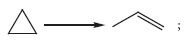 This reaction follows first order kinetics. The rate constant at particular temperature is 2.303 x 10⁻² hour-1. The initial concentration of cyclopropane is 0.25 M. What will be the concentration of cyclopropane after 1806 minutes? (log 2 = 0.3010)
0.125 M
0.215 M
0.25 x 2.303 M
0.05 M
12.
The correct difference between first and second order reactions is that________.
A first order reaction can be catalysed; a second order reaction cannot be catalysed.
The half life of a first order reaction does not depend on [A0]; the half life of a second order reaction does depend on [A0].
The rate of a first order reaction does not depend on reactant concentrations; the rate of a second order reaction does depend on reactant concentrations.
The rate of a first order reaction does depend on reactant concentrations; the rate of a second order reaction does not depend on reactant concentrations.
13.
If 75% of a first order reaction was completed in 60 minutes, 50% of the same reaction under the same conditions would be completed in_______.
20 minutes
30 minutes
35 minutes
75 minutes
14.
For the reaction \({ N }_{ 2 }{ O }_{ 5 }\left( g \right) \longrightarrow { 2NO }_{ 2 }\left( g \right) +\frac { 1 }{ 2 } { O }_{ 2 }\left( g \right) \) value of rate of disappearance of N2O5 is given as 6.5 x 10⁻² mol L-1s-1. The rate of formation of NO2 and O2 is given respectively as_____.
(3.25 x 10⁻² mol L-1s-1) and (1.3 x 10⁻² mol L-1s-1)
(1.3 x 10⁻² mol L-1s-1) and (3.25 x 10⁻² mol L-1s-1)
(1.3 x 10⁻¹ mol L-1s-1) and (3.25 x 10⁻² mol L-1s-1)
None of these
15.
What is the activation energy for a reaction if its rate doubles when the temperature is raised from 200K to 400K? (R = 8.314 JK-1 mol-1)
234.65 kJ mol-1
434.65 kJ mol-1
2.305 kJ mol-1
334.65 J mol-1
16.
Consider the following statements:
(i) increase in concentration of the reactant increases the rate of a zero order reaction.
(ii) rate constant k is equal to collision frequency A if Ea = 0
(iii) rate constant k is equal to collision frequency A if Ea = ∞
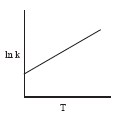
(iv) a plot of ln (k) vs T is a straight line.
(v) a plot of ln (k) vs \(\left( \frac { 1 }{ T } \right) \) is a straight line with a positive slope.
Correct statements are
(ii) only
(ii) and (iv)
(ii) and (v)
(i), (ii) and (v)
17.
For a reaction Rate = k[acetone]3/2 then unit of rate constant and rate of reaction respectively is _______.
(mol L-1 S-1),(mol1/2 L1/2 S-1)
(mol-1/2 L1/2 s-1),(mol L-1 s-1)
(mol1/2 L1/2 s-1),(mol L-1 s-1)
(mol L s-1),(mol1/2 L1/2 s)
18.
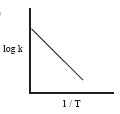
Among the following graphs showing variation of rate constant with temperature (T) for a reaction, the one that exhibits Arrhenius behavior over the entire temperature range is _______.

both (b) and (c)
19.
For a first order reaction A ⟶ B the rate constant is x min−1. If the initial concentration of A is 0.01M, the concentration of A after one hour is given by the expression.
001. e−x
1 x 10⁻²(1-e-60x)
(1 x 10⁻²)e-60x
none of these
20.
Assertion: Rate of reaction doubles when the concentration of the reactant is doubles if it is a first order reaction.
Reason: Rate constant also doubles
Codes:
a) Both assertion and reason are true and reason is the correct explanation of assertion.
b) Both assertion and reason are true but reason is not the correct explanation of assertion.
c) Assertion is true but reason is false
d) Both assertion and reason are false.
Both assertion and reason are true and reason is the correct explanation of assertion.
Both assertion and reason are true but reason is not the correct explanation of assertion.
Assertion is true but reason is false
Both assertion and reason are false.
1.
(d)
Frequency factor
2.
(b)
decreases
3.
(c)
3.47 x 10⁻² min-1
4.
(c)
III order
5.
(a)
Activation energy
6.
(b)
Second
7.
(d)
None of these
8.
(d)
All of these
9.
(a)
4 x 10⁻⁵mol L-1s-1
10.
(c)
2k1 = k2 = 4k3
11.
\(k=\frac { 2.303 }{ t } log\frac { \left[ { A }_{ 0 } \right] }{ \left[ A \right] } \)
2.303 x 10⁻² hour-1 = \(\frac { 2.303 }{ 1806 min } log\frac { \left[ { 0.25 }_{ } \right] }{ \left[ A \right] } \)
\(=\left(\frac{2.303 \times 10^{-2} hour^{-1 }\times 1806 min}{2.303}\right) = \log \left(\frac{0.25}{A}\right) \)
\(=\left(\frac{ 1806 \times 10 ^{-2}}{60}\right) = \log \left(\frac{0.25}{A}\right) \)
\(= 0.301 = \log \left(\frac{0.25}{A}\right) \)
\(=\log2 = \log \left(\frac{0.25}{A}\right) \)
\(2 = \log \left(\frac{0.25}{A}\right) \)
\([A] = \log \left(\frac{0.25}{2}\right) = 0.125 M\)
12.
\({ t }_{ 1/2 }=\frac { 0.6932 }{ k } \)
For a second order reaction
\(\mathrm{t}_{1 / 2}=\frac{2^{\mathrm{n}-1}-1}{(\mathrm{n}-1) \mathrm{k} \cdot\left[\mathrm{A}_{0}\right]^{\mathrm{n}-1}}\)
n = 2
\(\mathrm{t}_{1 / 2}=\frac{2^{\mathrm{2}-1}-1}{(\mathrm{n}-1) \mathrm{k} \cdot\left[\mathrm{A}_{0}\right]^{\mathrm{2}-1}}\)
\(\mathrm{t}_{1 / 2} =\frac{1}{ \mathrm{k}\left[\mathrm{A}_{0}\right]}\)
13.
t75% = 2t50%
t50% = (t75%/2) = (60/2) = 30 minutes
14.
Rate \(=\frac { d\left[ { N_2O_5 } \right] }{ dt } =\frac { 1 }{ 2 } =\frac { d\left[ { NO}_{ 2 } \right] }{ dt } =\frac { 2d\left[ { O }_{ 2 } \right] }{ dt } \)
Given that \(=\frac { d\left[ { N_2O_5 } \right] }{ dt } \) =6.5 x 10⁻² mol L-1 s-1
\(=\frac { d\left[ { NO}_{ 2 } \right] }{ dt }\) =2 x 6.5 x 10-2 = 1.3 x 10⁻¹ mol L-1 s-1
\(=\frac { d\left[ { O}_{ 2 } \right] }{ dt }\)\(=\frac{6.5 \times 10^{-2}}{2}\) = 3.25 x 10⁻² mol L-1s-1
15.
T1= 200 K ; k = k1
T2 =400 K ; k1 = k2 = 2k1
log\(\frac {{ k }_{ 2 } }{ { k }_{ 1 } } =\frac { { E }_{ a } }{ 2.303R } \left[ \frac { { T }_{ 2 }-{ T }_{ 1 } }{ { T }_{ 1 }{ T }_{ 2 } } \right] \)
log \( [\frac {{2 k }_{ 1 } }{ { k }_{ 1 } }]\)
\(= \left[ \frac { E_{a} }{ 2.303\times 8.314 JK^{-1} mol^{-1} } \right] \)
\(= \left[ \frac { 400 k - 200K }{200 k \times 400 k } \right] \)
\(E_{a} = \frac{ 0.3010 \times 2.303 \times 8.314 JK^{-1}mol^{-1} \times 200K \times 400 K}{200 K}\)
Ea = 2305 J mol-1
Ea = 2.305 kJ mol-1
16.
(rate constant K is equal to collision frequency A if Ea = 0)
In zero order reactions, increase in the concentration of reactant does not alter the rate.
So statement (i) is wrong.
\(k=A{ e }^{ -\left( \frac { { E }_{ a } }{ RT } \right) }\)
if Ea = 0 so, statement (ii) is correct, and statement (iii) is wrong
k = Ae0
k = A
In k = In A - \({ \left( \frac { { E }_{ a } }{ R } \right) }\) \(\left( \frac { 1 }{ T } \right) \)
This equation is of the form of a straight line y = mx+c
A plot of In k Vs \(\left( \frac { 1 }{ T } \right) \) gives a straight line with a negative slope
So statement (iv) and (v) are wrong.
17.
Rate = k[A]n
Rate = \(\frac{-\mathrm{d}[\mathrm{A}]}{\mathrm{dt}}\)
unit of rate = \(\frac{mol L^{-1}}{s}\)=mol L-1/s-1
unit of rate constant
\(=\frac{ (mol{ L }^{ -1 }{ S }^{ -1 }) }{ ({ mol }{ L }^{ -1 })^n } \)
= mol1-nLn-1s-1
in the case
rate = k [Acetone]3/2
n = 3/2
= mol1-(3/2)L(3/2)-1s-1
(mol-(1/2) L(1/2) s-1).
18.
\(k=A{ e }^{ -\left( \frac { { E }_{ a } }{ RT } \right) }\)
In k = In A - \({ \left( \frac { { E }_{ a } }{ R } \right) }\) \(\left( \frac { 1 }{ T } \right) \)
This equation is of the form of a straight line y = mx+c
A plot of In k Vs \(\left( \frac { 1 }{ T } \right) \) gives a straight line with a negative slope.
19.
\(k=\frac { 2.303 }{ t } log\frac { \left[ { A }_{ 0 } \right] }{ \left[ A \right] } \)
\(k=\frac { 1 }{ t } ln \frac { \left[ { A }_{ 0 } \right] }{ \left[ A \right] } \)
\(e^{kt}=\frac { \left[ { A }_{ 0 } \right] }{ \left[ A \right] }\)
[A] = [A0] ekt
In this case
k = x min-1 and [A0] = 0.01 M = 1 x 10⁻²M
t = 1 hour = 60 min
[A] = (1 x 10⁻²)e-60x
20.
c) Assertion is true but reason is false

12th Standard Syllabus & Materials
12th Standard
TN 12th Computer Applications களப்பெயர் முறைமை (DNS) Sample Question Papers Study Material - QB365 Set A
NEW12th Standard
TN 12th Computer Applications வலையமைப்பு எடுத்துக்காட்டுகள் மற்றும் நெறிமுறைகள் Sample Question Papers Study Material - QB365 Set A
NEW12th Standard
TN 12th Computer Applications கணினி வலையமைப்பு ஓர் அறிமுகம் Sample Question Papers Study Material - QB365 Set A
NEW12th Standard
TN 12th Computer Applications PHP-உடன் MySQL-ஐ இணைத்தல் Sample Question Papers Study Material - QB365 Set A



Tamilnadu Stateboard 12th Standard Subjects

Maths
Chemistry

Physics

Biology

Computer Science

Business Maths and Statistics

Economics

Commerce

Accountancy

History

Computer Applications
Biology
Computer Technology
Computer Applications
Computer Science
Business Maths and Statistics
Commerce
Economics
Maths
Chemistry
Physics
Computer Technology
History
Accountancy

Tamil

English

French
Tamilnadu Stateboard Standards
